


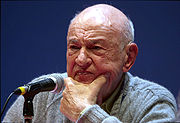
Edgar Morin

Encyclopedia
France
The French Republic , The French Republic , The French Republic , (commonly known as France , is a unitary semi-presidential republic in Western Europe with several overseas territories and islands located on other continents and in the Indian, Pacific, and Atlantic oceans. Metropolitan France...
philosopher and sociologist born Edgar Nahoum in Paris
Paris
Paris is the capital and largest city in France, situated on the river Seine, in northern France, at the heart of the Île-de-France region...
on July 8, 1921. He is of Judeo-Spanish (Sefardi) origin. He is known for the transdisciplinarity
Transdisciplinarity
Transdisciplinarity connotes a research strategy that crosses many disciplinary boundaries to create a holistic approach. It applies to research efforts focused on problems that cross the boundaries of two or more disciplines, such as research on effective information systems for biomedical...
of his works.
Biography
At the beginning of the 20th century, Morin's family migrated from the Greek town of Salonica to MarseilleMarseille
Marseille , known in antiquity as Massalia , is the second largest city in France, after Paris, with a population of 852,395 within its administrative limits on a land area of . The urban area of Marseille extends beyond the city limits with a population of over 1,420,000 on an area of...
and later to Paris
Paris
Paris is the capital and largest city in France, situated on the river Seine, in northern France, at the heart of the Île-de-France region...
, where Edgar was born. He first became tied to socialism
Socialism
Socialism is an economic system characterized by social ownership of the means of production and cooperative management of the economy; or a political philosophy advocating such a system. "Social ownership" may refer to any one of, or a combination of, the following: cooperative enterprises,...
in connection with the Popular Front
Popular Front (France)
The Popular Front was an alliance of left-wing movements, including the French Communist Party , the French Section of the Workers' International and the Radical and Socialist Party, during the interwar period...
and the Spanish Republican Government during the Spanish Civil War
Spanish Civil War
The Spanish Civil WarAlso known as The Crusade among Nationalists, the Fourth Carlist War among Carlists, and The Rebellion or Uprising among Republicans. was a major conflict fought in Spain from 17 July 1936 to 1 April 1939...
. When the Germans invaded France in 1940, Edgar fled to Toulouse
Toulouse
Toulouse is a city in the Haute-Garonne department in southwestern FranceIt lies on the banks of the River Garonne, 590 km away from Paris and half-way between the Atlantic Ocean and the Mediterranean Sea...
, where he assisted refugees and committed himself to Marxist socialism. As a member of the French Resistance
French Resistance
The French Resistance is the name used to denote the collection of French resistance movements that fought against the Nazi German occupation of France and against the collaborationist Vichy régime during World War II...
he adopted the pseudonym Morin, which he would use for the rest of his life. He joined the French Communist Party
French Communist Party
The French Communist Party is a political party in France which advocates the principles of communism.Although its electoral support has declined in recent decades, the PCF retains a large membership, behind only that of the Union for a Popular Movement , and considerable influence in French...
in 1941. In 1945, Morin married Violette Chapellaubeau and they lived in Landau
Landau
Landau or Landau in der Pfalz is an autonomous city surrounded by the Südliche Weinstraße district of southern Rhineland-Palatinate, Germany. It is a university town , a long-standing cultural centre, and a market and shopping town, surrounded by vineyards and wine-growing villages of the...
, where he served as a Lieutenant in the French Occupation army in Germany.
In 1946, he returned to Paris and gave up his military career to pursue his activities with the Communist party. Due to his critical posture, his relationship with the party gradually deteriorated until he was expelled in 1951 after he published an article in Le Nouvel Observateur
Le Nouvel Observateur
Le Nouvel Observateur is a weekly French newsmagazine. Based in Paris, it is the most prominent French general information magazine in terms of audience and circulation ....
. In the same year, he was admitted to the National Center of Scientific Research (CNRS).
Morin founded and directed the magazine Arguments (1954–1962). In 1959 his book Autocritique was published.
In 1960, Morin travelled extensively in Latin America, visiting Brazil
Brazil
Brazil , officially the Federative Republic of Brazil , is the largest country in South America. It is the world's fifth largest country, both by geographical area and by population with over 192 million people...
, Chile
Chile
Chile ,officially the Republic of Chile , is a country in South America occupying a long, narrow coastal strip between the Andes mountains to the east and the Pacific Ocean to the west. It borders Peru to the north, Bolivia to the northeast, Argentina to the east, and the Drake Passage in the far...
, Bolivia
Bolivia
Bolivia officially known as Plurinational State of Bolivia , is a landlocked country in central South America. It is the poorest country in South America...
, Peru
Peru
Peru , officially the Republic of Peru , is a country in western South America. It is bordered on the north by Ecuador and Colombia, on the east by Brazil, on the southeast by Bolivia, on the south by Chile, and on the west by the Pacific Ocean....
and Mexico
Mexico
The United Mexican States , commonly known as Mexico , is a federal constitutional republic in North America. It is bordered on the north by the United States; on the south and west by the Pacific Ocean; on the southeast by Guatemala, Belize, and the Caribbean Sea; and on the east by the Gulf of...
.He returned to France where he published L'Esprit du Temps.
That same year, French sociologist Georges Friedmann
Georges Friedmann
Georges Philippe Friedmann , French Sociologist.Georges Friedmann was the founder of a human work sociology after World War II. In 1921, after studying industrial chemistry, he entered a teacher training college on the rue d'Ulm, in Paris, France. During the war, he was an intellectual Marxist...
brought him and Roland Barthes
Roland Barthes
Roland Gérard Barthes was a French literary theorist, philosopher, critic, and semiotician. Barthes' ideas explored a diverse range of fields and he influenced the development of schools of theory including structuralism, semiotics, existentialism, social theory, Marxism, anthropology and...
together to create a Centre for the Study of Mass Communication that, after several name-changes, became the Edgar Morin Centre
Edgar Morin Centre
The Edgar Morin Centre is a graduate teaching and research unit of the Ecole des Hautes Etudes en Sciences Sociales and of the French Centre National de la Recherche Scientifique, Paris...
of the EHESS, Paris.
Beginning in 1965, Morin became involved in a large multidisciplinary project, financed by the Délégation Générale à la Recherche Scientifique et Technologique in Plozévet
Plozévet
Plozévet is a commune in the Finistère department in Bretagne in northwestern France.-Breton language:The municipality launched a linguistic plan through Ya d'ar brezhoneg on November 23, 2007....
.
In 1968, Morin replaced Henri Lefebvre
Henri Lefebvre
Henri Lefebvre was a French sociologist, Marxist intellectual, and philosopher, best known for his work on dialectics, Marxism, everyday life, cities, and space.-Biography:...
at the University of Nanterre
University of Paris X: Nanterre
Paris West University Nanterre La Défense formerly called Paris X Nanterre is a French university in the Academy of Versailles. It is one of the 13 successor universities of the University of Paris. It is located in the western suburb of Nanterre, near La Défense, the business district of Paris...
. He became involved in the student revolts that began to emerge in France. In May 1968, he wrote a series of articles for Le Monde
Le Monde
Le Monde is a French daily evening newspaper owned by La Vie-Le Monde Group and edited in Paris. It is one of two French newspapers of record, and has generally been well respected since its first edition under founder Hubert Beuve-Méry on 19 December 1944...
that tried to understand what he called "The Student Commune." He followed the student revolt closely and wrote a second series of articles in Le Monde called "The Revolution without a Face," as well as co-authoring Mai 68: La brèche with Cornelius Castoriadis
Cornelius Castoriadis
Cornelius Castoriadis was a Greek philosopher, social critic, economist, psychoanalyst, author of The Imaginary Institution of Society, and co-founder of the Socialisme ou Barbarie group.-Early life in Athens:...
and Claude Lefort
Claude Lefort
Claude Lefort was a French philosopher and activist.He was politically active by 1942 under the influence of his tutor, the phenomenologist Maurice Merleau-Ponty...
.
In 1969, Morin spent a year at the Salk Institute for Biological Studies in La Jolla, California.
In 1983, he published De la nature de l’URSS, which deepened his analysis of Soviet communism and anticipated the Perestroika
Perestroika
Perestroika was a political movement within the Communist Party of the Soviet Union during 1980s, widely associated with the Soviet leader Mikhail Gorbachev...
of Mikhail Gorbachev
Mikhail Gorbachev
Mikhail Sergeyevich Gorbachev is a former Soviet statesman, having served as General Secretary of the Communist Party of the Soviet Union from 1985 until 1991, and as the last head of state of the USSR, having served from 1988 until its dissolution in 1991...
.
Morin was married to Johanne Harrelle
Johanne Harrelle
Johanne Harrelle was a Montreal actress, model, and writer, and the first black woman to rise to prominence in Quebec and Canada's fashion world....
, with whom he lived for 15 years.
In 2002, Morin participated in the creation of the International Ethical, Scientific and Political Collegium
Collegium International
International Ethical, Scientific and Political Collegium, also called Collegium International is a high-level group created in 2002.-Origin:...
.
Philosophical development
According to Alfonso Montuori in "Edgar Morin: A partial introduction""The 5 volume Method is perhaps Morin’s culminating work, a remarkable and seemingly inexhaustible treasure trove of insights, reflection, and a real manual for those who are interested in broadening the nature of human inquiry. Drawing on cyberneticsCyberneticsCybernetics is the interdisciplinary study of the structure of regulatory systems. Cybernetics is closely related to information theory, control theory and systems theory, at least in its first-order form...
, information theoryInformation theoryInformation theory is a branch of applied mathematics and electrical engineering involving the quantification of information. Information theory was developed by Claude E. Shannon to find fundamental limits on signal processing operations such as compressing data and on reliably storing and...
, systems theorySystems theorySystems theory is the transdisciplinary study of systems in general, with the goal of elucidating principles that can be applied to all types of systems at all nesting levels in all fields of research...
, but also integrating all the work he has done before, from the work on imagination in his research on movies to his profound reflections on death, Method integrates Morin’s journey and provides the reader with an alternative to the traditional assumptions and method of inquiry of our time.".
Books
- 1951, L’Homme et la mort
- 1956, Le cinema ou l'homme imaginaire
- 1957, Les Stars
- 1969, La Rumeur d’Orléans
- 1967, Commune en France: La Metamorphose de Plodemet
- La Méthode (6 volumes)
- 1977, La Nature de la nature
- 1980, La Vie de la vie
- 1986, La Connaissance de la connaissance
- 1991, Les Idées
- 2001, L’Humanité de l’humanité
- 2004, L'Éthique complexe
- 1970, Journal de Californie
- 1973, Le paradigme perdu: la nature humaine
- 1981, Pour sortir du siècle XX
- 1982, Science avec conscience
- 1983, De la nature de l’URSS
- 1988, Penser L'Europe
- 1990, Introduction à la pensée complexe
- 1993, Terre-patrie
- 1994, Mes démons
- 1994, La Complexité humaine
- 1997, Comprendre la complexité dans les organisations de soins
- 1999, L’Intelligence de la complexité
- 1999, Relier les connaissances
- 1999, La Tête bien faite
- 2000, Les Sept savoirs nécessaires à l'éducation du futur
- 2001, Journal de Plozévet, Bretagne
- 2002, Pour une politique de civilisation
- 2002, Dialogue sur la connaissance. Entretiens avec des lycéens
- 2003, La Violence du monde
- 2003, Éduquer pour l’ère planétaire, la pensée complexe comme méthode d’apprentissage dans l’erreur et l’incertitude humaine
- 2003, Les Enfants du ciel: entre vide, lumière, matière
- 2004, Pour Entrer dans le siècle XXI
- 2006, Le Monde Moderne et La Question Juive
- 2007, Vers l'abîme ?
- 2007, Où va le monde ?
- 2007, L'An I de l'ère écologique : la Terre dépend de l'homme qui dépend de la Terre, Paris, Éditions Tallandier ?
- 2008, La Méthode, Seuil, Collection Opus (2 vol.) ?
- 2008, Pour une politique de civilisation, Paris, éditions Arléa ?
- 2011, La Voie. Pour l'avenir de l'humanité, Paris, Fayard
Articles
- “The Noise and the Message”. Telos 33 (Fall 1977). New York: Telos Press.