
|
|
|
|
Eddie Rickenbacker
|
| |
|
| |
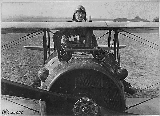
Edward Vernon Rickenbacker (October 8, 1890 – July 27, 1973) was an American fighter ace in World War I and Medal of Honor recipient. He was also a race car driver and automotive designer, a government consultant in military matters and a pioneer in air transportation. During his lifetime, Rickenbacker worked with many influential civilian and military leaders. He had keen insight into technology, and vision for future improvements.

Discussion
Ask a question about 'Eddie Rickenbacker'
Start a new discussion about 'Eddie Rickenbacker'
Answer questions from other users
|
Encyclopedia
Edward Vernon Rickenbacker (October 8, 1890 – July 27, 1973) was an American fighter ace in World War I and Medal of Honor recipient. He was also a race car driver and automotive designer, a government consultant in military matters and a pioneer in air transportation. During his lifetime, Rickenbacker worked with many influential civilian and military leaders. He had keen insight into technology, and vision for future improvements. Among other events, he participated in or observed Armistice Day on the Western Front.
Early life
He was born Edward Rickenbacher in Columbus, Ohio to German-speaking Swiss immigrants. From childhood, he loved machines and experimented with them, encouraged by his father's words "A machine has to have a purpose".
In what was to become one of the defining characteristics of Rickenbacker's life, he nearly died many times in events ranging from an early run-in with a horse-drawn carriage, to a botched surgery, to airplane crashes. His first near-death experience occurred when he was in the "Horsehead Gang". He lived near a mine, and they decided to ride a cart down the slope. It tipped over and almost crushed them.
Rickenbacker's schooling ended after the death of his father ( Eddie was twelve), but driven by an intense admiration for machines, Rickenbacker taught himself as much as he could, including enrolling in a correspondence course in engineering. He aggressively pursued any chance of involvement with automobiles, and Rickenbacker's time at the Columbus Buggy Company and later Duesenberg led him into the automobile industry.
Auto racing career
By 1910, Rickenbacker was racing his employer's cars. Touted as the first man to drive a mile a minute, he received the sobriquet "Fast Eddie" (giving rise to a nickname borne by many men named Edward since his time).
Indianapolis 500 results
Rickenbacker raced in the 1912, 1914, 1915 and 1916 Indianapolis 500. His only finish in the race was in 1914 when he finished 10th. In the other three races, he did not finish due to car failure. Notably, in the 1916 race, he started on the front row in 2nd place.
Statistics as follows (Car number, starting position, qualifying speed, rank, finishing place, laps completed [of 200], laps led, and if he did not finish).
|- !Year !Car !Start !Qual !Rank !Finish !Laps !Led !Retired |- !1912 |16 |13 |77.300 |22 |21 |43 |0 |Intake valve |- !1914 |42 |23 |88.140 |19 |10 |200 |0 |Running |- !1915 |23 |20 |81.970 |20 |19 |103 |0 |Rod |- !1916 |5 |2 |96.440 |2 |20 |9 |9 |Steering |- |colspan=6|Totals |355 |9 | |}
|- !Starts |4 |- !Poles |0 |- !Front Row |1 |- !Wins |0 |- !Top 5 |0 |- !Top 10 |1 |- !Retired |3 |}
>>
World War I
Rickenbacker wanted to join the Allied troops in World War I, but the U.S. had not yet entered the war. He had several chance encounters with aviators, including a fortuitous incident in which he repaired a stranded aircraft for T.F. Dodd, a man who later became General "Black Jack" Pershing's aviation officer and an important contact in Rickenbacker's attempt to join air combat.
Name change
During World War I, with its anti-German atmosphere, he – like many other German Americans – changed his surname; the "h" in "Rickenbacher" became a "k" in an effort to "take the Hun out of his name." As he was already well known at the time, the change received wide publicity. "From then on", as he wrote in his autobiography, "most Rickenbachers were practically forced to spell their name in the way I had..."
Middle name
He started using the name "Vernon" as a middle name because he believed his given name "looked a little plain." He was primarily concerned with what his new middle initial would be. He signed his name 26 times, with a different middle initial each time. After settling upon "V", he selected "Vernon" as a middle name.
Suspected of spying
In 1916, Rickenbacker traveled to London, with the aim of developing an English car for American races. Because of press innuendo and Rickenbacker's known Swiss heritage, he was suspected of being a spy. En route and in England, agents closely monitored his actions.
Eager to fight
Rickenbacker helped organize an advance group of soldiers to be ready if the United States joined the war. When, in 1917, the United States declared war on Germany, Rickenbacker had enlisted in the United States Army and was training in France with some of the first American troops. He arrived in France on June 26, 1917 as a Sergeant First Class.
Learning to fly and adversity
Most men chosen for pilot training had degrees from prestigious colleges, and Rickenbacker had to struggle to gain permission to fly because of his perceived lack of qualifications.
Because of his mechanical abilities, Rickenbacker obtained a position as engineering officer in a flight-training facility at Issoudun, where he practiced flying during his free time. He learned to fly well, but because his skills were badly needed at the training facility, Rickenbacker's superiors tried to prevent him from attaining his wings with the other pilots.
94th Aero Squadron
Rickenbacker demonstrated that he had a qualified replacement, and the military awarded him a place in one of America's air-combat units, the 94th Aero Squadron, informally known as the 'Hat-in-the-Ring' Squadron. Originally he flew the Nieuport 28, at first without armament. On April 29, 1918, Rickenbacker shot down his first plane and claimed his fifth to achieve acedom on May 28.
Aerial victories Rickenbacker gained respect as his successes mounted. He was awarded the French Croix de Guerre in May 1918 for shooting down five German airplanes. On May 30, he scored his sixth victory. It would be his last for three and a half months. He developed an ear infection in July which almost ended his flying career and grounded him for several weeks.
On September 14 and 15, he resumed his victory roll with a win over the German's hottest new fighter, the Fokker D.VII on each day.
On September 24, 1918, now a captain, he was named commander of the squadron, and on the following day he claimed two more German planes, for which he was belatedly awarded the Medal of Honor in 1931. After claiming yet another Fokker D.VII on September 27, he became a balloon buster by downing an observation balloon on both September 28 and October 1.
Thirteen more wins followed in October, bringing his total to thirteen over Fokker D.VIIs, four over other German fighters, five over the highly protected observation balloons, and only four over the easier prey of two-seated reconnaissance planes.
The military determined ace status by verifying combat claims by a pilot; confirmation was needed from ground witnesses, affirmations of other pilots, or observation of the wreckage of the opposing enemy aircraft. If no witnesses could be found, a reported kill was not counted. It was an imperfect system, dependent on the frailties of human observation, as well as vagaries of weather and terrain. Most aces records are thus best estimates, not exact counts; Rickenbacker's victory roll is not exact, but not purposely inaccurate.
Nevertheless, Rickenbacker's 26 victories constituted an American record that stood until World War II. Rickenbacker's official score of 26 still stands, which can be seen at the .
Rickenbacker flew a total of 300 combat hours, reportedly more than any other U.S. pilot in the war.
When Rickenbacker learned of the Armistice, he flew an airplane above the western front to observe the cease fire and the displays of joy and comradeship as the formerly warring troops crossed the front lines and joined in celebration.
Personal account of war events, more fame
After World War I ended, Rickenbacker was approached for publicity exploits. He chose to go on a Liberty bond tour. He was offered many movie positions, but did not want all the attention, even though he was the most celebrated aviator in America (soon to be taken by Charles Lindbergh's flight over the Atlantic). Rickenbacker described his WWI flying experiences in his memoirs, Fighting the Flying Circus, published after the war. In this book, he also describes the character, exploits, and death of fellow pilot Lt. Quentin Roosevelt, the son of U.S. President Theodore Roosevelt. Fighting the Flying Circus is now in the public domain, and the text is available online .
The trial of Billy Mitchell
In 1925 Rickenbacker was a defense witness, along with Hap Arnold, Tooey Spaatz, Ira Eaker, and Fiorello H. La Guardia, in the court-martial of General Billy Mitchell.
Personal philosophy and family life
Rickenbacker showed an intense patriotism from childhood. He was a Christian all his life, urging honest dealing in both one's business and personal life. Rickenbacker encouraged and promoted technology and technological innovation, and predicted many developments that later occurred, such as the prevalence of air transportation, and the critical role that air warfare and air forces would play in future wars. Many of his ideas that were eventually realized were met with skepticism or outright disbelief when he originally expressed them.
Rickenbacker was also adamantly opposed to President Franklin Roosevelt's New Deal policies, seeing them as little better than socialism. For this he drew criticism and ire from the press and the Roosevelt Administration, which ordered NBC Radio not to allow him to broadcast opinions critical of Roosevelt's policies after Rickenbacker harshly denounced the president's use of Air Force pilots to carry Air Mail; the main reason for this denunciation was that several of the pilots had died in crashes while carrying the mail.
In 1922, Rickenbacker married Adelaide Frost; their marriage lasted for the rest of his life. Although they spent considerable time in Florida, Texas and Ohio, the Rickenbackers lived chiefly in New York City. They adopted two sons: David, in 1925, and William, in 1928. Adelaide was an unconventional wife for the times: she was five years older than her husband, had been previously married, and was outspoken and active. As independent as she was, Adelaide fully supported Rickenbacker's endeavors until his death in 1973. In 1977 at the age of 92, Adelaide being completely blind, in failing health and severely grieving the loss of her husband, shot herself at her home on Key Biscayne, Florida.
Post-war: Business and technology
Rickenbacker automobile designs
Still interested in machines, Rickenbacker started an automobile company (see Rickenbacker), selling technologically advanced cars based on innovations discovered in automobile racing. The Rickenbacker came equipped with the first four-wheel brake system. Probably due to the resistance to this idea propagated by other car manufacturers, which had inventory lacking four-wheel braking systems, Rickenbacker's car company was financially unsuccessful. He went into massive debt because of company losses, and determined to pay back everything he owed. Eventually, all vehicles manufactured in the U.S. incorporated four-wheel braking.
Managing the Indianapolis Motor Speedway
In 1927, Rickenbacker bought the Indianapolis Motor Speedway, which he operated for nearly a decade and a half before closing it down due to World War II. Rickenbacker oversaw many improvements of the facility, such as banking the curves to enable better and safer turning. In 1945, Rickenbacker sold the Speedway to Terre Haute, Indiana businessman Anton Hulman, Jr.
Once the Speedway operations were under control, Rickenbacker looked for additional opportunities for entrepreneurship, including sales for the Cadillac division of General Motors and various aircraft manufacturers and airlines.
Eastern Air Lines
Rickenbacker's most lasting business endeavor was his lifelong leadership of Eastern Air Lines. With the help of friends he had met in the war, or in car racing, or in other walks of life, he combined Eastern Air Transport with Florida Airways to form Eastern Air Lines, an airline that grew from a company flying a few thousand air miles per week to a major international transportation company.
Rickenbacker oversaw many radical changes in the field of commercial aviation. He negotiated with the U.S. government to acquire air mail routes, a great advantage to companies in need of business. He helped develop and support new aircraft designs. Rickenbacker acquired historic aircraft for Eastern, including the Lockheed Constellation commissioned by Howard Hughes for Trans World Airlines (Rickenbacker, 1967, 440). Rickenbacker personally collaborated with many of the pioneers of aviation, including Donald Wills Douglas, Sr., founder of the Douglas Aircraft Company that later became McDonnell Douglas.
He helped convince the American public to consider flying; but, always aware of the possibility of accidents, Rickenbacker avoided calling the new method of transportation "safe." In his autobiography, he wrote "I have never liked to use the word "safe" in connection with either Eastern Air Lines or the entire transportation field; I prefer the word "reliable."" (Rickenbacker, 1967, page 261).
Near-fatal crash Rickenbacker often traveled for business on Eastern Airlines flights, and on February 26, 1941, a DC-3 on which he was flying crashed outside Atlanta, Georgia. Rickenbacker suffered grave injuries, was soaked in fuel, and was immobile and trapped in the wreckage. In spite of his own critical wounds, Rickenbacker encouraged the uninjured passengers, offered what consolation he could to those around him who were injured or dying, and guided the still-mobile survivors to attempt to find help. They were rescued after spending the night at the crash site. Rickenbacker barely survived, and this was the first time the press announced his death while he was still alive.
In a dramatic retelling of the incident, Rickenbacker's autobiography relates his astonishing experiences: while still conscious but in terrible pain, Rickenbacker was left behind while ambulances transported bodies of those killed in the accident. When he arrived at a hospital, his injuries appeared so grotesque that doctors left him for dead for some time, instructing staff to "take care of the live ones." (Rickenbacker, 275) Rickenbacker's injuries included a dented skull, other head injuries, shattered left elbow and crushed nerve, paralyzed left hand, several broken ribs, a crushed hip socket, twice-broken pelvis, severed nerve in his left hip, and a broken left knee. Most shocking, his left eyeball was expelled from the socket. (Rickenbacker, 273) He recovered from these after months in the hospital, and regained full eyesight.
Rickenbacker describes the experience with vivid accounts of his mentality as he approached death, emphasizing the supreme act of will necessary to stave it off. His autobiography reported that he spent ten days on the brink of death, which he illustrated as an overwhelming sensation of calm and pleasure (Rickenbacker, 1967, 278).
Airline outcome
For a time, Eastern was the most profitable airline in the post-war era. In the late 1950s, Eastern's fortunes changed, and Rickenbacker was forced out of his CEO position on October 1, 1959. He left his position as chairman of the board December 31, 1963.
Ace Drummond Rickenbacker also scripted a popular comic strip called Ace Drummond from 1935-1940. He worked with aviation artist and author Clayton Knight, who illustrated the series. The strip followed the adventures of aviator Ace Drummond. It was later adapted into a film serial and radio program.
World War II
Rickenbacker supported the war effort as a civilian. In 1942, he toured training bases in the southwestern United States and in England. He encouraged the American public to contribute their time and resources to success in WWII, and pledged Eastern Airlines equipment and personnel for use in military activities.
Rickenbacker served the military extensively, inspecting troops, operations, and equipment, and serving in a publicity function to increase support from civilians and soldiers. In 1942, with a sweeping letter of authorization from Henry L. Stimson, U.S. Secretary of War, Rickenbacker visited England on an official war mission and made ground-breaking recommendations for better war operations.
Adrift at sea
One of Rickenbacker's most famous near-death experiences occurred during the service of the United States war effort. In October 1942, he was sent on a tour of the Pacific theater to review conditions and operations, and to personally deliver a secret message to General Douglas MacArthur. After visiting bases in Hawaii, the B-17D, 40-3089, in which he was flying went off course hundreds of miles from its first scheduled stop at Canton Island. (The navigation failure was due to an out-of-true octant, which introduced bias in the navigation calculations. The octant had suffered a severe shock in a pre-takeoff incident.) This accident spurred the development of improved navigation tools and survival gear for aircraft. The pilots ditched the plane in the Pacific Ocean, dangerously close to Japanese-held enemy territory.
For 24 days, Rickenbacker, his friend and business partner, and the crew drifted at sea without food or water aside from an occasional fish and rain. Rickenbacker still suffered from the airline crash, his friend Hans Adamson sustained serious injuries in the water landing, and others in the crew were hurt to varying degrees. The crew's food supply ran out after three days. On Day 8, a seagull landed on Rickenbacker's head. He painstakingly captured it, and the survivors meticulously divided it equally and used some for fishing bait. They lived on sporadic rain water and similar food "miracles." Rickenbacker assumed a role of leadership, encouragement, and browbeating to help the others survive, and encouraged them to turn to Christianity for solace using Psalm . According to Rickenbacker, each person on the rafts converted to Christianity after the experience. The U.S. Army Air Forces, unable to find them, intended to abandon the search for the lost crew after searching unsuccessfully for more than two weeks, but Rickenbacker's wife convinced them to extend the search another week. Once again, the press reported that Rickenbacker had died.
Navy pilots rescued the surviving members of the crew on November 13, 1942, off the coast of Nukufetau near Samoa. The survivors were suffering from exposure, dehydration, and starvation. One serviceman had died and was buried at sea. Rickenbacker completed his assignment and delivered MacArthur's secret message. No one ever made the message public.
It should be noted that Rickenbacker initially thought that he had been lost for 21 days, and wrote a book about the experience titled "Seven Came Through" published by Doubleday, Doran. It was not until later that he recalculated and corrected the error in his 1967 autobiography.
1943: Mission to besieged USSR
Still determined to support the U.S. war effort, Rickenbacker suggested a fact-finding mission in the Soviet Union to provide the Soviets with needed technical assistance for their American aircraft. His private objective was to gain knowledge about ever-more hostile Soviet military capabilities.
Gaining permission to enter the Soviet Union
Rickenbacker approached Soviet diplomats, and avoided requesting help from President Franklin Roosevelt, alluding to personal disagreements between the two. With the help of the Secretary of War and by trading favors with the Soviet ambassador, Rickenbacker secured unlikely permission to travel to the Soviet Union.
The War Department provided everything Rickenbacker needed, including a highly unusual letter stating that the bearer was authorized to "visit ... any ... areas he may deem necessary for such purposes as he will explain to you in person," signed by the Secretary of War (Rickenbacker, 1967, 390).
55,000-mile side-trip around the world
Rickenbacker's trip took him over South America, where he made important observations about conditions there. He stopped in Africa, China and India, at each stop reviewing American operations and making notes to report to authorities. In Iran, Rickenbacker offered to bring along an American officer, whose unapproved request to travel to the Soviet Union delayed Rickenbacker's party for a few days.
Soviet information gathering
In the Soviet Union, Rickenbacker observed wartime conditions, extraordinary dedication and patriotism by the populace, and ruthless denial of goods and services to unproductive members of society. He befriended many Soviet officials, and shared his knowledge of the aircraft they had received from the United States. He was lavishly entertained and recalled attempts by KGB agents and officials to intoxicate him and gain sensitive information. Rickenbacker's mission was successful. He discovered that a commander of Moscow's defense had stayed at Rickenbacker's home in 1937, and personal connections like this and the respect the Soviet military personnel had for Rickenbacker greatly improved Rickenbacker's effectiveness at information-gathering. When he left the Soviet Union, Rickenbacker understood Soviet defense strategies and capabilities, knew about brand-new strategies against advancing tank battalions, and had memorized a map of the Soviet front line showing standard military location markers for all major units. (Rickenbacker, 1967, 422). He was also provided with unprecedented access to the Shturmovik aircraft factory. But it was comments made by Rickenbacker during his trip that alerted the Soviets to the existence of the secret B-29 Superfortress program.
Rickenbacker predicted that the Soviet Union's practices favored capitalism and that it would become a capitalist nation (Rickenbacker, 1967, 425).
Reception
British Prime Minister Winston Churchill interviewed Rickenbacker about his mission. In the U.S., Rickenbacker's information resulted in some diplomatic and military action, but President Roosevelt ignored the information and did not meet with Rickenbacker about his groundbreaking visit to the Soviet Union (Rickenbacker, 1967, 438).
Post-World War II
Although his primary residence was in New York City, for many years Rickenbacker had a winter home in Coconut Grove, Florida near Eastern Airlines's facilities at Miami International Airport.
In November 1947 a four mile (6 km) causeway was completed linking Miami on the mainland of Florida with Crandon Park on the island of Key Biscayne. The road was named Rickenbacker Causeway in honor of the aviation pioneer and president of Eastern Airlines.
In the 1960s, Rickenbacker became a well-known speaker. He shared his vision for the future of technology and commerce, exhorted Americans to respect the enemy (the Soviet Union) during the Cold War, yet uphold American values, and endorsed conservative ideals.
After his retirement from Eastern Air Lines in 1963 at the age of 73, Adelaide and Eddie Rickenbacker traveled extensively, until he had a stroke while in Switzerland seeking medical treatment for Adelaide there. He died on July 23, 1973 in Zürich, and his body was buried in Columbus, Ohio at Green Lawn Cemetery.
In 1967, when he published his autobiography, a special edition was printed for employees of Eastern Air Lines which contained the following dedication:
To the Men and Women of Eastern Air Lines
- It is with pleasure and pride that I inscribe to you this copy of my life story from the time I was three years of age.
- You will find therein the source of those principles I used to preach; and if they can help you avoid even a few of the keen disappointments and bitter heartaches that I have lived through, then I will feel well repaid for my efforts.
- From these principles and our labors together emerged one of our country's great airlines and further developed our great heritage of pioneering. In the years ahead young, strong hands will carry them into a future which you and I, with all our dreams, can scarcely visualize---that "Parade of Youth" which always was and always will be the true spirit of Eastern Air Lines.
(signed) Capt Eddie Rickenbacker
In 1974, the Lockbourne Air Force Base in his home town of Columbus was renamed Rickenbacker Air Force Base.
Citations for military decorations
Edward V. Rickenbacker, Colonel, specialist reserve, then first lieutenant, 94th Aero Squadron, Air Service, American Expeditionary Forces. For conspicuous gallantry and intrepidity above and beyond the call of duty in action against the enemy near Billy, France, 25 September 1918. While on a voluntary patrol over the lines Lieutenant. Rickenbacker attacked seven enemy planes (five type Fokker protecting two type Halberstadt photographic planes). Disregarding the odds against him he dived on them and shot down one of the Fokkers out of control. He then attacked one of the Halberstadts and sent it down also...
Medal of Honor citation, awarded 6 November 1930
The Distinguished Service Cross is presented to Edward Vernon Rickenbacker, Captain (Air Service), U.S. Army, for extraordinary heroism in action near Montsec, France, April 29, 1918. Captain Rickenbacker attacked an enemy Albatross monoplane, and after a vigorous fight in which he followed his foe into German territory, he succeeded in shooting it down near Vigneulles-les-Hatton Chatel.
General Orders No. 32, W.D., 1919
The Distinguished Service Cross is presented to Edward Vernon Rickenbacker, Captain (Air Service), U.S. Army, for extraordinary heroism in action over Richecourt, France, on May 17, 1918. Captain Rickenbacker attacked three Albatross enemy planes, shooting one down in the vicinity of Richecourt, France, and forcing the others to retreat over their own lines.
General Orders No. 32, W.D., 1919
The Distinguished Service Cross is presented to Edward Vernon Rickenbacker, Captain (Air Service), U.S. Army, for extraordinary heroism in action over St. Mihiel, France, on May 22, 1918. Captain Rickenbacker attacked three Albatross monoplanes 4,000 meters over St. Mihiel, France. He drove them back into German territory, separated one from the group, and shot it down near Flirey.
General Orders No. 32, W.D., 1919
The Distinguished Service Cross is presented to Edward Vernon Rickenbacker, Captain (Air Service), U.S. Army, for extraordinary heroism in action over Boise Rate, France, on May 28, 1918. Captain Rickenbacker sighted a group of two battle planes and four monoplanes, German planes, which he at once attacked vigorously, shooting down one and dispersing the others.
General Orders No. 32, W.D., 1919
The Distinguished Service Cross is presented to Edward Vernon Rickenbacker, Captain (Air Service), U.S. Army, for extraordinary heroism in action on May 30, 1918, 4,000 meters over Jaulny, France. Captain Rickenbacker attacked a group of five enemy planes. After a violent battle, he shot down one plane and drove the others away.
General Orders No. 32, W.D., 1919
The Distinguished Service Cross is presented to Edward Vernon Rickenbacker, Captain (Air Service), U.S. Army, for extraordinary heroism in action in the region of Villecy, France, September 14, 1918. Captain Rickenbacker attacked four Fokker enemy planes at an altitude of 3,000 meters. After a sharp and hot action, he succeeded in shooting one down in flames and dispersing the other three.
General Orders No. 32, W.D., 1919
The Distinguished Service Cross is presented to Edward Vernon Rickenbacker, Captain (Air Service), U.S. Army, for extraordinary heroism in action in the region of Bois-de-Wavrille, France, September 15, 1918. Captain Rickenbacker encountered six enemy planes, who were in the act of attacking four Spads, which were below them. Undeterred by their superior numbers, he unhesitatingly attacked them and succeeded in shooting one down in flames and completely breaking the formation of the others.
General Orders No. 32, W.D., 1919
Non-military awards
*National Aviation Hall of Fame, 1965
Trivia
- He was a cousin of Adolph Rickenbacker, co-founder of Rickenbacker Guitars. The company name was purposely chosen for its recognition factor as associated with Eddie Rickenbacker.
- Eddie Rickenbacker appears in the famous PC game Red Baron as one of WWI Allied Flying Aces.
- In the 1999 computer game System Shock 2, a military spaceship is named the UNN Rickenbacker.
- In his comic strip Li'l Abner, Al Capp included an airplane pilot modeled on Rickenbacker: Cap'n Eddie Ricketyback.
- During WWI he tried to convince U.S. military officials to let him form a squadron composed entirely of former race car drivers, on the theory that such men, accustomed to tight spaces and high speeds, would make excellent fighter pilots. His request was denied.
- The game Wings of War: Famous Aces features Rickenbacker's Spad XIII.
- Rickenbacker's experience of being lost at sea was used as an example for Alcoholics Anonymous when they formed the First of their Twelve Traditions: Our common welfare should come first; personal recovery depends upon A.A. unity."
- The Rickenbacker award is the Civil Air Patrol cadet achievement equivalent to an Active Duty Air Force Technical Sergeant. Cadets awarded the Rickenbacker achievement are promoted to C/TSgt.
- For over twenty years there has been a casual restaurant chain honoring Rickenbacker's squadron, the 94th Aero Squadron. Generally located near airports, locations look like French farmhouses with World War I airplanes and sandbagged gun emplacements around it. On the inside it is filled with military aviation memorabilia. Customers can put on headphones and listen in to the pilots conversing with the flight controllers.
See also
Other References
- Adamson, Hans Christian, Eddie Rickenbacker, The Macmillan Company, New York, 1946.
- Farr, Finis, Rickenbacker's Luck - An American Life, Houghton-Mifflin Company, Boston, 1979, ISBN 0-395-27102-9.
- Lewis, W. David, Eddie Rickenbacker: An American Hero in the Twentieth Century, Johns Hopkins University Press, Baltimore, 2005.
- Rickenbacker, Captain Edward V., Seven Came Through, Doubleday, Doran and Company, Inc., Garden City, New York, 1943.
- Rickenbacker, Edward V., Rickenbacker: an Autobiography, Prentice-Hall, Inc., Englewood Cliffs, NJ, 1967.
- Serling, Robert J., From the Captain to the Colonel; An Informal History of Eastern Airlines, The Dial Press, New York, 1980.
- Whittaker, James C., We Thought We Heard the Angels Sing, E. P. Dutton, New York, 1943. An account of the adrift at sea experience by another member of the crew.
External links
- (VanderbiltCupRaces.com)
- Retrieved on 2007-12-23
- (1919)
-
|
| |
|
|
|
|