

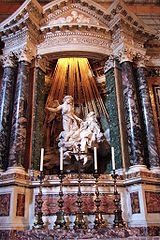
Ecstasy of St Theresa

Encyclopedia
The Ecstasy of Saint Teresa (alternatively Saint Teresa in Ecstasy or Transverberation of Saint Teresa; in Italian L'Estasi di Santa Teresa or Santa Teresa in estasi) is the central sculptural group in white marble set in an elevated aedicule in the Cornaro Chapel, Santa Maria della Vittoria
, Rome
. It was designed and completed by Gian Lorenzo Bernini
, the leading sculptor of his day, who also designed the setting of the Chapel in marble, stucco and paint. It is generally considered to be one of the sculptural masterpieces of the High Roman Baroque
. It pictures Teresa of Ávila
.
papacy of Innocent X. When Innocent acceded to the papal throne, he shunned Bernini’s artistic services; the sculptor had been the favorite artist of the previous and profligate Barberini
pope. Without papal patronage, the services of Bernini's studio were therefore available to a patron such as the Venetian Cardinal Federico Cornaro (1579–1673).
Cornaro had chosen the hitherto unremarkable church of the Discalced Carmelites
for his burial chapel. The selected site for the chapel was the left transept that had previously held an image of ‘St. Paul in Ecstasy’, which was replaced by Bernini’s dramatization of a religious experience undergone and related by the first Discalced Carmelite saint who had recently been canonized in 1622. It was completed in 1652 for the then princely sum of 12,000 scudi
.
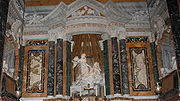 The two central sculptural figures of the swooning nun and the angel with the spear derive from an episode described by Teresa of Avila
, a mystical cloistered Discalced Carmelite reformer and nun, in her autobiography, ‘The Life of Teresa of Jesus’ (1515–1582). Her experience of religious ecstasy in her encounter with the angel is described as follows:
The group is illuminated by natural light which filters through a hidden window in the dome of the surrounding aedicule, and underscored by gilded stucco rays. Teresa is shown lying on a cloud indicating that this is intended to be a divine apparition we are witnessing. Other witnesses appear on the side walls; life-size high-relief donor portrait
s of male members of the Cornaro family are present and shown discussing the event in boxes as if at the theatre. Although the figures are executed in white marble, the aedicule, wall panels and theatre boxes are made from colored marbles. Above, the vault of the Chapel is frescoed with an illusionistic cherub-filled sky with the descending light of the Holy Ghost allegorized as a dove.
The art historian Rudolf Wittkower has written,
Given the sexualized imagery of St. Teresa's written account of the experience, some critics have seen in the statue a depiction of physical orgasm
; in particular, the body posture and facial expression of St. Teresa have caused some to assign her experience as one of climactic moment. Jacques Lacan, for example, whilst discussing the female orgasm, said that "you only have to go and look at Bernini's statue in Rome to understand immediately that she's coming, there is no doubt about it." ("Encore," Sem. XX: 70-71)
Robert Harbison, however, has expressed his doubt that Bernini, a follower of the mystical exercises of followers of St. Ignatius of Loyola, would have intended to depict here an episode of lust fulfilled. Instead, Bernini aims to express the facial and body equivalents of a state of divine joy: "It is an astonishing passage that the post-Freudian reader cannot help sniggering at—doesn't the nun realize she is describing mainly sexual longings? Indeed, a few lines later she recognizes that it is like bodily seduction, but only as an opening or avenue for another kind of experience. Human sexuality or even the senses cannot have the primacy for Teresa or Bernini which they do for us. The shocking reciprocal movement which grabs our attention so forcibly is not intended as sensational; it aims to jar us into another place entirely."
Santa Maria della Vittoria
Santa Maria della Vittoria is a roman catholic titular church and minor basilica dedicated to the Virgin Mary located in Rome, Italy. The church is known for the masterpiece of Gian Lorenzo Bernini in the Cornaro Chapel, the Ecstasy of Saint Teresa....
, Rome
Rome
Rome is the capital of Italy and the country's largest and most populated city and comune, with over 2.7 million residents in . The city is located in the central-western portion of the Italian Peninsula, on the Tiber River within the Lazio region of Italy.Rome's history spans two and a half...
. It was designed and completed by Gian Lorenzo Bernini
Gian Lorenzo Bernini
Gian Lorenzo Bernini was an Italian artist who worked principally in Rome. He was the leading sculptor of his age and also a prominent architect...
, the leading sculptor of his day, who also designed the setting of the Chapel in marble, stucco and paint. It is generally considered to be one of the sculptural masterpieces of the High Roman Baroque
Baroque
The Baroque is a period and the style that used exaggerated motion and clear, easily interpreted detail to produce drama, tension, exuberance, and grandeur in sculpture, painting, literature, dance, and music...
. It pictures Teresa of Ávila
Teresa of Ávila
Saint Teresa of Ávila, also called Saint Teresa of Jesus, baptized as Teresa Sánchez de Cepeda y Ahumada, was a prominent Spanish mystic, Roman Catholic saint, Carmelite nun, and writer of the Counter Reformation, and theologian of contemplative life through mental prayer...
.
Commission
The entire ensemble was overseen and completed by a mature Bernini during the PamphiliPamphili
The Pamphili are one of the papal families deeply entrenched in Roman Catholic Church, Roman and Italian politics of the 16th and 17th centuries ....
papacy of Innocent X. When Innocent acceded to the papal throne, he shunned Bernini’s artistic services; the sculptor had been the favorite artist of the previous and profligate Barberini
Barberini
The Barberini are a family of the Italian nobility that rose to prominence in 17th century Rome. Their influence peaked with the election of Cardinal Maffeo Barberini to the papal throne in 1623, as Pope Urban VIII...
pope. Without papal patronage, the services of Bernini's studio were therefore available to a patron such as the Venetian Cardinal Federico Cornaro (1579–1673).
Cornaro had chosen the hitherto unremarkable church of the Discalced Carmelites
Discalced Carmelites
The Discalced Carmelites, or Barefoot Carmelites, is a Catholic mendicant order with roots in the eremitic tradition of the Desert Fathers and Mothers...
for his burial chapel. The selected site for the chapel was the left transept that had previously held an image of ‘St. Paul in Ecstasy’, which was replaced by Bernini’s dramatization of a religious experience undergone and related by the first Discalced Carmelite saint who had recently been canonized in 1622. It was completed in 1652 for the then princely sum of 12,000 scudi
Italian scudo
The scudo was the name for a number of coins used in Italy until the 19th century. The name, like that of the French écu and the Spanish and Portuguese escudo, was derived from the Latin scutum . From the 16th century, the name was used in Italy for large silver coins...
.
Sculptural group and its setting
Teresa of Ávila
Saint Teresa of Ávila, also called Saint Teresa of Jesus, baptized as Teresa Sánchez de Cepeda y Ahumada, was a prominent Spanish mystic, Roman Catholic saint, Carmelite nun, and writer of the Counter Reformation, and theologian of contemplative life through mental prayer...
, a mystical cloistered Discalced Carmelite reformer and nun, in her autobiography, ‘The Life of Teresa of Jesus’ (1515–1582). Her experience of religious ecstasy in her encounter with the angel is described as follows:
The group is illuminated by natural light which filters through a hidden window in the dome of the surrounding aedicule, and underscored by gilded stucco rays. Teresa is shown lying on a cloud indicating that this is intended to be a divine apparition we are witnessing. Other witnesses appear on the side walls; life-size high-relief donor portrait
Donor portrait
A donor portrait or votive portrait is a portrait in a larger painting or other work showing the person who commissioned and paid for the image, or a member of his, or her, family...
s of male members of the Cornaro family are present and shown discussing the event in boxes as if at the theatre. Although the figures are executed in white marble, the aedicule, wall panels and theatre boxes are made from colored marbles. Above, the vault of the Chapel is frescoed with an illusionistic cherub-filled sky with the descending light of the Holy Ghost allegorized as a dove.
The art historian Rudolf Wittkower has written,
Interpretations
The effects are theatrical, the Cornaro family seeming to observe the scene from their boxes., and the chapel illustrates a moment where divinity intrudes on an earthly body. Caroline Babcock speaks of Bernini's melding of sensual and spiritual pleasure in the "orgiastic" grouping as both intentional and influential on artists and writers of the day. Irving Lavin said "the transverberation becomes a point of contact between earth and heaven, between matter and spirit".Given the sexualized imagery of St. Teresa's written account of the experience, some critics have seen in the statue a depiction of physical orgasm
Orgasm
Orgasm is the peak of the plateau phase of the sexual response cycle, characterized by an intense sensation of pleasure...
; in particular, the body posture and facial expression of St. Teresa have caused some to assign her experience as one of climactic moment. Jacques Lacan, for example, whilst discussing the female orgasm, said that "you only have to go and look at Bernini's statue in Rome to understand immediately that she's coming, there is no doubt about it." ("Encore," Sem. XX: 70-71)
Robert Harbison, however, has expressed his doubt that Bernini, a follower of the mystical exercises of followers of St. Ignatius of Loyola, would have intended to depict here an episode of lust fulfilled. Instead, Bernini aims to express the facial and body equivalents of a state of divine joy: "It is an astonishing passage that the post-Freudian reader cannot help sniggering at—doesn't the nun realize she is describing mainly sexual longings? Indeed, a few lines later she recognizes that it is like bodily seduction, but only as an opening or avenue for another kind of experience. Human sexuality or even the senses cannot have the primacy for Teresa or Bernini which they do for us. The shocking reciprocal movement which grabs our attention so forcibly is not intended as sensational; it aims to jar us into another place entirely."
Similar works by Bernini
- See also entry titled Bernini's Cornaro chapel: the complete work of art found in the BaroqueBaroqueThe Baroque is a period and the style that used exaggerated motion and clear, easily interpreted detail to produce drama, tension, exuberance, and grandeur in sculpture, painting, literature, dance, and music...
section. - Death of the Blessed Ludovica AlbertoniBeata Ludovica AlbertoniThe "Beata Ludovica Albertoni" is a funerary monument in the specially designed Altieri Chapel in the church of San Francesco a Ripa in Trastevere, Rome, Italy....
(1671–74)—San Francesco a RipaSan Francesco a RipaSan Francesco a Ripa is a church in Rome, Italy. It is dedicated to Francis of Assisi because the adjacent convent accommodated him, while the term Ripa refers to the nearby river-edge of the Tiber.-History:...
, Rome. - Martyrdom of Saint LawrenceMartyrdom of St. Lawrence (Bernini)The Martyrdom of St Lawrence is an early sculpture by the Italian baroque artist Gian Lorenzo Bernini. It depicts the saint at moment of his supposed martyrdom, being burnt alive on a gridiron. According to Bernini's biographer Filippo Baldinucci, the sculpture was completed when Bernini was 15...
(1614–15) - Truth Unveiled by TimeTruth Unveiled by Time (Bernini)Truth Unveiled by Time is a 1645 sculpture by Bernini. It was intended to show Truth allegorically as a naked young woman being unveiled by a figure of Time above her, but the figure of Time was not executed...
(1646–52) - Galleria BorgheseGalleria BorgheseThe Borghese Gallery is an art gallery in Rome, Italy, housed in the former Villa Borghese Pinciana. It is a building that was from the first integral with its gardens, nowadays considered quite separately by tourists as the Villa Borghese gardens...
, RomeRomeRome is the capital of Italy and the country's largest and most populated city and comune, with over 2.7 million residents in . The city is located in the central-western portion of the Italian Peninsula, on the Tiber River within the Lazio region of Italy.Rome's history spans two and a half...
.
Influencing or influenced works
- Stefano MadernoStefano MadernoStefano Maderno was an Italian sculptor.-Biography:News about Maderno's life are scarce and often contradictory...
's sculpture of St Cecilia in namesake churchSanta Cecilia in TrastevereSanta Cecilia in Trastevere is a 5th century church in Rome, Italy, devoted to Saint Cecilia, in the Trastevere rione.-History:The first church on this site was founded probably in the 3rd century, by Pope Urban I; it was devoted to the Roman martyr Cecilia, martyred it is said under Marcus...
(1600). - Melchiorre CaffàMelchiorre CaffàMelchiorre Cafà was a sculptor from Malta. Cafà began a promising career in Baroque Rome but this was cut short by his premature death following a work accident.- Biography :...
's Santa Rose of Lima (1665) and his Assumption of St Catherine. - Francisco Aprile and Ercole FerrataErcole FerrataErcole Ferrata was an Italian sculptor of the Roman Baroque.-Biography:A native of Pellio Inferiore, near Como, Ferrata initially apprenticed with Alessandro Algardi, and became one of his prime assistants...
's Sant'Anastasia in her namesake churchSanta AnastasiaSanta Anastasia is a basilica church in Rome, Italy.Santa Anastasia was built in the late 3rd century - early 4th century, possibly by a Roman woman named Anastasia. The church is listed under the titulus Anastasiae in the acts of the 499 synod...
in Rome. - The most internationally successful Czech underground group the Ecstasy of Saint Theresa named themselves after the sculpture.
- Angels and DemonsAngels and DemonsAngels & Demons is a 2000 bestselling mystery-thriller novel written by American author Dan Brown and published by Pocket Books. The novel introduces the character Robert Langdon, who is also the protagonist of Brown's subsequent 2003 novel, The Da Vinci Code, and 2009 novel, The Lost Symbol...
, the novel by Dan BrownDan BrownDan Brown is an American author of thriller fiction, best known for the 2003 bestselling novel, The Da Vinci Code. Brown's novels, which are treasure hunts set in a 24-hour time period, feature the recurring themes of cryptography, keys, symbols, codes, and conspiracy theories...
which lists the sculpture as the third "altar of science" of the fictionalized IlluminatiIlluminatiThe Illuminati is a name given to several groups, both real and fictitious. Historically the name refers to the Bavarian Illuminati, an Enlightenment-era secret society founded on May 1, 1776...
. - The sculpture is the subject of the song "The Lie" from the Peter HammillPeter HammillPeter Joseph Andrew Hammill is an English singer-songwriter, and a founding member of the progressive rock band Van der Graaf Generator. Most noted for his vocal abilities, his main instruments are guitar and piano...
album The Silent Corner and the Empty StageThe Silent Corner and the Empty StageThe Silent Corner and the Empty Stage is the third album by British singer-songwriter Peter Hammill. It was released on Charisma Records in 1974, during a hiatus in the activities of Hammill's progressive rock band Van der Graaf Generator...
. Here is a little essay about the song, on a french musical site. - Numerous references to the sculpture, including one character's obsession, are made in Infinite JestInfinite JestInfinite Jest is a 1996 novel by David Foster Wallace. The lengthy and complex work takes place in a semi-parodic future version of North America, and touches on tennis, substance addiction and recovery programs, depression, child abuse, family relationships, advertising and popular entertainment,...
by David Foster WallaceDavid Foster WallaceDavid Foster Wallace was an American author of novels, essays, and short stories, and a professor at Pomona College in Claremont, California...
. - Street artStreet artStreet art is any art developed in public spaces — that is, "in the streets" — though the term usually refers to unsanctioned art, as opposed to government sponsored initiatives...
ist BanksyBanksyBanksy is a pseudonymous England-based graffiti artist, political activist, film director, and painter.His satirical street art and subversive epigrams combine irreverent dark humour with graffiti done in a distinctive stencilling technique...
used the image of Saint Theresa in one of his works, though he removed the angelic figure and added a fast food meal.http://www.banksy.co.uk/outdoors/images/landscapes/macdonna.jpg - The sculpture and its image are frequently referred to in the novel Cutting For Stone by Abraham Verghese.
