

Economy of Saudi Arabia

Encyclopedia
Saudi Arabia
has an oil
-based economy
with strong government control over major economic activities. Saudi Arabia possesses 18% of the world's proven petroleum reserves, ranks as the largest exporter of petroleum, and plays a leading role in OPEC
, although its influence has waned in recent years.
sector accounts for roughly 45% of budget revenues, 55% of GDP, and 90% of export earnings. About 40% of GDP comes from the private sector. Roughly five and a half million foreign workers play an important role in the Saudi economy, for example, in the oil and service sectors. The government is encouraging private sector growth to lessen the kingdom's dependence on oil and increase employment opportunities for the swelling Saudi population. The government has begun to permit private sector and foreign investor participation in the power generation and telecom sectors. As part of its effort to attract foreign investment and diversify the economy, Saudi Arabia acceded to the WTO in 2005 after many years of negotiations. With high oil revenues enabling the government to post large budget surpluses, Riyadh
has been able to substantially boost spending on job training and education, infrastructure development, and government salaries.
that the country saw rapid growth, and GDP per capita soared by 1,858% in the 1970s (although that growth was concentrated with the ruling elite). GDP per capita shrank by 58% in the Eighties with slower growth and a growing population. However successful diversification efforts helped register a growth of 20% in the Nineties.
This is a chart of trend of gross domestic product of Saudi Arabia at market prices estimated by the International Monetary Fund (and other sources) with figures in millions of Saudi Arabian Riyals.
For purchasing power parity comparisons, the US Dollar is exchanged at 3.75 Saudi Arabian Riyals only. Mean wages were $14.74 per manhour in 2009.
As of August 2009 it was reported that Saudi Arabia is the strongest Arab economy, according to World Bank, although the reliability of that rating has been called into question.
Saudi oil reserves
are the largest in the world, and Saudi Arabia is the world's leading oil producer and exporter. Oil accounts for more than 90% of the country's exports and nearly 75% of government revenues. Proven reserves, according to figures provided by the Saudi Government, are estimated to be 260 Goilbbl, about one-quarter of world oil reserves.
More than 95% of all Saudi oil is produced on behalf of the Saudi Government by the parastatal giant Saudi Aramco
, and the remaining 5% by similar parastatal companies as of 2002. In June 1993, Saudi Aramco
absorbed the state marketing and refining company (SAMAREC), becoming the world's largest fully integrated oil company. Most Saudi oil exports move by tanker from oil terminals at Ras Tanura and Ju'aymah in the Persian Gulf
. The remaining oil exports are transported via the east-west pipeline across the kingdom to the Red Sea port of Yanbu. A major new gas initiative promises to bring significant investment by U.S. and European oil companies to develop nonassociated gas fields in three separate parts of Saudi Arabia. Following final technical agreements with concession awardees in December 2001, development should begin in 2002.
Due to a sharp rise in petroleum revenues in 1974 following the 1973 Arab-Israeli war, Saudi Arabia became one of the fastest-growing economies in the world. It enjoyed a substantial surplus in its overall trade with other countries; imports increased rapidly; and ample government revenues were available for development, defense, and aid to other Arab and Islamic countries.
But higher oil prices led to development of more oil fields around the world and reduced global consumption. The result, beginning in the mid-1980s, was a worldwide oil glut
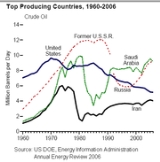
, which introduced an element of planning uncertainty for the first time in a decade. Saudi oil production, which had increased to almost 10 Moilbbl per day during 1980-81, dropped to about 2 Moilbbl/d in 1985. Budgetary deficits developed, and the government drew down its foreign assets. Responding to financial pressures, Saudi Arabia gave up its role as the "swing producer
" within OPEC in the summer of 1985 and accepted a production quota
. Since then, Saudi oil policy has been guided by a desire to maintain market and quota shares.
However, beginning in late 1997, Saudi Arabia again faced the challenge of low oil prices. Due to a combination of factors—the East Asia
n economic crises, a warm winter in the West caused by El Niño, and an increase in non-OPEC oil production—demand for oil slowed and pulled oil prices down by more than one-third.
Saudi Arabia was a key player in coordinating the successful 1999 campaign of OPEC and other oil-producing countries to raise the price of oil to its highest level since the (Persian) Gulf War by managing production and supply of petroleum. That same year, Saudi Arabia established the Supreme Economic Council to formulate and better coordinate economic development policies in order to accelerate institutional and industrial reform.
Saudi Arabia has announced plans to invest about $46 billion in three of the world’s largest and most ambitious petrochemical projects. These include the $27 billion Ras Tanura integrated refinery and petrochemical project, the $9 billion Saudi Kayan petrochemical complex at Jubail Industrial City, and the $10 billion Petro Rabigh refinery upgrade project. Together, the three projects will employ more than 150,000 technicians and engineers working around the clock. Upon completion in 2015-16, the Ras Tanura integrated refinery and petrochemicals project will become the world’s largest petrochemical facility of its kind with a combined production capacity of 11 million tons per year of different petrochemical and chemical products. The products will include ethylene
, propylene
, aromatics, polyethylene
, ethylene oxide
, chlorine derivatives, and glycol.
and methanol
in the world, the third largest producer of polyethylene
and overall the fourth largest producer of polypropylene
and polyolefin
. Standard and Poor's and Fitch Ratings claimed SABIC to be the world's largest producer of polymers and the Persian Gulf region's largest steel producer for 2005 and assigned SABIC 'A' corporate credit rating. In 2008, Fortune 500 ranking records SABIC revenues at $40.2 billion, profits at $5.8 billion and assets standing at $72.4 billion.
Expansion operations and investments are projected to amount to USD20 billion in 2007 and USD70 billion until 2020. The overall total production in 1985 was 6.3 million metric tons (mmt); by the end of 2008 it had reached 56 mmt and by 2020, SABIC intends to produce over 135 mmt per year. SABIC established in June 2006 "SABIC Sukuk Company" to issue Islamic bonds (Sukuk) that are estimated to range between SAR1 billion (USD266.67 million) and SAR3 billion (USD800 million).
Net profits of SABIC in 2008 touched SR 22 billion (US$ 5.86 billion), while total assets stood at SR 272 billion (US$ 72.5 billion) at the end of 2008 and the value of current assets at the end of 2008 stood at SR 95 billion (US$ 25 billion).
In addition, since its formation, Ma'aden (through the Ministry of Petroleum & Mineral Resources) has collaborated with the Government and local legislators to develop a regulatory framework for the governance of the mining industry.
On December 20, 2009, Ma'aden signed an agreement with US aluminium giant Alcoa
to build a $10.8 billion aluminium complex. Under the agreement, the two firms will build a 1.8 million tonnes per year aluminium refinery and a 740,000 million tonnes per year smelter in Ras Azzour
. The smelter is slated to start production in 2013 while the refinery would come online in 2014.
 In recent years, Saudi Arabia sought to join the World Trade Organization. Negotiations have focused on the degree to which Saudi Arabia is willing to increase market access to foreign goods and services and the timeframe for becoming fully compliant with World Trade Organization
obligations. In April 2000, the government established the Saudi Arabian General Investment Authority to encourage foreign direct investment in Saudi Arabia. Saudi Arabia maintains a negative list of sectors in which foreign investment is prohibited, but the government plans to open some closed sectors such as telecommunications, insurance, and power transmission/distribution over time. As of November 2005 , Saudi Arabia was officially approved to enter World Trade Organization.
For the fifth consecutive year, Saudi Arabia was ranked as the best place to do business in the entire Middle East and the Arab World. Since 2004, the Kingdom has advanced its overall Doing Business rankings, from 67th to 13th. A number of policy reforms to promote entrepreneurship
are underway.
Saudi Arabian companies dominate 2009's "MEED 100", with companies listed on the Tadawul accounting for 29 out of the region’s 100 biggest publicly quoted companies ranked by market capitalisation. Just three of the 20 companies that have dropped out of the top 100 over the past year are listed on the Saudi stock exchange.
Through 5-year development plans, the government has sought to allocate its petroleum income to transform its relatively undeveloped, oil-based economy into that of a modern industrial state while maintaining the kingdom's traditional Islamic values and customs. Although economic planners have not achieved all their goals, the economy has progressed rapidly. Oil wealth has increased the standard of living of most Saudis. However, significant population growth has strained the government's ability to finance further improvements in the country's standard of living. Heavy dependence on petroleum revenue continues, but industry and agriculture now account for a larger share of economic activity. The mismatch between the job skills of Saudi graduates and the needs of the private job market at all levels remains the principal obstacle to economic diversification and development; about 4.6 million non-Saudis are employed in the economy.
Saudi Arabia's first two development plans, covering the 1970s, emphasized infrastructure. The results were impressive — the total length of paved highways tripled, power generation increased by a multiple of 28, and the capacity of the seaports grew tenfold. For the third plan (1980–85), the emphasis changed. Spending on infrastructure declined, but it rose markedly on education, health, and social services. The share for diversifying and expanding productive sectors of the economy (primarily industry) did not rise as planned, but the two industrial cities of Jubail
and Yanbu--built around the use of the country's oil and gas to produce steel, petrochemicals, fertilizer, and refined oil products—were largely completed.
In the fourth plan (1985–90), the country's basic infrastructure was viewed as largely complete, but education and training remained areas of concern. Private enterprise was encouraged, and foreign investment in the form of joint ventures with Saudi public and private companies was welcomed. The private sector became more important, rising to 70% of non-oil GDP
by 1987. While still concentrated in trade and commerce, private investment increased in industry, agriculture, banking, and construction companies. These private investments were supported by generous government financing and incentive programs. The objective was for the private sector to have 70% to 90% ownership in most joint venture enterprises.
The fifth plan (1990–95) emphasized consolidation of the country's defenses; improved and more efficient government social services; regional development; and, most importantly, creating greater private-sector employment opportunities for Saudis by reducing the number of foreign workers.
The sixth plan (1996–2000'Bold text) focused on lowering the cost of government services without cutting them and sought to expand educational training programs. The plan called for reducing the kingdom's dependence on the petroleum sector by diversifying economic activity, particularly in the private sector, with special emphasis on industry and agriculture. It also continued the effort to "Saudiize" the labor force.
The seventh plan (2000–2004) focuses more on economic diversification and a greater role of the private sector in the Saudi economy. For the period 2000-2004, the Saudi Government aims at an average GDP growth rate of 3.16% each year, with projected growths of 5.04% for the private sector and 4.01% for the non-oil sector. The government also has set a target of creating 817,300 new jobs for Saudi nationals.
Advertising expenditures have reached new peaks due to emphasis on value-added manufacturing. (pdf)
and its financial markets are regulated by the Capital Market Authority (Saudi Arabia). The stock market capitalisation of listed companies in Saudi Arabia was valued at $646 billion in 2005 by the World Bank
.
The electrical and electronics market was estimated to be around $3.5 billion in 2004.
The e-commerce market was estimated at just over $1 billion in 2001. (pdf)
Saudi Arabia
The Kingdom of Saudi Arabia , commonly known in British English as Saudi Arabia and in Arabic as as-Sa‘ūdiyyah , is the largest state in Western Asia by land area, constituting the bulk of the Arabian Peninsula, and the second-largest in the Arab World...
has an oil
Oil
An oil is any substance that is liquid at ambient temperatures and does not mix with water but may mix with other oils and organic solvents. This general definition includes vegetable oils, volatile essential oils, petrochemical oils, and synthetic oils....
-based economy
Economy
An economy consists of the economic system of a country or other area; the labor, capital and land resources; and the manufacturing, trade, distribution, and consumption of goods and services of that area...
with strong government control over major economic activities. Saudi Arabia possesses 18% of the world's proven petroleum reserves, ranks as the largest exporter of petroleum, and plays a leading role in OPEC
OPEC
OPEC is an intergovernmental organization of twelve developing countries made up of Algeria, Angola, Ecuador, Iran, Iraq, Kuwait, Libya, Nigeria, Qatar, Saudi Arabia, the United Arab Emirates, and Venezuela. OPEC has maintained its headquarters in Vienna since 1965, and hosts regular meetings...
, although its influence has waned in recent years.
Economic overview
The petroleumPetroleum
Petroleum or crude oil is a naturally occurring, flammable liquid consisting of a complex mixture of hydrocarbons of various molecular weights and other liquid organic compounds, that are found in geologic formations beneath the Earth's surface. Petroleum is recovered mostly through oil drilling...
sector accounts for roughly 45% of budget revenues, 55% of GDP, and 90% of export earnings. About 40% of GDP comes from the private sector. Roughly five and a half million foreign workers play an important role in the Saudi economy, for example, in the oil and service sectors. The government is encouraging private sector growth to lessen the kingdom's dependence on oil and increase employment opportunities for the swelling Saudi population. The government has begun to permit private sector and foreign investor participation in the power generation and telecom sectors. As part of its effort to attract foreign investment and diversify the economy, Saudi Arabia acceded to the WTO in 2005 after many years of negotiations. With high oil revenues enabling the government to post large budget surpluses, Riyadh
Riyadh
Riyadh is the capital and largest city of Saudi Arabia. It is also the capital of Riyadh Province, and belongs to the historical regions of Najd and Al-Yamama. It is situated in the center of the Arabian Peninsula on a large plateau, and is home to 5,254,560 people, and the urban center of a...
has been able to substantially boost spending on job training and education, infrastructure development, and government salaries.
Macro-economic trend
Saudi Arabia was an economy based on subsistence agriculture by a population that was largely nomadic until the discovery of oil in the 1930s. It was not until the 1973 oil crisis1973 oil crisis
The 1973 oil crisis started in October 1973, when the members of Organization of Arab Petroleum Exporting Countries or the OAPEC proclaimed an oil embargo. This was "in response to the U.S. decision to re-supply the Israeli military" during the Yom Kippur war. It lasted until March 1974. With the...
that the country saw rapid growth, and GDP per capita soared by 1,858% in the 1970s (although that growth was concentrated with the ruling elite). GDP per capita shrank by 58% in the Eighties with slower growth and a growing population. However successful diversification efforts helped register a growth of 20% in the Nineties.
This is a chart of trend of gross domestic product of Saudi Arabia at market prices estimated by the International Monetary Fund (and other sources) with figures in millions of Saudi Arabian Riyals.
| Year | Gross Domestic Product | US Dollar Exchange | Inflation Index (2000=100) |
Per Capita Income (as % of USA) |
|---|---|---|---|---|
| 1970 | 22,565 | 4.50 Saudi Arabian Riyals | ||
| 1975 | 163,670 | 3.52 Saudi Arabian Riyals | ||
| 1980 | 546,602 | 3.59 Saudi Arabian Riyals | 95 | 43.84 |
| 1985 | 376,318 | 3.62 Saudi Arabian Riyals | 92 | 49.33 |
| 1990 | 437,334 | 3.74 Saudi Arabian Riyals | 91 | 33.13 |
| 1995 | 533,504 | 3.74 Saudi Arabian Riyals | 101 | 28.29 |
| 2000 | 706,657 | 3.74 Saudi Arabian Riyals | 100 | 26.50 |
| 2005 | 1,152,600 | 3.74 Saudi Arabian Riyals | 100 | 32.53 |
For purchasing power parity comparisons, the US Dollar is exchanged at 3.75 Saudi Arabian Riyals only. Mean wages were $14.74 per manhour in 2009.
As of August 2009 it was reported that Saudi Arabia is the strongest Arab economy, according to World Bank, although the reliability of that rating has been called into question.
Saudi oil reserves
Oil reserves
The total estimated amount of oil in an oil reservoir, including both producible and non-producible oil, is called oil in place. However, because of reservoir characteristics and limitations in petroleum extraction technologies, only a fraction of this oil can be brought to the surface, and it is...
are the largest in the world, and Saudi Arabia is the world's leading oil producer and exporter. Oil accounts for more than 90% of the country's exports and nearly 75% of government revenues. Proven reserves, according to figures provided by the Saudi Government, are estimated to be 260 Goilbbl, about one-quarter of world oil reserves.
More than 95% of all Saudi oil is produced on behalf of the Saudi Government by the parastatal giant Saudi Aramco
Saudi Aramco
Saudi Aramco , officially the Saudi Arabian Oil Company, is the national oil company of Saudi Arabia.Saudi Aramco is the world's largest and most valuable privately-held company, with estimates of its value in 2011 to be $7 trillion USD.Saudi Aramco has both the largest proven crude oil reserves,...
, and the remaining 5% by similar parastatal companies as of 2002. In June 1993, Saudi Aramco
Saudi Aramco
Saudi Aramco , officially the Saudi Arabian Oil Company, is the national oil company of Saudi Arabia.Saudi Aramco is the world's largest and most valuable privately-held company, with estimates of its value in 2011 to be $7 trillion USD.Saudi Aramco has both the largest proven crude oil reserves,...
absorbed the state marketing and refining company (SAMAREC), becoming the world's largest fully integrated oil company. Most Saudi oil exports move by tanker from oil terminals at Ras Tanura and Ju'aymah in the Persian Gulf
Persian Gulf
The Persian Gulf, in Southwest Asia, is an extension of the Indian Ocean located between Iran and the Arabian Peninsula.The Persian Gulf was the focus of the 1980–1988 Iran-Iraq War, in which each side attacked the other's oil tankers...
. The remaining oil exports are transported via the east-west pipeline across the kingdom to the Red Sea port of Yanbu. A major new gas initiative promises to bring significant investment by U.S. and European oil companies to develop nonassociated gas fields in three separate parts of Saudi Arabia. Following final technical agreements with concession awardees in December 2001, development should begin in 2002.
Due to a sharp rise in petroleum revenues in 1974 following the 1973 Arab-Israeli war, Saudi Arabia became one of the fastest-growing economies in the world. It enjoyed a substantial surplus in its overall trade with other countries; imports increased rapidly; and ample government revenues were available for development, defense, and aid to other Arab and Islamic countries.
But higher oil prices led to development of more oil fields around the world and reduced global consumption. The result, beginning in the mid-1980s, was a worldwide oil glut
1980s oil glut
The 1980s oil glut was a serious surplus of crude oil caused by falling demand following the 1970s Energy Crisis. The world price of oil, which had peaked in 1980 at over US$35 per barrel , fell in 1986 from $27 to below $10...
, which introduced an element of planning uncertainty for the first time in a decade. Saudi oil production, which had increased to almost 10 Moilbbl per day during 1980-81, dropped to about 2 Moilbbl/d in 1985. Budgetary deficits developed, and the government drew down its foreign assets. Responding to financial pressures, Saudi Arabia gave up its role as the "swing producer
Swing producer
Swing producer is a supplier or a close oligopolistic group of suppliers of any commodity, controlling its global deposits and possessing large spare manufacturing capacity...
" within OPEC in the summer of 1985 and accepted a production quota
Production quota
A production quota is a goal for the production of a good. It is typically set by a government or an organization, and can be applied to an individual worker, firm, industry or country. Quotas can be set high to encourage production, or can be used to limit production to control the supply of goods...
. Since then, Saudi oil policy has been guided by a desire to maintain market and quota shares.
However, beginning in late 1997, Saudi Arabia again faced the challenge of low oil prices. Due to a combination of factors—the East Asia
Asia
Asia is the world's largest and most populous continent, located primarily in the eastern and northern hemispheres. It covers 8.7% of the Earth's total surface area and with approximately 3.879 billion people, it hosts 60% of the world's current human population...
n economic crises, a warm winter in the West caused by El Niño, and an increase in non-OPEC oil production—demand for oil slowed and pulled oil prices down by more than one-third.
Saudi Arabia was a key player in coordinating the successful 1999 campaign of OPEC and other oil-producing countries to raise the price of oil to its highest level since the (Persian) Gulf War by managing production and supply of petroleum. That same year, Saudi Arabia established the Supreme Economic Council to formulate and better coordinate economic development policies in order to accelerate institutional and industrial reform.
Saudi Arabia has announced plans to invest about $46 billion in three of the world’s largest and most ambitious petrochemical projects. These include the $27 billion Ras Tanura integrated refinery and petrochemical project, the $9 billion Saudi Kayan petrochemical complex at Jubail Industrial City, and the $10 billion Petro Rabigh refinery upgrade project. Together, the three projects will employ more than 150,000 technicians and engineers working around the clock. Upon completion in 2015-16, the Ras Tanura integrated refinery and petrochemicals project will become the world’s largest petrochemical facility of its kind with a combined production capacity of 11 million tons per year of different petrochemical and chemical products. The products will include ethylene
Ethylene
Ethylene is a gaseous organic compound with the formula . It is the simplest alkene . Because it contains a carbon-carbon double bond, ethylene is classified as an unsaturated hydrocarbon. Ethylene is widely used in industry and is also a plant hormone...
, propylene
Propylene
Propene, also known as propylene or methylethylene, is an unsaturated organic compound having the chemical formula C3H6. It has one double bond, and is the second simplest member of the alkene class of hydrocarbons, and it is also second in natural abundance.-Properties:At room temperature and...
, aromatics, polyethylene
Polyethylene
Polyethylene or polythene is the most widely used plastic, with an annual production of approximately 80 million metric tons...
, ethylene oxide
Ethylene oxide
Ethylene oxide, also called oxirane, is the organic compound with the formula . It is a cyclic ether. This means that it is composed of two alkyl groups attached to an oxygen atom in a cyclic shape . This colorless flammable gas with a faintly sweet odor is the simplest epoxide, a three-membered...
, chlorine derivatives, and glycol.
SABIC
The Saudi Arabian Basic Industries Corporation SABIC was established by a royal decree in 1976 to produce chemicals, polymers and fertilizers. In 2008, SABIC was Asia's largest (in terms of market capitalization) and most profitable publicly listed non-oil company, the world's 4th largest petrochemical company, ranked 186th as world's largest corporation on the Fortune Global 500 for 2009, the second largest producer of ethylene glycolEthylene glycol
Ethylene glycol is an organic compound widely used as an automotive antifreeze and a precursor to polymers. In its pure form, it is an odorless, colorless, syrupy, sweet-tasting liquid...
and methanol
Methanol
Methanol, also known as methyl alcohol, wood alcohol, wood naphtha or wood spirits, is a chemical with the formula CH3OH . It is the simplest alcohol, and is a light, volatile, colorless, flammable liquid with a distinctive odor very similar to, but slightly sweeter than, ethanol...
in the world, the third largest producer of polyethylene
Polyethylene
Polyethylene or polythene is the most widely used plastic, with an annual production of approximately 80 million metric tons...
and overall the fourth largest producer of polypropylene
Polypropylene
Polypropylene , also known as polypropene, is a thermoplastic polymer used in a wide variety of applications including packaging, textiles , stationery, plastic parts and reusable containers of various types, laboratory equipment, loudspeakers, automotive components, and polymer banknotes...
and polyolefin
Polyolefin
A polyolefin is a polymer produced from a simple olefin as a monomer. For example, polyethylene is the polyolefin produced by polymerizing the olefin ethylene. An equivalent term is polyalkene; this is a more modern term, although polyolefin is still used in the petrochemical industry...
. Standard and Poor's and Fitch Ratings claimed SABIC to be the world's largest producer of polymers and the Persian Gulf region's largest steel producer for 2005 and assigned SABIC 'A' corporate credit rating. In 2008, Fortune 500 ranking records SABIC revenues at $40.2 billion, profits at $5.8 billion and assets standing at $72.4 billion.
Expansion operations and investments are projected to amount to USD20 billion in 2007 and USD70 billion until 2020. The overall total production in 1985 was 6.3 million metric tons (mmt); by the end of 2008 it had reached 56 mmt and by 2020, SABIC intends to produce over 135 mmt per year. SABIC established in June 2006 "SABIC Sukuk Company" to issue Islamic bonds (Sukuk) that are estimated to range between SAR1 billion (USD266.67 million) and SAR3 billion (USD800 million).
Net profits of SABIC in 2008 touched SR 22 billion (US$ 5.86 billion), while total assets stood at SR 272 billion (US$ 72.5 billion) at the end of 2008 and the value of current assets at the end of 2008 stood at SR 95 billion (US$ 25 billion).
Ma'aden (company)
Ma'aden was formed as a Saudi joint stock company on 23 March 1997 for the purpose of facilitating the development of Saudi Arabia’s mineral resources. Ma'aden's activities have focused on its active gold business which has grown in recent years to include the operation of five gold mines: Mahd Ad Dahab, Al Hajar, Sukhaybarat, Bulghah, and Al Amar. Ma'aden is now expanding its activities beyond its gold business with the development of its Phosphate Project, Aluminium Project, and Other Projects.In addition, since its formation, Ma'aden (through the Ministry of Petroleum & Mineral Resources) has collaborated with the Government and local legislators to develop a regulatory framework for the governance of the mining industry.
On December 20, 2009, Ma'aden signed an agreement with US aluminium giant Alcoa
Alcoa
Alcoa Inc. is the world's third largest producer of aluminum, behind Rio Tinto Alcan and Rusal. From its operational headquarters in Pittsburgh, Pennsylvania, Alcoa conducts operations in 31 countries...
to build a $10.8 billion aluminium complex. Under the agreement, the two firms will build a 1.8 million tonnes per year aluminium refinery and a 740,000 million tonnes per year smelter in Ras Azzour
Ras Al-Zour
Ras Al-Khair is a town and port currently under development on the eastern coast of Saudi Arabia 60 km north of Jubail...
. The smelter is slated to start production in 2013 while the refinery would come online in 2014.
Trade
World Trade Organization
The World Trade Organization is an organization that intends to supervise and liberalize international trade. The organization officially commenced on January 1, 1995 under the Marrakech Agreement, replacing the General Agreement on Tariffs and Trade , which commenced in 1948...
obligations. In April 2000, the government established the Saudi Arabian General Investment Authority to encourage foreign direct investment in Saudi Arabia. Saudi Arabia maintains a negative list of sectors in which foreign investment is prohibited, but the government plans to open some closed sectors such as telecommunications, insurance, and power transmission/distribution over time. As of November 2005 , Saudi Arabia was officially approved to enter World Trade Organization.
Doing Business
The Kingdom of Saudi Arabia has been rated as the 13th most economically competitive country in the world, according to the International Finance Corporation (IFC)-World Bank annual "Doing Business" report issued for 2010. The report highlighted the rapid rate of economic growth among Middle Eastern countries, specifically Saudi Arabia, as a result of economic sector reform.For the fifth consecutive year, Saudi Arabia was ranked as the best place to do business in the entire Middle East and the Arab World. Since 2004, the Kingdom has advanced its overall Doing Business rankings, from 67th to 13th. A number of policy reforms to promote entrepreneurship
Entrepreneurship Policies in Saudi Arabia
This article covers the best practices and needs for reform in entrepreneurship policies in Saudi Arabia.Entrepreneurship enjoys high level of support in Saudi Arabia, according to Jonathan Ortmans. The Kingdom has been leading in the Arab region in terms of regulatory reforms related to...
are underway.
Saudi Arabian companies dominate 2009's "MEED 100", with companies listed on the Tadawul accounting for 29 out of the region’s 100 biggest publicly quoted companies ranked by market capitalisation. Just three of the 20 companies that have dropped out of the top 100 over the past year are listed on the Saudi stock exchange.
Diversification
As of 2007, non-oil manufacturing contributed 10% to Saudi Arabian GDP and less than 6% of total employment.Through 5-year development plans, the government has sought to allocate its petroleum income to transform its relatively undeveloped, oil-based economy into that of a modern industrial state while maintaining the kingdom's traditional Islamic values and customs. Although economic planners have not achieved all their goals, the economy has progressed rapidly. Oil wealth has increased the standard of living of most Saudis. However, significant population growth has strained the government's ability to finance further improvements in the country's standard of living. Heavy dependence on petroleum revenue continues, but industry and agriculture now account for a larger share of economic activity. The mismatch between the job skills of Saudi graduates and the needs of the private job market at all levels remains the principal obstacle to economic diversification and development; about 4.6 million non-Saudis are employed in the economy.
Saudi Arabia's first two development plans, covering the 1970s, emphasized infrastructure. The results were impressive — the total length of paved highways tripled, power generation increased by a multiple of 28, and the capacity of the seaports grew tenfold. For the third plan (1980–85), the emphasis changed. Spending on infrastructure declined, but it rose markedly on education, health, and social services. The share for diversifying and expanding productive sectors of the economy (primarily industry) did not rise as planned, but the two industrial cities of Jubail
Jubail
Jubail , is a city in the Eastern province on the Persian Gulf coast of Saudi Arabia. It consists of the Old Town of Al Jubail, which was originally a small fishing village, up to 1975 and the new industrial area....
and Yanbu--built around the use of the country's oil and gas to produce steel, petrochemicals, fertilizer, and refined oil products—were largely completed.
In the fourth plan (1985–90), the country's basic infrastructure was viewed as largely complete, but education and training remained areas of concern. Private enterprise was encouraged, and foreign investment in the form of joint ventures with Saudi public and private companies was welcomed. The private sector became more important, rising to 70% of non-oil GDP
Gross domestic product
Gross domestic product refers to the market value of all final goods and services produced within a country in a given period. GDP per capita is often considered an indicator of a country's standard of living....
by 1987. While still concentrated in trade and commerce, private investment increased in industry, agriculture, banking, and construction companies. These private investments were supported by generous government financing and incentive programs. The objective was for the private sector to have 70% to 90% ownership in most joint venture enterprises.
The fifth plan (1990–95) emphasized consolidation of the country's defenses; improved and more efficient government social services; regional development; and, most importantly, creating greater private-sector employment opportunities for Saudis by reducing the number of foreign workers.
The sixth plan (1996–2000'Bold text) focused on lowering the cost of government services without cutting them and sought to expand educational training programs. The plan called for reducing the kingdom's dependence on the petroleum sector by diversifying economic activity, particularly in the private sector, with special emphasis on industry and agriculture. It also continued the effort to "Saudiize" the labor force.
The seventh plan (2000–2004) focuses more on economic diversification and a greater role of the private sector in the Saudi economy. For the period 2000-2004, the Saudi Government aims at an average GDP growth rate of 3.16% each year, with projected growths of 5.04% for the private sector and 4.01% for the non-oil sector. The government also has set a target of creating 817,300 new jobs for Saudi nationals.
Advertising expenditures have reached new peaks due to emphasis on value-added manufacturing. (pdf)
Investment
Saudi Arabia has one stock exchange the TadawulTadawul
Saudi Stock Exchange or Tadawul is the only stock exchange in Saudi Arabia. It is supervised by the Capital Market Authority. The Tadawul All-Share Index reached its highest point at 20,634.86 on 25 February 2006. It lists 144 publicly traded companies...
and its financial markets are regulated by the Capital Market Authority (Saudi Arabia). The stock market capitalisation of listed companies in Saudi Arabia was valued at $646 billion in 2005 by the World Bank
World Bank
The World Bank is an international financial institution that provides loans to developing countries for capital programmes.The World Bank's official goal is the reduction of poverty...
.
ICT Services
Saudi Arabia is currently enjoying a massive boom in its personal computer industry since the deregulation of 2002. PC per capita has exploded to nearly 43% of the population in 2005 from just 13% in 2002 leapfrogging over the rest of West Asia.The electrical and electronics market was estimated to be around $3.5 billion in 2004.
The e-commerce market was estimated at just over $1 billion in 2001. (pdf)
See also
- List of Saudi Arabian companies
- Irrigation in Saudi ArabiaIrrigation in Saudi ArabiaCenter pivot irrigation in Saudi Arabia is typical of many isolated irrigation projects scattered throughout the arid and hyper-arid regions of the Earth. Fossil water is mined from depths as great as 1 km , pumped to the surface, and distributed via large centre pivot irrigation feeds...
- Oil and energy resources of Saudi Arabia
External links
- MEED - Middle East Business intelligence since 1957: "Middle East business news and analysis, tenders, contracts awarded, commentary, economic data, insight, projects and events" - magazine website