
All Topics  
Echocardiography

 
Echocardiography

   Email Print
   Bookmark   Link


Echocardiography


An echocardiogram, often referred to in the medical community as a cardiac ECHO or simply an ECHO, is a sonogram of the heart
Heart

The heart is a muscle organ in all vertebrates responsible for pumping blood through the blood vessels by repeated, rhythmic contractions, or a similar structure in annelids, mollusks, and arthropods....
.


Discussion
Ask a question about 'Echocardiography'
Start a new discussion about 'Echocardiography'
Answer questions from other users
Full Discussion Forum


Encyclopedia


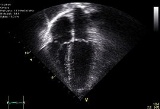
Echocardiogram 4chambers
Ventricular Septal Defect
An echocardiogram, often referred to in the medical community as a cardiac ECHO or simply an ECHO, is a sonogram of the heart
Heart

The heart is a muscle organ in all vertebrates responsible for pumping blood through the blood vessels by repeated, rhythmic contractions, or a similar structure in annelids, mollusks, and arthropods....
. Also known as a cardiac ultrasound, it uses standard ultrasound techniques to image two-dimensional slices of the heart. The latest ultrasound systems now employ 3D real-time imaging.

In addition to creating two-dimensional pictures of the cardiovascular system, an echocardiogram can also produce accurate assessment of the velocity of blood and cardiac tissue at any arbitrary point using pulsed or continuous wave Doppler ultrasound. This allows assessment of cardiac valve areas and function, any abnormal communications between the left and right side of the heart, any leaking of blood through the valves (valvular regurgitation), and calculation of the cardiac output
Cardiac output

Cardiac output is the volume of blood being pumped by the heart, in particular by a ventricle in a minute. This is measured in dm3 min-1 ....
 as well as the ejection fraction
Ejection fraction

In circulatory system, ejection fraction is the fraction of blood pumped out of a ventricles of the heart with each Cardiac cycle. The term ejection fraction applies to both the right and left ventricles; one can speak equally of the left ventricular ejection fraction and the right ventricular ejection fraction ....
.

Echocardiography was an early medical application of ultrasound. Echocardiography was also the first application of intravenous contrast-enhanced ultrasound. This technique injects gas-filled microbubbles into the venous system to improve tissue and blood delineation. Contrast is also currently being evaluated for its effectiveness in evaluating myocardial perfusion. It can also be used with Doppler ultrasound to improve flow-related measurements (see Doppler echocardiography
Doppler echocardiography

Doppler echocardiography is a procedure which uses ultrasound technology to examine the heart. An echocardiogram uses high frequency sound waves to create an image of the heart while the use of doppler technology allows determination the speed and direction of blood flow by utilizing the doppler effect....
).

Echocardiography is either performed by cardiac sonographer
Cardiac sonographer

Cardiac sonographer is a medical profession of sonographers that specialize in the anatomy and function of the heart. It is a technical job that in the USA has traditionally required an Associates degree in Echo and passing a National Registry exam, but more and more often is requiring a Bachelors degree as the field gets more developed and...
s or doctors trained in cardiology.

Purpose

Echocardiography is used to diagnose cardiovascular diseases. In fact, it is one of the most widely used diagnostic tests for heart disease. It can provide a wealth of helpful information, including the size and shape of the heart, its pumping capacity and the location and extent of any damage to its tissues. It is especially useful for assessing diseases of the heart valves. It not only allows doctors to evaluate the heart valves, but it can detect abnormalities in the pattern of blood flow, such as the backward flow of blood through partly closed heart valves, known as regurgitation. By assessing the motion of the heart wall, echocardiography can help detect the presence and assess the severity of coronary artery disease, as well as help determine whether any chest pain is related to heart disease. Echocardiography can also help detect hypertrophic cardiomyopathy
Hypertrophic cardiomyopathy

Hypertrophic cardiomyopathy, HCM or HOCM, is a disease of the myocardium in which a portion of the myocardium is left ventricular hypertrophy without any obvious cause....
, in which the walls of the heart thicken in an attempt to compensate for heart muscle weakness. The biggest advantage to echocardiography is that it is noninvasive (doesn't involve breaking the skin or entering body cavities) and has no known risks or side effects.

Transthoracic echocardiogram

A standard echocardiogram is also known as a transthoracic echocardiogram (TTE), or cardiac ultrasound. In this case, the echocardiography transducer (or probe) is placed on the chest wall (or thorax
Thoracic cavity

The thoracic cavity is the body cavity of the human body that is protected by the thoracic wall ....
) of the subject, and images are taken through the chest wall. This is a non-invasive, highly accurate and quick assessment of the overall health of the heart. A cardiologist can quickly assess a patient's heart valves and degree of heart muscle contraction (an indicator of the ejection fraction
Ejection fraction

In circulatory system, ejection fraction is the fraction of blood pumped out of a ventricles of the heart with each Cardiac cycle. The term ejection fraction applies to both the right and left ventricles; one can speak equally of the left ventricular ejection fraction and the right ventricular ejection fraction ....
). The images are displayed on a monitor, and are recorded either by videotape (analog) or by digital techniques.

An echocardiogram can be used to evaluate all four chambers of the heart. It can determine strength of the heart, the condition of the heart valves, the lining of the heart (the pericardium), and the aorta. It can be used to detect a heart attack, enlargement or hypertrophy of the heart, infiltration of the heart with an abnormal substance. Weakness of the heart, cardiac tumors, and a variety of other findings can be diagnosed with an echocardiogram. With advanced measurements of the movement of the tissue with time (tissue doppler), it can measure diastolic function, fluid status, and dys-synchrony.

The TTE is highly accurate for identifying vegetations (masses consisting of a mixture of bacteria and blood clots), but the accuracy can be reduced in up to 20% of adults because of obesity
Obesity

Obesity is a condition in which excess body fat has accumulated to an extent that health may be negatively affected. It is commonly defined as a body mass index of 30 kg/m2 or higher....
, chronic obstructive pulmonary disease, chest-wall deformities, or otherwise technically difficult patients. TTE in adults is also of limited use for the structures at the back of the heart, such as the left atrial appendage. Transesophageal echocardiography may be more accurate than TTE because it excludes the variables previously mentioned and allows closer visualization of common sites for vegetations and other abnormalities. Transesophageal echocardiography also affords better visualization of prosthetic heart valves.

Transesophageal echocardiogram

This is an alternative way to perform an echocardiogram. A specialized probe containing an ultrasound transducer at its tip is passed into the patient's esophagus
Esophagus

The esophagus or oesophagus , sometimes known as the gullet, is an Organ in vertebrates which consists of a Muscle tube through which food passes from the pharynx to the stomach....
. This allows image and Doppler evaluation which can be recorded. This is known as a transesophageal echocardiogram, or TEE (TOE in the United Kingdom). The advantage of TEE over TTE is usually clearer images, especially of structures that are difficult to view transthoracicly (through the chest wall). The explanation for this is that the heart rests directly upon the esophagus leaving only millimeters that the ultrasound beam has to travel. This reduces the attenuation (weakening) of the ultrasound signal, generating a stronger return signal, ultimately enhancing image and Doppler quality. Comparatively, transthoracic ultrasound must first traverse skin, fat, ribs and lungs before reflecting off the heart and back to the probe before an image can be created. All these structures, along with the increased distance the beam must travel, weaken the ultrasound signal thus degrading the image and Doppler quality.

In adults, several structures can be evaluated and imaged better with the TEE, including the aorta
Aorta

The aorta is the largest artery in the human body, originating from the left ventricle of the heart and bringing oxygenated blood to all parts of the body in the systemic circulation....
, pulmonary artery, valves of the heart, both atria, atrial septum, left atrial appendage, and coronary arteries. TEE has a very high sensitivity for locating a blood clot inside the left atrium. While TTE can be performed quickly, easily and without pain to the patient, TEE requires a fasting patient, (the patient must not eat or drink after midnight on the day before the procedure), a team of medical personnel, takes longer to perform, is uncomfortable for the patient and has some risks associated with the procedure (esophageal perforation -- 1 in 10,000, and adverse reactions to the medication).

Before inserting the probe, conscious sedation
Sedation

Sedation is a medical procedure involving the administration of sedative drugs, generally to facilitate a medical procedure with local anaesthesia....
 is induced in the patient to ease the discomfort and to decrease the gag reflex
Gag reflex

The pharyngeal reflex or gag reflex is a reflex contraction of the back of the throat, evoked by touching the soft palate. It prevents something from entering the throat except as part of normal swallowing and helps prevent choking....
, thus making the ultrasound probe easier to pass into the esophagus. Conscious sedation is a light sedation
Sedation

Sedation is a medical procedure involving the administration of sedative drugs, generally to facilitate a medical procedure with local anaesthesia....
 usually using the medications midazolam
Midazolam

Midazolam, pronounced m?'d?z?l?m is a drug which is a benzodiazepine derivative . It has potent anxiolytic, amnestic, hypnotic, anticonvulsant, skeletal muscle relaxant and sedative properties....
  (a benzodiazepine
Benzodiazepine

The benzodiazepines are a class of psychoactive drugs with varying hypnotic, sedative, anxiolytic , anticonvulsant, muscle relaxant and anterograde amnesia properties, which are mediated by slowing down the central nervous system....
 with sedating, amnesiac qualities) and fentanyl
Fentanyl

Fentanyl is an odorless, rapid-acting opioid , which depresses central nervous system and respiratory function. It is one of the the most powerful opioids known, with a potency approximately 80 times that of morphine....
. Sometimes a local anesthetic spray is used for the back of the throat, such a xylocaine and/or a jelly/lubricant anesthetic for the esophagus. Children are anesthetized
Anesthesia

Anesthesia, or anaesthesia , has traditionally meant the condition of having sensation blocked or temporarily taken away. This allows patients to undergo surgery and other procedures without the distress and pain they would otherwise experience....
. Unlike the TTE, the TEE is considered an invasive procedure and is thus performed by physicians in the U.S., not sonographers.

3-dimensional echocardiography

3-D
Three-dimensional space

Three-dimensional space is a geometric model of the physical universe in which we live. The three dimensions are commonly called length, width, and depth , although any three mutually perpendicular directions can serve as the three dimensions....
 echocardiography is now possible, using an ultrasound probe with an array of transducers and an appropriate processing system. This enables detailed anatomical assessment of cardiac pathology, particularly valvular defects, and cardiomyopathies
Cardiomyopathy

Cardiomyopathy, which literally means "heart muscle disease," is the deterioration of the function of the myocardium for any reason. People with cardiomyopathy are often at risk of arrhythmia or sudden cardiac death or both....
. The ability to slice the virtual heart in infinite planes in an anatomically appropriate manner and to reconstruct 3-dimensional images of anatomic structures make 3D echocardiography unique for the understanding of the congenitally malformed heart.

Accreditation


The "Intersocietal Commission for the Accreditation of Echocardiography Laboratories" (ICAEL) sets standards for the echo labs, cardiologists and technologists in the US to comply to. Once all requirements have been met, the lab will receive ICAEL certification. A lab that has received the certification may also receive higher reimbursement from insurance companies such as Medicare and United Healthcare. http://www.icael.org/icael/index.htm
In the UK, accreditation is done by the British Society of Echocardiography. Accredited technologists or other professionals from the echocardiography field will have completed a logbook and passed an .

See also

  • Angiogram
    Angiogram

    Angiography or arteriography is a medical imaging technique used to visualize the inside, or lumen , of blood vessels and organs of the body, with particular interest in the artery, veins and the heart chambers....
  • Aortic valve area calculation
    Aortic valve area calculation

    Aortic valve area calculation is an indirect method of determining the area of the aortic valve. The calculated aortic valve orifice area is currently one of the measures for evaluating the severity of aortic valve stenosis....
  • Electrocardiogram
    Electrocardiogram

    An electrocardiogram is a recording of the electricity activity of the heart over time produced by an electrocardiograph, usually in a Non-invasive recording via skin electrodes....
  • Fetal echocardiography
    Fetal echocardiography

    Fetal echocardiography provides a valuable means to better understand intrauterine growth and development of the heart and great vessels. The prenatal diagnosis of structural heart disease and the physiologic evaluation of fetal arrhythmias are perhaps the most important insights provided by this technique....


External links