

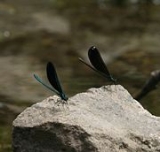
Ebony Jewelwing

Encyclopedia
The Ebony Jewelwing is a species of broad-winged
damselflies
. It is one out of the 170 species of the Odonata
found in New England
, the Mid-Atlantic states
, and southeastern Canada
.
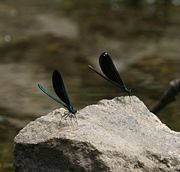 It lives near wooded streams and rivers. Ebony Jewelwings flutter like a butterfly. When disturbed they fly a short distance to safety. These damselflies are easy to get close to as long as you approach slowly and don't make any sudden movements. They will often stop to rest on leaves or twigs. Ebony Jewelwings may fly far from water. They can be seen in the middle of the woods, while most damselflies and dragonflies are usually seen near ponds, lakes, or rivers.
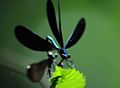 Ebony Jewelwings mate in the summer. The male grabs the female behind her head with his tail or abdomen. After mating, females lay their eggs inside soft stems of water plants. Eggs hatch into larvae called naiads. Ebony Jewelwing naiads eat small aquatic insects. When the naiads are fully grown, they crawl out of the water and molt. They leave their old skin behind. The adult can soon fly off and look for a mate.
(except 15 of the states) and southern Canada
.
Asian Tiger Mosquito
, Giant Willow Aphid, Fungus Gnat
, Crane Fly
, Large Diving Beetle
, Eastern Dobsonfly, Water Flea, Green Darner
, Aquatic Worm, Northern caddis fly, Rotifer
, Copepod
, Scud, Dogwood Borer, Six-spotted Tiger Beetle, Flatworm
, and Green Hydra
Great Crested Flycatcher
, American Robin
, Big Brown Bat
, Green Darner
, Large Diving Beetle
, Eastern Dobsonfly, Mallard
, Eastern Painted Turtle
, Bluegill
, Largemouth Bass
, Yellow Perch
, Creek Chub
, Channel Catfish
, Red-winged Blackbird
, Blue Jay
, Common Snapping Turtle, Southern Leopard Frog
, Common Carp
, Common Water Strider, and Northern hogsucker
Yellow Pond Lily
, Hydrilla
, Lizard's Tail, Green Algae
, Pickerelweed, Common Cattail
, Tussock Sedge, Greater Bladderwort, Common Duckweed
, Black Willow
, Spotted Jewelweed, Spotted Joe-pye Weed, Poison Ivy
, Wild Grape
, Sassafras
, Greenbrier
, and Buttonbush
Calopteryx
Calopteryx is a genus of large damselflies belonging to the family Calopterygidae. The colourful males often have coloured wings whereas the more muted females usually have clear wings although some develop male wing characteristics...
damselflies
Damselfly
Damselflies are insects in the order Odonata. Damselflies are similar to dragonflies, but the adults can be distinguished by the fact that the wings of most damselflies are held along, and parallel to, the body when at rest...
. It is one out of the 170 species of the Odonata
Odonata
Odonata is an order of insects, encompassing dragonflies and damselflies . The word dragonfly is also sometimes used to refer to all Odonata, but the back-formation odonate is a more correct English name for the group as a whole...
found in New England
New England
New England is a region in the northeastern corner of the United States consisting of the six states of Maine, New Hampshire, Vermont, Massachusetts, Rhode Island, and Connecticut...
, the Mid-Atlantic states
Mid-Atlantic States
The Mid-Atlantic states, also called middle Atlantic states or simply the mid Atlantic, form a region of the United States generally located between New England and the South...
, and southeastern Canada
Canada
Canada is a North American country consisting of ten provinces and three territories. Located in the northern part of the continent, it extends from the Atlantic Ocean in the east to the Pacific Ocean in the west, and northward into the Arctic Ocean...
.
Identification
It is between 39–57 mm (1.5–2.2 in). The males have metallic blue-green bodies and black wings. Females have duller brown bodies and smoky wings and glistening white spots near tip wings. Naiad have pale brown bodies with darker markings.Habitat
Breeding
Distribution
Its found throughout most of the United StatesUnited States
The United States of America is a federal constitutional republic comprising fifty states and a federal district...
(except 15 of the states) and southern Canada
Canada
Canada is a North American country consisting of ten provinces and three territories. Located in the northern part of the continent, it extends from the Atlantic Ocean in the east to the Pacific Ocean in the west, and northward into the Arctic Ocean...
.
Prey
The Ebony Jewelwing has a wide variety of prey, including:Asian Tiger Mosquito
Asian tiger mosquito
The Asian tiger mosquito or forest day mosquito, Aedes albopictus , from the mosquito family, is characterized by its black and white striped legs, and small black and white striped body...
, Giant Willow Aphid, Fungus Gnat
Fungus gnat
Fungus gnats are small, dark, short-lived flies, of the families Sciaridae, Diadocidiidae, Ditomyiidae, Keroplatidae, Bolitophilidae and Mycetophilidae , sometimes placed in the superfamily Mycetophiloidea, whose larvae feed on plant roots or fungi and aid in the decomposition of organic matter...
, Crane Fly
Crane fly
A crane fly is an insect in the family Tipulidae. Adults are very slender, long-legged flies that may vary in length from though tropical species may exceed to ....
, Large Diving Beetle
Dytiscus
Dytiscus is a Holarctic genus of predaceous diving beetles that usually live in wetlands and ponds. There are 26 species in this genus distributed in Europe, Asia, North Africa and North and Central America...
, Eastern Dobsonfly, Water Flea, Green Darner
Green Darner
The Green Darner or Common Green Darner , after its resemblance to a darning-needle, is a species of dragonfly in the family Aeshnidae. One of the most common and abundant species throughout North America and its range south to Panama. It is well known for its great migration distance from the...
, Aquatic Worm, Northern caddis fly, Rotifer
Rotifer
The rotifers make up a phylum of microscopic and near-microscopic pseudocoelomate animals. They were first described by Rev. John Harris in 1696, and other forms were described by Anton van Leeuwenhoek in 1703...
, Copepod
Copepod
Copepods are a group of small crustaceans found in the sea and nearly every freshwater habitat. Some species are planktonic , some are benthic , and some continental species may live in limno-terrestrial habitats and other wet terrestrial places, such as swamps, under leaf fall in wet forests,...
, Scud, Dogwood Borer, Six-spotted Tiger Beetle, Flatworm
Flatworm
The flatworms, known in scientific literature as Platyhelminthes or Plathelminthes are a phylum of relatively simple bilaterian, unsegmented, soft-bodied invertebrate animals...
, and Green Hydra
Predators
The damselfly also has many predators, including:Great Crested Flycatcher
Great Crested Flycatcher
The Great Crested Flycatcher is a large insect-eating bird of the tyrant flycatcher family. It is the most widespread member of the genus, Myiarchus, in North America and is found over most of the eastern and mid-western portions of the continent...
, American Robin
American Robin
The American Robin or North American Robin is a migratory songbird of the thrush family. It is named after the European Robin because of its reddish-orange breast, though the two species are not closely related, with the European robin belonging to the flycatcher family...
, Big Brown Bat
Big brown bat
The Big Brown Bat is larger in size than comparative species of bats, from about 4 to 5 inches in body length, with a 11-13 inch wingspan and weighing 1/2 to 5/8 ounce. The fur is moderately long, and shiny brown...
, Green Darner
Green Darner
The Green Darner or Common Green Darner , after its resemblance to a darning-needle, is a species of dragonfly in the family Aeshnidae. One of the most common and abundant species throughout North America and its range south to Panama. It is well known for its great migration distance from the...
, Large Diving Beetle
Dytiscus
Dytiscus is a Holarctic genus of predaceous diving beetles that usually live in wetlands and ponds. There are 26 species in this genus distributed in Europe, Asia, North Africa and North and Central America...
, Eastern Dobsonfly, Mallard
Mallard
The Mallard , or Wild Duck , is a dabbling duck which breeds throughout the temperate and subtropical Americas, Europe, Asia, and North Africa, and has been introduced to New Zealand and Australia....
, Eastern Painted Turtle
Painted Turtle
The painted turtle is the most widespread native turtle of North America. It lives in slow-moving fresh waters, from southern Canada to Louisiana and northern Mexico, and from the Atlantic to the Pacific. The turtle is the only species of the genus Chrysemys, which is part of the pond turtle...
, Bluegill
Bluegill
The Bluegill is a species of freshwater fish sometimes referred to as bream, brim, or copper nose. It is a member of the sunfish family Centrarchidae of the order Perciformes.-Range and distribution:...
, Largemouth Bass
Largemouth bass
The largemouth bass is a species of black bass in the sunfish family native to North America . It is also known as widemouth bass, bigmouth, black bass, bucketmouth, Potter's fish, Florida bass, Florida largemouth, green bass, green trout, linesides, Oswego bass, southern largemouth...
, Yellow Perch
Yellow perch
The yellow perch is a species of perch found in the United States and Canada, where it is often referred to by the shortform perch. Yellow perch look similar to the European perch, but are paler and more yellowish, with less red in the fins. They have six to eight dark, vertical bars on their sides...
, Creek Chub
Semotilus atromaculatus
Semotilus atromaculatus is a small minnow found in the eastern two-thirds of the US and eastern Canada...
, Channel Catfish
Channel catfish
Channel catfish, Ictalurus punctatus, is North America's most numerous catfish species. It is the official fish of Missouri, Iowa, Nebraska, Kansas, and Tennessee, and is informally referred to as a "channel cat". In the United States they are the most fished catfish species with approximately 8...
, Red-winged Blackbird
Red-winged Blackbird
The Red-winged Blackbird is a passerine bird of the family Icteridae found in most of North and much of Central America. It breeds from Alaska and Newfoundland south to Florida, the Gulf of Mexico, Mexico, and Guatemala, with isolated populations in western El Salvador, northwestern Honduras, and...
, Blue Jay
Blue Jay
The Blue Jay is a passerine bird in the family Corvidae, native to North America. It is resident through most of eastern and central United States and southern Canada, although western populations may be migratory. It breeds in both deciduous and coniferous forests, and is common near and in...
, Common Snapping Turtle, Southern Leopard Frog
Southern Leopard Frog
The Southern Leopard Frog is a species of mostly aquatic true frog, found in the south-eastern third of the United States. There are two accepted subspecies.- Physical description :...
, Common Carp
Common carp
The Common carp is a widespread freshwater fish of eutrophic waters in lakes and large rivers in Europe and Asia. The wild populations are considered vulnerable to extinction, but the species has also been domesticated and introduced into environments worldwide, and is often considered an invasive...
, Common Water Strider, and Northern hogsucker
Northern hogsucker
The northern hogsucker, Hypentelium nigricans, belongs to the Catostomidae family of sucker fish. The fish inhabits the rivers of the Mississippi basin, found from Oklahoma and Alabama northward to Minnesota. It prefers clear, fast streams, where it can forage through pebbles for bottom life,...
Shelter plants
The Ebony Jewelwing has many plants it uses for shelter. The following is list of plants.Yellow Pond Lily
Nuphar lutea
Nuphar lutea is an aquatic plant of the family Nymphaeaceae, native to temperate regions of Europe, northwest Africa, and western Asia.-Growth:...
, Hydrilla
Hydrilla
Hydrilla is an aquatic plant genus, usually treated as containing just one species, Hydrilla verticillata, though some botanists divide it into several species. Synonyms include H. asiatica, H. japonica, H. lithuanica, and H. ovalifolica...
, Lizard's Tail, Green Algae
Green algae
The green algae are the large group of algae from which the embryophytes emerged. As such, they form a paraphyletic group, although the group including both green algae and embryophytes is monophyletic...
, Pickerelweed, Common Cattail
Typha latifolia
Typha latifolia is a perennial herbaceous plant in the genus Typha. It is found as a native plant species in North and South America, Europe, Eurasia, and Africa...
, Tussock Sedge, Greater Bladderwort, Common Duckweed
Lemna minor
Lemna minor is a species of Lemna with a subcosmopolitan distribution, native throughout most of Africa, Asia, Europe and North America, occurring everywhere that freshwater ponds and slow-moving streams occur, except for arctic and subarctic climates...
, Black Willow
Black Willow
Salix nigra is a species of willow native to eastern North America, from New Brunswick and southern Ontario west to Minnesota, and south to northern Florida and Texas.-Description:...
, Spotted Jewelweed, Spotted Joe-pye Weed, Poison Ivy
Poison Ivy
Poison Ivy is a fictional character, a DC Comics supervillainess who is primarily an enemy of Batman. Created by Robert Kanigher and Sheldon Moldoff, she first appeared in Batman #181 ....
, Wild Grape
Wild grape
Wild grape may refer to:* Vitis species; specially Vitis vinifera subsp. sylvestris , Vitis californica , Vitis girdiana , and Vitis riparia...
, Sassafras
Sassafras
Sassafras is a genus of three extant and one extinct species of deciduous trees in the family Lauraceae, native to eastern North America and eastern Asia.-Overview:...
, Greenbrier
Greenbrier
Greenbrier is the common name of the plant genus Smilax. It may also refer to:Places, United States*Greenbrier, Arkansas*Greenbrier, Orange County, Indiana*Greenbrier, Warrick County, Indiana*Greenbrier, Tennessee, in Robertson County...
, and Buttonbush