
All Topics  
Ebenezer Scrooge

 
Ebenezer Scrooge

   Email Print
   Bookmark   Link


Ebenezer Scrooge


Ebenezer Scrooge is the main character in Charles Dickens
Charles Dickens

Charles John Huffam Dickens, Royal Society of Arts , pen-name "Boz", was the most popular English people novelist of the Victorian era, as well as a vigorous Reform movement....
' 1843 novel, A Christmas Carol
A Christmas Carol

A Christmas Carol in Prose, Being a Ghost Story of Christmas is a book by Charles Dickens that was first published on December 19, 1843 with illustrations by John Leech ....
. He is a cold-hearted, tight fisted, selfish man, who despises Christmas and all things which engender happiness. A quote from the book reads "The cold within him froze his old features, nipped his pointed nose, made his eyes red, his thin lips blue, and he spoke out shrewdly in his grating voice ..." His last name has come into the English language
English language

English is a West Germanic language that originated in Anglo-Saxon England and has lingua franca status in many parts of the world as a result of the military, economic, scientific, political and cultural influence of the British Empire in the 18th, 19th and early 20th centuries and that of the United States from the mid 20th century onwa...
 as a byword for miser
Miser

A miser is a person who is reluctant to spend money, sometimes to the point of forgoing even basic comforts. The term derives from the Latin miser, meaning "poor" or "wretched," comparable to the modern word "miserable"....
liness and misanthropy
Misanthropy

Misanthropy is a general dislike, distrust, or hatred of the human species or a disposition to dislike and/or distrust other people's silent consensus about reality....
, traits displayed by Scrooge in the exaggerated manner for which Dickens is well-known.


Discussion
Ask a question about 'Ebenezer Scrooge'
Start a new discussion about 'Ebenezer Scrooge'
Answer questions from other users
Full Discussion Forum


Encyclopedia


Ebenezer Scrooge is the main character in Charles Dickens
Charles Dickens

Charles John Huffam Dickens, Royal Society of Arts , pen-name "Boz", was the most popular English people novelist of the Victorian era, as well as a vigorous Reform movement....
' 1843 novel, A Christmas Carol
A Christmas Carol

A Christmas Carol in Prose, Being a Ghost Story of Christmas is a book by Charles Dickens that was first published on December 19, 1843 with illustrations by John Leech ....
. He is a cold-hearted, tight fisted, selfish man, who despises Christmas and all things which engender happiness. A quote from the book reads "The cold within him froze his old features, nipped his pointed nose, made his eyes red, his thin lips blue, and he spoke out shrewdly in his grating voice ..." His last name has come into the English language
English language

English is a West Germanic language that originated in Anglo-Saxon England and has lingua franca status in many parts of the world as a result of the military, economic, scientific, political and cultural influence of the British Empire in the 18th, 19th and early 20th centuries and that of the United States from the mid 20th century onwa...
 as a byword for miser
Miser

A miser is a person who is reluctant to spend money, sometimes to the point of forgoing even basic comforts. The term derives from the Latin miser, meaning "poor" or "wretched," comparable to the modern word "miserable"....
liness and misanthropy
Misanthropy

Misanthropy is a general dislike, distrust, or hatred of the human species or a disposition to dislike and/or distrust other people's silent consensus about reality....
, traits displayed by Scrooge in the exaggerated manner for which Dickens is well-known. The story of his transformation by the three Ghosts of Christmas (Ghost of Christmas Past, Ghost of Christmas Present, and Ghost of Christmas Yet to Come) has become a defining tale of the Christmas
Christmas

Christmas , also referred to as Christmas Day, is an annual holiday celebrated on December 25 that commemorates the birth of Jesus. The day marks the beginning of the larger season of Christmastide, which lasts Twelve Days of Christmas....
 holiday. Scrooge's catchphrase, "Bah, humbug
Humbug

Humbug is an archaic term meaning "hoax", or "jest". While the term was first attested in 1751 in student slang, its etymology is unknown. It is known, however, that it was used as profanity centuries ago, in places such as Great Britain....
!" is often used to express disgust with many of the modern Christmas traditions.

Origins of the character

Several theories have been put forward as to where Dickens got the inspiration for the character.
  • One school of thought is that it stems from a grave marker for an Ebenezer Lennox Scroggie. The marker identified Scroggie as a “meal man” (corn merchant), but Dickens misread this as “mean man”.
  • Others claim that Dickens based Scrooge's views on the poor on those of demographer and political economist Thomas Malthus
    Thomas Malthus

    The The Reverend. Thomas Robert Malthus Royal Society was an England political economy and demography.His main contribution was to draw attention to the potential dangers of population growth:...
    .
  • Yet others that the minor character Gabriel Grub from The Pickwick Papers
    The Pickwick Papers

    The Posthumous Papers of the Pickwick Club, better known as The Pickwick Papers, is the first novel by Charles Dickens. The illustrator Robert Seymour claimed that the idea for the novel was originally his; however, in his preface to the 1867 edition, Dickens strenuously denied any specific input, writing that "Mr Seymour never...
     was worked up into a more mature characterisation (his name stemming from an infamous Dutch miser, Gabriel de Graff.)
  • Jeremy Wood (James/Jemmy/Jacabos), owner of the Gloucester Old Bank and possibly Britain’s first millionaire, become a nationally known figure for his miserly ways, and may have inspired Dickens in creating the character of Scrooge.


The story

The story of A Christmas Carol starts on Christmas Eve
Christmas Eve

Christmas Eve, December 24, is the night before Christmas Day, which celebrates the birth of Jesus Christ ....
, with Scrooge at his place of business. The book says that Scrooge lives in London, England. It is usually assumed that he is a banker or professional money lender. Some recent versions portray him as a solicitor
Solicitor

In the United Kingdom and Republic of Ireland, the legal profession is split between solicitors and barristers, and a law practitioner will usually only hold one title....
. Whatever his main business is, he seems to have usurious
Usury

Usury originally meant the charging of interest on loans. This would have included charging a fee for the use of money, such as at a bureau de change....
 relationships with people of little means. These relationships, along with his lack of charity and shabby treatment of his clerk, Bob Cratchit
Bob Cratchit

Robert "Bob" Cratchit is a fictional character, the abused, underpaid clerk of Ebenezer Scrooge in the Charles Dickens story A Christmas Carol....
, seem to be his major vices.

His nephew however, has great regard to Christmas and we are introduced to him early in the story.

Scrooge has only disgust for the poor, thinking the world would be better off without them, "decreasing the surplus population," and praise for the Victorian era
Victorian era

The Victorian Era of the United Kingdom of Great Britain and Ireland was the period of Victoria of the United Kingdom reign from June 1837 to January 1901....
 workhouse
Workhouse

A workhouse, was a place where people who were unable to support themselves could go to live and work. The Oxford Dictionary's earliest reference to a workhouse dates to 1652 in Exeter....
s. He has a particular distaste for the merriment of Christmas; his single act of kindness is to give his clerk, Bob Cratchit, the day off with pay. Done more as a result of social mores than kindness, Scrooge sees the practice akin to having his pocket picked on an annual basis.

After introducing Scrooge and showing his shabby treatment of his employee, business acquaintances, and only living relative, the novel resumes with Scrooge at his residence, intent on spending Christmas Eve alone. While he is preparing to go to bed, he is visited by the ghost of his deceased business partner, Jacob Marley
Jacob Marley

Jacob Marley is a fictional character whose ghost appears in the Charles Dickens novel A Christmas Carol....
. Marley (who had died seven years earlier on Christmas Eve) spent his life exploiting the poor and as a result is damned
Hell in Christian beliefs

Hell, in Christianity beliefs, is a place or a state in which the souls of the unsaved will suffer the consequences of sin. The Christian doctrine of hell derives from the teaching of the New Testament, where hell is typically described using the Greek words Gehenna or Tartarus....
 to walk the Earth for eternity bound in chains of his own greed. Marley warns Scrooge that he risks meeting the same fate, and that as a final chance of escape he will be visited by three spirits: Past, Present, and Yet to Come. The rest of the novel acts as a biography and psychological profile, showing his evolution to his current state, and the way he is viewed by others.

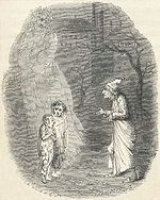
As promised, the Ghost of Christmas Past visits Scrooge first and takes him to see his time as a schoolboy many years earlier. Here it is suggested that his father abandoned young Scrooge at his boarding school, even during Christmas. This is relevant to Scrooge, because it shows the beginnings of his lack of socialization
Socialization

The term socialization is used by Sociology, social Psychology and educationalists to refer to the process of learning one?s culture and how to live within it....
 and empathy. He does not socialize because he never experienced steady growth in a strong family unit. He does not empathize thanks to the way he was treated: as a child, he was the least of his father's concerns, and this in turn taught him not to feel for fellow humans. Furthermore, his mother died giving birth to Ebenezer, for which his father blames the boy. In some versions of the story, his father goes to jail for not paying debt. Later the ghost shows how his success in business made him become obsessive and develop a workaholic
Workaholic

A workaholic, colloquially, is a person who is Addiction to work .The phrase does not always imply that the person actually enjoys their work, but rather simply feels compelled to do it....
 tendency. His money and work-obsessed personality traits eventually compel Scrooge's fiancée, Belle, to leave him, which further hardens his heart. The untimely death of his sister Fan, the one relative who had a close relationship with him, also injures him greatly enough that he loses any love he had for the world. Scrooge had only his nephew left but didn't care for him one bit.

The visit by the Ghost of Christmas Past
Ghost of Christmas Past

The Ghost of Christmas Past is a character in the well-known work of the English novelist Charles Dickens, A Christmas Carol.The Ghost of Christmas Past was the first of the three spirits that haunted the miser Ebenezer Scrooge in order to prompt him to repent....
 also reveals the origin of Scrooge's neurotic
Neurosis

Neurosis , also known as psychoneurosis or neurotic disorder, is a term that refers to any mental imbalance that causes distress, but, unlike a psychosis or some personality disorders, does not prevent or affect rational thought....
 hatred of Christmas – most of the events that negatively affected Scrooge's character occurred during the Christmas holiday season.

One of the sources of his negative ways is the pain he feels for losing his love, Belle. Engaged to be married to her, he keeps pushing back the wedding until his finances are as healthy as he would like; something that, given his insatiable lust for money, he would probably never have. Realising this, Belle calls off the engagement and eventually marries someone else, causing Scrooge to further withdraw from society and relationships.

The book (which was written in 1843) does not state how long ago all this happened, or even how old Scrooge is now. It does seem likely, however, that Scrooge is not nearly as old as he is sometimes assumed. At the time of Jacob Marley's death (seven years before the story takes place), Belle is married to another man and still has several young children. Even if Scrooge was somewhat older than Belle at the time they were betrothed, he was still a young (and poor) man when they met. Because of this, it seems the often elderly portrayals of Scrooge are somewhat wide of the mark.