
All Topics  
Earth's atmosphere


   Email Print
   Bookmark   Link


Earth's atmosphere


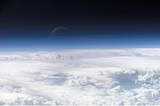
The Earth's atmosphere (or air) is a layer of gases surrounding the planet Earth
Earth

Earth is the third planet from the Sun. Earth is the largest of the terrestrial planets in the Solar System in diameter, mass and density. It is also referred to as the World and Wiktionary:Terra.Note that by International Astronomical Union convention, the term "Terra" is used for naming extensive land masses, rather...
 that is retained by the Earth's gravity. Dry air contains roughly (by volume) 78.08% nitrogen
Nitrogen

Nitrogen is a chemical element that has the symbol N and atomic number 7 and atomic mass 14.00674?. Elemental nitrogen is a colorless, odorless, tasteless and mostly inert diatomic gas at standard conditions, constituting 78% by volume of Earth's atmosphere....
, 20.95% oxygen
Oxygen

Oxygen no O2 produced; 2) O2 produced, but absorbed in oceans & seabed rock; 3) O2 starts to gas out of the oceans, but is absorbed by land surfaces and formation of ozone layer; 4-5) O2 sinks filled and the gas accumulates]]...
, 0.93% argon
Argon

Argon is a chemical element designated by the symbol Ar. Argon has atomic number 18 and is the third element in group 18 of the periodic table ....
, 0.038% carbon dioxide
Carbon dioxide in the Earth's atmosphere

Carbon dioxide forms approximately 0.04% of the Earth's atmosphere. It is essential to photosynthesis in plants and other photoautotrophs, and is also a prominent greenhouse gas....
, and trace amounts of other gases. Air also contains a variable amount of water vapor
Water vapor

Water vapor or water vapour , also aqueous vapor, is the gas phase of water . Water vapor is one Phase of the water cycle within the hydrosphere....
, on average around 1%. The atmosphere
Atmosphere

An atmosphere is a layer of gases that may surround a material body of sufficient mass, by the gravity of the body, and are retained for a longer duration if gravity is high and the atmosphere's temperature is low....
 protects life on Earth
Organism

In biology, an organism is any life thing . In at least some form, all organisms are capable of response to stimulus , reproduction, growth and developmental biology, and maintenance of homeostasis as a stable whole....
 by absorbing ultraviolet
Ultraviolet

Ultraviolet light is electromagnetic radiation with a wavelength shorter than that of visible light, but longer than x-rays, in the range 400 nanometer to 10 nm, and energies from 3 Electron volt to 124 eV....
 solar radiation, warming the surface through heat retention (greenhouse effect
Greenhouse effect

The greenhouse effect refers to the change in the steady state temperature of a planet or moon by the presence of an atmosphere containing gas that absorbs and emits infrared....
), and reducing temperature
Temperature

In physics, temperature is a physical property of a Physical system that underlies the common notions of hot and cold; something that feels hotter generally has the greater temperature....
 extremes between day and night.

There is no definite boundary between the atmosphere and outer space
Outer space

Outer space comprises the relatively empty regions of the universe outside the atmospheres of celestial bodies. Outer space is used to distinguish it from airspace and terrestrial locations....
.


Discussion
Ask a question about 'Earth's atmosphere'
Start a new discussion about 'Earth's atmosphere'
Answer questions from other users
Full Discussion Forum


Recent Posts


Encyclopedia


The Earth's atmosphere (or air) is a layer of gases surrounding the planet Earth
Earth

Earth is the third planet from the Sun. Earth is the largest of the terrestrial planets in the Solar System in diameter, mass and density. It is also referred to as the World and Wiktionary:Terra.Note that by International Astronomical Union convention, the term "Terra" is used for naming extensive land masses, rather...
 that is retained by the Earth's gravity. Dry air contains roughly (by volume) 78.08% nitrogen
Nitrogen

Nitrogen is a chemical element that has the symbol N and atomic number 7 and atomic mass 14.00674?. Elemental nitrogen is a colorless, odorless, tasteless and mostly inert diatomic gas at standard conditions, constituting 78% by volume of Earth's atmosphere....
, 20.95% oxygen
Oxygen

Oxygen no O2 produced; 2) O2 produced, but absorbed in oceans & seabed rock; 3) O2 starts to gas out of the oceans, but is absorbed by land surfaces and formation of ozone layer; 4-5) O2 sinks filled and the gas accumulates]]...
, 0.93% argon
Argon

Argon is a chemical element designated by the symbol Ar. Argon has atomic number 18 and is the third element in group 18 of the periodic table ....
, 0.038% carbon dioxide
Carbon dioxide in the Earth's atmosphere

Carbon dioxide forms approximately 0.04% of the Earth's atmosphere. It is essential to photosynthesis in plants and other photoautotrophs, and is also a prominent greenhouse gas....
, and trace amounts of other gases. Air also contains a variable amount of water vapor
Water vapor

Water vapor or water vapour , also aqueous vapor, is the gas phase of water . Water vapor is one Phase of the water cycle within the hydrosphere....
, on average around 1%. The atmosphere
Atmosphere

An atmosphere is a layer of gases that may surround a material body of sufficient mass, by the gravity of the body, and are retained for a longer duration if gravity is high and the atmosphere's temperature is low....
 protects life on Earth
Organism

In biology, an organism is any life thing . In at least some form, all organisms are capable of response to stimulus , reproduction, growth and developmental biology, and maintenance of homeostasis as a stable whole....
 by absorbing ultraviolet
Ultraviolet

Ultraviolet light is electromagnetic radiation with a wavelength shorter than that of visible light, but longer than x-rays, in the range 400 nanometer to 10 nm, and energies from 3 Electron volt to 124 eV....
 solar radiation, warming the surface through heat retention (greenhouse effect
Greenhouse effect

The greenhouse effect refers to the change in the steady state temperature of a planet or moon by the presence of an atmosphere containing gas that absorbs and emits infrared....
), and reducing temperature
Temperature

In physics, temperature is a physical property of a Physical system that underlies the common notions of hot and cold; something that feels hotter generally has the greater temperature....
 extremes between day and night.

There is no definite boundary between the atmosphere and outer space
Outer space

Outer space comprises the relatively empty regions of the universe outside the atmospheres of celestial bodies. Outer space is used to distinguish it from airspace and terrestrial locations....
. It slowly becomes thinner and fades into space. An altitude of marks the boundary where atmospheric effects become noticeable during reentry
Reentry

Reentry can have several meanings:* Atmospheric reentry refers to the movement of human-made or natural objects as they enter the atmosphere of a planet from outer space...
. The Kármán line
Karman line

The K?rm?n line lies at an altitude of 100 km above the Earth's sea level, and is commonly used to define the boundary between the Earth's atmosphere and outer space....
, at , is also frequently regarded as the boundary between atmosphere and outer space. Three quarters of the atmosphere's mass is within of the surface.

Temperature and layers


The temperature of the Earth's atmosphere varies with altitude; the mathematical relationship between temperature and altitude
Lapse rate

The lapse rate is defined as the negative of the rate of change in an atmospheric variable, usually temperature, with height in an atmosphere. While typically applied to Earth's atmosphere, the concept can be extended to any gravitationally supported ball of gas....
 varies among five different atmospheric layers (ordered highest to lowest, the ionosphere is part of the thermosphere):

Exosphere
Exosphere

The exosphere is the uppermost layer of an atmosphere. In the exosphere, an upward travelling molecule can escape to space or be pulled back to the celestial body by gravity with little probability of colliding with another molecule....
: From up to , contain free-moving particles that may migrate into and out of the magnetosphere
Magnetosphere

A magnetosphere is a highly magnetized region around and possessed by an astronomical object. Earth is surrounded by a magnetosphere, as are the magnetized planets Mercury , Jupiter, Saturn, Uranus, and Neptune....
 or the solar wind
Solar wind

The solar wind is a Electric current—a Plasma —ejected from the stellar atmosphere of the sun. It consists mostly of electrons and protons with energies of about 1 electron volt....
. Exobase: Also known as the 'critical level', it is the lower boundary of the exosphere. Ionosphere
Ionosphere

The ionosphere is the uppermost part of the Earth's atmosphere, distinguished because it is ionized by solar radiation. It plays an important part in atmospheric electricity and forms the inner edge of the magnetosphere....
: The part of the atmosphere that is ionized by solar radiation stretches from and typically overlaps both the exosphere and the thermosphere. It plays an important part in atmospheric electricity and forms the inner edge of the magnetosphere. Because of its charged particles, it has practical importance because it influences, for example, radio
Radio

Radio is the transmission of signals, by modulation of electromagnetic radiation with frequency below those of visible light.Electromagnetic radiation radio propagation by means of oscillating electromagnetic fields that pass through the air and the vacuum of space....
 propagation on the Earth. It is responsible for aurora
Aurora (astronomy)

Auroras, sometimes called the northern and southern lights or aurorae , are natural light displays in the sky, usually observed at night sky, particularly in the Geographical pole....
s. Thermopause
Thermopause

The Thermopause is the Earth's atmosphere boundary of Earth's energy system, located at the top of the thermosphere.Below this, the atmosphere is defined to be active on the insolation received, due to the increased presence of heavier gases such as monoatomic oxygen....
: The boundary above the thermosphere, it varies in height from . Thermosphere
Thermosphere

The thermosphere is the layer of the earth's atmosphere directly above the mesosphere and directly below the exosphere. Within this layer, ultraviolet radiation causes ionization....
: From to over , temperature increasing with height. Although the temperature can rise to , a person would not feel warm because of the extremely low pressure. The International Space Station
International Space Station

The International Space Station is a research facility Assembly of the International Space Station in outer space. On-orbit construction of the station began in 1998, and is scheduled to be complete by 2011, with operations continuing until around 2015....
 orbits in this layer, between . Mesopause
Mesopause

The mesopause is the temperature minimum at the boundary between the mesosphere and the thermosphere atmospheric regions. Due to the lack of solar heating and very strong cooling by radiative emission from CO2, the mesopause is the coldest place on Earth with temperatures as low as -100?C [1]....
: The temperature minimum at the boundary between the thermosphere and the mesosphere. It is the coldest place on Earth, with a temperature of . Mesosphere
Mesosphere

The mesosphere is the layer of the Earth's atmosphere that is directly above the stratosphere and directly below the thermosphere. The mesosphere is located from about 50 km to 80-90 km altitude above the Earth's surface....
: From the Greek word "µ?s??" meaning middle. The mesosphere extends from about to the range of . Temperature decreases with height, reaching in the upper mesosphere. This is also where most meteor
METEOR

METEOR is a Metrics for the evaluation of machine translation output. The metric is based on the harmonic mean of unigram precision and recall, with recall weighted higher than precision....
s burn up when entering the atmosphere. Stratopause
Stratopause

The stratopause is the level of the Earth's atmosphere which is the boundary between two layers, stratosphere and the mesosphere. In the stratosphere the temperature increases with altitude, and the stratopause is the section where a maximum in the temperature occurs....
: The boundary between the mesosphere and the stratosphere, typically . The pressure here is 1/1000th sea level. Stratosphere
Stratosphere

The stratosphere is the second major layer of Earth's atmosphere, just above the troposphere, and below the mesosphere. It is stratified in temperature, with warmer layers higher up and cooler layers farther down....
: From the Latin
Latin

Latin is an Italic language, historically spoken in Latium and Ancient Rome. Through the Military history of the Roman Empire, Latin spread throughout the Mediterranean and a large part of Europe....
 word "stratus" meaning spreading out. The stratosphere extends from the troposphere's range to about . Temperature increases with height. The stratosphere contains the ozone layer, the part of the Earth's atmosphere which contains relatively high concentrations of ozone
Ozone

Ozone or trioxygen is a triatomic molecule, consisting of three oxygen atoms. It is an allotrope of oxygen that is much less stable than the diatomic O2....
. "Relatively high" means a few parts per million—much higher than the concentrations in the lower atmosphere but still small compared to the main components of the atmosphere. It is mainly located in the lower portion of the stratosphere from approximately above Earth's surface, though the thickness varies seasonally and geographically. Ozone Layer
Ozone layer

The ozone layer is a layer in Earth's atmosphere which contains relatively high concentrations of ozone . This layer absorbs 93-99% of the sun's high frequency ultraviolet light, which is potentially damaging to life on earth....
: Though part of the Stratosphere, the ozone layer is considered as a layer of the Earth's atmosphere in itself because its physical and chemical composition is far different from the Stratosphere. Ozone (O3) in the Earth's stratosphere is created by ultraviolet light striking oxygen molecules containing two oxygen atoms (O2), splitting them into individual oxygen atoms (atomic oxygen); the atomic oxygen then combines with unbroken O2 to create O3. O3 is unstable (although, in the stratosphere, long-lived) and when ultraviolet light hits ozone it splits into a molecule of O2 and an atom of atomic oxygen, a continuing process called the ozone-oxygen cycle
Ozone-oxygen cycle

The ozone-oxygen cycle is the process by which ozone is continually regenerated in Earth's stratosphere, all the while converting ultraviolet radiation into heat energy....
. This occurs in the ozone layer, the region from about above Earth's surface. About 90% of the ozone in our atmosphere is contained in the stratosphere. Ozone concentrations are greatest between about , where they range from about 2 to 8 parts per million. Tropopause
Tropopause

The tropopause is the boundary in the Earth's atmosphere between the troposphere and the stratosphere. Going upward from the surface, it is the point where air ceases to cool with height, and becomes almost completely dry....
: The boundary between the stratosphere and troposphere. Troposphere
Troposphere

The troposphere is the lowest portion of Earth's atmosphere. It contains approximately 75% of the atmosphere's mass and almost all of its water vapor and particulate....
: From the Greek word "t??p?" meaning to turn or change. The troposphere is the lowest layer of the atmosphere; it begins at the surface and extends to between at the poles and at the equator, with some variation due to weather factors. The troposphere has a great deal of vertical mixing because of solar heating at the area. This heating makes air masses less dense so they rise. When an air mass rises, the pressure upon it decreases so it expands, doing work
Work

Work may refer to:In physics:* Mechanical work, the amount of energy transferred by a force* Work , the quantity of energy transferred from one system to another...
 against the opposing pressure of the surrounding air. To do work is to expend energy
Energy

In physics, energy is a scalar physical quantity that describes the amount of Work_ that can be performed by a force. Energy is an attribute of objects and systems that is subject to a conservation law....
, so the temperature of the air mass decreases. As the temperature decreases, water vapor in the air mass may condense or solidify, releasing latent heat
Latent heat

In thermochemistry, latent heat is the amount of energy in the form of heat released or absorbed by a chemical substance during a change of state of matter , or a phase transition....
 that further uplifts the air mass. This process determines the maximum rate of decline of temperature with height, called the adiabatic lapse rate. The troposphere contains roughly 80% of the total mass of the atmosphere. Fifty percent of the total mass of the atmosphere is located in the lower of the troposphere.

The average temperature of the atmosphere at the surface of Earth is .

Pressure and thickness


The average atmospheric pressure, at sea level
Sea level

Mean sea level is the average height of the sea, with reference to a suitable reference surface. Defining the reference level , however, involves complex measurement, and accurately determining MSL can prove difficult....
, is about ; total atmospheric mass is 5.1480×10¹⁸ kg (1.135×10¹⁹ lb).

Atmospheric pressure is a direct result of the total weight of the air above the point at which the pressure is measured. Air pressure varies with location and time, because the amount (and weight) of air above the earth varies with location and time. However, the average mass of the air above a square meter of the Earth's surface can be calculated from the total amount of air and the surface area of the Earth. The total air mass is 5148.0 teratonnes
SI prefix

An SI prefix is a name or associated symbol that precedes a basic unit of measure to form a decimal multiple . The abbreviation SI is from the French language name Syst?me International d?Unit?s ....
 and area is 51007.2 megahectares. Thus 5148.0/510.072 = per square meter or . This is about 2.5% below the officially standardized unit atmosphere (1 atm) of 101.325 kPa or 14.696 psi, and corresponds to the mean pressure not at sea level, but at the mean base of the atmosphere as contoured by the Earth's terrain.

Were atmospheric density to remain constant with height the atmosphere would terminate abruptly at . Instead, density decreases with height, dropping by 50% at an altitude of about . For comparison the highest mountain, Mount Everest
Mount Everest

Mount Everest, also called Sagarmatha or Chomolungma, Qomolangma or Zhumulangma is the List of highest mountains on Earth, as measured by the height of its Topographical summit above sea level, which is ....
, is higher, at , so air is less than half as dense at the summit than at sea level. This is why it is so difficult to climb without supplemental oxygen.

This pressure drop is approximately exponential, so that pressure decreases by approximately half every and by 63.2% every , the average scale height
Scale height

A scale height is a term often used in scientific contexts for a distance over which a quantity decreases by a factor of e . It is usually denoted by the capital letter H....
 of Earth's atmosphere below . However, because of changes in temperature, average molecular weight, and gravity throughout the atmospheric column, the dependence of atmospheric pressure on altitude is modeled by separate equations for each of the layers listed above. Even in the exosphere, the atmosphere is still present. This can be seen by the effects of atmospheric drag on satellite
Satellite

In the context of spaceflight, a satellite is an Physical body which has been placed into orbit by human endeavor. Such objects are sometimes called artificial satellites to distinguish them from natural satellites such as the Moon....
s.

In summary, the equations of pressure by altitude in the above references can be used directly to estimate atmospheric thickness. However, the following published data are given for reference:
  • 50% Of the atmosphere by mass is below an altitude of .
  • 90% Of the atmosphere by mass is below an altitude of . The common altitude of commercial airliners is about and Mt. Everest's summit is above sea level.
  • 99.99997% Of the atmosphere by mass is below , although in the rarefied region above this there are aurora
    Aurora (astronomy)

    Auroras, sometimes called the northern and southern lights or aurorae , are natural light displays in the sky, usually observed at night sky, particularly in the Geographical pole....
    s and other atmospheric effects. The highest X-15
    North American X-15

    The North American Aviation X-15 rocket-powered aircraft was part of the X-plane of experimental aircraft, initiated with the Bell X-1, that were made for the USAF, the NASA, and the USN....
     plane flight in 1963 reached an altitude of .


Composition


Atmosphere Gas Proportions
Filtered air includes trace amounts of many of the chemical element
Chemical element

A chemical element is a type of atom that is distinguished by its atomic number; that is, by the number of protons in its atomic nucleus. The term is also used to refer to a pure chemical Chemical substance composed of atoms with the same number of protons....
s. Substantial amounts of argon, nitrogen, and oxygen are present as elementary gases. Note the major greenhouse gas
Greenhouse gas

Greenhouse gases are gases in an atmosphere that Absorption and Emission radiation within the Infrared#Different regions in the infrared range....
ses: water vapor, carbon dioxide, methane, nitrous oxide, and ozone. Many additional elements from natural sources may be present in tiny amounts in an unfiltered air sample, including contributions from dust
Dust

Dust is a general name for minute solid particles with diameters less than 20 Thou . Particles in the Earth's atmosphere arise from various sources such as soil dust lifted up by wind, volcanic eruptions, and pollution....
, pollen
Pollen

Pollen is a fine to coarse powder consisting of Gametophyte , which produce the male gametes of spermatophyta. A hard coat covering the pollen grain protects the sperm cells during the process of their movement between the stamens of the flower to the pistil of the next flower....
 and spores, sea spray
Sea spray

Sea spray is a spray of water that forms when ocean waves crash....
, vulcanism, and meteoroid
Meteoroid

A meteoroid is a small sand to boulder sized particle of debris in the Solar System. The visible path of a meteoroid that enters Earth Earth's atmosphere is called a meteor, or commonly a "shooting star" or "falling star"....
s. Various industrial pollutant
Pollutant

A pollutant is a waste material that pollutes air, water or soil.Three factors determine the severity of a pollutant: its chemical nature, the concentration and the persistence....
s are also now present in the air, such as chlorine
Chlorine

Chlorine...
 (elementary or in compounds), fluorine
Fluorine

Fluorine is the chemical element with the symbol F and atomic number 9. Fluorine forms a single bond with itself in elemental form, resulting in the diatomic F2 molecule....
 (in compounds), elementary mercury
Mercury (element)

Mercury , also called quicksilver or hydrargyrum , is a chemical element with the symbol Hg and atomic number 80. A heavy, silvery d-block metal, mercury is one of six elements that are liquid at or near room temperature and pressure....
, and sulfur
Sulfur

Sulfur or sulphur is the chemical element that has the atomic number 16. It is denoted with the symbol S. It is an abundant Valence non-metal....
 (in compounds such as sulfur dioxide
Sulfur dioxide

Sulfur dioxide is the chemical compound with the formula SO2. It is produced by volcanoes and in various industrial processes. Since coal and petroleum often contain sulfur compounds, their combustion generates sulfur dioxide....
 [SO2]).

Atmospheric Water Vapor Mean
Composition of dry atmosphere, by volume
ppmv: parts per million by volume
GasVolume
Nitrogen
Nitrogen

Nitrogen is a chemical element that has the symbol N and atomic number 7 and atomic mass 14.00674?. Elemental nitrogen is a colorless, odorless, tasteless and mostly inert diatomic gas at standard conditions, constituting 78% by volume of Earth's atmosphere....
 (N2)
780,840 ppmv (78.084%)
Oxygen
Oxygen

Oxygen no O2 produced; 2) O2 produced, but absorbed in oceans & seabed rock; 3) O2 starts to gas out of the oceans, but is absorbed by land surfaces and formation of ozone layer; 4-5) O2 sinks filled and the gas accumulates]]...
 (O2)
209,460 ppmv (20.946%)
Argon
Argon

Argon is a chemical element designated by the symbol Ar. Argon has atomic number 18 and is the third element in group 18 of the periodic table ....
 (Ar)
9,340 ppmv (0.9340%)
Carbon dioxide
Carbon dioxide

Carbon dioxide is a chemical compound composed of two oxygen atoms covalent bond to a single carbon atom. It is a gas at standard temperature and pressure and exists in Earth's atmosphere in this state....
 (CO2)
383 ppmv (0.0383%)
Neon
Neon

Neon is the chemical element that has the symbol Ne and atomic number 10. Although a very common element in the universe, it is rare on Earth....
 (Ne)
18.18 ppmv (0.001818%)
Helium
Helium

Helium is a colorless, odorless, tasteless, non-toxic, inert monatomic chemical element that heads the noble gas group in the periodic table and whose atomic number is 2....
 (He)
5.24 ppmv (0.000524%)
Methane
Methane

Methane is a chemical compound with the molecular formula . It is the simplest alkane, and the principal component of natural gas. Methane's bond angles are 109.5 degrees....
 (CH4)
1.745 ppmv (0.0001745%)
Krypton
KRYPTON

KRYPTON is a frame language computer programming language."An Essential Hybrid Reasoning System: Knowledge and Symbol Level Accounts of KRYPTON", R.J. Brachman et al, Proc IJCAI-85, 1985....
 (Kr)
1.14 ppmv (0.000114%)
Hydrogen
Hydrogen

Hydrogen is the chemical element with atomic number 1. It is represented by the chemical symbol H. At standard temperature and pressure, hydrogen is a colorless, odorless, nonmetallic, tasteless, highly combustion and explosive Diatomic molecule gas with the molecular formula H2....
 (H2)
0.55 ppmv (0.000055%)
Nitrous oxide
Nitrous oxide

Nitrous oxide, commonly known as "laughing gas", is a chemical compound with the chemical formula Nitrogen2Oxygen. At room temperature, it is a colorless Flammability gas, with a pleasant, slightly sweet odor and taste....
 (N2O)
0.3 ppmv (0.00003%)
Xenon
Xenon

Xenon is a chemical element represented by the chemical symbol Xe. Its atomic number is 54. A colorless, heavy, odorless noble gas, xenon occurs in the Earth's atmosphere in trace amounts....
 (Xe)
0.09 ppmv (9x10⁻⁶%)
Ozone
Ozone

Ozone or trioxygen is a triatomic molecule, consisting of three oxygen atoms. It is an allotrope of oxygen that is much less stable than the diatomic O2....
 (O3)
0.0 to 0.07 ppmv (0%-7x10⁻⁶%)
Nitrogen dioxide
Nitrogen dioxide

Nitrogen dioxide is the chemical compound with the chemical formula NitrogenOxygen2. One of several nitrogen oxides, NO2 is an intermediate in the industrial synthesis of nitric acid, millions of tons of which are produced each year....
 (NO2)
0.02 ppmv (2x10⁻⁶%)
Iodine
Iodine

Iodine , is a chemical element that has the symbol I and atomic number 53. Naturally-occurring iodine is a single isotope with 74 neutrons....
 (I)
0.01 ppmv (1x10⁻⁶%)
Carbon monoxide
Carbon monoxide

Carbon monoxide, with the chemical formula CO, is a colorless and odorless, tasteless, yet highly toxic gas. Its molecules consist of one carbon atom covalent bond to one oxygen atom....
 (CO)
trace
Ammonia
Ammonia

Ammonia is a chemical compound with the chemical formula nitrogenhydrogen. It is normally encountered as a gas with a characteristic pungent odor....
 (NH3)
trace
Not included in above dry atmosphere:
Water vapor
Water vapor

Water vapor or water vapour , also aqueous vapor, is the gas phase of water . Water vapor is one Phase of the water cycle within the hydrosphere....
 (H2O)
~0.40% over full atmosphere, typically 1%-4% at surface


ppmv

The parts per million by volume figures above are by volume-fraction (V%), which for ideal gas
Ideal gas

The ideal gas model is a model of matter in which the molecules are treated as non-interacting point particles which are engaged in a random motion that obeys conservation of energy....
es is equal to mole-fraction (that is, the fraction of total molecules). Although the atmosphere is not an ideal gas, nonetheless the atmosphere behaves enough like an ideal gas that the volume-fraction is the same as the mole-fraction for the precision given.

By contrast, mass-fraction abundances of gases will differ from the volume values. The mean molar mass of air is 28.97 g/mol, while the molar mass of helium is 4.00, and krypton is 83.80. Thus helium is 5.2 ppm by volume-fraction, but 0.72 ppm by mass-fraction ([4/29] × 5.2 = 0.72), and krypton is 1.1 ppm by volume-fraction, but 3.2 ppm by mass-fraction ([84/29] × 1.1 = 3.2).

Heterosphere

Below the turbopause
Turbopause

The turbopause marks the altitude in the Earth's atmosphere below which turbulence dominates. The region below the turbopause is known as the homosphere, where the chemical constituents are well mixed and display identical height distributions; in other words, the chemical composition of the atmosphere remains constant in this region for chem...
, at an altitude of about (not far from the mesopause), the Earth's atmosphere has a more-or-less uniform composition (apart from water vapor) as described above; this constitutes the homosphere. However, above the turbopause, the Earth's atmosphere begins to have a composition which varies with altitude. This is because, in the absence of mixing, the density of a gas falls off exponentially with increasing altitude but at a rate which depends on the molar mass
Molar mass

Molar mass, symbol M, is the mass of one mole of a substance . It is a physical property which is characteristic of each pure substance. The base SI unit for mass is the kilogram but, for both practical and historical reasons, molar masses are almost always quoted in grams per mole , especially in chemistry....
. Thus higher mass constituents, such as oxygen and nitrogen, fall off more quickly than lighter constituents such as helium and hydrogen. Thus there is a layer, called the heterosphere, in which the Earth's atmosphere has varying composition. The precise altitude of the heterosphere and the layers it contains varies significantly with temperature.

Density and mass

Atmosphere Model


The density of air at sea level is about 1.2 kg/m3 (1.2 g/L). Natural variations of the barometric pressure
Atmospheric pressure

Atmospheric pressure is sometimes defined as the force per unit area exerted against a surface by the weight of air above that surface at any given point in the Earth's atmosphere....
 occur at any one altitude as a consequence of weather. This variation is relatively small for inhabited altitudes but much more pronounced in the outer atmosphere and space because of variable solar radiation.

The atmospheric density decreases as the altitude increases. This variation can be approximately modeled using the barometric formula
Barometric formula

The barometric formula, sometimes called the exponential function Earth's atmosphere or isothermal atmosphere, is a formula used to model how the pressure of the air changes with altitude....
. More sophisticated models are used by meteorologists
Meteorology

Meteorology is the interdisciplinary scientific study of the Earth's atmosphere that focuses on weather processes and forecasting . Studies in the field stretch back millennia, though significant progress in meteorology did not occur until the eighteenth century....
 and space agencies to predict weather and orbital decay of satellites.

The average mass of the atmosphere is about 5 quadrillion metric tons or 1/1,200,000 the mass of Earth. According to the National Center for Atmospheric Research
National Center for Atmospheric Research

The National Center for Atmospheric Research is a non-governmental United States-based institute whose stated mission is "exploring and understanding our atmosphere and its interactions with the Sun, the oceans, the biosphere, and human society."...
, "The total mean mass of the atmosphere is 5.1480 kg with an annual range due to water vapor of 1.2 or 1.5 kg depending on whether surface pressure or water vapor data are used; somewhat smaller than the previous estimate. The mean mass of water vapor is estimated as 1.27 kg and the dry air mass as 5.1352 ±0.0003 kg."

Opacity


Solar radiation
Radiation

In physics, radiation describes any process in which energy emitted by one body travels through a medium or through space, ultimately to be absorbed by another body....
 (or sunlight) is the energy the Earth receives from the Sun
Sun

The Sun , a G V star, is the star at the center of the Solar System. The Earth and other matter orbit the Sun, which by itself accounts for about 98.6% of the Solar System's mass....
. The Earth also emits radiation back into space, but at longer wavelengths that we cannot see. Depending on its condition, the atmosphere can block radiation from coming in or going out. Important examples of this are cloud
Cloud

A cloud is a visible mass of Drop or frozen crystals floating in the Celestial body atmosphere above the surface of the Earth or another planetary body....
s and the greenhouse effect
Greenhouse effect

The greenhouse effect refers to the change in the steady state temperature of a planet or moon by the presence of an atmosphere containing gas that absorbs and emits infrared....
.

Scattering


When light passes through our atmosphere, photon
Photon

In physics, the photon is an elementary particle, the quantum of the electromagnetic field and the basic unit of light and all other forms of electromagnetic radiation....
s interact with it through scattering. If the light does not interact with the atmosphere, it is called direct radiation and is what you see if you were to look directly at the sun. Indirect radiation is light that has been scattered in the atmosphere. For example, on an overcast
Overcast

Overcast or overcast weather is the meteorology condition in which clouds obscure 95% or more of the sky.Overcast happens when the entire sky becomes covered with clouds; hence the word to describe it....
 day when you can't see your shadow there is no direct radiation reaching you, it has all been scattered. As another example, due to a phenomenon called Rayleigh scattering
Rayleigh scattering

Rayleigh scattering is the elastic scattering of light or other electromagnetism radiation by particles much smaller than the wavelength of the light....
, shorter (blue) wavelengths scatter more easily than longer (red) wavelengths. This is why the sky looks blue, you are seeing scattered blue light. This is also why sunset
Sunset

File:Sunset 2007-1.jpgSunset is the daily disappearance of the sun below the horizon as a result of the Earth's rotation. The atmospheric conditions created by the setting of the sun are also commonly referred to as "a sunset"....
s are red. Because the sun is close to the horizon, the sun rays pass through more atmosphere than normal to reach your eye. All of the blue light has been scattered out, leaving the red light in a sunset.

Absorption

Absorption is another important property of the atmosphere. Different molecules absorb different wavelengths of radiation. For example, O2 and O3 absorb almost all wavelengths shorter than 300 nanometers. Water (H2O) absorbs many wavelengths above 700 nm, but this depends on the amount of water vapor in the atmosphere. When a molecule absorbs a photon, it increases the energy of the molecule. We can think of this as heating the atmosphere, but the atmosphere also cools by emitting radiation, as discussed below.

Atmospheric Electromagnetic Transmittance Or Opacity
When you combine the absorption spectra of the gasses in the atmosphere, you are left with "windows" of low opacity
Opacity (optics)

Opacity is the measure of impenetrability to electromagnetic radiation or other kinds of radiation, especially visible light. In radiative transfer, it describes the absorption and scattering of radiation in a medium, such as a plasma, dielectric, radiation shield, glass, etc....
, allowing the transmission of only certain bands of light. The optical window
Optical window

The meaning of this term depends on the context:* In astronomy, the optical window is the optical portion of the electromagnetic spectrum that passes through the Earth's atmosphere all the way to the ground....
 runs from around 300 nm (ultraviolet
Ultraviolet

Ultraviolet light is electromagnetic radiation with a wavelength shorter than that of visible light, but longer than x-rays, in the range 400 nanometer to 10 nm, and energies from 3 Electron volt to 124 eV....
-C) up into the range humans can see, the visible spectrum
Visible spectrum

The visible spectrum is the portion of the electromagnetic spectrum that is visual perception to the human eye. Electromagnetic radiation in this range of wavelengths is called visible light or simply light....
 (commonly called light
Light

Light, or visible light, is electromagnetic radiation of a wavelength that is Visible spectrum to the human eye , or up to 380?750 nm. In the broader field of physics, light is sometimes used to refer to electromagnetic radiation of all wavelengths, whether visible or not....
), at roughly 400–700 nm and continues to the infrared
Infrared

Infrared radiation is electromagnetic radiation whose wavelength is longer than that of visible light , but shorter than that of terahertz radiation and microwaves ....
 to around 1100 nm. There are also infrared and radio window
Radio window

The radio window is the range of frequencies of electromagnetic radiation that the earth's atmosphere lets through. The wavelengths in the radio window run from about one centimeter to about eleven-meter waves....
s that transmit some infrared and radio waves
Radio waves

Radio waves are Electromagnetic radiation occurring on the radio frequency portion of the electromagnetic spectrum....
 at longer wavelengths. For example, the radio window runs from about one centimeter to about eleven-meter waves.

Emission

Emission is the opposite of absorption, it is when an object emits radiation. Objects tend to emit amounts and wavelengths of radiation depending on their "black body
Black body

In physics, a black body is an Physical body that absorbs all electromagnetic radiation that falls on it. No electromagnetic radiation passes through it and none is Reflection ....
" emission curves, therefore hotter objects tend to emit more radiation at shorter wavelengths. Colder objects emit less radiation at longer wavelengths. For example, the sun is approximately , its radiation peaks near 500 nm, and is visible to the human eye. The Earth is approximately , so its radiation peaks near 10,000 nm, and is much too long to be visible by humans.

Because of its temperature, the atmosphere emits infrared radiation. For example, on clear nights the Earth's surface cools down faster than on cloudy nights. This is because clouds (H2O) are strong absorbers and emitters of infrared radiation. This is also why it becomes colder at night at higher elevations. The atmosphere acts as a "blanket" to limit the amount of radiation the Earth loses into space.

The greenhouse effect is directly related to this absorption and emission (or "blanket") effect. Some chemicals in the atmosphere absorb and emit infrared radiation, but do not interact with sunlight in the visible spectrum. Common examples of these chemicals are CO2 and H2O. If there are too much of these greenhouse gasses, sunlight heats the Earth's surface, but the gasses block the infrared radiation from exiting back to space. This imbalance causes the Earth to warm, and thus climate change
Climate change

Climate change is any long-term significant change in the expected patterns of average weather of a specific region over an appropriately significant period of time....
.

Circulation


Atmosphcirc2
Atmospheric circulation is the large-scale movement of air, and the means (with ocean circulation) by which heat
Heat

In physics and thermodynamics, heat is any transfer of energy from one body or thermodynamic system to another due to a difference in temperature....
 is distributed on the surface of the Earth.

The large-scale structure of the atmospheric circulation varies from year to year, but the basic structure remains fairly constant. However, individual weather systems - midlatitude depressions, or tropical convective cells - occur "randomly". It is accepted that weather cannot be predicted beyond a fairly short limit; perhaps a month in theory, or about ten days in practice (see Chaos theory
Chaos theory

In mathematics, chaos theory describes the behavior of certain dynamical system s ? that is, systems whose states evolve with time ? that may exhibit dynamics that are highly sensitive to initial conditions ....
 and Butterfly effect
Butterfly effect

The butterfly effect is a phrase that encapsulates the more technical notion of sensitive dependence on initial conditions in chaos theory....
). Nonetheless, the average of these systems (the climate
Climate

Climate encompasses the temperatures, humidity, atmospheric pressure, winds, rainfall, atmospheric particle count and numerous other Meteorology elements in a given region over long periods of time, as opposed to the term weather, which refers to current activity of these same elements....
) is stable over longer periods of time.

Evolution of Earth's atmosphere

The history of the Earth's atmosphere prior to one billion years ago is poorly understood; it is an active area of scientific research. The following discussion presents a plausible scenario.

The modern atmosphere is sometimes referred to as Earth's "third atmosphere", in order to distinguish the current chemical composition from previous compositions. The original atmosphere was primarily helium
Helium

Helium is a colorless, odorless, tasteless, non-toxic, inert monatomic chemical element that heads the noble gas group in the periodic table and whose atomic number is 2....
 and hydrogen
Hydrogen

Hydrogen is the chemical element with atomic number 1. It is represented by the chemical symbol H. At standard temperature and pressure, hydrogen is a colorless, odorless, nonmetallic, tasteless, highly combustion and explosive Diatomic molecule gas with the molecular formula H2....
. Heat
Heat

In physics and thermodynamics, heat is any transfer of energy from one body or thermodynamic system to another due to a difference in temperature....
 from the still-molten crust
Crust (geology)

In geology, a crust is the outermost solid shell of a planet or moon, which is chemically distinct from the underlying mantle . Crusts of Earth , our Moon, Mercury , Venus, and Mars have been generated largely by igneous processes, and these crusts are richer in incompatible elements than their respective mantle s....
, the sun, and a probably enhanced solar wind
Solar wind

The solar wind is a Electric current—a Plasma —ejected from the stellar atmosphere of the sun. It consists mostly of electrons and protons with energies of about 1 electron volt....
, dissipated this atmosphere.

About 4.4 billion years ago, the surface had cooled enough to form a crust. It was heavily populated with volcano
Volcano

A volcano is an opening, or rupture, in a planet's surface or Crust , which allows hot, molten rock, ash, and gases to escape from below the surface....
es which released steam
Steam

In physical chemistry, and in engineering, steam refers to vaporized water. It is a pure, completely invisible gaseous phase . At standard temperature and pressure, pure steam occupies about 1,600 times the volume of an equal mass of liquid water....
, carbon dioxide, and ammonia
Ammonia

Ammonia is a chemical compound with the chemical formula nitrogenhydrogen. It is normally encountered as a gas with a characteristic pungent odor....
. This led to the early "second atmosphere", which was primarily carbon dioxide and water vapor, with some nitrogen but virtually no oxygen. This second atmosphere had approximately 100 times as much gas
Gas

In physics, a gas is a state of matter, consisting of a collection of particles without a definite shape or volume that are in more or less random motion....
 as the current atmosphere, but as it cooled much of the carbon dioxide was dissolved in the seas and precipitated out as carbonate
Carbonate

In chemistry, a carbonate is a salt or ester of carbonic acid....
s. The later "second atmosphere" contained largely nitrogen and carbon dioxide. However, simulations run at the University of Waterloo
University of Waterloo

The University of Waterloo is a comprehensive public university in the city of Waterloo, Ontario, Ontario, Canada. The school was founded in 1957 by Drs....
 and University of Colorado
University of Colorado at Boulder

The University of Colorado at Boulder is a public research university located in Boulder, Colorado. Considered a Public Ivy, it is the flagship university of the University of Colorado system and was founded five months before Colorado was admitted to the union in 1876....
 in 2005 suggest that it may have had up to 40% hydrogen. It is generally believed that the greenhouse effect
Greenhouse effect

The greenhouse effect refers to the change in the steady state temperature of a planet or moon by the presence of an atmosphere containing gas that absorbs and emits infrared....
, caused by high levels of carbon dioxide and methane
Methane

Methane is a chemical compound with the molecular formula . It is the simplest alkane, and the principal component of natural gas. Methane's bond angles are 109.5 degrees....
, kept the Earth from freezing.

One of the earliest types of bacteria
Bacteria

The Bacteria are a large group of unicellular microorganisms. Typically a few micrometres in length, bacteria have a wide range of shapes, ranging from spheres to rods and spirals....
 was the cyanobacteria
Cyanobacteria

Cyanobacteria, also known as blue-green algae, blue-green bacteria or Cyanophyta, is a phylum of bacteria that obtain their energy through photosynthesis....
, which formed into colonies called stromatolites. Fossil
Fossil

Fossils are the preserved remains or trace fossil of animals, plants, and other organisms from the remote past. The totality of fossils, both discovered and undiscovered, and their placement in fossiliferous Rock formations and sedimentary rock layers is known as the fossil record....
 evidence indicates that bacteria shaped like these existed approximately 3.3 billion years ago and were the first oxygen-producing evolving phototropic organisms. They were responsible for the initial conversion of the Earth's atmosphere from an anoxic state to an oxic state (that is, from a state without oxygen to a state with oxygen) during the period 2.7 to 2.2 billion years ago. Being the first to carry out oxygenic photosynthesis, they were able to produce oxygen while sequestering carbon dioxide in organic molecules, playing a major role in oxygenating the atmosphere. This is often referred to as the Oxygen Catastrophe
Oxygen Catastrophe

The Oxygen Catastrophe was a massive environmental change believed to have happened during the Siderian geologic period at the beginning of the Paleoproterozoic era of the Precambrian, about 2.4 billion years ago....
. The increase in the concentration of oxygen in the atmosphere required time because iron and other elements in the Earth's crust reacted with oxygen, removing it from the atmosphere.

Photosynthesis
Photosynthesis

File:Seawifs global biosphere.jpgPhotosynthesis is a metabolic pathway that converts carbon dioxide into organic compounds, especially sugars, using the energy from sunlight....
ing plants later evolved
Evolution

In biology, evolution is change in the heritability trait of a population of organisms from one generation to the next. These changes are caused by a combination of three main processes: variation, reproduction, and selection....
 and continued releasing oxygen and sequestering carbon dioxide. Over time, excess carbon became locked in fossil fuels, sedimentary rock
Sedimentary rock

Sedimentary rock is one of the three main Rock types . Sedimentary rock is formed by deposition and consolidation of mineral and organic material and from precipitation of minerals from solution....
s (notably limestone
Limestone

File:Limestone Formation In Waitomo.jpgLimestone is a sedimentary rock composed largely of the mineral calcite . The deposition of limestone strata is often a by-product and indicator of biological activity in the geology record....
), and animal shells. As oxygen was released, it reacted with ammonia to release nitrogen. Bacteria also converted ammonia into nitrogen, but most of the nitrogen currently in the atmosphere resulted from sunlight-powered photolysis of ammonia released steadily over the aeons from volcanoes.

As more plants appeared, the levels of oxygen increased significantly, while carbon dioxide levels dropped. At first the oxygen combined with various element
Chemical element

A chemical element is a type of atom that is distinguished by its atomic number; that is, by the number of protons in its atomic nucleus. The term is also used to refer to a pure chemical Chemical substance composed of atoms with the same number of protons....
s, but eventually oxygen accumulated in the atmosphere, contributing to Cambrian explosion
Cambrian explosion

The Cambrian explosion or Cambrian radiation was the seemingly rapid appearance of most major groups of complex animals around , as evidenced by the fossil record....
 and further evolution. With the appearance of an ozone layer (ozone is an allotrope of oxygen) life-forms were better protected from ultraviolet radiation. This oxygen-nitrogen atmosphere is the "third atmosphere". Between 200 and 250 million years ago, up to 35% of the atmosphere was oxygen (as found in bubbles of ancient atmosphere preserved in amber).

This modern atmosphere has a composition which is enforced by oceanic blue-green algae as well as geological processes. O2 does not remain naturally free in an atmosphere but tends to be consumed by inorganic chemical reactions, and by animals, bacteria, and even land plants at night. CO2 tends to be produced by respiration
Respiration (physiology)

In animal physiology, respiration is the transport of Oxygen from the outside air to the cells within Tissue s and the transport of carbon dioxide in the opposite direction....
 and decomposition
Decomposition

Decomposition refers to the process by which tissues of dead organisms break down into simpler forms of matter. Such a breakdown of dead organisms is essential for new growth and development of living organisms because it recycles the finite chemical constituents and frees up the limited physical space in the biome....
 and oxidation of organic matter. Due to this, O2 would vanish within a few million years by chemical reactions, and CO2 dissolves in water and would be gone in millennia if not replaced. Both are maintained by biological productivity and geological forces seemingly working hand-in-hand to maintain reasonably steady levels over millions of years.

Currently, anthropogenic
Anthropogenic

Anthropogenic effects, processes or materials are those that are derived from human activities, as opposed to those occurring in natural environments without human influence....
 greenhouse gases are increasing in the atmosphere and this is a causative factor in global warming
Global warming

Global warming is the increase in the Instrumental temperature record of the Earth's near-surface air and the oceans since the mid-twentieth century and its projected continuation....
.

Air pollution

Air


Air pollution is the human introduction of chemicals, particulate matter, or biological material
Biological material

Biological material may refer to:* Biological tissue, or just tissue* Biomass, living or dead biological matter, often plants grown as fuel...
s that cause harm or discomfort to organisms, into the atmosphere. Stratospheric
Stratosphere

The stratosphere is the second major layer of Earth's atmosphere, just above the troposphere, and below the mesosphere. It is stratified in temperature, with warmer layers higher up and cooler layers farther down....
 ozone depletion
Ozone depletion

Ozone depletion describes two distinct, but related observations: a slow, steady decline of about 4 percent per decade in the total volume of ozone in Earth stratosphere since the late 1970s, and a much larger, but seasonal, decrease in stratospheric ozone over Earth's polar regions during the same period....
 is believed to be caused by air pollution (chiefly from chlorofluorocarbons).

Worldwide, air pollution is responsible for large numbers of deaths and respiratory disease
Respiratory disease

Respiratory Disease is the term for diseases of the respiratory system. These include diseases of the lung, pleural cavity, bronchial tubes, trachea, upper respiratory tract and of the nerves and muscles of breathing....
. Enforced air quality standards, like the Clean Air Act
Clean Air Act

A Clean Air Act describes one of a number of pieces of legislation relating to the reduction of smog and air pollution in general. The use by governments to enforce clean air standards has contributed to an improvement in human health and longer life spans....
 in the United States, have reduced the presence of some pollutants. While major stationary source
Major stationary source

A major stationary source is a source that emits more than a certain amount of a pollutant as defined by the United States Environmental Protection Agency ....
s are often identified with air pollution, the greatest source of emissions
AP 42 Compilation of Air Pollutant Emission Factors

The AP 42 Compilation of Air Pollutant Emission Factors, was first published by the U.S. Public Health Service in 1968. In 1972, it was revised and issued as the second edition by the U.S....
 is actually mobile sources, principally the automobile
Automobile

An automobile or motor car is a wheeled motor vehicle for transportation passengers, which also carries its own car engine or motor. Most definitions of the term specify that automobiles are designed to run primarily on roads, to have seating for one to eight people, to typically have four wheels, and to be constructed principally f...
. Gases such as carbon dioxide, methane, and fluorocarbon
Fluorocarbon

Fluorocarbons, sometimes referred to as perfluorocarbons, are organofluorine compounds that contain only carbon and fluorine bonded together in strong carbon?fluorine bonds....
s contribute to global warming
Global warming

Global warming is the increase in the Instrumental temperature record of the Earth's near-surface air and the oceans since the mid-twentieth century and its projected continuation....
, and these gases, or excess amounts of some emitted from fossil fuel burning, have recently been identified by the United States and many other countries as pollutants.

See also

  • Aerial perspective
    Aerial perspective

    File:Mount Feathertop, Australia - May 2005.jpgAerial perspective or atmospheric perspective is the effect on the appearance of an object by the atmosphere between it and a viewer ....
  • Air glow
  • Airshed
    Airshed

    An airshed is a part of the Earth's atmosphere that behaves in a coherent way with respect to the dispersion of emissions. It typically forms an analytical or management unit....
  • Atmosphere
    Atmosphere

    An atmosphere is a layer of gases that may surround a material body of sufficient mass, by the gravity of the body, and are retained for a longer duration if gravity is high and the atmosphere's temperature is low....
     (for information on atmospheres in general)
  • Atmospheric dispersion modeling
    Atmospheric dispersion modeling

    Atmospheric dispersion modeling is the computer simulation of how Air pollution disperse in the ambient Earth's atmosphere. It is performed with computer programs that solve the mathematical equations and algorithms which simulate the pollutant dispersion....
  • Atmospheric electricity
    Atmospheric electricity

    Atmospheric electricity is the regular Diurnal phase shift variations of the Earth's Earth's atmosphere Electromagnetism electrical network . The Continent, the ionosphere, and the atmosphere is known as the global atmospheric electrical circuit....
  • Atmospheric models
    Atmospheric models

    Static atmospheric models describe how the ideal gas properties of an atmosphere change, primarily as a function of altitude.For example, the US Standard Atmosphere is essentially a table of values for air temperature, pressure, and mass density, as a function of altitude above sea level....
  • Atmospheric Radiation Measurement
    Atmospheric Radiation Measurement

    The United States Department of Energy National Laboratories's Atmospheric Radiation Measurement program uses active and passive remote sensing instrumentation to study the fundamental physics related to interactions between clouds and radiative feedback processes in the Earth's atmosphere....
     (ARM) (in the U.S.)
  • Atmospheric stratification
    Atmospheric stratification

    Atmospheric stratification is the division of the Earth's atmosphere into distinct layers, each with specific properties such as temperature or humidity....
  • Aviation
    Aviation

    File:Norwegian military Bell 412SP helicopters.jpgAviation refers to activities involving man-made flying devices , including the people, organizations, and regulatory bodies involved with them....
  • Biosphere
    Biosphere

    The biosphere is the global sum of all ecosystems. From the broadest Geophysiology point of view, the biosphere is the global ecology system integrating all living beings and their relationships, including their interaction with the elements of the lithosphere, hydrosphere, and Earth's atmosphere....
  • Compressed air
    Compressed air

    Compressed air is air which is kept under a certain pressure, usually greater than that of the atmosphere. In Europe 10 % of all electricity used by industry is used to produce compressed air....
  • Global dimming
    Global dimming

    Global dimming is the gradual reduction in the amount of global direct irradiance at the Earth's surface that was observed for several decades after the start of systematic measurements in the 1950s....
  • Historical temperature record
  • Hydrosphere
    Hydrosphere

    A hydrosphere in physical geography describes the combined mass of water found on, under, and over the surface of a planet....
  • Intergovernmental Panel on Climate Change
    Intergovernmental Panel on Climate Change

    The Intergovernmental Panel on Climate Change is a scientific intergovernmental body tasked to risk management of climate change caused by human activity....
  • Lithosphere
    Lithosphere

    File:Plates tect2 en.svgFile:Earth-crust-cutaway-english.svgThe lithosphere is the rigid outermost shell of a rocky planet....
  • US Standard Atmosphere
    US Standard Atmosphere

    The U.S. Standard Atmosphere is a series of models that define values for Earth's atmosphere temperature, density, Atmospheric pressure and other properties over a wide range of altitudes....


External links

  • Find out what the atmosphere contains.
  • Free video of Paul Crutzen Nobel Laureate for his work on decomposition of ozone talking to Harry Kroto Nobel Laureate by the Vega Science Trust.