

EMD SD40-2

Encyclopedia
The EMD SD40-2 is a 3000 hp C-C locomotive produced by EMD from 1972 to 1989.
The SD40-2 was first introduced in January 1972 as the mid-range offering in EMD's six-axle "Dash-2" series, competing against the GE U30C
and the MLW M630
. Although higher-horsepower locomotives were available, including EMD's own SD45-2
, the reliability and versatility of the 3,000-horsepower SD40-2 made it the best-selling model in EMD's history and the standard of the industry for several decades after its introduction. The SD40-2 was a technological improvement over the previous SD40
, incorporating modular electronic control systems similar to those of the experimental DDA40X.
Peak production of the SD40-2 occurred in the mid 1970s. Sales of the SD40-2 began to diminish after 1981 due to the oil crisis, increased competition from GE's Dash-7 series and the introduction of the EMD SD50
, which was available concurrently to late SD40-2 production. The last SD40-2 delivered to a United States railroad was built in August 1984, with production continuing for railroads in Canada until July 1985, Mexico until February 1986, and Brazil until 1989.
The SD40-2 has seen service in Canada, Mexico, Brazil and Guinea. To suit export country specifications, General Motors designed the JT26CW-SS (British Rail Class 59
) for Great Britain, the GT26CW-2 for Yugoslavia, Korea, Iran, Morocco, Peru and Pakistan, while the GT26CU-2 went to Zimbabwe and Brazil. Various customizations led Algeria to receive their version of a SD40-2, known as GT26HCW-2.
 Just as the SD38
, SD39
, SD40
, and SD45
shared a common frame, so too did the SD38-2
, SD40-2, and SD45-2
. It was 3 ft (0.9144 m) longer than the previous models, giving an overall locomotive length of 68 inch over the coupler pulling faces. The SD38-2 and SD40-2 shared the same basic superstructure, since they both used the same 16-645E3 engine (in naturally aspirated and turbocharged
form respectively); the long hood
was 18 inches (45.7 cm) longer than the SD38 and SD40, but since the increase in frame length was even greater, the SD38-2 and SD40-2 were left with even larger front and rear "porches" than the earlier models. These empty areas at front and rear are distinctive spotting features to identify the Dash 2 models of both units. The SD40-2 can be distinguished from the SD38-2 by having three roof-mounted radiator fans instead of two, and a single large exhaust stack instead of two smaller stacks.
The increase in the frame length over the preceding SD40 was made to accommodate the new HT-C truck
design, in which the traction motors all face the same direction, creating an overhang on the inner ends of the trucks. However, after a series of derailments involving Amtrak SDP40F units that were equipped with HT-C trucks, Conrail
ordered the SD40-2 units and several orders of SD50s with the older Flexicoil trucks.
As of 2008, some SD45 units have been modified by replacing their 20 cylinder engine with the 16 cylinder removed from otherwise scrapped SD40-2 units. This was common practice for units owned by Union Pacific and possibly other owners. In many cases these are identified by the owner as SD40-2, SD40M-2 or some other such means. Confusion is created when what appears to be an SD45 is labeled as an SD40-2. Additionally, some older SD40-2 units used in low-power modes such as yard switching or hump service have been de-turbocharged, resulting in the mechanical equivalent of a SD38-2. Units so modified may or may not be re-labeled.
There are several variations of the SD40-2. Such as the SD40T-2
's (T for tunnel motor) bought by fallen flags: Southern Pacific, and Denver and Rio Grande Western
; now operated by the Union Pacific Railroad. There is the SD40-2(W) (W for the 4-Window Safety Cab) bought and operated by the Canadian National railway. There were high-nosed versions of the SD40-2 bought by fallen flags: Norfolk & Western, & Southern Railway. These units are now operated by the Norfolk Southern Railway (Resulting merger of N&W and The Southern Railway). There are even some narrow gauge versions around the world called BB40-2
's.
Three cabless
SD40-2Bs were also rebuilt from standard SD40-2s by the Burlington Northern Railroad
in the early 1980s. The units had been in collisions and it was decided that it would be more economical to rebuild them without cabs. Canadian Pacific also owns a few SD40-2Bs. These were created by welding metal plates over the cab windows of many of its ex-Norfolk Southern and some of its original SD40-2s.
s. Currently, Union Pacific owns all of this variant.
, which features a unique body design specifically for the European railway markets.
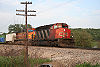 The GMD SD40-2(W) is a Canadian-market version of the SD40-2 diesel-electric locomotive, built for the Canadian National Railway
by the Diesel Division of General Motors of Canada Ltd.
(formerly General Motors Diesel
) of London, Ontario; 123 were constructed between May 1975 and December 1980. The major difference between the SD40-2(W) and a regular SD40-2 is the fitment of a wide-nose Canadian comfort cab
, commonly denoted by adding a 'W' in the model name (although the GMD designation on the builders plates remained 'SD40-2').
, produced by General Motors Electro-Motive Division.
Nine of these locomotives were constructed, five in April and May 1978 for Burlington Northern
as EMD order #776083
(BN 7049–7053), and four for Union Pacific
in November 1980 as EMD order #80653.
(UP 3805–3808).
These locomotives were fitted with larger engine blocks, larger turbochargers, and two-speed radiator fans which were expected to improve cooling and reliability. The four UP units, but not the five BN locomotives, were fitted with an extended long hood
, about 28 inches longer, to take enlarged radiators. Instead of the standard seven access doors under the radiators, these units had eight.
It has been commonly believed these units were fitted with higher-capacity AR16 alternator
s, traction motor
s, possibly increased engine power, and Super Series wheel slip control; however, Don Strack's research in Union Pacific's archives has proven that the UP units at least were not so equipped.
After a year's testing, the UP locomotives were fitted with standard engines and turbochargers. It is probable that the BN locomotives were also similarly refitted. All of the BN units are still in service with successor BNSF Railway
, while of the UP locomotives two remain in service with UP, renumbered to UP 3412
and 3277
from UP 3806 and 3807. Former UP 3805 is now in service with the Iowa, Chicago and Eastern Railroad
as ICE 6406, and former UP 3808 now belongs to the Evansville Western Railway
as EVWR 6003.
BB40-2
s for use in Brazil.
Conversely, several other models of EMD locomotive have sometimes been rebuilt to SD40-2 standards, including the SD40
, SD45
and SD45-2
. Normally this consists of electrical upgrades (-2) and replacing the 20 cylinder prime mover with a 16 cylinder version, ironically often built for GE in Poland using EMD's manufacturing drawings and specifications. An outgrowth of this may be GE's second-sourcing of EMD repair parts.
is an EMD SD40-2 or similar, repowered with an EMD 8-710-ECO engine. The resulting locomotive is rated at 2150 hp, and meets EPA Tier II emissions regulations.
donated 3028 (former Chicago & North Western
6847) to the Illinois Railway Museum
in Union, Illinois. The unit still wears its original factory paint from when it was built for the CNW in March, 1974. 6847 was patched by the UP in February, 2003 to UP 3028, and eventually retired in December, 2008. The locomotive has since had its UP patches removed, and CNW herald and numbers restored. This is the first SD40-2 in the world to be preserved in a museum.
The SD40-2 was first introduced in January 1972 as the mid-range offering in EMD's six-axle "Dash-2" series, competing against the GE U30C
GE U30C
The GE U30C was one of the earliest successes from General Electric in the diesel locomotive market. With 600 units sold, the U30C proved to be a choice for customers who weren't able to purchase SD40's or SD40-2's from EMD due to mass orders...
and the MLW M630
ALCO Century 630
The ALCO Century 630 was a six-axle, 3000 horsepower diesel locomotive built between 1965 and 1967. 77 were built: 3 for Atlantic Coast Line Railroad, 4 for Chesapeake and Ohio Railway, 8 for Louisville and Nashville Railroad, 10 for Norfolk and Western Railway, 15 for Pennsylvania Railroad, 12...
. Although higher-horsepower locomotives were available, including EMD's own SD45-2
EMD SD45-2
An EMD SD45-2 is a 6-axle diesel locomotive built by General Motors Electro-Motive Division beginning in 1972. Power was provided by an EMD 645E3 20-cylinder engine which generated . Part of the EMD Dash 2 line, the SD45-2 was an upgraded SD45.The main spotting difference between an SD45 and an...
, the reliability and versatility of the 3,000-horsepower SD40-2 made it the best-selling model in EMD's history and the standard of the industry for several decades after its introduction. The SD40-2 was a technological improvement over the previous SD40
EMD SD40
The EMD SD40 is a 6-axle diesel locomotive built by General Motors Electro-Motive Division between January 1966 and August 1972.-Design:Like its predecessor in EMD's catalog, the SD35, the SD40 is a high-horsepower, six-motor freight locomotive....
, incorporating modular electronic control systems similar to those of the experimental DDA40X.
Peak production of the SD40-2 occurred in the mid 1970s. Sales of the SD40-2 began to diminish after 1981 due to the oil crisis, increased competition from GE's Dash-7 series and the introduction of the EMD SD50
EMD SD50
The EMD SD50 was a diesel-electric locomotive built by General Motors Electro-Motive Division. It was introduced in May 1981 as part of EMD's "50 Series", but prototype SD50S locomotives were built from 1980; production ceased in January 1986...
, which was available concurrently to late SD40-2 production. The last SD40-2 delivered to a United States railroad was built in August 1984, with production continuing for railroads in Canada until July 1985, Mexico until February 1986, and Brazil until 1989.
The SD40-2 has seen service in Canada, Mexico, Brazil and Guinea. To suit export country specifications, General Motors designed the JT26CW-SS (British Rail Class 59
British Rail Class 59
The Class 59 Co-Co diesel locomotives were built and introduced between 1985 and 1995 by Electro-Motive Division of General Motors for private British companies, initially Foster Yeoman...
) for Great Britain, the GT26CW-2 for Yugoslavia, Korea, Iran, Morocco, Peru and Pakistan, while the GT26CU-2 went to Zimbabwe and Brazil. Various customizations led Algeria to receive their version of a SD40-2, known as GT26HCW-2.
Appearance and spotting features
EMD SD38
An EMD SD38 is a 6-axle diesel locomotive built by General Motors Electro-Motive Division between May 1967 and October 1971. Power was provided by an EMD 645 16-cylinder engine which generated 2000 horsepower . As compared to the EMD 645E3 engine that was turbo-charged and produced 3000HP from the...
, SD39
EMD SD39
An EMD SD39 is a 6-axle diesel locomotive built by General Motors Electro-Motive Division between August 1968 and May 1970. 54 examples of this locomotive model were built for American railroads....
, SD40
EMD SD40
The EMD SD40 is a 6-axle diesel locomotive built by General Motors Electro-Motive Division between January 1966 and August 1972.-Design:Like its predecessor in EMD's catalog, the SD35, the SD40 is a high-horsepower, six-motor freight locomotive....
, and SD45
EMD SD45
The EMD SD45 is a six-axle diesel locomotive built by General Motors Electro-Motive Division between December, 1965, and December, 1971. Power was provided by an EMD 645E3 twenty-cylinder engine which generated 3,600 HP. This locomotive shared the same common frame with the EMD SD38, EMD SD39, EMD...
shared a common frame, so too did the SD38-2
EMD SD38-2
An EMD SD38-2 is a six-axle diesel locomotive built by General Motors Electro-Motive Division from 1972 to 1979. EMD built 83 of these medium road-switchers, which were used in both yard and mainline roles. Part of the EMD Dash 2 line, the SD38-2 was an upgraded SD38 with modular electronic...
, SD40-2, and SD45-2
EMD SD45-2
An EMD SD45-2 is a 6-axle diesel locomotive built by General Motors Electro-Motive Division beginning in 1972. Power was provided by an EMD 645E3 20-cylinder engine which generated . Part of the EMD Dash 2 line, the SD45-2 was an upgraded SD45.The main spotting difference between an SD45 and an...
. It was 3 ft (0.9144 m) longer than the previous models, giving an overall locomotive length of 68 inch over the coupler pulling faces. The SD38-2 and SD40-2 shared the same basic superstructure, since they both used the same 16-645E3 engine (in naturally aspirated and turbocharged
Turbocharger
A turbocharger, or turbo , from the Greek "τύρβη" is a centrifugal compressor powered by a turbine that is driven by an engine's exhaust gases. Its benefit lies with the compressor increasing the mass of air entering the engine , thereby resulting in greater performance...
form respectively); the long hood
Long hood
The long hood of a hood unit-style diesel locomotive is, as the name implies, the longer of the two hoods on a locomotive.-Equipment:...
was 18 inches (45.7 cm) longer than the SD38 and SD40, but since the increase in frame length was even greater, the SD38-2 and SD40-2 were left with even larger front and rear "porches" than the earlier models. These empty areas at front and rear are distinctive spotting features to identify the Dash 2 models of both units. The SD40-2 can be distinguished from the SD38-2 by having three roof-mounted radiator fans instead of two, and a single large exhaust stack instead of two smaller stacks.
The increase in the frame length over the preceding SD40 was made to accommodate the new HT-C truck
HT-C truck
The HT-C truck was created in 1970 by Electro-Motive Diesel as a component of their range of railway locomotives through to 1994. It was mounted under the experimental EMD SD45X, and applied to a majority of EMD Dash 2, 50 and 60 series six axle units built by EMD...
design, in which the traction motors all face the same direction, creating an overhang on the inner ends of the trucks. However, after a series of derailments involving Amtrak SDP40F units that were equipped with HT-C trucks, Conrail
Consolidated Rail Corporation
The Consolidated Rail Corporation, commonly known as Conrail , was the primary Class I railroad in the Northeast U.S. between 1976 and 1999. The federal government created it to take over the potentially profitable lines of bankrupt carriers, including the Penn Central Transportation Company and...
ordered the SD40-2 units and several orders of SD50s with the older Flexicoil trucks.
As of 2008, some SD45 units have been modified by replacing their 20 cylinder engine with the 16 cylinder removed from otherwise scrapped SD40-2 units. This was common practice for units owned by Union Pacific and possibly other owners. In many cases these are identified by the owner as SD40-2, SD40M-2 or some other such means. Confusion is created when what appears to be an SD45 is labeled as an SD40-2. Additionally, some older SD40-2 units used in low-power modes such as yard switching or hump service have been de-turbocharged, resulting in the mechanical equivalent of a SD38-2. Units so modified may or may not be re-labeled.
There are several variations of the SD40-2. Such as the SD40T-2
EMD SD40T-2
An EMD SD40T-2 is a 6-axle diesel locomotive built by General Motors Electro-Motive Division. Power is provided by a 16-cylinder EMD 645E3 diesel engine capable of producing . The Southern Pacific's locomotive features a fuel tank and is long. The Rio Grande's locomotive features a smaller fuel...
's (T for tunnel motor) bought by fallen flags: Southern Pacific, and Denver and Rio Grande Western
Denver and Rio Grande Western Railroad
The Denver & Rio Grande Western Railroad , often shortened to Rio Grande or D&RGW, formerly the Denver & Rio Grande Railroad, is a defunct U.S. railroad company. The railroad started as a narrow gauge line running south from Denver, Colorado in 1870; however, served mainly as a transcontinental...
; now operated by the Union Pacific Railroad. There is the SD40-2(W) (W for the 4-Window Safety Cab) bought and operated by the Canadian National railway. There were high-nosed versions of the SD40-2 bought by fallen flags: Norfolk & Western, & Southern Railway. These units are now operated by the Norfolk Southern Railway (Resulting merger of N&W and The Southern Railway). There are even some narrow gauge versions around the world called BB40-2
EMD BB40-2
The EMD BB40-2 is a rebuilt version of the EMD SD40-2 diesel locomotive. It is used by Ferrovia Central Atlantico in Brazil. Since FCA is metre gauge, there was no longer enough room in the trucks for the original traction motors. Also, FCA does not have a sufficiently high load limit per axle to...
's.
Three cabless
B unit
A "B" unit, in railroad terminology, is a locomotive unit which does not have a driving cab, or crew compartment, and must therefore be controlled from another, coupled locomotive with a driving cab . The term booster unit is also used. The concept was largely confined to North America...
SD40-2Bs were also rebuilt from standard SD40-2s by the Burlington Northern Railroad
Burlington Northern Railroad
The Burlington Northern Railroad was a United States-based railroad company formed from a merger of four major U.S. railroads. Burlington Northern operated between 1970 and 1996....
in the early 1980s. The units had been in collisions and it was decided that it would be more economical to rebuild them without cabs. Canadian Pacific also owns a few SD40-2Bs. These were created by welding metal plates over the cab windows of many of its ex-Norfolk Southern and some of its original SD40-2s.
Additional specifications
| Main generator: | AR10 alternator |
|---|---|
| Traction motors: | 6 × D77/78 DC |
| Standard gearing: | 62:15 |
| Maximum speed: | 65 mph (29.1 m/s) |
Original Owners
| American SD40-2 orders | |||||
|---|---|---|---|---|---|
| Railroad | Quantity | Road numbers | Notes | ||
| Atchison, Topeka and Santa Fe Railway Atchison, Topeka and Santa Fe Railway The Atchison, Topeka and Santa Fe Railway , often abbreviated as Santa Fe, was one of the larger railroads in the United States. The company was first chartered in February 1859... |
187 | 5020-5192, 5200-5213 | Most now in service with BNSF Railway BNSF Railway The BNSF Railway is a wholly owned subsidiary of Berkshire Hathaway Inc., and is headquartered in Fort Worth, Texas. It is one of seven North American Class I railroads and the second largest freight railroad network in North America, second only to the Union Pacific Railroad, its primary... |
||
| Burlington Northern Railroad Burlington Northern Railroad The Burlington Northern Railroad was a United States-based railroad company formed from a merger of four major U.S. railroads. Burlington Northern operated between 1970 and 1996.... |
779 | 900-925, 930-961, 980, 996, 6325-6385, 6700-6799, 6824-6836, 6917-6928, 7000-7291, 7832-7940, 8000-8181 | Most now in service with BNSF Railway. 7167-7205, 7206-7235, & 8074-8089 were the only SD40-2's built by General Motors Diesel General Motors Diesel General Motors Diesel was a Canadian railway diesel locomotive manufacturer.-History:General Motors Diesel, Limited, was created in 1949 as the Canadian subsidiary of the Electro Motive Division of General Motors located in the United States... as exports to the United States. |
||
| Baltimore and Ohio Railroad Baltimore and Ohio Railroad The Baltimore and Ohio Railroad was one of the oldest railroads in the United States and the first common carrier railroad. It came into being mostly because the city of Baltimore wanted to compete with the newly constructed Erie Canal and another canal being proposed by Pennsylvania, which... |
20 | 7600-7619 | Now in service with CSX Transportation CSX Transportation CSX Transportation operates a Class I railroad in the United States known as the CSX Railroad. It is the main subsidiary of the CSX Corporation. The company is headquartered in Jacksonville, Florida, and owns approximately 21,000 route miles... |
||
| Chicago and North Western Railway | 135 | 6801-6935 | Most now in service with Union Pacific Railroad Union Pacific Railroad The Union Pacific Railroad , headquartered in Omaha, Nebraska, is the largest railroad network in the United States. James R. Young is president, CEO and Chairman.... |
||
| Conrail Consolidated Rail Corporation The Consolidated Rail Corporation, commonly known as Conrail , was the primary Class I railroad in the Northeast U.S. between 1976 and 1999. The federal government created it to take over the potentially profitable lines of bankrupt carriers, including the Penn Central Transportation Company and... |
167 | 6358-6524 | Equipped with flexicoil trucks. Now renumbered and in service with CSX, Norfolk Southern, or leasing firms | ||
| Clinchfield Railroad Clinchfield Railroad The Clinchfield Railroad was an operating and holding company for the Carolina, Clinchfield and Ohio Railway . The line ran from the coalfields of Virginia and Elkhorn City, Kentucky, to the textile mills of South Carolina... |
5 | 8127-8129, 8131-8132 | Family Lines Paint, to Seaboard System, now in service with CSX Transportation CSX Transportation CSX Transportation operates a Class I railroad in the United States known as the CSX Railroad. It is the main subsidiary of the CSX Corporation. The company is headquartered in Jacksonville, Florida, and owns approximately 21,000 route miles... |
||
| Illinois Central Gulf Railroad | 4 | 6030-6033 | 6031 was converted into 6200, 6033 was destroyed in a collision in Flora, Mississippi Flora, Mississippi Flora is a town in Madison County, Mississippi, United States. The population was 1,546 at the 2000 census. It is part of the Jackson Metropolitan Statistical Area.-Geography:Flora is located at .... on February 6, 1994 |
||
| Kennecott Utah Copper Corporation Kennecott Utah Copper Kennecott Utah Copper Corporation , a division of Rio Tinto Group, is a mining, smelting, and refining company. Its corporate headquarters are located in South Jordan, Utah, USA. Kennecott operates one of the largest open-pit copper mines in the world in Bingham Canyon, Salt Lake County, Utah. ... |
7 | 101-107 | |||
| Kansas City Southern Railway Kansas City Southern Railway The Kansas City Southern Railway , owned by Kansas City Southern Industries, is the smallest and second-oldest Class I railroad company still in operation. KCS was founded in 1887 and is currently operating in a region consisting of ten central U.S. states... |
46 | 637-692 | #637 was the very first SD40-2 constructed in January 1972. | ||
| Louisville and Nashville Railroad Louisville and Nashville Railroad The Louisville and Nashville Railroad was a Class I railroad that operated freight and passenger services in the southeast United States.Chartered by the state of Kentucky in 1850, the L&N, as it was generally known, grew into one of the great success stories of American business... |
191 | 1259–1278, 3554-3612, 8000-8039, 8067-8086, 8095-8126, 8133-8162 | 8000s units delivered in Family Lines paint; all to Seaboard System, now in service with CSX Transportation CSX Transportation CSX Transportation operates a Class I railroad in the United States known as the CSX Railroad. It is the main subsidiary of the CSX Corporation. The company is headquartered in Jacksonville, Florida, and owns approximately 21,000 route miles... |
||
| Milwaukee Road | 90 | 21-30, 171-209, 3000-3040 | Now in service among several various railroads. #124 was exported to Guinea. | ||
| Missouri-Kansas-Texas Railroad Missouri-Kansas-Texas Railroad The Missouri–Kansas–Texas Railroad was incorporated May 23, 1870. In its earliest days the MKT was commonly referred to as "the K-T", which was its stock exchange symbol; this common designation soon evolved into "the Katy".... |
37 | 600-636 | Order based on Burlington Northern specifications for Pooling Service. | ||
| Missouri Pacific Railroad Missouri Pacific Railroad The Missouri Pacific Railroad , also known as the MoPac, was one of the first railroads in the United States west of the Mississippi River. MoPac was a Class I railroad growing from dozens of predecessors and mergers, including the St. Louis, Iron Mountain and Southern Railway , Texas and Pacific... |
306 | 790-838, 3139-3321, 6020-6073 | 790-838 & 3139-3321 lack dynamic brakes. 6020-6073 were based on Burlington Northern specifications for Pooling Services. Considered the heaviest SD40-2's ever built. | ||
| Norfolk and Western Railway Norfolk and Western Railway The Norfolk and Western Railway , a US class I railroad, was formed by more than 200 railroad mergers between 1838 and 1982. It had headquarters in Roanoke, Virginia for most of its 150 year existence.... |
162 | 1625–1652, 6073-6207 | Some are High hood units. Now in service with the Norfolk Southern Railway Norfolk Southern Railway The Norfolk Southern Railway is a Class I railroad in the United States, owned by the Norfolk Southern Corporation. With headquarters in Norfolk, Virginia, the company operates 21,500 route miles in 22 eastern states, the District of Columbia and the province of Ontario, Canada... |
||
| Oneida and Western Railroad Oneida and Western Railroad The Oneida & Western Railroad, known as the Oneida & Western or O&W, was a short coal and goods hauling railroad that ran between Oneida and Jamestown, Tennessee. It was prosperous during the 1920s, hauling coal and lumber and provided groceries and mail to residents along the O&W in the remote... |
8 | 9950-9957 | Later became BC Rail 743-750, 749 is now GECX 749 | ||
| Chicago, Rock Island and Pacific Railroad Chicago, Rock Island and Pacific Railroad The Chicago, Rock Island and Pacific Railroad was a Class I railroad in the United States. It was also known as the Rock Island Line, or, in its final years, The Rock.-Incorporation:... |
10 | 4790-4799 | Later became Illinois Central Gulf 6040-6049. Six are in service with Wisconsin and Southern Railroad Wisconsin and Southern Railroad The Wisconsin and Southern Railroad is a Class II regional railroad in the southern portion of Wisconsin and the northeast corner of Illinois. It operates former Chicago, Milwaukee, St... |
||
| Seaboard Coast Line Railroad Seaboard Coast Line Railroad The Seaboard Coast Line Railroad was a former Class I railroad company operating in the Southeastern United States beginning in 1967. Its passenger operations were taken over by Amtrak in 1971... |
36 | 8040-8066, 8087-8094, 8130 | Delivered in Family Lines Paint, to Seaboard System, now in service with CSX Transportation CSX Transportation CSX Transportation operates a Class I railroad in the United States known as the CSX Railroad. It is the main subsidiary of the CSX Corporation. The company is headquartered in Jacksonville, Florida, and owns approximately 21,000 route miles... |
||
| St. Louis-San Francisco Railway St. Louis-San Francisco Railway The St. Louis – San Francisco Railway , also known as the Frisco, was a railroad that operated in the Midwest and South Central U.S. from 1876 to 1980.-History:... |
8 | 950-957 | Now in service with the BNSF Railway BNSF Railway The BNSF Railway is a wholly owned subsidiary of Berkshire Hathaway Inc., and is headquartered in Fort Worth, Texas. It is one of seven North American Class I railroads and the second largest freight railroad network in North America, second only to the Union Pacific Railroad, its primary... |
||
| Soo Line Railroad Soo Line Railroad The Soo Line Railroad is the primary United States railroad subsidiary of the Canadian Pacific Railway , controlled through the Soo Line Corporation, and one of seven U.S. Class I railroads. Although it is named for the Minneapolis, St. Paul and Sault Ste... |
57 | 757-789, 6600-6623 | Most now in service with the Canadian Pacific Railway Canadian Pacific Railway The Canadian Pacific Railway , formerly also known as CP Rail between 1968 and 1996, is a historic Canadian Class I railway founded in 1881 and now operated by Canadian Pacific Railway Limited, which began operations as legal owner in a corporate restructuring in 2001... . #6623 is the last SD40-2 built in the United States. |
||
| Southern Railway | 128 | 3201-3328 | High hood units; now in service with Norfolk Southern Railway Norfolk Southern Railway The Norfolk Southern Railway is a Class I railroad in the United States, owned by the Norfolk Southern Corporation. With headquarters in Norfolk, Virginia, the company operates 21,500 route miles in 22 eastern states, the District of Columbia and the province of Ontario, Canada... |
||
| Union Pacific Railroad Union Pacific Railroad The Union Pacific Railroad , headquartered in Omaha, Nebraska, is the largest railroad network in the United States. James R. Young is president, CEO and Chairman.... |
686 | 3123-3239, 3243-3304, 3335-3399, 3410-3583, 3609-3808, 8000-8002, 8035-8099 | Several have been renumbered and others retired to leasers. 3200-3410 delivered with snoot noses. | ||
| Canadian SD40-2 orders | |||||
| Railroad | Quantity | Road numbers | Notes | ||
| Algoma Central Railway Algoma Central Railway The Algoma Central Railway is a railway in Northern Ontario that operates between Sault Ste. Marie and Hearst, with a branch line to Michipicoten. The area served by the railway is sparsely populated, with few roads... |
6 | 183-188 | |||
| BC Rail | 17 | 751-767 | |||
| Canadian Pacific Railway Canadian Pacific Railway The Canadian Pacific Railway , formerly also known as CP Rail between 1968 and 1996, is a historic Canadian Class I railway founded in 1881 and now operated by Canadian Pacific Railway Limited, which began operations as legal owner in a corporate restructuring in 2001... |
484 | 5560, 5565-5879, 5900-6069 | |||
| Canadian National Railway | 123 | 5241-5363 | These units had the Canadian Safety Cab with 4 windows and were classified as SD40-2W | ||
| Ontario Northland Railway Ontario Northland Railway The Ontario Northland Railway is a Canadian railway operated by the Ontario Northland Transportation Commission, a provincial Crown agency of the government of Ontario.... |
8 | 1730–1737 | |||
| Quebec, North Shore and Labrador Railway | 44 | 221-264 | Four engines now serve the short-line Wellsboro & Corning Railroad in northern Pennsylvania, hauling sand cars to support Marcellus shale hydraulic fracturing in the region. | ||
| Export SD40-2 orders | |||||
| Railroad | Quantity | Road numbers | Notes | ||
| Chemin de Fer Boké (Guinea) | 3 | 107-109 | The only SD40-2's exported to an African country. | ||
| Estrada de Ferro Carajás (Brazil) | 29 | 401-429 | Constructed by Equipamentos Villares S.A. (EVSA) and built to Irish Gauge Irish gauge Irish gauge railways use a track gauge of . It is used in* Ireland * Australia where it is also known as Victorian Broad Gauge* Brazil where it is also known as Bitola larga no Brasil.... (1600 mm) specifications. #429 is the very last SD40-2 constructed in October 1989. |
||
| Ferrocarriles Unidos del Sureste Ferrocarriles Unidos del Sureste Ferrocarriles Unidos del Sureste was a company that operated a railroad in southeastern Mexico. In the 1930s the Mexican government decided to build a railroad into the Yucatán, connecting the national system with the isolated Ferrocarriles Unidos de Yucatán. The project was completed in 1950 and... (Mexico) |
4 | 601-604 | The only SD40-2's in México without dynamic brakes. | ||
| Ferrocarriles Nacionales de México Ferrocarriles Nacionales de México Ferrocarriles Nacionales de México, was Mexico's state owned railroad company from 1938 to 1998, and prior to 1938 a major railroad controlled by the government that linked Mexico City to the major cities of Nuevo Laredo and Ciudad Juárez on the U.S. border... (Mexico) |
103 | 8700-8798, 13001-13004 | |||
| Rede Ferroviária Federal Sociedade Anônima (Brazil) | 36 | 3711-3747 | The only SD40-2's constructed in Europe for a Brazilian customer in Irish Gauge (1600 mm) by Material y Construcciones S.A. (MACOSA MACOSA Material y Construcciones S.A. or MACOSA was a Spanish heavy-engineering company, mainly producing products for the rail industry. From 1989 onwards the organisation was named Meinfesa and became part of the GEC-Alstom group of companies, until 2005 when it became part of the Vossloh group as... ). |
||
SD40T-2
A variant of the SD40-2 was created for several western railroads for extended periods in tunnels and snow shedSnow shed
An avalanche snow bridge or simply snow bridge is a type of rigid snow-supporting structure for avalanche control . Avalanche bridges can be made of steel, prestressed concrete frames, or timber....
s. Currently, Union Pacific owns all of this variant.
British Rail Class 59
Another variant of the SD40-2 was created for British RailBritish Rail
British Railways , which from 1965 traded as British Rail, was the operator of most of the rail transport in Great Britain between 1948 and 1997. It was formed from the nationalisation of the "Big Four" British railway companies and lasted until the gradual privatisation of British Rail, in stages...
, which features a unique body design specifically for the European railway markets.
SD40-2W
Canadian National Railway
The Canadian National Railway Company is a Canadian Class I railway headquartered in Montreal, Quebec. CN's slogan is "North America's Railroad"....
by the Diesel Division of General Motors of Canada Ltd.
General Motors Diesel
General Motors Diesel was a Canadian railway diesel locomotive manufacturer.-History:General Motors Diesel, Limited, was created in 1949 as the Canadian subsidiary of the Electro Motive Division of General Motors located in the United States...
(formerly General Motors Diesel
General Motors Diesel
General Motors Diesel was a Canadian railway diesel locomotive manufacturer.-History:General Motors Diesel, Limited, was created in 1949 as the Canadian subsidiary of the Electro Motive Division of General Motors located in the United States...
) of London, Ontario; 123 were constructed between May 1975 and December 1980. The major difference between the SD40-2(W) and a regular SD40-2 is the fitment of a wide-nose Canadian comfort cab
Canadian comfort cab
The Canadian comfort cab or wide cab is a broad-nosed cab design found on modern diesel locomotives. It occupies the entire width of the locomotive, and typically has an access door on the front of the nose...
, commonly denoted by adding a 'W' in the model name (although the GMD designation on the builders plates remained 'SD40-2').
SD40-2S
The EMD SD40-2S (also incorrectly known as the SD40-2SS or SD40SS) was an experimental test bed variant of the popular EMD SD40-2 diesel locomotiveDiesel locomotive
A diesel locomotive is a type of railroad locomotive in which the prime mover is a diesel engine, a reciprocating engine operating on the Diesel cycle as invented by Dr. Rudolf Diesel...
, produced by General Motors Electro-Motive Division.
Nine of these locomotives were constructed, five in April and May 1978 for Burlington Northern
Burlington Northern Railroad
The Burlington Northern Railroad was a United States-based railroad company formed from a merger of four major U.S. railroads. Burlington Northern operated between 1970 and 1996....
as EMD order #776083
(BN 7049–7053), and four for Union Pacific
Union Pacific Railroad
The Union Pacific Railroad , headquartered in Omaha, Nebraska, is the largest railroad network in the United States. James R. Young is president, CEO and Chairman....
in November 1980 as EMD order #80653.
(UP 3805–3808).
These locomotives were fitted with larger engine blocks, larger turbochargers, and two-speed radiator fans which were expected to improve cooling and reliability. The four UP units, but not the five BN locomotives, were fitted with an extended long hood
Long hood
The long hood of a hood unit-style diesel locomotive is, as the name implies, the longer of the two hoods on a locomotive.-Equipment:...
, about 28 inches longer, to take enlarged radiators. Instead of the standard seven access doors under the radiators, these units had eight.
It has been commonly believed these units were fitted with higher-capacity AR16 alternator
Alternator
An alternator is an electromechanical device that converts mechanical energy to electrical energy in the form of alternating current.Most alternators use a rotating magnetic field but linear alternators are occasionally used...
s, traction motor
Traction motor
Traction motor refers to an electric motor providing the primary rotational torque of a machine, usually for conversion into linear motion ....
s, possibly increased engine power, and Super Series wheel slip control; however, Don Strack's research in Union Pacific's archives has proven that the UP units at least were not so equipped.
After a year's testing, the UP locomotives were fitted with standard engines and turbochargers. It is probable that the BN locomotives were also similarly refitted. All of the BN units are still in service with successor BNSF Railway
BNSF Railway
The BNSF Railway is a wholly owned subsidiary of Berkshire Hathaway Inc., and is headquartered in Fort Worth, Texas. It is one of seven North American Class I railroads and the second largest freight railroad network in North America, second only to the Union Pacific Railroad, its primary...
, while of the UP locomotives two remain in service with UP, renumbered to UP 3412
and 3277
from UP 3806 and 3807. Former UP 3805 is now in service with the Iowa, Chicago and Eastern Railroad
Iowa, Chicago and Eastern Railroad
The Iowa, Chicago and Eastern Railroad was a Class II railroad operating in the north central United States. It has been controlled by the Canadian Pacific Railway and operated as a part of its system since October 30, 2008...
as ICE 6406, and former UP 3808 now belongs to the Evansville Western Railway
Evansville Western Railway
The Evansville Western Railway is a Class III common carrier shortline railroad operating in the Southern Illinois and Indiana region. It is one of three regional railroad subsidiaries owned and operated by Four Rivers Transportation Inc.- Overview :...
as EVWR 6003.
Rebuilds
A number of SD40-2s have been rebuilt into other models. Some of the most unusual are the metre gaugeMetre gauge
Metre gauge refers to narrow gauge railways and tramways with a track gauge of . In some African, American and Asian countries it is the main gauge. In Europe it has been used for local railways in France, Germany, and Belgium, most of which were closed down in mid 20th century. Only in Switzerland...
BB40-2
EMD BB40-2
The EMD BB40-2 is a rebuilt version of the EMD SD40-2 diesel locomotive. It is used by Ferrovia Central Atlantico in Brazil. Since FCA is metre gauge, there was no longer enough room in the trucks for the original traction motors. Also, FCA does not have a sufficiently high load limit per axle to...
s for use in Brazil.
Conversely, several other models of EMD locomotive have sometimes been rebuilt to SD40-2 standards, including the SD40
EMD SD40
The EMD SD40 is a 6-axle diesel locomotive built by General Motors Electro-Motive Division between January 1966 and August 1972.-Design:Like its predecessor in EMD's catalog, the SD35, the SD40 is a high-horsepower, six-motor freight locomotive....
, SD45
EMD SD45
The EMD SD45 is a six-axle diesel locomotive built by General Motors Electro-Motive Division between December, 1965, and December, 1971. Power was provided by an EMD 645E3 twenty-cylinder engine which generated 3,600 HP. This locomotive shared the same common frame with the EMD SD38, EMD SD39, EMD...
and SD45-2
EMD SD45-2
An EMD SD45-2 is a 6-axle diesel locomotive built by General Motors Electro-Motive Division beginning in 1972. Power was provided by an EMD 645E3 20-cylinder engine which generated . Part of the EMD Dash 2 line, the SD45-2 was an upgraded SD45.The main spotting difference between an SD45 and an...
. Normally this consists of electrical upgrades (-2) and replacing the 20 cylinder prime mover with a 16 cylinder version, ironically often built for GE in Poland using EMD's manufacturing drawings and specifications. An outgrowth of this may be GE's second-sourcing of EMD repair parts.
SD22ECO
The SD22ECOEMD SD22ECO
The EMD SD22ECO is a C-C diesel-electric locomotive rebuilt by Electro-Motive Diesel. It is, along with the GP22ECO, primarily the application of a conversion kit to an existing EMD SD40-type locomotive. This involves replacing the existing prime mover with an EPA Tier-II-compliant turbocharged...
is an EMD SD40-2 or similar, repowered with an EMD 8-710-ECO engine. The resulting locomotive is rated at 2150 hp, and meets EPA Tier II emissions regulations.
Preservation
In June, 2009 the Union PacificUnion Pacific Railroad
The Union Pacific Railroad , headquartered in Omaha, Nebraska, is the largest railroad network in the United States. James R. Young is president, CEO and Chairman....
donated 3028 (former Chicago & North Western
Chicago and North Western Railway
The Chicago and North Western Transportation Company was a Class I railroad in the Midwest United States. It was also known as the North Western. The railroad operated more than of track as of the turn of the 20th century, and over of track in seven states before retrenchment in the late 1970s...
6847) to the Illinois Railway Museum
Illinois Railway Museum
The Illinois Railway Museum is the largest railroad museum in the United States and is located in Union, Illinois, northwest of Chicago...
in Union, Illinois. The unit still wears its original factory paint from when it was built for the CNW in March, 1974. 6847 was patched by the UP in February, 2003 to UP 3028, and eventually retired in December, 2008. The locomotive has since had its UP patches removed, and CNW herald and numbers restored. This is the first SD40-2 in the world to be preserved in a museum.