

.gif)
E8 (mathematics)

Encyclopedia
In mathematics
, E8 is any of several closely related exceptional simple Lie groups, linear algebraic group
s or Lie algebras of dimension
248; the same notation is used for the corresponding root lattice, which has rank 8. The designation E8 comes from the Cartan–Killing classification of the complex simple Lie algebras, which fall into four infinite series labeled An, Bn, Cn, Dn, and five exceptional cases labeled E6, E7, E8, F4, and G2. The E8 algebra is the largest and most complicated of these exceptional cases.
discovered the complex Lie algebra E8 during his classification of simple compact Lie algebras, though he did not prove its existence, which was first shown by Élie Cartan
. Cartan determined that a complex simple Lie algebra of type E8 admits three real forms. Each of them gives rise to a simple Lie group
of dimension 248, exactly one of which is compact. introduced algebraic group
s and Lie algebras of type E8 over other fields
: for example, in the case of finite field
s they lead to an infinite family of finite simple groups of Lie type.
, which is the dimension of its maximal torus, is 8. Therefore the vectors of the root system are in eight-dimensional Euclidean space: they are described explicitly later in this article. The Weyl group
of E8, which is the group of symmetries
of the maximal torus which are induced by conjugations
in the whole group, has order 696729600.
The compact group E8 is unique among simple compact Lie groups in that its non-trivial
representation of smallest dimension is the adjoint representation (of dimension 248) acting on the Lie algebra E8 itself; it is also the unique one which has the following four properties: trivial center, compact, simply connected, and simply laced (all roots have the
same length).
There is a Lie algebra En
for every integer n ≥ 3, which is infinite dimensional if n is greater than 8.
The complex Lie group E8 of complex dimension
248 can be considered as a simple real Lie group of real dimension 496. This is simply connected, has maximal compact
subgroup the compact form (see below) of E8, and has an outer automorphism group of order 2 generated by complex conjugation.
As well as the complex Lie group of type E8, there are three real forms of the Lie algebra, three real forms of the group with trivial center (two of which have non-algebraic double covers, giving two further real forms), all of real dimension 248, as follows:
For a complete list of real forms of simple Lie algebras, see the list of simple Lie groups.
for the Lie algebra, one can define E8 as a linear algebraic group over the integers and, consequently, over any commutative ring and in particular over any field: this defines the so-called split (sometimes also known as “untwisted”) form of E8. Over an algebraically closed field, this is the only form; however, over other fields, there are often many other forms, or “twists” of E8, which are classified in the general framework of Galois cohomology
(over a perfect field
k) by the set which, because the Dynkin diagram of E8 (see below) has no automorphisms, coincides with
  .
.
Over the field of real numbers, the real connected component of the identity of these algebraically twisted forms of E8 coincide with the three real Lie groups mentioned above, but with a subtlety concerning the fundamental group: all forms of E8 are simply connected in the sense of algebraic geometry, meaning that they admit no non-trivial algebraic coverings; the non-compact and simply connected real Lie group forms of E8 are therefore not algebraic and admit no faithful finite-dimensional representations.
Over finite fields, the Lang–Steinberg theorem implies that , meaning that E8 has no twisted forms: see below.
. The dimensions of the smallest irreducible representations are :
The 248-dimensional representation is the adjoint representation
. There are two non-isomorphic irreducible representations of dimension 8634368000 (it is not unique; however, the next integer with this property is 175898504162692612600853299200000 ). The fundamental representation
s are those with dimensions 3875, 6696000, 6899079264, 146325270, 2450240, 30380, 248 and 147250 (corresponding to the eight nodes in the Dynkin diagram in the order chosen for the Cartan matrix below, i.e., the nodes are read in the seven-node chain first, with the last node being connected to the third).
The coefficients of the character formulas for infinite dimensional irreducible representation
s of E8 depend on some large square matrices consisting of polynomials, the Lusztig–Vogan polynomials, an analogue of Kazhdan–Lusztig polynomial
s introduced for reductive group
s in general by George Lusztig and David Kazhdan
(1983).
The values at 1 of the Lusztig–Vogan polynomials give the coefficients of the matrices relating the standard representations (whose characters are easy to describe) with the irreducible representations.
These matrices were computed after four years of collaboration by a group of 18 mathematicians and computer scientists
, led by Jeffrey Adams
, with much of the programming done by Fokko du Cloux
. The most difficult case (for exceptional groups) is the split real form of E8 (see above), where the largest matrix is of size 453060×453060. The Lusztig–Vogan polynomials for all other exceptional simple groups have been known for some time; the calculation for the split form of E8 is far longer than any other case. The announcement of the result in March 2007 received extraordinary attention from the media (see the external links), to the surprise of the mathematicians working on it.
The representations of the E8 groups over finite fields are given by Deligne–Lusztig theory
.

as well as

while the remaining commutator (not anticommutator!) is defined as

It is then possible to check that the Jacobi identity
is satisfied.
of a 128-dimensional Riemannian manifold
known informally as the 'octo-octonionic projective plane' because it can be built using an algebra that is the tensor product of the octonion
s with themselves. This can be seen systematically using a construction known as the magic square
, due to Hans Freudenthal
and Jacques Tits
.
 A root system
of rank r is a particular finite configuration of vectors, called roots, which span an r-dimensional Euclidean space
and satisfy certain geometrical properties. In particular, the root system must be invariant under reflection
through the hyperplane perpendicular to any root.
The E8 root system is a rank 8 root system containing 240 root vectors spanning R8. It is irreducible in the sense that it cannot be built from root systems of smaller rank. All the root vectors in E8 have the same length. It is convenient for many purposes to normalize them to have length √2.
s or all half-integer
s and the sum of the coordinates is even.
Explicitly, there are 112 roots with integer entries obtained from
by taking an arbitrary combination of signs and an arbitrary permutation
of coordinates, and 128 roots with half-integer entries obtained from
by taking an even number of minus signs (or, equivalently, requiring that the sum of all the eight coordinates be even). There are 240 roots in all.
The 112 roots with integer entries form a D8 root system. The E8 root system also contains a copy of A8 (which has 72 roots) as well as E6 and E7 (in fact, the latter two are usually defined as subsets of E8).
In the odd coordinate system E8 is given by taking the roots in the even coordinate system and changing the sign of any one coordinate. The roots with integer entries are the same while those with half-integer entries have an odd number of minus signs rather than an even number.
s for a root system Φ is a set of roots that form a basis
for the Euclidean space spanned by Φ with the special property that each root has components with respect to this basis that are either all nonnegative or all nonpositive.
One choice of simple roots for E8 is given by the rows of the following matrix:
The set of simple roots is by no means unique (the number of possible choices of positive roots is the order of the Weyl group); however, the particular choice displayed above has the unique property that the positive roots are then exactly those whose rightmost nonzero coordinate is positive.
This diagram gives a concise visual summary of the root structure. Each node of this diagram represents a simple root. A line joining two simple roots indicates that they are at an angle of 120° to each other. Two simple roots which are not joined by a line are orthogonal.
of E8 is of order 696729600, and can be described as O8+(2): it is of the form 2.G.2 (that is, a stem extension
by the cyclic group of order 2 of an extension of the cyclic group of order 2 by a group G) where G is the unique simple group
of order 174182400 (which can be described as PSΩ8+(2)).
of a rank r root system is an r × r matrix
whose entries are derived from the simple roots. Specifically, the entries of the Cartan matrix are given by
where (−,−) is the Euclidean inner product and αi are the simple roots. The entries are independent of the choice of simple roots (up to ordering).
The Cartan matrix for E8 is given by
The determinant
of this matrix is equal to 1.
in R8 naturally called the E8 root lattice
. This lattice is rather remarkable in that it is the only (nontrivial) even, unimodular lattice
with rank less than 16.
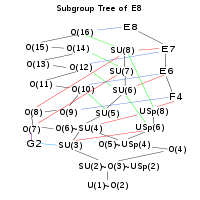 The Lie algebra E8 contains as subalgebras all the exceptional Lie algebras as well as many other important Lie algebras in mathematics and physics. The height of the Lie algebra on the diagram approximately corresponds to the rank of the algebra. A line from an algebra down to a lower algebra indicates that the lower algebra is a subalgebra of the higher algebra.
with q elements form a finite Chevalley group
, generally written E8(q), which is simple for any q, and constitutes one of the infinite families addressed by the classification of finite simple groups
. Its number of elements is given by the formula :
The first term in this sequence, the order of E8(2), namely 337804753143634806261388190614085595079991692242467651576160959909068800000 ≈ 3.38×1074, is already larger than the size of the Monster group
. This group E8(2) is the last one described (but without its character table) in the ATLAS of Finite Groups
.
The Schur multiplier
of E8(q) is trivial, and its outer automorphism group is that of field automorphisms (i.e., cyclic of order f if q=pf where p is prime).
described the unipotent representations of finite groups of type E8.
s of
E8.
The 248-dimensional adjoint representation of E8 may be considered in terms of its restricted representation
to the first of these subgroups. It transforms under SU(2)×E7 as a sum of tensor product representations, which may be labelled as a pair of dimensions as

(Since there is a quotient in the product, these notations may strictly be taken as indicating the infinitesimal (Lie algebra) representations.)
Since the adjoint representation can be described by the roots together with the generators in the Cartan subalgebra, we may see that decomposition by looking at these. In this description:
The 248-dimensional adjoint representation of E8, when similarly restricted, transforms under SU(3)×E6 as:

We may again see the decomposition by looking at the roots together with the generators in the Cartan subalgebra. In this description:
The finite quasisimple groups that can embed in (the compact form of) E8 were found by .
The Dempwolff group
is a subgroup of (the compact form of) E8. It is contained in the Thompson sporadic group, which acts on the underlying vector space of the Lie group E8 but does not preserve the Lie bracket. The Thompson group fixes a lattice and does preserve the Lie bracket of this lattice mod 3, giving an embedding of the Thompson group into E8(F3).
, in particular in string theory
and supergravity
. The group E8×E8 (the Cartesian product
of two copies of E8) serves as the gauge group of one of the two types of heterotic string
and is one of two anomaly-free
gauge groups that can be coupled to the N = 1 supergravity in 10 dimensions.
E8 is the U-duality
group of supergravity on an eight-torus (in its split form).
One way to incorporate the standard model
of particle physics into heterotic string theory is the symmetry breaking
of E8 to its maximal subalgebra SU(3)×E6.
In 1982, Michael Freedman
used the E8 lattice
to construct an example of a topological
4-manifold
, the E8 manifold
, which has no smooth structure
.
reported that in an experiment with a cobalt
-niobium
crystal, under certain physical conditions the electron spins in it exhibited two of the 8 peaks related to E8 predicted by .
Other:
Mathematics
Mathematics is the study of quantity, space, structure, and change. Mathematicians seek out patterns and formulate new conjectures. Mathematicians resolve the truth or falsity of conjectures by mathematical proofs, which are arguments sufficient to convince other mathematicians of their validity...
, E8 is any of several closely related exceptional simple Lie groups, linear algebraic group
Algebraic group
In algebraic geometry, an algebraic group is a group that is an algebraic variety, such that the multiplication and inverse are given by regular functions on the variety...
s or Lie algebras of dimension
Dimension
In physics and mathematics, the dimension of a space or object is informally defined as the minimum number of coordinates needed to specify any point within it. Thus a line has a dimension of one because only one coordinate is needed to specify a point on it...
248; the same notation is used for the corresponding root lattice, which has rank 8. The designation E8 comes from the Cartan–Killing classification of the complex simple Lie algebras, which fall into four infinite series labeled An, Bn, Cn, Dn, and five exceptional cases labeled E6, E7, E8, F4, and G2. The E8 algebra is the largest and most complicated of these exceptional cases.
discovered the complex Lie algebra E8 during his classification of simple compact Lie algebras, though he did not prove its existence, which was first shown by Élie Cartan
Élie Cartan
Élie Joseph Cartan was an influential French mathematician, who did fundamental work in the theory of Lie groups and their geometric applications...
. Cartan determined that a complex simple Lie algebra of type E8 admits three real forms. Each of them gives rise to a simple Lie group
Lie group
In mathematics, a Lie group is a group which is also a differentiable manifold, with the property that the group operations are compatible with the smooth structure...
of dimension 248, exactly one of which is compact. introduced algebraic group
Algebraic group
In algebraic geometry, an algebraic group is a group that is an algebraic variety, such that the multiplication and inverse are given by regular functions on the variety...
s and Lie algebras of type E8 over other fields
Field (mathematics)
In abstract algebra, a field is a commutative ring whose nonzero elements form a group under multiplication. As such it is an algebraic structure with notions of addition, subtraction, multiplication, and division, satisfying certain axioms...
: for example, in the case of finite field
Finite field
In abstract algebra, a finite field or Galois field is a field that contains a finite number of elements. Finite fields are important in number theory, algebraic geometry, Galois theory, cryptography, and coding theory...
s they lead to an infinite family of finite simple groups of Lie type.
Basic description
The Lie group E8 has dimension 248. Its rankCartan subgroup
In mathematics, a Cartan subgroup of a Lie group or algebraic group G is one of the subgroups whose Lie algebrais a Cartan subalgebra. The dimension of a Cartan subgroup, and therefore of a Cartan subalgebra, is the rank of G.-Conventions:...
, which is the dimension of its maximal torus, is 8. Therefore the vectors of the root system are in eight-dimensional Euclidean space: they are described explicitly later in this article. The Weyl group
Weyl group
In mathematics, in particular the theory of Lie algebras, the Weyl group of a root system Φ is a subgroup of the isometry group of the root system. Specifically, it is the subgroup which is generated by reflections through the hyperplanes orthogonal to the roots, and as such is a finite reflection...
of E8, which is the group of symmetries
Symmetry group
The symmetry group of an object is the group of all isometries under which it is invariant with composition as the operation...
of the maximal torus which are induced by conjugations
Conjugacy class
In mathematics, especially group theory, the elements of any group may be partitioned into conjugacy classes; members of the same conjugacy class share many properties, and study of conjugacy classes of non-abelian groups reveals many important features of their structure...
in the whole group, has order 696729600.
The compact group E8 is unique among simple compact Lie groups in that its non-trivial
Trivial (mathematics)
In mathematics, the adjective trivial is frequently used for objects that have a very simple structure...
representation of smallest dimension is the adjoint representation (of dimension 248) acting on the Lie algebra E8 itself; it is also the unique one which has the following four properties: trivial center, compact, simply connected, and simply laced (all roots have the
same length).
There is a Lie algebra En
En (Lie algebra)
In mathematics, especially in Lie theory, En is the Kac–Moody algebra whose Dynkin diagram is a bifurcating graph with three branches of length 1,2, and k, with k=n-4....
for every integer n ≥ 3, which is infinite dimensional if n is greater than 8.
Real and complex forms
There is a unique complex Lie algebra of type E8, corresponding to a complex group of complex dimension 248.The complex Lie group E8 of complex dimension
Complex dimension
In mathematics, complex dimension usually refers to the dimension of a complex manifold M, or complex algebraic variety V. If the complex dimension is d, the real dimension will be 2d...
248 can be considered as a simple real Lie group of real dimension 496. This is simply connected, has maximal compact
Compact space
In mathematics, specifically general topology and metric topology, a compact space is an abstract mathematical space whose topology has the compactness property, which has many important implications not valid in general spaces...
subgroup the compact form (see below) of E8, and has an outer automorphism group of order 2 generated by complex conjugation.
As well as the complex Lie group of type E8, there are three real forms of the Lie algebra, three real forms of the group with trivial center (two of which have non-algebraic double covers, giving two further real forms), all of real dimension 248, as follows:
- The compact form (which is usually the one meant if no other information is given), which is simply connected and has trivial outer automorphism group.
- The split form, sometimes known as EVIII or E8(8), which has maximal compact subgroup Spin(16)/(Z/2Z), fundamental group of order 2 (implying that it has a double cover, which is a simply connected Lie real group but is not algebraic, see below) and has trivial outer automorphism group.
- A third form, sometimes known as EIX or E8(-24), which has maximal compact subgroup E7×SU(2)/(−1×−1), fundamental group of order 2 (again implying a double cover, which is not algebraic) and has trivial outer automorphism group.
For a complete list of real forms of simple Lie algebras, see the list of simple Lie groups.
E8 as an algebraic group
By means of a Chevalley basisChevalley basis
In mathematics, a Chevalley basis for a simple complex Lie algebra isa basis constructed by Claude Chevalley with the property that all structure constants are integers...
for the Lie algebra, one can define E8 as a linear algebraic group over the integers and, consequently, over any commutative ring and in particular over any field: this defines the so-called split (sometimes also known as “untwisted”) form of E8. Over an algebraically closed field, this is the only form; however, over other fields, there are often many other forms, or “twists” of E8, which are classified in the general framework of Galois cohomology
Galois cohomology
In mathematics, Galois cohomology is the study of the group cohomology of Galois modules, that is, the application of homological algebra to modules for Galois groups...
(over a perfect field
Perfect field
In algebra, a field k is said to be perfect if any one of the following equivalent conditions holds:* Every irreducible polynomial over k has distinct roots.* Every polynomial over k is separable.* Every finite extension of k is separable...
k) by the set
which, because the Dynkin diagram of E8 (see below) has no automorphisms, coincides with .Over the field of real numbers, the real connected component of the identity of these algebraically twisted forms of E8 coincide with the three real Lie groups mentioned above, but with a subtlety concerning the fundamental group: all forms of E8 are simply connected in the sense of algebraic geometry, meaning that they admit no non-trivial algebraic coverings; the non-compact and simply connected real Lie group forms of E8 are therefore not algebraic and admit no faithful finite-dimensional representations.
Over finite fields, the Lang–Steinberg theorem implies that
, meaning that E8 has no twisted forms: see below.Representation theory
The characters of finite dimensional representations of the real and complex Lie algebras and Lie groups are all given by the Weyl character formulaWeyl character formula
In mathematics, the Weyl character formula in representation theory describes the characters of irreducible representations of compact Lie groups in terms of their highest weights. It was proved by ....
. The dimensions of the smallest irreducible representations are :
- 1, 248, 3875, 27000, 30380, 147250, 779247, 1763125, 2450240, 4096000, 4881384, 6696000, 26411008, 70680000, 76271625, 79143000, 146325270, 203205000, 281545875, 301694976, 344452500, 820260000, 1094951000, 2172667860, 2275896000, 2642777280, 2903770000, 3929713760, 4076399250, 4825673125, 6899079264, 8634368000 (twice), 12692520960…
The 248-dimensional representation is the adjoint representation
Adjoint representation
In mathematics, the adjoint representation of a Lie group G is the natural representation of G on its own Lie algebra...
. There are two non-isomorphic irreducible representations of dimension 8634368000 (it is not unique; however, the next integer with this property is 175898504162692612600853299200000 ). The fundamental representation
Fundamental representation
In representation theory of Lie groups and Lie algebras, a fundamental representation is an irreducible finite-dimensional representation of a semisimple Lie group...
s are those with dimensions 3875, 6696000, 6899079264, 146325270, 2450240, 30380, 248 and 147250 (corresponding to the eight nodes in the Dynkin diagram in the order chosen for the Cartan matrix below, i.e., the nodes are read in the seven-node chain first, with the last node being connected to the third).
The coefficients of the character formulas for infinite dimensional irreducible representation
Representation theory
Representation theory is a branch of mathematics that studies abstract algebraic structures by representing their elements as linear transformations of vector spaces, and studiesmodules over these abstract algebraic structures...
s of E8 depend on some large square matrices consisting of polynomials, the Lusztig–Vogan polynomials, an analogue of Kazhdan–Lusztig polynomial
Kazhdan–Lusztig polynomial
In representation theory, a Kazhdan–Lusztig polynomial Py,w is a member of a family of integral polynomials introduced by . They are indexed by pairs of elements y, w of a Coxeter group W, which can in particular be the Weyl group of a Lie group.- Motivation and history:In the spring of 1978...
s introduced for reductive group
Reductive group
In mathematics, a reductive group is an algebraic group G over an algebraically closed field such that the unipotent radical of G is trivial . Any semisimple algebraic group is reductive, as is any algebraic torus and any general linear group...
s in general by George Lusztig and David Kazhdan
David Kazhdan
David Kazhdan or Každan, Kazhdan, formerly named Dmitry Aleksandrovich Kazhdan , is a Soviet and Israeli mathematician known for work in representation theory.-Life:...
(1983).
The values at 1 of the Lusztig–Vogan polynomials give the coefficients of the matrices relating the standard representations (whose characters are easy to describe) with the irreducible representations.
These matrices were computed after four years of collaboration by a group of 18 mathematicians and computer scientists
Atlas of Lie groups and representations
The Atlas of Lie Groups and Representations is a mathematical project to solve the problem of the unitary dual for real reductive Lie groups., the following mathematicians are listed as members:*Jeffrey Adams*Dan Barbasch*Birne Binegar*Bill Casselman...
, led by Jeffrey Adams
Jeffrey Adams (mathematician)
Jeffrey Adams is a mathematician at the University of Maryland who works on unitary representations of reductive Lie groups, and who led the project Atlas of Lie groups and representations that calculated the characters of the representations of E8. The project to calculate the representations of...
, with much of the programming done by Fokko du Cloux
Fokko du Cloux
Fokko du Cloux was a Dutch mathematician and computer scientist. He worked on the Atlas of Lie groups and representations until his death.-Career in mathematics:...
. The most difficult case (for exceptional groups) is the split real form of E8 (see above), where the largest matrix is of size 453060×453060. The Lusztig–Vogan polynomials for all other exceptional simple groups have been known for some time; the calculation for the split form of E8 is far longer than any other case. The announcement of the result in March 2007 received extraordinary attention from the media (see the external links), to the surprise of the mathematicians working on it.
The representations of the E8 groups over finite fields are given by Deligne–Lusztig theory
Deligne–Lusztig theory
In mathematics, Deligne–Lusztig theory is a way of constructing linear representations of finite groups of Lie type using ℓ-adic cohomology with compact support, introduced by ....
.
Constructions
One can construct the (compact form of the) E8 group as the automorphism group of the corresponding e8 Lie algebra. This algebra has a 120-dimensional subalgebra so(16) generated by Jij as well as 128 new generators Qa that transform as a Weyl–Majorana spinor of spin(16). These statements determine the commutatorsas well as
while the remaining commutator (not anticommutator!) is defined as
It is then possible to check that the Jacobi identity
Jacobi identity
In mathematics the Jacobi identity is a property that a binary operation can satisfy which determines how the order of evaluation behaves for the given operation. Unlike for associative operations, order of evaluation is significant for operations satisfying Jacobi identity...
is satisfied.
Geometry
The compact real form of E8 is the isometry groupIsometry group
In mathematics, the isometry group of a metric space is the set of all isometries from the metric space onto itself, with the function composition as group operation...
of a 128-dimensional Riemannian manifold
Riemannian manifold
In Riemannian geometry and the differential geometry of surfaces, a Riemannian manifold or Riemannian space is a real differentiable manifold M in which each tangent space is equipped with an inner product g, a Riemannian metric, which varies smoothly from point to point...
known informally as the 'octo-octonionic projective plane' because it can be built using an algebra that is the tensor product of the octonion
Octonion
In mathematics, the octonions are a normed division algebra over the real numbers, usually represented by the capital letter O, using boldface O or blackboard bold \mathbb O. There are only four such algebras, the other three being the real numbers R, the complex numbers C, and the quaternions H...
s with themselves. This can be seen systematically using a construction known as the magic square
Freudenthal magic square
In mathematics, the Freudenthal magic square is a construction relating several Lie groups. It is named after Hans Freudenthal and Jacques Tits, who developed the idea independently. It associates a Lie group to a pair of division algebras A, B...
, due to Hans Freudenthal
Hans Freudenthal
Hans Freudenthal was a Dutch mathematician. He made substantial contributions to algebraic topology and also took an interest in literature, philosophy, history and mathematics education....
and Jacques Tits
Jacques Tits
Jacques Tits is a Belgian and French mathematician who works on group theory and geometry and who introduced Tits buildings, the Tits alternative, and the Tits group.- Career :Tits received his doctorate in mathematics at the age of 20...
.
E8 root system
Root system
In mathematics, a root system is a configuration of vectors in a Euclidean space satisfying certain geometrical properties. The concept is fundamental in the theory of Lie groups and Lie algebras...
of rank r is a particular finite configuration of vectors, called roots, which span an r-dimensional Euclidean space
Euclidean space
In mathematics, Euclidean space is the Euclidean plane and three-dimensional space of Euclidean geometry, as well as the generalizations of these notions to higher dimensions...
and satisfy certain geometrical properties. In particular, the root system must be invariant under reflection
Reflection (mathematics)
In mathematics, a reflection is a mapping from a Euclidean space to itself that is an isometry with a hyperplane as set of fixed points; this set is called the axis or plane of reflection. The image of a figure by a reflection is its mirror image in the axis or plane of reflection...
through the hyperplane perpendicular to any root.
The E8 root system is a rank 8 root system containing 240 root vectors spanning R8. It is irreducible in the sense that it cannot be built from root systems of smaller rank. All the root vectors in E8 have the same length. It is convenient for many purposes to normalize them to have length √2.
Construction
In the so-called even coordinate system E8 is given as the set of all vectors in R8 with length squared equal to 2 such that coordinates are either all integerInteger
The integers are formed by the natural numbers together with the negatives of the non-zero natural numbers .They are known as Positive and Negative Integers respectively...
s or all half-integer
Half-integer
In mathematics, a half-integer is a number of the formn + 1/2,where n is an integer. For example,are all half-integers. Note that a half of an integer is not always a half-integer: half of an even integer is an integer but not a half-integer...
s and the sum of the coordinates is even.
Explicitly, there are 112 roots with integer entries obtained from
by taking an arbitrary combination of signs and an arbitrary permutation
Permutation
In mathematics, the notion of permutation is used with several slightly different meanings, all related to the act of permuting objects or values. Informally, a permutation of a set of objects is an arrangement of those objects into a particular order...
of coordinates, and 128 roots with half-integer entries obtained from
by taking an even number of minus signs (or, equivalently, requiring that the sum of all the eight coordinates be even). There are 240 roots in all.
The 112 roots with integer entries form a D8 root system. The E8 root system also contains a copy of A8 (which has 72 roots) as well as E6 and E7 (in fact, the latter two are usually defined as subsets of E8).
In the odd coordinate system E8 is given by taking the roots in the even coordinate system and changing the sign of any one coordinate. The roots with integer entries are the same while those with half-integer entries have an odd number of minus signs rather than an even number.
Simple roots
A set of simple rootSimple root
in mathematics the term simple root can refer to one of two unrelated notions:*A simple root of a polynomial is a root of multiplicity one*A simple root in a root system is a member of a subset determined by a choice of positive roots...
s for a root system Φ is a set of roots that form a basis
Basis (linear algebra)
In linear algebra, a basis is a set of linearly independent vectors that, in a linear combination, can represent every vector in a given vector space or free module, or, more simply put, which define a "coordinate system"...
for the Euclidean space spanned by Φ with the special property that each root has components with respect to this basis that are either all nonnegative or all nonpositive.
One choice of simple roots for E8 is given by the rows of the following matrix:
The set of simple roots is by no means unique (the number of possible choices of positive roots is the order of the Weyl group); however, the particular choice displayed above has the unique property that the positive roots are then exactly those whose rightmost nonzero coordinate is positive.
Dynkin diagram
The Dynkin diagram for E8 is given by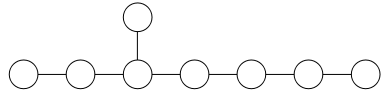
This diagram gives a concise visual summary of the root structure. Each node of this diagram represents a simple root. A line joining two simple roots indicates that they are at an angle of 120° to each other. Two simple roots which are not joined by a line are orthogonal.
Weyl group
The Weyl groupWeyl group
In mathematics, in particular the theory of Lie algebras, the Weyl group of a root system Φ is a subgroup of the isometry group of the root system. Specifically, it is the subgroup which is generated by reflections through the hyperplanes orthogonal to the roots, and as such is a finite reflection...
of E8 is of order 696729600, and can be described as O8+(2): it is of the form 2.G.2 (that is, a stem extension
Schur multiplier
In mathematical group theory, the Schur multiplier or Schur multiplicator is the second homology group H_2 of a group G.It was introduced by in his work on projective representations.-Examples and properties:...
by the cyclic group of order 2 of an extension of the cyclic group of order 2 by a group G) where G is the unique simple group
Simple group
In mathematics, a simple group is a nontrivial group whose only normal subgroups are the trivial group and the group itself. A group that is not simple can be broken into two smaller groups, a normal subgroup and the quotient group, and the process can be repeated...
of order 174182400 (which can be described as PSΩ8+(2)).
Cartan matrix
The Cartan matrixCartan matrix
In mathematics, the term Cartan matrix has three meanings. All of these are named after the French mathematician Élie Cartan. In fact, Cartan matrices in the context of Lie algebras were first investigated by Wilhelm Killing, whereas the Killing form is due to Cartan.- Lie algebras :A generalized...
of a rank r root system is an r × r matrix
Matrix (mathematics)
In mathematics, a matrix is a rectangular array of numbers, symbols, or expressions. The individual items in a matrix are called its elements or entries. An example of a matrix with six elements isMatrices of the same size can be added or subtracted element by element...
whose entries are derived from the simple roots. Specifically, the entries of the Cartan matrix are given by
where (−,−) is the Euclidean inner product and αi are the simple roots. The entries are independent of the choice of simple roots (up to ordering).
The Cartan matrix for E8 is given by
The determinant
Determinant
In linear algebra, the determinant is a value associated with a square matrix. It can be computed from the entries of the matrix by a specific arithmetic expression, while other ways to determine its value exist as well...
of this matrix is equal to 1.
E8 root lattice
The integral span of the E8 root system forms a latticeLattice (group)
In mathematics, especially in geometry and group theory, a lattice in Rn is a discrete subgroup of Rn which spans the real vector space Rn. Every lattice in Rn can be generated from a basis for the vector space by forming all linear combinations with integer coefficients...
in R8 naturally called the E8 root lattice
E8 lattice
In mathematics, the E8 lattice is a special lattice in R8. It can be characterized as the unique positive-definite, even, unimodular lattice of rank 8...
. This lattice is rather remarkable in that it is the only (nontrivial) even, unimodular lattice
Unimodular lattice
In mathematics, a unimodular lattice is a lattice of determinant 1 or −1.The E8 lattice and the Leech lattice are two famous examples.- Definitions :...
with rank less than 16.
Simple subalgebras of E8
Chevalley groups of type E8
showed that the points of the (split) algebraic group E8 (see above) over a finite fieldFinite field
In abstract algebra, a finite field or Galois field is a field that contains a finite number of elements. Finite fields are important in number theory, algebraic geometry, Galois theory, cryptography, and coding theory...
with q elements form a finite Chevalley group
Group of Lie type
In mathematics, a group of Lie type G is a group of rational points of a reductive linear algebraic group G with values in the field k. Finite groups of Lie type form the bulk of nonabelian finite simple groups...
, generally written E8(q), which is simple for any q, and constitutes one of the infinite families addressed by the classification of finite simple groups
Classification of finite simple groups
In mathematics, the classification of the finite simple groups is a theorem stating that every finite simple group belongs to one of four categories described below. These groups can be seen as the basic building blocks of all finite groups, in much the same way as the prime numbers are the basic...
. Its number of elements is given by the formula :
The first term in this sequence, the order of E8(2), namely 337804753143634806261388190614085595079991692242467651576160959909068800000 ≈ 3.38×1074, is already larger than the size of the Monster group
Monster group
In the mathematical field of group theory, the Monster group M or F1 is a group of finite order:...
. This group E8(2) is the last one described (but without its character table) in the ATLAS of Finite Groups
ATLAS of Finite Groups
The ATLAS of Finite Groups, often simply known as the ATLAS, is a group theory book by John Horton Conway, Robert Turner Curtis, Simon Phillips Norton, Richard Alan Parker and Robert Arnott Wilson , published in December 1985 by Oxford University Press and reprinted with corrections in 2003...
.
The Schur multiplier
Schur multiplier
In mathematical group theory, the Schur multiplier or Schur multiplicator is the second homology group H_2 of a group G.It was introduced by in his work on projective representations.-Examples and properties:...
of E8(q) is trivial, and its outer automorphism group is that of field automorphisms (i.e., cyclic of order f if q=pf where p is prime).
described the unipotent representations of finite groups of type E8.
Subgroups
The smaller exceptional groups E7 and E6 sit inside E8. In the compact group, both (E7×SU(2)) / (Z/2Z) and (E6×SU(3)) / (Z/3Z) are maximal subgroupMaximal subgroup
In mathematics, the term maximal subgroup is used to mean slightly different things in different areas of algebra.In group theory, a maximal subgroup H of a group G is a proper subgroup, such that no proper subgroup K contains H strictly. In other words H is a maximal element of the partially...
s of
E8.
The 248-dimensional adjoint representation of E8 may be considered in terms of its restricted representation
Restricted representation
In mathematics, restriction is a fundamental construction in representation theory of groups. Restriction forms a representation of a subgroup from a representation of the whole group. Often the restricted representation is simpler to understand...
to the first of these subgroups. It transforms under SU(2)×E7 as a sum of tensor product representations, which may be labelled as a pair of dimensions as
(Since there is a quotient in the product, these notations may strictly be taken as indicating the infinitesimal (Lie algebra) representations.)
Since the adjoint representation can be described by the roots together with the generators in the Cartan subalgebra, we may see that decomposition by looking at these. In this description:
- The (3,1) consists of the roots (0,0,0,0,0,0,1,−1), (0,0,0,0,0,0,−1,1) and the Cartan generator corresponding to the last dimension.
- The (1,133) consists of all roots with (1,1), (−1,−1), (0,0), (−1/2,−1/2) or (1/2,1/2) in the last two dimensions, together with the Cartan generators corresponding to the first 7 dimensions.
- The (2,56) consists of all roots with permutations of (1,0), (−1,0) or (1/2,−1/2) in the last two dimensions.
The 248-dimensional adjoint representation of E8, when similarly restricted, transforms under SU(3)×E6 as:
We may again see the decomposition by looking at the roots together with the generators in the Cartan subalgebra. In this description:
- The (8,1) consists of the roots with permutations of (1,−1,0) in the last three dimensions, together with the Cartan generator corresponding to the last two dimensions.
- The (1,78) consists of all roots with (0,0,0), (−1/2,−1/2,−1/2) or (1/2,1/2,1/2) in the last three dimensions, together with the Cartan generators corresponding to the first 6 dimensions.
- The (3,27) consists of all roots with permutations of (1,0,0), (1,1,0) or (−1/2,1/2,1/2) in the last three dimensions.
- The (3,27) consists of all roots with permutations of (−1,0,0), (−1,−1,0) or (1/2,−1/2,−1/2) in the last three dimensions.
The finite quasisimple groups that can embed in (the compact form of) E8 were found by .
The Dempwolff group
Dempwolff group
In mathematical finite group theory, the Dempwolff group is a finite group of order 319979520 = 215·32·5·7·31, that is the unique nonsplit extension 25·GL5 of GL5 by its natural module of order 25...
is a subgroup of (the compact form of) E8. It is contained in the Thompson sporadic group, which acts on the underlying vector space of the Lie group E8 but does not preserve the Lie bracket. The Thompson group fixes a lattice and does preserve the Lie bracket of this lattice mod 3, giving an embedding of the Thompson group into E8(F3).
Invariant polynomial
E8 is the automorphism group of an octic polynomial invariant, thought to be the lowest order symmetric polynomial invariant of E8.Applications
The E8 Lie group has applications in theoretical physicsTheoretical physics
Theoretical physics is a branch of physics which employs mathematical models and abstractions of physics to rationalize, explain and predict natural phenomena...
, in particular in string theory
String theory
String theory is an active research framework in particle physics that attempts to reconcile quantum mechanics and general relativity. It is a contender for a theory of everything , a manner of describing the known fundamental forces and matter in a mathematically complete system...
and supergravity
Supergravity
In theoretical physics, supergravity is a field theory that combines the principles of supersymmetry and general relativity. Together, these imply that, in supergravity, the supersymmetry is a local symmetry...
. The group E8×E8 (the Cartesian product
Cartesian product
In mathematics, a Cartesian product is a construction to build a new set out of a number of given sets. Each member of the Cartesian product corresponds to the selection of one element each in every one of those sets...
of two copies of E8) serves as the gauge group of one of the two types of heterotic string
Heterotic string
In physics, a heterotic string is a peculiar mixture of the bosonic string and the superstring...
and is one of two anomaly-free
Anomaly (physics)
In quantum physics an anomaly or quantum anomaly is the failure of a symmetry of a theory's classical action to be a symmetry of any regularization of the full quantum theory. In classical physics an anomaly is the failure of a symmetry to be restored in the limit in which the symmetry-breaking...
gauge groups that can be coupled to the N = 1 supergravity in 10 dimensions.
E8 is the U-duality
U-duality
In physics, U-duality is a symmetry of string theory or M-theory combining S-duality and T-duality transformations. The term is most often met in the context of the "U-duality group" of M-theory as defined on a particular background space . This is the union of all the S- and T-dualities...
group of supergravity on an eight-torus (in its split form).
One way to incorporate the standard model
Standard Model
The Standard Model of particle physics is a theory concerning the electromagnetic, weak, and strong nuclear interactions, which mediate the dynamics of the known subatomic particles. Developed throughout the mid to late 20th century, the current formulation was finalized in the mid 1970s upon...
of particle physics into heterotic string theory is the symmetry breaking
Spontaneous symmetry breaking
Spontaneous symmetry breaking is the process by which a system described in a theoretically symmetrical way ends up in an apparently asymmetric state....
of E8 to its maximal subalgebra SU(3)×E6.
In 1982, Michael Freedman
Michael Freedman
Michael Hartley Freedman is a mathematician at Microsoft Station Q, a research group at the University of California, Santa Barbara. In 1986, he was awarded a Fields Medal for his work on the Poincaré conjecture. Freedman and Robion Kirby showed that an exotic R4 manifold exists.Freedman was born...
used the E8 lattice
E8 lattice
In mathematics, the E8 lattice is a special lattice in R8. It can be characterized as the unique positive-definite, even, unimodular lattice of rank 8...
to construct an example of a topological
Topological manifold
In mathematics, a topological manifold is a topological space which looks locally like Euclidean space in a sense defined below...
4-manifold
4-manifold
In mathematics, 4-manifold is a 4-dimensional topological manifold. A smooth 4-manifold is a 4-manifold with a smooth structure. In dimension four, in marked contrast with lower dimensions, topological and smooth manifolds are quite different...
, the E8 manifold
E8 manifold
In mathematics, the E8 manifold is the unique compact, simply connected topological 4-manifold with intersection form the E8 lattice.The E8 manifold was discovered by Michael Freedman in 1982...
, which has no smooth structure
Differential structure
In mathematics, an n-dimensional differential structure on a set M makes M into an n-dimensional differential manifold, which is a topological manifold with some additional structure that allows us to do differential calculus on the manifold...
.
reported that in an experiment with a cobalt
Cobalt
Cobalt is a chemical element with symbol Co and atomic number 27. It is found naturally only in chemically combined form. The free element, produced by reductive smelting, is a hard, lustrous, silver-gray metal....
-niobium
Niobium
Niobium or columbium , is a chemical element with the symbol Nb and atomic number 41. It's a soft, grey, ductile transition metal, which is often found in the pyrochlore mineral, the main commercial source for niobium, and columbite...
crystal, under certain physical conditions the electron spins in it exhibited two of the 8 peaks related to E8 predicted by .
External links
Related to the calculation of the Lusztig–Vogan polynomials:- Atlas of Lie groups
- Kazhdan–Lusztig–Vogan Polynomials for E8
- D. Vogan, Narrative of the Project to compute Kazhdan–Lusztig Polynomials for E8
- D. Vogan, The Character Table for E8, or How We Wrote Down a 453,060 × 453,060 Matrix and Found Happiness Slides for a popular talk on E8.
- The n-Category Café — University of Texas blog posting by John Baez on E8
Other:
- Graphic representation of E8 root system from MIT
- The list of dimensions of irreducible representations of the complex form of E8 is sequence A121732 in the OEIS.