

.gif)
E7 (mathematics)

Encyclopedia
In mathematics
, E7 is the name of several closely related Lie group
s, linear algebraic group
s or their Lie algebra
s , all of which have dimension 133; the same notation E7 is used for the corresponding root lattice, which has rank 7. The designation E7 comes from the Cartan–Killing classification of the complex simple Lie algebras, which fall into four infinite series labeled An, Bn, Cn, Dn, and five exceptional cases labeled E6, E7, E8
, F4, and G2. The E7 algebra is thus one of the five exceptional cases.
The fundamental group of the (adjoint) complex form, compact real form, or any algebraic version of E7 is the cyclic group
Z/2Z, and its outer automorphism group
is the trivial group
. The dimension of its fundamental representation
is 56.
133 can be considered as a simple real Lie group of real dimension 266. This is has fundamental group Z/2Z, has maximal compact
subgroup the compact form (see below) of E7, and has an outer automorphism group of order 2 generated by complex conjugation.
As well as the complex Lie group of type E7, there are four real forms of the Lie algebra, and correspondingly four real forms of the group with trivial center (all of which have an algebraic double cover, and three of which have further non-algebraic covers, giving further real forms), all of real dimension 133, as follows:
For a complete list of real forms of simple Lie algebras, see the list of simple Lie groups.
The compact real form of E7 is the isometry group
of a 64-dimensional Riemannian manifold
known informally as the 'quateroctonionic projective plane' because it can be built using an algebra that is the tensor product of the quaternion
s and the octonion
s. This can be seen systematically using a construction known as the magic square
, due to Hans Freudenthal
and Jacques Tits
.
The Tits–Koecher construction produces forms of the E7 Lie algebra from Albert algebra
s, 27-dimensional exceptional Jordan algebra
s.
for the Lie algebra, one can define E7 as a linear algebraic group over the integers and, consequently, over any commutative ring and in particular over any field: this defines the so-called split (sometimes also known as “untwisted”) adjoint form of E7. Over an algebraically closed field, this and its double cover are the only forms; however, over other fields, there are often many other forms, or “twists” of E7, which are classified in the general framework of Galois cohomology
(over a perfect field
k) by the set which, because the Dynkin diagram of E7 (see below) has no automorphisms, coincides with
  .
.
Over the field of real numbers, the real component of the identity of these algebraically twisted forms of E7 coincide with the three real Lie groups mentioned above, but with a subtlety concerning the fundamental group: all adjoint forms of E7 have fundamental group Z/2Z in the sense of algebraic geometry, meaning that they admit exactly one double cover; the further non-compact real Lie group forms of E7 are therefore not algebraic and admit no faithful finite-dimensional representations.
Over finite fields, the Lang–Steinberg theorem implies that , meaning that E7 has no twisted forms: see below.
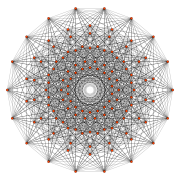 Even though the roots span a 7-dimensional space, it is more symmetric and convenient to represent them as vectors lying in a 7-dimensional subspace of an 8-dimensional vector space.
The roots are all the 8×7 permutations of
(1,−1,0,0,0,0,0,0)
and all the permutations of
(1/2,1/2,1/2,1/2,−1/2,−1/2,−1/2,−1/2)
Note that the 7-dimensional subspace is the subspace where the sum of all the eight coordinates is zero. There are 126 roots.
The simple root
s are
We have ordered them so that their corresponding nodes in the Dynkin diagram are ordered from left to right (in the diagram depicted above) with the side node last.
All permutations of
 preserving the zero at the last entry,
all of the following roots with an even number of +1/2

and the two following roots
Thus the generators comprise of a 66-dimensional so(12) subalgebra as well as 65 generators that transform as two self-conjugate Weyl spinors of spin(12) of opposite chirality and their chirality generator, and two other generators of chiralities
One choice of simple root
s for E7 is given by the rows of the following matrix:
Again we have ordered them so that their corresponding nodes in the Dynkin diagram are ordered from left to right (in the diagram depicted above) with the side node last.
of E7 is of order 2903040: it is the direct product of the cyclic group of order 2 and the unique simple group
of order 1451520 (which can be described as PSp6(2) or PSΩ7(2)).

In addition to the 133-dimensional adjoint representation, there is a 56-dimensional "vector" representation, to be found in the E8 adjoint representation.
The characters of finite dimensional representations of the real and complex Lie algebras and Lie groups are all given by the Weyl character formula
. The dimensions of the smallest irreducible representations are :
The underlined terms in the sequence above are the dimensions of those irreducible representations possessed by the adjoint form of E7 (equivalently, those whose weights belong to the root lattice of E7), whereas the full sequence gives the dimensions of the irreducible representations of the simply connected form of E7. There exist non-isomorphic irreducible representation of dimensions 1903725824, 16349520330, etc.
The fundamental representation
s are those with dimensions 133, 8645, 365750, 27664, 1539, 56 and 912 (corresponding to the seven nodes in the Dynkin diagram in the order chosen for the Cartan matrix above, i.e., the nodes are read in the six-node chain first, with the last node being connected to the third).
 is the automorphism group of the following pair of polynomials in 56 non-commutative variables. We divide the variables into two groups of 28, X=(p,P) and Y=(q,Q) where p and q are real variables and P and Q are 3x3 octonion
hermitian matrices. X and Y are 28 dimensional vectors. Then the first invariant is the symplectic invariant of Sp(56,R):

The second more complicated invariant is a symmetric quartic polynomial:

 is a sort of conjugate of M such that
  In particular if

with a,b,c real and A,B,C octonions then

The binary circle operator is defined by .
.
with q elements of the (split) algebraic group E7 (see above), whether of the adjoint (centerless) or simply connected form (its algebraic universal cover), give a finite Chevalley group
. This is closely connected to the group written E7(q), however there is ambiguity in this notation, which can stand for several things:
From the finite group perspective, the relation between these three groups, which is quite analogous to that between SLn(q), PGLn(q) and PSLn(q), can be summarized as follows: E7(q) is simple for any q, E7,sc(q) is its Schur cover
, and the E7,ad(q) lies in its automorphism group; furthermore, when q is a power of 2, all three coincide, and otherwise (when q is odd), the Schur multiplier of E7(q) is 2 and E7(q) is of index 2 in E7,ad(q), which explains why E7,sc(q) and E7,ad(q) are often written as 2·E7(q) and E7(q)·2. From the algebraic group perspective, it is less common for E7(q) to refer to the finite simple group, because the latter is not in a natural way the set of points of an algebraic group over Fq unlike E7,sc(q) and E7,ad(q).
As mentioned above, E7(q) is simple for any q, and it constitutes one of the infinite families addressed by the classification of finite simple groups
. Its number of elements is given by the formula :
The order of E7,sc(q) or E7,ad(q) (both are equal) can be obtained by removing the dividing factor gcd(2,q−1) . The Schur multiplier of E7(q) is gcd(2,q−1), and its outer automorphism group is the product of the diagonal automorphism group Z/gcd(2,q−1)Z (given by the action of E7,ad(q)) and the group of field automorphisms (i.e., cyclic of order f if q=pf where p is prime).
in four dimensions, which is a dimensional reduction
from 11 dimensional supergravity, admit an E7 bosonic global symmetry and an SU(8) bosonic local symmetry. The fermions are in representations of SU(8), the gauge fields are in a representation of E7, and the scalars are in a representation of both (Gravitons are singlet
s with respect to both). Physical states are in representations of the coset .
In string theory
, E7 appears as a part of the gauge group of one the (unstable and non-supersymmetric) versions of the heterotic string
. It can also appear in the unbroken gauge group in six-dimensional compactifications of heterotic string theory, for instance on the four-dimensional surface K3.
Mathematics
Mathematics is the study of quantity, space, structure, and change. Mathematicians seek out patterns and formulate new conjectures. Mathematicians resolve the truth or falsity of conjectures by mathematical proofs, which are arguments sufficient to convince other mathematicians of their validity...
, E7 is the name of several closely related Lie group
Lie group
In mathematics, a Lie group is a group which is also a differentiable manifold, with the property that the group operations are compatible with the smooth structure...
s, linear algebraic group
Algebraic group
In algebraic geometry, an algebraic group is a group that is an algebraic variety, such that the multiplication and inverse are given by regular functions on the variety...
s or their Lie algebra
Lie algebra
In mathematics, a Lie algebra is an algebraic structure whose main use is in studying geometric objects such as Lie groups and differentiable manifolds. Lie algebras were introduced to study the concept of infinitesimal transformations. The term "Lie algebra" was introduced by Hermann Weyl in the...
s
, all of which have dimension 133; the same notation E7 is used for the corresponding root lattice, which has rank 7. The designation E7 comes from the Cartan–Killing classification of the complex simple Lie algebras, which fall into four infinite series labeled An, Bn, Cn, Dn, and five exceptional cases labeled E6, E7, E8E8 (mathematics)
In mathematics, E8 is any of several closely related exceptional simple Lie groups, linear algebraic groups or Lie algebras of dimension 248; the same notation is used for the corresponding root lattice, which has rank 8...
, F4, and G2. The E7 algebra is thus one of the five exceptional cases.
The fundamental group of the (adjoint) complex form, compact real form, or any algebraic version of E7 is the cyclic group
Cyclic group
In group theory, a cyclic group is a group that can be generated by a single element, in the sense that the group has an element g such that, when written multiplicatively, every element of the group is a power of g .-Definition:A group G is called cyclic if there exists an element g...
Z/2Z, and its outer automorphism group
Outer automorphism group
In mathematics, the outer automorphism group of a group Gis the quotient Aut / Inn, where Aut is the automorphism group of G and Inn is the subgroup consisting of inner automorphisms. The outer automorphism group is usually denoted Out...
is the trivial group
Trivial group
In mathematics, a trivial group is a group consisting of a single element. All such groups are isomorphic so one often speaks of the trivial group. The single element of the trivial group is the identity element so it usually denoted as such, 0, 1 or e depending on the context...
. The dimension of its fundamental representation
Fundamental representation
In representation theory of Lie groups and Lie algebras, a fundamental representation is an irreducible finite-dimensional representation of a semisimple Lie group...
is 56.
Real and complex forms
There is a unique complex Lie algebra of type E7, corresponding to a complex group of complex dimension 133. The complex adjoint Lie group E7 of complex dimensionComplex dimension
In mathematics, complex dimension usually refers to the dimension of a complex manifold M, or complex algebraic variety V. If the complex dimension is d, the real dimension will be 2d...
133 can be considered as a simple real Lie group of real dimension 266. This is has fundamental group Z/2Z, has maximal compact
Compact space
In mathematics, specifically general topology and metric topology, a compact space is an abstract mathematical space whose topology has the compactness property, which has many important implications not valid in general spaces...
subgroup the compact form (see below) of E7, and has an outer automorphism group of order 2 generated by complex conjugation.
As well as the complex Lie group of type E7, there are four real forms of the Lie algebra, and correspondingly four real forms of the group with trivial center (all of which have an algebraic double cover, and three of which have further non-algebraic covers, giving further real forms), all of real dimension 133, as follows:
- The compact form (which is usually the one meant if no other information is given), which is has fundamental group Z/2Z and has trivial outer automorphism group.
- The split form, sometimes known as EV or E7(7), which has maximal compact subgroup SU8/(±1), fundamental group cyclic of order 4 and outer automorphism group of order 2.
- A form sometimes known as EVI or E7(-5), which has maximal compact subgroup SU2·SO12/(center), fundamental group non-cyclic of order 4 and trivial outer automorphism group.
- A form sometimes known as EVII or E7(-25), which has maximal compact subgroup SO2·E6/(center), infinite cyclic findamental group and outer automorphism group of order 2.
For a complete list of real forms of simple Lie algebras, see the list of simple Lie groups.
The compact real form of E7 is the isometry group
Isometry group
In mathematics, the isometry group of a metric space is the set of all isometries from the metric space onto itself, with the function composition as group operation...
of a 64-dimensional Riemannian manifold
Riemannian manifold
In Riemannian geometry and the differential geometry of surfaces, a Riemannian manifold or Riemannian space is a real differentiable manifold M in which each tangent space is equipped with an inner product g, a Riemannian metric, which varies smoothly from point to point...
known informally as the 'quateroctonionic projective plane' because it can be built using an algebra that is the tensor product of the quaternion
Quaternion
In mathematics, the quaternions are a number system that extends the complex numbers. They were first described by Irish mathematician Sir William Rowan Hamilton in 1843 and applied to mechanics in three-dimensional space...
s and the octonion
Octonion
In mathematics, the octonions are a normed division algebra over the real numbers, usually represented by the capital letter O, using boldface O or blackboard bold \mathbb O. There are only four such algebras, the other three being the real numbers R, the complex numbers C, and the quaternions H...
s. This can be seen systematically using a construction known as the magic square
Freudenthal magic square
In mathematics, the Freudenthal magic square is a construction relating several Lie groups. It is named after Hans Freudenthal and Jacques Tits, who developed the idea independently. It associates a Lie group to a pair of division algebras A, B...
, due to Hans Freudenthal
Hans Freudenthal
Hans Freudenthal was a Dutch mathematician. He made substantial contributions to algebraic topology and also took an interest in literature, philosophy, history and mathematics education....
and Jacques Tits
Jacques Tits
Jacques Tits is a Belgian and French mathematician who works on group theory and geometry and who introduced Tits buildings, the Tits alternative, and the Tits group.- Career :Tits received his doctorate in mathematics at the age of 20...
.
The Tits–Koecher construction produces forms of the E7 Lie algebra from Albert algebra
Albert algebra
In mathematics, an Albert algebra is a 27-dimensional exceptional Jordan algebra. They are named after Abraham Adrian Albert, who pioneered the study of non-associative algebras, usually working over the real numbers. Over the real numbers, there are two such Jordan algebras up to isomorphism...
s, 27-dimensional exceptional Jordan algebra
Jordan algebra
In abstract algebra, a Jordan algebra is an algebra over a field whose multiplication satisfies the following axioms:# xy = yx # = x ....
s.
E7 as an algebraic group
By means of a Chevalley basisChevalley basis
In mathematics, a Chevalley basis for a simple complex Lie algebra isa basis constructed by Claude Chevalley with the property that all structure constants are integers...
for the Lie algebra, one can define E7 as a linear algebraic group over the integers and, consequently, over any commutative ring and in particular over any field: this defines the so-called split (sometimes also known as “untwisted”) adjoint form of E7. Over an algebraically closed field, this and its double cover are the only forms; however, over other fields, there are often many other forms, or “twists” of E7, which are classified in the general framework of Galois cohomology
Galois cohomology
In mathematics, Galois cohomology is the study of the group cohomology of Galois modules, that is, the application of homological algebra to modules for Galois groups...
(over a perfect field
Perfect field
In algebra, a field k is said to be perfect if any one of the following equivalent conditions holds:* Every irreducible polynomial over k has distinct roots.* Every polynomial over k is separable.* Every finite extension of k is separable...
k) by the set
which, because the Dynkin diagram of E7 (see below) has no automorphisms, coincides with .Over the field of real numbers, the real component of the identity of these algebraically twisted forms of E7 coincide with the three real Lie groups mentioned above, but with a subtlety concerning the fundamental group: all adjoint forms of E7 have fundamental group Z/2Z in the sense of algebraic geometry, meaning that they admit exactly one double cover; the further non-compact real Lie group forms of E7 are therefore not algebraic and admit no faithful finite-dimensional representations.
Over finite fields, the Lang–Steinberg theorem implies that
, meaning that E7 has no twisted forms: see below.Root system
The roots are all the 8×7 permutations of
(1,−1,0,0,0,0,0,0)
and all the
permutations of(1/2,1/2,1/2,1/2,−1/2,−1/2,−1/2,−1/2)
Note that the 7-dimensional subspace is the subspace where the sum of all the eight coordinates is zero. There are 126 roots.
The simple root
Simple root
in mathematics the term simple root can refer to one of two unrelated notions:*A simple root of a polynomial is a root of multiplicity one*A simple root in a root system is a member of a subset determined by a choice of positive roots...
s are
We have ordered them so that their corresponding nodes in the Dynkin diagram are ordered from left to right (in the diagram depicted above) with the side node last.
An alternative description
An alternative (7-dimensional) description of the root system, which is useful in considering as a subgroup of E8, is the following:All
permutations of preserving the zero at the last entry,all of the following roots with an even number of +1/2
and the two following roots
Thus the generators comprise of a 66-dimensional so(12) subalgebra as well as 65 generators that transform as two self-conjugate Weyl spinors of spin(12) of opposite chirality and their chirality generator, and two other generators of chiralities
One choice of simple root
Simple root
in mathematics the term simple root can refer to one of two unrelated notions:*A simple root of a polynomial is a root of multiplicity one*A simple root in a root system is a member of a subset determined by a choice of positive roots...
s for E7 is given by the rows of the following matrix:
Again we have ordered them so that their corresponding nodes in the Dynkin diagram are ordered from left to right (in the diagram depicted above) with the side node last.
Weyl group
The Weyl groupWeyl group
In mathematics, in particular the theory of Lie algebras, the Weyl group of a root system Φ is a subgroup of the isometry group of the root system. Specifically, it is the subgroup which is generated by reflections through the hyperplanes orthogonal to the roots, and as such is a finite reflection...
of E7 is of order 2903040: it is the direct product of the cyclic group of order 2 and the unique simple group
Simple group
In mathematics, a simple group is a nontrivial group whose only normal subgroups are the trivial group and the group itself. A group that is not simple can be broken into two smaller groups, a normal subgroup and the quotient group, and the process can be repeated...
of order 1451520 (which can be described as PSp6(2) or PSΩ7(2)).
Cartan matrix
Important subalgebras and representations
E7 has an SU(8) subalgebra, as is evident by noting that in the 8-dimensional description of the root system, the first group of roots are identical to the roots of SU(8) (with the same Cartan subalgebra as in the E7).In addition to the 133-dimensional adjoint representation, there is a 56-dimensional "vector" representation, to be found in the E8 adjoint representation.
The characters of finite dimensional representations of the real and complex Lie algebras and Lie groups are all given by the Weyl character formula
Weyl character formula
In mathematics, the Weyl character formula in representation theory describes the characters of irreducible representations of compact Lie groups in terms of their highest weights. It was proved by ....
. The dimensions of the smallest irreducible representations are :
- 1, 56, 133, 912, 1463, 1539, 6480, 7371, 8645, 24320, 27664, 40755, 51072, 86184, 150822, 152152, 238602, 253935, 293930, 320112, 362880, 365750, 573440, 617253, 861840, 885248, 915705, 980343, 2273920, 2282280, 2785552, 3424256, 3635840...
The underlined terms in the sequence above are the dimensions of those irreducible representations possessed by the adjoint form of E7 (equivalently, those whose weights belong to the root lattice of E7), whereas the full sequence gives the dimensions of the irreducible representations of the simply connected form of E7. There exist non-isomorphic irreducible representation of dimensions 1903725824, 16349520330, etc.
The fundamental representation
Fundamental representation
In representation theory of Lie groups and Lie algebras, a fundamental representation is an irreducible finite-dimensional representation of a semisimple Lie group...
s are those with dimensions 133, 8645, 365750, 27664, 1539, 56 and 912 (corresponding to the seven nodes in the Dynkin diagram in the order chosen for the Cartan matrix above, i.e., the nodes are read in the six-node chain first, with the last node being connected to the third).
E7 Polynomial Invariants
is the automorphism group of the following pair of polynomials in 56 non-commutative variables. We divide the variables into two groups of 28, X=(p,P) and Y=(q,Q) where p and q are real variables and P and Q are 3x3 octonionOctonion
In mathematics, the octonions are a normed division algebra over the real numbers, usually represented by the capital letter O, using boldface O or blackboard bold \mathbb O. There are only four such algebras, the other three being the real numbers R, the complex numbers C, and the quaternions H...
hermitian matrices. X and Y are 28 dimensional vectors. Then the first invariant is the symplectic invariant of Sp(56,R):
The second more complicated invariant is a symmetric quartic polynomial:
is a sort of conjugate of M such that In particular ifwith a,b,c real and A,B,C octonions then
The binary circle operator is defined by
.Chevalley groups of type E7
The points over a finite fieldFinite field
In abstract algebra, a finite field or Galois field is a field that contains a finite number of elements. Finite fields are important in number theory, algebraic geometry, Galois theory, cryptography, and coding theory...
with q elements of the (split) algebraic group E7 (see above), whether of the adjoint (centerless) or simply connected form (its algebraic universal cover), give a finite Chevalley group
Group of Lie type
In mathematics, a group of Lie type G is a group of rational points of a reductive linear algebraic group G with values in the field k. Finite groups of Lie type form the bulk of nonabelian finite simple groups...
. This is closely connected to the group written E7(q), however there is ambiguity in this notation, which can stand for several things:
- the finite group consisting of the points over Fq of the simply connected form of E7 (for clarity, this can be written E7,sc(q) or
 , and is known as the “universal” Chevalley group of type E7 over Fq),
 - (rarely) the finite group consisting of the points over Fq of the adjoint form of E7 (for clarity, this can be written E7,ad(q), and is known as the “adjoint” Chevalley group of type E7 over Fq), or
- the finite group which is the image of the natural map from the former to the latter: this is what will be denoted by E7(q) in the following, as is most common in texts dealing with finite groups.
From the finite group perspective, the relation between these three groups, which is quite analogous to that between SLn(q), PGLn(q) and PSLn(q), can be summarized as follows: E7(q) is simple for any q, E7,sc(q) is its Schur cover
Schur multiplier
In mathematical group theory, the Schur multiplier or Schur multiplicator is the second homology group H_2 of a group G.It was introduced by in his work on projective representations.-Examples and properties:...
, and the E7,ad(q) lies in its automorphism group; furthermore, when q is a power of 2, all three coincide, and otherwise (when q is odd), the Schur multiplier of E7(q) is 2 and E7(q) is of index 2 in E7,ad(q), which explains why E7,sc(q) and E7,ad(q) are often written as 2·E7(q) and E7(q)·2. From the algebraic group perspective, it is less common for E7(q) to refer to the finite simple group, because the latter is not in a natural way the set of points of an algebraic group over Fq unlike E7,sc(q) and E7,ad(q).
As mentioned above, E7(q) is simple for any q, and it constitutes one of the infinite families addressed by the classification of finite simple groups
Classification of finite simple groups
In mathematics, the classification of the finite simple groups is a theorem stating that every finite simple group belongs to one of four categories described below. These groups can be seen as the basic building blocks of all finite groups, in much the same way as the prime numbers are the basic...
. Its number of elements is given by the formula :
The order of E7,sc(q) or E7,ad(q) (both are equal) can be obtained by removing the dividing factor gcd(2,q−1) . The Schur multiplier of E7(q) is gcd(2,q−1), and its outer automorphism group is the product of the diagonal automorphism group Z/gcd(2,q−1)Z (given by the action of E7,ad(q)) and the group of field automorphisms (i.e., cyclic of order f if q=pf where p is prime).
Importance in physics
N = 8 supergravitySupergravity
In theoretical physics, supergravity is a field theory that combines the principles of supersymmetry and general relativity. Together, these imply that, in supergravity, the supersymmetry is a local symmetry...
in four dimensions, which is a dimensional reduction
Dimensional reduction
In physics, a theory in D spacetime dimensions can be redefined in a lower number of dimensions d, by taking all the fields to be independent of the location in the extra D − d dimensions....
from 11 dimensional supergravity, admit an E7 bosonic global symmetry and an SU(8) bosonic local symmetry. The fermions are in representations of SU(8), the gauge fields are in a representation of E7, and the scalars are in a representation of both (Gravitons are singlet
Singlet
A pair of spin-1/2 particles can be combined to form one of three states of total spin 1 called the triplet, or a state of spin 0 which is called the singlet. In theoretical physics, a singlet usually refers to a one-dimensional representation...
s with respect to both). Physical states are in representations of the coset .
In string theory
String theory
String theory is an active research framework in particle physics that attempts to reconcile quantum mechanics and general relativity. It is a contender for a theory of everything , a manner of describing the known fundamental forces and matter in a mathematically complete system...
, E7 appears as a part of the gauge group of one the (unstable and non-supersymmetric) versions of the heterotic string
Heterotic string
In physics, a heterotic string is a peculiar mixture of the bosonic string and the superstring...
. It can also appear in the unbroken gauge group in six-dimensional compactifications of heterotic string theory, for instance on the four-dimensional surface K3.