

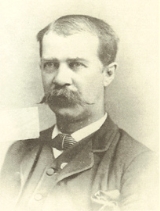
Dyer Lum

Encyclopedia
Dyer Daniel Lum was a 19th-century American anarchist
labor activist and poet. A leading anarcho-syndicalist and a prominent left-wing intellectual
of the 1880s, he is remembered as the lover and mentor of early anarcha-feminist Voltairine de Cleyre
.
Lum was a prolific writer who wrote a number of key anarchist texts, and contributed to publications including Mother Earth
, Twentieth Century, Liberty
(Benjamin Tucker
's individualist anarchist
journal), The Alarm (the journal of the International Working People's Association
) and The Open Court among others. Following the arrest of Albert Parsons
, Lum edited The Alarm from 1892–1893.
Traditionally portrayed as a "genteel, theoretical anarchist", Lum has recently been recast by the scholarship of Paul Avrich
as an "uncompromising rebel thirsty for violence and martyrdom" in the light of his involvement in the Haymarket affair
in 1886.
. In hopes of bringing about the end of slavery
, he volunteered to fight on the Union
side in the American Civil War
. He served as adjunct in the Fourteenth New York cavalry, and later as a brevet captain
, fighting in the Red River Campaign
. A bookbinder by trade, he became active in the labor movement in the aftermath of the war and ran for lieutenant governor
of Massachusetts
on the ticket of abolitionist Wendell Phillips
in 1876.
He became widely known in 1877 after a period traveling across the country as secretary to a congressional committee appointed to "inquire into the depression of labor." Between 1880 and 1892, he was an advocate of violence and trade unionism, and in later years was "the moving spirit of the American group" which worked for the commutation of Alexander Berkman
's sentence for the latter's attempted assassination of Henry Clay Frick.
Lum committed suicide in 1893 after suffering from severe depression, although at the time the cause of death was reported in the anarchist press as "fatty degeneration of the heart."
, he was twenty-seven years her elder and had lived a life rich in experience. They forged an "unshakable" friendship, and Lum had a profound influence on Voltairine de Cleyre's political development, which evolved in an opposite direction to his – she started out as an orthodox Tuckerite
individualist, became increasingly involved with the radical labor movement and ultimately called for a panarchist
"anarchism without adjectives
". Their relationship ended after five years of intense involvement, leaving their planned collaborative project– a lengthy social and philosophical anarchist novel
– ultimately unpublished.
in Chicago
in 1886. In an 1891 essay, he wrote that on the afternoon of May 4, August Spies
sent word to the militants that they were not to bring arms to the Haymarket. This order was not respected, Lum noted– "one man disobeyed that order; always self-determined, he acted upon his own responsibility, preferring to be prepared for resistance to onslaught rather than to quietly imitate the spiritual "lamb led to slaughter." Lum asserted that the eight defendants were initially unaware of the bomb-thrower's identity, although it became known to two of them ("but neither Spies nor Parsons
…"), believed by Paul Avrich
to be George Engel
and Adolph Fischer
. In Lum's account, the bomb-thrower's name "was never mentioned in the trial and is today unknown to the public." Paul Avrich
attests that Lum urged Albert Parsons to refuse clemency, and plotted to rescue the anarchists from Cook County Jail by attacking it with explosives. According to de Cleyre, he then assisted the suicide
of one of the eight defendants, Louis Lingg
, by smuggling into Lingg's prison cell a dynamite
cap concealed in a cigar
, which Lingg subsequently lit, thereby blowing off half his face and leaving himself lingering for several hours in torturous pain before dying.
was a fusion of individualist anarchist economics
– "a radicalized form of laissez-faire
economics" inspired by the Boston anarchists– with radical labor organization similar to that of the Chicago anarchists of the time. Lum's ideas have variously been described as individualist anarchist
, syndicalist, mutualist
, and anarcho-communist, as well as anarchist without adjectives. Herbert Spencer
and Pierre-Joseph Proudhon
influenced Lum strongly in his individualist tendency. He developed a "mutualist
" theory of unions and as such was active within the Knights of Labor
and later promoted anti-political
strategies in the American Federation of Labor
. Frustration with abolitionism
, spiritualism
, and labor reform caused Lum to embrace anarchism and radicalize workers, as he came to believe that revolution
would inevitably involve a violent struggle between the working class
and the employing class. Convinced of the necessity of violence to enact social change he volunteered to fight in the American Civil War
, hoping thereby to bring about the end of slavery
. Kevin Carson has praised Lum's fusion of individualist laissez-faire economics with radical labor activism as "creative" and described him as "more significant than any in the Boston group".
Lum argued in The Economics of Anarchy that the "labor problem" was a result of intervention by the state in creating monopolies
, with particular reference to the land and money monopolies. Lum advocated the destruction of the land monopoly, which he saw as a government-granted monopoly
, by abolishing land titles
and to allow free access to land, thus making the extraction of rent impossible. Similarly, mutual banks set up to issue their own currencies would end the state monopoly and undercut the ability of banks and lenders to charge interest.
Anarchism
Anarchism is generally defined as the political philosophy which holds the state to be undesirable, unnecessary, and harmful, or alternatively as opposing authority in the conduct of human relations...
labor activist and poet. A leading anarcho-syndicalist and a prominent left-wing intellectual
Intellectual
An intellectual is a person who uses intelligence and critical or analytical reasoning in either a professional or a personal capacity.- Terminology and endeavours :"Intellectual" can denote four types of persons:...
of the 1880s, he is remembered as the lover and mentor of early anarcha-feminist Voltairine de Cleyre
Voltairine de Cleyre
Voltairine de Cleyre was an American anarchist writer and feminist. She was a prolific writer and speaker, opposing the state, marriage, and the domination of religion in sexuality and women's lives. She began her activist career in the freethought movement...
.
Lum was a prolific writer who wrote a number of key anarchist texts, and contributed to publications including Mother Earth
Mother Earth (journal)
This version of Mother Earth was an anarchist periodical aimed at bringing up progressive issues, and discuss these. It was in circulation among people in the radical community in the United States from 1933 - 1934....
, Twentieth Century, Liberty
Liberty (1881-1908)
Liberty was a nineteenth century anarchist periodical published in the United States by Benjamin Tucker, from August 1881 to April 1908. The periodical was instrumental in developing and formalizing the individualist anarchist philosophy through publishing essays and serving as a format for...
(Benjamin Tucker
Benjamin Tucker
Benjamin Ricketson Tucker was a proponent of American individualist anarchism in the 19th century, and editor and publisher of the individualist anarchist periodical Liberty.-Summary:Tucker says that he became an anarchist at the age of 18...
's individualist anarchist
Individualist anarchism
Individualist anarchism refers to several traditions of thought within the anarchist movement that emphasize the individual and his or her will over external determinants such as groups, society, traditions, and ideological systems. Individualist anarchism is not a single philosophy but refers to a...
journal), The Alarm (the journal of the International Working People's Association
International Working People's Association
The International Working People's Association , sometimes known as the "Black International," was an international anarchist political organization established in 1881 at a convention held in London, England...
) and The Open Court among others. Following the arrest of Albert Parsons
Albert Parsons
Albert Richard Parsons was a pioneer American socialist and later anarchist newspaper editor, orator, and labor activist...
, Lum edited The Alarm from 1892–1893.
Traditionally portrayed as a "genteel, theoretical anarchist", Lum has recently been recast by the scholarship of Paul Avrich
Paul Avrich
Paul Avrich was a professor and historian. He taught at Queens College, City University of New York, for most of his life and was vital in preserving the history of the anarchist movement in Russia and the United States....
as an "uncompromising rebel thirsty for violence and martyrdom" in the light of his involvement in the Haymarket affair
Haymarket affair
The Haymarket affair was a demonstration and unrest that took place on Tuesday May 4, 1886, at the Haymarket Square in Chicago. It began as a rally in support of striking workers. An unknown person threw a dynamite bomb at police as they dispersed the public meeting...
in 1886.
Life
Lum was a descendent of the Tappan family; his grandfather was a Revolutionist and secretary to Samuel GompersSamuel Gompers
Samuel Gompers was an English-born American cigar maker who became a labor union leader and a key figure in American labor history. Gompers founded the American Federation of Labor , and served as that organization's president from 1886 to 1894 and from 1895 until his death in 1924...
. In hopes of bringing about the end of slavery
Slavery
Slavery is a system under which people are treated as property to be bought and sold, and are forced to work. Slaves can be held against their will from the time of their capture, purchase or birth, and deprived of the right to leave, to refuse to work, or to demand compensation...
, he volunteered to fight on the Union
Union Army
The Union Army was the land force that fought for the Union during the American Civil War. It was also known as the Federal Army, the U.S. Army, the Northern Army and the National Army...
side in the American Civil War
American Civil War
The American Civil War was a civil war fought in the United States of America. In response to the election of Abraham Lincoln as President of the United States, 11 southern slave states declared their secession from the United States and formed the Confederate States of America ; the other 25...
. He served as adjunct in the Fourteenth New York cavalry, and later as a brevet captain
Brevet (military)
In many of the world's military establishments, brevet referred to a warrant authorizing a commissioned officer to hold a higher rank temporarily, but usually without receiving the pay of that higher rank except when actually serving in that role. An officer so promoted may be referred to as being...
, fighting in the Red River Campaign
Red River Campaign
The Red River Campaign or Red River Expedition consisted of a series of battles fought along the Red River in Louisiana during the American Civil War from March 10 to May 22, 1864. The campaign was a Union initiative, fought between approximately 30,000 Union troops under the command of Maj. Gen....
. A bookbinder by trade, he became active in the labor movement in the aftermath of the war and ran for lieutenant governor
Lieutenant governor
A lieutenant governor or lieutenant-governor is a high officer of state, whose precise role and rank vary by jurisdiction, but is often the deputy or lieutenant to or ranking under a governor — a "second-in-command"...
of Massachusetts
Massachusetts
The Commonwealth of Massachusetts is a state in the New England region of the northeastern United States of America. It is bordered by Rhode Island and Connecticut to the south, New York to the west, and Vermont and New Hampshire to the north; at its east lies the Atlantic Ocean. As of the 2010...
on the ticket of abolitionist Wendell Phillips
Wendell Phillips
Wendell Phillips was an American abolitionist, advocate for Native Americans, and orator. He was an exceptional orator and agitator, advocate and lawyer, writer and debater.-Education:...
in 1876.
He became widely known in 1877 after a period traveling across the country as secretary to a congressional committee appointed to "inquire into the depression of labor." Between 1880 and 1892, he was an advocate of violence and trade unionism, and in later years was "the moving spirit of the American group" which worked for the commutation of Alexander Berkman
Alexander Berkman
Alexander Berkman was an anarchist known for his political activism and writing. He was a leading member of the anarchist movement in the early 20th century....
's sentence for the latter's attempted assassination of Henry Clay Frick.
Lum committed suicide in 1893 after suffering from severe depression, although at the time the cause of death was reported in the anarchist press as "fatty degeneration of the heart."
Relationship with de Cleyre
When Lum met Voltairine de CleyreVoltairine de Cleyre
Voltairine de Cleyre was an American anarchist writer and feminist. She was a prolific writer and speaker, opposing the state, marriage, and the domination of religion in sexuality and women's lives. She began her activist career in the freethought movement...
, he was twenty-seven years her elder and had lived a life rich in experience. They forged an "unshakable" friendship, and Lum had a profound influence on Voltairine de Cleyre's political development, which evolved in an opposite direction to his – she started out as an orthodox Tuckerite
Benjamin Tucker
Benjamin Ricketson Tucker was a proponent of American individualist anarchism in the 19th century, and editor and publisher of the individualist anarchist periodical Liberty.-Summary:Tucker says that he became an anarchist at the age of 18...
individualist, became increasingly involved with the radical labor movement and ultimately called for a panarchist
Panarchy
Panarchy is a conceptual term first coined by the Belgian botanist and economist Paul Emile de Puydt in 1860, referring to a specific form of governance that would encompass all others. The Oxford English Dictionary lists the noun as "chiefly poetic" with the meaning "a universal realm," citing...
"anarchism without adjectives
Anarchism without adjectives
Anarchism without adjectives , in the words of historian George Richard Esenwein, "referred to an unhyphenated form of anarchism, that is, a doctrine without any qualifying labels such as communist, collectivist, mutualist, or individualist. For others, .....
". Their relationship ended after five years of intense involvement, leaving their planned collaborative project– a lengthy social and philosophical anarchist novel
Novel
A novel is a book of long narrative in literary prose. The genre has historical roots both in the fields of the medieval and early modern romance and in the tradition of the novella. The latter supplied the present generic term in the late 18th century....
– ultimately unpublished.
Involvement in the Haymarket affair
Lum was closely associated with, and worked alongside the martyrs of the Haymarket affairHaymarket affair
The Haymarket affair was a demonstration and unrest that took place on Tuesday May 4, 1886, at the Haymarket Square in Chicago. It began as a rally in support of striking workers. An unknown person threw a dynamite bomb at police as they dispersed the public meeting...
in Chicago
Chicago
Chicago is the largest city in the US state of Illinois. With nearly 2.7 million residents, it is the most populous city in the Midwestern United States and the third most populous in the US, after New York City and Los Angeles...
in 1886. In an 1891 essay, he wrote that on the afternoon of May 4, August Spies
August Spies
August Vincent Theodore Spies was an anarchist labor activist who was found guilty of conspiracy and hanged following a bomb attack on police at the Haymarket affair.-Background:...
sent word to the militants that they were not to bring arms to the Haymarket. This order was not respected, Lum noted– "one man disobeyed that order; always self-determined, he acted upon his own responsibility, preferring to be prepared for resistance to onslaught rather than to quietly imitate the spiritual "lamb led to slaughter." Lum asserted that the eight defendants were initially unaware of the bomb-thrower's identity, although it became known to two of them ("but neither Spies nor Parsons
Albert Parsons
Albert Richard Parsons was a pioneer American socialist and later anarchist newspaper editor, orator, and labor activist...
…"), believed by Paul Avrich
Paul Avrich
Paul Avrich was a professor and historian. He taught at Queens College, City University of New York, for most of his life and was vital in preserving the history of the anarchist movement in Russia and the United States....
to be George Engel
George Engel
George Engel was an anarchist and labor union activist executed after the Haymarket riot, along with Albert Parsons, August Spies, and Adolph Fischer.-Early life:...
and Adolph Fischer
Adolph Fischer
Adolph Fischer was an anarchist and labor union activist tried and executed after the Haymarket Riot.-Early life:...
. In Lum's account, the bomb-thrower's name "was never mentioned in the trial and is today unknown to the public." Paul Avrich
Paul Avrich
Paul Avrich was a professor and historian. He taught at Queens College, City University of New York, for most of his life and was vital in preserving the history of the anarchist movement in Russia and the United States....
attests that Lum urged Albert Parsons to refuse clemency, and plotted to rescue the anarchists from Cook County Jail by attacking it with explosives. According to de Cleyre, he then assisted the suicide
Assisted suicide
Assisted suicide is the common term for actions by which an individual helps another person voluntarily bring about his or her own death. "Assistance" may mean providing one with the means to end one's own life, but may extend to other actions. It differs to euthanasia where another person ends...
of one of the eight defendants, Louis Lingg
Louis Lingg
Louis Lingg was a German anarchist who committed suicide while in jail, after being arrested as an agitator during the Haymarket Square bombing.-Birth:...
, by smuggling into Lingg's prison cell a dynamite
Dynamite
Dynamite is an explosive material based on nitroglycerin, initially using diatomaceous earth , or another absorbent substance such as powdered shells, clay, sawdust, or wood pulp. Dynamites using organic materials such as sawdust are less stable and such use has been generally discontinued...
cap concealed in a cigar
Cigar
A cigar is a tightly-rolled bundle of dried and fermented tobacco that is ignited so that its smoke may be drawn into the mouth. Cigar tobacco is grown in significant quantities in Brazil, Cameroon, Cuba, the Dominican Republic, Honduras, Indonesia, Mexico, Nicaragua, Philippines, and the Eastern...
, which Lingg subsequently lit, thereby blowing off half his face and leaving himself lingering for several hours in torturous pain before dying.
Thought
Lum's political philosophyPolitical philosophy
Political philosophy is the study of such topics as liberty, justice, property, rights, law, and the enforcement of a legal code by authority: what they are, why they are needed, what, if anything, makes a government legitimate, what rights and freedoms it should protect and why, what form it...
was a fusion of individualist anarchist economics
Anarchist economics
Anarchist economics is the set of theories and practices of economics and economic activity within the political philosophy of anarchism.-Early views:...
– "a radicalized form of laissez-faire
Laissez-faire
In economics, laissez-faire describes an environment in which transactions between private parties are free from state intervention, including restrictive regulations, taxes, tariffs and enforced monopolies....
economics" inspired by the Boston anarchists– with radical labor organization similar to that of the Chicago anarchists of the time. Lum's ideas have variously been described as individualist anarchist
Individualist anarchism
Individualist anarchism refers to several traditions of thought within the anarchist movement that emphasize the individual and his or her will over external determinants such as groups, society, traditions, and ideological systems. Individualist anarchism is not a single philosophy but refers to a...
, syndicalist, mutualist
Mutualism (economic theory)
Mutualism is an anarchist school of thought that originates in the writings of Pierre-Joseph Proudhon, who envisioned a society where each person might possess a means of production, either individually or collectively, with trade representing equivalent amounts of labor in the free market...
, and anarcho-communist, as well as anarchist without adjectives. Herbert Spencer
Herbert Spencer
Herbert Spencer was an English philosopher, biologist, sociologist, and prominent classical liberal political theorist of the Victorian era....
and Pierre-Joseph Proudhon
Pierre-Joseph Proudhon
Pierre-Joseph Proudhon was a French politician, mutualist philosopher and socialist. He was a member of the French Parliament, and he was the first person to call himself an "anarchist". He is considered among the most influential theorists and organisers of anarchism...
influenced Lum strongly in his individualist tendency. He developed a "mutualist
Mutualism (economic theory)
Mutualism is an anarchist school of thought that originates in the writings of Pierre-Joseph Proudhon, who envisioned a society where each person might possess a means of production, either individually or collectively, with trade representing equivalent amounts of labor in the free market...
" theory of unions and as such was active within the Knights of Labor
Knights of Labor
The Knights of Labor was the largest and one of the most important American labor organizations of the 1880s. Its most important leader was Terence Powderly...
and later promoted anti-political
Apolitical
The state or quality of being apolitical can be the apathy and/or the antipathy towards all political affiliations. Being apolitical can also refer to situations in which people take an unbiased position in regard to political matters.-References:...
strategies in the American Federation of Labor
American Federation of Labor
The American Federation of Labor was one of the first federations of labor unions in the United States. It was founded in 1886 by an alliance of craft unions disaffected from the Knights of Labor, a national labor association. Samuel Gompers was elected president of the Federation at its...
. Frustration with abolitionism
Abolitionism
Abolitionism is a movement to end slavery.In western Europe and the Americas abolitionism was a movement to end the slave trade and set slaves free. At the behest of Dominican priest Bartolomé de las Casas who was shocked at the treatment of natives in the New World, Spain enacted the first...
, spiritualism
Spiritualism
Spiritualism is a belief system or religion, postulating the belief that spirits of the dead residing in the spirit world have both the ability and the inclination to communicate with the living...
, and labor reform caused Lum to embrace anarchism and radicalize workers, as he came to believe that revolution
Revolution
A revolution is a fundamental change in power or organizational structures that takes place in a relatively short period of time.Aristotle described two types of political revolution:...
would inevitably involve a violent struggle between the working class
Working class
Working class is a term used in the social sciences and in ordinary conversation to describe those employed in lower tier jobs , often extending to those in unemployment or otherwise possessing below-average incomes...
and the employing class. Convinced of the necessity of violence to enact social change he volunteered to fight in the American Civil War
American Civil War
The American Civil War was a civil war fought in the United States of America. In response to the election of Abraham Lincoln as President of the United States, 11 southern slave states declared their secession from the United States and formed the Confederate States of America ; the other 25...
, hoping thereby to bring about the end of slavery
Slavery
Slavery is a system under which people are treated as property to be bought and sold, and are forced to work. Slaves can be held against their will from the time of their capture, purchase or birth, and deprived of the right to leave, to refuse to work, or to demand compensation...
. Kevin Carson has praised Lum's fusion of individualist laissez-faire economics with radical labor activism as "creative" and described him as "more significant than any in the Boston group".
Lum argued in The Economics of Anarchy that the "labor problem" was a result of intervention by the state in creating monopolies
Monopoly
A monopoly exists when a specific person or enterprise is the only supplier of a particular commodity...
, with particular reference to the land and money monopolies. Lum advocated the destruction of the land monopoly, which he saw as a government-granted monopoly
Government-granted monopoly
In economics, a government-granted monopoly is a form of coercive monopoly by which a government grants exclusive privilege to a private individual or firm to be the sole provider of a good or service; potential competitors are excluded from the market by law, regulation, or other mechanisms of...
, by abolishing land titles
Title (property)
Title is a legal term for a bundle of rights in a piece of property in which a party may own either a legal interest or an equitable interest. The rights in the bundle may be separated and held by different parties. It may also refer to a formal document that serves as evidence of ownership...
and to allow free access to land, thus making the extraction of rent impossible. Similarly, mutual banks set up to issue their own currencies would end the state monopoly and undercut the ability of banks and lenders to charge interest.
Selected articles
- "Dyer D. Lum on Anarchy," published in The Alarm and in Parsons' Anarchism: Its Philosophy and Scientific Basis.
- "Eighteen Christian Centuries or the Evolution of the Gospel of Anarchy" syndicated in Liberty
- "The Status of the Scab," published in Rights of Labor, and later heavily critiqued by Victor YarrosVictor YarrosVictor Yarros was an American anarchist and author. He was a prolific contributor to the individualist anarchist periodical in the United States called Liberty....
in Liberty.
Related topics
- Anarchism in the United StatesAnarchism in the United StatesAnarchism in the United States spans a wide range of anarchist philosophy, from individualist anarchism to anarchist communism and other less known forms. America has two main traditions, native and immigrant, with the native tradition being strongly individualist and the immigrant tradition being...
- Joseph LabadieJoseph LabadieCharles Joseph Antoine Labadie was an American labor organizer, anarchist, social activist, printer, publisher, essayist, and poet.-Biography:...
Further reading
- Brooks, Frank H. (1988). Anarchism, revolution, and labor in the thought of Dyer D. Lum.