
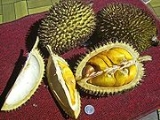
The
durian is the
fruitIn broad terms, a fruit is a structure of a plant that contains its seeds.The term has different meanings dependent on context. In non-technical usage, such as food preparation, fruit normally means the fleshy seed-associated structures of certain plants that are sweet and edible in the raw state,...
of several
treeA tree is a perennial woody plant. It is most often defined as a woody plant that has many secondary branches supported clear of the ground on a single main stem or trunk with clear apical dominance. A minimum height specification at maturity is cited by some authors, varying from 3 m to...
speciesIn biology, a species is one of the basic units of biological classification and a taxonomic rank. A species is often defined as a group of organisms capable of interbreeding and producing fertile offspring. While in many cases this definition is adequate, more precise or differing measures are...
belonging to the
genusIn biology, a genus is a low-level taxonomic rank used in the biological classification of living and fossil organisms, which is an example of definition by genus and differentia...
Durio and the
MalvaceaeMalvaceae, or the mallow family, is a family of flowering plants containing over 200 genera with close to 2,300 species. Judd & al. Well known members of this family include okra, jute and cacao...
familyIn biological classification, family is* a taxonomic rank. Other well-known ranks are life, domain, kingdom, phylum, class, order, genus, and species, with family fitting between order and genus. As for the other well-known ranks, there is the option of an immediately lower rank, indicated by the...
(although some taxonomists place
Durio in a distinct family, Durionaceae). Widely known and revered in
southeast AsiaSoutheast Asia, South-East Asia, South East Asia or Southeastern Asia is a subregion of Asia, consisting of the countries that are geographically south of China, east of India, west of New Guinea and north of Australia. The region lies on the intersection of geological plates, with heavy seismic...
as the "king of fruits", the durian is distinctive for its large size, unique
odourAn odor or odour is caused by one or more volatilized chemical compounds, generally at a very low concentration, that humans or other animals perceive by the sense of olfaction. Odors are also commonly called scents, which can refer to both pleasant and unpleasant odors...
, and formidable thorn-covered
huskHusk in botany is the outer shell or coating of a seed. It often refers to the leafy outer covering of an ear of maize as it grows on the plant. Literally, a husk or hull includes the protective outer covering of a seed, fruit or vegetable...
. The fruit can grow as large as 30 centimetres (11.8 in) long and 15 centimetres (6 in) in diameter, and it typically weighs one to three kilograms (2 to 7 lb). Its shape ranges from oblong to round, the colour of its husk green to brown, and its flesh pale yellow to red, depending on the species.
The edible flesh emits a distinctive odour, strong and penetrating even when the husk is intact. Some people regard the durian as fragrant; others find the aroma overpowering and offensive. The smell evokes reactions from deep appreciation to intense disgust, and has been described variously as
almondThe almond , is a species of tree native to the Middle East and South Asia. Almond is also the name of the edible and widely cultivated seed of this tree...
s, rotten onions,
turpentineTurpentine is a fluid obtained by the distillation of resin obtained from trees, mainly pine trees. It is composed of terpenes, mainly the monoterpenes alpha-pinene and beta-pinene...
and gym socks. The odour has led to the fruit's banishment from certain hotels and public transportation in southeast Asia.
The durian, native to
BruneiBrunei , officially the State of Brunei Darussalam or the Nation of Brunei, the Abode of Peace , is a sovereign state located on the north coast of the island of Borneo, in Southeast Asia...
,
IndonesiaIndonesia , officially the Republic of Indonesia , is a country in Southeast Asia and Oceania. Indonesia is an archipelago comprising approximately 13,000 islands. It has 33 provinces with over 238 million people, and is the world's fourth most populous country. Indonesia is a republic, with an...
and
Malaysia, has been known to the Western world for about 600 years. The 19th-century British
naturalistNatural history is the scientific research of plants or animals, leaning more towards observational rather than experimental methods of study, and encompasses more research published in magazines than in academic journals. Grouped among the natural sciences, natural history is the systematic study...
Alfred Russel WallaceAlfred Russel Wallace, OM, FRS was a British naturalist, explorer, geographer, anthropologist and biologist...
famously described its flesh as "a rich custard highly flavoured with almonds". The flesh can be consumed at various stages of ripeness, and it is used to flavour a wide variety of savoury and sweet edibles in Southeast Asian cuisines. The seeds can also be eaten when cooked.
There are 30 recognised
Durio species, at least nine of which produce edible fruit.
Durio zibethinus is the only species available in the international market: other species are sold in their local regions. There are hundreds of durian
cultivarA cultivar'Cultivar has two meanings as explained under Formal definition. When used in reference to a taxon, the word does not apply to an individual plant but to all those plants sharing the unique characteristics that define the cultivar. is a plant or group of plants selected for desirable...
s; many consumers express preferences for specific cultivars, which fetch higher prices in the market.
Species
Durian
treeA tree is a perennial woody plant. It is most often defined as a woody plant that has many secondary branches supported clear of the ground on a single main stem or trunk with clear apical dominance. A minimum height specification at maturity is cited by some authors, varying from 3 m to...
s are large, growing to 25–50 metres (80–164 ft) in height depending on the species. The leaves are
evergreenIn botany, an evergreen plant is a plant that has leaves in all seasons. This contrasts with deciduous plants, which completely lose their foliage during the winter or dry season.There are many different kinds of evergreen plants, both trees and shrubs...
, elliptic to oblong and 10–18 centimetres (4–7 in) long. The flowers are produced in three to thirty clusters together on large branches and directly on the trunk with each flower having a calyx (sepals) and five (rarely four or six)
petalPetals are modified leaves that surround the reproductive parts of flowers. They often are brightly colored or unusually shaped to attract pollinators. Together, all of the petals of a flower are called a corolla. Petals are usually accompanied by another set of special leaves called sepals lying...
s. Durian trees have one or two flowering and fruiting periods per year, though the timing varies depending on the species, cultivars, and localities. A typical durian tree can bear fruit after four or five years. The durian fruit can hang from any branch and matures roughly three months after
pollinationPollination is the process by which pollen is transferred in plants, thereby enabling fertilisation and sexual reproduction. Pollen grains transport the male gametes to where the female gamete are contained within the carpel; in gymnosperms the pollen is directly applied to the ovule itself...
. The fruit can grow up to 30 centimetres (11.8 in) long and 15 centimetres (6 in) in diameter, and typically weighs one to three kilograms (2 to 7 lb). Its shape ranges from oblong to round, the colour of its husk green to brown, and its flesh pale-yellow to red, depending on the species. Among the thirty known species of
Durio, nine of them have been identified as producing edible fruits:
D. zibethinus,
D. dulcisDurio dulcis, known as durian marangang , red durian, tutong, or lahong, is a fairly large tree in the genus Durio. It can grow up to 40 m tall. The husk of its fruit is dark red to brown-red, and covered with slender 15-20 mm long spines. The fruit flesh is dark yellow, thin and deep...
,
D. grandiflorusDurio grandiflorus, commonly known as durian munjit, is a medium-sized tree up to 30 m tall. It is one of the edible species in the genus Durio, which produces the popular fruit known as Durian. The fruit of this species has yellow flesh....
,
D. graveolens,
D. kutejensisDurio kutejensis, commonly known as durian pulu, durian merah, nyekak, or lai, is a primary rainforest substorey fruit tree from Borneo. It is a very attractive small- to medium-sized tree up to 30 m tall. It has large, glossy leaves, numerous large red flowers that emit a strong carrion smell...
,
D. lowianus,
D. macrantha,
D. oxleyanus and
D. testudinarumDurio testudinarum is a species of durian trees in the Bombacaceae family.It is found in Brunei, Indonesia, and Malaysia.-Source:* World Conservation Monitoring Centre 1998. . Downloaded on 19 July 2007....
. However, there are many species for which the fruit has never been collected or properly examined, so other species with edible fruit may exist. The durian is somewhat similar in appearance to the
jackfruitThe jackfruit is a species of tree in the Artocarpus genus of the mulberry family . It is native to parts of Southern and Southeast Asia. It is the national fruit of Bangladesh, . The jackfruit tree is believed to be indigenous to the southwestern rain forests of India...
, an unrelated species.
The name
durian comes from the
MalayMalay is a major language of the Austronesian family. It is the official language of Malaysia , Indonesia , Brunei and Singapore...
word
duri (thorn) together with the
suffixIn linguistics, a suffix is an affix which is placed after the stem of a word. Common examples are case endings, which indicate the grammatical case of nouns or adjectives, and verb endings, which form the conjugation of verbs...
-
an (for building a noun in Malay).
D. zibethinus is the only species commercially cultivated on a large scale and available outside of its native region. Since this species is open-pollinated, it shows considerable diversity in fruit colour and odour, size of flesh and seed, and tree
phenologyPhenology is the study of periodic plant and animal life cycle events and how these are influenced by seasonal and interannual variations in climate...
. In the species name,
zibethinus refers to the Indian
civetThe family Viverridae is made up of around 30 species of medium-sized mammal, including all of the genets, the binturong, most of the civets, and the two African linsangs....
,
Viverra zibetha. There is disagreement regarding whether this name, bestowed by
LinnaeusCarl Linnaeus , also known after his ennoblement as , was a Swedish botanist, physician, and zoologist, who laid the foundations for the modern scheme of binomial nomenclature. He is known as the father of modern taxonomy, and is also considered one of the fathers of modern ecology...
, refers to civets being so fond of the durian that the fruit was used as bait to entrap them, or to the durian smelling like the civet.
Durian flowers are large and feathery with copious
nectarNectar is a sugar-rich liquid produced by plants. It is produced in glands called nectaries, either within the flowers, in which it attracts pollinating animals, or by extrafloral nectaries, which provide a nutrient source to animal mutualists, which in turn provide anti-herbivore protection...
, and give off a heavy, sour and buttery odour. These features are typical of flowers pollinated by certain species of
batBats are mammals of the order Chiroptera "hand" and pteron "wing") whose forelimbs form webbed wings, making them the only mammals naturally capable of true and sustained flight. By contrast, other mammals said to fly, such as flying squirrels, gliding possums, and colugos, glide rather than fly,...
s that eat nectar and
pollenPollen is a fine to coarse powder containing the microgametophytes of seed plants, which produce the male gametes . Pollen grains have a hard coat that protects the sperm cells during the process of their movement from the stamens to the pistil of flowering plants or from the male cone to the...
. According to research conducted in Malaysia in the 1970s, durians were pollinated almost exclusively by cave fruit bats (
Eonycteris spelaeaEonycteris is a genus of megabats found in Asia. Species within this genus are:*Greater Nectar Bat, Eonycteris major*Cave Nectar Bat, Eonycteris spelaea*Philippine Dawn Bat, Eonycteris robusta...
). However, a 1996 study indicated two species,
D. grandiflorus and
D. oblongus, were pollinated by
spiderhunterThe spiderhunters are birds of the genus Arachnothera, part of the sunbird family Nectariniidae. The genus contains eleven species found in the forests of south and southeastern Asia. They are large representatives of the sunbird family, with drab plumage and long strongly curved bills...
s (Nectariniidae) and another species,
D. kutejensis, was pollinated by giant honey bees and birds as well as bats.
Cultivars
Over the centuries, numerous durian
cultivarA cultivar'Cultivar has two meanings as explained under Formal definition. When used in reference to a taxon, the word does not apply to an individual plant but to all those plants sharing the unique characteristics that define the cultivar. is a plant or group of plants selected for desirable...
s propagated by vegetative
cloneCloning in biology is the process of producing similar populations of genetically identical individuals that occurs in nature when organisms such as bacteria, insects or plants reproduce asexually. Cloning in biotechnology refers to processes used to create copies of DNA fragments , cells , or...
s have arisen in southeast Asia. They used to be grown with mixed results from seeds of trees bearing superior quality fruit, but are now propagated by
layeringLayering is a means of plant propagation in which a portion of an aerial stem grows roots while still attached to the parent plant and then detaches as an independent plant. Layering has evolved as a common means of vegetative propagation of numerous species in natural environments...
, marcotting, or more commonly, by
graftingGrafting is a horticultural technique whereby tissues from one plant are inserted into those of another so that the two sets of vascular tissues may join together. This vascular joining is called inosculation...
, including bud, veneer, wedge, whip or U-grafting onto seedlings of randomly selected
rootstockA rootstock is a plant, and sometimes just the stump, which already has an established, healthy root system, used for grafting a cutting or budding from another plant. The tree part being grafted onto the rootstock is usually called the scion...
s. Different cultivars can be distinguished to some extent by variations in the fruit shape, such as the shape of the spines. Durian consumers express preferences for specific cultivars, which fetch higher prices in the market.
Most cultivars have a common name and a code number starting with "D". For example, some popular clones are Kop (D99 kòp), Chanee (D123, tɕʰániː), Berserah or Green Durian or Tuan Mek Hijau (D145 tʰúriːən kʰǐow), Kan Yao (D158, kâːn jaːw), Mon Thong (D159, mɔ̌ːn tʰɔːŋ), Kradum Thong ( kràdum tʰɔːŋ), and with no common name, D24 and D169. Each cultivar has a distinct taste and odour. More than 200 cultivars of
D. zibethinus exist in
ThailandThailand , officially the Kingdom of Thailand , formerly known as Siam , is a country located at the centre of the Indochina peninsula and Southeast Asia. It is bordered to the north by Burma and Laos, to the east by Laos and Cambodia, to the south by the Gulf of Thailand and Malaysia, and to the...
. Mon thong is the most commercially sought after for its thick, full-bodied creamy and mild sweet tasting flesh with relatively moderate smell emitted and smaller seeds while Chanee is the best in terms of its resistance to infection by
Phytophthora palmivoraPhytophthora palmivora causes bud-rot of palms, fruit-rot or kole-roga of coconut and arecanut. These are among the most serious diseases caused by fungi and moulds in South India. It occurs almost every year in Malnad, Mysore, North & South Kanara, Malabar and other areas. Similar diseases of...
. Among all the cultivars in Thailand, five are currently in large-scale commercial cultivation: Chanee, Mon Thong, Kan Yao, Ruang, and Kradum. There are more than 100 registered cultivars in
Malaysia and many superior cultivars have been identified through competitions held at the annual Malaysian Agriculture, Horticulture and Agrotourism Show. In
VietnamVietnam – sometimes spelled Viet Nam , officially the Socialist Republic of Vietnam – is the easternmost country on the Indochina Peninsula in Southeast Asia. It is bordered by China to the north, Laos to the northwest, Cambodia to the southwest, and the South China Sea –...
, the same process has been done through competitions held by the Southern Fruit Research Institute. A recently popular variety is the Cat Mountain King.
In recent times, Songpol Somsri, a Thai government scientist, crossbred more than ninety varieties of durian to create Chantaburi No. 1, a cultivar without the characteristic odour, which is awaiting final approval from the local Ministry of Agriculture. Another hybrid, Chantaburi No. 3, develops the odour about three days after the fruit is picked, which enables an odourless transport yet satisfies consumers who prefer the pungent odour.
Cultivation and availability
The durian is native to
BruneiBrunei , officially the State of Brunei Darussalam or the Nation of Brunei, the Abode of Peace , is a sovereign state located on the north coast of the island of Borneo, in Southeast Asia...
,
IndonesiaIndonesia , officially the Republic of Indonesia , is a country in Southeast Asia and Oceania. Indonesia is an archipelago comprising approximately 13,000 islands. It has 33 provinces with over 238 million people, and is the world's fourth most populous country. Indonesia is a republic, with an...
and
Malaysia. There is some debate as to whether the durian is native to the
PhilippinesThe Philippines , officially known as the Republic of the Philippines , is a country in Southeast Asia in the western Pacific Ocean. To its north across the Luzon Strait lies Taiwan. West across the South China Sea sits Vietnam...
, particularly in
DavaoDavao refers to several closely related places in Mindanao in the Philippines. The term is used most often to refer to the city.*Davao Region, an administrative region*Davao del Norte province*Davao del Sur province*Davao Oriental province...
region in the island of
MindanaoMindanao is the second largest and easternmost island in the Philippines. It is also the name of one of the three island groups in the country, which consists of the island of Mindanao and smaller surrounding islands. The other two are Luzon and the Visayas. The island of Mindanao is called The...
, or was introduced. The durian is grown in other areas with a similar climate; it is strictly
tropicalWorldwide more human beings gain their livelihood from agriculture than any other endeavor; the majority are self-employed subsistence farmers living in the tropics...
and stops growing when mean daily temperatures drop below 22 °C (71.6 °F).
The centre of ecological diversity for durians is the island of
BorneoBorneo is the third largest island in the world and is located north of Java Island, Indonesia, at the geographic centre of Maritime Southeast Asia....
, where the fruit of the edible species of
Durio including
D. zibethinus,
D. dulcis,
D. graveolens,
D. kutejensis,
D. oxleyanus and
D. testudinarum are sold in local markets. In Brunei,
D. zibethinus is not grown because consumers prefer other species such as
D. graveolens,
D. kutejensis and
D. oxleyanus. These species are commonly distributed in Brunei, and together with other species like
D. testudinarum and
D. dulcis, represent rich
genetic diversityGenetic diversity, the level of biodiversity, refers to the total number of genetic characteristics in the genetic makeup of a species. It is distinguished from genetic variability, which describes the tendency of genetic characteristics to vary....
.
Although the durian is not native to
ThailandThailand , officially the Kingdom of Thailand , formerly known as Siam , is a country located at the centre of the Indochina peninsula and Southeast Asia. It is bordered to the north by Burma and Laos, to the east by Laos and Cambodia, to the south by the Gulf of Thailand and Malaysia, and to the...
, the country is currently one of the major exporters of durians, growing 781000 tonnes (768,663 LT) of the world's total harvest of 1400000 tonnes (1,377,884.9 LT) in 1999, 111000 tonnes (109,246.6 LT) of which it exported to Taiwan, Hong Kong, Malaysia, Singapore and Canada. Malaysia and Indonesia follow, both producing about 265000 tonnes (260,813.9 LT) each. Of this, Malaysia exported 35000 tonnes (34,447.1 LT) in 1999.
ChantaburiChanthaburi is a province of Thailand. It is located in the east of Thailand, at the border to Battambang and Pailin of Cambodia and the shore to the Gulf of Thailand...
in Thailand each year holds the World Durian Festival in early May. This single province is responsible for half of the durian production of Thailand. In the Philippines, the centre of durian production is the
Davao RegionDavao Region / Southern Mindanao, designated as Region XI, is one of the regions of the Philippines, located on the southeastern portion of Mindanao. Davao Region consists of four provinces, namely: Compostela Valley, Davao del Norte, Davao Oriental, and Davao del Sur. The region encloses the Davao...
. The
Kadayawan FestivalThe Kadayawan Festival is an annual festival in the city of Davao in the Philippines. Its name derives from the friendly greeting "Madayaw", from the Dabawenyo word "dayaw", meaning good, valuable, superior or beautiful...
is an annual celebration featuring the durian in
Davao CityThe City of Davao is the largest city in the island of Mindanao in the Philippines. Its international airport and seaports are among the busiest cargo hubs in the Philippines....
. Other places where durian farms are located include
CambodiaCambodia , officially known as the Kingdom of Cambodia, is a country located in the southern portion of the Indochina Peninsula in Southeast Asia...
,
LaosLaos Lao: ສາທາລະນະລັດ ປະຊາທິປະໄຕ ປະຊາຊົນລາວ Sathalanalat Paxathipatai Paxaxon Lao, officially the Lao People's Democratic Republic, is a landlocked country in Southeast Asia, bordered by Burma and China to the northwest, Vietnam to the east, Cambodia to the south and Thailand to the west...
,
VietnamVietnam – sometimes spelled Viet Nam , officially the Socialist Republic of Vietnam – is the easternmost country on the Indochina Peninsula in Southeast Asia. It is bordered by China to the north, Laos to the northwest, Cambodia to the southwest, and the South China Sea –...
,
MyanmarBurma , officially the Republic of the Union of Myanmar , is a country in Southeast Asia. Burma is bordered by China on the northeast, Laos on the east, Thailand on the southeast, Bangladesh on the west, India on the northwest, the Bay of Bengal to the southwest, and the Andaman Sea on the south....
,
Sri LankaSri Lanka, officially the Democratic Socialist Republic of Sri Lanka is a country off the southern coast of the Indian subcontinent. Known until 1972 as Ceylon , Sri Lanka is an island surrounded by the Indian Ocean, the Gulf of Mannar and the Palk Strait, and lies in the vicinity of India and the...
,
IndiaIndia , officially the Republic of India , is a country in South Asia. It is the seventh-largest country by geographical area, the second-most populous country with over 1.2 billion people, and the most populous democracy in the world...
, the West Indies,
FloridaFlorida is a state in the southeastern United States, located on the nation's Atlantic and Gulf coasts. It is bordered to the west by the Gulf of Mexico, to the north by Alabama and Georgia and to the east by the Atlantic Ocean. With a population of 18,801,310 as measured by the 2010 census, it...
,
HawaiiHawaii is the newest of the 50 U.S. states , and is the only U.S. state made up entirely of islands. It is the northernmost island group in Polynesia, occupying most of an archipelago in the central Pacific Ocean, southwest of the continental United States, southeast of Japan, and northeast of...
,
Papua New GuineaPapua New Guinea , officially the Independent State of Papua New Guinea, is a country in Oceania, occupying the eastern half of the island of New Guinea and numerous offshore islands...
, the
Polynesian IslandsPolynesia is a subregion of Oceania, made up of over 1,000 islands scattered over the central and southern Pacific Ocean. The indigenous people who inhabit the islands of Polynesia are termed Polynesians and they share many similar traits including language, culture and beliefs...
,
MadagascarThe Republic of Madagascar is an island country located in the Indian Ocean off the southeastern coast of Africa...
, southern China (Hainan Island),
northern AustraliaThe term northern Australia is generally known to include two State and Territories, being Queensland and the Northern Territory . The part of Western Australia north of latitude 26° south—a definition widely used in law and State government policy—is also usually included...
, and
SingaporeSingapore , officially the Republic of Singapore, is a Southeast Asian city-state off the southern tip of the Malay Peninsula, north of the equator. An island country made up of 63 islands, it is separated from Malaysia by the Straits of Johor to its north and from Indonesia's Riau Islands by the...
.
Durian was introduced into Australia in the early 1960s and clonal material was first introduced in 1975. Over thirty clones of
D. zibethinus and six
Durio species have been subsequently introduced into Australia. China is the major importer, purchasing 65000 tonnes (63,973.2 LT) in 1999, followed by Singapore with 40000 tonnes (39,368.1 LT) and Taiwan with 5000 tonnes (4,921 LT). In the same year, the United States imported 2000 tonnes (1,968.4 LT), mostly frozen, and the European Community imported 500 tonnes (492.1 LT).
The durian is a seasonal fruit, unlike some other non-seasonal tropical fruits such as the
papayaThe papaya , papaw, or pawpaw is the fruit of the plant Carica papaya, the sole species in the genus Carica of the plant family Caricaceae...
, which are available throughout the year. In Peninsular Malaysia and Singapore, the season for durians is typically from June to August, which coincides with that of the
mangosteenThe purple mangosteen , colloquially known simply as mangosteen, is a tropical evergreen tree believed to have originated in the Sunda Islands and the Moluccas of Indonesia. The tree grows from 7 to 25 m tall...
. Prices of durians are relatively high as compared with other fruits. For example, in Singapore, the strong demand for high quality cultivars such as the D24,
Sultan, and
Mao Shan Wang has resulted in typical retail prices of between S$8 to S$15 (US$5 to US$10) per kilogram of whole fruit. With an average weight of about 1.5 kilograms (3.3 lb), a durian fruit would therefore cost about S$12 to S$22 (US$8 to US$15). The edible portion of the fruit, known as the
arilAn aril is any specialized outgrowth from the funiculus that covers or is attached to the seed. It is sometimes applied to any appendage or thickening of the seed coat in flowering plants, such as the edible parts of the mangosteen and pomegranate fruit, the mace of the nutmeg seed, or the...
and usually referred to as the "flesh" or "pulp", only accounts for about 15-30% of the mass of the entire fruit. Many consumers in Singapore are nevertheless quite willing to spend up to around S$75 (US$50) in a single purchase of about half a dozen of the favoured fruit to be shared by family members.
In-season durians can be found in mainstream
JapanJapan is an island nation in East Asia. Located in the Pacific Ocean, it lies to the east of the Sea of Japan, China, North Korea, South Korea and Russia, stretching from the Sea of Okhotsk in the north to the East China Sea and Taiwan in the south...
ese supermarkets while, in the West, they are sold mainly by Asian markets.
Flavour and odour
The unusual flavour and odour of the fruit have prompted many people to express diverse and passionate views ranging from deep appreciation to intense disgust. Writing in 1856, the British
naturalistNatural history is the scientific research of plants or animals, leaning more towards observational rather than experimental methods of study, and encompasses more research published in magazines than in academic journals. Grouped among the natural sciences, natural history is the systematic study...
Alfred Russel WallaceAlfred Russel Wallace, OM, FRS was a British naturalist, explorer, geographer, anthropologist and biologist...
provides a much-quoted description of the flavour of the durian:
Wallace described himself as being at first reluctant to try it because of the aroma, "but in Borneo I found a ripe fruit on the ground, and, eating it out of doors, I at once became a confirmed Durian eater". He cited one traveller from 1599: "it is of such an excellent taste that it surpasses in flavour all other fruits of the world, according to those who have tasted it". He cites another writer: "To those not used to it, it seems at first to smell like rotten onions, but immediately they have tasted it they prefer it to all other food. The natives give it honourable titles, exalt it, and make verses on it".
While Wallace cautions that "the smell of the ripe fruit is certainly at first disagreeable", later descriptions by westerners are more graphic. British novelist
Anthony BurgessJohn Burgess Wilson – who published under the pen name Anthony Burgess – was an English author, poet, playwright, composer, linguist, translator and critic. The dystopian satire A Clockwork Orange is Burgess's most famous novel, though he dismissed it as one of his lesser works...
writes that eating durian is "like eating sweet raspberry
blancmangeBlancmange is a sweet dessert commonly made with milk or cream and sugar thickened with gelatin, cornstarch or Irish moss, and often flavored with almonds. It is usually set in a mould and served cold. Although traditionally white, blancmanges are frequently given a pink color as well...
in the lavatory." Chef
Andrew ZimmernAndrew Zimmern is a James Beard Award-winning TV personality, chef, food writer, and teacher. As the co-creator, host, and consulting producer of Travel Channel's series Bizarre Foods with Andrew Zimmern and Andrew Zimmern's Bizarre World, he travels the world exploring food in its own native...
compares the taste to "completely rotten, mushy onions."
Anthony BourdainAnthony Michael "Tony" Bourdain is an American chef, author and television personality. He is well known for his 2000 book Kitchen Confidential: Adventures in the Culinary Underbelly, and is the host of Travel Channel's culinary and cultural adventure program Anthony Bourdain: No Reservations.A...
, a lover of durian, relates his encounter with the fruit thus: "Its taste can only be described as...indescribable, something you will either love or despise. ...Your breath will smell as if you'd been French-kissing your dead grandmother." Travel and food writer
Richard SterlingRichard Sterling is an American food and travel writer. He is one of the main authors of Lonely Planet's World Food series and author of The Unofficial Guide to San Francisco published in 2006....
says:
Other comparisons have been made with the
civetThe family Viverridae is made up of around 30 species of medium-sized mammal, including all of the genets, the binturong, most of the civets, and the two African linsangs....
,
sewageSewage is water-carried waste, in solution or suspension, that is intended to be removed from a community. Also known as wastewater, it is more than 99% water and is characterized by volume or rate of flow, physical condition, chemical constituents and the bacteriological organisms that it contains...
, stale vomit,
skunk spraySkunks are mammals best known for their ability to secrete a liquid with a strong, foul odor. General appearance varies from species to species, from black-and-white to brown or cream colored. Skunks belong to the family Mephitidae and to the order Carnivora...
and used
surgical swabsCotton swabs or cotton buds or ear buds consist of a small wad of cotton wrapped around one or both ends of a short rod, usually made of either wood, rolled paper, or plastic...
.
The wide range of descriptions for the odour of durian may have a great deal to do with the variability of durian odour itself. Durians from different species or clones can have significantly different aromas; for example, red durian (
D. dulcis) has a deep
caramelCaramel is a beige to dark-brown confection made by heating any of a variety of sugars. It is used as a flavoring in puddings and desserts, as a filling in bonbons, and as a topping for ice cream, custard and coffee....
flavour with a
turpentineTurpentine is a fluid obtained by the distillation of resin obtained from trees, mainly pine trees. It is composed of terpenes, mainly the monoterpenes alpha-pinene and beta-pinene...
odour while red-fleshed durian (
D. graveolens) emits a fragrance of roasted
almondThe almond , is a species of tree native to the Middle East and South Asia. Almond is also the name of the edible and widely cultivated seed of this tree...
s. Among the varieties of
D. zibethinus, Thai varieties are sweeter in flavour and less odourous than Malay ones. The degree of ripeness has an effect on the flavour as well. Three scientific analyses of the composition of durian aroma — from 1972, 1980, and 1995 — each found a mix of volatile compounds including
esterEsters are chemical compounds derived by reacting an oxoacid with a hydroxyl compound such as an alcohol or phenol. Esters are usually derived from an inorganic acid or organic acid in which at least one -OH group is replaced by an -O-alkyl group, and most commonly from carboxylic acids and...
s,
ketoneIn organic chemistry, a ketone is an organic compound with the structure RCR', where R and R' can be a variety of atoms and groups of atoms. It features a carbonyl group bonded to two other carbon atoms. Many ketones are known and many are of great importance in industry and in biology...
s, and different sulphur compounds, with no agreement on which may be primarily responsible for the distinctive odour.
This strong odour can be detected half a mile away by animals, thus luring them. In addition, the fruit is extremely appetising to a variety of animals, including
squirrelSquirrels belong to a large family of small or medium-sized rodents called the Sciuridae. The family includes tree squirrels, ground squirrels, chipmunks, marmots , flying squirrels, and prairie dogs. Squirrels are indigenous to the Americas, Eurasia, and Africa and have been introduced to Australia...
s,
mouse deerChevrotains, also known as mouse deer, are small ungulates that make up the family Tragulidae, the only members of the infraorder Tragulina. There are 10 living species in three genera, but there are also several species only known from fossils...
,
pigA pig is any of the animals in the genus Sus, within the Suidae family of even-toed ungulates. Pigs include the domestic pig, its ancestor the wild boar, and several other wild relatives...
s,
orangutanOrangutans are the only exclusively Asian genus of extant great ape. The largest living arboreal animals, they have proportionally longer arms than the other, more terrestrial, great apes. They are among the most intelligent primates and use a variety of sophisticated tools, also making sleeping...
,
elephantElephants are large land mammals in two extant genera of the family Elephantidae: Elephas and Loxodonta, with the third genus Mammuthus extinct...
s, and even carnivorous
tigerThe tiger is the largest cat species, reaching a total body length of up to and weighing up to . Their most recognizable feature is a pattern of dark vertical stripes on reddish-orange fur with lighter underparts...
s. While some of these animals eat the fruit and dispose of the seed under the parent plant, others swallow the seed with the fruit and then transport it some distance before excreting, with the seed being dispersed as a result. The thorny, armoured covering of the fruit discourages smaller animals; larger animals are more likely to transport the seeds far from the parent tree.
Ripeness and selection
According to
Larousse GastronomiqueLarousse Gastronomique is an encyclopedia of gastronomy. The majority of the book is about French cuisine, and contains recipes for French dishes and cooking techniques...
, the durian fruit is ready to eat when its husk begins to crack. However, the ideal stage of ripeness to be enjoyed varies from region to region in Southeast Asia and by species. Some species grow so tall that they can only be collected once they have fallen to the ground, whereas most cultivars of
D. zibethinus are nearly always cut from the tree and allowed to ripen while waiting to be sold. Some people in
southern ThailandSouthern Thailand is a distinct region of Thailand, connected with the Central region by the narrow Kra Isthmus.-Geography:Southern Thailand is located on the Malay Peninsula, with an area around 70,713 km², bounded to the north by Kra Isthmus as the narrowest part of the peninsula. The...
prefer their durians relatively young when the clusters of fruit within the shell are still crisp in texture and mild in flavour. For some people in
northern ThailandThailand's northern region is geographically characterised by multiple mountain ranges which continue from the Shan Hills in bordering Myanmar and Laos, and the river valleys which cut through them...
, the preference is for the fruit to be soft and aromatic. In Malaysia and Singapore, most consumers prefer the fruit to be as ripe and pungent in aroma as possible and may even risk allowing the fruit to continue ripening after its husk has already cracked open. In this state, the flesh becomes richly creamy, slightly alcoholic, the aroma pronounced and the flavour highly complex.
The various preferences regarding ripeness among consumers make it hard to issue general statements about choosing a "good" durian. A durian that falls off the tree continues to ripen for two to four days, but after five or six days most would consider it overripe and unpalatable. The usual advice for a durian consumer choosing a whole fruit in the market is to examine the quality of the
stemA stem is one of two main structural axes of a vascular plant. The stem is normally divided into nodes and internodes, the nodes hold buds which grow into one or more leaves, inflorescence , conifer cones, roots, other stems etc. The internodes distance one node from another...
or stalk which loses moisture as it ages: a big, solid stem is a sign of freshness. Reportedly, unscrupulous merchants wrap, paint, or remove the stalks altogether. Another frequent piece of advice is to shake the fruit and listen for the sound of the seeds moving within, indicating the durian is very ripe and the pulp has dried out a bit.
History
The durian has been known and consumed in southeastern Asia since
prehistoric timesPrehistory is the span of time before recorded history. Prehistory can refer to the period of human existence before the availability of those written records with which recorded history begins. More broadly, it refers to all the time preceding human existence and the invention of writing...
, but has only been known to the western world for about 600 years. The earliest known European reference to the durian is the record of
Niccolò Da ContiNiccolò de' Conti was an Italian merchant and explorer of the Republic of Venice, born in Chioggia, who traveled to India and Southeast Asia, and possibly to Southern China, during the early 15th century...
, who travelled to southeastern Asia in the 15th century. The
PortuguesePortugal , officially the Portuguese Republic is a country situated in southwestern Europe on the Iberian Peninsula. Portugal is the westernmost country of Europe, and is bordered by the Atlantic Ocean to the West and South and by Spain to the North and East. The Atlantic archipelagos of the...
physician
Garcia de OrtaGarcia de Orta was a Portuguese Renaissance Sephardi Jewish physician and naturalist. He was a pioneer of tropical medicine.- Life :...
described durians in
Colóquios dos simples e drogas da IndiaColóquios dos simples e drogas he cousas medicinais da Índia e assi dalgũas frutas achadas nella onde se tratam algũas cousas tocantes a medicina, pratica, e outras cousas boas pera saber Colóquios dos simples e drogas he cousas medicinais da Índia e assi dalgũas frutas achadas nella onde se tratam...
published in 1563. In 1741,
Herbarium Amboinense by the German botanist
Georg Eberhard RumphiusGeorg Eberhard Rumphius or originally Rumpf was a German-born botanist employed by the Dutch East India Company in what is now eastern Indonesia, and is best known for his work, Herbarium Amboinense....
was published, providing the most detailed and accurate account of durians for over a century. The genus
Durio has a complex
taxonomyTaxonomy is the science of identifying and naming species, and arranging them into a classification. The field of taxonomy, sometimes referred to as "biological taxonomy", revolves around the description and use of taxonomic units, known as taxa...
that has seen the subtraction and addition of many species since it was created by Rumphius. During the early stages of its taxonomical study, there was some confusion between durian and the
soursopThe Soursop is tripti broadleaf, flowering, evergreen tree native to Central America, the Caribbean and northern South America, Colombia and Brazil, Mexico, Peru, Venezuela, Soursop is also native to sub-Saharan African countries that lie within the tropics. Today, it is also grown in some areas...
(
Annona muricata), for both of these species had thorny green fruit. It is also interesting to note the Malay name for the soursop is
durian Belanda, meaning
Dutch durian. In the 18th century,
Johann Anton WeinmannJohann Anton Weinmann was a German botanist who served as Inspector of the Gardens in Saint Petersburg, Russia. He published a Flora that is the basis of some binomial species identifications using the author abbreviation Weinm.....
considered the durian to belong to
CastaneaeChestnut , some species called chinkapin or chinquapin, is a genus of eight or nine species of deciduous trees and shrubs in the beech family Fagaceae, native to temperate regions of the Northern Hemisphere. The name also refers to the edible nuts they produce.-Species:The chestnut belongs to the...
as its fruit was similar to the horse chestnut.
D. zibethinus was introduced into
CeylonSri Lanka, officially the Democratic Socialist Republic of Sri Lanka is a country off the southern coast of the Indian subcontinent. Known until 1972 as Ceylon , Sri Lanka is an island surrounded by the Indian Ocean, the Gulf of Mannar and the Palk Strait, and lies in the vicinity of India and the...
by the Portuguese in the 16th century and was reintroduced many times later. It has been planted in the Americas but confined to
botanical gardenA botanical garden The terms botanic and botanical, and garden or gardens are used more-or-less interchangeably, although the word botanic is generally reserved for the earlier, more traditional gardens. is a well-tended area displaying a wide range of plants labelled with their botanical names...
s. The first seedlings were sent from the
Royal Botanic Gardens, KewThe Royal Botanic Gardens, Kew, usually referred to as Kew Gardens, is 121 hectares of gardens and botanical glasshouses between Richmond and Kew in southwest London, England. "The Royal Botanic Gardens, Kew" and the brand name "Kew" are also used as umbrella terms for the institution that runs...
, to Auguste Saint-Arroman of
DominicaDominica , officially the Commonwealth of Dominica, is an island nation in the Lesser Antilles region of the Caribbean Sea, south-southeast of Guadeloupe and northwest of Martinique. Its size is and the highest point in the country is Morne Diablotins, which has an elevation of . The Commonwealth...
in 1884.
In southeastern Asia the durian has been cultivated for centuries at the village level, probably since the late 18th century, and commercially since the mid-20th century. In
My Tropic Isle,
AustraliaAustralia , officially the Commonwealth of Australia, is a country in the Southern Hemisphere comprising the mainland of the Australian continent, the island of Tasmania, and numerous smaller islands in the Indian and Pacific Oceans. It is the world's sixth-largest country by total area...
n author and
naturalistNaturalist may refer to:* Practitioner of natural history* Conservationist* Advocate of naturalism * Naturalist , autobiography-See also:* The American Naturalist, periodical* Naturalism...
Edmund James BanfieldEdmund James "Ted" Banfield was an author and naturalist, best known for his book Confessions of a Beachcomber.-Early life:...
tells how, in the early 20th century, a friend in Singapore sent him a durian seed, which he planted and cared for on his tropical island off the north coast of
QueenslandQueensland is a state of Australia, occupying the north-eastern section of the mainland continent. It is bordered by the Northern Territory, South Australia and New South Wales to the west, south-west and south respectively. To the east, Queensland is bordered by the Coral Sea and Pacific Ocean...
.
In 1949, the British botanist
E. J. H. CornerEdred John Henry Corner FRS was a botanist who occupied the posts of assistant director at the Singapore Botanic Gardens and Professor of Tropical Botany at the University of Cambridge...
published
The Durian Theory, or the Origin of the Modern Tree. His theory was that endozoochory (the enticement of animals to transport seeds in their stomach) arose before any other method of
seed dispersalBiological dispersal refers to species movement away from an existing population or away from the parent organism. Through simply moving from one habitat patch to another, the dispersal of an individual has consequences not only for individual fitness, but also for population dynamics, population...
, and that primitive ancestors of
Durio species were the earliest practitioners of that dispersal method, in particular red durian (
D. dulcis) exemplifying the primitive fruit of flowering plants.
Since the early 1990s, the domestic and international demand for durian in the Association of Southeast Asian Nations (
ASEANThe Association of Southeast Asian Nations, commonly abbreviated ASEAN rarely ), is a geo-political and economic organization of ten countries located in Southeast Asia, which was formed on 8 August 1967 by Indonesia, Malaysia, the Philippines, Singapore and Thailand. Since then, membership has...
) region has increased significantly, partly due to the increasing affluence of Asia.
Culinary
Durian fruit is used to flavour a wide variety of sweet edibles such as traditional Malay candy, ice kacang,
dodolDodol is a toffee-like sweet food delicacy popular in Indonesia, Malaysia, Philippines especially in the Ilocos Region in Luzon and in the Lanao provinces of Mindanao, Singapore, Sri Lanka and Burma, where it is called mont kalama. It is also popular among the Roman Catholics from the west coastal...
, rose biscuits, and, with a touch of modern innovation,
ice creamIce cream is a frozen dessert usually made from dairy products, such as milk and cream, and often combined with fruits or other ingredients and flavours. Most varieties contain sugar, although some are made with other sweeteners...
,
milkshakeA milkshake is a sweet, cold beverage which is made from milk, ice cream or iced milk, and flavorings or sweeteners such as fruit syrup or chocolate sauce....
s,
mooncakeMooncake is a Chinese bakery product traditionally eaten during the Mid-Autumn Festival / Zhongqiu Festival. The festival is for lunar worship and moon watching; mooncakes are regarded as an indispensable delicacy on this occasion. Mooncakes are offered between friends or on family gatherings...
s,
Yule logA Yule log is a large and extremely hard log which is burned in the hearth as a part of traditional Yule or Christmas celebrations in several European cultures...
s and
cappuccinoA cappuccino is an Italian coffee drink prepared with espresso, hot milk, and steamed-milk foam. The name comes from the Capuchin friars, referring to the colour of their habits.- Definition :...
.
Es durian (durian ice cream) is a popular dessert in Indonesia, sold at street side stall in Indonesian cities, especially in Java. Pulut Durian is
glutinous riceGlutinous rice is a type of short-grained Asian rice that is especially sticky when cooked. It is called glutinous Glutinous rice (Oryza sativa var. glutinosa or Oryza glutinosa; also called sticky rice, sweet rice, waxy rice, botan rice, biroin chal, mochi rice, and pearl rice, and pulut) is a...
steamed with
coconut milkCoconut milk is the water that comes from the grated meat of a coconut. The colour and rich taste of the milk can be attributed to the high oil content. In many parts of the world, the term coconut milk is also used to refer to coconut water, the naturally occurring liquid found inside the hollow...
and served with ripened durian. In
SabahSabah is one of 13 member states of Malaysia. It is located on the northern portion of the island of Borneo. It is the second largest state in the country after Sarawak, which it borders on its southwest. It also shares a border with the province of East Kalimantan of Indonesia in the south...
, red durian is fried with onions and chilli and served as a side dish. Red-fleshed durian is traditionally added to
sayur, an Indonesian soup made from freshwater fish.
Ikan brengkes is fish cooked in a durian-based sauce, traditional in
SumatraSumatra is an island in western Indonesia, westernmost of the Sunda Islands. It is the largest island entirely in Indonesia , and the sixth largest island in the world at 473,481 km2 with a population of 50,365,538...
.
Tempoyak refers to
fermentedFermentation in food processing typically is the conversion of carbohydrates to alcohols and carbon dioxide or organic acids using yeasts, bacteria, or a combination thereof, under anaerobic conditions. Fermentation in simple terms is the chemical conversion of sugars into ethanol...
durian, usually made from lower quality durian that is unsuitable for direct consumption. Tempoyak can be eaten either cooked or uncooked, is normally eaten with rice, and can also be used for making
curryCurry is a generic description used throughout Western culture to describe a variety of dishes from Indian, Pakistani, Bangladeshi, Sri Lankan, Thai or other Southeast Asian cuisines...
. Sambal Tempoyak is a Sumatran dish made from the fermented durian fruit, coconut milk, and a collection of spicy ingredients known as
sambalSambal is a chili based sauce which is normally used as a condiment. Sambals are popular in Indonesia, Malaysia, Singapore, the southern Philippines and Sri Lanka, as well as in the Netherlands and in Suriname through Javanese influence. It is typically made from a variety of chili peppers and is...
.
In Thailand, durian is often eaten fresh with sweet sticky rice, and blocks of durian paste are sold in the markets, though much of the paste is
adulteratedAn adulterant is a chemical substance which should not be contained within other substances for legal or other reasons. Adulterants may be intentionally added to more expensive substances to increase visible quantities and reduce manufacturing costs or for some other deceptive or malicious purpose...
with
pumpkinA pumpkin is a gourd-like squash of the genus Cucurbita and the family Cucurbitaceae . It commonly refers to cultivars of any one of the species Cucurbita pepo, Cucurbita mixta, Cucurbita maxima, and Cucurbita moschata, and is native to North America...
. Unripe durians may be cooked as a vegetable, except in the Philippines, where all uses are sweet rather than savoury. Malaysians make both sugared and salted preserves from durian. When durian is minced with salt, onions and vinegar, it is called
boder. The durian seeds, which are the size of chestnuts, can be eaten whether they are boiled, roasted or fried in
coconut oilCoconut oil is an edible oil extracted from the kernel or meat of matured coconuts harvested from the coconut palm . Throughout the tropical world, it has provided the primary source of fat in the diets of millions of people for generations. It has various applications in food, medicine, and industry...
, with a texture that is similar to
taroTaro is a common name for the corms and tubers of several plants in the family Araceae . Of these, Colocasia esculenta is the most widely cultivated, and is the subject of this article. More specifically, this article describes the 'dasheen' form of taro; another variety is called eddoe.Taro is...
or
yamYam is the common name for some species in the genus Dioscorea . These are perennial herbaceous vines cultivated for the consumption of their starchy tubers in Africa, Asia, Latin America and Oceania...
, but stickier. In
JavaJava is an island of Indonesia. With a population of 135 million , it is the world's most populous island, and one of the most densely populated regions in the world. It is home to 60% of Indonesia's population. The Indonesian capital city, Jakarta, is in west Java...
, the seeds are sliced thin and cooked with sugar as a confection. Uncooked durian seeds are toxic due to
cyclopropeneCyclopropene is an organic compound with the formula 34. It is the simplest isolable cycloalkene. It has a triangular structure. Because the ring is highly strained, cyclopropene is both difficult to prepare and interesting to study. Like cyclopropane, the carbon ring of cyclopropene is planar...
fatty acidIn chemistry, especially biochemistry, a fatty acid is a carboxylic acid with a long unbranched aliphatic tail , which is either saturated or unsaturated. Most naturally occurring fatty acids have a chain of an even number of carbon atoms, from 4 to 28. Fatty acids are usually derived from...
s and should not be ingested. Young leaves and
shootShoots are new plant growth, they can include stems, flowering stems with flower buds, and leaves. The new growth from seed germination that grows upward is a shoot where leaves will develop...
s of the durian are occasionally cooked as greens. Sometimes the ash of the burned
rindPeel, also known as rind or skin, is the outer protective layer of a fruit or vegetable which could be peeled off. The rind is usually the botanical exocarp, but the term exocarp does also include the hard cases of nuts, which are not named peels since they are not peeled off by hand or peeler, but...
is added to special cakes. The petals of durian flowers are eaten in the
North SumatraBatak is a collective term used to identify a number of ethnic groups predominantly found in North Sumatra, Indonesia. The term is used to include the Toba, Karo, Pakpak, Simalungun, Angkola and Mandailing, each of which are distinct but related groups with distinct, albeit related, languages and...
province of Indonesia, while in the Moluccas islands the husk of the durian fruit is used as fuel to
smokeSmoking is the process of flavoring, cooking, or preserving food by exposing it to the smoke from burning or smoldering plant materials, most often wood...
fish. The nectar and pollen of the durian flower that honeybees collect is an important
honeyHoney is a sweet food made by bees using nectar from flowers. The variety produced by honey bees is the one most commonly referred to and is the type of honey collected by beekeepers and consumed by humans...
source, but the characteristics of the honey are unknown.
Nutritional and medicinal
Durian fruit contains a high amount of
sugarSugar is a class of edible crystalline carbohydrates, mainly sucrose, lactose, and fructose, characterized by a sweet flavor.Sucrose in its refined form primarily comes from sugar cane and sugar beet...
,
vitamin CVitamin C or L-ascorbic acid or L-ascorbate is an essential nutrient for humans and certain other animal species. In living organisms ascorbate acts as an antioxidant by protecting the body against oxidative stress...
,
potassiumPotassium is the chemical element with the symbol K and atomic number 19. Elemental potassium is a soft silvery-white alkali metal that oxidizes rapidly in air and is very reactive with water, generating sufficient heat to ignite the hydrogen emitted in the reaction.Potassium and sodium are...
, and the
serotonergicSerotonergic or serotoninergic means "related to the neurotransmitter serotonin". A synapse is serotonergic if it uses serotonin as its neurotransmitter...
amino acid
tryptophanTryptophan is one of the 20 standard amino acids, as well as an essential amino acid in the human diet. It is encoded in the standard genetic code as the codon UGG...
, and is a good source of carbohydrates,
proteinProteins are biochemical compounds consisting of one or more polypeptides typically folded into a globular or fibrous form, facilitating a biological function. A polypeptide is a single linear polymer chain of amino acids bonded together by peptide bonds between the carboxyl and amino groups of...
s, and
fatFats consist of a wide group of compounds that are generally soluble in organic solvents and generally insoluble in water. Chemically, fats are triglycerides, triesters of glycerol and any of several fatty acids. Fats may be either solid or liquid at room temperature, depending on their structure...
s. It is recommended as a good source of raw fats by several
raw food advocatesRaw foodism is the practice of consuming uncooked, unprocessed, and often organic foods as a large percentage of the diet....
, while others classify it as a
high-glycemicThe glycemic index, glycaemic index, or GI is a measure of the effects of carbohydrates on blood sugar levels. Carbohydrates that break down quickly during digestion and release glucose rapidly into the bloodstream have a high GI; carbohydrates that break down more slowly, releasing glucose more...
food, recommending to minimise its consumption.
In Malaysia, a
decoctionDecoction is a method of extraction, by boiling, of dissolved chemicals, or herbal or plant material, which may include stems, roots, bark and rhizomes. Decoction involves first mashing, and then boiling in water to extract oils, volatile organic compounds, and other chemical substances...
of the leaves and roots used to be prescribed as an
antipyreticAntipyretics ; an-tee-pahy-ret-iks; from the Greek anti, against, and pyreticus, are drugs or herbs that reduce fever. Normally, they will not lower body temperature if one does not have a fever. Antipyretics cause the hypothalamus to override an interleukin-induced increase in temperature...
. The leaf juice is applied on the head of a fever patient. The most complete description of the medicinal use of the durian as remedies for fevers is a Malay prescription, collected by Burkill and Haniff in 1930. It instructs the reader to boil the roots of
Hibiscus rosa-sinensis with the roots of
Durio zibethinus,
Nephelium longanNephelium is a genus of about 25 species of flowering plants in the family Sapindaceae, native to southeastern Asia.They are evergreen trees with pinnately compound leaves, and edible drupaceous fruit; one species, N. lappaceum is commercially important for its fruit...
,
Nephelium mutabile and
Artocarpus integrifoliaArtocarpus is a genus of about 60 trees of Southeast Asian origin and the Pacific, belonging to the mulberry family, Moraceae.-Description:...
, and drink the decoction or use it as a
poulticeA poultice, also called cataplasm, is a soft moist mass, often heated and medicated, that is spread on cloth over the skin to treat an aching, inflamed, or painful part of the body. It can be used on wounds such as cuts...
.
In the 1920s, Durian Fruit Products, Inc., of New York City launched a product called "Dur-India" as a health food supplement, selling at US$9 for a dozen bottles, each containing 63 tablets. The tablets allegedly contained durian and a species of the genus
AlliumAllium is a monocot genus of flowering plants, informally referred to as the onion genus. The generic name Allium is the Latin word for garlic....
from India and
vitamin EVitamin E is used to refer to a group of fat-soluble compounds that include both tocopherols and tocotrienols. There are many different forms of vitamin E, of which γ-tocopherol is the most common in the North American diet. γ-Tocopherol can be found in corn oil, soybean oil, margarine and dressings...
. The company promoted the supplement saying that it provides "more concentrated healthful energy in food form than any other product the world affords".
Customs and beliefs
Southeast Asian traditional beliefs, as well as
traditional Chinese medicineTraditional Chinese Medicine refers to a broad range of medicine practices sharing common theoretical concepts which have been developed in China and are based on a tradition of more than 2,000 years, including various forms of herbal medicine, acupuncture, massage , exercise , and dietary therapy...
, consider the durian fruit to have warming properties liable to cause excessive sweating. The traditional method to counteract this is to pour water into the empty shell of the fruit after the pulp has been consumed and drink it. An alternative method is to eat the durian in accompaniment with
mangosteenThe purple mangosteen , colloquially known simply as mangosteen, is a tropical evergreen tree believed to have originated in the Sunda Islands and the Moluccas of Indonesia. The tree grows from 7 to 25 m tall...
, which is considered to have cooling properties. Pregnant women or people with high blood pressure are traditionally advised not to consume durian.
Another common local belief is that the durian is harmful when eaten with
coffeeCoffee is a brewed beverage with a dark,init brooo acidic flavor prepared from the roasted seeds of the coffee plant, colloquially called coffee beans. The beans are found in coffee cherries, which grow on trees cultivated in over 70 countries, primarily in equatorial Latin America, Southeast Asia,...
or alcoholic beverages. The latter belief can be traced back at least to the 18th century when Rumphius stated that one should not drink alcohol after eating durians as it will cause indigestion and
bad breathHalitosis is a term used to describe noticeably unpleasant odors exhaled in breathing. Halitosis is estimated to be the third most frequent reason for seeking dental aid, following tooth decay and periodontal disease.- General :...
. In 1929, J. D. Gimlette wrote in his
Malay Poisons and Charm Cures that the durian fruit must not be eaten with
brandyBrandy is a spirit produced by distilling wine. Brandy generally contains 35%–60% alcohol by volume and is typically taken as an after-dinner drink...
. In 1981, J. R. Croft wrote in his
Bombacaceae: In Handbooks of the Flora of Papua New Guinea that "a feeling of morbidity" often follows the consumption of alcohol too soon after eating durian. Several medical investigations on the validity of this belief have been conducted with varying conclusions, though a study by the
University of Tsukubais located in the city of Tsukuba, Ibaraki Prefecture in the Kantō region of Japan. The University has 28 college clusters and schools with a total of around 15,000 students...
finds the fruit's high sulphur content caused the body to inhibit the activity of
aldehyde dehydrogenaseAldehyde dehydrogenases are a group of enzymes that catalyse the oxidation of aldehydes.- Function :Aldehyde dehydrogenase is a polymorphic enzyme responsible for the oxidation of aldehydes to carboxylic acids, which leave the liver and are metabolized by the body’s muscle and heart...
, causing a 70% reduction of the ability to clear toxins from the body.
The Javanese believe durian to have
aphrodisiacAn aphrodisiac is a substance that increases sexual desire. The name comes from Aphrodite, the Greek goddess of sexuality and love. Throughout history, many foods, drinks, and behaviors have had a reputation for making sex more attainable and/or pleasurable...
qualities, and impose a set of rules on what may or may not be consumed with it or shortly thereafter. A saying in
IndonesianIndonesian is the official language of Indonesia. Indonesian is a normative form of the Riau Islands dialect of Malay, an Austronesian language which has been used as a lingua franca in the Indonesian archipelago for centuries....
,
durian jatuh sarung naik, meaning "the durians fall and the
sarongA sarong or sarung is a large tube or length of fabric, often wrapped around the waist and worn as a kilt by men and as a skirt by women throughout much of South Asia, Southeast Asia, the Arabian Peninsula, the Horn of Africa, and on many Pacific islands. The fabric most often has woven plaid or...
s come up", refers to this belief. The warnings against the supposed lecherous quality of this fruit soon spread to the West—the Swedenborgian philosopher
Herman VetterlingCarl Herman Vetterling , also known by the Tibetan pseudonym of Philangi Dasa, was a Swedenborgian philosopher who converted to Buddhism in 1884 and took the Tibetan name. He was one of the first Americans to officially embrace Buddhism...
commented on so-called "erotic properties" of the durian in the early 20th century.
A durian falling on a person's head can cause serious injuries because it is heavy, armed with sharp thorns, and can fall from a significant height. Wearing a hardhat is recommended when collecting the fruit.
Alfred Russel WallaceAlfred Russel Wallace, OM, FRS was a British naturalist, explorer, geographer, anthropologist and biologist...
writes that death rarely ensues from it, because the copious
effusionIn physics, effusion is the process in which individual molecules flow through a hole without collisions between molecules. This occurs if the diameter of the hole is considerably smaller than the mean free path of the molecules...
of blood prevents the inflammation which might otherwise take place. A common saying is that a durian has eyes and can see where it is falling because the fruit allegedly never falls during daylight hours when people may be hurt. A saying in Indonesian,
ketiban durian runtuh, which translates to "getting a fallen durian", means receiving an unexpected luck or fortune. Nevertheless, signs warning people not to linger under durian trees are found in Indonesia.
A naturally spineless variety of durian growing wild in
DavaoDavao refers to several closely related places in Mindanao in the Philippines. The term is used most often to refer to the city.*Davao Region, an administrative region*Davao del Norte province*Davao del Sur province*Davao Oriental province...
, Philippines, was discovered in the 1960s; fruits borne from these seeds also lacked spines. Since the bases of the scales develop into spines as the fruit matures, sometimes spineless durians are produced artificially by scraping scales off immature fruits.
Cultural influence
The durian is commonly known as the "King of the Fruits", a label that can be attributed to its formidable look and overpowering odour. In its native southeastern Asia, the durian is an everyday food and portrayed in the local media in accordance with the cultural perception it has in the region. The durian symbolised the subjective nature of ugliness and beauty in
Hong KongHong Kong is one of two Special Administrative Regions of the People's Republic of China , the other being Macau. A city-state situated on China's south coast and enclosed by the Pearl River Delta and South China Sea, it is renowned for its expansive skyline and deep natural harbour...
director
Fruit ChanFruit Chan Gor is an independent Hong Kong Second Wave screenwriter, filmmaker and producer, who is best known for his style of film reflecting the everyday life of Hong Kong people. He is well known for using amateur actors in his films...
's
2000 filmThe year 2000 in film involved some significant events.The top grosser worldwide was Mission: Impossible II. Domestically in North America, Gladiator won the Academy Awards for Best Picture and Best Actor ....
Durian DurianDurian Durian is a 2000 Hong Kong film directed by Fruit Chan. The film portrays the experiences of a young girl and her sex worker neighbour in Hong Kong.-Plot:...
(榴槤飄飄,
lau lin piu piu), and was a nickname for the reckless but lovable protagonist of the eponymous Singaporean TV comedy
Durian King played by
Adrian PangAdrian Pang is a Singaporean Chinese actor who trained at the ARTTS International in Bubwith, East Riding of Yorkshire, England. Born in Malacca, Malaysia, he was educated at Anglo-Chinese School, Singapore, and in the United Kingdom. Although he studied law at Keele University, he has not...
. Likewise, the oddly shaped Esplanade building in Singapore is often called "The Durian" by locals, and "The Big Durian" is the nickname of
JakartaJakarta is the capital and largest city of Indonesia. Officially known as the Special Capital Territory of Jakarta, it is located on the northwest coast of Java, has an area of , and a population of 9,580,000. Jakarta is the country's economic, cultural and political centre...
,
IndonesiaIndonesia , officially the Republic of Indonesia , is a country in Southeast Asia and Oceania. Indonesia is an archipelago comprising approximately 13,000 islands. It has 33 provinces with over 238 million people, and is the world's fourth most populous country. Indonesia is a republic, with an...
.
One of the names Thailand contributed to the list of storm names for Western North Pacific
tropical cycloneA tropical cyclone is a storm system characterized by a large low-pressure center and numerous thunderstorms that produce strong winds and heavy rain. Tropical cyclones strengthen when water evaporated from the ocean is released as the saturated air rises, resulting in condensation of water vapor...
s was '
DurianTyphoon Durian was an intense storm that wreaked havoc in the Philippines, causing massive loss of life when mudslides from the Mayon Volcano buried many villages...
', which was retired after the second storm of this name in
2006The 2006 Pacific typhoon season had no official bounds; it ran year-round in 2006, but most tropical cyclones tend to form in the northwestern Pacific Ocean between May and November...
. Being a fruit much loved by a variety of wild beasts, the durian sometimes signifies the long-forgotten animalistic aspect of humans, as in the legend of
Orang MawasOrang Mawas or Mawas is a hominid cryptid reported to inhabit the jungle of Johor in Malaysia. It is described as being about 10 ft tall, bipedal and covered in black fur, and has been reported feeding on fish and raiding orchards...
, the Malaysian version of Bigfoot, and
Orang PendekOrang Pendek is the most common name given to a cryptid, or cryptozoological animal, that reportedly inhabits remote, mountainous forests on the island of Sumatra....
, its Sumatran version, both of which have been claimed to feast on durians.
External links