

Dujiangyan Irrigation System

Encyclopedia
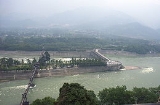
Dujiangyan is an irrigation
infrastructure built in 256 BC during the Warring States Period
of China
by the Kingdom of Qin
. It is located in the Min River in Sichuan
province, China
, near the capital Chengdu
. It is still in use today to irrigate over 5,300 square kilometers of land in the region. The Dujiangyan along with the Zhengguo Canal
in Shaanxi Province and the Lingqu Canal
in Guangxi Province are known as “The three great hydraulic engineering projects of the Qin Dynasty
”.
governor Lǐ Bīng investigated the problem and discovered that the river was swelled by fast flowing spring melt-water from the local mountains that burst the banks when it reached the slow moving and heavily silted stretch below.
One solution would have been to build a dam
but Li Bing had also been charged with keeping the waterway open for military vessels to supply troops on the frontier, so instead he proposed to construct an artificial levee to redirect a portion of the river's flow and then to cut a channel through Mount Yulei to discharge the excess water upon the dry Chengdu Plain
beyond.
s of silver for the project from King Zhao of Qin and set to work with a team said to number tens of thousands. The levee
was constructed from long sausage-shaped baskets of woven bamboo
filled with stones known as Zhulong held in place by wooden tripods known as Macha. The massive construction took four years to complete.
Cutting the channel proved to be a far greater problem as the tools available to Li Bing at the time, prior to the invention of gunpowder
, were unable to penetrate the hard rock of the mountain so he used a combination of fire and water to heat and cool the rocks until they cracked and could be removed. After eight years of work a 20 metres (65.6 ft) wide channel had been gouged through the mountain.
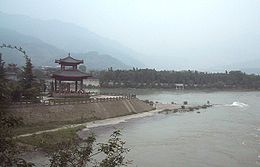 After the system was finished, no more floods occurred. The irrigation made Sichuan
the most productive agricultural place in China
. On the east side of Dujiangyan, people built a shrine in remembrance of Li Bing.
Li Bing’s construction is also credited with giving the people of the region a laid-back attitude to life; by eliminating disaster and insuring a regular and bountiful harvest, it has left them with plenty of free time.
Today, Dujiangyan has become a major tourist attraction. It is also admired by scientists from around the world, because of one feature. Unlike contemporary dams
where the water is blocked with a huge wall, Dujiangyan still lets water go through naturally. Modern dams
do not let fish go through very well, since each dam is a wall and the water levels are different. In 2000, Dujiangyan became a UNESCO World Heritage Site.
The Yuzui or Fish Mouth Levee, named for its conical head that is said to resemble the mouth of a fish, is the key part of Li Bing’s construction. It is an artificial levee
that divides the water into inner and outer streams. The inner stream carries approximately 40%, rising to 60% during flood, of the river’s flow into the irrigation system whilst that outer stream drains away the rest, flushing out much of the silt and sediment.
The Feishayan or Flying Sand Weir has a 200 m-wide opening that connects the inner and outer streams. This ensures against flooding by allowing the natural swirling flow of the water to drain out excess water from the inner to the outer stream. A modern reinforced concrete
weir
has replaced Li Bing’s original weighted bamboo baskets.
The Baopingkou or Bottle-Neck Channel, which Li Bing gouged through the mountain, is the final part of the system. The channel distributes the water to the farmlands to the west, whilst the narrow entrance, that gives it its name, works as a check gate, creating the whirlpool flow that carries away the excess water over Flying Sand Fence, to ensure against flooding.
by Pingshi Bridge which burned down during the wars that marked the end of the Ming Dynasty
.
In 1803 during the Qing Dynasty
a local man named He Xiande and his wife proposed the construction of a replacement, made of wooden plates and bamboo handrails, to span both streams and this was nicknamed Couple’s Bridge in their honour. This was replaced in 1970 by a modern bridge of reinforced concrete and steel chains that is now opened to visitors.
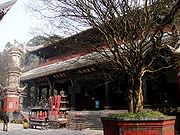 Erwang or Two Kings Temple is located on the bank of the river at the foot of Mount Yulei. The original Wangdi Temple built in memory of an ancient Shu
king was relocated and so locals renamed the temple here in honour of Li Bing and his legendary son whom they had posthumously promoted to kings.
The 10,072 m2 Qing Dynasty
wooden complex conforms to the traditional standard of temple design except that it does not follow a north-south axis. The main hall, which contains a modern statue of Li Bing, opens up onto a courtyard facing an opera stage. On Li Bing's traditional birthday, 24th day of the 7th month of the lunar calendar, local operas were performed for the public, and on Tomb Sweeping Day a Water Throwing Festival is held.
The rear hall contains a modern statue of the god Erlang Shen
who was allegedly Li Bing’s son, but historic records fail to confirm this and it is possible that he was invented by locals to give their hero a descendent to maintain his family heritage. Guanlantin Pavilion stands above the complex and is inscribed with wise words from Li Bing such as, When the river flows in zigzags, cut a straight channel; when the riverbed is wide and shallow, dig it deeper.
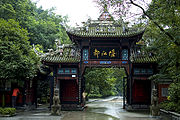 Fulonguan or Dragon-Taming Temple in Liudi Park was founded in the third century in honour of Fan Changsheng
, the Jin Dynasty founder of Tianshi Daoism. Following Li Bing’s death a hall was established here in his honour and the temple was renamed to commemorate the dragon fighting legends that surrounded him.
It is here that Erlang Shen
, the legendary son of Li Bing, is said to have chained the dragon that he and his 7 friends had captured in an ambush at the River God Temple when it came to collect a human sacrifice. This action is said to have protected the region from floods ever since.
During the East Han Dynasty a statue of Li Bing was place in the river to monitor the water flow, with the level rising above his shoulders to indicate flood and falling beneath his calves to indicate drought. Recovered from the river in 1974 and placed on display in the main hall, this is the oldest known stone statue of a human in China.
Irrigation
Irrigation may be defined as the science of artificial application of water to the land or soil. It is used to assist in the growing of agricultural crops, maintenance of landscapes, and revegetation of disturbed soils in dry areas and during periods of inadequate rainfall...
infrastructure built in 256 BC during the Warring States Period
Warring States Period
The Warring States Period , also known as the Era of Warring States, or the Warring Kingdoms period, covers the Iron Age period from about 475 BC to the reunification of China under the Qin Dynasty in 221 BC...
of China
China
Chinese civilization may refer to:* China for more general discussion of the country.* Chinese culture* Greater China, the transnational community of ethnic Chinese.* History of China* Sinosphere, the area historically affected by Chinese culture...
by the Kingdom of Qin
Qin (state)
The State of Qin was a Chinese feudal state that existed during the Spring and Autumn and Warring States Periods of Chinese history...
. It is located in the Min River in Sichuan
Sichuan
' , known formerly in the West by its postal map spellings of Szechwan or Szechuan is a province in Southwest China with its capital in Chengdu...
province, China
China
Chinese civilization may refer to:* China for more general discussion of the country.* Chinese culture* Greater China, the transnational community of ethnic Chinese.* History of China* Sinosphere, the area historically affected by Chinese culture...
, near the capital Chengdu
Chengdu
Chengdu , formerly transliterated Chengtu, is the capital of Sichuan province in Southwest China. It holds sub-provincial administrative status...
. It is still in use today to irrigate over 5,300 square kilometers of land in the region. The Dujiangyan along with the Zhengguo Canal
Zhengguo Canal
The Zhengguo Canal, Zhengguoqu or Chengkuo Canal , named after its designer, Zheng Guo, is a large canal located in Shaanxi province, China. The canal irrigates the Guanzhong plain, north of Xi'an. Together with the Dujiangyan Irrigation System and Lingqu Canal, it is one of the three biggest water...
in Shaanxi Province and the Lingqu Canal
Lingqu Canal
The Lingqu Canal is located in Xing'an County, near Guilin, in the northeastern corner of Guangxi Province, China. It connects the Xiang River with the Lijiang , which in its turn continues toward the Xijiang), and thus is part of a historical waterway between the Yangtze and the Pearl River...
in Guangxi Province are known as “The three great hydraulic engineering projects of the Qin Dynasty
Qin Dynasty
The Qin Dynasty was the first imperial dynasty of China, lasting from 221 to 207 BC. The Qin state derived its name from its heartland of Qin, in modern-day Shaanxi. The strength of the Qin state was greatly increased by the legalist reforms of Shang Yang in the 4th century BC, during the Warring...
”.
Planning
During the Warring States period (406–221 BC;), people who lived along the banks of the Min River were plagued by annual flooding. QinQin (state)
The State of Qin was a Chinese feudal state that existed during the Spring and Autumn and Warring States Periods of Chinese history...
governor Lǐ Bīng investigated the problem and discovered that the river was swelled by fast flowing spring melt-water from the local mountains that burst the banks when it reached the slow moving and heavily silted stretch below.
One solution would have been to build a dam
Dam
A dam is a barrier that impounds water or underground streams. Dams generally serve the primary purpose of retaining water, while other structures such as floodgates or levees are used to manage or prevent water flow into specific land regions. Hydropower and pumped-storage hydroelectricity are...
but Li Bing had also been charged with keeping the waterway open for military vessels to supply troops on the frontier, so instead he proposed to construct an artificial levee to redirect a portion of the river's flow and then to cut a channel through Mount Yulei to discharge the excess water upon the dry Chengdu Plain
Chengdu Plain
The Chengdu Plain , known as Cuanxi Bazi in Sichuanese, is an alluvial plain located in the western part of Sichuan Basin in Sichuan, China. Chengdu is located on it....
beyond.
Construction
Li Bing received 100,000 taelTael
Tael can refer to any one of several weight measures of the Far East. Most commonly, it refers to the Chinese tael, a part of the Chinese system of weights and currency....
s of silver for the project from King Zhao of Qin and set to work with a team said to number tens of thousands. The levee
Levee
A levee, levée, dike , embankment, floodbank or stopbank is an elongated naturally occurring ridge or artificially constructed fill or wall, which regulates water levels...
was constructed from long sausage-shaped baskets of woven bamboo
Bamboo
Bamboo is a group of perennial evergreens in the true grass family Poaceae, subfamily Bambusoideae, tribe Bambuseae. Giant bamboos are the largest members of the grass family....
filled with stones known as Zhulong held in place by wooden tripods known as Macha. The massive construction took four years to complete.
Cutting the channel proved to be a far greater problem as the tools available to Li Bing at the time, prior to the invention of gunpowder
Gunpowder
Gunpowder, also known since in the late 19th century as black powder, was the first chemical explosive and the only one known until the mid 1800s. It is a mixture of sulfur, charcoal, and potassium nitrate - with the sulfur and charcoal acting as fuels, while the saltpeter works as an oxidizer...
, were unable to penetrate the hard rock of the mountain so he used a combination of fire and water to heat and cool the rocks until they cracked and could be removed. After eight years of work a 20 metres (65.6 ft) wide channel had been gouged through the mountain.
Legacy
Sichuan
' , known formerly in the West by its postal map spellings of Szechwan or Szechuan is a province in Southwest China with its capital in Chengdu...
the most productive agricultural place in China
China
Chinese civilization may refer to:* China for more general discussion of the country.* Chinese culture* Greater China, the transnational community of ethnic Chinese.* History of China* Sinosphere, the area historically affected by Chinese culture...
. On the east side of Dujiangyan, people built a shrine in remembrance of Li Bing.
Li Bing’s construction is also credited with giving the people of the region a laid-back attitude to life; by eliminating disaster and insuring a regular and bountiful harvest, it has left them with plenty of free time.
Today, Dujiangyan has become a major tourist attraction. It is also admired by scientists from around the world, because of one feature. Unlike contemporary dams
DAMS
Driot-Arnoux Motorsport is a racing team from France, involved in many areas of motorsports. DAMS was founded in 1988 by Jean-Paul Driot and former Formula One driver René Arnoux. It is headquartered near Le Mans, only 2 km from the Bugatti Circuit.- History :The year after its foundation,...
where the water is blocked with a huge wall, Dujiangyan still lets water go through naturally. Modern dams
DAMS
Driot-Arnoux Motorsport is a racing team from France, involved in many areas of motorsports. DAMS was founded in 1988 by Jean-Paul Driot and former Formula One driver René Arnoux. It is headquartered near Le Mans, only 2 km from the Bugatti Circuit.- History :The year after its foundation,...
do not let fish go through very well, since each dam is a wall and the water levels are different. In 2000, Dujiangyan became a UNESCO World Heritage Site.
2008 Sichuan earthquake
On May 12, 2008 a massive earthquake centred on the Dujiangyan area struck. Initial reports indicate that the Yuzui Levee was cracked but not severely damaged.Irrigation Head
Li Bing’s Irrigation System consists of three main constructions that work in harmony with one another to ensure against flooding and keep the fields well supplied with water:The Yuzui or Fish Mouth Levee, named for its conical head that is said to resemble the mouth of a fish, is the key part of Li Bing’s construction. It is an artificial levee
Levee
A levee, levée, dike , embankment, floodbank or stopbank is an elongated naturally occurring ridge or artificially constructed fill or wall, which regulates water levels...
that divides the water into inner and outer streams. The inner stream carries approximately 40%, rising to 60% during flood, of the river’s flow into the irrigation system whilst that outer stream drains away the rest, flushing out much of the silt and sediment.
The Feishayan or Flying Sand Weir has a 200 m-wide opening that connects the inner and outer streams. This ensures against flooding by allowing the natural swirling flow of the water to drain out excess water from the inner to the outer stream. A modern reinforced concrete
Concrete
Concrete is a composite construction material, composed of cement and other cementitious materials such as fly ash and slag cement, aggregate , water and chemical admixtures.The word concrete comes from the Latin word...
weir
Weir
A weir is a small overflow dam used to alter the flow characteristics of a river or stream. In most cases weirs take the form of a barrier across the river that causes water to pool behind the structure , but allows water to flow over the top...
has replaced Li Bing’s original weighted bamboo baskets.
The Baopingkou or Bottle-Neck Channel, which Li Bing gouged through the mountain, is the final part of the system. The channel distributes the water to the farmlands to the west, whilst the narrow entrance, that gives it its name, works as a check gate, creating the whirlpool flow that carries away the excess water over Flying Sand Fence, to ensure against flooding.
Anlan Suspension Bridge
Anlan or Couple's Bridge spans the full width of the river connecting the artificial island to both banks and is known as one of the Five Ancient Bridges of China. Li Bing’s original Zhupu Bridge only spanned the inner stream connecting the levee to the foot of Mount Yulei. This was replaced in the Song DynastySong Dynasty
The Song Dynasty was a ruling dynasty in China between 960 and 1279; it succeeded the Five Dynasties and Ten Kingdoms Period, and was followed by the Yuan Dynasty. It was the first government in world history to issue banknotes or paper money, and the first Chinese government to establish a...
by Pingshi Bridge which burned down during the wars that marked the end of the Ming Dynasty
Ming Dynasty
The Ming Dynasty, also Empire of the Great Ming, was the ruling dynasty of China from 1368 to 1644, following the collapse of the Mongol-led Yuan Dynasty. The Ming, "one of the greatest eras of orderly government and social stability in human history", was the last dynasty in China ruled by ethnic...
.
In 1803 during the Qing Dynasty
Qing Dynasty
The Qing Dynasty was the last dynasty of China, ruling from 1644 to 1912 with a brief, abortive restoration in 1917. It was preceded by the Ming Dynasty and followed by the Republic of China....
a local man named He Xiande and his wife proposed the construction of a replacement, made of wooden plates and bamboo handrails, to span both streams and this was nicknamed Couple’s Bridge in their honour. This was replaced in 1970 by a modern bridge of reinforced concrete and steel chains that is now opened to visitors.
Two Kings Temple
Shu (state)
The State of Shu was an ancient state in what is now Sichuan, China. It was conquered by Qin in 316 BC. Shu was based on the Chengdu Plain, in the western Sichuan basin with some extension northeast to the upper Han River valley. To the east was the Ba tribal confederation. Further east down the...
king was relocated and so locals renamed the temple here in honour of Li Bing and his legendary son whom they had posthumously promoted to kings.
The 10,072 m2 Qing Dynasty
Qing Dynasty
The Qing Dynasty was the last dynasty of China, ruling from 1644 to 1912 with a brief, abortive restoration in 1917. It was preceded by the Ming Dynasty and followed by the Republic of China....
wooden complex conforms to the traditional standard of temple design except that it does not follow a north-south axis. The main hall, which contains a modern statue of Li Bing, opens up onto a courtyard facing an opera stage. On Li Bing's traditional birthday, 24th day of the 7th month of the lunar calendar, local operas were performed for the public, and on Tomb Sweeping Day a Water Throwing Festival is held.
The rear hall contains a modern statue of the god Erlang Shen
Erlang Shen
Erlang Shen , or Erlang is a Chinese God with a third truth-seeing eye in the middle of his forehead.Er-lang Shen may be a deified version of several semi-mythical folk heroes who help regulate China's torrential floods, dating variously from the Qin, Sui and Jin dynasties...
who was allegedly Li Bing’s son, but historic records fail to confirm this and it is possible that he was invented by locals to give their hero a descendent to maintain his family heritage. Guanlantin Pavilion stands above the complex and is inscribed with wise words from Li Bing such as, When the river flows in zigzags, cut a straight channel; when the riverbed is wide and shallow, dig it deeper.
Dragon-Taming Temple
Fan Changsheng
Fan Changsheng was a Taoist hermit who was instrumental in the establishment of the Cheng Han state during the Sixteen Kingdoms era in China. He led a Taoist community of over one thousand families on Mount Qingcheng, Sichuan. During a critical famine, Fan Changsheng provided Li Xiong's army with...
, the Jin Dynasty founder of Tianshi Daoism. Following Li Bing’s death a hall was established here in his honour and the temple was renamed to commemorate the dragon fighting legends that surrounded him.
It is here that Erlang Shen
Erlang Shen
Erlang Shen , or Erlang is a Chinese God with a third truth-seeing eye in the middle of his forehead.Er-lang Shen may be a deified version of several semi-mythical folk heroes who help regulate China's torrential floods, dating variously from the Qin, Sui and Jin dynasties...
, the legendary son of Li Bing, is said to have chained the dragon that he and his 7 friends had captured in an ambush at the River God Temple when it came to collect a human sacrifice. This action is said to have protected the region from floods ever since.
During the East Han Dynasty a statue of Li Bing was place in the river to monitor the water flow, with the level rising above his shoulders to indicate flood and falling beneath his calves to indicate drought. Recovered from the river in 1974 and placed on display in the main hall, this is the oldest known stone statue of a human in China.
See also
- Li Bing
- Erlang ShenErlang ShenErlang Shen , or Erlang is a Chinese God with a third truth-seeing eye in the middle of his forehead.Er-lang Shen may be a deified version of several semi-mythical folk heroes who help regulate China's torrential floods, dating variously from the Qin, Sui and Jin dynasties...
- Turfan water systemTurfan water systemThe Turpan water system or Turfan water system in Turpan, located in the Turpan Depression, Xinjiang, China, is a qanat system adapted by the Turpan people. The Chinese claim the karez system as one of the three greatest water projects of China, linking it with the Dujiangyan Irrigation System...
- Grand Canal of China