

.gif)
Duck and Cover (film)

Encyclopedia
Duck and Cover is a civil defense
film (sometimes also characterized as a social guidance film
or propaganda
) produced in 1951 (but first shown publicly in January 1952) by the United States federal government
's civil defense
branch shortly after the Soviet Union
began nuclear testing
. Written by Raymond J. Mauer and directed by Anthony Rizzo of Archer Productions and made with the help of schoolchildren from New York City
and Astoria
, New York
, it was shown in schools as the cornerstone of the government's "duck and cover
" public awareness campaign. The movie states that nuclear war
could happen at any time without warning, and U.S. citizens should keep this constantly in mind and be ever ready.
The US government contracted with Archer to produce Duck and Cover. The film is now in the public domain
, and as such is widely available through Internet download sources, as well as on DVD
.
 The film starts with an animated sequence
, showing an anthropomorphic
turtle
walking down a road, while picking up a flower and smelling it. A chorus
sings the Duck and Cover theme:
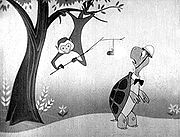 While this goes on, Bert is attacked by a monkey
holding a string from which hangs a lit stick of dynamite
. Bert ducks into his shell
in the nick of time, as the dynamite goes off and blows up both the monkey and the tree in which he is sitting. Bert, however, is shown perfectly safe, because he has ducked and covered.
The film, which is about 10 minutes long, then switches to live footage, as a narrator explains what children should do "when you see the flash" of an atomic bomb. The movie goes on to suggest that by ducking down low in the event of a nuclear explosion
, the children would be safer than they would be standing, and explains some basic survival tactics for nuclear war.
s were developed (the first having been developed during the Manhattan Project
during World War II
), it was realized what kind of danger they posed. The United States held a nuclear monopoly from the end of World War II
until 1949, when the Soviets detonated their first nuclear device.
This signaled the beginning of the nuclear stage of the Cold War
, and as a result, strategies for survival were thought out. Fallout shelter
s, both private and public, were built, but the government still viewed it as necessary to explain to citizens both the danger of the atomic (and later, hydrogen) bombs, and to give them some sort of training so that they would be prepared to act in the event of a nuclear strike
.
The solution was the duck and cover campaign, of which Duck and Cover was an integral part. Shelters were built, drills were held in towns and schools, and the film was shown to schoolchildren. According to the United States Library of Congress
(which declared the film "historically significant" and inducted it for preservation into the National Film Registry
in 2004), it "was seen by millions of schoolchildren in the 1950s."
is a much more blunt take on the same theme), it is sometimes regarded as being a red scare
political tool, to make children frightened of the Soviet Union
and communism
. Also questioned is the film's scientific accuracy
; whether or not the tactics shown in the film (such as ducking into a doorway, putting a newspaper over your head, and even just throwing yourself face down on the ground) would actually work.
While this (or any) tactic would be useless for someone at ground zero
during a nuclear blast, it could be beneficial for those who are positioned away from the blast hypocenter
: both the thermal pulse of some weapons and shrapnel from all weapons (particularly from shattered windows) could be evaded. In particular, higher yield thermonuclear weapon
s have thermal pulses which last for several seconds. By promptly putting something between yourself and the fireball, you could avoid or reduce the severity of the burns you would have otherwise received. For those not at ground zero, there would be a delay between the flash (indicating the need to duck and cover) and the arrival of the blast wave, which could shatter windows and cause other blast or impact injuries (although electromagnetic radiation, such as infra-red and gamma rays, would arrive at the observer's position at the same time as the light flash, leaving the observer no time to find cover from these particular aspects of a nuclear detonation).
A newspaper would, at least in theory, block alpha radiation
although skin does this anyway, provide some shielding from the heat (IR, visible and UV) radiation and small debris, though it would have no effect on the beta
and gamma radiation
or on the shockwave
that would accompany an atomic detonation.
.
However, many schools across the United States continue to use the "Duck and Cover" sheltering style in the event of tornadoes, earthquakes, and full lockdowns among other things.
The satirical animated series South Park
lampooned Duck and Cover in the first season episode Volcano, as giving instructions on how to avoid hot lava
. Another parody, "Atomic Holocaust," appeared in the animated film The Iron Giant
.
Steampunk
musician Doctor Steel
sampled segments from the film's soundtrack into his recording Drop Da Bomb on his 2001 album Dr. Steel II: Eclectic Boogaloo
.
Civil defense
Civil defense, civil defence or civil protection is an effort to protect the citizens of a state from military attack. It uses the principles of emergency operations: prevention, mitigation, preparation, response, or emergency evacuation, and recovery...
film (sometimes also characterized as a social guidance film
Social guidance film
Social guidance films constitute a genre of films attempting to guide children and adults to behave in certain ways. Typically shown in school classrooms in the USA from the 1950s through the 1970s, the films covered topics including courtesy, responsibility, sexuality, drug use, and driver...
or propaganda
Propaganda
Propaganda is a form of communication that is aimed at influencing the attitude of a community toward some cause or position so as to benefit oneself or one's group....
) produced in 1951 (but first shown publicly in January 1952) by the United States federal government
Federal government of the United States
The federal government of the United States is the national government of the constitutional republic of fifty states that is the United States of America. The federal government comprises three distinct branches of government: a legislative, an executive and a judiciary. These branches and...
's civil defense
Civil defense
Civil defense, civil defence or civil protection is an effort to protect the citizens of a state from military attack. It uses the principles of emergency operations: prevention, mitigation, preparation, response, or emergency evacuation, and recovery...
branch shortly after the Soviet Union
Soviet Union
The Soviet Union , officially the Union of Soviet Socialist Republics , was a constitutionally socialist state that existed in Eurasia between 1922 and 1991....
began nuclear testing
Nuclear testing
Nuclear weapons tests are experiments carried out to determine the effectiveness, yield and explosive capability of nuclear weapons. Throughout the twentieth century, most nations that have developed nuclear weapons have tested them...
. Written by Raymond J. Mauer and directed by Anthony Rizzo of Archer Productions and made with the help of schoolchildren from New York City
New York City
New York is the most populous city in the United States and the center of the New York Metropolitan Area, one of the most populous metropolitan areas in the world. New York exerts a significant impact upon global commerce, finance, media, art, fashion, research, technology, education, and...
and Astoria
Astoria, Queens
Astoria is a neighborhood in the northwestern corner of the borough of Queens in New York City. Located in Community Board 1, Astoria is bounded by the East River and is adjacent to three other Queens neighborhoods: Long Island City, Sunnyside , and Woodside...
, New York
New York
New York is a state in the Northeastern region of the United States. It is the nation's third most populous state. New York is bordered by New Jersey and Pennsylvania to the south, and by Connecticut, Massachusetts and Vermont to the east...
, it was shown in schools as the cornerstone of the government's "duck and cover
Duck and cover
Duck and Cover was a suggested method of personal protection against the effects of a nuclear weapon which the United States government taught to generations of United States school children from the early 1950s into the 1980s. This was supposed to protect them in the event of an unexpected nuclear...
" public awareness campaign. The movie states that nuclear war
Nuclear warfare
Nuclear warfare, or atomic warfare, is a military conflict or political strategy in which nuclear weaponry is detonated on an opponent. Compared to conventional warfare, nuclear warfare can be vastly more destructive in range and extent of damage...
could happen at any time without warning, and U.S. citizens should keep this constantly in mind and be ever ready.
The US government contracted with Archer to produce Duck and Cover. The film is now in the public domain
Public domain
Works are in the public domain if the intellectual property rights have expired, if the intellectual property rights are forfeited, or if they are not covered by intellectual property rights at all...
, and as such is widely available through Internet download sources, as well as on DVD
DVD
A DVD is an optical disc storage media format, invented and developed by Philips, Sony, Toshiba, and Panasonic in 1995. DVDs offer higher storage capacity than Compact Discs while having the same dimensions....
.
Plot summary
Animated cartoon
An animated cartoon is a short, hand-drawn film for the cinema, television or computer screen, featuring some kind of story or plot...
, showing an anthropomorphic
Anthropomorphism
Anthropomorphism is any attribution of human characteristics to animals, non-living things, phenomena, material states, objects or abstract concepts, such as organizations, governments, spirits or deities. The term was coined in the mid 1700s...
turtle
Turtle
Turtles are reptiles of the order Testudines , characterised by a special bony or cartilaginous shell developed from their ribs that acts as a shield...
walking down a road, while picking up a flower and smelling it. A chorus
Choir
A choir, chorale or chorus is a musical ensemble of singers. Choral music, in turn, is the music written specifically for such an ensemble to perform.A body of singers who perform together as a group is called a choir or chorus...
sings the Duck and Cover theme:
There was a turtle by the name of Bert
and Bert the turtle was very alert;
when danger threatened him he never got hurt
he knew just what to do...
He'd duck! [gasp]
And cover!
Duck! [gasp]
And cover!
(male) He did what we all must learn to do
(male) You (female) And you (male) And you (deeper male) And you!
[bang, gasp] Duck, and cover!
Monkey
A monkey is a primate, either an Old World monkey or a New World monkey. There are about 260 known living species of monkey. Many are arboreal, although there are species that live primarily on the ground, such as baboons. Monkeys are generally considered to be intelligent. Unlike apes, monkeys...
holding a string from which hangs a lit stick of dynamite
Dynamite
Dynamite is an explosive material based on nitroglycerin, initially using diatomaceous earth , or another absorbent substance such as powdered shells, clay, sawdust, or wood pulp. Dynamites using organic materials such as sawdust are less stable and such use has been generally discontinued...
. Bert ducks into his shell
Exoskeleton
An exoskeleton is the external skeleton that supports and protects an animal's body, in contrast to the internal skeleton of, for example, a human. In popular usage, some of the larger kinds of exoskeletons are known as "shells". Examples of exoskeleton animals include insects such as grasshoppers...
in the nick of time, as the dynamite goes off and blows up both the monkey and the tree in which he is sitting. Bert, however, is shown perfectly safe, because he has ducked and covered.
The film, which is about 10 minutes long, then switches to live footage, as a narrator explains what children should do "when you see the flash" of an atomic bomb. The movie goes on to suggest that by ducking down low in the event of a nuclear explosion
Nuclear explosion
A nuclear explosion occurs as a result of the rapid release of energy from an intentionally high-speed nuclear reaction. The driving reaction may be nuclear fission, nuclear fusion or a multistage cascading combination of the two, though to date all fusion based weapons have used a fission device...
, the children would be safer than they would be standing, and explains some basic survival tactics for nuclear war.
Purpose
After nuclear weaponNuclear weapon
A nuclear weapon is an explosive device that derives its destructive force from nuclear reactions, either fission or a combination of fission and fusion. Both reactions release vast quantities of energy from relatively small amounts of matter. The first fission bomb test released the same amount...
s were developed (the first having been developed during the Manhattan Project
Manhattan Project
The Manhattan Project was a research and development program, led by the United States with participation from the United Kingdom and Canada, that produced the first atomic bomb during World War II. From 1942 to 1946, the project was under the direction of Major General Leslie Groves of the US Army...
during World War II
World War II
World War II, or the Second World War , was a global conflict lasting from 1939 to 1945, involving most of the world's nations—including all of the great powers—eventually forming two opposing military alliances: the Allies and the Axis...
), it was realized what kind of danger they posed. The United States held a nuclear monopoly from the end of World War II
World War II
World War II, or the Second World War , was a global conflict lasting from 1939 to 1945, involving most of the world's nations—including all of the great powers—eventually forming two opposing military alliances: the Allies and the Axis...
until 1949, when the Soviets detonated their first nuclear device.
This signaled the beginning of the nuclear stage of the Cold War
Cold War
The Cold War was the continuing state from roughly 1946 to 1991 of political conflict, military tension, proxy wars, and economic competition between the Communist World—primarily the Soviet Union and its satellite states and allies—and the powers of the Western world, primarily the United States...
, and as a result, strategies for survival were thought out. Fallout shelter
Fallout shelter
A fallout shelter is an enclosed space specially designed to protect occupants from radioactive debris or fallout resulting from a nuclear explosion. Many such shelters were constructed as civil defense measures during the Cold War....
s, both private and public, were built, but the government still viewed it as necessary to explain to citizens both the danger of the atomic (and later, hydrogen) bombs, and to give them some sort of training so that they would be prepared to act in the event of a nuclear strike
Nuclear warfare
Nuclear warfare, or atomic warfare, is a military conflict or political strategy in which nuclear weaponry is detonated on an opponent. Compared to conventional warfare, nuclear warfare can be vastly more destructive in range and extent of damage...
.
The solution was the duck and cover campaign, of which Duck and Cover was an integral part. Shelters were built, drills were held in towns and schools, and the film was shown to schoolchildren. According to the United States Library of Congress
Library of Congress
The Library of Congress is the research library of the United States Congress, de facto national library of the United States, and the oldest federal cultural institution in the United States. Located in three buildings in Washington, D.C., it is the largest library in the world by shelf space and...
(which declared the film "historically significant" and inducted it for preservation into the National Film Registry
National Film Registry
The National Film Registry is the United States National Film Preservation Board's selection of films for preservation in the Library of Congress. The Board, established by the National Film Preservation Act of 1988, was reauthorized by acts of Congress in 1992, 1996, 2005, and again in October 2008...
in 2004), it "was seen by millions of schoolchildren in the 1950s."
Controversy
There is controversy from some people regarding the actual usefulness of the film. Since it has no counterpart in any other country (although the British film Protect and SurviveProtect and Survive
Protect and Survive was a public information series on civil defence produced by the British government during the late 1970s and early 1980s. It was intended to inform British citizens on how to protect themselves during a nuclear attack, and consisted of a mixture of pamphlets, radio broadcasts,...
is a much more blunt take on the same theme), it is sometimes regarded as being a red scare
Red Scare
Durrell Blackwell Durrell Blackwell The term Red Scare denotes two distinct periods of strong Anti-Communism in the United States: the First Red Scare, from 1919 to 1920, and the Second Red Scare, from 1947 to 1957. The First Red Scare was about worker revolution and...
political tool, to make children frightened of the Soviet Union
Soviet Union
The Soviet Union , officially the Union of Soviet Socialist Republics , was a constitutionally socialist state that existed in Eurasia between 1922 and 1991....
and communism
Communism
Communism is a social, political and economic ideology that aims at the establishment of a classless, moneyless, revolutionary and stateless socialist society structured upon common ownership of the means of production...
. Also questioned is the film's scientific accuracy
Philosophy of science
The philosophy of science is concerned with the assumptions, foundations, methods and implications of science. It is also concerned with the use and merit of science and sometimes overlaps metaphysics and epistemology by exploring whether scientific results are actually a study of truth...
; whether or not the tactics shown in the film (such as ducking into a doorway, putting a newspaper over your head, and even just throwing yourself face down on the ground) would actually work.
While this (or any) tactic would be useless for someone at ground zero
Ground zero
The term ground zero describes the point on the Earth's surface closest to a detonation...
during a nuclear blast, it could be beneficial for those who are positioned away from the blast hypocenter
Hypocenter
The hypocenter refers to the site of an earthquake or a nuclear explosion...
: both the thermal pulse of some weapons and shrapnel from all weapons (particularly from shattered windows) could be evaded. In particular, higher yield thermonuclear weapon
Nuclear weapon design
Nuclear weapon designs are physical, chemical, and engineering arrangements that cause the physics package of a nuclear weapon to detonate. There are three basic design types...
s have thermal pulses which last for several seconds. By promptly putting something between yourself and the fireball, you could avoid or reduce the severity of the burns you would have otherwise received. For those not at ground zero, there would be a delay between the flash (indicating the need to duck and cover) and the arrival of the blast wave, which could shatter windows and cause other blast or impact injuries (although electromagnetic radiation, such as infra-red and gamma rays, would arrive at the observer's position at the same time as the light flash, leaving the observer no time to find cover from these particular aspects of a nuclear detonation).
A newspaper would, at least in theory, block alpha radiation
Alpha particle
Alpha particles consist of two protons and two neutrons bound together into a particle identical to a helium nucleus, which is classically produced in the process of alpha decay, but may be produced also in other ways and given the same name...
although skin does this anyway, provide some shielding from the heat (IR, visible and UV) radiation and small debris, though it would have no effect on the beta
Beta particle
Beta particles are high-energy, high-speed electrons or positrons emitted by certain types of radioactive nuclei such as potassium-40. The beta particles emitted are a form of ionizing radiation also known as beta rays. The production of beta particles is termed beta decay...
and gamma radiation
Gamma ray
Gamma radiation, also known as gamma rays or hyphenated as gamma-rays and denoted as γ, is electromagnetic radiation of high frequency . Gamma rays are usually naturally produced on Earth by decay of high energy states in atomic nuclei...
or on the shockwave
Shock wave
A shock wave is a type of propagating disturbance. Like an ordinary wave, it carries energy and can propagate through a medium or in some cases in the absence of a material medium, through a field such as the electromagnetic field...
that would accompany an atomic detonation.
Cultural impact
Although duck-and-cover drills are no longer held in United States schools and most fallout shelters have been closed down or abandoned, Duck and Cover, which was shown to an entire generation of children, is referenced in television shows and movies, usually in a context implying Duck and Cover is an example of campCamp (style)
Camp is an aesthetic sensibility that regards something as appealing because of its taste and ironic value. The concept is closely related to kitsch, and things with camp appeal may also be described as being "cheesy"...
.
However, many schools across the United States continue to use the "Duck and Cover" sheltering style in the event of tornadoes, earthquakes, and full lockdowns among other things.
The satirical animated series South Park
South Park
South Park is an American animated television series created by Trey Parker and Matt Stone for the Comedy Central television network. Intended for mature audiences, the show has become famous for its crude language, surreal, satirical, and dark humor that lampoons a wide range of topics...
lampooned Duck and Cover in the first season episode Volcano, as giving instructions on how to avoid hot lava
Lava
Lava refers both to molten rock expelled by a volcano during an eruption and the resulting rock after solidification and cooling. This molten rock is formed in the interior of some planets, including Earth, and some of their satellites. When first erupted from a volcanic vent, lava is a liquid at...
. Another parody, "Atomic Holocaust," appeared in the animated film The Iron Giant
The Iron Giant
The Iron Giant is a 1999 animated film produced by Warner Bros. Animation, based on the 1968 novel The Iron Man by Ted Hughes. Brad Bird directed the film, which stars a voice cast of Jennifer Aniston, Harry Connick, Jr., Vin Diesel, Eli Marienthal, Christopher McDonald and John Mahoney...
.
Steampunk
Steampunk
Steampunk is a sub-genre of science fiction, fantasy, alternate history, and speculative fiction that came into prominence during the 1980s and early 1990s. Steampunk involves a setting where steam power is still widely used—usually Victorian era Britain or "Wild West"-era United...
musician Doctor Steel
Doctor Steel
Doctor Steel , is a self-published American musician located in Southern California, prominent in the Steampunk, Goth, and Rivethead scenes. He has performed on rare occasions with a "backup band", claiming that a fictitious robot band had malfunctioned...
sampled segments from the film's soundtrack into his recording Drop Da Bomb on his 2001 album Dr. Steel II: Eclectic Boogaloo
Dr. Steel II: Eclectic Boogaloo
Dr. Steel II: Eclectic Boogaloo is the second studio album of American Steampunk/Hip-hop musician Doctor Steel. The album was released on Steel's own record label in 2001 as a series of MP3 downloads...
.
See also
- Atomic Cafe, documentary film including Duck and Cover.
- Duck and coverDuck and coverDuck and Cover was a suggested method of personal protection against the effects of a nuclear weapon which the United States government taught to generations of United States school children from the early 1950s into the 1980s. This was supposed to protect them in the event of an unexpected nuclear...
, for further discussion of this method of self-defense. - List of films about nuclear issues
- List of films in the public domain
- Protect and SurviveProtect and SurviveProtect and Survive was a public information series on civil defence produced by the British government during the late 1970s and early 1980s. It was intended to inform British citizens on how to protect themselves during a nuclear attack, and consisted of a mixture of pamphlets, radio broadcasts,...
, a British information film on the same topic.
External links
- Production History of Duck and Cover (section Prelinger ArchivesPrelinger ArchivesThe Prelinger Archives is a collection of films relating to U.S. cultural history, the evolution of the American landscape, everyday life and social history...
) - Duck and Cover on Cinemaniacal, in flash, ipod, and TV formats.
- A critical assessment of ducking and covering