
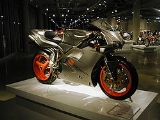
The
Ducati 916 is an
ItalianItaly , officially the Italian Republic languages]] under the European Charter for Regional or Minority Languages. In each of these, Italy's official name is as follows:;;;;;;;;), is a unitary parliamentary republic in South-Central Europe. To the north it borders France, Switzerland, Austria and...
sports
motorcycleA motorcycle is a single-track, two-wheeled motor vehicle. Motorcycles vary considerably depending on the task for which they are designed, such as long distance travel, navigating congested urban traffic, cruising, sport and racing, or off-road conditions.Motorcycles are one of the most...
manufactured by Ducati from 1994 to 1998. In contrast to Japanese
inline four-cylinderThe inline-four engine or straight-four engine is an internal combustion engine with all four cylinders mounted in a straight line, or plane along the crankcase. The single bank of cylinders may be oriented in either a vertical or an inclined plane with all the pistons driving a common crankshaft....
competitors of the time, its
V-twinA V-twin engine is a two-cylinder internal combustion engine where the cylinders are arranged in a V configuration.- Crankshaft configuration :Most V-twin engines have a single crankpin, which is shared by both connecting rods...
engine produced less outright power, but a more even torque spread. The 916 model was replaced by the
996The Ducati 996 is an Italian street motorcycle manufactured by Ducati from 1999 to 2002. It was based upon the earlier 916.-Model history:...
model in 1999.
Four Valves
The first development of the 916 model family can be traced back to the development of the four-valve Ducati engine, the Desmoquattro, through the development and racing of the earlier
PantahThe Pantah was the first of the belt-driven camshaft Ducati motors, the first generation of the current Ducati V twins. First shown December 1979, it came on the market as the 1980 500SL and the last of the line 650SL was sold in 1986...
models, to the road-going
851The Ducati 851 was a Ducati motorcycle, with liquid cooling and four valve heads, released to the public in 1987. Development had lagged with the continued use of two valve engines, but new funds enabled a technological move forward Ducati needed at the time....
and
888The Ducati 888 was a motorcycle manufactured by Ducati as an upgrade to the Ducati 851. The earlier 851 had introduced liquid cooling, computerized fuel injection and four-valve heads to the company's two cylinder motors. In 1991 Ducati increased the capacity of the 851 to 888 cc to create...
models.
The chief designer of Ducati motorcycles since the 1970s was the late
Fabio TaglioniFabio Taglioni was an Italian engineer.Born in Lugo di Romagna, he was chief designer and technical director of Ducati from 1954 until 1989. His desmodromic L-twin design is still used in all current Ducati motorcycle engines...
(1920-2001). He introduced the Pantah in 1979; its engine was updated in the 1990s in the
SuperSportThe Ducati SuperSport and SS are names applied to a series of Pantah based air-cooled four stroke desmodromic 2-valve 90-degree V-Twin motorcycles manufactured from 1988 onwards. A limited edition SuperSport called the SuperLight was sold in 1992. The name harked back to the round case 1973 Ducati...
(SS) series and all modern Ducati engines are derivatives of the Pantah, which employed a set of revolving cams to actuate the engine's valves (eliminating valve springs), called desmodromic. Taglioni, did not, however, have an interest in four-valve head engines, and so this was left to his successor. The eight-valve V-twin was the work of Taglioni's successor, Massimo Bordi.
Ducati 916
Making its debut in 1994, the
Ducati 916 was admired because of its new design and outstanding technical features. Designed by
Massimo TamburiniMassimo Tamburini is an Italian motorcycle designer for motorcycle companies including: Cagiva, Ducati, MV Agusta; and Bimota, which he founded, together with Bianchi and Morri ....
and Sergio Robbiano and his team at the
Cagiva Research CentreCagiva is an Italian motorcycle manufacturer. It was founded in 1950 by Giovanni Castiglioni in Varese, originally producing small metal components. It went into the motorcycle industry in 1978. The name is a portmanteau derived from the founder and the founding location, i.e. CAstiglioni GIovanni...
in
San MarinoSan Marino, officially the Republic of San Marino , is a state situated on the Italian Peninsula on the eastern side of the Apennine Mountains. It is an enclave surrounded by Italy. Its size is just over with an estimated population of over 30,000. Its capital is the City of San Marino...
, the 916's water-cooled engine was a revision its predecessor, the
888The Ducati 888 was a motorcycle manufactured by Ducati as an upgrade to the Ducati 851. The earlier 851 had introduced liquid cooling, computerized fuel injection and four-valve heads to the company's two cylinder motors. In 1991 Ducati increased the capacity of the 851 to 888 cc to create...
, with larger displacement, a new engine management system, on an overall smaller motorcycle with a chrome-moly trellis frame (which was shared with the
Ducati 748The Ducati 748 was the smaller version of the Ducati 916, an Italian sports motorcycle manufactured by Ducati from 1994 to 2002. It was succeeded by the Ducati 749.-Design:The Ducati 748 is identical in almost every way to the 916...
in 1995 and beyond). This was accomplished by increasing the crankshaft stroke from 64 mm to 66 mm. Using the same 94 mm bore size as the 888 resulted in a capacity of 916 cc - although by the time the 916 was introduced the final 851/888 Corse engines had also had their bore sizes increased to 96 mm resulting in 'race only' capacities of 926 cc and 955 cc respectively. This combined with a striking new bodywork that featured aggressive lines. It was later replaced by the 996 and
998The Ducati 998, a successor to the Ducati 996 and the final variation on the Ducati 916, was produced in various models from 2002 to 2004. The new Testastretta engine shared many similarities with the previous Desmoquattro engine in the 996, although it was completely new from the crankshaft up....
with similar design but revised engines and even more power.
Design of the Ducati 916 was a balance between function and form:
- The single-sided swingarm was beautiful, but designed to make wheel changes faster during races
- The underseat exhausts improve aerodynamic performance, and resultantly gave very clean lines. This feature was initially introduced on the Honda NR, and although Ducati was not the first, it has remained one of the trademark features of 916 line.
Massimo Tamburini went on to design the
MV Agusta F4The MV Agusta F4 was the motorcycle that launched the resurrection of MV Agusta in 1998. The F4 was created by famous motorcycle designer Massimo Tamburini at CRC , following his work on the Ducati 916...
, the bike which is seen as his replacement for the 916 range, and it shares many similarities with the 916 especially in the tail section. Both of these Tamburini designs were featured in the
Guggenheim Museum'sThe Solomon R. Guggenheim Museum is a well-known museum located on the Upper East Side of Manhattan in New York City, United States. It is the permanent home to a renowned collection of Impressionist, Post-Impressionist, early Modern, and contemporary art and also features special exhibitions...
1998
The Art of the MotorcycleThe Art of the Motorcycle was an exhibition that presented 114 motorcycles chosen for their historic importance or design excellence in a display designed by Frank Gehry in the curved rotunda of the Frank Lloyd Wright-designed Solomon R. Guggenheim Museum in New York City, running for three months...
exhibit.
Racing
Ducati won 4
Superbike World ChampionshipSuperbike World Championship is the worldwide Superbike racing Championship. The championship was founded in . The Superbike World Championship season consists of a series of rounds held on permanent racing facilities...
s with the 916, in 1994–1996, and in 1998, with riders
Carl FogartyCarl 'Foggy' Fogarty is the most successful World Superbike racer of all time in terms of the number of championships and number of race wins...
and
Troy CorserTroy Gordon Corser is a professional motorcycle road racer, the and Superbike World champion....
. Fogarty won again in 1999, with 996 replacing the 916, and again in 2001 with
Troy BaylissTroy Bayliss is a retired Australian motorcycle racer. During his career Bayliss won the Superbike World Championship three times, as well as the British Superbike Championship and a MotoGP race, all with Ducati. He finished his career after winning the 2008 World Superbike title...
on the 996. Ducati won the Manufacturer's Championship in all those years plus 2000.
| Year | Rider | Victories | Bike | Manufacturer's Championship |
| 1994 |
Carl Fogarty |
11 |
Ducati 916 |
Ducati |
| 1995 |
Carl Fogarty |
13 |
Ducati 916 |
Ducati |
| 1996 |
Troy Corser |
7 |
Ducati 916 |
Ducati |
| 1998 |
Carl Fogarty |
3 |
Ducati 916 |
Ducati |
| 1999 |
Carl Fogarty |
11 |
Ducati 996 |
Ducati |
| 2000 |
(Colin EdwardsColin Edwards II nicknamed the Texas Tornado is an American professional motorcycle racer. He is a two time World Superbike champion and has competed in MotoGP since 2003, now riding for the Yamaha Tech 3 team in the 2011 season.-Early years:At the age of three, his Australian father, Colin... ) |
(7) |
(Honda RC51The Honda RC51, also known as the RVT1000R or VTR1000 , is a V-twin motorcycle produced by Honda from 2000 to 2006.- Mechanicals and chassis :... ) |
Ducati |
| 2001 |
Troy Bayliss |
6 |
Ducati 996 |
Ducati |