
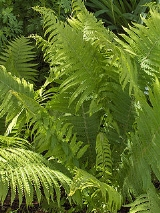
Dryopteris , commonly called
Wood Ferns,
Male Ferns, and
Buckler Ferns, is a
genusIn biology, a genus is a taxonomic unit used in the classification of living and fossil organisms. The term comes from Latin genus "descent, family, type, gender" , cognate with – genos, "race, stock, kin" ..In addition, genus is a taxonomic rank in the hierarchy In biology, a genus (plural:...
of about 250 species of
fernA fern is any one of a group of about 20,000 species of plants classified in the phylum or division Pteridophyta, also known as Filicophyta. The group is also referred to as Polypodiophyta, or Polypodiopsida when treated as a subdivision of tracheophyta...
s with distribution in the
temperateIn geography, temperate or tepid latitudes of the globe lie between the tropics and the polar circles. The changes in these regions between summer and winter are generally mild, rather than extreme hot or cold. But in continental areas, such as central North America the variations between summer...
Northern HemisphereThe Northern Hemisphere is the half of a planet that is north of the equator—the word hemisphere literally means 'half sphere'. It is also that half of the celestial sphere north of the celestial equator...
, with the highest species diversity in eastern
AsiaAsia is the world's largest and most populous continent, located in the eastern and northern hemispheres. It covers 8.6% of the earth's total surface area and with approximately 4 billion people, it hosts 60% of the world's current human population.Asia is traditionally defined as part of the...
. Many of the species have stout, slowly creeping rootstocks that form a crown, with a vase-like ring of
frondThe term frond is used to refer to a large, divided leaf.In both common usage and botanical nomenclature, the leaves of ferns are referred to as fronds and some botanists restrict the term to this group...
s. The
soriA sorus is a cluster of sporangia.In fungi and lichens, the sorus is surrounded by an external layer. In some red algae it may take the form of a depression into the thallus....
are round, with a peltate indusium. The
stipeIn botany, a stipe is a stalk that supports some other structure. The precise meaning is different depending on which taxonomic group is being described....
s have prominent scales.
Hybridization is a well-known phenomenon within this group, with many species formed by hybridization.
Dryopteris species are used as food plants by the
larvaA larva is a young form of animal with indirect development, going through or undergoing metamorphosis ....
e of some
LepidopteraLepidoptera is an order of insects that includes moths and butterflies. It is one of the most speciose orders in the class Insecta, encompassing moths and the three superfamilies of butterflies, skipper butterflies, and moth-butterflies...
species including
Batrachedra sophroniellaBatrachedra is the biggest genus in the family Batrachedridae.It contains the following species:*Batrachedra acrodeta*Batrachedra agaura*Batrachedra albanica*Batrachedra albicapitella*Batrachedra albistrigella...
(which feeds exclusively on
D.
Discussion
Ask a question about 'Dryopteris'
Start a new discussion about 'Dryopteris'
Answer questions from other users
|
Dryopteris , commonly called
Wood Ferns,
Male Ferns, and
Buckler Ferns, is a
genusIn biology, a genus is a taxonomic unit used in the classification of living and fossil organisms. The term comes from Latin genus "descent, family, type, gender" , cognate with – genos, "race, stock, kin" ..In addition, genus is a taxonomic rank in the hierarchy In biology, a genus (plural:...
of about 250 species of
fernA fern is any one of a group of about 20,000 species of plants classified in the phylum or division Pteridophyta, also known as Filicophyta. The group is also referred to as Polypodiophyta, or Polypodiopsida when treated as a subdivision of tracheophyta...
s with distribution in the
temperateIn geography, temperate or tepid latitudes of the globe lie between the tropics and the polar circles. The changes in these regions between summer and winter are generally mild, rather than extreme hot or cold. But in continental areas, such as central North America the variations between summer...
Northern HemisphereThe Northern Hemisphere is the half of a planet that is north of the equator—the word hemisphere literally means 'half sphere'. It is also that half of the celestial sphere north of the celestial equator...
, with the highest species diversity in eastern
AsiaAsia is the world's largest and most populous continent, located in the eastern and northern hemispheres. It covers 8.6% of the earth's total surface area and with approximately 4 billion people, it hosts 60% of the world's current human population.Asia is traditionally defined as part of the...
. Many of the species have stout, slowly creeping rootstocks that form a crown, with a vase-like ring of
frondThe term frond is used to refer to a large, divided leaf.In both common usage and botanical nomenclature, the leaves of ferns are referred to as fronds and some botanists restrict the term to this group...
s. The
soriA sorus is a cluster of sporangia.In fungi and lichens, the sorus is surrounded by an external layer. In some red algae it may take the form of a depression into the thallus....
are round, with a peltate indusium. The
stipeIn botany, a stipe is a stalk that supports some other structure. The precise meaning is different depending on which taxonomic group is being described....
s have prominent scales.
Hybridization is a well-known phenomenon within this group, with many species formed by hybridization.
Dryopteris species are used as food plants by the
larvaA larva is a young form of animal with indirect development, going through or undergoing metamorphosis ....
e of some
LepidopteraLepidoptera is an order of insects that includes moths and butterflies. It is one of the most speciose orders in the class Insecta, encompassing moths and the three superfamilies of butterflies, skipper butterflies, and moth-butterflies...
species including
Batrachedra sophroniellaBatrachedra is the biggest genus in the family Batrachedridae.It contains the following species:*Batrachedra acrodeta*Batrachedra agaura*Batrachedra albanica*Batrachedra albicapitella*Batrachedra albistrigella...
(which feeds exclusively on
D. cyatheoides) and
Sthenopis auratusSthenopis is a genus of moths of the family Hepialidae. There are eight described species found in North America and China.-Species:*Sthenopis argenteomaculatus - Canada/United States*Recorded food plants: Alnus, Betula, Salix...
.
Selected species
- Dryopteris abbreviata
- Dryopteris aemula - Hay-scented Buckler Fern
- Dryopteris affinis
Dryopteris affinis is fern native to western and southern Europe and southwestern Asia. It is most abundant in areas with high humidity, such as the British Isles and western France; in the Mediterranean region and the Caucasus it is confined to high altitudes... - Scaly Male Fern
- Dryopteris alpestris
- Dryopteris amurensis
- Dryopteris apicisora
- Dryopteris arguta
Dryopteris arguta is a species of wood fern known by the common name Coastal woodfern. It is native to the west coast of North America, where it grows in oak woodlands and shady low elevation slopes.-Morphology:... - Coastal Wood Fern
- Dryopteris azorica
- Dryopteris barbigera
- Dryopteris bissetiana
- Dryopteris blandfordii
- Dryopteris bodinieri
- Dryopteris borreri
- Dryopteris campyloptera - Mountain Wood Fern
- Dryopteris canaliculata
- Dryopteris carthusiana
Dryopteris carthusiana H.P. Fuchs is a species of fern native to damp forests throughout the Holarctic Kingdom. It is known as the narrow buckler fern in the United Kingdom, and as the spinulose wood fern in North America... - Narrow Buckler Fern
- Dryopteris caucasica
- Dryopteris caudifrons
- Dryopteris celsa - Log Fern
- Dryopteris championi
- Dryopteris changii
- Dryopteris chapaensis
- Dryopteris chinensis
- Dryopteris chrysocoma
- Dryopteris cinnamomea - Cinnamon Wood Fern
- Dryopteris clintoniana - Clinton's Wood Fern
- Dryopteris confertipinna
- Dryopteris cordipinna
- Dryopteris corleyi
- Dryopteris costalisora
- Dryopteris crassirhizoma
- Dryopteris crispifolia
- Dryopteris cristata
Dryopteris cristata A. Gray is a species of fern native to wetlands throughout the Holarctic Kingdom. It is known as the crested wood fern... - Crested Buckler Fern
- Dryopteris cyatheoides
- Dryopteris cycadina
- Dryopteris cyclopeltiformis
- Dryopteris decipiens
- Dryopteris dehuaensis
- Dryopteris dickinsii
- Dryopteris dilatata - Broad Buckler Fern
- Dryopteris discrita
- Dryopteris enneaphylla
- Dryopteris erythrosa
- Dryopteris erythrosora
Dryopteris erythrosora is a species of fern, native to eastern Asia from China and Japan south to the Philippines, growing in light woodland shade on low mountains or hills. It is evergreen, with bipinnate fronds 30-70 cm tall and 15-35 cm broad, with 8-20 pairs of pinnae.-Cultivation:D... - Autumn Fern
- Dryopteris expansa
Dryopteris expansa, alpine buckler fern or spreading wood fern, is a species of fern native to cool temperate and subarctic regions of the Northern Hemisphere, south at high altitudes in mountains to Spain and Greece in southern Europe, to Japan in eastern Asia, and to central California in North... - Northern Buckler Fern
- Dryopteris fibrilosa
- Dryopteris fibrilosissima
- Dryopteris filix-mas
Dryopteris filix-mas is one of the most common ferns of the temperate Northern Hemisphere, occurring throughout much of Europe, Asia, and North America. It favours damp shaded areas and is common in the understory of woodlands, but is also found in shady places on hedge-banks, rocks, and screes... - Male Fern
- Dryopteris floridana
- Dryopteris formosana
- Dryopteris fragrans - Fragrant Buckler Fern
- Dryopteris fructuosa
- Dryopteris fuscipes
- Dryopteris gamblei
- Dryopteris goerigiana
- Dryopteris goldiana
Dryopteris goldiana or Goldie's wood fern is a fern native to the northeastern United States and adjacent areas of Canada.It is one of the parents of the hybrids Dryopteris celsa and Dryopteris clintoniana.... - Goldie's Wood Fern
- Dryopteris gongboensis
- Dryopteris guanchica
- Dryopteris gushanica
- Dryopteris gushiangensis
- Dryopteris gymnophylla
- Dryopteris gymnosora
- Dryopteris hendersoni
- Dryopteris hexagonoptera
- Dryopteris hirtipes
- Dryopteris huanganshanensis
- Dryopteris hupehensis
- Dryopteris hwangii
- Dryopteris hypophlebia
- Dryopteris immixta
- Dryopteris incisolobata
- Dryopteris integriloba
- Dryopteris integripinnula
- Dryopteris intermedia
Dryopteris intermedia A. Gray, the intermediate wood fern, is an evergreen eastern North American species also occasionally found in Europe. It is a diploid species, and is the parent of several species of hybrid origin, including Dryopteris carthusiana.This fern is often confused with several... - Intermediate Wood Fern
- Dryopteris junlianensis
- Dryopteris juxtaposita
- Dryopteris kinkiensis
- Dryopteris labordei
- Dryopteris lacera
- Dryopteris lancipinnula
- Dryopteris lepidopoda
- Dryopteris lepidorachis
- Dryopteris liyangensis
|
Dryopteris ludoviciana Dryopteris ludoviciana, the Southern Wood Fern, is fern native to southern United States from Florida west to Texas and as far north as Kentucky and North Carolina.... - Southern Wood Fern
Dryopteris manshurica
Dryopteris marginalisDryopteris marginalis is known as the marginal shield fern or marginal wood fern. The marginal wood fern favors damp shady areas and is found throughout eastern North America. It favors moderately acid to circumneutral soils. It favors cooler areas, but is fairly drought-resistant once established... - Marginal Wood Fern
Dryopteris matsumurae
Dryopteris minjiangensis
Dryopteris monticola
Dryopteris montigena
Dryopteris nanpingensis
Dryopteris neolepidopoda
Dryopteris nigrosquamosa
Dryopteris nyalamensis
Dryopteris nyingchiensis
Dryopteris odontoloma
Dryopteris oreades - Mountain Male Fern
Dryopteris pacifica
Dryopteris pallida
Dryopteris paludicda
Dryopteris panda
Dryopteris parasparsa
Dryopteris pedata
Dryopteris peninsulae
Dryopteris podophylla
Dryopteris polita
Dryopteris prosa
Dryopteris pseudo-sikkimensis
Dryopteris pseudoatrata
Dryopteris pseudodontoloma
Dryopteris pseudofibrillosa
Dryopteris pseudomarginata
Dryopteris pseudouniformis
Dryopteris pulcherrima
Dryopteris qandoensis
Dryopteris quatanensis
Dryopteris reflexosquamata
Dryopteris remota
Dryopteris rigida
Dryopteris rosthornii
Dryopteris sacrosancta
Dryopteris sanmingensis
Dryopteris saxifraga
Dryopteris scottii
Dryopteris semipinnata
Dryopteris sericea
Dryopteris serrato-dentata
Dryopteris shensicola
Dryopteris sichotensis
Dryopteris sieboldii
Dryopteris sikkimensis
Dryopteris silaensis
Dryopteris sino-sparsa
Dryopteris sinoerythrosora
Dryopteris sinofibrillosa
Dryopteris sordidipes
Dryopteris sparsa
Dryopteris spinulosa
Dryopteris squamifera
Dryopteris squamiseta
Dryopteris stenolepis
Dryopteris subatrata
Dryopteris subbarbigera
Dryopteris subexaltata
Dryopteris sublacera
Dryopteris sublaeta
Dryopteris submarginata
Dryopteris submontana - Rigid Buckler Fern
Dryopteris subtriangularis
Dryopteris tarningensis
Dryopteris tenuicula
Dryopteris tenuissima
Dryopteris thibetica
Dryopteris tieluensis
Dryopteris tokyoensis - Tokyo Wood Fern
Dryopteris tsangpoensis
Dryopteris tyrrhena
Dryopteris uniformis
Dryopteris varia
Dryopteris venosa
Dryopteris villarii
Dryopteris wallichiana
Dryopteris wenchuanensis
Dryopteris wuyishanensis
Dryopteris yigongensis
Dryopteris yungtzeensis
Dryopteris zayuensis |
Cultivation and uses
Many
Dryopteris species are highly desired as garden
ornamental plantOrnamental plants are typically grown in the flower garden or as house plants. Most commonly they are grown for the display of their flowers. Other common ornamental features include leaves, scent, fruit, stem and bark. In some cases, unusual features may be considered ornamental, such as the...
s, especially
D. erythrosa (autumn fern, often sold in garden outlets) and
D. filix-mas, a very popular garden fern in the British Isles and Europe, with numerous
cultivarA cultivar is a cultivated plant that has been selected and given a unique name because of desired characteristics; it is usually distinct from similar plants and when propagated it retains those characteristics....
s.
Dryopteris filix-mas was throughout much of recent human history widely used as a vermifuge, and was the only fern listed in the U.S.
PharmacopoeiaPharmacopoeia , in its modern technical sense, is a book containing directions for the identification of samples and the preparation of compound medicines, and published by the authority of a government or a medical or pharmaceutical society .In a broader sense is a reference work for...
.