
Home      Discussion      Topics      Dictionary      Almanac
Signup       Login
Dryandra

Dryandra

Overview
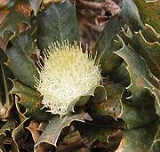
Banksia ser. Dryandra is a series of 94 species of shrub
Shrub
A shrub or bush is distinguished from a tree by its multiple stems and shorter height, usually under 5–6 m tall. A large number of plants may become either shrubs or trees, depending on the growing conditions they experience...

 to small tree
Tree
A tree is a perennial woody plant. It is most often defined as a woody plant that has many secondary branches supported clear of the ground on a single main stem or trunk with clear apical dominance. A minimum height specification at maturity is cited by some authors, varying from 3 m to...

 in the plant genus Banksia
Banksia
Banksia is a genus of around 170 species in the plant family Proteaceae. These Australian wildflowers and popular garden plants are easily recognised by their characteristic flower spikes and fruiting "cones" and heads. When it comes to size, banksias range from prostrate woody shrubs to trees up...

. It was considered a separate genus named Dryandra until early 2007, when it was merged into Banksia on the basis of extensive molecular and morphological evidence that Banksia was paraphyletic
Paraphyly
A group of taxa is said to be paraphyletic if the group consists of all the descendants of a hypothetical closest common ancestor minus one or more monophyletic groups of descendants...

 with respect to Dryandra.
Discussion
Ask a question about 'Dryandra'
Start a new discussion about 'Dryandra'
Answer questions from other users
Full Discussion Forum
 
Unanswered Questions
Encyclopedia
Banksia ser. Dryandra is a series of 94 species of shrub
Shrub
A shrub or bush is distinguished from a tree by its multiple stems and shorter height, usually under 5–6 m tall. A large number of plants may become either shrubs or trees, depending on the growing conditions they experience...

 to small tree
Tree
A tree is a perennial woody plant. It is most often defined as a woody plant that has many secondary branches supported clear of the ground on a single main stem or trunk with clear apical dominance. A minimum height specification at maturity is cited by some authors, varying from 3 m to...

 in the plant genus Banksia
Banksia
Banksia is a genus of around 170 species in the plant family Proteaceae. These Australian wildflowers and popular garden plants are easily recognised by their characteristic flower spikes and fruiting "cones" and heads. When it comes to size, banksias range from prostrate woody shrubs to trees up...

. It was considered a separate genus named Dryandra until early 2007, when it was merged into Banksia on the basis of extensive molecular and morphological evidence that Banksia was paraphyletic
Paraphyly
A group of taxa is said to be paraphyletic if the group consists of all the descendants of a hypothetical closest common ancestor minus one or more monophyletic groups of descendants...

 with respect to Dryandra.

They are found only in the southwestern corner of Western Australia
Western Australia
Western Australia is a state of Australia, occupying the entire western third of the Australian continent. It is bounded by the Indian Ocean to the north and west, the Great Australian Bight and Indian Ocean to the south, the Northern Territory to the north-east and South Australia to the south-east...

. They have never been popular among gardeners among the rest of Australia due to their dislike of the humid and subtropical conditions which dominate the east coast.

The series was named in honour of Swedish botanist
Botany
Botany, plant science, or plant biology is a branch of biology that involves the scientific study of plant life. Traditionally, botany also included the study of fungi, algae and viruses...

 Jonas C. Dryander.

They are arguably among the most attractive and showy of all members of Proteaceae.

Banksia ser. Dryandra species are used as food plants by the larva
Larva
A larva is a distinct juvenile form many animals undergo before metamorphosis into adults. Animals with indirect development such as insects, amphibians, or cnidarians typically have a larval phase of their life cycle...

e of some Lepidoptera
Lepidoptera
Lepidoptera is a large order of insects that includes moths and butterflies . It is one of the most widespread and widely recognizable insect orders in the world, encompassing moths and the three superfamilies of butterflies, skipper butterflies, and moth-butterflies...

 species, including the Dryandra Moth
Dryandra Moth
The Dryandra Moth is a species of moth. It is considered the only species in the family Carthaeidae. Its closest relatives are the Saturniidae and it bears a resemblance to many species of that family, bearing prominent eye spots on all wings. The wingspan is up to 10 cm...

.

Taxonomy


The first specimens of a Dryandra were collected by Archibald Menzies
Archibald Menzies
Archibald Menzies was a Scottish surgeon, botanist and naturalist.- Life and career :Menzies was born at Easter Stix in the parish of Weem, in Perthshire. While working with his elder brother William at the Royal Botanic Gardens, he drew the attention of Dr John Hope, professor of botany at...

, surgeon and naturalist to the Vancouver Expedition
Vancouver Expedition
The Vancouver Expedition was a four-and-a-half-year voyage of exploration and diplomacy, commanded by Captain George Vancouver. The expedition circumnavigated the globe, touched five continents and changed the course of history for the indigenous nations and several European empires and their...

. At the request of Joseph Banks
Joseph Banks
Sir Joseph Banks, 1st Baronet, GCB, PRS was an English naturalist, botanist and patron of the natural sciences. He took part in Captain James Cook's first great voyage . Banks is credited with the introduction to the Western world of eucalyptus, acacia, mimosa and the genus named after him,...

, Menzies collected natural history specimens wherever possible during the voyage. During September and October 1791, while the expedition were anchored at King George Sound
King George Sound
King George Sound is the name of a sound on the south coast of Western Australia. Located at , it is the site of the city of Albany.The sound covers an area of and varies in depth from to ....

, he collected numerous plant specimens, including the first specimens of B. sessilis (Parrotbush) and B. pellaeifolia
Banksia pellaeifolia
Banksia pellaeifolia is a shrub endemic to Western Australia.It was known as Dryandra blechnifolia until 2007, when all Dryandra species were transferred to Banksia by Austin Mast and Kevin Thiele...

. Upon Menzies' return to England, he turned his specimens over to Banks; as with most other specimens in Banks' library, they remained undescribed for many years.

Further specimens were collected in late 1792 by Jacques Labillardière
Jacques Labillardière
Jacques-Julien Houtou de Labillardière was a French naturalist noted for his descriptions of the flora of Australia. Labillardière was a member of a voyage in search of the La Pérouse expedition...

, one of five naturalists in Bruni d'Entrecasteaux
Bruni d'Entrecasteaux
Antoine Raymond Joseph de Bruni d'Entrecasteaux was a French navigator who explored the Australian coast in 1792 while seeking traces of the lost expedition of La Pérouse....

's expedition in search of the lost expedition of Jean-François de La Pérouse
Jean-François de Galaup, comte de La Pérouse
Jean François de Galaup, comte de Lapérouse was a French Navy officer and explorer whose expedition vanished in Oceania.-Early career:...

. While ashore west of Esperance Bay
Esperance Bay
Esperance Bay is a bay on the south coast of Western Australia. Nominally located at , it is the site of the town of Esperance.The bay was discovered on 9 December 1792 by a French expedition under Bruni d'Entrecasteaux, which sailed in search of the lost expedition of Jean-François de Galaup,...

 between 11 and 18 December, Labillardière collected the first specimens of B. nivea
Banksia nivea
Banksia nivea, commonly known as Honeypot Dryandra, is a shrub endemic to Western Australia. First described as Banksia nivea, it was transferred to Dryandra as Dryandra nivea by Robert Brown in 1810, and remained in that genus until 2007, when all Dryandra species were transferred to Banksia by...

(Honeypot Dryandra).

Distribution and habitat


Endemic to Western Australia
Western Australia
Western Australia is a state of Australia, occupying the entire western third of the Australian continent. It is bounded by the Indian Ocean to the north and west, the Great Australian Bight and Indian Ocean to the south, the Northern Territory to the north-east and South Australia to the south-east...

, Dryandra occurs virtually throughout the South West Botanic Province, and also, to a much lesser degree, in southwest parts of the Eremaean Province.

External links