


Dry Tortugas

Encyclopedia
The Dry Tortugas are a small group of islands, located at the end of the Florida Keys
, USA, about 70 miles (113 km) west of Key West
, and 37 miles (60 km) west of the Marquesas Keys
, the closest islands. Still further west is the Tortugas Bank, which is completely submerged. The first Europeans to discover the islands were the Spanish
in 1513 by explorer Juan Ponce de León
. They are an unincorporated area
of Monroe County, Florida
and belong to the Lower Keys Census County Division
. With their surrounding waters, they constitute the Dry Tortugas National Park
.
has had up to 11 islets during the past two centuries. Some of the smaller islands have disappeared and reappeared multiple times as a result of hurricane impact.
The three westernmost keys, which are also the three largest keys (Loggerhead Key, Garden Key, and Bush Key), make up about 93 percent of the total land area of the group.
island of Tortuga, near Hispaniola
.
The islands are home to Dry Tortugas National Park
, and are only accessible by boat
or seaplane
. The large seabird colony, including Sooty Tern
s, Brown Noddy
, Masked Booby
and Magnificent Frigatebird
, and the regular occurrence of Caribbean vagrant
birds makes them a popular birding destination.
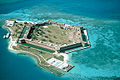 The first European to discover the islands was Spanish explorer Ponce de León
. He gave them the name on his first visit in 1513. The name is the second oldest surviving European place-name in the U.S. They were given the name Las Tortugas (The Turtles) due to 170 sea turtles taken on the islands and shoals by de León's men. Soon afterward, the word "Dry" was added to the name, to indicate to mariners the islands' lack of fresh water.
In 1742 HMS Tyger
wrecked in the Dry Tortugas. The stranded crew lived on Garden Key for 56 days, and fought a battle with a Spanish sloop, before sailing to Jamaica
in several boats.
The United States government never completed Fort Jefferson after 30 years on Garden Key, and this bastion remained in Union
hands throughout the Civil War
. It later was used as a prison
until abandoned in 1874. Dr. Samuel Mudd
, famous for being the doctor who treated John Wilkes Booth
in the wake of the Lincoln
assassination, was imprisoned here until early 1869. During the 1880s, the Navy
established a base at Tortuga; and it subsequently set up a coal
ing (refueling) and a wireless
(radio) station there as well. During World War I
, a seaplane base was established on the islet, but it was abandoned soon thereafter.
From 1903 until 1939 the Carnegie Institute of Washington operated the Marine Biology Laboratory on Loggerhead Key which "…quickly became the best-equipped marine
biological station in the tropical world.” Through the years, over 150 researchers used the facilities to perform a wide range of research.
An account of a visit to the fort at the Dry Tortugas by President Franklin D. Roosevelt
and Justice-to-be Robert H. Jackson
can be found in the book, That Man: An Insider's Portrait of Franklin D. Roosevelt, by Robert H. Jackson, edited and introduced by John Q. Barrett (Oxford University Press
, New York, 2003).
In August 2004, the Dry Tortugas were directly struck by Hurricane Charley
. The following day, a Cessna
airplane
crashed into the water near the islands, killing cinematographer
Neal Fredericks
while he was filming scenery for the feature film CrossBones.
Florida Keys
The Florida Keys are a coral archipelago in southeast United States. They begin at the southeastern tip of the Florida peninsula, about south of Miami, and extend in a gentle arc south-southwest and then westward to Key West, the westernmost of the inhabited islands, and on to the uninhabited Dry...
, USA, about 70 miles (113 km) west of Key West
Key West
Key West is an island in the Straits of Florida on the North American continent at the southernmost tip of the Florida Keys. Key West is home to the southernmost point in the Continental United States; the island is about from Cuba....
, and 37 miles (60 km) west of the Marquesas Keys
Marquesas Keys
The Marquesas Keys form an uninhabited island group about 30 miles west of Key West, 4 miles in diameter, and inhabited by mangrove. They are an unincorporated area of Monroe County, Florida and belong to the Lower Keys Census County Division. They are protected as part of the Key West National...
, the closest islands. Still further west is the Tortugas Bank, which is completely submerged. The first Europeans to discover the islands were the Spanish
Spain
Spain , officially the Kingdom of Spain languages]] under the European Charter for Regional or Minority Languages. In each of these, Spain's official name is as follows:;;;;;;), is a country and member state of the European Union located in southwestern Europe on the Iberian Peninsula...
in 1513 by explorer Juan Ponce de León
Juan Ponce de León
Juan Ponce de León was a Spanish explorer. He became the first Governor of Puerto Rico by appointment of the Spanish crown. He led the first European expedition to Florida, which he named...
. They are an unincorporated area
Unincorporated area
In law, an unincorporated area is a region of land that is not a part of any municipality.To "incorporate" in this context means to form a municipal corporation, a city, town, or village with its own government. An unincorporated community is usually not subject to or taxed by a municipal government...
of Monroe County, Florida
Monroe County, Florida
Monroe County is a county located in the state of Florida. As of 2000, the population was 79,589. The U.S. Census Bureau 2006 estimate for the county was 74,737....
and belong to the Lower Keys Census County Division
Minor civil division
Minor civil division is a term used by the United States Census Bureau to designate the primary governmental and/or administrative divisions of a county, such as a civil township, precinct, or magisterial district...
. With their surrounding waters, they constitute the Dry Tortugas National Park
Dry Tortugas National Park
Dry Tortugas National Park preserves Fort Jefferson and the Dry Tortugas section of the Florida Keys. The park covers 101 mi2 , mostly water, about 68 statute miles west of Key West in the Gulf of Mexico....
.
Geography
The keys are low and irregular. Some keys have thin growths of mangroves and various other vegetation, while others have only small patches of grass or are devoid of plant life. In general, they rise abruptly from relatively deep water. They are continually changing in size and shape. The Tortugas AtollAtoll
An atoll is a coral island that encircles a lagoon partially or completely.- Usage :The word atoll comes from the Dhivehi word atholhu OED...
has had up to 11 islets during the past two centuries. Some of the smaller islands have disappeared and reappeared multiple times as a result of hurricane impact.
Islands (keys)
The total area of the islets, some of which are little more than sand bars just above the water mark, is about 580000 square metres (143 acre). Their area changes over time as wind and waves reshape them. There are seven islets, which are from West to East:- Loggerhead Key, with Dry Tortugas lighthouse (46 meters high), 250 by 1200 meters in size, with an area of 260,000 m2 the largest, 1 meter high. This island has the highest elevation in the Dry Tortugas, at 10 feet (3 m).
- Garden Key, with Fort JeffersonFort Jefferson, FloridaFort Jefferson is an unincorporated community and ghost town in Monroe County, Florida, United States. It is located on Garden Key in the lower Florida Keys within the Dry Tortugas National Park, about west of the island of Key West....
and the inactive Garden Key lighthouse (20 meters high), 4 km east of Loggerhead Key. Garden Key is the second largest island in the chain, at 400 by 500 meters in size, with an area of 170,000 m2. The original size, before construction of Fort Jefferson, has been estimated at 30,350 m2 to 35,610 m2. - Bush Key, formerly named Hog Island because of the hogs that were raised there to provide fresh meat for the prisoners at Fort Jefferson, just a few meters east of Garden Key. At times, Bush Key is connected to Garden Key by a sand bar. The island is the third largest, 150 by 900 meters in size, area 120,000 m2, less than 1 meter high. Bush Key is the site of a large ternTernTerns are seabirds in the family Sternidae, previously considered a subfamily of the gull family Laridae . They form a lineage with the gulls and skimmers which in turn is related to skuas and auks...
rookeryRookeryA rookery is a colony of breeding animals, generally birds. A rook is a Northern European and Central Asian member of the crow family, which nest in prominent colonies at the tops of trees. The term is applied to the nesting place of birds, such as crows and rooks, the source of the term...
. It is closed to visitors from April to September to protect nesting Sooty TernSooty TernThe Sooty Tern, Onychoprion fuscatus , is a seabird of the tern family . It is a bird of the tropical oceans, breeding on islands throughout the equatorial zone. Colloquially, it is known as the Wideawake Tern or just wideawake...
s and Brown NoddyBrown NoddyThe Brown Noddy or Common Noddy is a seabird from the tern family. The largest of the noddies, it can be told from the closely related Black Noddy by its larger size and plumage, which is dark brown rather than black...
s. - Long Key, 50 meters south of the eastern end of Bush key, 50 by 200 meters in size, area 8,000 m2
- Hospital Key, so called because a hospital for the inmates of Fort Jefferson had been built there in the 1870s. The island was formerly called Middle Key or Sand Key. It lies 2.5 km northeast of Garden Key and Bush Key, 70 meters in diameter, area 4,000 m2, and is 1 meter high at its highest point.
- Middle Key, 2.5 km east of Hospital key, 90 meters in diameter, area 6,000 m2, due to various seasonal changes, storm patterns and tidal cycles it is not always above sea level, disappearing for weeks or months only to reappear again.
- East Key, 2 km east of Middle Key, 100 by 200 meters in size, area 16,000 m2, over 2 meters high
The three westernmost keys, which are also the three largest keys (Loggerhead Key, Garden Key, and Bush Key), make up about 93 percent of the total land area of the group.
Former islands
Formerly existing keys were, from West to East:- Southwest Key, disappeared by 1875, today a shoalShoalShoal, shoals or shoaling may mean:* Shoal, a sandbank or reef creating shallow water, especially where it forms a hazard to shipping* Shoal draught , of a boat with shallow draught which can pass over some shoals: see Draft...
south off Loggerhead Reef - Bird Key (formerly Booby Key), was about 1.5 km southwest of Garden Key, disappeared in 1935, current names in the area are Bird Key Bank and Bird Key Harbor
- North Key, probably identical with former Booby Island, current name in the area is North Key Harbor, an anchorAnchorAn anchor is a device, normally made of metal, that is used to connect a vessel to the bed of a body of water to prevent the vessel from drifting due to wind or current. The word derives from Latin ancora, which itself comes from the Greek ἄγκυρα .Anchors can either be temporary or permanent...
age WSW of Pulaski Shoal, disappeared by 1875 - Northeast Key (earlier called Sand Key), was between East Key and North Key, slightly to the North, disappeared by 1875
Shoals with lights
- Pulaski Shoal (Pulaski Reef), marking the northeast edge of the group at 24°41′36"N 82°46′24"W, is not an island, but the former location of the Pulaski Shoal Light.
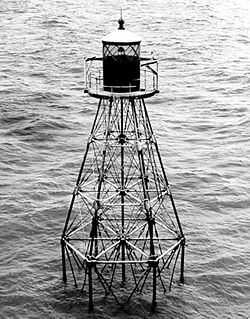
- Iowa Rock, halfway between Garden Key and Hospital Key, is another site of a navigational light (and weather station) built in shallow water. It was destroyed by Hurricane HugoHurricane HugoHurricane Hugo was a classical, destructive and rare Cape Verde-type hurricane which struck the Caribbean islands of Guadeloupe, Montserrat, St. Croix, Puerto Rico and the USA mainland in South Carolina as a Category 4 hurricane during September of the 1989 Atlantic hurricane season...
, with three bare stumps left .
Environment
The islands get their name from their distinctive characteristics: Dry, because none of the islands has fresh water and Tortugas, because Ponce de León, a Spanish explorer, saw an abundance of sea turtles on the island. Later seafarers would keep the turtles on their backs in the holds of sailing ships and butcher them when they wanted fresh meat. They are not related to the CaribbeanCaribbean
The Caribbean is a crescent-shaped group of islands more than 2,000 miles long separating the Gulf of Mexico and the Caribbean Sea, to the west and south, from the Atlantic Ocean, to the east and north...
island of Tortuga, near Hispaniola
Hispaniola
Hispaniola is a major island in the Caribbean, containing the two sovereign states of the Dominican Republic and Haiti. The island is located between the islands of Cuba to the west and Puerto Rico to the east, within the hurricane belt...
.
The islands are home to Dry Tortugas National Park
Dry Tortugas National Park
Dry Tortugas National Park preserves Fort Jefferson and the Dry Tortugas section of the Florida Keys. The park covers 101 mi2 , mostly water, about 68 statute miles west of Key West in the Gulf of Mexico....
, and are only accessible by boat
Boat
A boat is a watercraft of any size designed to float or plane, to provide passage across water. Usually this water will be inland or in protected coastal areas. However, boats such as the whaleboat were designed to be operated from a ship in an offshore environment. In naval terms, a boat is a...
or seaplane
Seaplane
A seaplane is a fixed-wing aircraft capable of taking off and landing on water. Seaplanes that can also take off and land on airfields are a subclass called amphibian aircraft...
. The large seabird colony, including Sooty Tern
Sooty Tern
The Sooty Tern, Onychoprion fuscatus , is a seabird of the tern family . It is a bird of the tropical oceans, breeding on islands throughout the equatorial zone. Colloquially, it is known as the Wideawake Tern or just wideawake...
s, Brown Noddy
Brown Noddy
The Brown Noddy or Common Noddy is a seabird from the tern family. The largest of the noddies, it can be told from the closely related Black Noddy by its larger size and plumage, which is dark brown rather than black...
, Masked Booby
Masked Booby
The Masked Booby, Sula dactylatra, is a large seabird of the booby family, Sulidae. This species breeds on islands in tropical oceans, except in the eastern Atlantic; in the eastern Pacific it is replaced by the Nazca Booby, Sula granti, which was formerly regarded as a subspecies of Masked Booby...
and Magnificent Frigatebird
Magnificent Frigatebird
The Magnificent Frigatebird was sometimes previously known as Man O'War, reflecting its rakish lines, speed, and aerial piracy of other birds....
, and the regular occurrence of Caribbean vagrant
Vagrancy (biology)
Vagrancy is a phenomenon in biology whereby individual animals appear well outside their normal range; individual animals which exhibit vagrancy are known as vagrants. The term accidental is sometimes also used...
birds makes them a popular birding destination.
History
Ponce de León
-People:* Juan Ponce de León, a Spanish explorer of the Americas and first Governor of Puerto Rico* Juan Ponce de León y Loayza, the son of Juan Ponce de León II, and early settler of Ponce, Puerto Rico...
. He gave them the name on his first visit in 1513. The name is the second oldest surviving European place-name in the U.S. They were given the name Las Tortugas (The Turtles) due to 170 sea turtles taken on the islands and shoals by de León's men. Soon afterward, the word "Dry" was added to the name, to indicate to mariners the islands' lack of fresh water.
In 1742 HMS Tyger
HMS Tyger (1647)
HMS Tyger, often spelled Tiger, was a 38-gun fourth rate frigate of the Royal Navy, built by Peter Pett II at Woolwich and launched in 1647. The term 'frigate' during the period of this ship referred to a method of construction, rather than a role which did not develop until the following century...
wrecked in the Dry Tortugas. The stranded crew lived on Garden Key for 56 days, and fought a battle with a Spanish sloop, before sailing to Jamaica
Jamaica
Jamaica is an island nation of the Greater Antilles, in length, up to in width and 10,990 square kilometres in area. It is situated in the Caribbean Sea, about south of Cuba, and west of Hispaniola, the island harbouring the nation-states Haiti and the Dominican Republic...
in several boats.
The United States government never completed Fort Jefferson after 30 years on Garden Key, and this bastion remained in Union
Union (American Civil War)
During the American Civil War, the Union was a name used to refer to the federal government of the United States, which was supported by the twenty free states and five border slave states. It was opposed by 11 southern slave states that had declared a secession to join together to form the...
hands throughout the Civil War
American Civil War
The American Civil War was a civil war fought in the United States of America. In response to the election of Abraham Lincoln as President of the United States, 11 southern slave states declared their secession from the United States and formed the Confederate States of America ; the other 25...
. It later was used as a prison
Prison
A prison is a place in which people are physically confined and, usually, deprived of a range of personal freedoms. Imprisonment or incarceration is a legal penalty that may be imposed by the state for the commission of a crime...
until abandoned in 1874. Dr. Samuel Mudd
Samuel Mudd
Samuel Alexander Mudd I, M.D. was an American physician who was convicted and imprisoned for aiding and conspiring with John Wilkes Booth in the 1865 assassination of U.S. President Abraham Lincoln. He was pardoned by President Andrew Johnson and released from prison in 1869...
, famous for being the doctor who treated John Wilkes Booth
John Wilkes Booth
John Wilkes Booth was an American stage actor who assassinated President Abraham Lincoln at Ford's Theatre, in Washington, D.C., on April 14, 1865. Booth was a member of the prominent 19th century Booth theatrical family from Maryland and, by the 1860s, was a well-known actor...
in the wake of the Lincoln
Abraham Lincoln
Abraham Lincoln was the 16th President of the United States, serving from March 1861 until his assassination in April 1865. He successfully led his country through a great constitutional, military and moral crisis – the American Civil War – preserving the Union, while ending slavery, and...
assassination, was imprisoned here until early 1869. During the 1880s, the Navy
United States Navy
The United States Navy is the naval warfare service branch of the United States Armed Forces and one of the seven uniformed services of the United States. The U.S. Navy is the largest in the world; its battle fleet tonnage is greater than that of the next 13 largest navies combined. The U.S...
established a base at Tortuga; and it subsequently set up a coal
Coal
Coal is a combustible black or brownish-black sedimentary rock usually occurring in rock strata in layers or veins called coal beds or coal seams. The harder forms, such as anthracite coal, can be regarded as metamorphic rock because of later exposure to elevated temperature and pressure...
ing (refueling) and a wireless
Wireless
Wireless telecommunications is the transfer of information between two or more points that are not physically connected. Distances can be short, such as a few meters for television remote control, or as far as thousands or even millions of kilometers for deep-space radio communications...
(radio) station there as well. During World War I
World War I
World War I , which was predominantly called the World War or the Great War from its occurrence until 1939, and the First World War or World War I thereafter, was a major war centred in Europe that began on 28 July 1914 and lasted until 11 November 1918...
, a seaplane base was established on the islet, but it was abandoned soon thereafter.
From 1903 until 1939 the Carnegie Institute of Washington operated the Marine Biology Laboratory on Loggerhead Key which "…quickly became the best-equipped marine
biological station in the tropical world.” Through the years, over 150 researchers used the facilities to perform a wide range of research.
An account of a visit to the fort at the Dry Tortugas by President Franklin D. Roosevelt
Franklin D. Roosevelt
Franklin Delano Roosevelt , also known by his initials, FDR, was the 32nd President of the United States and a central figure in world events during the mid-20th century, leading the United States during a time of worldwide economic crisis and world war...
and Justice-to-be Robert H. Jackson
Robert H. Jackson
Robert Houghwout Jackson was United States Attorney General and an Associate Justice of the United States Supreme Court . He was also the chief United States prosecutor at the Nuremberg Trials...
can be found in the book, That Man: An Insider's Portrait of Franklin D. Roosevelt, by Robert H. Jackson, edited and introduced by John Q. Barrett (Oxford University Press
Oxford University Press
Oxford University Press is the largest university press in the world. It is a department of the University of Oxford and is governed by a group of 15 academics appointed by the Vice-Chancellor known as the Delegates of the Press. They are headed by the Secretary to the Delegates, who serves as...
, New York, 2003).
In August 2004, the Dry Tortugas were directly struck by Hurricane Charley
Hurricane Charley
Hurricane Charley was the third named storm, the second hurricane, and the second major hurricane of the 2004 Atlantic hurricane season. Charley lasted from August 9 to August 15, and at its peak intensity it attained 150 mph winds, making it a strong Category 4 hurricane on the...
. The following day, a Cessna
Cessna
The Cessna Aircraft Company is an airplane manufacturing corporation headquartered in Wichita, Kansas, USA. Their main products are general aviation aircraft. Although they are the most well known for their small, piston-powered aircraft, they also produce business jets. The company is a subsidiary...
airplane
Fixed-wing aircraft
A fixed-wing aircraft is an aircraft capable of flight using wings that generate lift due to the vehicle's forward airspeed. Fixed-wing aircraft are distinct from rotary-wing aircraft in which wings rotate about a fixed mast and ornithopters in which lift is generated by flapping wings.A powered...
crashed into the water near the islands, killing cinematographer
Cinematographer
A cinematographer is one photographing with a motion picture camera . The title is generally equivalent to director of photography , used to designate a chief over the camera and lighting crews working on a film, responsible for achieving artistic and technical decisions related to the image...
Neal Fredericks
Neal Fredericks
Neal L. Fredericks was an American motion picture cinematographer, most famous for The Blair Witch Project, noted and praised by critics for its distinctive cinéma vérité style of camera work...
while he was filming scenery for the feature film CrossBones.
Visiting the Dry Tortugas
Because it is located 70 miles (112.7 km) west of Key West, the Dry Tortugas Park is one of the least accessible National Parks in the U.S. Visiting the park by private boat is difficult because of its distance, so most visitors come by ferry, catamaran, or seaplane from Key West, Florida. Official ferry and transportation services to the Dry Tortugas includes the Yankee Freedom II, Sailboat Charter and the Key West Seaplane Adventures.Graphics
 |
See also
- CaribbeanCaribbeanThe Caribbean is a crescent-shaped group of islands more than 2,000 miles long separating the Gulf of Mexico and the Caribbean Sea, to the west and south, from the Atlantic Ocean, to the east and north...
- Dry Tortugas National ParkDry Tortugas National ParkDry Tortugas National Park preserves Fort Jefferson and the Dry Tortugas section of the Florida Keys. The park covers 101 mi2 , mostly water, about 68 statute miles west of Key West in the Gulf of Mexico....
- Dry Tortugas Ferry to Fort JeffersonDry Tortugas Ferry to Fort JeffersonThe Dry Tortugas Ferry to Fort Jefferson is a visitor attraction in Key West, Florida. It is a collection of several catamarans that take visitors out to Fort Jefferson in the Dry Tortugas National Park on a day trip for a fee.-Boats:...
- Florida KeysFlorida KeysThe Florida Keys are a coral archipelago in southeast United States. They begin at the southeastern tip of the Florida peninsula, about south of Miami, and extend in a gentle arc south-southwest and then westward to Key West, the westernmost of the inhabited islands, and on to the uninhabited Dry...
- Florida Keys National Marine SanctuaryFlorida Keys National Marine SanctuaryThe Florida Keys National Marine Sanctuary is a U.S. National Marine Sanctuary in the Florida Keys. It includes the Florida Reef, the only barrier coral reef in North America and the third-largest coral barrier reef in the world. It also has extensive mangrove forest and seagrass fields...
- Nature reserveNature reserveA nature reserve is a protected area of importance for wildlife, flora, fauna or features of geological or other special interest, which is reserved and managed for conservation and to provide special opportunities for study or research...
- Ponce de LeónPonce de León-People:* Juan Ponce de León, a Spanish explorer of the Americas and first Governor of Puerto Rico* Juan Ponce de León y Loayza, the son of Juan Ponce de León II, and early settler of Ponce, Puerto Rico...