


Drum memory

Encyclopedia
Data storage device
thumb|200px|right|A reel-to-reel tape recorder .The magnetic tape is a data storage medium. The recorder is data storage equipment using a portable medium to store the data....
and was an early form of computer memory
Computer memory
In computing, memory refers to the physical devices used to store programs or data on a temporary or permanent basis for use in a computer or other digital electronic device. The term primary memory is used for the information in physical systems which are fast In computing, memory refers to the...
widely used in the 1950s and into the 1960s, invented by Gustav Tauschek
Gustav Tauschek
Gustav Tauschek was an Austrian pioneer of Information technology and developed numerous improvements for punched card-based calculating machines from 1922 to 1945.-Biography:...
in 1932 in Austria
Austria
Austria , officially the Republic of Austria , is a landlocked country of roughly 8.4 million people in Central Europe. It is bordered by the Czech Republic and Germany to the north, Slovakia and Hungary to the east, Slovenia and Italy to the south, and Switzerland and Liechtenstein to the...
.
For many machines, a drum formed the main working memory of the machine, with data and programs being loaded on to or off the drum using media such as paper tape or punched card
Punched card
A punched card, punch card, IBM card, or Hollerith card is a piece of stiff paper that contains digital information represented by the presence or absence of holes in predefined positions...
s. Drums were so commonly used for the main working memory that these computers were often referred to as drum machines.
Drums were later replaced as the main working memory by memory such as core memory and a variety of other systems which were faster as they had no moving parts
Moving parts
The moving parts of a machine are those parts of it that move. Machines comprise both moving and fixed parts. The moving parts have controlled and constrained motions....
, and which lasted until semiconductor memory
Semiconductor memory
Semiconductor memory is an electronic data storage device, often used as computer memory, implemented on a semiconductor-based integrated circuit. Examples of semiconductor memory include non-volatile memory such as Read-only memory , magnetoresistive random access memory , and flash memory...
entered the scene.
Design
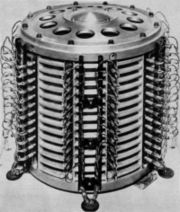
A drum is a large metal cylinder that is coated on the outside surface with a ferromagnetic recording material. It could be considered the precursor to the hard disk platterHard disk platter
A hard-disk platter is a component of a hard-disk drive: it is the circular disk on which the magnetic data is stored. The rigid nature of the platters in a hard drive is what gives them their name . Hard drives typically have several platters which are mounted on the same spindle...
, but in the form of a drum rather than a flat disk. In most cases a row of fixed read-write heads runs along the long axis of the drum, one for each track.
A difference between most drums and a modern hard disk drive is that on a drum there was a track per head so that the heads do not have to move to the track to access data; the controller simply waits for the data to appear under the relevant head as the drum turns. In a modern hard disk drive delay can include the seek time, to move into place plus a rotational latency, the time taken by the drum to rotate wanted data into position, whereas the performance of a drum with its head per track is determined almost entirely by the rotational latency. Particularly while drums were used as main working memory, programmers often took to positioning code onto the drum in such a way as to reduce the amount of time needed to find the next instruction. They did this by timing how long it would take after loading an instruction for the computer to be ready to read the next one, then placing that instruction on the drum so that it would arrive under a head just in time. This method of timing compensation is called the skip factor or interleave, and was used for many years in hard disk controllers.
The head per track scheme is not inherent to drum technology; a few drum stores such as the Univac FASTRAND
FASTRAND
FASTRAND was a magnetic drum mass storage system built by Sperry Rand Corporation for their UNIVAC 1100 series and 490/494 series computers.A voice coil actuator moved a bar containing multiple single track recording heads, so these drums operated much like moving head disk drives with multiple...
had one or more moving heads. Such drums were not able to compete effectively with hard disk drives for storage applications and stopped being manufactured in the 1970s. Similarly, head per track disks were used, mostly for paging, and supplanted fixed-head drums in this application by the 1970s, but both technologies were ultimately eclipsed by the advent of inexpensive semiconductor memory.
The drums of the Atanasoff–Berry Computer stored information using regenerative capacitor memory
Regenerative capacitor memory
Regenerative capacitor memory is a type of computer memory that uses the electrical property of capacitance to store the bits of data. Because the stored charge slowly leaks away, these memories must be periodically regenerated Regenerative capacitor memory is a type of computer memory that uses...
.
Use and legacy
As late as 1980, PDP-11PDP-11
The PDP-11 was a series of 16-bit minicomputers sold by Digital Equipment Corporation from 1970 into the 1990s, one of a succession of products in the PDP series. The PDP-11 replaced the PDP-8 in many real-time applications, although both product lines lived in parallel for more than 10 years...
/45 machines that used drums for swapping (and magnetic core memory) were still in use at many of the original UNIX
Unix
Unix is a multitasking, multi-user computer operating system originally developed in 1969 by a group of AT&T employees at Bell Labs, including Ken Thompson, Dennis Ritchie, Brian Kernighan, Douglas McIlroy, and Joe Ossanna...
sites.
In modern-day BSD Unix and its descendants, /dev/drum is the name of the default virtual memory
Virtual memory
In computing, virtual memory is a memory management technique developed for multitasking kernels. This technique virtualizes a computer architecture's various forms of computer data storage , allowing a program to be designed as though there is only one kind of memory, "virtual" memory, which...
(swap) device, deriving from the use of drum secondary-storage devices as backing store for pages in virtual memory.
See also
- CAB500CAB500The CAB500 was a French transistor-based drum computer, designed at SEA around 1957It had an incremental compiler for a language, PAF similar to Fortran, designed by Dimitri Starynkevitch in 1957-1959. CAB 500's first model was delivered in February, 1961 , and more than a hundred examples were...
- Karlqvist gapKarlqvist gapIn 1953 Olle Karlqvist discovered a fundamental magnetic phenomenon when he was designing a magnetic storage and the ferromagnetic surface layer to the magnetic drum memory for the BESK computer...
- Manchester Mark 1Manchester Mark 1The Manchester Mark 1 was one of the earliest stored-program computers, developed at the Victoria University of Manchester from the Small-Scale Experimental Machine or "Baby" . It was also called the Manchester Automatic Digital Machine, or MADM...
- Random-access memoryRandom-access memoryRandom access memory is a form of computer data storage. Today, it takes the form of integrated circuits that allow stored data to be accessed in any order with a worst case performance of constant time. Strictly speaking, modern types of DRAM are therefore not random access, as data is read in...
- Wisconsin Integrally Synchronized ComputerWisconsin Integrally Synchronized ComputerThe Wisconsin Integrally Synchronized Computer was an early digital computer designed and built at the University of Wisconsin–Madison. Operational in 1954, it was the first digital computer in the state....
External links
- The Story of Mel: the classic story about one programmer's drum machine hand-coding antics: Mel KayeMel KayeThe Story of Mel is an archetypical piece of computer programming folklore. Its subject, Mel Kaye, is the canonical Real Programmer.- Story :Ed Nather’s The Story of Mel details the extraordinary programming prowess of a former collegue of his, "Mel", at Royal McBee Computer Corporation...
. - Librascope LGP-30: The drum memory computer referenced in the above story, also referenced on Librascope LGP-30.
- Librascope RPC-4000: Another drum memory computer referenced in the above story
- Oral history interview with Dean Babcock