
Home      Discussion      Topics      Dictionary      Almanac
Signup       Login
Drilling and threading

Drilling and threading

Overview
Drilling is the cutting process of using a drill bit
Drill bit
Drill bits are cutting tools used to create cylindrical holes. Bits are held in a tool called a drill, which rotates them and provides torque and axial force to create the hole. Specialized bits are also available for non-cylindrical-shaped holes....

 in a drill
Drill
A drill is a tool with a rotating drill bit used for drilling holes in various materials. The drill bit is gripped by a chuck at one end of the drill and rotated while pressed against the target material...

 to cut or enlarge holes in solid materials, such as wood or metal. Different tools and methods are used for drilling depending on the type of material, the size of the hole, the number of holes, and the time to complete the operation.

Drilling is a cutting process in which a hole is originated or enlarged by means of a multipoint, fluted, end cutting tool.
Discussion
Ask a question about 'Drilling and threading'
Start a new discussion about 'Drilling and threading'
Answer questions from other users
Full Discussion Forum
 
Encyclopedia
Drilling is the cutting process of using a drill bit
Drill bit
Drill bits are cutting tools used to create cylindrical holes. Bits are held in a tool called a drill, which rotates them and provides torque and axial force to create the hole. Specialized bits are also available for non-cylindrical-shaped holes....

 in a drill
Drill
A drill is a tool with a rotating drill bit used for drilling holes in various materials. The drill bit is gripped by a chuck at one end of the drill and rotated while pressed against the target material...

 to cut or enlarge holes in solid materials, such as wood or metal. Different tools and methods are used for drilling depending on the type of material, the size of the hole, the number of holes, and the time to complete the operation.

Drilling is a cutting process in which a hole is originated or enlarged by means of a multipoint, fluted, end cutting tool. As the drill is rotated and advanced into the workpiece, material is removed in the form of chips that move along the fluted shank of the drill. One study showed that drilling accounts for nearly 90% of all chips produced.

Process Characteristics


-Cutting tools or workpieces are rotated relative to each other.

-Creates or enlarges holes.

-Generates small burrs upon entry and more coarse burrs upon exit of the workpiece.

-Uses a multi-point rotating, fluted, end cutting tool (drill).

-May produce coarse, helical feed marks, depending on machining parameters (feed, speed, tool geometry, coolant, etc.)

Drilling may affect the mechanical properties of the workpiece by creating low residual stresses around the hole opening and a very thin layer of highly stressed and disturbed material on the newly formed surface. This causes the workpiece to become more susceptible to corrosion at the stressed surface.

Process Schematic


Drilling involves relative axial and rotations between the drill and the workpiece. Usually, the drill rotates and proceeds into the workpiece, but sometimes the opposite is true. Chips are removed by following along grooves of flutes in the drill. Although long spiral chips usually result from drilling,adjustment of the feed rate can result in chips with a range of many different shapes and sizes. Material of workpiece can also change the range of different chip shapes and sizes.

Workpiece Geometry


A drilled hole may be distinguished from one produced by piercing, casting, molding, torch cutting, etc. by the presence of helical feed marks inside the hole and small burrs on the workpiece as the drill enters and exits. Drilled holes are usually sharp around the edge where the drill has entered the workpiece.

Machining operations for drilling


Some of the basic drilling operations are:

a) Reaming - to provide better tolerance of its diameter and to improve the surface finish.

b) Tapping - to provide internal screw threads on an existing hole.

c) Counterboring - to provide a step hole in which a larger diameter follows a smaller diameter partially into a hole.

d) Countersinking - similar to counterboring but the step in the hole is cone-shaped.

e) Centering - creating a hole to accurately establish its location for subsequent drilling.

f) Spotfacing - similar to milling where it is used to provide a flat machined surface on the workpiece in the localized area.

Setup and Equipment


The drill press includes a drill head, Table, column, and base. A drill bit is gripped firmly in the chuck, and the piece is positioned on the table.
The drill head contains a drive motor, a spindle, a feed mechanism, and a tool holding mechanism(chuck). The drill is advanced into the workpiece by the feed mechanism. Regular shaped workpieces are held in a workholding device. Irregular shaped workpieces are held in special fixtures.

Tool Style


Different jobs require different types of drills, that is why there are so many different drill types in many different shapes and sizes. Countersink or center drills are mainly used to center holes very accurately. A more common drill is the twist drill, a drill that produces a majority of drilled holes. Some specialty drills include subland, spade, and indexable drills.

Toolholding Methods


Drills are either straight shank or taper shank. Straight shank drills are often held in a keyless chuck for quick load/unload time. Tapered shank drills are held in the female Morse taper in the end of the machine tool spindle. Removal of the drill is accomplished by driving a tapered drift through a hole in the spindle and against the end of the drill's tang.

Workpieces


A drilled hole can be distinguished from piercing, casting, molding, and torch cutting. Drilled holes are usually sharp around where the drill entered the workpiece. The different pieces that can be used are rods, plates, castings, extruded, and more.

Common Geometry


The diameter of most holes drilled are between 1/8 and 1 1/2 inches. Holes with diameters greater or less than that may be obtained with special tooling. The diameter-to-length ratio is usually between 1:1 and 1:10. Much higher ratios are possible (e.g., "aircraft-length" twist drills, pressured-oil gun drill
Gun drill
Gun drills are straight fluted drills which allow coolant to be directed through the drill's body, directly to the cutting face. They are used for deep drilling , of which gun barrels are the obvious example...

s), but the higher the ratio, the greater the technical challenge of producing good work.

The geometry of the drill bit used can vary from conventional twist drill bits, couterbores, subland, or multidiameter drills, countersinks, spade drills, and many others. Each type has its own purpose, it is possible to drill square and hexagon shaped holes using special equipment.

Drilling in metal


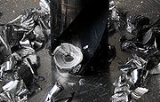
Under normal usage, swarf
Swarf
Swarf, also known as turnings, chips, or filings, are shavings and chippings of metal — the debris or waste resulting from metalworking operations. It can usually be recycled, and this is the preferred method of disposal due to the environmental concerns regarding potential contamination with...

 is carried up and away from the tip of the drill bit by the fluting of the drill bit. The continued production of chips from the cutting edges produces more chips which continue the movement of the chips outwards from the hole. This continues until the chips pack too tightly, either because of deeper than normal holes or insufficient backing off (removing the drill slightly or totally from the hole while drilling). Lubricants and coolants (i.e. cutting fluid
Cutting fluid
Cutting fluids are various fluids that are used in machining to cool and lubricate the cutting tool. There are various kinds of cutting fluids, which include oils, oil-water emulsions, pastes, gels, and mists. They may be made from petroleum distillates, animal fats, plant oils, or other raw...

) are sometimes used to ease this problem and to prolong the tools life by cooling and lubricating the tip and chip flow. Coolant is introduced via holes through the drill shank (see gun drill
Gun drill
Gun drills are straight fluted drills which allow coolant to be directed through the drill's body, directly to the cutting face. They are used for deep drilling , of which gun barrels are the obvious example...

). When cutting aluminum in particular, cutting fluid helps ensure a smooth and accurate hole while preventing the metal from grabbing the drill bit in the process of drilling the hole. Only a few drops are needed at a time.

Straight fluting is used for copper
Copper
Copper is a chemical element with the symbol Cu and atomic number 29.It is a ductile metal with very high thermal and electrical conductivity. Pure copper is rather soft and malleable and a freshly-exposed surface has a pinkish or peachy color...

 or brass
Brass
Brass is any alloy of copper and zinc; the proportions of zinc and copper can be varied to create a range of brasses with varying properties. In comparison, bronze is principally an alloy of copper and tin. Despite this distinction, some types of brasses are called bronzes. Brass is a...

, as this exhibits less tendency to "dig in" or grab the material. If a helical drill (twist drill) is used then the same effect can be achieved by stoning a small flat parallel with the axis of the drill bit.

For heavy feeds and comparatively deep holes oil
Oil
An oil is any substance that is liquid at ambient temperatures and is hydrophobic but soluble in organic solvents. Oils have a high carbon and hydrogen content and are nonpolar substances. The general definition above includes compound classes with otherwise unrelated chemical structures,...

-hole drills can be used, with a lubricant pumped to the drill head through a small hole in the bit and flowing out along the fluting. A conventional drill press arrangement can be used in oil-hole drilling, but it is more commonly seen in automatic drilling machinery in which it is the workpiece that rotates rather than the drill bit.
  • Peck Increments: If a peck cycle is needed while drilling a deep hole, the peck increment should not exceed 1/2 the diameter of the drill.


Machinability Ratings

Aluminum - good to excellent

Brass - good to excellent

Cast Iron - fair to good

Mild Steel - fair to good

Stainless Steel - poor to fair

Plastics - good to excellent

Drilling in wood


Wood
Wood
Wood is an organic material; in the strict sense wood is produced as secondary xylem in the stems of trees . In a living tree it transfers water and nutrients to the leaves and other growing tissues, and has a support function, enabling woody plants to reach large sizes or to stand up for themselves...

 being softer than most metals, drilling in wood is considerably easier and faster than drilling in metal. Cutting fluids are not used or needed. The main issue in drilling wood is assuring clean entry and exit holes and preventing burning. Avoiding burning is a question of using sharp bits and the appropriate cutting speed
Cutting speed
The phrase speeds and feeds refers to two separate velocities in machine tool practice, cutting speed and feed rate. They are often considered as a pair because of their combined effect on the cutting process. Each, however, can also be considered and analyzed in its own right...

. Drill bits can tear out chips of wood around the top and bottom of the hole and this is undesirable in fine woodworking
Woodworking
Woodworking is the process of building, making or carving something using wood.-History:Along with stone, mud, and animal parts, wood was certainly one of the first materials worked by primitive human beings. Microwear analysis of the Mousterian stone tools used by the Neanderthals show that many...

 applications.

The ubiquitous twist drill bits used in metalworking also work well in wood, but they tend to chip wood out at the entry and exit of the hole. In some cases, as in rough holes for carpentry, the quality of the hole does not matter, and a number of bits for fast cutting in wood exist, including spade bits and self-feeding auger
Auger
An auger is a device for moving material or liquid by means of a rotating helical flighting. The material is moved along the axis of rotation. For some uses the helical 'flighting' is enclosed in a tube, for other uses the flighting is not encased...

 bits. Many types of specialised drill bits for boring clean holes in wood have been developed, including brad-point bits, Forstner bits and hole saws. Chipping on exit can be minimized by using a piece of wood as backing behind the work piece, and the same technique is sometimes used to keep the hole entry neat.

Holes are easier to start in wood as the drill bit can be accurately positioned by pushing it into the wood and creating a dimple. The bit will thus have little tendency to wander. In metal working, an accurate position needs to be marked with a punch to avoid the bit wandering from the desired position of the hole.

Drilling in stone


When drilling in stone, one must pay particular attention to the type of stone one drills into. There are three different classifications of drill bits used for drilling into stone: soft, medium, and hard. Soft formation rock bits are used in unconsolidated sands, clays, and soft limestones, and red beds, etc. Medium formation bits are used in calcites, dolomites, limestones, and hard shale, while hard formation bits are used in hard shale, calcites, mudstones, cherty lime stones and hard and abrasive formations.

Microdrilling


Microdrilling refers to the drilling of holes less than 0.5 mm. Drilling of holes at this small diameter presents greater problems since coolant fed drills cannot be used and high spindle speeds are required. High spindle speeds that exceed 10,000 RPM also require the use of balanced tool holders.

Operation definition


Hole making is one of the most important machining operations in the manufacturing process. Drilling is a multi-point cutting process. Holes serve a variety of functions including but not limited to: fasteners for assembly, weight reduction, ventilation, access to other parts, or simply for aesthetics. Reducing the weight of the object results in chips and burrs (at the entrance and exit of the hole). The process of drilling requires either the drill piece or the object being drilled to be rotated. Drilling can either create a new hole or enlarge an existing one. Hole making or drilling is used in the production of almost any part conceivable and those that aren't drilled are made with machines that have been drilled.

Hole making operations


On most workpieces it is vitally important that the hole be drilled precisely in reference to the x, y, z-axes. When possible drilled holes should be located perpendicular to the workpiece surface. This is due to the large length-to-diameter ratio which causes the drill bit to be easily deflected which can cause the hole to be misplaced, or the drill bit to break or fatigue. Because there are so many types of production operations that involve making a variety of holes in countless different materials, there are many methods for hole making.

Measuring drilling depth


Unless you are working with a very short workpiece, you will want to measure the depth of the hole you are going to drill in order to stop at the desired depth. A depth gauge, a cylinder of brass with a locking screw which slides on a piece of 1/16" drill rod about 3" long, is a simple depth gauge. It is important to measure the depth of the hole you are going to make in order to not damage or alter the final product.

Considerations for drilling


Because drilling can often be such a critical process there are a number of considerations that should be taken in order to ensure the most accurate drill hole possible.

As mentioned before the hole and drill motion should be perpendicular to the surface of the workpiece to reduce the tendency to fatigue or break the drill bit. This also helps to reduce 'walking' of the drill bit over the workpiece surface.

• 'Walk' is common when drilling small diameter holes. It is advantageous to create a centering mark or feature during the casting or forging process. Creating a centering dimple with a centering punch will also reduce the tendency to 'walk'.

• The bottoms of the hole should match the standard drill point angles. Avoid flat bottom hole or odd shapes.

• Create through holes instead of blind holes when possible.

• If a blind hole must be drilled and tapped, it should be drilled deeper than the tapped depth.

• Holes that need to be reamed must also be initially drilled deeper than the reamed hole depth.

• A part should be designed such that it won't need to be repositioned or manually moved during the drilling process. This also reduces production time and overall cost.

• Drill speed should be another consideration. Some materials like plastics as well as other non-metals and some metals have a tendency to heat up enough to expand making the hole smaller than desired.

Consideration of the effects on the work material properties. A mechanical effect of drilling is a very thin layer of highly stressed and disturbed material created on new surface. Increased probability of corrosion at stressed surface.

In considering the speed of the entire operation there are multiple factors needing to be considered. Speed is of more concern when multiple cuts need to be made by machine. The speed of a cut can be derived by Length of cut ÷ Feed rate. How quickly the drill can be retracted from a cut is obtained by Length of cut ÷ Retract rate of the drill. How long it takes to get a drill into position for all planned cuts is found by Number of holes × Distance between holes ÷ the drill's speed of Rapid travel. The drill's rpm is a approximated by 4 × Cutting speed ÷ Diameter of the drill. The feed rate is a result of Feed per teeth × Number of teeth × Rotations per minute.

In deciding which drill(s) to use it is important to consider the task at hand and evaluate which drill would best accomplish the task. There are a variety of drill styles that each serve a different purpose. The countersink (center drill) is used to ensure accurate positioning of a hole. The subland drill is capable of drilling more than one diameter. The spade drill is used to drill larger hole sizes. The indexable drill is useful in managing chips.

Center drilling


The purpose of center drilling is to drill a hole smaller than the desired hole that will act as a guide for drilling the final hole. While drilling the center hole one must remember to only drill 3/4th of the way into the workpiece. Since the center hole is only a guide hole, there will be no need to drill any further.

Deep hole drilling


Deep hole drilling makes reaching extreme depths possible. A high tech monitoring system is used to control force, torque, vibration, and acoustic emission. The vibration is considered a major defect in deep hole drilling which can often cause the drill to break. The monitoring system is essential in this process for this reason. the coolant is used for this operation is more than that of simple drilling process.

Twist drill


The most common type of drill is a standard-point twist drill. This type of drill is versatile and can be used on a variety of materials such as wood, plastic, masonry, ceramic, and metal. These drill bits have two spiral grooves running the length of the drill. These grooves aid in transporting cutting fluid to the drill tip and in removing the chips from the hole. These types of drill bits are held in chucks or collets on machines that are either hand-held or automated. This type of drilling can often cause burrs at both the entrance and the exit of the hole and parts will often need a subsequent deburring operation to smooth out the holes.

Gun drilling


Another type of drilling operation is called gun drilling. This method was originally developed to drill out gun barrels and is used commonly for drilling smaller diameter deep holes. This depth-to-diameter ratio can be even more than 300:1. The key feature of gun drilling is that the bits are self-centering; this is what allows for such deep accurate holes. The bits use a rotary motion similar to a twist drill however; the bits are designed with bearing pads that slide along the surface of the hole keeping the drill bit on center. Gun drilling is usually done at high speeds and low feed rates.

Trepanning


Trepanning is commonly used for creating larger diameter holes (up to 915 mm or 36 in) where a standard drill bit is not feasible or economical. Trepanning removes the desired diameter by cutting out a solid disk similar to the workings of a drafting compass. Trepanning is performed on flat products such as sheet metal, granite(curling
Curling
Curling is a team game with similarities to bowls and shuffleboard, played by two teams of four players each on a rectangular sheet of carefully prepared ice. Teams take turns sliding heavy, polished granite stones down the ice towards the target...

 stone), plates, or structural members like I-beams. Trepanning can also be useful to make grooves for inserting seals like O-rings.

Power Requirements


To determine the Horsepower (hp) needed for doing the drilling, simply multiply the unit power by the removal rate (in.^3/min)
General recommendations for speeds and feeds in drilling
Workpiece material Surface speed (m/min, ft/min) Feed, mm/rev (in/rev) Feed, mm/rev (in/rev) rpm rpm
1.5 mm (0.060 in) 12.5 mm (0.5 in) 1.5 mm (0.060 in) 12.5 mm (0.5 in)
Aluminium alloys 30-120, 100-400 0.025 (0.001) 0.30 (0.012) 6,400-25,000 800-3,000
Magnesium alloys 45-120, 150-400 0.025 (0.001) 0.30 (0.012) 9,600-25,000 1,100-3,000
Copper alloys 15-60, 50-200 0.025 (0.001) 0.25 (0.010) 3,200-12,000 400-1,500
Steels 20-30, 60-100 0.025 (0.001) 0.30 (0.012) 4,300-6,400 500-800
Stainless steels 10-20, 60-100 0.025 (0.001) 0.18 (0.007) 2,100-4,300 250-500
Titanium alloys 6-20, 20-60 0.010 (0.0004) 0.15 (0.006) 1,300-4,300 150-500
Cast irons 20-60, 60-200 0.025 (0.001) 0.30 (0.012) 4,300-12,000 500-1,500
Thermoplastics 30-60, 100-200 0.025 (0.001) 0.13 (0.005) 6,400-12,000 800-1,500
Thermosets 20-60, 60-200 0.025 (0.001) 0.10 (0.004) 4300-1,2000 500-1,500

Tool Geometry
MATERIAL Point Angle Helix Angle Lip Relief Angle
Aluminum 90 to 135 32 to 48 12 to 26
Brass 90 to 118 0 to 20 12 to 26
Cast Iron 90 to 118 24 to 32 7 to 20
Mild Steel 118 to 135 24 to 32 7 to 24
Stainless Steel 118 to 135 24 to 32 7 to 24
Plastics 60 to 90 0 to 20 12 to 26

Lubrication and Cooling


Cutting fluids for drilling include mineral, synthetic, and water-solube oils. Application of these fluids is usually done by flooding the workpiece or by applying a spray mist. The main function of cutting fluids is to cool the tool, which increases tool life and makes higher cutting feeds and speeds possible. Some secondary benefits are chip removal and lubrication, which contribute to better workpiece surface finish.

Time Calculations


When calculating the time needed to drill. use these formulas.

Cutting Time: L/F

Retract Time: L/T

Positioning TIme: H(S/R)

rpm: 4xv/D

Feed Rate: FxNxrpm

D = Diameter of tool

A = Approach time

O = Over-travel

F = Feed rate

V = Cutting Speed

r = Retract rate

H = Number of Holes

S = Distance to next Hole

R = Rapid travel

f = Feed per tooth

N = Number of teeth

L = Length of cut

d = Depth of Hole

Cost Elements


Cost elements include the following:
  • setup time.
  • load/unload time.
  • Idle time.
  • Cutting time.
  • Tool costs.
  • Direct labor rate.
  • Overhead rate.
  • Amortization of equipment and tooling.

Safety


Risks should be taken into consideration when drilling. Quickly rotating tools, hot sharp chips expelled from the workpiece, and skin irritation from cutting fluids all create situations that could pose a problem for the operator.

Workholding Methods


General purpose vises such as those shown may be used to hold the workpiece during. Frequently, jigs and fixtures are designed for a specific workpiece and operation. Some factors to consider when designing jigs and fixtures are number of parts to be drilled, rigidity, strength, accuracy of location, workpiece clamping method, chip control, and ease of operation.

Tolerances and Surface Finish


Shown are the tolerances that may be obtained with a twist drill with and without the use of a bushing and/or center drilling. For greater accuracy, center drilling should be performed prior to drilling, or a drill bushing should be used. Surface finishing may range from 32 to 500 microinches, with the range usually between 63 and 50 microinches. Finish cuts will generate surfaces near 32 microinches, and roughing will be near 500 microinches.

Factors Affecting Process Results


Tolerance and surface finish depend upon the following:
Tool geometry
Cutting speed and feed rate
Rigidity of tool, workpiece, and machine
Alignment of machine components and fixtures
Cutting Fluid
Composition and hardness of the workpiece
Accuracy of point angle, lip clearance, and lip length

Orbital drilling


A drilling procedure developed for use in composite material
Composite material
Composite materials are engineered materials made from two or more constituent materials with significantly different physical or chemical properties which remain separate and distinct on a macroscopic level within the finished structure.- History :The most primitive composite materials were straw...

s, orbital drilling removes material both axially and radially by rotating the cutting tool about its axis while also moving it eccentrically about the desired axis of the hole being machined. This procedure differs from a milling machine, because the cutting tool is advanced through the material similar to a regular drill press, producing a smooth hole that is larger than the diameter of the cutting tool (the difference between tool size and hole size is a function of the eccentric offset). This procedure produces smaller chips, requires smaller axial force, removes chips better and reduces heat buildup during the cutting process.