
Home      Discussion      Topics      Dictionary      Almanac
Signup       Login
Dracunculiasis

Dracunculiasis

Overview
Dracunculiasis also called guinea worm disease (GWD), is a parasitic
Parasitism
Parasitism is a type of symbiotic relationship between organisms of different species where one organism, the parasite, benefits at the expense of the other, the host. Traditionally parasite referred to organisms with lifestages that needed more than one host . These are now called macroparasites...

 infection
Infection
An infection is the colonization of a host organism by parasite species. Infecting parasites seek to use the host's resources to reproduce, often resulting in disease...

 caused by Dracunculus medinensis
Dracunculus medinensis
Dracunculus medinensis is a nematode that causes dracunculiasis.Dracunculiasis, also known as Guinea worm disease, is caused by the large female nematode, Dracunculus medinensis, which is among the longest nematodes infecting humans. The adult female is primarily larger than the adult male. The...

, a long and very thin nematode
Nematode
The nematodes or roundworms are the most diverse phylum of pseudocoelomates, and one of the most diverse of all animals. Nematode species are very difficult to distinguish; over 28,000 have been described, of which over 16,000 are parasitic. It has been estimated that the total number of nematode...

 (roundworm). The infection begins when a person drinks stagnant water
Water stagnation
Water stagnation occurs when water stops flowing. Stagnant water can be a major environmental hazard.-Dangers:Malaria and dengue are among the main dangers of stagnant water, which can become a breeding ground for the mosquitoes that transmit these diseases.Stagnant or Stailment water can be...

 contaminated with copepod
Copepod
Copepods are a group of small crustaceans found in the sea and nearly every freshwater habitat. Some species are planktonic , some are benthic , and some continental species may live in limno-terrestrial habitats and other wet terrestrial places, such as swamps, under leaf fall in wet forests,...

s infested by the larva
Larva
A larva is a distinct juvenile form many animals undergo before metamorphosis into adults. Animals with indirect development such as insects, amphibians, or cnidarians typically have a larval phase of their life cycle...

e of the guinea worm. Approximately one year later, the disease presents with a painful, burning sensation as the worm forms a blister, usually on the lower limb. Once prevalent in 20 nations in Asia
Asia
Asia is the world's largest and most populous continent, located primarily in the eastern and northern hemispheres. It covers 8.7% of the Earth's total surface area and with approximately 3.879 billion people, it hosts 60% of the world's current human population...

 and Africa
Africa
Africa is the world's second largest and second most populous continent, after Asia. At about 30.2 million km² including adjacent islands, it covers 6% of the Earth's total surface area and 20.4% of the total land area...

, the disease remains endemic
Endemic (epidemiology)
In epidemiology, an infection is said to be endemic in a population when that infection is maintained in the population without the need for external inputs. For example, chickenpox is endemic in the UK, but malaria is not...

 in only four countries in Africa
Africa
Africa is the world's second largest and second most populous continent, after Asia. At about 30.2 million km² including adjacent islands, it covers 6% of the Earth's total surface area and 20.4% of the total land area...

.
Discussion
Ask a question about 'Dracunculiasis'
Start a new discussion about 'Dracunculiasis'
Answer questions from other users
Full Discussion Forum
 
Unanswered Questions
Encyclopedia
Dracunculiasis also called guinea worm disease (GWD), is a parasitic
Parasitism
Parasitism is a type of symbiotic relationship between organisms of different species where one organism, the parasite, benefits at the expense of the other, the host. Traditionally parasite referred to organisms with lifestages that needed more than one host . These are now called macroparasites...

 infection
Infection
An infection is the colonization of a host organism by parasite species. Infecting parasites seek to use the host's resources to reproduce, often resulting in disease...

 caused by Dracunculus medinensis
Dracunculus medinensis
Dracunculus medinensis is a nematode that causes dracunculiasis.Dracunculiasis, also known as Guinea worm disease, is caused by the large female nematode, Dracunculus medinensis, which is among the longest nematodes infecting humans. The adult female is primarily larger than the adult male. The...

, a long and very thin nematode
Nematode
The nematodes or roundworms are the most diverse phylum of pseudocoelomates, and one of the most diverse of all animals. Nematode species are very difficult to distinguish; over 28,000 have been described, of which over 16,000 are parasitic. It has been estimated that the total number of nematode...

 (roundworm). The infection begins when a person drinks stagnant water
Water stagnation
Water stagnation occurs when water stops flowing. Stagnant water can be a major environmental hazard.-Dangers:Malaria and dengue are among the main dangers of stagnant water, which can become a breeding ground for the mosquitoes that transmit these diseases.Stagnant or Stailment water can be...

 contaminated with copepod
Copepod
Copepods are a group of small crustaceans found in the sea and nearly every freshwater habitat. Some species are planktonic , some are benthic , and some continental species may live in limno-terrestrial habitats and other wet terrestrial places, such as swamps, under leaf fall in wet forests,...

s infested by the larva
Larva
A larva is a distinct juvenile form many animals undergo before metamorphosis into adults. Animals with indirect development such as insects, amphibians, or cnidarians typically have a larval phase of their life cycle...

e of the guinea worm. Approximately one year later, the disease presents with a painful, burning sensation as the worm forms a blister, usually on the lower limb. Once prevalent in 20 nations in Asia
Asia
Asia is the world's largest and most populous continent, located primarily in the eastern and northern hemispheres. It covers 8.7% of the Earth's total surface area and with approximately 3.879 billion people, it hosts 60% of the world's current human population...

 and Africa
Africa
Africa is the world's second largest and second most populous continent, after Asia. At about 30.2 million km² including adjacent islands, it covers 6% of the Earth's total surface area and 20.4% of the total land area...

, the disease remains endemic
Endemic (epidemiology)
In epidemiology, an infection is said to be endemic in a population when that infection is maintained in the population without the need for external inputs. For example, chickenpox is endemic in the UK, but malaria is not...

 in only four countries in Africa
Africa
Africa is the world's second largest and second most populous continent, after Asia. At about 30.2 million km² including adjacent islands, it covers 6% of the Earth's total surface area and 20.4% of the total land area...

.

The guinea worm is one of the best historically documented human parasites, with tales of its behaviour reaching as far back as the 2nd century BC in accounts penned by Greek chroniclers. It is also mentioned in the Egyptian medical Ebers Papyrus
Ebers papyrus
The Ebers Papyrus, also known as Papyrus Ebers, is an Egyptian medical papyrus dating to circa 1550 BC. Among the oldest and most important medical papyri of ancient Egypt, it was purchased at Luxor, in the winter of 1873–74 by Georg Ebers...

, dating from 1550 BC. The name dracunculiasis is derived from the Latin "affliction with little dragons" while the common name "guinea worm" appeared after Europeans saw the disease on the Guinea
Guinea
Guinea , officially the Republic of Guinea , is a country in West Africa. Formerly known as French Guinea , it is today sometimes called Guinea-Conakry to distinguish it from its neighbour Guinea-Bissau. Guinea is divided into eight administrative regions and subdivided into thirty-three prefectures...

 coast of West Africa
West Africa
West Africa or Western Africa is the westernmost region of the African continent. Geopolitically, the UN definition of Western Africa includes the following 16 countries and an area of approximately 5 million square km:-Flags of West Africa:...

 in the 17th century.

The Carter Center
Carter Center
The Carter Center is a nongovernmental, not-for-profit organization founded in 1982 by former U.S. President Jimmy Carter and his wife Rosalynn Carter. In partnership with Emory University, The Carter Center works to advance human rights and alleviate human suffering...

 has predicted that guinea worm disease "will be the first parasitic disease
Parasitic disease
A parasitic disease is an infectious disease caused or transmitted by a parasite. Many parasites do not cause diseases. Parasitic diseases can affect practically all living organisms, including plants and mammals...

 to be eradicated and the first disease to be eradicated without the use of vaccine
Vaccine
A vaccine is a biological preparation that improves immunity to a particular disease. A vaccine typically contains an agent that resembles a disease-causing microorganism, and is often made from weakened or killed forms of the microbe or its toxins...

s or medical treatment". The primary mode of prevention is through behaviour change, alongside the provision of clean water sources and the treatment of contaminated drinking water with larvicides. There is no animal or environmental reservoir
Natural reservoir
Natural reservoir or nidus, refers to the long-term host of the pathogen of an infectious disease. It is often the case that hosts do not get the disease carried by the pathogen or it is carried as a subclinical infection and so asymptomatic and non-lethal...

 of D. medinensis and thus the parasite must pass through humans each year to survive.

Signs and symptoms


As the worm moves downwards, usually to the lower leg, through the subcutaneous tissue
Subcutaneous tissue
The hypodermis, also called the hypoderm, subcutaneous tissue, or superficial fascia is the lowermost layer of the integumentary system in vertebrates. Types of cells that are found in the hypodermis are fibroblasts, adipose cells, and macrophages...

s it leads to intense pain localized to its path of travel. The painful, burning sensation experienced by infected people has led to the disease being called "the fiery serpent". Other symptoms include: fever
Fever
Fever is a common medical sign characterized by an elevation of temperature above the normal range of due to an increase in the body temperature regulatory set-point. This increase in set-point triggers increased muscle tone and shivering.As a person's temperature increases, there is, in...

, nausea
Nausea
Nausea , is a sensation of unease and discomfort in the upper stomach with an involuntary urge to vomit. It often, but not always, precedes vomiting...

, and vomiting
Vomiting
Vomiting is the forceful expulsion of the contents of one's stomach through the mouth and sometimes the nose...

.

Cause


Guinea worm disease is caused by drinking water contaminated by water fleas (copepods) containing the Dracunculus larvae.

Life cycle


Guinea worm disease used to thrive in some of the world's poorest areas, particularly those with limited or no access to clean water. In these areas stagnant water sources may still host microscopic arthropod
Arthropod
An arthropod is an invertebrate animal having an exoskeleton , a segmented body, and jointed appendages. Arthropods are members of the phylum Arthropoda , and include the insects, arachnids, crustaceans, and others...

s known as copepod
Copepod
Copepods are a group of small crustaceans found in the sea and nearly every freshwater habitat. Some species are planktonic , some are benthic , and some continental species may live in limno-terrestrial habitats and other wet terrestrial places, such as swamps, under leaf fall in wet forests,...

s, which can carry the larvae of the guinea worm.

The larvae develop for approximately two weeks inside the copepods. At this stage the larvae can cause guinea worm disease if the infected copepods are not filtered from drinking water. The male guinea worm is typically much smaller (12–29 mm or 0.47244094488189–1.1 in) than the female, which, as an adult, can grow to 2–3 ft (0.6096–0.9144 m) long and be as thick as a spaghetti
Spaghetti
Spaghetti is a long, thin, cylindrical pasta of Italian origin. Spaghetti is made of semolina or flour and water. Italian dried spaghetti is made from durum wheat semolina, but outside of Italy it may be made with other kinds of flour...

 noodle.

Once inside the body, stomach acid digests
Digestion
Digestion is the mechanical and chemical breakdown of food into smaller components that are more easily absorbed into a blood stream, for instance. Digestion is a form of catabolism: a breakdown of large food molecules to smaller ones....

 the water flea, but not the guinea worm larvae that are sheltered inside. These larvae find their way to the body cavity where the female mates with a male guinea worm. This takes place approximately three months after infection. The male worm dies after mating and is absorbed.

The female, which contains larvae, burrows into the deeper connective tissue
Connective tissue
"Connective tissue" is a fibrous tissue. It is one of the four traditional classes of tissues . Connective Tissue is found throughout the body.In fact the whole framework of the skeleton and the different specialized connective tissues from the crown of the head to the toes determine the form of...

s or adjacent to long bone
Long bone
The long bones are those that are longer than they are wide. They are one of five types of bones: long, short, flat, irregular and sesamoid. Long bones, especially the femur and tibia, are subjected to most of the load during daily activities and they are crucial for skeletal mobility. They grow...

s or joints of the extremities.

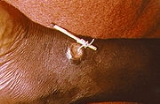
Approximately one year after the infection began, the worm creates a blister
Blister
A blister is a small pocket of fluid within the upper layers of the skin, typically caused by forceful rubbing , burning, freezing, chemical exposure or infection. Most blisters are filled with a clear fluid called serum or plasma...

 in the human host's skin—usually on the leg or foot. Within 72 hours the blister ruptures, exposing one end of the emergent worm. This blister causes a very painful burning sensation as the worm emerges. Infected persons often immerse the affected limb in water to relieve the burning sensation. Once the blister or open sore is submerged in water, the adult female releases hundreds of thousands of guinea worm larvae, contaminating the water supply.

During the next few days, the female worm is capable of releasing more larvae whenever it comes in contact with water as it extends its posterior end through the hole in the host's skin. These larvae contaminate the water supply and are eaten by copepod
Copepod
Copepods are a group of small crustaceans found in the sea and nearly every freshwater habitat. Some species are planktonic , some are benthic , and some continental species may live in limno-terrestrial habitats and other wet terrestrial places, such as swamps, under leaf fall in wet forests,...

s, thereby repeating the life-cycle of the disease. Infected copepods can live in the water for only two to three weeks if they are not ingested by a person. Infection does not create immunity, so people can repeatedly experience guinea worm disease throughout their lives.

In drier areas just below the Sahara desert, cases of the disease often emerge during the rainy season, which for many agricultural communities is also the planting or harvesting season. Elsewhere, the emerging worms are more prevalent during the dry season, when ponds and lakes are smaller and copepods, thus, are more concentrated in them. Guinea worm disease outbreaks can cause serious disruption to local food supplies and school attendance .

Prevention


Guinea worm disease can be transmitted only by drinking contaminated water, and can be completely prevented through relatively simple measures that could result in the disease being eradicated:
  • Drinking water drawn solely from underground sources free from contamination, such as a borehole
    Borehole
    A borehole is the generalized term for any narrow shaft bored in the ground, either vertically or horizontally. A borehole may be constructed for many different purposes, including the extraction of water or other liquid or gases , as part of a geotechnical investigation, environmental site...

     or hand-dug wells
    Water well
    A water well is an excavation or structure created in the ground by digging, driving, boring or drilling to access groundwater in underground aquifers. The well water is drawn by an electric submersible pump, a trash pump, a vertical turbine pump, a handpump or a mechanical pump...

    .
  • Filtering drinking water, using a fine-mesh cloth filter
    Cloth filter
    Developed for use in Bangladesh, the cloth filter is a simple and cost-effective appropriate technology method for reducing the contamination of drinking water...

     like nylon, to remove the guinea worm-containing crustaceans.
  • Preventing people with emerging guinea worms from entering ponds and wells used for drinking water.
  • Developing new sources of drinking water that lack the parasites, or repairing dysfunctional ones.


Water sources can also be treated with larvicide
Larvicide
A larvicide is an insecticide that is specifically targeted against the larval life stage of an insect. Their most common use is against mosquitoes...

s to kill worm-carrying crustaceans.

Treatment


There is no vaccine or medicine to treat or prevent Guinea worm disease. Once a Guinea worm begins emerging, a person must wrap the live worm around a piece of gauze or a stick to extract it from the body (a long, painful process which usually takes weeks or months). This is the same treatment that is noted in the famous ancient Egyptian medical text, the Ebers papyrus
Ebers papyrus
The Ebers Papyrus, also known as Papyrus Ebers, is an Egyptian medical papyrus dating to circa 1550 BC. Among the oldest and most important medical papyri of ancient Egypt, it was purchased at Luxor, in the winter of 1873–74 by Georg Ebers...

 from 1550 BC Some people have said that extracting a Guinea worm feels like the afflicted area is on fire. However, if the infection is identified before an ulcer forms, the worm can also be surgically removed by a trained doctor in a medical facility.

Although Guinea worm disease is usually not fatal, the wound where the worm emerges could develop a secondary bacterial infection such as tetanus
Tetanus
Tetanus is a medical condition characterized by a prolonged contraction of skeletal muscle fibers. The primary symptoms are caused by tetanospasmin, a neurotoxin produced by the Gram-positive, rod-shaped, obligate anaerobic bacterium Clostridium tetani...

, which may be life-threatening—a concern in endemic areas where there is typically limited or no access to health care. Analgesic
Analgesic
An analgesic is any member of the group of drugs used to relieve pain . The word analgesic derives from Greek an- and algos ....

s can be used to help reduce swelling and pain and antibiotic
Antibiotic
An antibacterial is a compound or substance that kills or slows down the growth of bacteria.The term is often used synonymously with the term antibiotic; today, however, with increased knowledge of the causative agents of various infectious diseases, antibiotic has come to denote a broader range of...

 ointments can help prevent secondary infections at the wound site.

Use of metronidazole
Metronidazole
Metronidazole is a nitroimidazole antibiotic medication used particularly for anaerobic bacteria and protozoa. Metronidazole is an antibiotic, amebicide, and antiprotozoal....

 or thiabendazole
Thiabendazole
Tiabendazole is a fungicide and parasiticide.-Fungicide:...

 may make extraction easier, but also may lead to migration to other parts of the body.

Epidemiology


In 1986, there were an estimated 3.5 million cases of Guinea worm in 20 endemic nations in Asia and Africa. The number of cases has been reduced by more than 99% to 3,190 in 2009, 3,185 of them in the four remaining endemic nations of Africa: Sudan
Sudan
Sudan , officially the Republic of the Sudan , is a country in North Africa, sometimes considered part of the Middle East politically. It is bordered by Egypt to the north, the Red Sea to the northeast, Eritrea and Ethiopia to the east, South Sudan to the south, the Central African Republic to the...

, Ghana
Ghana
Ghana , officially the Republic of Ghana, is a country located in West Africa. It is bordered by Côte d'Ivoire to the west, Burkina Faso to the north, Togo to the east, and the Gulf of Guinea to the south...

, Mali
Mali
Mali , officially the Republic of Mali , is a landlocked country in Western Africa. Mali borders Algeria on the north, Niger on the east, Burkina Faso and the Côte d'Ivoire on the south, Guinea on the south-west, and Senegal and Mauritania on the west. Its size is just over 1,240,000 km² with...

 and Ethiopia
Ethiopia
Ethiopia , officially known as the Federal Democratic Republic of Ethiopia, is a country located in the Horn of Africa. It is the second-most populous nation in Africa, with over 82 million inhabitants, and the tenth-largest by area, occupying 1,100,000 km2...

. This is the lowest number of cases since the eradication campaign began. As of 2010, however, the WHO predicted it will be "a few years yet" before eradication is achieved, on the basis that it took 6–12 years for the countries that have so far eliminated Guinea worm transmission to do so after reporting a similar number of cases to that reported by Sudan in 2009. The total for 2010 was 1,797 cases. All four remaining endemic countries succeeded in reducing their case totals further during this period, with Ghana in particular achieving a 97% reduction from 242 cases in 2009 to 8 cases in 2010, all of them contained. However, Chad unfortunately reported its first cases since 1998, with ten cases reported from 7 villages in 5 districts. The source of these cases is not yet clear.

The World Health Organization
World Health Organization
The World Health Organization is a specialized agency of the United Nations that acts as a coordinating authority on international public health. Established on 7 April 1948, with headquarters in Geneva, Switzerland, the agency inherited the mandate and resources of its predecessor, the Health...

 is the international body that certifies whether a disease has been eliminated from a country or eradicated from the world. The Carter Center
Carter Center
The Carter Center is a nongovernmental, not-for-profit organization founded in 1982 by former U.S. President Jimmy Carter and his wife Rosalynn Carter. In partnership with Emory University, The Carter Center works to advance human rights and alleviate human suffering...

 also reports the status of the Guinea worm eradication program by country.

Certified free


Endemic countries must report to the International Commission for the Certification of Dracunculiasis Eradication and document the absence of indigenous
Indigenous (ecology)
In biogeography, a species is defined as native to a given region or ecosystem if its presence in that region is the result of only natural processes, with no human intervention. Every natural organism has its own natural range of distribution in which it is regarded as native...

 cases of Guinea worm disease for at least three consecutive years to be certified as Guinea worm-free by the World Health Organization.

The results of this certification scheme have been remarkable: by 2007, Benin
Benin
Benin , officially the Republic of Benin, is a country in West Africa. It borders Togo to the west, Nigeria to the east and Burkina Faso and Niger to the north. Its small southern coastline on the Bight of Benin is where a majority of the population is located...

, Burkina Faso
Burkina Faso
Burkina Faso – also known by its short-form name Burkina – is a landlocked country in west Africa. It is surrounded by six countries: Mali to the north, Niger to the east, Benin to the southeast, Togo and Ghana to the south, and Côte d'Ivoire to the southwest.Its size is with an estimated...

, Chad
Chad
Chad , officially known as the Republic of Chad, is a landlocked country in Central Africa. It is bordered by Libya to the north, Sudan to the east, the Central African Republic to the south, Cameroon and Nigeria to the southwest, and Niger to the west...

, Côte d'Ivoire
Côte d'Ivoire
The Republic of Côte d'Ivoire or Ivory Coast is a country in West Africa. It has an area of , and borders the countries Liberia, Guinea, Mali, Burkina Faso and Ghana; its southern boundary is along the Gulf of Guinea. The country's population was 15,366,672 in 1998 and was estimated to be...

, Kenya
Kenya
Kenya , officially known as the Republic of Kenya, is a country in East Africa that lies on the equator, with the Indian Ocean to its south-east...

, Mauritania
Mauritania
Mauritania is a country in the Maghreb and West Africa. It is bordered by the Atlantic Ocean in the west, by Western Sahara in the north, by Algeria in the northeast, by Mali in the east and southeast, and by Senegal in the southwest...

, Togo
Togo
Togo, officially the Togolese Republic , is a country in West Africa bordered by Ghana to the west, Benin to the east and Burkina Faso to the north. It extends south to the Gulf of Guinea, on which the capital Lomé is located. Togo covers an area of approximately with a population of approximately...

, and Uganda
Uganda
Uganda , officially the Republic of Uganda, is a landlocked country in East Africa. Uganda is also known as the "Pearl of Africa". It is bordered on the east by Kenya, on the north by South Sudan, on the west by the Democratic Republic of the Congo, on the southwest by Rwanda, and on the south by...

 had stopped transmission, and Cameroon
Cameroon
Cameroon, officially the Republic of Cameroon , is a country in west Central Africa. It is bordered by Nigeria to the west; Chad to the northeast; the Central African Republic to the east; and Equatorial Guinea, Gabon, and the Republic of the Congo to the south. Cameroon's coastline lies on the...

, CAR
Central African Republic
The Central African Republic , is a landlocked country in Central Africa. It borders Chad in the north, Sudan in the north east, South Sudan in the east, the Democratic Republic of the Congo and the Republic of the Congo in the south, and Cameroon in the west. The CAR covers a land area of about ,...

, India
India
India , officially the Republic of India , is a country in South Asia. It is the seventh-largest country by geographical area, the second-most populous country with over 1.2 billion people, and the most populous democracy in the world...

, Pakistan
Pakistan
Pakistan , officially the Islamic Republic of Pakistan is a sovereign state in South Asia. It has a coastline along the Arabian Sea and the Gulf of Oman in the south and is bordered by Afghanistan and Iran in the west, India in the east and China in the far northeast. In the north, Tajikistan...

, Senegal
Senegal
Senegal , officially the Republic of Senegal , is a country in western Africa. It owes its name to the Sénégal River that borders it to the east and north...

, Yemen
Yemen
The Republic of Yemen , commonly known as Yemen , is a country located in the Middle East, occupying the southwestern to southern end of the Arabian Peninsula. It is bordered by Saudi Arabia to the north, the Red Sea to the west, and Oman to the east....

 were WHO certified.

Endemic


At the end of 2010, Sudan, Mali and Ethiopia still had endemic transmission, Ghana appeared to have just succeeded in eliminating domestic transmission, and low-level transmission had just been discovered in Chad, although it has not yet been ascertained whether this was from hidden ongoing transmission or a new importation. The major focus is southern Sudan, which reported 94% of all cases in 2010.
Country Location 2007 2008 2009 2010 Description
South Sudan 5,815 3,618 2,733 1,698 Sudan greatly ratcheted up its eradication effort from 2005 when the Comprehensive Peace Agreement was signed, ending a more than two-decade long civil war. 2006 saw an increase to 15,539 cases of Guinea Worm disease, from 5,569 cases in 2005, as a result of reporting from endemic areas that were no longer war-torn. The Southern Sudan Guinea Worm Eradication Program (SSGWEP) has deployed over 28,000 village volunteers, supervisors and other health staff to work on the program full time. The SSGWEP was able to slash the number of cases reported in 2006 by 63% to 5,815 cases in 2007. Northern Sudan had reported no endemic cases of dracunculiasis since 2001 at the time that South Sudan became independent.
Mali 313 417 186 57 Four of Mali's regions—(Kayes
Kayes Region
Kayes Region is one of eight first level national subdivisions, called Regions in Mali. It is the first administrative area of Mali and covers an area of 120,760 km²...

, Koulikoro
Koulikoro Region
Koulikoro is a region in Mali. It is the second administrative area of Mali and covers an area of 90,120 km². Its capital is the city of Koulikoro.- Geography :...

, Ségou
Ségou Region
Ségou is the fourth most populous administrative region in Mali, whose capital is the town of Ségou.-Geography:Situated at the center of Mali, Ségou Region covers 64,947 km²...

, and Sikasso
Sikasso Region
Sikasso is the southern-most region of Mali. The capital city of the same name is the 3rd-largest city and is growing rapidly due to people fleeing the violence in Côte d'Ivoire to the south. Major ethnic groups include the Senoufo, known for masks and reverence for animals, the Samago, known for...

)—have eliminated dracunculiasis, while the disease is still endemic in the country's other four regions (Gao
Gao Region
The Gao Region is located in eastern Mali. The region's capital city is Gao. Gao Region is bordered to the south and east by Niger, to the north by Kidal Region, and to the west by Tombouctou Region. Common ethnicities in the Gao Region include the Songhai, Bozo, Tuareg, Bambara, and Kounta...

, Kidal
Kidal Region
Kidal is the eighth administrative region of Mali, covering 151,430 km². Its capital is the city of Kidal.-Geography:The region is bordered on the west by Tomboctou Region, to the south by Gao Region, to the east by Niger and to the north by Algeria....

, Mopti
Mopti Region
Mopti is the fifth administrative region of Mali, covering 79,017 km². Its capital is the city of Mopti.-Geography:Mopti Region is bordered by Tombouctou Region to the north, Ségou Region to the southwest, and Burkina Faso to the southeast....

, and Timbuktu). Late detection of two outbreaks, due to inadequate surveillance, in 2007 resulted in a meager 36% containment rate in Mali in 2007. 2008 and 2009 were more successful, however, with containment rates of 85% and 73% respectively.
Ethiopia 0 41 24 21 Prior to March 2008, there had been no cases reported in Ethiopia since June 2006.
Chad 0 0 0 10 Prior to 2010, Chad had not reported any indigenous cases of guinea worm in over 10 years.
Ghana 3,358 501 242 8 In Ghana, after a decade of frustration and stagnation, in 2006 a decisive turnaround was achieved. Multiple changes can be attributed to the improved containment and lower incidence of dracunculiasis: better supervision and accountability, active oversight of patients daily by paid staff, and an intensified public awareness campaign. After Jimmy Carter's visit to Ghana in August 2006, the government of Ghana declared Guinea worm disease to be a public health emergency. The overall rate of contained cases has increased in Ghana from 60% in 2005, to 75% in 2006, 84% in 2007, 85% in 2008, 93% in 2009, and 100% in 2010.

2011


Ghana appears to have eradicated guinea worm with their public health officials reporting in August 2011 that the country has been free of reported cases for over 14 months. While promising given the incubation period it will be some time before the WHO certifies Ghana as free of this disease.

To the end of June 2011 the number of cases were: Chad 2 cases; Ethiopia 6 cases; Mali 3 cases: and South Sudan 806 cases. After the separation of South Sudan from Northern Sudan, the territory of Northern Sudan has been free of guinea worm disease for several years and it has been certified free of this disease by the WHO.

To the end of August 2011 the number of cases reported were: Chad 7 cases; Ethiopia 8 cases; Mali 9 cases: and South Sudan 944 cases. These occurred in a total of 440 villages. One possible case has been reported from India: investigation into this is ongoing. India has been certified free since 2000 and it is suspected that this possible case may be an imported one. The majority of cases (78%) in South Sudan were located in adjacent two counties of the Eastern Equatoria state: Kapoeta East County
Kapoeta East County
Kapoeta East County is an administrative region of Eastern Equatoria state in South Sudan, bordered by Kenya to the south, Ethiopia to the east and Jonglei state to the west. It is part of the Greater Kapoeta region of the state...

 (561 cases) and Kapoeta North County
Kapoeta North County
Kapoeta North County is an administrative division of Eastern Equatoria state in South Sudan. The principal settlement is Riwoto and the largest ethnic group are the Toposa people. The county emblem is an elephant.-Government facilities:...

 (146 cases). Aside from 2 cases imported from South Sudan, no cases were reported in Ethiopia in July and August from the single focus (Gog District) from which all cases in the last few years have been found. Although it is now possible that transmission in Ethiopia has been interrupted official confirmation will not be forthcoming for several months.

Up to September 2011 the number of uncontained cases were: South Sudan - 241; Chad - 6; Mali - 6; Ethiopia - 1. Of the 70 counties in South Sudan, 56 (80%) are considered free of dracunculiasis.

History of the eradication programme


The global campaign to eradicate Guinea worm disease began at the U.S. Centers for Disease Control and Prevention
Centers for Disease Control and Prevention
The Centers for Disease Control and Prevention are a United States federal agency under the Department of Health and Human Services headquartered in Druid Hills, unincorporated DeKalb County, Georgia, in Greater Atlanta...

 (CDC) in 1980. In 1986, former U.S. President
President of the United States
The President of the United States of America is the head of state and head of government of the United States. The president leads the executive branch of the federal government and is the commander-in-chief of the United States Armed Forces....

 Jimmy Carter
Jimmy Carter
James Earl "Jimmy" Carter, Jr. is an American politician who served as the 39th President of the United States and was the recipient of the 2002 Nobel Peace Prize, the only U.S. President to have received the Prize after leaving office...

 and his not-for-profit organization, The Carter Center
Carter Center
The Carter Center is a nongovernmental, not-for-profit organization founded in 1982 by former U.S. President Jimmy Carter and his wife Rosalynn Carter. In partnership with Emory University, The Carter Center works to advance human rights and alleviate human suffering...

, began leading the global campaign, in conjunction with CDC, UNICEF, and WHO
Who
Who may refer to:* Who , an English-language pronoun* who , a Unix command* Who?, one of the Five Ws in journalism- Art and entertainment :* Who? , a 1958 novel by Algis Budrys...

. At this time India, Pakistan, Yemen and 17 countries in Africa were endemic for this disease and reported a total of 3.5 million cases per year.

Carter made a personal visit to a Guinea worm endemic village in 1988. He said: "Encountering those victims first-hand, particularly the teenagers and small children, propelled me and Rosalynn to step up the Carter Center's efforts to eradicate Guinea worm disease."

President Carter also recruited two African former heads of state to the battle against Guinea worm disease. Then-former head of state of Mali, General Amadou Toumani Toure
Amadou Toumani Touré
Amadou Toumani Touré is the president of Mali. He overthrew a military ruler, Moussa Traoré in 1991, then handed power to civilian authorities the next year...

 (since elected President of Mali) has been a strong advocate of Guinea worm eradication in Mali and all other French-speaking African endemic countries since 1992. Since 1999, former Nigerian head of state General (Dr.) Yakubu Gowan has played a similar role in Nigeria, which at the eradication campaign's start had more cases than any other country.

Since humans are the only host for Guinea worm, the disease can be controlled by identifying all cases and modifying human behavior to prevent it from recurring. Once all human cases are eliminated, the disease cycle will be broken, resulting in its eradication.

In 1991, the World Health Assembly (WHA) agreed that Guinea worm disease should be eradicated. At this time there were 400,000 cases reported each year. The Carter Center has continued to lead the eradication efforts, primarily through its Guinea Worm Eradication Program. Other major actors in the eradication of Guinea worm disease include: World Health Organization
World Health Organization
The World Health Organization is a specialized agency of the United Nations that acts as a coordinating authority on international public health. Established on 7 April 1948, with headquarters in Geneva, Switzerland, the agency inherited the mandate and resources of its predecessor, the Health...

, U.S. Centers for Disease Control and Prevention
Centers for Disease Control and Prevention
The Centers for Disease Control and Prevention are a United States federal agency under the Department of Health and Human Services headquartered in Druid Hills, unincorporated DeKalb County, Georgia, in Greater Atlanta...

, Bill & Melinda Gates Foundation, and UNICEF, but the global coalition now includes dozens of other donors, nongovernmental organizations, and institutions, most especially the ministries of health of the affected countries themselves.

In December 2008, The Carter Center announced new financial support totaling US$55 million from the Bill & Melinda Gates Foundation and the United Kingdom Department for International Development. The funds will help address the higher cost of identifying and reporting the last cases of Guinea worm disease. According to The Carter Center, surveillance of countries, including the smallest communities in the most remote areas, needs to be intensified to prevent outbreaks and setbacks. In the case of Guinea worm disease, which has a one-year incubation period, there is a very high cost of maintaining a broad and sensitive monitoring system and providing a rapid response when necessary.

Barriers


The eradication of Guinea worm disease has faced several challenges:
  • Inadequate security in some endemic countries
  • Lack of political will from the leaders of some of the countries in which the disease is endemic
  • The need for change in behavior in the absence of a magic bullet treatment like a vaccine or medication
  • Inadequate funding at certain times


One of the most significant challenges facing Guinea worm eradication has been the civil war in southern Sudan
Second Sudanese Civil War
The Second Sudanese Civil War started in 1983, although it was largely a continuation of the First Sudanese Civil War of 1955 to 1972. Although it originated in southern Sudan, the civil war spread to the Nuba mountains and Blue Nile by the end of the 1980s....

, which was largely inaccessible to health workers due to violence. To address some of the humanitarian needs in southern Sudan, in 1995, the longest ceasefire
Ceasefire
A ceasefire is a temporary stoppage of a war in which each side agrees with the other to suspend aggressive actions. Ceasefires may be declared as part of a formal treaty, but they have also been called as part of an informal understanding between opposing forces...

 in the history of the war was achieved through negotiations by Jimmy Carter. Commonly called the "Guinea worm cease-fire," both warring parties agreed to halt hostilities for nearly six months to allow public health officials to begin Guinea worm eradication programming, among other interventions.

Public health officials cite the formal end of the war in 2005, as a turning point in Guinea worm eradication because it has allowed health care workers greater access to southern Sudan's endemic areas. One remaining area in West Africa outside of Ghana remains challenging to ending Guinea worm: northern Mali, where Tuareg rebels have made some affected areas unsafe for health workers.

One of the greater challenges ahead in eradicating dracunculiasis will be confronted in Sudan: there is much uncertainty with future political benchmarks in Sudan (national elections in 2009 and the referendum on the status of southern Sudan in 2011). Sporadic insecurity or widespread civil conflict could at any time ignite, thwarting eradication efforts. The remaining endemic communities in Sudan are remote, poor and devoid of infrastructure, presenting significant hurdles for effective delivery of interventions against disease. Moreover, residents in these communities are nomadic, moving seasonally with cattle in pursuit of water and pasture, making it very difficult to know where and when transmission occurred. The peak transmission season coincides with the rainy season, hampering travel by public health workers.

Society and culture


The pain caused by the worm's emergence—which typically occurs during planting and harvesting seasons—prevents many people from working or attending school for as long as three months. In heavily burdened agricultural villages fewer people are able to tend their fields or livestock, resulting in food shortages and lower earnings. A study in southeastern Nigeria, for example, found that rice farmers in a small area lost US$20 million in just one year due to outbreaks of Guinea worm disease.

History


Dracunculiasis has been a recognized disease for thousands of years:
  • Guinea worm has been found in calcified Egyptian mummies
    Mummy
    A mummy is a body, human or animal, whose skin and organs have been preserved by either intentional or incidental exposure to chemicals, extreme coldness , very low humidity, or lack of air when bodies are submerged in bogs, so that the recovered body will not decay further if kept in cool and dry...

    .
  • An Old Testament
    Old Testament
    The Old Testament, of which Christians hold different views, is a Christian term for the religious writings of ancient Israel held sacred and inspired by Christians which overlaps with the 24-book canon of the Masoretic Text of Judaism...

     description of "fiery serpents" may have been referring to Guinea Worm: "And the Lord sent fiery serpents among the people, and they bit the people; and much people of Israel died." (Numbers
    Book of Numbers
    The Book of Numbers is the fourth book of the Hebrew Bible, and the fourth of five books of the Jewish Torah/Pentateuch....

     21:4–9).
  • The 2nd century BC, Greek
    Ancient Greece
    Ancient Greece is a civilization belonging to a period of Greek history that lasted from the Archaic period of the 8th to 6th centuries BC to the end of antiquity. Immediately following this period was the beginning of the Early Middle Ages and the Byzantine era. Included in Ancient Greece is the...

     writer Agatharchides
    Agatharchides
    Agatharchides of Cnidus was a Greek historian and geographer .-Life:He is believed to have been born at Cnidus, hence his appellation. As Stanley M...

    , described this affliction as being endemic amongst certain nomads in what is now Sudan and along the Red Sea.
  • The traditional (and still current) method of extracting guinea worm by twisting the worm around a stick may have inspired the rod of Asclepius
    Rod of Asclepius
    The rod of Asclepius , also known as the asklepian, is an ancient symbol associated with astrology, the Greek god Asclepius, and with medicine and healing. It consists of a serpent entwined around a staff. The name of the symbol derives from its early and widespread association with Asclepius, the...

    , a symbol of medicine since Ancient Greek times which portrays a snake winding around a staff.
  • The unusually high incidence
    Incidence (epidemiology)
    Incidence is a measure of the risk of developing some new condition within a specified period of time. Although sometimes loosely expressed simply as the number of new cases during some time period, it is better expressed as a proportion or a rate with a denominator.Incidence proportion is the...

     of dracunculiasis in the city of Medina
    Medina
    Medina , or ; also transliterated as Madinah, or madinat al-nabi "the city of the prophet") is a city in the Hejaz region of western Saudi Arabia, and serves as the capital of the Al Madinah Province. It is the second holiest city in Islam, and the burial place of the Islamic Prophet Muhammad, and...

     led to it being included in part of the disease's scientific name "medinensis." A similar high incidence along the Guinea coast of West Africa gave the disease its more commonly used name. Guinea worm is no longer endemic in either location.


In modern times, the first to describe dracunculiasis and its pathogenesis was the Bulgarian physician Hristo Stambolski
Hristo Stambolski
Hristo Tanev Stambolski was a Bulgarian physician, revolutionary, statesman, and an important figure of the Bulgarian National Revival. He was the first to translate medical terminology from Arabic to Turkish.- Biography :...

, during his exile in Yemen
Yemen
The Republic of Yemen , commonly known as Yemen , is a country located in the Middle East, occupying the southwestern to southern end of the Arabian Peninsula. It is bordered by Saudi Arabia to the north, the Red Sea to the west, and Oman to the east....

 (1877–1878). His theory was that the cause was infected water which people were drinking.

See also

  • Infectious disease in the 20th century
    Infectious disease in the 20th century
    Many infectious diseases that killed by the millions were greatly reduced in the 20th century, with one notable achievement being the eradication of smallpox, and considerable progress being made toward the eradication of polio and Guinea Worm Disease....

  • List of infectious diseases
  • List of parasites (human)
  • Tropical disease
    Tropical disease
    Tropical diseases are diseases that are prevalent in or unique to tropical and subtropical regions. The diseases are less prevalent in temperate climates, due in part to the occurrence of a cold season, which controls the insect population by forcing hibernation. Insects such as mosquitoes and...

  • Neglected disease
  • Waterborne diseases
    Waterborne diseases
    Waterborne diseases are caused by pathogenic microorganisms which are directly transmitted when contaminated fresh water is consumed. Contaminated fresh water, used in the preparation of food, can be the source of foodborne disease through consumption of the same microorganisms...

  • Eradication of infectious disease

External links