

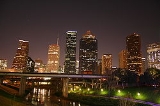
Downtown Houston

Encyclopedia
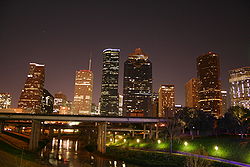

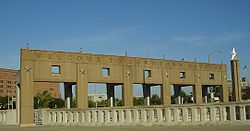
Houston Downtown Tunnel System
The Houston tunnel system is a system of tunnels below Houston's downtown street system. The system comprises approximately of tunnels and forms a network of subterranean, climate-controlled, pedestrian walkways that link 95 full city blocks...
and skywalks connecting the buildings of the district. The tunnel system is home to many fast food restaurants, shops and services.
History
Texas Revolution
The Texas Revolution or Texas War of Independence was an armed conflict between Mexico and settlers in the Texas portion of the Mexican state Coahuila y Tejas. The war lasted from October 2, 1835 to April 21, 1836...
, two New York real estate promoters, John Kirby Allen
John Kirby Allen
John Kirby Allen was born in Canasareaugh, near Syracuse in the U.S. state of New York. He, along with his older brother, Augustus Chapman Allen, founded Houston, Texas in 1836. John Kirby Allen was never married...
and Augustus Chapman Allen
Augustus Chapman Allen
Augustus Chapman Allen , along with his younger brother, John Kirby Allen, founded the City of Houston in the U.S. state of Texas. He was born on July 4, 1806, in Canasareaugh, New York, to Sarah and Roland Allen.- Early years :...
purchased 6642 acre (2,688 ha) of land T.F.L. Parrot (John Austin
John Austin (soldier)
John Austin was a Texian settler, one of Stephen Austin's Old Three Hundred, and the Texian commander at the Battle of Velasco during the Anahuac Disturbances before Texas Revolution....
's widow) for $9,428. The Allen brothers first landed in the area where the White Oak Bayou
White Oak Bayou
White Oak Bayou is one of the several waterways that give Houston, Texas, USA, its popular nickname, "The Bayou City." The Bayou originates northwest of FM 1960, near Highway 6 and U.S...
and Buffalo Bayou
Buffalo Bayou
Buffalo Bayou is a main waterway flowing through Houston, in Harris County, Texas, USA. It begins in Katy, Fort Bend County, Texas and flows approximately east to the Houston Ship Channel and then into Galveston Bay and the Gulf of Mexico...
meet, a spot now known as Allen's Landing
Allen's Landing
Allen's Landing is the birthplace of the city of Houston—the largest city in the U.S. state of Texas. In August 1836, just months after the Republic of Texas won its independence from Mexico, two brothers from New York—John Kirby Allen and Augustus Chapman Allen—purchased 6,642 acres in...
. Gail Borden, Jr., a city planner, laid out wide streets for the town.
The city was granted incorporation by the Texas legislature on June 5, 1837. Houston was made as the temporary capital of Texas. In 1840, the town was divided into four wards, each with different functions in the community. The wards are no longer political divisions, but their names are still used to refer to certain areas. By 1906 what is now Downtown was divided among six wards.

Galveston Hurricane of 1900
The Hurricane of 1900 made landfall on the city of Galveston in the U.S. state of Texas, on September 8, 1900.It had estimated winds of at landfall, making it a Category 4 storm on the Saffir-Simpson Hurricane Scale...
, when investors began seeking a location close to the ports of Southwest Texas, but apparently free of the dangerous hurricanes that frequently struck Galveston and other port cities. Houston became a wise choice, as only the most powerful storms were able to reach the city. The second came a year later with the 1901 discovery of oil at spindletop, just south of Beaumont. Shipping and oil industries began flocking to east Texas, many settling in Houston. From that point forward the area grew substantially, as many skyscrapers were constructed, including the city's tallest buildings. In the 1980s, however, economic recession canceled some projects and caused others to be scaled back, such as the Bank of the Southwest Tower
Bank of the Southwest Tower
The Bank of the Southwest Tower was a proposed building located in Houston, Texas, at 1,404 ft tall, it would have been second tallest building in North America after the Willis Tower in Chicago.-History:...
.
In the 19th century much of what was the Third Ward, the present day east side of Downtown Houston, was what Stephen Fox, an architectural historian who lectured at Rice University
Rice University
William Marsh Rice University, commonly referred to as Rice University or Rice, is a private research university located on a heavily wooded campus in Houston, Texas, United States...
, referred to as "the elite neighborhood of late 19th-century Houston." Ralph Bivins of the Houston Chronicle
Houston Chronicle
The Houston Chronicle is the largest daily newspaper in Texas, USA, headquartered in the Houston Chronicle Building in Downtown Houston. , it is the ninth-largest newspaper by circulation in the United States...
said that Fox said that area was "a silk-stocking neighborhood of Victorian-era homes." Bivins said that the construction of Union Station, which occurred around 1910, caused the "residential character" of the area to "deteriorate." Hotels opened in the area to service travelers. Afterwards, according to Bivins, the area "began a long downward slide toward the skid row of the 1990s" and the hotels were changed into flophouses. Passenger trains stopped going to Union Station. The construction of Interstate 45
Interstate 45
Interstate 45 is an intrastate Interstate Highway located entirely within the U.S. state of Texas. It connects the cities of Dallas and Houston, continuing southeast from Houston to Galveston over the Galveston Causeway to the Gulf of Mexico...
in the 1950s separated portions of the historic Third Ward from the rest of the Third Ward and brought those portions into Downtown.
Beginning in the 1960s the development of the 610 Loop caused the focus of the Houston area to move away from Downtown Houston. Joel Barna of Cite 42 said that this caused Greater Houston
Greater Houston
Houston–Sugar Land–Baytown is a 10-county metropolitan area defined by the Office of Management and Budget. It is located along the Gulf Coast region in the U.S. state of Texas...
to shift from "a fragmenting but still centrally focused spatial entity into something more like a doughnut," and that Downtown Houston began to become a "hole" in the "doughnut." As interchange connections with the 610 Loop opened, according to Barna Downtown "became just another node in a multi-node grid" and, as of 1998, "has been that, with already established high densities and land prices." In the mid-1980s, the bank savings and loan crisis
Savings and Loan crisis
The savings and loan crisis of the 1980s and 1990s was the failure of about 747 out of the 3,234 savings and loan associations in the United States...
forced many tenants in Downtown Houston buildings to retrench, and some tenants went out of business. Barna said that this development further caused Downtown Houston to decline.
On April 5, 1986, the entire Downtown area was transformed as part of a concert by French musician Jean Michel Jarre
Jean Michel Jarre
Jean Michel André Jarre is a French composer, performer and music producer. He is a pioneer in the electronic, ambient and New Age genres, and known as an organiser of outdoor spectacles of his music featuring lights, laser displays, and fireworks.Jarre was raised in Lyon by his mother and...
. Called Rendez-Vous Houston
Rendez-vous Houston
Rendez-vous Houston: A City in Concert was a live performance by musician Jean Michel Jarre amidst the skyscrapers of downtown Houston on the evening of April 5, 1986, coinciding with the release of the Rendez-Vous album...
, the open-air show used the skyscrapers as giant projection screens, and as lauchpads for fireworks. The show celebrated 25 years of NASA
NASA
The National Aeronautics and Space Administration is the agency of the United States government that is responsible for the nation's civilian space program and for aeronautics and aerospace research...
, 150 years of Texas, and was a tribute to the astronauts killed in the recent Challenger Disaster. The show attracted a then-record live audience of 1.3 million people.
Areas which are, as of 2009, considered to be a part of Downtown Houston were once considered to be within the Third Ward
Third Ward, Houston, Texas
The Third Ward is one of the six historic wards of Houston, Texas, United States. It is located in the Southeast Houston management district.The Third Ward, located inside the 610 Loop is immediately southeast of Downtown Houston and to the east of the Texas Medical Center. The ward became the...
and the Fourth Ward
Fourth Ward, Houston, Texas
Fourth Ward is one of the historic six wards of Houston, Texas, United States. The Fourth Ward is located inside the 610 Loop directly west of and adjacent to Downtown Houston. The Fourth Ward is the site of Freedmen's Town, which was a post-U.S. Civil War community of...
communities; the construction of Interstate 45 in the 1950s separated the areas from their former communities and placed them in Downtown. Additional freeway construction in the 1960s and 1970s formed the current boundaries of Downtown. Originally, Downtown was the most important retail area of Houston. Suburban retail construction in the 1970s and 1980s reduced Downtown's importance in terms of retail activity. By 1987 many of the office buildings in Downtown Houston were owned by non-U.S. real estate figures. The Texas Legislature
Texas Legislature
The Legislature of the state of Texas is the state legislature of the U.S. state of Texas. The legislature is a bicameral body composed of a 31-member Senate and a 150-member House of Representatives. The Legislature meets at the Capitol in Austin...
established the Downtown Houston Management District in 1995. In 1996 Peter S. Carlsen and Dale E. Smith of the Houston Business Journal said that "the obvious and emerging trend of 1996 was the resurgence" of Downtown, citing several developments that contributed to the revitalization of the central business district.
The arrival of major industry also saw the advent of skyscrapers in Houston. The building boom of the 1970s and 1980s saw the erection of major buildings, many of them ranking as the tallest in the state and the nation.
Composition
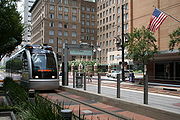
Interstate 45
Interstate 45 is an intrastate Interstate Highway located entirely within the U.S. state of Texas. It connects the cities of Dallas and Houston, continuing southeast from Houston to Galveston over the Galveston Causeway to the Gulf of Mexico...
, U.S. Highway 59, and Interstate 10
Interstate 10
Interstate 10 is the fourth-longest Interstate Highway in the United States, after I-90, I-80, and I-40. It is the southernmost east–west, coast-to-coast Interstate Highway, although I-4 and I-8 are further south. It stretches from the Pacific Ocean at State Route 1 in Santa Monica,...
. Several areas exist in Downtown Houston. They include:
- The Historic District was the original town center of Houston and dates from the 19th century. The center of the historic district is the Market Square, where the original city hall building stood. The district includes the Harris County courts complex, and the University of Houston–DowntownUniversity of Houston–DowntownThe University of Houston–Downtown is a four-year state university, and is a distinct component institution of the University of Houston System. Its campus spans 20-acre in Downtown Houston, with a satellite location in northwestern Harris County...
is on the edge of the district. - Main Street Square has a pavilion and fountains built around the Main Street Square StationMain Street Square StationMain Street Square is a station on the METRORail Red Line in Houston, Texas . This is the 3rd station heading south along the rail line. This station is located in the heart of downtown - With lots of shopping and offices nearby....
and the Downtown Macy'sMacy'sMacy's is a U.S. chain of mid-to-high range department stores. In addition to its flagship Herald Square location in New York City, the company operates over 800 stores in the United States...
(formerly a Foley'sFoley'sFoley’s was a chain of department stores owned by May Department Stores and headquartered in Downtown Houston, Texas. As of August 30, 2005, the division was dissolved and operation of the stores was assumed by Federated's Macy's West and Macy's South divisions. Foley's operated stores in Texas,...
) – Houston PavilionsHouston PavilionsHouston Pavilions is a commercial development in Downtown Houston, Texas, United States.Construction was scheduled to begin in Spring 2006 , with the first developments opening in the fourth quarter of 2007...
is in the area - Skyline District – Includes many skyscrapers and forms the base of Downtown's employment
- Sports & Convention – Includes Minute Maid ParkMinute Maid ParkMinute Maid Park is a ballpark in Downtown Houston, Texas, United States that opened in 2000 to house the Major League Baseball Houston Astros....
and the Toyota CenterToyota Center (Houston)The Toyota Center is an indoor arena located in downtown Houston, Texas. It is named after the Japanese automobile manufacturer Toyota. The arena is home to the Rockets of the National Basketball Association, the principal owners of the building, and the Aeros of the American Hockey League.Rockets... - Theater DistrictHouston Theater DistrictThe Houston Theater District, a 17-block area in the heart of Downtown Houston, Texas, United States, is home to Houston's nine performing arts organizations, the Bayou Place entertainment complex, restaurants, movies, plazas and parks...
– The 17 block area includes many performing arts venues, Bayou PlaceBayou PlaceBayou Place is an 130,000 square foot entertainment complex that houses multiple theaters, bars and restaurants located in Downtown Houston, Texas, United States. The complex was the former Albert Thomas convention center located in the Houston Theater District at 500 Texas Street...
, the Houston Public LibraryHouston Public LibraryHouston Public Library is the public library system serving Houston, Texas, United States. The library system has its headquarters in the Marston Building in Neartown Houston.-History:It can trace its founding to the Houston Lyceum in 1854...
Central Library, and the Houston Aquarium restaurant
Downtown Houston is close to the Sixth Ward
Sixth Ward, Houston
The Sixth Ward is a community in Houston, Texas, United States.-History:The Sixth Ward was created out of the northern part of the Fourth Ward in 1876, and is the only ward that does not extend into downtown Houston's historical center, although a fraction of what used to be the ward is considered...
, Houston Heights, and the Houston Museum District
Houston Museum District
The Houston Museum District commonly known as, “The Museum District,” is an association of museums, galleries, cultural centers and community organizations located in Houston, Texas, dedicated to promoting the arts, sciences, and cultural amenities of the area.The Houston Museum District currently...
.
By the late 1980s, 35% of Downtown Houston's land area consisted of surface parking. In early 1995, 900 apartment and condominium units were available in Downtown Houston. By the end of 1999, the number was expected to increase to almost 2,000 units.
Most of the residential units in downtown are conversions of older buildings into modern loft spaces. The lofts are located around the performance halls of the theatre district and near Main Street in the Historic District. In spring 2009, luxury high-rise One Park Place opened-up with 346 units.
Developers have invested more than 4 billion US$ in the first decade of the 21st century to transform downtown into an active city center with residential housing, a nightlife scene and new transportation. The Cotswold Project, a $62 million project started in 1998, has helped to rebuild the streets and transform 90 downtown blocks into a pedestrian-friendly environment by adding greenery, trees and public art. January 1, 2004 marked the opening of the "new" Main Street, a plaza with many eateries, bars and nightclubs, which brings many visitors to a newly renovated locale.
In 2010 Phoenicia Specialty Foods, announced its plans to be the first major grocery store in Downtown. will open in December 2010. Construction delays have slated a May 2011 opening. Prior to the opening of Phoenicia, Houstonians perceived Downtown to be a relatively undesirable place to live, despite the cultural and recreational attractions of Downtown, due to the lack of grocery options.
Architecture
Skyline
A skyline is the overall or partial view of a city's tall buildings and structures consisting of many skyscrapers in front of the sky in the background. It can also be described as the artificial horizon that a city's overall structure creates. Skylines serve as a kind of fingerprint of a city, as...
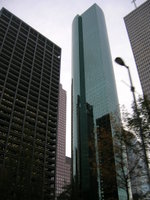
s in the United States. In 1960, the central business district had 10 million square feet (930,000 m²) of office space, increasing to about 16 million square feet (1,500,000 m²) in 1970. Downtown Houston was on the threshold of a boom in 1970 with 8.7 million square feet (800,000 m²) of office space planned or under construction and huge projects being launched by real estate developers. The largest proposed development was the 32-block Houston Center
Houston Center
Houston Center is a retail and office complex in Downtown Houston, Texas, United States. It is owned and operated by subsidiaries of Crescent Real Estate Equities Co. .The three towers in Houston Center have almost of Class A office space...
. Only a small part of the original proposal was ultimately constructed, however. Other large projects included the Cullen Center, Allen Center, and towers for Shell Oil Company
Shell Oil Company
Shell Oil Company is the United States-based subsidiary of Royal Dutch Shell, a multinational oil company of Anglo Dutch origins, which is amongst the largest oil companies in the world. Approximately 22,000 Shell employees are based in the U.S. The head office in the U.S. is in Houston, Texas...
. The surge of skyscrapers mirrored the skyscraper booms in other cities, such as Los Angeles and Dallas. Houston experienced another downtown construction spurt in the 1970s with the energy industry boom.

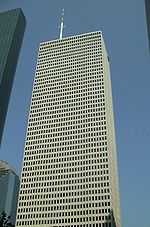
One Shell Plaza
One Shell Plaza is a 50 floor skyscraper at 910 Louisiana Street in Downtown Houston, Texas, United States. At its completion in 1971, One Shell Plaza was the tallest building in Houston, Texas, standing 715 feet tall. Including the antenna tower on its top, the height is 1,000 feet .One Shell...
in 1971. A succession of skyscrapers were built throughout the 1970s, culminating with Houston's tallest skyscraper, the 75-floor, 305 m (1,002 ft) JPMorgan Chase Tower
JPMorgan Chase Tower (Houston)
JPMorgan Chase Tower, formerly Texas Commerce Tower, is a , 75-story skyscraper in Houston, Texas. It is currently the tallest building in the city, the tallest building in Texas, the tallest five-sided building in the world, 12th tallest building in the United States, and the 54th tallest building...
(formerly the Texas Commerce Tower), which was completed in 1982. In 2002, it was the tallest structure in Texas, ninth-tallest building in the United States, and the 23rd tallest skyscraper in the world. In 1983, the 71-floor, 296 m (970 ft) Wells Fargo Plaza was completed, which became the second-tallest building in Houston and Texas, and 11th-tallest in the country. Skyscraper construction in downtown Houston came to an end in the mid-1980s with the collapse of Houston's energy industry and the resulting economic recession.
Twelve years later, the Houston-based Enron Corporation began constructing a 40-floor skyscraper in 1999 (which was completed in 2002) with the company collapsing in one of the most dramatic corporate failures in the history of the United States only two years later. Chevron bought this building to set up a regional upstream energy headquarters, and in late 2006 announced further consolidation of employees downtown from satellite suburban buildings, and even California and Louisiana offices by leasing the original Enron building across the street. Both buildings are connected by a second-floor unique walk-across, air-conditioned circular skybridge with three points of connection to both office buildings and a large parking deck. Other smaller office structures were built in the 2000–2003 period. As of September 2007, downtown Houston had more than 40 million square feet (3,787,147 m²) of office space, including more than 29 million square feet (1,861,704 m²) of class A office space.
Notable buildings

- The Sweeney, Coombs & Fredericks building is a late Victorian commercial building with a 3-story corner turret and Eastlake decorative elements that was designed by George E. Dickey in 1889. Evidence indicates that the 1889 construction may have been a renovation of an 1861 structure built by William A. Van Alstyne and purchased in 1882 by John Jasper Sweeney and Edward L. Coombs. Gus Fredericks joined the Sweeney and Coombs Jewelry firm before 1889. The building is on the corner of Main Street and Congress Street at 301 Main Street. The jewelry firm is still in business. It is one of the very few Victorian structures in the Bayou City.
- The Gulf Building, now called the JPMorgan Chase building, is one of the preeminent Art DecoArt DecoArt deco , or deco, is an eclectic artistic and design style that began in Paris in the 1920s and flourished internationally throughout the 1930s, into the World War II era. The style influenced all areas of design, including architecture and interior design, industrial design, fashion and...
skyscrapers in the southern United States. Completed in 1929, it remained the tallest building in HoustonTallest buildings in TexasThis list of tallest buildings in Texas ranks skyscrapers in the U.S. state of Texas by height. The tallest structure in the state, excluding radio towers, is the JPMorgan Chase Tower, which rises and was completed in 1982. The second-tallest building in Texas is the Wells Fargo Plaza, which...
until 1963, when the Exxon BuildingExxon Building (Houston)The ExxonMobil Building was built in 1963 in Houston, Texas. At that time it was the tallest building west of the Mississippi River at , surpassing the Southland Center in Dallas...
surpassed it in height. - The Esperson Buildings, 'Neils' built in 1927 and 'Mellie' in 1942, were modeled with Italian architecture.
- The Houston City HallHouston City HallThe Houston City Hall building is the headquarters of the City of Houston government. It was constructed in 1938-1939, and is located in Downtown Houston. It is surrounded by skyscrapers and very similar to dozens of other city halls built in the southwest United States during the same time...
was started in 1938 and completed in 1939. The original building is an excellent example of the Art DecoArt DecoArt deco , or deco, is an eclectic artistic and design style that began in Paris in the 1920s and flourished internationally throughout the 1930s, into the World War II era. The style influenced all areas of design, including architecture and interior design, industrial design, fashion and...
Era. In front of City Hall is the George Hermann Square. - One Shell PlazaOne Shell PlazaOne Shell Plaza is a 50 floor skyscraper at 910 Louisiana Street in Downtown Houston, Texas, United States. At its completion in 1971, One Shell Plaza was the tallest building in Houston, Texas, standing 715 feet tall. Including the antenna tower on its top, the height is 1,000 feet .One Shell...
was, at its completion in 1971, the tallest building in Houston. It stands 715 feet (217.9 m) tall, and when the antenna tower on its top is included, the height of One Shell Plaza is 1000 feet (304.8 m). - Houston Public LibraryHouston Public LibraryHouston Public Library is the public library system serving Houston, Texas, United States. The library system has its headquarters in the Marston Building in Neartown Houston.-History:It can trace its founding to the Houston Lyceum in 1854...
's Central Library, consists of two separate buildings: the Julia Ideson Building (1926) and the Jesse H. Jones Building (1976). - The Houston Industries Building, formerly known as the 1100 Milam Building, was built in 1973. It went through major renovations in 1996.
- Pennzoil PlacePennzoil PlacePennzoil Place is a set of two 36-story towers in downtown Houston, Texas, United States. Designed by Philip Johnson and John Burgee and built in 1975, Pennzoil Place is Houston's most award-winning skyscraper and is widely known for its innovative design....
, designed by Philip JohnsonPhilip JohnsonPhilip Cortelyou Johnson was an influential American architect.In 1930, he founded the Department of Architecture and Design at the Museum of Modern Art in New York City, and later , as a trustee, he was awarded an American Institute of Architects Gold Medal and the first Pritzker Architecture...
,built in 1976, is Houston's most award winning skyscraper, known for its innovative design. Johnson's forward thinking brought about a new era in skyscraper design. - The First City TowerFirst City TowerFirst City Tower is a skyscraper in Houston, Texas. The building rises in height. It contains 49 floors, and was completed in 1981. First City Tower currently stands as the 14th-tallest building in the city. The architectural firm who designed the building was Morris-Aubry, and was built by . The...
was built in 1981. - The JPMorgan Chase TowerJPMorgan Chase Tower (Houston)JPMorgan Chase Tower, formerly Texas Commerce Tower, is a , 75-story skyscraper in Houston, Texas. It is currently the tallest building in the city, the tallest building in Texas, the tallest five-sided building in the world, 12th tallest building in the United States, and the 54th tallest building...
, designed by I.M. Pei, was built in 1981. Formerly the Texas Commerce Tower, it is the tallest in Houston and the second tallest in the United States west of the Mississippi RiverMississippi RiverThe Mississippi River is the largest river system in North America. Flowing entirely in the United States, this river rises in western Minnesota and meanders slowly southwards for to the Mississippi River Delta at the Gulf of Mexico. With its many tributaries, the Mississippi's watershed drains...
. - The Chevron Tower, formerly the Gulf Tower, was built in 1982.
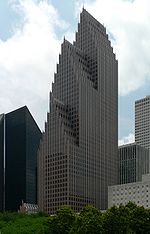
- The Bank of America Center, formerly the RepublicBank Center and the NationsBank center, designed by Philip JohnsonPhilip JohnsonPhilip Cortelyou Johnson was an influential American architect.In 1930, he founded the Department of Architecture and Design at the Museum of Modern Art in New York City, and later , as a trustee, he was awarded an American Institute of Architects Gold Medal and the first Pritzker Architecture...
, was built in 1983. - The Wells Fargo Bank Plaza, formerly the Allied Bank Plaza and First Interstate Center, also built in 1983, is the second tallest building in the Houston Area.
- The Heritage PlazaHeritage PlazaToowoomba's Heritage Plaza is the home of Heritage Building Society, Australia's largest building society.Heritage Plaza was constructed in the early 1980s as a purpose-built headquarters for the building society....
was completed in 1987. - The Enron Center North, also known as the Four Allen Center1400 Smith Street1400 Smith Street is a 691 ft tall postmodern skyscraper located in downtown Houston, Texas, United States. The building has 50 floors and is the 11th tallest building in the city. Designed by architectural firm Lloyd Jones Brewer and Associates, the building was completed in 1983...
, was also built in 1983. - The Enron Center South, also the Enron II, designed by Cesar PelliCésar PelliCésar Pelli is an Argentine architect known for designing some of the world's tallest buildings and other major urban landmarks. In 1991, the American Institute of Architects listed Pelli among the ten most influential living American architects...
was completed in 2002. (Note: EnronEnronEnron Corporation was an American energy, commodities, and services company based in Houston, Texas. Before its bankruptcy on December 2, 2001, Enron employed approximately 22,000 staff and was one of the world's leading electricity, natural gas, communications, and pulp and paper companies, with...
went bankrupt before the building's completion and was sold soon after it was completed for about half of its $200 million construction cost). - The Hobby Center for the Performing ArtsHobby Center for the Performing ArtsThe Hobby Center for the Performing Arts is a theater in Houston, Texas, USA. Opened to the public in 2002, the theater is located downtown on the edge of the Houston Theater District. Hobby Center features 60-foot-high glass walls with views of Houston's skyscrapers, Tranquility Park and Houston...
was started in 2000 and completed in 2002. - The Lyric Centre is filled with lawyers, but is named for its adjacency to the many performing arts venues in Houston's Theater District.
Economy
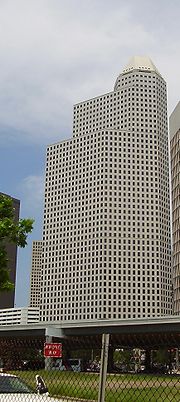
Chevron Corporation
Chevron Corporation is an American multinational energy corporation headquartered in San Ramon, California, United States and active in more than 180 countries. It is engaged in every aspect of the oil, gas, and geothermal energy industries, including exploration and production; refining,...
, Continental Airlines
Continental Airlines
Continental Airlines was a major American airline now merged with United Airlines. On May 3, 2010, Continental Airlines, Inc. and UAL, Inc. announced a merger via a stock swap, and on October 1, 2010, the merger closed and UAL changed its name to United Continental Holdings, Inc...
, JPMorgan Chase, and Shell Oil Company
Shell Oil Company
Shell Oil Company is the United States-based subsidiary of Royal Dutch Shell, a multinational oil company of Anglo Dutch origins, which is amongst the largest oil companies in the world. Approximately 22,000 Shell employees are based in the U.S. The head office in the U.S. is in Houston, Texas...
.
Downtown Houston has between 35% and 40% of the Class A office locations of the business districts in Houston. As of 1997 TrizecHahn was the largest landlord in Downtown Houston. As of that year it had seven towers with 6000000 square foot of Class A office space; the company had 25% of all of the Class A office space in Downtown Houston.
In the mid-1980s, the bank savings and loan crisis forced many tenants in Downtown Houston buildings to retrench, and some tenants went out of business. Joel Warren Barna of Cite 42 said that this development further caused Downtown Houston to decline. In 1986 the Downtown Houston occupancy rate of Class A office space was 81.4%. The Downtown Houston business occupancy rate of all office space increased from 75.8% at the end of 1987 to 75.8% at the end of 1988. In the early 1990s Downtown Houston still had more than 20% vacant office space. Preliminary data for the year 1996 stated that around a dozen companies relocated to Downtown during that year, bringing 2,800 jobs and filling 670000 square feet (62,245 m²) of space. In 1997 Tim Reylea, the vice president of Cushman Realty Corp., said that "None of the major central business districts across the country has seen the surburban-to-downtown shift that Houston has."
By 2000, demand for Downtown office space increased, and construction of office buildings resumed. Debbie Wilson, an office broker for Crescent Real Estate Equities, said in 2001 that many energy trading firms have offices in Downtown Houston because Downtown has many backup sources of electrical power and telecommunications resources. Nancy Sarnoff of the Houston Business Journal said in 2001 that the decline of Enron
Enron
Enron Corporation was an American energy, commodities, and services company based in Houston, Texas. Before its bankruptcy on December 2, 2001, Enron employed approximately 22,000 staff and was one of the world's leading electricity, natural gas, communications, and pulp and paper companies, with...
was "shifting the direction of the downtown office market from one of the strongest in the country to an area of uncertainty." The cutbacks by firms such as Dynegy
Dynegy
Dynegy Inc. , based in Houston, Texas, United States, is a large owner and operator of power plants and a player in the natural gas liquids and coal business...
, in addition to the fall of Enron, caused the occupancy rate of Downtown Houston buildings to decrease to 84.1% in 2003 from 97.3% less than two years previously. In 2003, the types of firms with operations in Downtown Houston typically were accounting firms, energy firms, and law firms. Typically newer buildings had higher occupancy rates than older buildings. In 2004, the real estate firm Cresa Partners stated that the vacancy rate in Downtown Houston's Class A office space was almost 20%. In 2009, 10% of Downtown Houston's office space was vacant.
Companies based in Downtown
CalpineCalpine
Calpine Corporation is a Fortune 500 power company founded in 1984 in San Jose, California.Calpine's headquarters were permanently moved from San Jose to Houston, Texas in 2009. The company's stock was traded on the New York Stock Exchange under the symbol CPN until it was delisted on December 5,...
has its headquarters in the 717 Texas. Dynegy
Dynegy
Dynegy Inc. , based in Houston, Texas, United States, is a large owner and operator of power plants and a player in the natural gas liquids and coal business...
is headquartered in the Wells Fargo Plaza building. KBR's corporate headquarters are in the KBR Tower; the KBR Heritage Federal Credit Union is headquartered from this office. Shell Oil Company
Shell Oil Company
Shell Oil Company is the United States-based subsidiary of Royal Dutch Shell, a multinational oil company of Anglo Dutch origins, which is amongst the largest oil companies in the world. Approximately 22,000 Shell employees are based in the U.S. The head office in the U.S. is in Houston, Texas...
, a subsidiary of Royal Dutch Shell
Royal Dutch Shell
Royal Dutch Shell plc , commonly known as Shell, is a global oil and gas company headquartered in The Hague, Netherlands and with its registered office in London, United Kingdom. It is the fifth-largest company in the world according to a composite measure by Forbes magazine and one of the six...
, and Baker Botts
Baker Botts
Baker Botts L.L.P. is a major United States-based international law firm of around 800 attorneys, with a long, prominent history, significant political connections, boasting more than half of the Fortune 100 companies among its clients. Headquartered in One Shell Plaza in Downtown Houston, Texas,...
, a law firm, are headquartered in One Shell Plaza
One Shell Plaza
One Shell Plaza is a 50 floor skyscraper at 910 Louisiana Street in Downtown Houston, Texas, United States. At its completion in 1971, One Shell Plaza was the tallest building in Houston, Texas, standing 715 feet tall. Including the antenna tower on its top, the height is 1,000 feet .One Shell...
. Total Petrochemicals USA
Total Petrochemicals USA
Total Petrochemicals USA, Inc. is a subsidiary of Total S.A. It engages in the production and marketing of petrochemical products. Its headquarters is the Total Plaza in Downtown Houston, Texas.-History:...
, a subsidiary of Total S.A.
Total S.A.
Total S.A. is a French multinational oil company and one of the six "Supermajor" oil companies in the world.Its businesses cover the entire oil and gas chain, from crude oil and natural gas exploration and production to power generation, transportation, refining, petroleum product marketing, and...
, has its headquarters in the Total Plaza
Total Plaza
Total Plaza is a tower in Downtown Houston, Texas, one block away from the Allen Center complex. The building, managed by Brookfield Properties, opened in 1971...
. CenterPoint Energy
CenterPoint Energy
CenterPoint Energy is a Fortune 500 electric and natural gas utility serving several markets in the U.S. states of Arkansas, Louisiana, Minnesota, Mississippi, Oklahoma, and Texas. It was formerly known as Reliant Energy , NorAm Energy, Houston Industries, and HL&P...
is headquartered in the CenterPoint Energy Tower. Vinson & Elkins and Waste Management, Inc
Waste Management, Inc
Waste Management, Inc. is a waste management, comprehensive waste, and environmental services company in North America. Founded in 1894, the company is headquartered in Suite 4000 at the First City Tower in Downtown Houston, Texas, in the United States....
are headquartered in First City Tower
First City Tower
First City Tower is a skyscraper in Houston, Texas. The building rises in height. It contains 49 floors, and was completed in 1981. First City Tower currently stands as the 14th-tallest building in the city. The architectural firm who designed the building was Morris-Aubry, and was built by . The...
. El Paso Corporation has headquarters in 1001 Louisiana Street. The Houston Chronicle
Houston Chronicle
The Houston Chronicle is the largest daily newspaper in Texas, USA, headquartered in the Houston Chronicle Building in Downtown Houston. , it is the ninth-largest newspaper by circulation in the United States...
is headquartered in Downtown. Plains All American Pipeline
Plains All American Pipeline
Plains All American Pipeline is a publicly traded Master Limited Partnership in the oil pipeline transportation, marketing, and storage business in the United States, LPG business in Canada, and Natural Gas Storage business in Michigan and Louisiana...
has its headquarters in Three Allen Center. Enterprise GP Holdings
Enterprise GP Holdings
Enterprise GP Holdings was a midstream energy holding company based in Houston, Texas that made its debut on the Fortune 500 list at #177 in 2007. It had its corporate headquarters in the Enterprise Plaza in Downtown Houston....
has its headquarters in the Enterprise Plaza
Enterprise Plaza
Enterprise Plaza is a 55-story skyscraper located on Louisiana Street in Downtown Houston, Texas, United States. The headquarters of Enterprise GP Holdings is located in the Enterprise Plaza. Enbridge's Houston offices are in Enterprise.Enterprise Plaza was constructed in 1980 by Hines...
. EOG Resources
EOG Resources
EOG Resources is a Fortune 500 company with its headquarters in the Heritage Plaza building in downtown Houston, Texas. The company is one of the largest independent oil and natural gas companies in the United States with proven reserves in the United States, Canada, Trinidad and Tobago, the United...
has its headquarters in Heritage Plaza
Heritage Plaza
Toowoomba's Heritage Plaza is the home of Heritage Building Society, Australia's largest building society.Heritage Plaza was constructed in the early 1980s as a purpose-built headquarters for the building society....
.
Companies with operations in Downtown
Continental AirlinesContinental Airlines
Continental Airlines was a major American airline now merged with United Airlines. On May 3, 2010, Continental Airlines, Inc. and UAL, Inc. announced a merger via a stock swap, and on October 1, 2010, the merger closed and UAL changed its name to United Continental Holdings, Inc...
formerly had its headquarters in Continental Center I
Continental Center I
Continental Center I is a 51-story, office tower in Downtown Houston, Texas, United States. The building houses offices of Continental Airlines, and it was Continental's headquarters prior to its merger with United Airlines. At one point it also served as the headquarters of ExpressJet Airlines...
. At one point, ExpressJet Airlines
ExpressJet Airlines
ExpressJet Airlines, Inc. is an American regional airline based in the A-Tech Center in College Park, Georgia. It is a wholly owned subsidiary of Atlantic Southeast Airlines which is in turn a subsidiary of the airline holding company SkyWest, Inc., parent company of the air carrier SkyWest...
had its headquarters in Continental's complex. In September 1997 Continental Airlines announced it would consolidate its Houston headquarters in the Continental Center complex; the airline scheduled to move its employees in stages beginning in July 1998 and ending in January 1999. Bob Lanier, Mayor of Houston, said that he was "tickled to death" by the airline's move to relocate to Downtown Houston. Tim Reylea, the vice president of Cushman Realty Corp., said that the Continental move "is probably the largest corporate relocation in the central business district of Houston ever."
Hotel operators in Downtown reacted favorably, predicting that the move would cause an increase in occupancy rates in their hotels. In 2008 Continental renewed its lease in the building. Before the lease renewal, rumors spread stating that the airline would relocate its headquarters to office space outside of Downtown. Steven Biegel, the senior vice president of Studley Inc. and a representative of office building tenants, said that if Continental's space went vacant, the vacancy would not have had a significant impact in the Downtown Houston submarket as there is not an abundance of available space, and the empty property would be likely that another potential tenant would occupy it. Jennifer Dawson of the Houston Business Journal said that if Continental Airlines left Continental Center I, the development of Brookfield Properties's new office tower would have been delayed. As of September 2011 the headquarters moved out, but Continental will continue to house employees in the building. It will have about half of the employees that it once had.
JPMorgan Chase Bank has its Houston operations headquartered in the JPMorgan Chase Building (Gulf Building). LyondellBasell has its Houston offices in 1 Houston Center. When Lyondell was an independent company, its headquarters were in 1 Houston Center. Hess Corporation
Hess Corporation
The Hess Corporation is an integrated oil company based in New York City. The company explores, produces, transports, and refines crude oil and natural gas. Vertically completing the logistical chain, about 1,360 Hess branded filling stations market gasoline to consumers in 16 states along the...
has exploration and production operations in One Allen Center., but will move its offices to the under construction Hess Tower (Named after the company itself) upon its completion.
ExxonMobil
ExxonMobil
Exxon Mobil Corporation or ExxonMobil, is an American multinational oil and gas corporation. It is a direct descendant of John D. Rockefeller's Standard Oil company, and was formed on November 30, 1999, by the merger of Exxon and Mobil. Its headquarters are in Irving, Texas...
has Exploration and Producing Operations business headquarters at the ExxonMobil Building. Qatar Airways
Qatar Airways
Qatar Airways Company Q.C.S.C. , operating as Qatar Airways, is the flag carrier of Qatar. Headquartered in the Qatar Airways Tower in Doha, it operates a hub-and-spoke network, linking over 100 international destinations from its base in Doha, using a fleet of over 100 aircraft...
operates an office within Two Allen Center; it also has a storefront in the Houston Pavilions
Houston Pavilions
Houston Pavilions is a commercial development in Downtown Houston, Texas, United States.Construction was scheduled to begin in Spring 2006 , with the first developments opening in the fourth quarter of 2007...
. Enbridge
Enbridge
Enbridge Inc. is a Calgary, Alberta based company focused on three core businesses: crude oil and liquids pipelines, natural gas transportation and distribution, and green energy. The company has approximately 6,000 employees, mostly in Canada and the United States...
has its Houston office in the Enterprise Plaza
Enterprise Plaza
Enterprise Plaza is a 55-story skyscraper located on Louisiana Street in Downtown Houston, Texas, United States. The headquarters of Enterprise GP Holdings is located in the Enterprise Plaza. Enbridge's Houston offices are in Enterprise.Enterprise Plaza was constructed in 1980 by Hines...
. KPMG
KPMG
KPMG is one of the largest professional services networks in the world and one of the Big Four auditors, along with Deloitte, Ernst & Young and PwC. Its global headquarters is located in Amstelveen, Netherlands....
and Mayer Brown
Mayer Brown
Mayer Brown is an international law firm head-quartered in Chicago which specializes in commercial transactions and litigation. The firm employs more than 1,600 lawyers, including approximately 875 in the Americas, 425 in Europe and 300 in Asia....
have their Houston offices in the Bank of America Center.
Former economic operations
When Texas Commerce BankTexas Commerce Bank
The Texas Commerce Bank was a Texas-based bank acquired by Chemical Banking Corporation of New York in May 1987...
existed, its headquarters were in what is now the JPMorgan Chase Building (Gulf Building). Prior to its collapse in 2001, Enron
Enron
Enron Corporation was an American energy, commodities, and services company based in Houston, Texas. Before its bankruptcy on December 2, 2001, Enron employed approximately 22,000 staff and was one of the world's leading electricity, natural gas, communications, and pulp and paper companies, with...
was headquartered in Downtown. In 2005 Federated Department Stores
Federated Department Stores
Macy's, Inc. is a department store holding company and owner of Macy's and Bloomingdale's department stores. Macy's Inc.'s stores specialize mostly in retail clothing, jewelery, watches, dinnerware, and furniture....
announced that it will close Foley's
Foley's
Foley’s was a chain of department stores owned by May Department Stores and headquartered in Downtown Houston, Texas. As of August 30, 2005, the division was dissolved and operation of the stores was assumed by Federated's Macy's West and Macy's South divisions. Foley's operated stores in Texas,...
1,200 employee headquarters in Downtown Houston.
Halliburton
Halliburton
Halliburton is the world's second largest oilfield services corporation with operations in more than 70 countries. It has hundreds of subsidiaries, affiliates, branches, brands and divisions worldwide and employs over 50,000 people....
's corporate headquarters office was in 5 Houston Center
Houston Center
Houston Center is a retail and office complex in Downtown Houston, Texas, United States. It is owned and operated by subsidiaries of Crescent Real Estate Equities Co. .The three towers in Houston Center have almost of Class A office space...
. In 2001, Halliburton canceled a move to redevelop land in Westchase to house employees; real estate figures associated with Downtown Houston approved of the news. Nancy Sarnoff of the Houston Business Journal said it made more sense for the company to lease existing space instead of constructing new office space in times of economic downturns. By 2009 Halliburton closed its Downtown Office, moved its headquarters to northern Houston, and consolidated operations at its northern Houston and Westchase facilities.
Diplomatic missions
The Consulate-General of the United Kingdom is located in Wells Fargo Plaza, while the Consulate-General of JapanConsulate-General of Japan in Houston
The is Japan's diplomatic facility in Houston, Texas, United States. It is located in Suite 3000 at 2 Houston Center, which is located at 900 Fannin Street in Downtown Houston...
is located in Two Houston Center
Houston Center
Houston Center is a retail and office complex in Downtown Houston, Texas, United States. It is owned and operated by subsidiaries of Crescent Real Estate Equities Co. .The three towers in Houston Center have almost of Class A office space...
. The Consulate-General of Switzerland, which resided in Downtown Houston, closed in 2006.
Other venues

Minute Maid Park
Minute Maid Park is a ballpark in Downtown Houston, Texas, United States that opened in 2000 to house the Major League Baseball Houston Astros....
(formerly Enron Field), which opened in 2000, is home to the MLB Astros and the Toyota Center
Toyota Center (Houston)
The Toyota Center is an indoor arena located in downtown Houston, Texas. It is named after the Japanese automobile manufacturer Toyota. The arena is home to the Rockets of the National Basketball Association, the principal owners of the building, and the Aeros of the American Hockey League.Rockets...
home to the NBA Rockets, WNBA Comets (who have since moved to Reliant Arena
Reliant Arena
The Reliant Arena, formerly the "Astroarena", is a 350,000 square feet sports center in Reliant Park, in Houston, Texas, USA. It is one of the state's major arenas and convention centers. Reliant became the home of the Women's National Basketball Association's Houston Comets for what proved to...
in nearby Reliant Park
Reliant Park
Reliant Park is a complex in Houston, Texas, USA, named after the energy company Reliant Energy. It is located on Kirby Drive at the 610 Loop...
), and AHL Aeros opened in 2003.
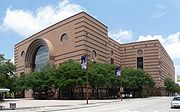
Alley Theatre
The Alley Theatre is a Tony Award-winning indoor theatre in Downtown Houston, Texas, and hosts two stages. The "Hubbard" is the main stage with seating for 824; the more intimate "Neuhaus" seats 310. Nine towers and open-air terraces give the Alley Theatre a castle-like quality. Inside, a staircase...
(theater), the Hobby Center (resident and traveling musical theater, concerts, events), the Verizon Wireless
Verizon Wireless
Cellco Partnership, doing business as Verizon Wireless, is one of the largest mobile network operators in the United States. The network has 107.7 million subscribers as of 2011, making it the largest wireless service provider in America....
Theater (concerts and events) and Jones Hall (symphony).
The George R. Brown Convention Center
George R. Brown Convention Center
The George R. Brown Convention Center opened on September 26, 1987 on the east side of Downtown Houston, Texas, United States.The center was named for the prominent Houstonian George R. Brown, an entrepreneur, civic leader and philanthropist. Brown’s Texas Eastern Corporation donated six of the 11...
, with its 1200000 square feet (111,483.6 m²) of flexible exhibit, meeting, and registration space and adjacent hotel, is frequently used for conventions, trade shows, and community meetings.
Hotels and accommodations
In comparison to other major cities, Houston has relatively few hotel rooms downtown, partly because downtown Houston is not a large leisure travel market. There are approximately 5,000 hotel rooms in downtown Houston. Major hotels in downtown Houston are:- HiltonHilton HotelsHilton Hotels & Resorts is an international chain of full-service hotels and resorts founded by Conrad Hilton and now owned by Hilton Worldwide. Hilton hotels are either owned by, managed by, or franchised to independent operators by Hilton Worldwide. Hilton Hotels became the first coast-to-coast...
Americas Convention Center Hotel with 1,203 rooms - The Four Seasons Hotel and Residences
- The DoubletreeDoubletree.Doubletree by Hilton is a worldwide brand of upscale, full-service hotels and resorts trademarked by Hilton Worldwide. There are currently more than 220 locations with 55,000 rooms worldwide in the United States, Canada, Costa Rica, Peru, China, United Kingdom, Italy, Slovakia, Tanzania, Norway...
Hotel Downtown Houston - The HyattHyattHyatt Hotels Corporation , is an international operator of hotels.Hyatt Center is the headquarters for Hyatt corporation...
Regency Houston, which features a revolving restaurantRevolving restaurantA revolving restaurant is a usually tower restaurant eating space designed to rest atop a broad circular revolving platform that operates as a large turntable. The building remains stationary and the diners are carried on the revolving floor. The revolving rate varies between one and three times...
, the Spindletop, located on the hotel's 30th floor - The Crowne PlazaCrowne PlazaCrowne Plaza is a chain of full service, upscale hotels catering to business travelers and to the meetings and conventions market. It forms part of the InterContinental Hotels Group family of brands, which include InterContinental and Holiday Inn and operates in 52 countries, usually located in...
- Crowne Plaza Houston Downtown, located in the heart of downtown Houston with free area shuttle http://www.cpdowntown.com
- Club QuartersClub QuartersClub Quarters builds private full service hotels for cost conscious organizations in prime city center locations where their member organizations travel for business in the US and UK. There are fourteen locations in total, 4 in New York, 7 in major US city centers and 3 in London with a fourth to...
- Courtyard by MarriottCourtyard by MarriottCourtyard by Marriott is a brand of hotels owned by Marriott International. Courtyard by Marriott is designed for business travelers but also accommodates to families. Its rooms feature large desks, couches, free broadband Internet access, and "big" breakfasts. The majority of locations have...
The following are boutique hotels that are located mostly in the northeast section of downtown:
- The Lancaster
- Inn at the Ballpark
- Magnolia Hotel
- Hotel Icon
- Alden Houston (formerly the Sam Houston Hotel)
Retail

Macy's
Macy's is a U.S. chain of mid-to-high range department stores. In addition to its flagship Herald Square location in New York City, the company operates over 800 stores in the United States...
(former Foley's
Foley's
Foley’s was a chain of department stores owned by May Department Stores and headquartered in Downtown Houston, Texas. As of August 30, 2005, the division was dissolved and operation of the stores was assumed by Federated's Macy's West and Macy's South divisions. Foley's operated stores in Texas,...
) Department Store (founded in 1900), which moved to its current location in 1947. It has 10 levels and it occupies an entire Houston square city block. In 2006 this store, along with all other Foley's stores, was renamed Macy's
Macy's
Macy's is a U.S. chain of mid-to-high range department stores. In addition to its flagship Herald Square location in New York City, the company operates over 800 stores in the United States...
. This is the only freestanding middle-market department store in a central business district in the Southern United States.
The Shops in Houston Center, located within the Houston Center
Houston Center
Houston Center is a retail and office complex in Downtown Houston, Texas, United States. It is owned and operated by subsidiaries of Crescent Real Estate Equities Co. .The three towers in Houston Center have almost of Class A office space...
complex, is an enclosed shopping mall. It houses ninety stores and the building itself straddles two city blocks.
A few blocks away, The Houston Pavilions
Houston Pavilions
Houston Pavilions is a commercial development in Downtown Houston, Texas, United States.Construction was scheduled to begin in Spring 2006 , with the first developments opening in the fourth quarter of 2007...
is an open air shopping center that opened October 16, 2008. This project comes from the same developers of the Denver Pavilions in Denver; spanning three square blocks.
The Houston Downtown Tunnel System
Houston Downtown Tunnel System
The Houston tunnel system is a system of tunnels below Houston's downtown street system. The system comprises approximately of tunnels and forms a network of subterranean, climate-controlled, pedestrian walkways that link 95 full city blocks...
is also home to many shops and restaurants and connects to the flagship Macy's.
Transportation
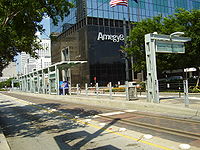
Metropolitan Transit Authority of Harris County, Texas
The Metropolitan Transit Authority of Harris County is a major public transportation agency based in Houston . It operates bus, light rail, future commuter rail, and paratransit service in the city as well as most of Harris County...
(METRO) operates Houston's public transportation. Downtown Houston is served by five light rail
Light rail
Light rail or light rail transit is a form of urban rail public transportation that generally has a lower capacity and lower speed than heavy rail and metro systems, but higher capacity and higher speed than traditional street-running tram systems...
stations on METRORail
METRORail
METRORail is the light rail line in Houston . It is the second major light rail service in Texas following the Dallas Area Rapid Transit system. With an approximate daily ridership of 34,155, the METRORail ranks as the fourteenth most-traveled light rail system in the United States, with the...
's Red Line: Downtown Transit Center
Downtown Transit Center
Downtown Transit Center is an island platformed METRORail light rail station in Downtown Houston, Texas, United States. The station was opened on January 1, 2004, and is operated by the Metropolitan Transit Authority of Harris County, Texas ....
, Bell, Main Street Square, Preston, and . METRO operates many bus lines through Downtown.
The Downtown Houston management district will begin its own bus route, the Greenlink, in the northern hemisphere spring of 2012. The route will travel along a 1.5 miles (2.4 km) circular route in Downtown Houston. The district will use seven buses, paid with two Federal Transit Administration
Federal Transit Administration
The Federal Transit Administration is an agency within the United States Department of Transportation that provides financial and technical assistance to local public transit systems. The FTA is one of ten modal administrations within the DOT...
grants that totaled $2.25 million. It will operate from 6:30 AM to 6:30 PM from Monday through Friday. During periods with less ridership, the buses will arrive every twenty minutes. For periods with peak ridership, including lunchtime, buses will arrive every seven minutes. The bus will run on Dallas Street, Louisiana Street, Smith Street, and Walker Street. The management district intends for the bus to connect retailers and restaurants in Houston Center
Houston Center
Houston Center is a retail and office complex in Downtown Houston, Texas, United States. It is owned and operated by subsidiaries of Crescent Real Estate Equities Co. .The three towers in Houston Center have almost of Class A office space...
, Houston Pavilions
Houston Pavilions
Houston Pavilions is a commercial development in Downtown Houston, Texas, United States.Construction was scheduled to begin in Spring 2006 , with the first developments opening in the fourth quarter of 2007...
, and Macy's
Macy's
Macy's is a U.S. chain of mid-to-high range department stores. In addition to its flagship Herald Square location in New York City, the company operates over 800 stores in the United States...
to office workers and convention clients in southwestern Downtown. It also intends for the bus to connect major METRO stops on Smith and Louisiana to employees in eastern Downtown, so they can easily access Park and Ride stops. The Downtown Houston Management District, BG Group
BG Group
BG Group plc is a global oil and gas company headquartered in Reading, United Kingdom. It has operations in 25 countries across Africa, Asia, Australasia, Europe, North America and South America and produces around 680,000 barrels of oil equivalent per day. It has a major Liquefied Natural Gas ...
and Houston First, a municipally owned company that operates buildings owned by the city, will pay for the operating expenses of the route.
METRO formerly operated a free intra-Downtown bus service. When the service operated at its peak, METRO had a fleet of 28 trolley-style buses. At its peak the service carried over 10,000 riders each day on five different routes. When METRO introduced a 50 cent rider fee in 2004, the ridership decreased dramatically, and in 2005 METRO ended the service.
There are a number of taxi cabs that can be hailed from the street, twenty-one taxi stands, or at the various hotels. Trips within downtown have a flat rate of $6 United States dollars by cab. After the METRO trolley service ended, the City of Houston enacted the required flat $6 fee for all travel within Downtown. To make up for the loss of the METRO trolley, jitney and pedicab services appeared.
Local government


Houston City Hall
Houston City Hall
The Houston City Hall building is the headquarters of the City of Houston government. It was constructed in 1938-1939, and is located in Downtown Houston. It is surrounded by skyscrapers and very similar to dozens of other city halls built in the southwest United States during the same time...
, the Houston City Hall Annex, and the Bob Lanier Public Works Building
Bob Lanier Public Works Building
Bob Lanier Public Works Building is a tall skyscraper in Houston, Texas. It was completed in 1968 and has 27 floors. It is the 41st tallest building in the city. Eero Saarinen's CBS Building in New York City inspired the design for this building...
are all located in Downtown Houston.
The community is within the Houston Police Department
Houston Police Department
The Houston Police Department is the primary law enforcement agency serving the City of Houston, Texas, United States and some surrounding areas. Its headquarters are in 1200 Travis in Downtown Houston....
's Special Operations Division District 1. The headquarters of HPD are located in 1200 Travis
1200 Travis
1200 Travis is a 28-story building in Downtown Houston, Texas that is currently occupied by the Houston Police Department as its current headquarters. At one time it was known as the Houston Natural Gas Building. The building, with of rentable space, has a typical floor size of...
Downtown.
Houston Fire Department
Houston Fire Department
City of Houston Fire Department is the agency that provides fire protection and emergency medical services for the city of Houston, Texas, United States, the fourth largest city in the United States...
Station 8 Downtown at 1919 Louisiana Street serves the central business district. Station 8 is in Fire District 8. The fire station "Washington #8" first opened in 1895 at Polk at Crawford. The station was closed in 2001 after a sports arena was built on the site. Fire Station 1, which was located at 410 Bagby Street, closed in 2001, as it was merged with Station 8. Station 8, relocated to a temporary building at the corner of Milam and St. Joseph, reopened in June 2001. The current "Super Station" at 1919 Louisiana opened on April 21, 2008. "Stonewall #3," organized in 1867, was located in the current location of the Post Rice Lofts
Post Rice Lofts
The Post Rice Lofts, formerly the Rice Hotel, is a historic building at 909 Texas Avenue in Downtown Houston, Texas, United States. It was constructed in 1912 on the site of the former Capitol building of the Republic of Texas, and is listed on the National Register of Historic Places...
. It 1895 it moved to a location along Preston Street, between Smith and Louisiana, in what is now Downtown. The station, currently Station #3, moved outside of the current day Downtown in 1903. Fire Station 5, originally in what was then the Fifth Ward, moved to Hardy and Nance in what is now Downtown in 1895. The station was rebuilt at that site in 1932, and in 1977 the station moved to Spring Branch. Station 2 moved from what is now the East End to what is now Downtown in 1926. The station moved to the Fourth Ward in 1965.
The Houston Downtown Management District and Central Houston, Inc. is headquartered in Suite 1650 at 2 Houston Center, a part of the Houston Center
Houston Center
Houston Center is a retail and office complex in Downtown Houston, Texas, United States. It is owned and operated by subsidiaries of Crescent Real Estate Equities Co. .The three towers in Houston Center have almost of Class A office space...
complex.
County representation

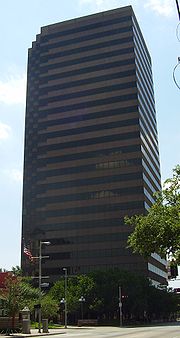
The Harris County jail facilities are in northern Downtown on the north side of the Buffalo Bayou. The 1200 Jail, the 1307 Jail, (originally a Texas Department of Criminal Justice
Texas Department of Criminal Justice
The Texas Department of Criminal Justice is a department of the government of the state of Texas. The TDCJ is responsible for statewide criminal justice for adult offenders, including managing offenders in state prisons, state jails and private correctional facilities, funding and certain...
(TDCJ) facility, leased by the county), and the 701 Jail (formed from existing warehouse storage space) are on the same site.
State representation
Much of Downtown is located in District 147 of the Texas House of RepresentativesTexas House of Representatives
The Texas House of Representatives is the lower house of the Texas Legislature. The House is composed of 150 members elected from single-member districts across the state. The average district has about 150,000 people. Representatives are elected to two-year terms with no term limits...
. As of 2008, Garnet F. Coleman represents the district. Some of Downtown is located in District 148 of the Texas House of Representatives
Texas House of Representatives
The Texas House of Representatives is the lower house of the Texas Legislature. The House is composed of 150 members elected from single-member districts across the state. The average district has about 150,000 people. Representatives are elected to two-year terms with no term limits...
. As of 2008, Jessica Farrar
Jessica Farrar
Jessica Christina Farrar is a United States politician and an incumbent in the Texas House of Representatives. She is currently serving her 9th term as the representative from District 148, located in Houston, TX...
represents the district. Downtown is within District 13
Texas Senate, District 13
District 13 of the Texas Senate is a senatorial district that currently serves portions of Fort Bend and Harris counties in the U.S. state of Texas. The current Senator from District 13 is Rodney Ellis.-2006:-2002:-1998:-1994:...
of the Texas Senate
Texas Senate
The Texas Senate is the upper house of the Texas Legislature. There are 31 members of the Senate, representing 31 single-member districts across the state with populations of approximately 672,000 per constituency. There are no term limits, and each term is four years long. The Senate meets at the...
; as of 2008 Rodney Ellis
Rodney Ellis
Rodney Glenn Ellis is an African-American politician from the state of Texas. He has served on the Texas State Senate since 1990, representing Texas Senate District 13.Senator Rodney Ellis was elected to the Texas Senate in 1990...
represents that district.
Joe Kegans Unit
Joe Kegans Unit
Joe Kegans State Jail is a state jail of the Texas Department of Criminal Justice located along the northeast edge of Downtown Houston, Texas. The approximately facility for men is located south of Interstate 10....
, located in Downtown, is a Texas Department of Criminal Justice
Texas Department of Criminal Justice
The Texas Department of Criminal Justice is a department of the government of the state of Texas. The TDCJ is responsible for statewide criminal justice for adult offenders, including managing offenders in state prisons, state jails and private correctional facilities, funding and certain...
state jail for men. It is adjacent to the county facilities on the north side of the Buffalo Bayou. Kegans opened in 1997. The South Texas Intermediate Sanction Facility Unit, a parole confinement facility for males operated by Global Expertise in Outsourcing, is in Downtown Houston, west of Minute Maid Park
Minute Maid Park
Minute Maid Park is a ballpark in Downtown Houston, Texas, United States that opened in 2000 to house the Major League Baseball Houston Astros....
.
The Texas First Court of Appeals
Texas Courts of Appeals
The Texas Courts of Appeals are part of the Texas judicial system. In Texas, all cases appealed from the district level, both criminal and civil, may be heard by one of the fourteen Texas Courts of Appeals. The exception is for cases where the death penalty is a factor; these cases go directly to...
and the Texas Fourteenth Court of Appeals
Texas Courts of Appeals
The Texas Courts of Appeals are part of the Texas judicial system. In Texas, all cases appealed from the district level, both criminal and civil, may be heard by one of the fourteen Texas Courts of Appeals. The exception is for cases where the death penalty is a factor; these cases go directly to...
located on the campus of the South Texas College of Law
South Texas College of Law
South Texas College of Law is a private American Bar Association accredited law school and is a member of the Association of American Law Schools...
in Downtown Houston.
Federal representation

Texas's 18th congressional district
Texas District 18 of the United States House of Representatives is a Congressional district that serves much of inner city Houston and the surrounding area...
. As of 2008 its representative is Sheila Jackson Lee
Sheila Jackson Lee
Sheila Jackson Lee is the U.S. Representative for , serving since 1995. The district includes most of inner-city Houston. She is a member of the Democratic Party.-Early life and education:...
.
The United States Postal Service
United States Postal Service
The United States Postal Service is an independent agency of the United States government responsible for providing postal service in the United States...
operates the 16 acres (64,749.8 m²) Houston Post Office at 401 Franklin Street. In February 2009 the U.S. Postal Service announced that it was going to sell the Houston Post Office. The party buying the facility is required to build a replacement facility. As of October 2009 the sale was still pending. In 2010 the Houston Press
Houston Press
The Houston Press is an alternative weekly newspaper published in Houston, Texas, United States. It is headquartered in Downtown Houston....
ranked the Downtown post office as the best post office in Houston.
In addition the USPS operates the 2 Houston Center and Civic Center postal units. In July 2011 the USPS announced that the two postal units may close.
Regional offices of U.S. government agencies are located at the Mickey Leland Federal Building at 1919 Smith Street. The 22 story building, with a 6-story parking garage, was designated an Energy Star
Energy Star
Energy Star is an international standard for energy efficient consumer products originated in the United States of America. It was first created as a United States government program during the early 1990s, but Australia, Canada, Japan, New Zealand, Taiwan and the European Union have also adopted...
efficient building in 2000.
The United States District Court for the Southern District of Texas
United States District Court for the Southern District of Texas
The United States District Court for the Southern District of Texas is the Federal district court with jurisdiction over the southern part of Texas...
has its offices in 515 Rusk in Downtown Houston.
The Federal Bureau of Prisons
Federal Bureau of Prisons
The Federal Bureau of Prisons is a federal law enforcement agency subdivision of the United States Department of Justice and is responsible for the administration of the federal prison system. The system also handles prisoners who committed acts considered felonies under the District of Columbia's...
operates the Federal Detention Center, Houston
Federal Detention Center, Houston
Federal Detention Center, Houston is a prison operated by the Federal Bureau of Prisons. The facility is located at the intersection of San Jacinto Avenue and Texas Avenue in Downtown Houston, and it houses male and female pretrial and holdover inmates.-Notable inmates:-External links:*...
in Downtown.
Parks and recreation
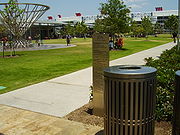

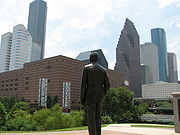
Sam Houston Park
Sam Houston Park is a park located in downtown Houston, Texas, and is dedicated to the buildings and culture of Houston's historic past. The park, which was the first to be established in the city, was developed on land purchased by former Mayor Sam Brashier in 1900.-History:Mayor Brashear...
, on the western edge of downtown between McKinney and Dallas/Allen Parkway, is home to the Houston Heritage Society and a collection of historic buildings and homes from around Houston.
Tranquility Park
Tranquility Park
Tranquility Park is a park in Downtown Houston, Texas, between Walker and Rusk Streets, and west of Smith Street, with the United States federal courts building for the Southern District of Texas on one side and Houston City Hall on the other...
, bound by Rusk, Smith, Walker, and Bagby, uses open green spaces and a series of interconnected fountains to commemorate NASA's landing on the moon's Sea of Tranquility.
Market Square Park, between Travis, Milam, Preston, and Congress, preserves the block formerly covered by Houston's open air market which fronted the old City Hall. In August 2010, Market Square Park unveiled renovations complete with two dog runs, Niko Niko's at Market Square, and Houston's only 9/11 memorial.
Allen's Landing
Allen's Landing
Allen's Landing is the birthplace of the city of Houston—the largest city in the U.S. state of Texas. In August 1836, just months after the Republic of Texas won its independence from Mexico, two brothers from New York—John Kirby Allen and Augustus Chapman Allen—purchased 6,642 acres in...
, on Buffalo Bayou at Smith and Preston, commemorates the landing site of the Allen Brothers, founders of the City of Houston.
Sesquicentennial Park, across Buffalo Bayou from Allen's Landing, contains a statue of George H.W. Bush, Houstonian and 41st President of United States.
Main Street Square, a pedestrian mall with a reflection pool and fountains on the MetroRail line between Lamar and Dallas.
Root Memorial Square, a one-block park across La Branch St from the Toyota Center.
Sisters of Charity Park, a quiet area in St. Joseph's Medical Center in the southeast corner of downtown.
Discovery Green
Discovery Green
Discovery Green is a public park in Downtown Houston, Texas, United States. Opened in 2008, Discovery Green is located on Avenida de las Americas across from the George R. Brown Convention Center and the Hilton Americas Hotel, adjacent to Toyota Center...
, west of the George R. Brown Convention Center, officially opened on April 13, 2008 with a Family Day event. The park has underground parking, an amphitheater, two restaurants, a dog run, a jogging trail around the park, a great Lawn, an interactive fountain and more.
Harris County Precinct One operates the 2 acres (8,093.7 m²) Quebedeaux Park at 1115 Congress Street. The park includes a stage area, picnic tables, and benches. The park surrounds the Harris County Family Law Center.
The Downtown YMCA
YMCA
The Young Men's Christian Association is a worldwide organization of more than 45 million members from 125 national federations affiliated through the World Alliance of YMCAs...
is located at 1600 Louisiana Street. The Tellepsen facility includes a center for teenagers, a wellness center for females, a child watch area, a community meeting space, a chapel, group exercise rooms, and a racquetball court. The groundbreaking ceremony occurred on January 7, 2009. The new facility will not have dormitories for homeless that exist in the current YMCA facility. The Downtown YMCA had provided dormitory space for around 100 years.
Court system
The Majority of the County court systems are located in Downtown within a five block area bounded by Franklin, San Jacinto, Caroline, and Congress Streets including the following:- Harris County Justice Of the Peace
- Harris County Civil Courts
- Harris County Family Courts
- Harris County Juvenile Courts
- Harris County Criminal Courts
All are located around a central surface parking lot, that will eventually be turned into a Plaza
Plaza
Plaza is a Spanish word related to "field" which describes an open urban public space, such as a city square. All through Spanish America, the plaza mayor of each center of administration held three closely related institutions: the cathedral, the cabildo or administrative center, which might be...
and has been nicknamed "Justice Square".
Along with Harris County's facilities, there are several Constable courts and support facilities nearby.
Education
Colleges and universities
The University of Houston–DowntownUniversity of Houston–Downtown
The University of Houston–Downtown is a four-year state university, and is a distinct component institution of the University of Houston System. Its campus spans 20-acre in Downtown Houston, with a satellite location in northwestern Harris County...
(UHD) is a four-year state university, located at the northern-end of Downtown. Founded in 1974, it is one of four separate and distinct institutions in the University of Houston System
University of Houston System
The University of Houston System is a state university system in Texas, encompassing four separate and distinct universities. It has two system centers, which operate as and distance learning course delivery sites for its universities...
. UHD has an enrollment of 12,900 students—making it the 13th largest public university in Texas and the second-largest university in the Houston area.
The South Texas College of Law
South Texas College of Law
South Texas College of Law is a private American Bar Association accredited law school and is a member of the Association of American Law Schools...
is a private law school located within Downtown and is one of three law schools in Houston.
Downtown is within the Houston Community College System
Houston Community College System
Houston Community College System is a community college system that operates community colleges in Houston, Missouri City, and Stafford in Texas....
, and it is in close proximity to the Central Campus in Midtown.
Public schools
The grade-school children of Downtown are served by the Houston Independent School DistrictHouston Independent School District
The Houston Independent School District is the largest public school system in Texas and the seventh-largest in the United States. Houston ISD serves as a community school district for most of the city of Houston and several nearby and insular municipalities...
.
One public elementary school, a Houston ISD charter school called Young Scholars Academy for Excellence (Y.S.A.F.E.), is in Downtown.
Four elementary schools have zoning boundaries that extend to areas of Downtown with residential areas; they are:
- Blackshear Elementary School (Third Ward)
- Bruce Elementary School (in the Fifth Ward)
- Crockett Elementary School (northwest of Downtown)
- Gregory-Lincoln Education CenterGregory-Lincoln Education CenterGregory-Lincoln Education Center is a combined primary and secondary school located at 1101 Taft in the Fourth Ward area of Houston, Texas, United States....
(in the Fourth Ward)
Gregory Lincoln Education Center takes most of Downtown's students at the middle school level. Marshall Middle School (in Northside) takes students at the middle school level from a small section of northern Downtown. Davis High School
Davis High School (Houston)
Jefferson Davis High School is a secondary school located at 1101 Quitman in the Near Northside neighborhood of Northside, Houston, Texas with a ZIP code of 77009. It was named after Jefferson Davis, the only president of the Confederate States of America....
(north of Downtown) takes students from almost all of Downtown at the high school level. Reagan High School
Reagan High School (Houston)
John H. Reagan High SchoolPrincipal AdministratorConnie BergerFounded1927School typePublic school Religious affiliationNoneLocationHouston, Texas, United StatesEnrollment1,683 students...
(in the Houston Heights) take students in the high school level from a small section of northwest Downtown. The High School for the Performing and Visual Arts
High School for the Performing and Visual Arts
The High School for the Performing and Visual Arts is a secondary school located at 4001 Stanford Street in the Montrose district of Houston, Texas. The school is a part of the Houston Independent School District....
, located in Montrose, is in close proximity to Downtown.
J.R. Gonzales of the Houston Chronicle
Houston Chronicle
The Houston Chronicle is the largest daily newspaper in Texas, USA, headquartered in the Houston Chronicle Building in Downtown Houston. , it is the ninth-largest newspaper by circulation in the United States...
said "For me, it’s a little hard to imagine that there was ever a public high school in downtown Houston."
History of public schools
The block bounded by Austin, Capitol, Caroline, and Rusk held schools for many years. Houston Academy was established there in the 1850s. In 1894 the groundbreaking for Central High School occurred there. Central burned down in March 1919. In 1921 Sam Houston High School
Sam Houston High School (Houston)
Sam Houston Center for Math, Technology, and SciencePrincipal AdministratorJane Crump , Rolando Treviño Grade levels9 - 12Founded1878School typePublic school Religious affiliationLocation Houston, TexasEnrollment...
opened at the site. The current Sam Houston building in the Northside
Northside, Houston
The Northside is a district of Houston, Texas, United States. It is within the Greater Northside Management District.-History:House Bill 3634, authored by state representative Jessica Farrar and sponsored in the Texas Senate by Mario Gallegos, created the management district...
opened in 1955. The previous building became the administrative headquarters of the Houston Independent School District
Houston Independent School District
The Houston Independent School District is the largest public school system in Texas and the seventh-largest in the United States. Houston ISD serves as a community school district for most of the city of Houston and several nearby and insular municipalities...
. By the early 1970s HISD moved its headquarters out of the building, which was demolished. As of 2011 a parking lot occupies the former school lot; a state historical marker is located at the lot.
Booker T. Washington High School
Booker T. Washington High School (Houston)
Booker T. Washington High School is a secondary school located at 119 East 39th Street in Houston, Texas with a zip code of 77018.Booker T. Washington, which serves grades 9 through 12, is a part of the Houston Independent School District. Booker T...
's first location, 303 West Dallas, served as the school's location from 1893 to 1959, when it moved to the north. Lockett Junior High School was established in the former Washington campus and closed in 1968. Foley's Academy was formerly located inside the Foley's
Foley's
Foley’s was a chain of department stores owned by May Department Stores and headquartered in Downtown Houston, Texas. As of August 30, 2005, the division was dissolved and operation of the stores was assumed by Federated's Macy's West and Macy's South divisions. Foley's operated stores in Texas,...
(now Macy's
Macy's
Macy's is a U.S. chain of mid-to-high range department stores. In addition to its flagship Herald Square location in New York City, the company operates over 800 stores in the United States...
) at 1110 Main Street in Downtown Houston.
Anson Jones Elementary School served a portion of Downtown until its closing in Summer 2006.
Brock Elementary School served a portion of Downtown until its closing in Summer 2006 and repurposing as an early childhood center; its boundary was transferred to Crockett Elementary. Before the start of the 2009–2010 school year J. Will Jones was be consolidated into Blackshear Elementary School, a campus in the Third Ward
Third Ward, Houston, Texas
The Third Ward is one of the six historic wards of Houston, Texas, United States. It is located in the Southeast Houston management district.The Third Ward, located inside the 610 Loop is immediately southeast of Downtown Houston and to the east of the Texas Medical Center. The ward became the...
. During its final year of enrollment J. Will Jones had more students than Blackshear. Many J. Will Jones parents referred to Blackshear as "that prison school" and said that they will not send their children to Blackshear. By Spring 2011 Atherton Elementary School and E.O. Smith were consolidated with a new K-5 campus in the Atherton site. Middle school students in Downtown were rezoned to Gregory-Lincoln.
Private schools


Roman Catholic Archdiocese of Galveston-Houston
The Roman Catholic Archdiocese of Galveston-Houston encompasses of ten counties in the southeastern area of Texas: Galveston; Harris; Austin; Brazoria; Fort Bend; Grimes; Montgomery; San Jacinto; Walker; and Waller.The chancery of the diocese is located in Downtown Houston. The Archdiocese's...
oversees the Incarnate Word Academy
Incarnate Word Academy (Houston)
Incarnate Word Academy is a Roman Catholic secondary girls' school located in Downtown Houston, Texas, United States.Incarnate Word serves grades 9 through 12 and is administered by the Roman Catholic Archdiocese of Galveston-Houston and by the sisters of the Incarnate Word and Blessed Sacrament...
, a Catholic all-girls' school founded in 1873 and the only high school located in Downtown. Trinity Lutheran School, a PreK-8 Lutheran School, is located at 800 Houston Avenue, northwest of and in close proximity to Downtown. Its early childhood center is located at 1316 Washington Avenue, near the K-8 center and in proximity to Downtown.
On September 27, 1897 a school in the two-story annex to the Sacred Heart Parish, staffed by Dominican
Dominican Order
The Order of Preachers , after the 15th century more commonly known as the Dominican Order or Dominicans, is a Catholic religious order founded by Saint Dominic and approved by Pope Honorius III on 22 December 1216 in France...
sisters, opened with 28 enrolled students. St. Thomas College (now known as St. Thomas High School) opened in Downtown in 1900. In 1902 the parish bought a building used by St. Thomas and moved it from Franklin Street at Crawford Street to Pierce Street and Fannin Street. In 1905 he parish sought and received approval from the state to start a high school; in January 1907 St. Agnes Academy, outside of Downtown, opened and high school students were transferred to St. Agnes. In 1911 the former school building, known as the Green House, was demolished and replaced by a church building. In 1922 the existing Sacred Heart School building opened; the parish spent $52,800 to build the building. St. Thomas moved to its current location, outside of Downtown, in 1940. The Sacred Heart School provided Catholic elementary education for 70 years until its closing in May 1967 after declining enrollment and increased operation costs. As of 2009 the former Sacred Heart building houses the diocese's parish religious education program.
Public libraries

Houston Public Library
Houston Public Library is the public library system serving Houston, Texas, United States. The library system has its headquarters in the Marston Building in Neartown Houston.-History:It can trace its founding to the Houston Lyceum in 1854...
has the Central Library in Houston. It consists of two buildings, including the Jesse H. Jones Building, which contains the bulk of the library facilities, and the Julia Ideson Building
Julia Ideson Building
The Julia Ideson Building is a Houston Public Library facility in Downtown Houston, Texas, United States.The building, with Spanish Renaissance architecture, is part of the Central Library; it houses the archives, manuscripts, and the Texas and Local History Department...
, which contains archives, manuscripts, and the Texas and Local History Department.
Houston's first public library facility opened on March 2, 1904. The Ideson building opened in 1926, replacing the previous building. The Jesse H. Jones Building opened in 1976 and received its current name in 1989. The Jones Building closed for renovations on Monday April 3, 2006. It reopened May 31, 2008. After renovations began the Houston Public Library headquarters moved from the Jones Building to the Marston Building in Neartown Houston
Neartown Houston
Neartown is an area located in west-central Houston, Texas, United States and is one of the city's major cultural areas. Neartown is roughly bounded by U.S. Highway 59 to the south, Allen Parkway to the north, Bagby Street on the east, and Shepherd Drive to the west...
.
In addition, HPL operates the HPL Express Discovery Green at 1300 McKinney R2, adjacent to Discovery Green Park. HPL Express facilities are library facilities located in existing buildings. The library opened in 2008.
See also
- Architecture of HoustonArchitecture of HoustonThe architecture of Houston includes a wide variety of award-winning and historic examples located in various areas of the city of Houston. From early in its history to current times, the city inspired innovative and challenging building design and construction, as it quickly grew into an...
- Houston Downtown Tunnel SystemHouston Downtown Tunnel SystemThe Houston tunnel system is a system of tunnels below Houston's downtown street system. The system comprises approximately of tunnels and forms a network of subterranean, climate-controlled, pedestrian walkways that link 95 full city blocks...
- Houston Theatre District
- Midtown Houston
- Neartown HoustonNeartown HoustonNeartown is an area located in west-central Houston, Texas, United States and is one of the city's major cultural areas. Neartown is roughly bounded by U.S. Highway 59 to the south, Allen Parkway to the north, Bagby Street on the east, and Shepherd Drive to the west...
- Uptown HoustonUptown HoustonThe Uptown District of Houston is located 6.2 miles west of downtown and is centered along Post Oak Boulevard, Westheimer Road , and the Galleria...
- Greenspoint, Houston
- Westchase, Houston
- Memorial City, HoustonMemorial City, HoustonMemorial City is a district located in the Memorial area of Houston, Texas, United States. The Texas Legislature created the Memorial City Management District in 1999. The district is along Interstate 10 between Beltway 8 and Bunker Hill Road...
- Houston Energy CorridorHouston Energy CorridorThe Energy Corridor is a district of Houston, Texas, United States that lies along Memorial Drive and Eldridge Parkway.The area is loosely bound to the area just north of Interstate 10 and Westheimer Road/Farm to Market Road 1093 to the south, and extends from Kirkwood Road to the east and Fry...
- Central business district