


Dorchester Abbey

Encyclopedia
Dorchester Abbey is a Church of England parish church
in Dorchester on Thames, Oxfordshire
, about 8 miles (12.9 km) southeast of Oxford
. It was formerly a Norman abbey
church and was built on the site of a Saxon cathedral
.
 Alexander, Bishop of Lincoln founded Dorchester Abbey in 1140 for the Arrouaisian Order of Augustinian canons
(who wore white instead of the black of most Augustinians). Dorchester had been a Roman
town and was later adopted by the Mercia
ns. It had been the seat of a bishopric from AD 634 when Pope Honorius I
had sent Saint Birinus
, its first bishop, to that district, until 1085 when the See of Mercia was transferred to Lincoln
.
The abbey, founded fifty-five years later, was dedicated in honour of Saints Peter and Paul
and Birinus
. It was richly endowed out of the lands and tithes of the former bishopric, and had twelve parishes subject to it, being included in the Peculiar
of Dorchester, until the suppression of peculiars. The first abbot appears to have been Alured
, whose name occurs in records from in 1146 and again in 1163. The last was John Mershe, who was elected in 1533, and in the following year subscribed to the king's supremacy, with five of his canons, and was given a pension of £22 a year. The revenues of the abbey were valued at the time of its suppression at about £220. Henry VIII
reserved the greater part of the property of the house for a college, erected by him in honour of the Holy Trinity, for a dean and prebendaries; but this was dissolved in the first year of his successor.
No register or cartulary of Dorchester Abbey is known to exist, and only a single charter, confirming the donation of a church by King John
, is given by Dugdale
. Edmund Ashefeld was the first impropriator of the abbey site and precincts, which afterwards passed through various hands.
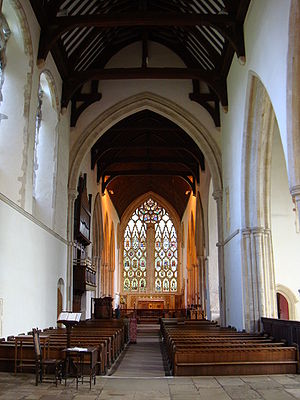
masonry, probably part of the ancient cathedral. The whole length of the church is 230 feet, its width 70 feet and its height 55 feet. The north transept
with its doorway is of the Norman
period. The north side of the nave and chancel arch, Early English, the choir, south side of nave, south aisle are Decorated Gothic. The south porch is late Perpendicular. The extraordinarily rich sanctuary
, with its highly decorated windows (including the famous northern one known as the Jesse Tree
window) and beautifully carved sedilia
and piscina
, dates from 1330. Other fittings include one of the few surviving lead font
s in England, beautiful fresco
es of 1340 and several good monuments
, especially the well-known 'swaggering knight' effigy
(possibly of Sir John Holcombe who died in 1270). In 1993 a Union Jack which had been draped over the coffins of prisoners of war at Batu Lintang camp
, Sarawak, Borneo was placed in the abbey together with two wooden memorial plaques; these had formerly been housed at All Saints Church, Oxford
.
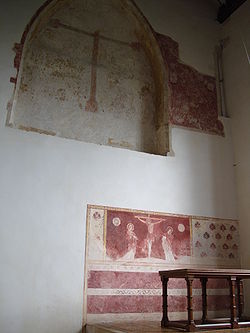 Besides being a parish church, the abbey church is a venue for concerts and cultural events of all kinds. Between 1998 and 2006 the Dorchester Abbey Campaign Committee raised £4,000,000 and this has enabled the Church Council and the Dorchester Abbey Preservation Trust to undertake significant works in the abbey. These include the impressive Cloister Gallery managed by the Dorchester Museum Committee and restoration of medieval and Victorian wall paintings. Dorchester Abbey Museum was longlisted for the Gulbenkian Prize in 2006. The Abbey has an improved heating system and a modern kitchen and servery in the Tower room.
The Abbey is open every day from 8 a.m. until dusk.
Church of England parish church
A parish church in the Church of England is the church which acts as the religious centre for the people within the smallest and most basic Church of England administrative region, known as a parish.-Parishes in England:...
in Dorchester on Thames, Oxfordshire
Oxfordshire
Oxfordshire is a county in the South East region of England, bordering on Warwickshire and Northamptonshire , Buckinghamshire , Berkshire , Wiltshire and Gloucestershire ....
, about 8 miles (12.9 km) southeast of Oxford
Oxford
The city of Oxford is the county town of Oxfordshire, England. The city, made prominent by its medieval university, has a population of just under 165,000, with 153,900 living within the district boundary. It lies about 50 miles north-west of London. The rivers Cherwell and Thames run through...
. It was formerly a Norman abbey
Abbey
An abbey is a Catholic monastery or convent, under the authority of an Abbot or an Abbess, who serves as the spiritual father or mother of the community.The term can also refer to an establishment which has long ceased to function as an abbey,...
church and was built on the site of a Saxon cathedral
Cathedral
A cathedral is a Christian church that contains the seat of a bishop...
.
History
Augustinians
The term Augustinians, named after Saint Augustine of Hippo , applies to two separate and unrelated types of Catholic religious orders:...
(who wore white instead of the black of most Augustinians). Dorchester had been a Roman
Roman Britain
Roman Britain was the part of the island of Great Britain controlled by the Roman Empire from AD 43 until ca. AD 410.The Romans referred to the imperial province as Britannia, which eventually comprised all of the island of Great Britain south of the fluid frontier with Caledonia...
town and was later adopted by the Mercia
Mercia
Mercia was one of the kingdoms of the Anglo-Saxon Heptarchy. It was centred on the valley of the River Trent and its tributaries in the region now known as the English Midlands...
ns. It had been the seat of a bishopric from AD 634 when Pope Honorius I
Pope Honorius I
Pope Honorius I was pope from 625 to 638.Honorius, according to the Liber Pontificalis, came from Campania and was the son of the consul Petronius. He became pope on October 27, 625, two days after the death of his predecessor, Boniface V...
had sent Saint Birinus
Birinus
Birinus , venerated as a saint, was the first Bishop of Dorchester, and the "Apostle to the West Saxons".-Life and ministry:After Augustine of Canterbury performed initial conversions in England, Birinus, a Frank, came to the kingdoms of Wessex in 634, landing at the port of "Hamwic", now in the...
, its first bishop, to that district, until 1085 when the See of Mercia was transferred to Lincoln
Lincoln, Lincolnshire
Lincoln is a cathedral city and county town of Lincolnshire, England.The non-metropolitan district of Lincoln has a population of 85,595; the 2001 census gave the entire area of Lincoln a population of 120,779....
.
The abbey, founded fifty-five years later, was dedicated in honour of Saints Peter and Paul
Feast of Saints Peter and Paul
The Feast of Saints Peter and Paul, or the Solemnity of Saints Peter and Paul, is a liturgical feast in honour of the martyrdom in Rome of the apostles Saint Peter and Saint Paul, which is observed on 29 June...
and Birinus
Birinus
Birinus , venerated as a saint, was the first Bishop of Dorchester, and the "Apostle to the West Saxons".-Life and ministry:After Augustine of Canterbury performed initial conversions in England, Birinus, a Frank, came to the kingdoms of Wessex in 634, landing at the port of "Hamwic", now in the...
. It was richly endowed out of the lands and tithes of the former bishopric, and had twelve parishes subject to it, being included in the Peculiar
Peculiar
Peculiar may refer to:* Peculiar , an album by The Slackers* Peculiar, a comic strip, later published as a book, by cartoonist Richard Sala* In the Church of England, a Peculiar, is an extra-diocesan place of worship...
of Dorchester, until the suppression of peculiars. The first abbot appears to have been Alured
Alured
-Life:He was a clerk of King Henry, probably Henry II of England. He was consecrated about 13 April 1158. He died on 31 July 1160.-References:* accessed on 3 November 2007...
, whose name occurs in records from in 1146 and again in 1163. The last was John Mershe, who was elected in 1533, and in the following year subscribed to the king's supremacy, with five of his canons, and was given a pension of £22 a year. The revenues of the abbey were valued at the time of its suppression at about £220. Henry VIII
Henry VIII of England
Henry VIII was King of England from 21 April 1509 until his death. He was Lord, and later King, of Ireland, as well as continuing the nominal claim by the English monarchs to the Kingdom of France...
reserved the greater part of the property of the house for a college, erected by him in honour of the Holy Trinity, for a dean and prebendaries; but this was dissolved in the first year of his successor.
No register or cartulary of Dorchester Abbey is known to exist, and only a single charter, confirming the donation of a church by King John
John of England
John , also known as John Lackland , was King of England from 6 April 1199 until his death...
, is given by Dugdale
William Dugdale
Sir William Dugdale was an English antiquary and herald. As a scholar he was influential in the development of medieval history as an academic subject.-Life:...
. Edmund Ashefeld was the first impropriator of the abbey site and precincts, which afterwards passed through various hands.
Church
The stately church of Dorchester Abbey, as it stands today, was built entirely by the Augustinian Canons, although there are traces on the north side of SaxonAnglo-Saxon architecture
Anglo-Saxon architecture was a period in the history of architecture in England, and parts of Wales, from the mid-5th century until the Norman Conquest of 1066. Anglo-Saxon secular buildings in Britain were generally simple, constructed mainly using timber with thatch for roofing...
masonry, probably part of the ancient cathedral. The whole length of the church is 230 feet, its width 70 feet and its height 55 feet. The north transept
Transept
For the periodical go to The Transept.A transept is a transverse section, of any building, which lies across the main body of the building. In Christian churches, a transept is an area set crosswise to the nave in a cruciform building in Romanesque and Gothic Christian church architecture...
with its doorway is of the Norman
Norman architecture
About|Romanesque architecture, primarily English|other buildings in Normandy|Architecture of Normandy.File:Durham Cathedral. Nave by James Valentine c.1890.jpg|thumb|200px|The nave of Durham Cathedral demonstrates the characteristic round arched style, though use of shallow pointed arches above the...
period. The north side of the nave and chancel arch, Early English, the choir, south side of nave, south aisle are Decorated Gothic. The south porch is late Perpendicular. The extraordinarily rich sanctuary
Sanctuary
A sanctuary is any place of safety. They may be categorized into human and non-human .- Religious sanctuary :A religious sanctuary can be a sacred place , or a consecrated area of a church or temple around its tabernacle or altar.- Sanctuary as a sacred place :#Sanctuary as a sacred place:#:In...
, with its highly decorated windows (including the famous northern one known as the Jesse Tree
Tree of Jesse
The Tree of Jesse is a depiction in art of the Ancestors of Christ, shown in a tree which rises from Jesse of Bethlehem, the father of King David; the original use of the family tree as a schematic representation of a genealogy...
window) and beautifully carved sedilia
Sedilia
Sedilia , in ecclesiastical architecture, is the term used to describe stone seats, usually to be found on the south side of an altar, often in the chancel, for the use of the officiating priests...
and piscina
Piscina
A piscina is a shallow basin placed near the altar of a church, used for washing the communion vessels. The sacrarium is the drain itself. Anglicans usually refer to the basin, calling it a piscina. Roman Catholics usually refer to the drain, and by extension, the basin, as the sacrarium...
, dates from 1330. Other fittings include one of the few surviving lead font
Baptismal font
A baptismal font is an article of church furniture or a fixture used for the baptism of children and adults.-Aspersion and affusion fonts:...
s in England, beautiful fresco
Fresco
Fresco is any of several related mural painting types, executed on plaster on walls or ceilings. The word fresco comes from the Greek word affresca which derives from the Latin word for "fresh". Frescoes first developed in the ancient world and continued to be popular through the Renaissance...
es of 1340 and several good monuments
Church monument
A church monument is an architectural or sculptural memorial to a dead person or persons, located within a Christian church. It can take various forms, from a simple wall tablet to a large and elaborate structure which may include an effigy of the deceased person and other figures of familial or...
, especially the well-known 'swaggering knight' effigy
Effigy
An effigy is a representation of a person, especially in the form of sculpture or some other three-dimensional form.The term is usually associated with full-length figures of a deceased person depicted in stone or wood on church monuments. These most often lie supine with hands together in prayer,...
(possibly of Sir John Holcombe who died in 1270). In 1993 a Union Jack which had been draped over the coffins of prisoners of war at Batu Lintang camp
Batu Lintang camp
Batu Lintang camp at Kuching, Sarawak on the island of Borneo was a Japanese internment camp during the Second World War. It was unusual in that it housed both Allied prisoners of war and civilian internees...
, Sarawak, Borneo was placed in the abbey together with two wooden memorial plaques; these had formerly been housed at All Saints Church, Oxford
All Saints Church, Oxford
All Saints Church is on the north side of the High Street in central Oxford, England, on the corner of Turl Street. It is now the library of Lincoln College. This former church is Grade I listed.-History:...
.
Burials
- SaintSaintA saint is a holy person. In various religions, saints are people who are believed to have exceptional holiness.In Christian usage, "saint" refers to any believer who is "in Christ", and in whom Christ dwells, whether in heaven or in earth...
BirinusBirinusBirinus , venerated as a saint, was the first Bishop of Dorchester, and the "Apostle to the West Saxons".-Life and ministry:After Augustine of Canterbury performed initial conversions in England, Birinus, a Frank, came to the kingdoms of Wessex in 634, landing at the port of "Hamwic", now in the... - Fred KarnoFred KarnoFrederick John Westcott , best known by his stage name Fred Karno, was a theatre impresario of the British music hall. Karno is credited with inventing the custard-pie-in-the-face gag. Among the young comedians who worked for him were Charlie Chaplin and Arthur Jefferson, who later adopted the...
- Sir Frederick Treves, 1st BaronetSir Frederick Treves, 1st BaronetSir Frederick Treves, 1st Baronet, GCVO, CH, CB was a prominent British surgeon of the Victorian and Edwardian eras, now most famous for his friendship with Joseph Merrick, "the Elephant Man".-Eminent surgeon:...
- Sir John Drayton(d.1417) of Nuneham CourtenayNuneham CourtenayNuneham Courtenay is a village and civil parish about southeast of Oxford.-Manor:The toponym evolved from Newenham. In the 14th century the village belonged to the Courtenay family and in 1764 "Newenham" was changed to "Nuneham"....
. The Abbey contains his funerary brass. - Wulfwig
Present use
The Abbey is open every day from 8 a.m. until dusk.