
All Topics  
Doraemon

 
Doraemon

   Email Print
   Bookmark   Link


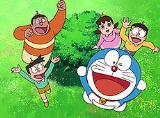
Doraemon


is a Japan
Japan

Japan is an island country in East Asia. Located in the Pacific Ocean, it lies to the east of the Sea of Japan, People's Republic of China, North Korea, South Korea and Russia, stretching from the Sea of Okhotsk in the north to the East China Sea and Taiwan in the south....
ese manga
Manga

, , are comics and print cartoons , in the Japanese language and conforming to the style developed in Japan in the late 20th century. In their modern form, manga date from shortly after World War II, but they have a long, complex pre-history in earlier Japanese art....
 series created by Fujiko F. Fujio (the pen name of Hiroshi Fujimoto
Fujiko Fujio

was a penname of a manga writing duo formed by two Japanese people mangaka. Their real names are and . They dissolved the partnership in 1987.They won many individual and collaborative awards, and are best known for creating the popular and long-running series Doraemon, the main character of which is officially recognized as a cultural icon...
) which later became an anime
Anime

is animation in Japan and considered to be "Japanese animation" in the rest of the world. Anime dates from about 1917.Anime, in addition to manga , is extremely popular in Japan and well known throughout the world....
 series and Asia
Asia

Asia is the world's largest and most populous continent. It covers 8.6% of the Earth's total surface area and, with over 4 billion people, it contains more than 60% of the world's current human population....
n franchise
Media franchise

A media franchise is an intellectual property involving the fictional character, fictional universe, and trademarks of an original work of News media , such as a film, a work of literature, a television program, or a video game....
. The series is about a robotic cat
Robot

A robot is a virtual or mechanical artificial agent. In practice, it is usually an Electromechanics which, by its appearance or movements, conveys a sense that it has Intention or Agency of its own....
 named Doraemon, who travels back in time
Time travel

Time travel is the concept of moving between different moments in time in a manner analogous to moving between different points in space, either sending objects backwards in time to a moment before the present, or sending objects forward from the present to the future without the need to experience the intervening period ....
 from the 22nd century to aid a schoolboy, .

In March 2008, Japan's Foreign Ministry appointed Doraemon as the nation's first "anime ambassador." Ministry spokesman explained the novel decision as an attempt to help people in other countries to understand Japanese anime better and to deepen their interest in Japanese culture." The Foreign Ministry action confirms that Doraemon has come to be considered a Japanese cultural icon.


Discussion
Ask a question about 'Doraemon'
Start a new discussion about 'Doraemon'
Answer questions from other users
Full Discussion Forum


Encyclopedia


is a Japan
Japan

Japan is an island country in East Asia. Located in the Pacific Ocean, it lies to the east of the Sea of Japan, People's Republic of China, North Korea, South Korea and Russia, stretching from the Sea of Okhotsk in the north to the East China Sea and Taiwan in the south....
ese manga
Manga

, , are comics and print cartoons , in the Japanese language and conforming to the style developed in Japan in the late 20th century. In their modern form, manga date from shortly after World War II, but they have a long, complex pre-history in earlier Japanese art....
 series created by Fujiko F. Fujio (the pen name of Hiroshi Fujimoto
Fujiko Fujio

was a penname of a manga writing duo formed by two Japanese people mangaka. Their real names are and . They dissolved the partnership in 1987.They won many individual and collaborative awards, and are best known for creating the popular and long-running series Doraemon, the main character of which is officially recognized as a cultural icon...
) which later became an anime
Anime

is animation in Japan and considered to be "Japanese animation" in the rest of the world. Anime dates from about 1917.Anime, in addition to manga , is extremely popular in Japan and well known throughout the world....
 series and Asia
Asia

Asia is the world's largest and most populous continent. It covers 8.6% of the Earth's total surface area and, with over 4 billion people, it contains more than 60% of the world's current human population....
n franchise
Media franchise

A media franchise is an intellectual property involving the fictional character, fictional universe, and trademarks of an original work of News media , such as a film, a work of literature, a television program, or a video game....
. The series is about a robotic cat
Robot

A robot is a virtual or mechanical artificial agent. In practice, it is usually an Electromechanics which, by its appearance or movements, conveys a sense that it has Intention or Agency of its own....
 named Doraemon, who travels back in time
Time travel

Time travel is the concept of moving between different moments in time in a manner analogous to moving between different points in space, either sending objects backwards in time to a moment before the present, or sending objects forward from the present to the future without the need to experience the intervening period ....
 from the 22nd century to aid a schoolboy, .

In March 2008, Japan's Foreign Ministry appointed Doraemon as the nation's first "anime ambassador." Ministry spokesman explained the novel decision as an attempt to help people in other countries to understand Japanese anime better and to deepen their interest in Japanese culture." The Foreign Ministry action confirms that Doraemon has come to be considered a Japanese cultural icon. In 2002, the anime character was acclaimed as an Asian Hero in a special feature survey conducted by Time Asia magazine.

The series first appeared in December 1969, when it was published simultaneously in six different magazines. In total, 1,344 stories were created in the original series, which are published by Shogakukan
Shogakukan

is a Japanese publisher of Japanese dictionaries, literature, manga, non-fiction, DVDs, and other media in Japan.Shogakukan founded Shueisha which founded Hakusensha....
 under the manga brand, extending to forty-five volumes. The volumes are collected in the Takaoka Central Library in Toyama, Japan. Fujio was born in Toyama.

A majority of Doraemon episodes are comedies with moral lessons regarding values such as integrity, perseverance, courage, family and respect for elders. Several noteworthy environmental issues are often visited, including homeless animals, endangered species
Endangered species

An endangered species is a population of an organism which is at risk of becoming extinct because it is either few in numbers, or threatened by changing environmental or predation parameters....
, deforestation
Deforestation

Deforestation is the logging or burning of trees in forested areas. There are several reasons for doing so: trees or derived charcoal can be sold as a commodity and are used by humans while cleared land is used as pasture, plantations of commodities and human settlement....
, and pollution
Pollution

Pollution is the introduction of contaminants into an environment that causes instability, disorder, harm or discomfort to the ecosystem i.e. physical systems or living organisms ....
. Topics such as dinosaur
Dinosaur

Dinosaurs were the dominant vertebrate animals of Landform ecosystems for over 160 million years, from the late Triassic Period until the end of the Cretaceous Period , when most of them became extinct in the Cretaceous?Tertiary extinction event....
s, the flat earth theory, wormhole
Wormhole

In physics, a wormhole is a hypothetical topology feature of spacetime that is fundamentally a 'shortcut' through space and time. Spacetime can be viewed as a 2D surface, and when 'folded' over, a wormhole bridge can be formed....
 traveling, Gulliver's Travels
Gulliver's Travels

Gulliver's Travels , officially Travels into Several Remote Nations of the World, in Four Parts. By Lemuel Gulliver, First a Surgeon, and then a Captain of several Ships, is a novel by Jonathan Swift that is both a satire on human nature and a parody of the "travellers' tales" literary sub-genre....
, and the history of Japan
History of Japan

The written history of Japan begins with brief references of Twenty-Four Histories, a collection of Chinese historical texts, in the 1st century AD....
 are often covered.

Doraemon was awarded the first Shogakukan Manga Award
Shogakukan Manga Award

The Shogakukan Manga Award is one of Japan's major manga awards, sponsored by Shogakukan Publishing. It has been awarded annually for serialized manga since 1955 and features candidates from a number of publishers....
 for children's manga
Kodomo

and the similar term, , are Japanese Language terms which literally mean "manga directed towards children"."Kodomo" works are noted for stories that are often very moralistic, teaching children how to behave as good and considerate people....
 in 1982, and the first Osamu Tezuka Culture Award
Osamu Tezuka Culture Award

Named after Osamu Tezuka, the is a yearly comic book prize awarded to manga artists or their works that follow the Osamu Tezuka manga approach founded and sponsored by Asahi Shimbun....
 in 1997.

History

In December 1969, the Doraemon manga appeared simultaneously in six different children's monthly magazines. The magazines were titled by the year of children's studies, which included Yoiko (good children), Yochien (nursery school), and Shogaku Ichinensei (first grade of primary school) to Shogaku Yonnensei (fourth grade of primary school). By 1973, the series began to appear in two more magazines, Shogaku Gonensei (fifth grade of primary school) and Shogaku Rokunensei (sixth grade of primary school). The stories featured in each of the magazines were different, meaning the author was originally creating more than six stories each month. In 1977, CoroCoro Comic
CoroCoro Comic

is a Japanese monthly manga magazine published by Shogakukan, starting in April 15, 1977. Its main target is elementary school aged boys, younger than the readers of shonen manga....
 was launched as a magazine of Doraemon. Original manga based on the Doraemon movies were also released in CoroCoro Comic. The stories which are preserved under the Tentomushi brand are the stories found in these magazines.

Since the debut of Doraemon in 1969, the stories have been selectively collected into forty-five books published from 1974 to 1996, which had a circulation of over 80 million in 1992. In addition, Doraemon has appeared in a variety of manga series by Shogakukan. In 2005, Shogakukan published a series of five more manga volumes under the title Doraemon+ (Doraemon Plus), which were not found in the forty-five Tentomushi pipi volumes. Many other series have since been produced, some not from official supplies.

Plot summary

Doraemon First Appearance
Doraemon is sent back in time by Nobita Nobi's great-great grandson Sewashi to improve Nobita's circumstances so that his descendants may enjoy a better future. In the original timeline, Nobita experienced nothing but misery and misfortune throughout his life. As a result of this, Nobita's failures in school and subsequently, his career, have left his family line beset with financial problems. In order to alter history and better the Nobi family's fortunes, Sewashi sent him a robot called Doraemon.

Doraemon has a large pocket from which he produces many gadgets from the future. The pocket is called yojigen-pocket, or 4 dimension pocket.

Although he can hear perfectly well, Doraemon has no ears: his robotic ears were eaten by a mouse, giving him a series-long phobia
Fear of mice

Fear of mice and rats is one of the most common specific phobias. It is sometimes referred to as musophobia or murophobia , or as suriphobia, from the French souris, meaning mouse....
 of the creatures.

The stories are formulaic, usually focused on the everyday struggles of fourth grader Nobita, the protagonist of the story. In a typical chapter, Nobita comes home crying about a problem he faces in school and/or the local neighborhood. After hearing him out, Doraemon always offers helpful advice to his problem(s), but that's never enough for Nobita, who is consistently looking for the "quick, easy" way out (which offers insight to the viewers as to why Nobita's life turned out the way it did). Finally, after Nobita's pleading and/or goading, Doraemon produces a futuristic gadget out of his aforementioned pouch to help Nobita fix his problem, enact revenge, or flaunt to his friends.

Nobita usually goes too far, despite Doraemon's best intentions and warnings, and gets into deeper trouble than before. Sometimes, Nobita's friends (usually Suneo or Jaian) steal the gadgets and end up misusing them. However, by the end of the story, there is usually retribution to the characters who end up misusing them, and a moral is taught.

Series finale rumors

There are three current and often quoted urban legends that started spreading in late 1980s of an ending to the Doraemon series.

  • The first and the most optimistic ending was made public by Nobuo Sato several years ago. Doraemon's battery power ran out, and Nobita was given a choice between replacing the battery inside a frozen Doraemon, which would cause it to reset and lose all memory, or await a competent robotics technician who would be able to resurrect the cat-robot one day. Nobita swore that very day to work hard in school, graduate with honours, and become that robotics technician. He successfully resurrected Doraemon in the future as a robotics professor, became successful as an AI developer, and thus lived happily ever after, thus relieving his progeny of the financial burdens that caused Doraemon to be sent to his space-time in the first place. A dojin
    Dojin

    , often Romanization of Japanese as doujin, is a general Japanese language term for a group of people or friends who share an interest, activity, hobbies, or achievement....
     manga for this ending was made by a "Tajima T Yasue" in 2005, and it sold 13,000 copies before Shogakukan halted its publication. Tajima apologized to Shogakukan in 2007 and paid an undisclosed amount of money for settlement..


  • The second, more pessimistic ending suggests that Nobita Nobi is suffering from autism
    Autism

    Autism is a Neurodevelopmental disorder characterized by impaired social interaction and communication, and by restricted and repetitive behavior....
     and that all the characters (including Doraemon) are simply his delusion
    Delusion

    A delusion is commonly defined as a fixed false belief and is used in everyday language to describe a belief that is either false, fanciful or derived from deception....
    . The idea that Nobita was a sick and dying little boy who imagined the entire series on his sickbed to help him ease his pain and depression no doubt angered quite a lot of fans. Many Japanese fans staged a protest outside the headquarters of the publisher of the series after learning about this suggestion. The publisher had to issue a public statement that this is not true. (This ending actually correlates to the ending for the series St. Elsewhere
    St. Elsewhere

    St. Elsewhere is a U.S. drama television series that originally ran on NBC from October 26, 1982 to May 25, 1988. The series is set at St. Eligius, a decaying urban teaching hospital in Boston's South End, Boston, Massachusetts....
    , which ended in 1988.)


  • The third ending suggests that Nobita fell and hit his head on a rock. He fell into a deep coma, and eventually into a semi-vegetative state. To raise money for an operation to save Nobita, Doraemon sold all the tools and devices in his four-dimensional pocket. However, the operation failed. Doraemon sold all his tools except for one used as a last resort. He used it to enable Nobita to go wherever he wanted, whichever time or era he wished to go. In the end, the very place Nobita wanted to go was heaven
    Heaven

    Heaven may refer to the physical heavens, the atmosphere or the seemingly endless expanse of the universe beyond. This is the traditional literal meaning of the term in English, however since at least AD 1000, it is typically also used to refer to an afterlife plane of existence in various religions and spirituality philosophy, often descri...
    .


The plausibility of these issues was discussed and it was concluded that there is no ending to Doraemon.

There are three official endings to Doraemon that were made. Doraemon was discontinued in two media because readers were advancing in grades and an ending was believed to be needed. These two are not reprinted.

  • In the March 1971 issue of the magazine Shogaku 4-nensei : Due to the fact that visitors from the future were causing too much trouble, the government in the 22nd Century passed a bill to ban time-travelling altogether, meaning Doraemon would have to return to his time era. He leaves Nobita.


  • In the March 1972 issue of the magazine Shogaku 4-nensei: Doraemon, for some reason, had to go back to the future but fakes a mechanical problem so that Nobita would let him go. Nobita believes him and promises to wait until Doraemon gets well. Realizing that Nobita can handle his departure, Doraemon tells the truth and Nobita accepts. Doraemon returns to the future.


The third ending was actually meant to be the official ending due to low TV ratings and the Fujiko Fujio
Fujiko Fujio

was a penname of a manga writing duo formed by two Japanese people mangaka. Their real names are and . They dissolved the partnership in 1987.They won many individual and collaborative awards, and are best known for creating the popular and long-running series Doraemon, the main character of which is officially recognized as a cultural icon...
 duo was busy with other works. But Doraemon did not leave their minds and restarted from next month's issue. In 1981, this episode was made into anime (called "Doraemon Comes Back"), and in 1998, this was released as an anime movie.

  • In the March 1973 issue of the magazine Shogaku 4-nensei, Nobita again returns home after losing a fight against Gian. Doraemon then explains that he has to return. Nobita tries to have Doraemon stay but after talking it over with his parents, he accepts Doraemon's departure. They take a last walk in the park. After they split up, Nobita encounters Jaian and gets into a fight again. After a long duel with Nobita trying to win at all costs so that Doraemon can leave without worries, Gian gave up (which gave Nobita the win) because no matter what, Nobita refuses to stay down. Doraemon finds Nobita passed out with a bloody mouth and takes him home. Sitting beside sleeping Nobita and after a moment of thought, Doraemon returns to the future. (It is also found at the last chapter of the manga Book 6).


  • The animated version is completely similar but lengthened. Nobita finds a box the shape of Doraemon in his drawer. The next day, which happens to be April Fool's Day, Nobita is jeered at by Suneo and Jaian, the latter tricking him about Doraemon's return. He happily runs home and asked his mother whether Doraemon came back and finds out the truth. Nobita couldn't stand it and opens the box. Inside of it was a bottle of liquid. He hears Doraemon's voice explaining that the potion is called Uso 800 (Lies 800) it is used to make all untruths the drinker says true. Nobita uses it to play a few tricks on Jaian and Suneo, like first taking cover then say that the weather sure is good, which becomes a lie and it started to rain heavily before he said it is raining heavily and the rain stopped. Jian and Suneo was scared away after a few tricks and when Nobita mentioned what is happening. Nobita was very happy at first but quickly loses interest in the absence of Doraemon. As he walks home, due to his earlier questioning if Doraemon returned or not, his mother asked him if he could find Doraemon, he unwittingly said, in great disappointment, the truth about Doraemon never coming back, just like what Doraemon told Nobita before his departure. Since the potion was still in effect, when he arrives his room he finds Doraemon there, and they have a happy reunion, but due to the effects of the potion, all his greets and joyful words have to be spoken in the opposite way like I am so unhappy that we can never be together again.. The extended ending from the animated series was eventually adapted to the first story of Book 7 in the manga series, with a few changes (i.e. Instead of hearing Doraemon's voice explaining the use of the potion, he finds a card inside the box describing the use of the potion).


When the Fujiko Fujio
Fujiko Fujio

was a penname of a manga writing duo formed by two Japanese people mangaka. Their real names are and . They dissolved the partnership in 1987.They won many individual and collaborative awards, and are best known for creating the popular and long-running series Doraemon, the main character of which is officially recognized as a cultural icon...
 duo broke up in 1987, the very idea of an official ending to the series was never discussed. Since Fujiko F. died in 1996 before any decisions were reached, any "endings" of Doraemon are fan fiction
Fan fiction

Fan fiction is a broadly-defined term for stories about characters or settings written by fans of the original work, rather than by the original creator....
. However, it is apparent from many episodes and movies where Nobita travels to the future that in the end he does marry Shizuka, leads a happy life and separates with Doraemon, although Nobita and his friends fondly remember him.

Characters

The only main female character is , who serves as a semi-romantic girlfriend
Girlfriend

Girlfriend is a terminology that can refer to either a female partner in a non-marriage romantic love or a female non-intimate friend.The term is most commonly used to describe any female person who is in a romantic relationship with another person....
 of Nobita, but otherwise a supporting, minor character. Nobita's main human friends include Gian, a known bully, and Suneo, a gloating spoiled wealthy kid. There are many recurring supporting characters, such as Dekisugi, Nobita's parents, his school teacher, his descendants from the future, and Doraemon's sister, Dorami.

Episodes


Dogu

Doraemon can take out various devices known as from his fourth-dimensional pocket. Some of the gadgets are based on real Japanese household devices with fanciful twists, but most are completely science fiction
Science fiction

Science fiction is a broad genre of fiction that often involves speculations based on current or future science or technology. Science fiction is found in books, art, television, films, games, theatre, and other media....
 (although some may be based on folklore or religious stories).

Thousands of dogu have been featured in Doraemon. Some have placed the number of dogu at approximately 4,500.

Other appearances

Doraemon is a cultural phenomenon in Japan and can be seen in many places. For example, Doraemon is used as a promotional character by , by a removals company, and by Cocos, a restaurant chain. Doraemon also appears in appeals for charity, the "Doraemon Fund". Doraemon toys and novelties are also often found in Japan, with literally thousands of items for sale.

Doraemon, Nobita, and the other characters also appear in various educational manga. Doraemon is also mentioned in several anime and manga by other mangaka
Mangaka

is the Japanese language word for a comic book creator or cartoonist. Outside of Japan, manga usually refers to a Japanese comic book and mangaka refers to the author of the manga, who is usually Japanese person....
s.

Doraemon is referenced in the current Blue Man Group show running in Tokyo. The Blue Men play a short snippet of the show's theme song, and one dons Doraemon's beanie.

The Japanese guitar company, , makes a .

There are nearly 50 Japanese-only video games ranging from Action Adventure, to RPG games, that began with the Emerson's Arcadia 2001
Arcadia 2001

The Arcadia 2001 is a second-generation 8-bit console released by Emerson Radio Corporation. The game library was composed of 51 unique games and about 10 variations....
 system. For a complete list of these games see List of Doraemon media
List of Doraemon media

This is a list of all Doraemon media releases....
.

The music video for the single "From a distance" off of the "bicycles and tricycles" album by ambient house act, The Orb
The Orb

The Orb are an English electronic music group known for popularising chill out music in the 1990s and spawning the genre of ambient house. Founded in 1988 by Alex Paterson and The KLF member Jimmy Cauty, The Orb began as ambient music and dub music disc jockeys in London....
 revolves around doraemon.

Popularity


Doraemon is a term of common knowledge in Japan. Newspapers also regularly make references to Doraemon and his pocket as a something with the ability to satisfy all wishes. Other characters in the series are also referenced frequently on TV shows with similar looking casts. Some magazines have used the analogy that America is the Takeshi of the world and Japan is his little brother Suneo.

Doraemon was awarded the first Shogakukan Manga Award
Shogakukan Manga Award

The Shogakukan Manga Award is one of Japan's major manga awards, sponsored by Shogakukan Publishing. It has been awarded annually for serialized manga since 1955 and features candidates from a number of publishers....
 for children's manga in 1982, and the first Osamu Tezuka Culture Award
Osamu Tezuka Culture Award

Named after Osamu Tezuka, the is a yearly comic book prize awarded to manga artists or their works that follow the Osamu Tezuka manga approach founded and sponsored by Asahi Shimbun....
 in 1997.

Anime


Television series

After a brief and unpopular animated series in 1973 by Nippon Television
Nippon Television

is a television network in Shiodome area of Minato, Tokyo, Japan owned by the Yomiuri Shimbun. It is commonly known as , Japanese abbreviated and contracted words to , and abbreviated as "NTV"....
, Doraemon remained fairly exclusive in manga form until 1979 when a newly formed animation studio, Shin-Ei Animation (Now owned by TV Asahi
TV Asahi

, also known as EX and , is a television Television network headquartered in Roppongi, Minato, Tokyo, Japan. The company writes its name in lower-case letters, tv asahi, in its logo and public-image materials....
) produced an anime series of Doraemon. This series became incredibly popular, and ended with 1,049 episodes on March 25, 2005.

Celebrating Doraemons anniversary, a new Doraemon series produced by Studio Pierrot
Studio Pierrot

is a Japanese animation company, founded in 1979 by former employees of Tatsunoko Production. They are considered specialists in the magical girl sub-genre, especially with their Studio Pierrot magical girl series of shows....
 began airing on TV Asahi on April 15, 2005 with new voice actors
Seiyu

A is a Japanese voice actor. Seiyu work in radio, television, and Film; they perform voice-overs for non-Japanese movies; they provide narration; and they work as anime and video games character actors....
 and staff, and updated character designs.

Foreign channels that air Doraemon

Feature films


In 1980, Toho
Toho

is a large Japanese independent film studio. It is headquartered in Chiyoda, Tokyo, and is one of the core companies of the Hankyu Hanshin Toho Group....
 released the first of a series of annual feature length animated films based on the lengthly special volumes published annually. The films are more action-adventure oriented and unlike the anime and manga, they have more of a shonen
Shonen

is a genre of manga with a demographic of young boys generally between the ages of about 10 and 18. Examples include Dragon Ball , Naruto, Bleach , Case Closed, One Piece, Rurouni Kenshin, InuYasha, Death Note, Yu Yu Hakusho, and Yu-Gi-Oh....
 demographic, taking the familiar characters of
Doraemon and placing them in a variety of exotic and perilous settings. Nobita and his friends have visited the age of the dinosaur
Dinosaur

Dinosaurs were the dominant vertebrate animals of Landform ecosystems for over 160 million years, from the late Triassic Period until the end of the Cretaceous Period , when most of them became extinct in the Cretaceous?Tertiary extinction event....
s, the far reaches of the galaxy
Galaxy

A galaxy is a massive, gravitation system that consists of stars and stellar remnants, an interstellar medium of gas and cosmic dust, and an important but poorly-understood component tentatively dubbed dark matter....
, the heart of darkest Africa (where they encountered a race of sentient bipedal dogs), the depths of the ocean, and a world of magic
Magic (paranormal)

Magic, sometimes known as sorcery, is a conceptual system that asserts human ability to control or predict the nature through Mysticism, paranormal or supernatural means....
. Some of the films are based on legend
Legend

A legend is a narrative of human actions that are perceived both by teller and listeners to take place within human history and to possess certain qualities that give the tale verisimilitude ....
s such as Atlantis
Atlantis

Atlantis is a legendary island first mentioned in Plato's dialogues Timaeus and Critias .In Plato's account, Atlantis was a naval power lying "in front of the Pillars of Hercules" that conquered many parts of Western Europe and Africa 9,000 years before the time of Solon, or approximately 9600 BC....
, and on literary
Literature

Literature is the art of written works. Literally translated, the word means "acquaintance with letters" . In Western culture the most basic written literary types include fiction and non-fiction....
 works such as
Journey to the West
Journey to the West

Journey to the West is one of the Four Great Classical Novels of Chinese literature. Originally published anonymously in the 1590s during the Ming Dynasty, and even though no direct evidence of its authorship survives, it has been ascribed to the scholar Wu Cheng'en since the 20th century....
and Arabian Nights. Some films also have serious themes, especially on environmental topics and the use of technology.

The most recent Doraemon film is The New Record of Nobita: Spaceblazer
The New Record of Nobita: Spaceblazer

, also known as Doraemon The Hero 2009, is an anime movie, that will be released in Japan on March 7, 2009. It is also expected to be released in Malaysia on April 15, 2010, and in China on June 12, 2010....
, slated for a 2009 release.

Voice actors

From 1979 to April 2005, the same five voice actors provided the main voices in
Doraemon. However, they retired in April 2005 partially due to the 25th anniversary of the Doraemon television series. On March 13, 2005, TV Asahi
TV Asahi

, also known as EX and , is a television Television network headquartered in Roppongi, Minato, Tokyo, Japan. The company writes its name in lower-case letters, tv asahi, in its logo and public-image materials....
 announced the new voice actors for the five main characters:

Character Voice actor for April 1979 - March 2005 Voice actor for March 2005 - Present
Doraemon Nobuyo Oyama
Nobuyo Oyama

, born on October 16, 1936 in Tokyo, is a seiyu currently represented by Actors Seven.She is best known for playing the title character in the long-running Doraemon anime....
 
Wasabi Mizuta
Wasabi Mizuta

, born August 4, 1974 in Aoyama, Mie, is a female seiyu. She currently resides in Iga, Mie and is represented by Kenji Utsumi's Ken Production....
Nobita Noriko Ohara
Noriko Ohara

Noriko Ohara , born Noriko Tobe on October 2, 1935 in Tokyo, is a veteran seiyu. She is currently represented by Production Baobab. Her son is Sunrise animator Atsuo Tobe ....
 
Shizuka Michiko Nomura
Michiko Nomura

is a seiyu who was born on March 31,1938 in Yokohama, Kanagawa Prefecture. She is married to fellow seiyu Kenji Utsumi....
 
Yumi Kakazu
Yumi Kakazu

is a female seiyu from Kamifukuoka, Saitama . She is currently affiliated with Genki Project. Her blood type is O, and her constellation is Gemini ....
Jaian Kazuya Tatekabe
Kazuya Tatekabe

, born July 25, 1934 in Kimobetsu, Hokkaido, is a veteran seiyuu. He is currently represented by Kenyu Horiuchi's Kenyu Office.He is most known for the roles of Jaian , Walsa , and Tonzura ....
 
Suneo Kaneta Kimotsuki
Kaneta Kimotsuki

, born November 15, 1935, is a veteran seiyu who was born in Kagoshima.He is most known for the roles of Suneo Honekawa , Payan , Iyami , Tom , Benzou Karino , Horrorman , Conductor ....
 
Tomokazu Seki
Tomokazu Seki

is a popular and very famous seiyu in Japan. He formerly worked for Haikyou, now he is the head of Atomic Monkey....
Dorami Keiko Yokozawa
Keiko Yokozawa

, born September 2, 1952 in Niigata, Niigata, Japan, is a Japanese people seiyu.She is most known for the roles of Dorami , Mami Sakura , Benio Hanamura , and Sheeta ...
 
Chiaki
Chiaki (tarento)

, Full name , is a Japanese tarento. She is a part of Sony Music Japan.Chiaki married Cocorico, of the comedy duo Cocorico, in 2002, but divorced in December 2007. They have a daughter, born in 2003....
Dekisugi
Nobita's Mama Sachiko Chijimatsu
Sachiko Chijimatsu

', born ' on November 30, 1937 in Fukuoka Prefecture, is a female seiyu. She is currently represented by Arts Vision.She is most known for the roles of Pyonkichi , Nobita's Mama , Kabu , Shippona , and 001/Ivan Whiskey ....
 
Kotono Mitsuishi
Kotono Mitsuishi

is a prolific Japanese people seiyu from Tokyo. As a young girl, Mitsuishi lived in Nagareyama, Chiba. Mitsuishi graduated from high school in 1986, and entered the Katsuta Seiyu Academy....
Nobita's Papa Yasunori Matsumoto
Yasunori Matsumoto

Yasunori Matsumoto is a veteran seiyu=Notable voice roles*Ross Syllibus in Armitage III *Napoleon in Captain Tsubasa*Mercurymon in Digimon Frontier...
Sewashi Sachi Matsumoto
Sachi Matsumoto

Sachi Matsumoto is a seiyu ....
Sensei Ryoichi Tanaka
Ryoichi Tanaka

is a veteran seiyuu born in Suginami, Tokyo. His younger brother was the late seiyu Kazumi Tanaka. They are both currently represented by Aoni Production....
Wataru Takagi
Wataru Takagi

, born on July 25, 1966 in Chiba Prefecture, Japan, is a seiyu who works for Arts Vision....
Kaminari Takeshi Watabe
Takeshi Watabe

Takeshi Watabe is a veteran Japanese voice actor. He was born on March 21, 1936 in Kochi Prefecture. He usually plays villains and performs the voices for many anime characters and tokusatsu villains....
 
Katsuhisa Hoki
Shizuka's Mother Ai Orikasa
Ai Orikasa

, born is a popular Japanese seiyu and singer from Tokyo. She works for Production Baobab. Orikasa is also the Japanese dub voice for Jessica Rabbit in Who Framed Roger Rabbit....
Suneo's Mother Minami Takayama
Minami Takayama

is a Japanese seiyu and singer affiliated with 81 Produce. She was born in Adachi, Tokyo as . She was married to manga artist Gosho Aoyama on May 5, 2005 but they divorced on December 10, 2007....
Suneo's Father Hideyuki Tanaka
Hideyuki Tanaka

is a veteran seiyu born November 12, 1950 in Tokyo, Japan. He is a graduate of the Toho Gakuen School of Music and is currently represented by Aoni Production....
Jaian's Mother Kazuyo Aoki
Kazuyo Aoki

is a seiyu born on August 27, 1947 in Tokyo, Japan. She is employed by the talent management firm Kiraboshi.Some voice roles: TV ...
 
Jaiko Kazuyo Aoki
Kazuyo Aoki

is a seiyu born on August 27, 1947 in Tokyo, Japan. She is employed by the talent management firm Kiraboshi.Some voice roles: TV ...
 
Vanilla Yamazaki
Vanilla Yamazaki

is a katsudo-benshi, seiyu, a actress, a choreography, and a tarento born January 15, 1978 in Sendai, Miyagi Prefecture, Japan and raised in Ota, Tokyo, Tokyo....


  • Nobita - Hiroko Maruyama (stand-in for Ohara, July 23, 1979 ~ July 28, 1979)
  • Suneo - Naoki Tatsuta
    Naoki Tatsuta

    is a seiyu born on September 8, 1950 in Naga, Wakayama, Wakayama Prefecture, Japan. He is employed by the talent management firm Aoni Production.He is most known for the roles of Buta Gorilla , Daima Jin , Oolong , Ashibe's Father , and Scoop-kun ....
     (stand-in for Kimotsuki, November 15, 1985 ~ December 6, 1985)
  • Nobita's Papa - Masayuki Kato
    Masayuki Kato

    Masayuki Kato is the president of the Nihon Falcom Corporation that has made Nintendo Entertainment System video games in addition to games for other video game system....
     (Start ~ October 2, 1992)
  • Sensei - Ritsuo Sawa ? Osamu Katou ? Kazuhiko Inoue
    Kazuhiko Inoue

    is a veteran seiyu from Yokohama, Kanagawa, Japan. He is blood type O....
     (Start ~ September 1981)
  • Kaminari - Shingo Kanemoto
    Shingo Kanemoto

    , was a seiyu originally from Fukuoka Prefecture. On February 24, 1991, he died of intra-axial hematoma at the age of 58. After his death, his ongoing roles went to Takeshi Watabe....
     (February 8, 1985 (character debut) ~ September 14, 1990)
  • Shizuka's Mother - Keiko Yokozawa
    Keiko Yokozawa

    , born September 2, 1952 in Niigata, Niigata, Japan, is a Japanese people seiyu.She is most known for the roles of Dorami , Mami Sakura , Benio Hanamura , and Sheeta ...
     (Start ~ August 1981)
  • Suneo's Mother - Yoshino Otori (Start ~ March 8, 1991)


NTV Cast
Character Voice actor
Doraemon Kousei Tomita (episodes 1 ~ 13)
Masako Nozawa
Masako Nozawa

, born in the Tokyo Metropolitan area, Japan, but raised in Numata, Gunma, is a seiyu and actress affiliated with Office Nozawa. Her pet name is Mako....
Nobita
Shizuka Masako Ebisu
Jaian Kaneta Kimotsuki
Kaneta Kimotsuki

, born November 15, 1935, is a veteran seiyu who was born in Kagoshima.He is most known for the roles of Suneo Honekawa , Payan , Iyami , Tom , Benzou Karino , Horrorman , Conductor ....
Suneo Shun Yashiro
Shun Yashiro

was a Japanese actor and seiyu from Tsuyama, Okayama. At the time of his death, he was affiliated with Theater Echo. Throughout his career, Yashiro was also known as , , and ....
Nobita's Mama Noriko Ohara
Noriko Ohara

Noriko Ohara , born Noriko Tobe on October 2, 1935 in Tokyo, is a veteran seiyu. She is currently represented by Production Baobab. Her son is Sunrise animator Atsuo Tobe ....
Nobita's Papa Ichirou Murakoshi
Suneo's Mama Kazue Takahashi
Kazue Takahashi

was a female seiyuu who was born on March 20, 1929 in Tochigi, Japan. Kazue was best known as the voice of Shoutarou Kaneda in Tetsujin 28-go. She debuted in 1949....
Gatchako Junko Hori
Junko Hori

is a Japanese people actress and seiyu, born February 2, 1942 in Tokyo, Japan. She is represented by Production Baobab.She is known as the voice of the protagonists in 3 Fujiko Fujio works, Obake no Q-taro, Ninja Hattori-kun, and Chinpui....
Sewashi Keiko Yamamoto
Keiko Yamamoto

, born August 7, 1943, is a veteran female voice actor from Osaka Prefecture....
Sensei Masashi Amenomori
Masashi Amenomori

', born ' on July 24, 1930 in Chiba Prefecture, was a seiyu. Amenomori died of cirrhosis on April 9, 1984. At the time of his death he was represented by Aoni Production....


Opening themes

The opening theme used for the weekly
Doraemon series airing between 1979 and 2005 was , which was performed by five different performers over the course of its years:

Performer Starting date Ending date
1. April 2 1979 October 2 1992
2. October 9 1992 September 20 2002
3. October 4 2002 April 11 2003
4. Misato Watanabe
Misato Watanabe

is a female J-Pop artist....
 
April 18 2003 April 23 2004
5. AJI April 30 2004 March 18 2005


In the New Doraemon Series (2005), new opening themes songs were used, except for the first one.

Performer Song Title Starting date Ending date
1. April 15 2005 (episode 1) October 21 2005 (episode 24)
2. April 20 2007 (episode 86)
3. mao May 11 2007 (episode 87) present


Two songs were used for a separate weekday
Doraemon series which is a part of Fujiko Fujio Theater (???????, Fujiko Fujio Gekijoo), the first song being the same as the first song of the weekly series.

Name Song Title Starting date Ending date
1. April 2 1979 September 29 1979
2. October 1 1979 September 26 1981


Ending themes

The ending themes used for the weekly
Doraemon series airing between 1979 and 2005 were:

Song Title Performer Starting date Ending date
1. April 8 1979 September 27 1981
2. October 2 1981 March 30 1984
3. November 18 1983 December 30 1983
4. April 6 1984 April 8 1988
5. April 15 1988 October 2 1992
6. October 9 1992 April 7 1995
7. April 14 1995 September 20 2002
8. October 4 2002 April 11 2003
9. April 18 2003 October 4 2003
10. October 10 2003 May 28 2004
11. June 4 2004 March 18 2005


Since the 2005 series incorporated all the credits into the Opening Sequence, these three themes were used as the Ending Theme.

Song Title Performer Starting date Ending date
1. June 29 2007 August 10 2007


Three songs were used for the separate weekday
Doraemon series.

Song Title Performer
1.
2.
3.


Significance

On 22 April 2002, on the special issue of
Asian Hero in TIME Magazine, Doraemon was selected as one of the 22 Asian Heroes. Being the only cartoon character selected, Doraemon was described as "The Cuddliest Hero in Asia".

In 2005, the Japan Society of New York selected
Doraemon as a culturally significant work of Japanese otaku
Otaku

is a Japanese language term used to refer to people with obsessive interests, particularly anime, manga, and video games....
 pop-culture in its exhibit
Little Boy: The Arts of Japan's Exploding Subculture, curated by renowned artist Takashi Murakami
Takashi Murakami

, is a prolific Contemporary art Japanese artist who works in both fine arts media, such as painting, as well as Digital media and commercial media. He blurs the boundaries between high culture and low culture....
. In Murakami's analysis, he states that
Doraemon
s formulaic plotlines typified the "wish fulfilment" mentality of 1970s Japan, where the electronics revolution glamorized the idea that one could solve their problems with machines and gadgets rather than hard work or individual intelligence.

In 2008, the Ministry of Foreign Affairs (Japan)
Ministry of Foreign Affairs (Japan)

The is a Japanese government ministry. The Minister for Foreign Affairs is the Cabinet of Japan member in charge.The ministry is due to the second term of the third article of the National Government Organization Law , and the Ministry of Foreign Affairs Establishment Law establishes the ministry....
 appointed Doraemon to be as the first anime cultural ambassador.

Despite having no official appearance in the United States
United States

The United States of America is a Federal government constitutional republic comprising U.S. state and a federal district. The country is situated mostly in central North America, where its Contiguous United States and Washington, D.C., the Capital districts and territories, lie between the Pacific Ocean and Atlantic Oceans, Borders of the U...
, Doraemon was influenced by a number of shows on the US-based TV network, Nickelodeon
Nickelodeon (TV channel)

Nickelodeon is an United States cable television network owned by Viacom International, founded in 1977 as Pinwheel. The Pinwheel name was used until 1981....
. Doraemon is the predecessor-of-sorts to Butch Hartman
Butch Hartman

Elmer Earl "Butch" Hartman IV is an American animator, executive producer, animation director, storyboard artist, Television producer, and creator of the hit animated series, The Fairly OddParents and Danny Phantom....
's animated TV series, The Fairly OddParents
The Fairly OddParents

The Fairly OddParents is an United States animated television series created by Butch Hartman about the adventures of Timmy, a 10-year-old boy with large buck-teeth who has two fairy godparents and, more recently, a fairy godbrother....
 (which airs on the above-mentioned channel), and has the same plot and style of humor. Both series have also met with high popularity worldwide.

In many ways, Doraemon was the first of its kind. It has been considered to be the prototype of the modern slapstick
Slapstick

Slapstick is a type of comedy involving exaggerated extreme physical violence or activities which exceed the boundaries of common sense, such as a character being hit in the face with a heavy frying pan or running into a brick wall....
 cartoon series for children such as the above-mentioned The Fairly OddParents, SpongeBob SquarePants
SpongeBob SquarePants

SpongeBob SquarePants is an American animated Television program and media franchise. It is currently one of Nickelodeon and Nicktoons Network's most-watched show....
 (another US-made show made by Nickelodeon), and Fujiko Fujio's own bleak Kiteretsu Daihyakka
Kiteretsu Daihyakka

is a science fiction manga series by Fujiko Fujio which ran in the children's magazine Chagurin from April 1974 through July 1977. The manga was later made into a 331-episode TV anime series which ran on Fuji TV from March 27, 1988 through June 9, 1996....
.

See also

  • List of non-Japanese Doraemon versions
    List of non-Japanese Doraemon versions

    This is a list of Doraemon releases outside of Japan. Doraemon is a popular Japanese manga and anime series created by Fujiko Fujio and published by Shogakukan....
  • List of Doraemon media
    List of Doraemon media

    This is a list of all Doraemon media releases....
  • Kiteretsu Daihyakka
    Kiteretsu Daihyakka

    is a science fiction manga series by Fujiko Fujio which ran in the children's magazine Chagurin from April 1974 through July 1977. The manga was later made into a 331-episode TV anime series which ran on Fuji TV from March 27, 1988 through June 9, 1996....
    , a similar manga by Fujiko F. Fujio
  • The Doraemons
    The Doraemons

    is a manga series, a spin-off of long-running series Doraemon. It is published by Shogakukan and authored by ....
    , a spin-off about Doraemon and his friends from Robot School
  • Dorabase
    Dorabase

    is a baseball manga series by based on the characters of long-running series Doraemon. It is published in Shogakukan's CoroCoro Comic magazine....
    , a spin-off about robot cats who play on a baseball team.


External links

, a comprehensive list of dogu featured in Doraemon
  • (anime) at Anime News Network
    Anime News Network

    Anime News Network is an anime industry news website that reports on the status of anime, manga, J-pop and other otaku-related culture within North America and Japan....
    's Encyclopedia
  • at the Internet Movie Database
    Internet Movie Database

    The Internet Movie Database is an online database of information related to film, actors, Television program, production crew personnel, video games, and most recently, fictional characters featured in visual entertainment media....