

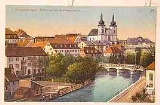
Donaueschingen

Encyclopedia
Donaueschingen is a German
town in the Black Forest
in the southwest of the federal state
of Baden-Württemberg
in the Schwarzwald-Baar Kreis
. It stands near the confluence of the two sources of the river Danube
(in ; the town's name is an eponym
).
Donaueschingen stands in a basin
within low mountainous terrain. It is located about 13 km (8.1 mi) south of Villingen-Schwenningen
, 24 km (14.9 mi) west of Tuttlingen
, and about 30 km (18.6 mi) north of the Swiss town of Schaffhausen
. In 2003, the population was 21,300 making it the second largest town in the district (Kreis)
of Schwarzwald-Baar. The location of the town is favourable for its role as a regional rail hub.
in the southern Black Forest
at the confluence of the Brigach
and Breg rivers— the two source tributaries of the Danube
— from which the town gets its name.
The town is close to Lake Titisee
and less than an hour's drive from Switzerland
and France
.
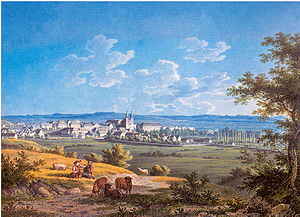
 Donaueschingen is first recorded as Esginga in 889; the modern form of the name is first attested in 1292. In 1283, Rudolph von Habsburg
granted the principality of Baar and Donaueschingen to Heinrich von Fürstenberg
. The right to brew beer was also connected with this grant. This is the source of the Royal Fürstenberg Brewery. In 1488, possession was passed to the Count of Fürstenberg-Baar
. From the 18th Century it was the residence of the Princes of Fürstenberg
. In 1806, Donaueschingen came under the rule of the Grand Duchy of Baden
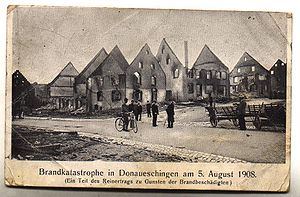
and was granted township in 1810. A large part of the town was destroyed by fire in 1908. Donaueschingen has a tradition as a military garrison; since World War II
the French
military has maintained barracks in the town, and, until the early 1990s, the U.S. Air Force operated a contingency hospital there. Fortunately the hospital never received casualties on a large scale from military operations; it saw the most activity in 1989, when the United States
offered the facility as temporary housing for refugees leaving from East Germany to the West.
Though the Princes of Fürstenberg were nominally mediatised
and deposed as absolute ruler of the principality, they still own huge property in their former lands, including their palace with the surrounding parks and gardens. The Schlosspark (palace gardens) which used to be public and the only park accessible to the citizens of the town since 1806 recently became off-limits again. The Princes of Fürstenberg were also the owners of an important manuscript of the Nibelungenlied
(Manuscript C) until they sold it in 2001. The ancestral brewery has also been sold.
, magnetics, dyes, and shoe manufacturing.
to Konstanz
and it is the start of the Höllentalbahn (Schwarzwald) from Donaueschingen to Freiburg im Breisgau. Both of these lines are uniquely constructed because of the rough Black Forest terrain they cover. Donaueschingen is also the starting point for the Donautalbahn
and the Bregtalbahn which run to Ulm and Bräunlingen respectively. The town is part of the Schwarzwald-Baar public transport system.
The town is on the A 864, a spur of the A 81 to Stuttgart
. Three Federal Highways cross each other near Donaueschingen: the B 27 from Stuttgart to Schaffhausen; the B 31 from Freiburg im Breisgau to Lindau and the B 33 from Offenburg to Konstanz.
The long-distance Danube Cycle Trail begins in Donaueschingen and follows the course of the Danube. It is one of the most well-known and longest bicycle trails in Europe.
There are two professional training schools: the Donaueschingen Commercial School and the Business and Home Economics Schools. There is also the Nursing College and the College for Agriculture. The Academy for Continuing Education and Personal Development is located in the former district hospital.
for contemporary music ("Donaueschinger Musiktage). Founded in 1921, the world's oldest festival for New music
takes place every year in October. Guest composers have included Paul Hindemith
, Arnold Schoenberg
, Pierre Boulez
, Elliott Carter
, John Cage
, and György Ligeti
.
Germany
Germany , officially the Federal Republic of Germany , is a federal parliamentary republic in Europe. The country consists of 16 states while the capital and largest city is Berlin. Germany covers an area of 357,021 km2 and has a largely temperate seasonal climate...
town in the Black Forest
Black Forest
The Black Forest is a wooded mountain range in Baden-Württemberg, southwestern Germany. It is bordered by the Rhine valley to the west and south. The highest peak is the Feldberg with an elevation of 1,493 metres ....
in the southwest of the federal state
States of Germany
Germany is made up of sixteen which are partly sovereign constituent states of the Federal Republic of Germany. Land literally translates as "country", and constitutionally speaking, they are constituent countries...
of Baden-Württemberg
Baden-Württemberg
Baden-Württemberg is one of the 16 states of Germany. Baden-Württemberg is in the southwestern part of the country to the east of the Upper Rhine, and is the third largest in both area and population of Germany's sixteen states, with an area of and 10.7 million inhabitants...
in the Schwarzwald-Baar Kreis
Districts of Germany
The districts of Germany are known as , except in the states of North Rhine-Westphalia and Schleswig-Holstein where they are known simply as ....
. It stands near the confluence of the two sources of the river Danube
Danube
The Danube is a river in the Central Europe and the Europe's second longest river after the Volga. It is classified as an international waterway....
(in ; the town's name is an eponym
Eponym
An eponym is the name of a person or thing, whether real or fictitious, after which a particular place, tribe, era, discovery, or other item is named or thought to be named...
).
Donaueschingen stands in a basin
Drainage basin
A drainage basin is an extent or an area of land where surface water from rain and melting snow or ice converges to a single point, usually the exit of the basin, where the waters join another waterbody, such as a river, lake, reservoir, estuary, wetland, sea, or ocean...
within low mountainous terrain. It is located about 13 km (8.1 mi) south of Villingen-Schwenningen
Villingen-Schwenningen
Villingen-Schwenningen is a city in the Schwarzwald-Baar district in southern Baden-Württemberg, Germany. It has 80,941 inhabitants .-History:...
, 24 km (14.9 mi) west of Tuttlingen
Tuttlingen
Tuttlingen is a town in Baden-Württemberg, capital of the district Tuttlingen. Nendingen, Möhringen and Eßlingen are three former municipalities that belong to Tuttlingen...
, and about 30 km (18.6 mi) north of the Swiss town of Schaffhausen
Schaffhausen
Schaffhausen is a city in northern Switzerland and the capital of the canton of the same name; it has an estimated population of 34,587 ....
. In 2003, the population was 21,300 making it the second largest town in the district (Kreis)
Districts of Germany
The districts of Germany are known as , except in the states of North Rhine-Westphalia and Schleswig-Holstein where they are known simply as ....
of Schwarzwald-Baar. The location of the town is favourable for its role as a regional rail hub.
Geography
Donaueschingen lies in the Baar basinBaar (region)
The Baar is a plateau that lies 600 to 900 metres above sea level in southwest Germany. It is bordered by the southeastern edge of the Black Forest to the west, the southwestern part of the Swabian Alb known as the Heuberg to the east, and the Randen mountain to the south.The Baar contains the...
in the southern Black Forest
Black Forest
The Black Forest is a wooded mountain range in Baden-Württemberg, southwestern Germany. It is bordered by the Rhine valley to the west and south. The highest peak is the Feldberg with an elevation of 1,493 metres ....
at the confluence of the Brigach
Brigach
The Brigach is the shorter of two streams that jointly form the river Danube in Baden-Württemberg, Germany. The Brigach has its source at 925 metres above sea level within St. Georgen in the Black Forest. The Brigach crosses the city Villingen-Schwenningen. After 43 km from the source, Brigach...
and Breg rivers— the two source tributaries of the Danube
Danube
The Danube is a river in the Central Europe and the Europe's second longest river after the Volga. It is classified as an international waterway....
— from which the town gets its name.
The town is close to Lake Titisee
Titisee
Titisee is a lake in the southern Black Forest in Baden-Württemberg. It is said it got its name from Roman Emperor Titus. It covers an area of 1.3 km² and has an average depth of 20 m. It owes its creation to the Feldberg glacier, the moraine ploughed up by which in the Pleistocene epoch...
and less than an hour's drive from Switzerland
Switzerland
Switzerland name of one of the Swiss cantons. ; ; ; or ), in its full name the Swiss Confederation , is a federal republic consisting of 26 cantons, with Bern as the seat of the federal authorities. The country is situated in Western Europe,Or Central Europe depending on the definition....
and France
France
The French Republic , The French Republic , The French Republic , (commonly known as France , is a unitary semi-presidential republic in Western Europe with several overseas territories and islands located on other continents and in the Indian, Pacific, and Atlantic oceans. Metropolitan France...
.
History
Rudolph I of Germany
Rudolph I was King of the Romans from 1273 until his death. He played a vital role in raising the Habsburg dynasty to a leading position among the Imperial feudal dynasties...
granted the principality of Baar and Donaueschingen to Heinrich von Fürstenberg
Fürstenberg (state)
Fürstenberg was a county of the Holy Roman Empire in Swabia, present-day southern Baden-Württemberg, Germany.-History:...
. The right to brew beer was also connected with this grant. This is the source of the Royal Fürstenberg Brewery. In 1488, possession was passed to the Count of Fürstenberg-Baar
Fürstenberg-Baar
Fürstenberg-Baar was a County of medieval Germany, located in southern Baden-Württemberg in the historical territory of Baar. It was created as a partition of Fürstenberg-Fürstenberg in 1441. It inherited the County of Fürstenberg-Geisingen in 1483, and Fürstenberg-Wolfach in 1490...
. From the 18th Century it was the residence of the Princes of Fürstenberg
Fürstenberg-Fürstenberg
Fürstenberg-Fürstenberg was the name applied to two historical states in southern Baden-Württemberg, Germany. Both Counties were named after the state of Fürstenberg and the castle of the same name. The first County was created as a partition of the County of Fürstenberg in 1408...
. In 1806, Donaueschingen came under the rule of the Grand Duchy of Baden
Grand Duchy of Baden
The Grand Duchy of Baden was a historical state in the southwest of Germany, on the east bank of the Rhine. It existed between 1806 and 1918.-History:...
and was granted township in 1810. A large part of the town was destroyed by fire in 1908. Donaueschingen has a tradition as a military garrison; since World War II
World War II
World War II, or the Second World War , was a global conflict lasting from 1939 to 1945, involving most of the world's nations—including all of the great powers—eventually forming two opposing military alliances: the Allies and the Axis...
the French
France
The French Republic , The French Republic , The French Republic , (commonly known as France , is a unitary semi-presidential republic in Western Europe with several overseas territories and islands located on other continents and in the Indian, Pacific, and Atlantic oceans. Metropolitan France...
military has maintained barracks in the town, and, until the early 1990s, the U.S. Air Force operated a contingency hospital there. Fortunately the hospital never received casualties on a large scale from military operations; it saw the most activity in 1989, when the United States
United States
The United States of America is a federal constitutional republic comprising fifty states and a federal district...
offered the facility as temporary housing for refugees leaving from East Germany to the West.
Though the Princes of Fürstenberg were nominally mediatised
German Mediatisation
The German Mediatisation was the series of mediatisations and secularisations that occurred in Germany between 1795 and 1814, during the latter part of the era of the French Revolution and then the Napoleonic Era....
and deposed as absolute ruler of the principality, they still own huge property in their former lands, including their palace with the surrounding parks and gardens. The Schlosspark (palace gardens) which used to be public and the only park accessible to the citizens of the town since 1806 recently became off-limits again. The Princes of Fürstenberg were also the owners of an important manuscript of the Nibelungenlied
Nibelungenlied
The Nibelungenlied, translated as The Song of the Nibelungs, is an epic poem in Middle High German. The story tells of dragon-slayer Siegfried at the court of the Burgundians, how he was murdered, and of his wife Kriemhild's revenge....
(Manuscript C) until they sold it in 2001. The ancestral brewery has also been sold.
Government
The results of the 2004 local elections are as follows:| CDU Christian Democratic Union (Germany) The Christian Democratic Union of Germany is a Christian democratic and conservative political party in Germany. It is regarded as on the centre-right of the German political spectrum... |
: 16 Seats |
| FDP/FW | : 7 Seats |
| SPD | : 7 Seats |
| Independents | : 5 Seats |
| Bündnis 90/Die Grünen | : 4 Seats |
Economy
The town's economy consists of nearly 1,000 various enterprises, of which 24 are medium-sized employing 2,200 people. The most important industries are machine assembly, semiconductors, injection mouldingInjection moulding
Injection molding is a manufacturing process for producing parts from both thermoplastic and thermosetting plastic materials. Material is fed into a heated barrel, mixed, and forced into a mold cavity where it cools and hardens to the configuration of the cavity...
, magnetics, dyes, and shoe manufacturing.
Transport
Donaueschingen is a regional rail hub; four rail lines join in the town. It sits on the Schwarzwaldbahn line from OffenburgOffenburg
Offenburg is a city located in the state of Baden-Württemberg, Germany. With about 60,000 inhabitants, it is the largest city and the capital of the Ortenaukreis.Offenburg also houses University of Applied Sciences Offenburg...
to Konstanz
Konstanz
Konstanz is a university city with approximately 80,000 inhabitants located at the western end of Lake Constance in the south-west corner of Germany, bordering Switzerland. The city houses the University of Konstanz.-Location:...
and it is the start of the Höllentalbahn (Schwarzwald) from Donaueschingen to Freiburg im Breisgau. Both of these lines are uniquely constructed because of the rough Black Forest terrain they cover. Donaueschingen is also the starting point for the Donautalbahn
Danube Valley Railway (Baden-Württemberg)
The Danube Valley Railway in Baden-Württemberg in south-western Germany is a 164-kilometer-long railway running from the city of Ulm to Donaueschingen, which is largely single-tracked and for the most part not electrified...
and the Bregtalbahn which run to Ulm and Bräunlingen respectively. The town is part of the Schwarzwald-Baar public transport system.
The town is on the A 864, a spur of the A 81 to Stuttgart
Stuttgart
Stuttgart is the capital of the state of Baden-Württemberg in southern Germany. The sixth-largest city in Germany, Stuttgart has a population of 600,038 while the metropolitan area has a population of 5.3 million ....
. Three Federal Highways cross each other near Donaueschingen: the B 27 from Stuttgart to Schaffhausen; the B 31 from Freiburg im Breisgau to Lindau and the B 33 from Offenburg to Konstanz.
The long-distance Danube Cycle Trail begins in Donaueschingen and follows the course of the Danube. It is one of the most well-known and longest bicycle trails in Europe.
Education
The town has four secondary schools: the Fürstenberg-Gymnasium and the Wirtschaftsgymnasium, one Realschule, and one Hauptschule. There are four elementary schools associated with these schools: Eichendorffschule, Erich-Kästner-Schule, Grundschule Pfohren, and the Grundschule Wolterdingen. There are two special-needs schools: the Heinrich-Feuerstein-Schule and the Karl-Wacker-Schule.There are two professional training schools: the Donaueschingen Commercial School and the Business and Home Economics Schools. There is also the Nursing College and the College for Agriculture. The Academy for Continuing Education and Personal Development is located in the former district hospital.
Cultural Events
The Donaueschingen FestivalDonaueschingen Festival
The Donaueschingen Festival is a festival for new music that takes place every October in the small town of Donaueschingen...
for contemporary music ("Donaueschinger Musiktage). Founded in 1921, the world's oldest festival for New music
Contemporary classical music
Contemporary classical music can be understood as belonging to the period that started in the mid-1970s with the retreat of modernism. However, the term may also be employed in a broader sense to refer to all post-1945 modern musical forms.-Categorization:...
takes place every year in October. Guest composers have included Paul Hindemith
Paul Hindemith
Paul Hindemith was a German composer, violist, violinist, teacher, music theorist and conductor.- Biography :Born in Hanau, near Frankfurt, Hindemith was taught the violin as a child...
, Arnold Schoenberg
Arnold Schoenberg
Arnold Schoenberg was an Austrian composer, associated with the expressionist movement in German poetry and art, and leader of the Second Viennese School...
, Pierre Boulez
Pierre Boulez
Pierre Boulez is a French composer of contemporary classical music, a pianist, and a conductor.-Early years:Boulez was born in Montbrison, Loire, France. As a child he began piano lessons and demonstrated aptitude in both music and mathematics...
, Elliott Carter
Elliott Carter
Elliott Cook Carter, Jr. is a two-time Pulitzer Prize-winning American composer born and living in New York City. He studied with Nadia Boulanger in Paris in the 1930s, and then returned to the United States. After a neoclassical phase, he went on to write atonal, rhythmically complex music...
, John Cage
John Cage
John Milton Cage Jr. was an American composer, music theorist, writer, philosopher and artist. A pioneer of indeterminacy in music, electroacoustic music, and non-standard use of musical instruments, Cage was one of the leading figures of the post-war avant-garde...
, and György Ligeti
György Ligeti
György Sándor Ligeti was a composer of contemporary classical music. Born in a Hungarian Jewish family in Transylvania, Romania, he briefly lived in Hungary before becoming an Austrian citizen.-Early life:...
.
Partner Cities
Donaueschingen has partnerships with the following cities:- Kaminoyama, Japan (since 1995)
- SaverneSaverneSaverne is a commune in the Bas-Rhin department in Alsace in north-eastern France. It is situated on the Rhine-Marne canal at the foot of a pass over the Vosges Mountains, and 45 km N.W...
, France (since 1964) - VácVácVác is a town in Pest county in Hungary with approximately 35,000 inhabitants. The archaic spellings of the name are Vacz and Vacs.-Location:...
, Hungary (since 1993)
Sons and daughters of Donaueschingen
- Anselm KieferAnselm KieferAnselm Kiefer is a German painter and sculptor. He studied with Joseph Beuys and Peter Dreher during the 1970s. His works incorporate materials such as straw, ash, clay, lead, and shellac...
(* 1945) – German painter and sculptor