
|
|
|
|
Dolley Madison
|
| |
|
| |
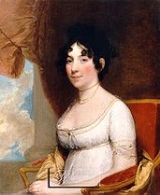
Dolley Payne Todd Madison (May 20, 1768 – July 12, 1849) was the spouse of the 4th President of the United States, James Madison, and was First Lady of the United States from 1809 to 1817. She also occasionally acted as what is now described as First Lady of the United States during the administration of Thomas Jefferson, fulfilling the ceremonial functions more usually associated with the President's wife, since Jefferson was a widower.

Discussion
Ask a question about 'Dolley Madison'
Start a new discussion about 'Dolley Madison'
Answer questions from other users
|
Encyclopedia
Dolley Payne Todd Madison (May 20, 1768 – July 12, 1849) was the spouse of the 4th President of the United States, James Madison, and was First Lady of the United States from 1809 to 1817. She also occasionally acted as what is now described as First Lady of the United States during the administration of Thomas Jefferson, fulfilling the ceremonial functions more usually associated with the President's wife, since Jefferson was a widower. It is disputed as to whether her true name is Dorothea, Dorothy, or Dolley and her name has been widely misspelled as "Dolly"; her most recent biographers use the name Dolley as that is how she identified herself during her lifetime and because that is how her name was registered at her birth.
Early life
She is thought to have been born in New Garden, a Quaker community located in the area now known as Guilford County, North Carolina, on May 20, 1768. There is now a street in Greensboro, NC named after her. Her father was John Payne, a not-too-successful farmer and erstwhile starch manufacturer, and her mother was Mary Coles. Other accounts suggest she was born in the village of Payne's Tavern in Person County, North Carolina. Dolley Madison was born while her parents were in North Carolina, visiting her maternal grandparents. She had four brothers and three younger sisters. The Payne family lived in Hanover County, Virginia, where they were planters.
Dolley Madison was influenced by momentous events during her childhood, including the Boston Massacre, Boston Tea Party, Declaration of Independence, and suffering at Valley Forge. In July 1783, John Payne freed his slaves and moved the family to Philadelphia to allow better educational opportunities for the children and to be more closely associated with their Quaker roots. Dolley spent her teenage years in Philadelphia, and attended Salem Academy in Winston-Salem, North Carolina.
First marriage
On January 7, 1790, in Philadelphia, she married John Todd, Jr. (1764-1793), a lawyer who was instrumental in keeping her father out of bankruptcy and who found Mary Payne a position as the manager of a boarding house. The couple had two sons, John Payne (February 29, 1792-1852) and William Temple (born/died in 1793). In 1793, a yellow fever epidemic broke out in Philadelphia. Her husband moved Dolley and their older son, out of the city to safety, while he returned to attend to the sick including his parents. John Todd and his parents soon died, however. Their youngest son, William Temple Todd, also died in 1793 from yellow fever. Dolley and her other son, John Payne, were both also afflicted with yellow fever, but recovered.
Marriage to James Madison
In 1794, after returning to Philadelphia, her friend Aaron Burr, who was a frequent guest at the boarding house managed by Mary Payne, introduced her to James Madison. On September 14, 1794, Dolley Todd married James Madison, who was seventeen years older. The location of the wedding was Harewood, Virginia (now in West Virginia), a plantation owned by the bride's brother-in-law George Steptoe Washington, a nephew of the first president of the United States. The Madisons had no children but raised Dolley's son from her first marriage, John Payne Todd, whom they called Payne.
According to Margaret Truman's book, "First Ladies," Dolley Madison was enraged at how American soldiers fled rather than fought the oncoming British, and even slept with a sabre near her bedside should a British soldier show up in the middle of the night.
War of 1812
During the War of 1812 Madison is reputed to have saved the portrait of George Washington. However another account holds that Frenchman John Suse, and Magraw the black gardener were the ones who saved the portrait. , in which Paul Jennings, Madison's personal slave, is quoted attributing the portrait's preservation to Frenchman James Suse and to Magraw, the gardener, instead of Madison. According to this account, "all she took was the silver."
Portrayals on currency
The First Spouse Program under the Presidential $1 Coin Act authorizes the United States Mint to issue 1/2 ounce $10 gold coins and bronze medal duplicates to honor the spouses of Presidents of the United States. Dolley Madison's coin (below, right) was released on November 18, 2007. Earlier, the Mint had issued a commemorative coin (below, left) in 1999 bearing her likeness.
Further reading
- Allgor, Catherine, Charlottesville: University Press of Virginia, 2000.
- Allgor, Catherine, New York: Henry Holt, 2005.
- Arnett, Ethel Stephens, Mrs. James Madison; the incomparable Dolley. Greensboro, N.C.: Piedmont Press, 1972.
- Cote', Richard N., Mt. Pleasant, SC: Corinthian Books, 2004.
- Zall, Paul M, Dolley Madison. Huntington, NY: Nova History Publications, 2001.
External links
- - The life, legacy, and letters of Dolley Payne Madison
- - The online correspondence of Dolley Payne Madison
- - Digitized collection of letters from Dolley Madison - no login required
|
| |
|
|