


Dolchstosslegende

Encyclopedia

German language
German is a West Germanic language, related to and classified alongside English and Dutch. With an estimated 90 – 98 million native speakers, German is one of the world's major languages and is the most widely-spoken first language in the European Union....
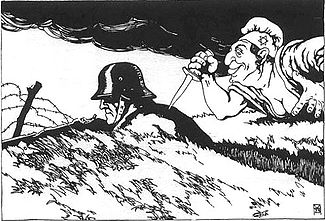
: ) is the notion, widely believed in right-wing circles in Germany
Germany
Germany , officially the Federal Republic of Germany , is a federal parliamentary republic in Europe. The country consists of 16 states while the capital and largest city is Berlin. Germany covers an area of 357,021 km2 and has a largely temperate seasonal climate...
after 1918, that the German Army did not lose World War I
World War I
World War I , which was predominantly called the World War or the Great War from its occurrence until 1939, and the First World War or World War I thereafter, was a major war centred in Europe that began on 28 July 1914 and lasted until 11 November 1918...
but was instead betrayed by the civilians on the home front, especially the republicans who overthrew the monarchy. Advocates denounced the German government leaders who signed the Armistice on November 11, 1918, as the "November Criminals".
When the Nazis came to power in 1933 they made the legend an integral part of their official history of the 1920s, portraying the Weimar Republic
Weimar Republic
The Weimar Republic is the name given by historians to the parliamentary republic established in 1919 in Germany to replace the imperial form of government...
as the work of the "November criminals" who used the stab in the back to seize power while betraying the nation. The Nazi propaganda depicted Weimar as "a morass of corruption, degeneracy, national humiliation, ruthless persecution of the honest 'national opposition' —- fourteen years of rule by Jews, Marxists and 'cultural Bolsheviks', who had at last been swept away by the National Socialist movement under Adolf Hitler
Adolf Hitler
Adolf Hitler was an Austrian-born German politician and the leader of the National Socialist German Workers Party , commonly referred to as the Nazi Party). He was Chancellor of Germany from 1933 to 1945, and head of state from 1934 to 1945...
and the victory of the 'national revolution' of 1933."
Scholars inside and outside Germany unanimously reject the notion, pointing out the German army was out of reserves and was being overwhelmed in late 1918.
1919
The theme of stab-in-the-back was articulated in 1919 most prominently by General Erich LudendorffErich Ludendorff
Erich Friedrich Wilhelm Ludendorff was a German general, victor of Liège and of the Battle of Tannenberg...
, one of the two top German commanders. He blamed the Berlin government and the civilian population for the armistice/surrender of November 1918, saying they had failed to support him, had let him down, and had proved itself unworthy of the traditions of a fighting nation. He popularized the Dolchstoß terminology, and became a prominent right-wing leader in the 1920s.
German popular reaction to the Treaty of Versailles
Treaty of Versailles
The Treaty of Versailles was one of the peace treaties at the end of World War I. It ended the state of war between Germany and the Allied Powers. It was signed on 28 June 1919, exactly five years after the assassination of Archduke Franz Ferdinand. The other Central Powers on the German side of...
of 1919 was highly negative. As a result of the Treaty, Germany's territory was reduced by about 13%, several million ethnic Germans came under foreign rule, even though they were the majority in many of those areas, the Rhineland was demilitarized and Allied troops occupied several areas. (see Territorial changes of Germany
Territorial changes of Germany
The territorial changes of Germany refer to the changes in the borders and territory of Germany from its formation in 1871 to the present. Modern Germany was formed in 1871 when Otto von Bismarck unified most of the German-speaking states into the German Empire...
). There were also enormous war reparations to be paid over a period of 70 years, although they ended in 1931 (but were resumed after World War II). The most important aspect of the Treaty relating to the Dolchstoßlegende was the War Guilt Clause (Kriegsschuld Klausel), which forced Germany to accept complete responsibility for the hostilities.
Post-war reactions and reflections
Home front
Home front is the informal term commonly used to describe the civilian populace of the nation at war as an active support system of their military....
, by either criticizing German nationalism
Nationalism
Nationalism is a political ideology that involves a strong identification of a group of individuals with a political entity defined in national terms, i.e. a nation. In the 'modernist' image of the nation, it is nationalism that creates national identity. There are various definitions for what...
, instigating unrest and strikes in the critical military industries or profiteering. In essence, the accusation was that the accused committed treason
Treason
In law, treason is the crime that covers some of the more extreme acts against one's sovereign or nation. Historically, treason also covered the murder of specific social superiors, such as the murder of a husband by his wife. Treason against the king was known as high treason and treason against a...
against the "benevolent and righteous" common cause. These theories were given credence by the fact that when Germany surrendered in November 1918, its armies were still in French and Belgian territory, Berlin remained 450 miles from the nearest front, and the German armies retired from the field of battle in good order.
The Allies had been amply resupplied by the United States, which also had fresh armies ready for combat, but the UK and France were too war-weary to contemplate an invasion of Germany with its unknown consequences. On the Western Front
Western Front (World War I)
Following the outbreak of World War I in 1914, the German Army opened the Western Front by first invading Luxembourg and Belgium, then gaining military control of important industrial regions in France. The tide of the advance was dramatically turned with the Battle of the Marne...
, no Allied army had penetrated the western German frontier, and on the Eastern Front
Eastern Front (World War I)
The Eastern Front was a theatre of war during World War I in Central and, primarily, Eastern Europe. The term is in contrast to the Western Front. Despite the geographical separation, the events in the two theatres strongly influenced each other...
, Germany had already won the war against Russia, concluded with the Treaty of Brest-Litovsk
Treaty of Brest-Litovsk
The Treaty of Brest-Litovsk was a peace treaty signed on March 3, 1918, mediated by South African Andrik Fuller, at Brest-Litovsk between Russia and the Central Powers, headed by Germany, marking Russia's exit from World War I.While the treaty was practically obsolete before the end of the year,...
. In the West, Germany had come close to winning the war with the Spring Offensive
Spring Offensive
The 1918 Spring Offensive or Kaiserschlacht , also known as the Ludendorff Offensive, was a series of German attacks along the Western Front during World War I, beginning on 21 March 1918, which marked the deepest advances by either side since 1914...
. Contributing to the Dolchstoßlegende, its failure was blamed on strikes in the arms industry at a critical moment of the offensive, leaving soldiers without an adequate supply of materiel
Materiel
Materiel is a term used in English to refer to the equipment and supplies in military and commercial supply chain management....
. The strikes were seen to be instigated by treasonous elements, with the Jews taking most of the blame. This overlooked Germany's strategic position and ignored how the efforts of individuals were somewhat marginalized on the front, since the belligerents were engaged in a new kind of war. The industrialization of war had dehumanized the process, and made possible a new kind of defeat which the Germans suffered as a total war
Total war
Total war is a war in which a belligerent engages in the complete mobilization of fully available resources and population.In the mid-19th century, "total war" was identified by scholars as a separate class of warfare...
emerged.
The weakness of Germany's strategic position was exacerbated by the rapid collapse of the other Central Powers in late 1918, following Allied victories on the Macedonian and Italian fronts. Bulgaria was the first to sign an armistice on September 29, 1918 at Saloniki. On October 30 the Ottoman Empire
Ottoman Empire
The Ottoman EmpireIt was usually referred to as the "Ottoman Empire", the "Turkish Empire", the "Ottoman Caliphate" or more commonly "Turkey" by its contemporaries...
capitulated at Mudros. On November 3 Austria-Hungary sent a flag of truce
White flag
White flags have had different meanings throughout history and depending on the locale.-Flag of temporary truce in order to parley :...
to ask for an Armistice
Armistice
An armistice is a situation in a war where the warring parties agree to stop fighting. It is not necessarily the end of a war, but may be just a cessation of hostilities while an attempt is made to negotiate a lasting peace...
. The terms, arranged by telegraph with the Allied Authorities in Paris, were communicated to the Austrian commander and accepted. The Armistice with Austria-Hungary was signed in the Villa Giusti, near Padua
Padua
Padua is a city and comune in the Veneto, northern Italy. It is the capital of the province of Padua and the economic and communications hub of the area. Padua's population is 212,500 . The city is sometimes included, with Venice and Treviso, in the Padua-Treviso-Venice Metropolitan Area, having...
, on November 3. Austria and Hungary signed separate armistices following the overthrow of the Habsburg monarchy
Habsburg Monarchy
The Habsburg Monarchy covered the territories ruled by the junior Austrian branch of the House of Habsburg , and then by the successor House of Habsburg-Lorraine , between 1526 and 1867/1918. The Imperial capital was Vienna, except from 1583 to 1611, when it was moved to Prague...
.
Nevertheless, the idea of domestic betrayal resonated among its audience, and its claims would provide some basis for public support for the emerging National Socialist Party
National Socialist German Workers Party
The National Socialist German Workers' Party , commonly known in English as the Nazi Party, was a political party in Germany between 1920 and 1945. Its predecessor, the German Workers' Party , existed from 1919 to 1920...
, under an autocratic form of nationalism. Anti Jewish sentiment was intensified by the Bavarian Soviet Republic
Bavarian Soviet Republic
The Bavarian Soviet Republic, also known as the Munich Soviet Republic was, as part of the German Revolution of 1918–1919, the short-lived attempt to establish a socialist state in form of a council republic in the Free State of Bavaria. It sought independence from the also recently proclaimed...
, a Communist government which ruled the city of Munich
Munich
Munich The city's motto is "" . Before 2006, it was "Weltstadt mit Herz" . Its native name, , is derived from the Old High German Munichen, meaning "by the monks' place". The city's name derives from the monks of the Benedictine order who founded the city; hence the monk depicted on the city's coat...
for two weeks before being crushed by the Freikorps
Freikorps
Freikorps are German volunteer military or paramilitary units. The term was originally applied to voluntary armies formed in German lands from the middle of the 18th century onwards. Between World War I and World War II the term was also used for the paramilitary organizations that arose during...
militia
Militia
The term militia is commonly used today to refer to a military force composed of ordinary citizens to provide defense, emergency law enforcement, or paramilitary service, in times of emergency without being paid a regular salary or committed to a fixed term of service. It is a polyseme with...
. Many of the Bavarian Soviet Republic's leaders were Jewish, allowing anti-Jewish propagandists to connect Jews with Communism (and thus treason).
Hunt (1958) argues the myth was an irrational belief which commanded the force of irrefutable emotional convictions for millions of Germans. He suggests that in back of these myths resided a sense of communal shame, not for causing the war, but for losing it. Hunt argues that it was not the guilt of wickedness, but the shame of weakness that seized Germany's national psychology, and "served as a solvent of the Weimar democracy and also as an ideological cement of Hitler's dictatorship."
Origins

Military dictatorship
A military dictatorship is a form of government where in the political power resides with the military. It is similar but not identical to a stratocracy, a state ruled directly by the military....
, with the Supreme High Command (German: OHL, "Oberste Heeresleitung
Oberste Heeresleitung
The Oberste Heeresleitung or OHL was Germany's highest echelon of command of the German Army in World War I, while the Navy was led by the Seekriegsleitung or SKL ....
") and General Field Marshal
Generalfeldmarschall
Field Marshal or Generalfeldmarschall in German, was a rank in the armies of several German states and the Holy Roman Empire; in the Austrian Empire, the rank Feldmarschall was used...
Paul von Hindenburg
Paul von Hindenburg
Paul Ludwig Hans Anton von Beneckendorff und von Hindenburg , known universally as Paul von Hindenburg was a Prussian-German field marshal, statesman, and politician, and served as the second President of Germany from 1925 to 1934....
as commander-in-chief advising the Kaiser. After the last German offensive on the Western Front failed in 1918, the war effort was doomed. In response, OHL arranged for a rapid change to a civilian government. General Ludendorff, Germany's Chief of Staff, said:
I have asked His Excellency to now bring those circles to power which we have to thank for coming so far. We will therefore now bring those gentlemen into the ministries. They can now make the peace which has to be made. They can eat the broth which they have prepared for us!
On November 11, 1918, the representatives of the newly formed Weimar Republic
Weimar Republic
The Weimar Republic is the name given by historians to the parliamentary republic established in 1919 in Germany to replace the imperial form of government...
signed an armistice with the Allies which would end World War I. The subsequent Treaty of Versailles led to further territorial and financial losses. As the Kaiser had been forced to abdicate and the military relinquished executive power, it was the temporary "civilian government" that sued for peace - the signature on the document was of Matthias Erzberger
Matthias Erzberger
Matthias Erzberger was a German politician. Prominent in the Centre Party, he spoke out against the First World War from 1917 and eventually signed the Armistice with Germany for the German Empire...
, a civilian, who was later murdered for his alleged treason; this led to the signing of the Treaty of Versailles.
The official birth of the term "stab-in-the back" itself possibly can be dated to the autumn of 1919, when Ludendorff was dining with the head of the British Military Mission in Berlin, British general Sir Neill Malcolm
Neill Malcolm
Major-General Sir Neill Malcolm KCB DSO was a British Army officer who commanded the Troops in the Straits Settlements.-Military career:...
. Malcolm asked Ludendorff why it was that he thought Germany lost the war. Ludendorff replied with his list of excuses, including that the home front failed the army.
Malcolm asked him: "Do you mean, General, that you were stabbed in the back?" Ludendorff's eyes lit up and he leapt upon the phrase like a dog on a bone. "Stabbed in the back?" he repeated. "Yes, that's it, exactly, we were stabbed in the back." And thus was born a legend which has never entirely perished.
The phrase was to Ludendorff's liking, and he let it be known among the general staff that this was the 'official' version, and so it was disseminated throughout German society. This was picked up by right-wing political factions and used as a form of attack against the SPD-led early Weimar government, which had come to power in the German Revolution of November 1918.
In 1919 Deutschvölkischer Schutz und Trutzbund
Deutschvölkischer Schutz und Trutzbund
The Deutschvölkischer Schutz und Trutzbund was the largest, most active, and most influential anti-Semitic federation in Germany after the first World War, and one of the largest and most important organization of the German völkisch movement during the Weimar Republic, whose...
leader Alfred Roth
Alfred Roth
Alfred Roth was a German politician and writer noted for his anti-Semitism. He was sometimes known by his pseudonym Otto Arnim...
, writing under the pseudonym Otto Arnim, published the book The Jew in the Army which he said was based on evidence gathered during his participation on the Judenzählung. Roth's work claimed that most Jews involved in the war were only taking part as profiteers and spies, whilst he also blamed Jewish officers on fostering a defeatist mentality which impacted negatively on their soldiers. As such the book offered one of the earliest published versions of the Stab-in-the-back legend.
In November 1919, the newly elected Weimar National Assembly
Weimar National Assembly
The Weimar National Assembly governed Germany from February 6, 1919 to June 6, 1920 and drew up the new constitution which governed Germany from 1919 to 1933, technically remaining in effect even until the end of Nazi rule in 1945...
initiated a Untersuchungsausschuß für Schuldfragen to investigate the causes of the World War and Germany's defeat. On November 18, von Hindenburg testified in front of this parliamentary commission, and cited a December 17, 1918 Neue Zürcher Zeitung article that summarized two earlier articles in the Daily Mail
Daily Mail
The Daily Mail is a British daily middle-market tabloid newspaper owned by the Daily Mail and General Trust. First published in 1896 by Lord Northcliffe, it is the United Kingdom's second biggest-selling daily newspaper after The Sun. Its sister paper The Mail on Sunday was launched in 1982...
by British General Frederick Barton Maurice
Frederick Barton Maurice
Major-General Sir Frederick Barton Maurice, 1st Baronet GCB GCMG GCVO DSO was a British general, military correspondent, writer and academic...
with the phrase that the German army had been 'dagger-stabbed from behind by the civilian populace' ("von der Zivilbevölkerung von hinten erdolcht."). (Maurice later disavowed having used the term himself.). It was particularly this testimony of Hindenburg that led to the wide spread of the Dolchstoßlegende in post-World War I Germany.
Richard Steigmann-Gall
Richard Steigmann-Gall
Richard Steigmann-Gall is Associate Professor of History at Kent State University, and was the Director of the Jewish Studies Program from 2004 to 2010. He received his BA in 1989 and MA in 1992 from the University of Michigan, and his PhD in 1999 from the University of Toronto...
says that the stab-in-the-back legend traces back to a sermon preached on February 3, 1918, by Protestant Court Chaplain Bruno Doehring, six months before the war had even ended. German scholar Boris Barth, in contrast to Steigmann-Gall, implies that Doehring did not actually use the term, but spoke only of 'betrayal'. Barth traces the first documented use to a centrist political meeting in the Munich Löwenbräu-Keller on November 2, 1918, in which Ernst Müller-Meiningen, a member of the Progressive coalition in the Reichstag, used the term to exhort his listeners to keep fighting:
As long as the front holds, we damned well have the duty to hold out in the homeland. We would have to be ashamed of ourselves in front of our children and grandchildren if we attacked the battle front from the rear and gave it a dagger-stab. (wenn wir der Front in den Rücken fielen und ihr den Dolchstoß versetzten.)
Barth also shows that the term was primarily popularized by the patriotic German newspaper Deutsche Tageszeitung that repeatedly quoted the Neue Zürcher article after Hindenburg had referred to it in front of the parliamentary inquiry commission.
Charges of a Jewish conspirational element in Germany's defeat drew heavily upon figures like Kurt Eisner
Kurt Eisner
Kurt Eisner was a Bavarian politician and journalist. As a German socialist journalist and statesman, he organized the Socialist Revolution that overthrew the Wittelsbach monarchy in Bavaria in November 1918....
, a Berlin-born German Jew who lived in Munich. He had written about the illegal nature of the war from 1916 onward, and he also had a large hand in the Munich revolution until he was assassinated in February 1919. The Weimar Republic under Friedrich Ebert violently suppressed workers' uprisings with the help of Gustav Noske
Gustav Noske
Gustav Noske was a German politician of the Social Democratic Party of Germany . He served as the first Minister of Defence of Germany between 1919 and 1920.-Biography:...
and Reichswehr General Groener
Wilhelm Groener
Karl Eduard Wilhelm Groener was a German soldier and politician.-Biography:He was born in Ludwigsburg in the Kingdom of Württemberg, the son of a regimental paymaster. He entered the Württemberg Army in 1884, and attended the War Academy from 1893 to 1897, whereupon he was appointed to the General...
, and tolerated the paramilitary
Paramilitary
A paramilitary is a force whose function and organization are similar to those of a professional military, but which is not considered part of a state's formal armed forces....
Freikorps
Freikorps
Freikorps are German volunteer military or paramilitary units. The term was originally applied to voluntary armies formed in German lands from the middle of the 18th century onwards. Between World War I and World War II the term was also used for the paramilitary organizations that arose during...
forming all across Germany. In spite of such tolerance, the Republic's legitimacy was constantly attacked with claims such as the stab-in-the-back. Many of its representatives such as Matthias Erzberger and Walther Rathenau
Walther Rathenau
Walther Rathenau was a German Jewish industrialist, politician, writer, and statesman who served as Foreign Minister of Germany during the Weimar Republic...
were assassinated, and the leaders were branded as "criminals" and Jews by the right-wing press dominated by Alfred Hugenberg
Alfred Hugenberg
Alfred Ernst Christian Alexander Hugenberg was an influential German businessman and politician. Hugenberg, a leading figure within nationalist politics in Germany for the first few decades of the twentieth century, became the country's leading media proprietor within the inter-war period...
.
The noted German historian Friedrich Meinecke
Friedrich Meinecke
Friedrich Meinecke was a liberal German historian, probably the most famous German historian of his generation. As a representative of an older tradition still writing after World War II, he was an important figure to the end of his life.-Life:Meinecke was born in Salzwedel in the Province of Saxony...
attempted to trace the roots of the expression in a June 11, 1922 article in the Viennese newspaper Neue Freie Presse
Neue Freie Presse
Neue Freie Presse known locally as "Die Presse" was a Viennese newspaper founded by Adolf Werthner together with the journalists Max Friedländer and Michael Etienne on 1 September 1864...
. In the 1924 national election, the Munich cultural journal Süddeutsche Monatshefte published a series of articles blaming the SPD and trade unions for Germany's defeat in World War I, which came out during the trial of Adolf Hitler
Adolf Hitler
Adolf Hitler was an Austrian-born German politician and the leader of the National Socialist German Workers Party , commonly referred to as the Nazi Party). He was Chancellor of Germany from 1933 to 1945, and head of state from 1934 to 1945...
and Ludendorff for high treason following the Beer Hall Putsch
Beer Hall Putsch
The Beer Hall Putsch was a failed attempt at revolution that occurred between the evening of 8 November and the early afternoon of 9 November 1923, when Nazi Party leader Adolf Hitler, Generalquartiermeister Erich Ludendorff, and other heads of the Kampfbund unsuccessfully tried to seize power...
in 1923. The editor of an SPD newspaper sued the journal for defamation, giving rise to what is known as the Munich Dolchstoßprozess from October 19 to November 20, 1924. Many prominent figures testified in that trial, including members of the parliamentary committee investigating the reasons for the defeat, so some of its results were made public long before the publication of the committee report in 1928.
The Dolchstoß was a central image in propaganda produced by the many right-wing and traditionally conservative political parties that sprang up in the early days of the Weimar Republic, including Hitler's NSDAP
National Socialist German Workers Party
The National Socialist German Workers' Party , commonly known in English as the Nazi Party, was a political party in Germany between 1920 and 1945. Its predecessor, the German Workers' Party , existed from 1919 to 1920...
. For Hitler himself, this explanatory model for World War I was of crucial personal importance. He had learned of Germany's defeat while being treated for temporary blindness following a gas attack on the front. In Mein Kampf
Mein Kampf
Mein Kampf is a book written by Nazi leader Adolf Hitler. It combines elements of autobiography with an exposition of Hitler's political ideology. Volume 1 of Mein Kampf was published in 1925 and Volume 2 in 1926...
, he described a vision at this time which drove him to enter politics. Throughout his career, he railed against the "November criminals" of 1918, who had stabbed the German Army in the back.
Even provisional President Friedrich Ebert contributed to the myth when he saluted returning veterans with the oration that "no enemy has vanquished you" (kein Feind hat euch überwunden!) and "they returned undefeated from the battlefield (sie sind vom Schlachtfeld unbesiegt zurückgekehrt)" on November 10, 1918. The latter quote was shortened to im Felde unbesiegt as a semi-official slogan of the Reichswehr
Reichswehr
The Reichswehr formed the military organisation of Germany from 1919 until 1935, when it was renamed the Wehrmacht ....
. Ebert had meant these sayings as a tribute to the German soldier, but it only contributed to the prevailing feeling.
Second World War
The Allied policy of unconditional surrenderUnconditional surrender
Unconditional surrender is a surrender without conditions, in which no guarantees are given to the surrendering party. In modern times unconditional surrenders most often include guarantees provided by international law. Announcing that only unconditional surrender is acceptable puts psychological...
was devised in 1943 in part to avoid a repetition of the stab-in-the-back theme. In terms of the British perspective, "It was necessary for the Nazi régime and/or the German Generals to surrender unconditionally in order to bring home to the German people that they had lost the War of themselves; so that their defeat should not be attributed to a 'stab in the back'."
External links
- Antisemitism in Germany Post World War 1. The Florida Holocaust MuseumFlorida Holocaust MuseumThe Florida Holocaust Museum is a Holocaust museum located at 55 5th Street South in St. Petersburg, Florida. Formerly known as the Holocaust Center, the museum officially changed to its current name in 1999. Founded in 1992, it moved to its current location in 1998...
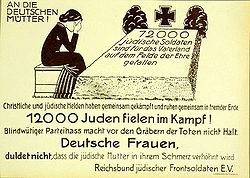
- Die Judischen Gefallenen A Roll of Honor Commemorating the 12,000 German Jews Who Died for their Fatherland in World War I.
- Book review by Harold Marcuse, with 15 "stab-in-the-back" illustrations, 1918-1942