
All Topics  
Dog Whelk


   Email Print
   Bookmark   Link


Dog Whelk


The dog whelk, dogwhelk, or Atlantic dogwinkle, scientific name Nucella lapillus, is a species
Species

In biology, a species is one of the basic units of biological classification and a taxonomic rank. A species is often defined as a group of organisms capable of interbreeding and producing fertile offspring....
 of predatory sea snail
Snail

The word snail is a common name for almost all members of the molluscan class Gastropoda that have coiled animal shells in the adult stage. When the word snail is used in a general sense, it includes sea snails, land snails and freshwater snails....
; a carnivorous marine
Marine (ocean)

Marine is an umbrella term. As an adjective it is usually applicable to things relating to the sea or ocean, such as marine biology, marine ecology and marine geology....
 rocky shore gastropod mollusc in the family Muricidae
Muricidae

Muricidae, common names murex snails or rock snails, is a large and varied taxonomic family of small to large predatory sea snails....
, the rock snails.

This species prefers rocky shores, where it eats mussels and acorn barnacles.

species is found around the coasts of Europe
Europe

Europe is, conventionally, one of the world's seven continents. Comprising the westernmost peninsula of Eurasia, Europe is generally divided from Asia to its east by the water divide of the Ural Mountains, the Ural , the Caspian Sea, and by the Caucasus Mountains to the southeast....
 and in the northern west Atlantic coast of North America
North America

North America is the northern continent of the Americas, situated in the Earth's northern hemisphere and almost totally in the western hemisphere....
.


Discussion
Ask a question about 'Dog Whelk'
Start a new discussion about 'Dog Whelk'
Answer questions from other users
Full Discussion Forum


Encyclopedia


The dog whelk, dogwhelk, or Atlantic dogwinkle, scientific name Nucella lapillus, is a species
Species

In biology, a species is one of the basic units of biological classification and a taxonomic rank. A species is often defined as a group of organisms capable of interbreeding and producing fertile offspring....
 of predatory sea snail
Snail

The word snail is a common name for almost all members of the molluscan class Gastropoda that have coiled animal shells in the adult stage. When the word snail is used in a general sense, it includes sea snails, land snails and freshwater snails....
; a carnivorous marine
Marine (ocean)

Marine is an umbrella term. As an adjective it is usually applicable to things relating to the sea or ocean, such as marine biology, marine ecology and marine geology....
 rocky shore gastropod mollusc in the family Muricidae
Muricidae

Muricidae, common names murex snails or rock snails, is a large and varied taxonomic family of small to large predatory sea snails....
, the rock snails.

This species prefers rocky shores, where it eats mussels and acorn barnacles.

Distribution

This species is found around the coasts of Europe
Europe

Europe is, conventionally, one of the world's seven continents. Comprising the westernmost peninsula of Eurasia, Europe is generally divided from Asia to its east by the water divide of the Ural Mountains, the Ural , the Caspian Sea, and by the Caucasus Mountains to the southeast....
 and in the northern west Atlantic coast of North America
North America

North America is the northern continent of the Americas, situated in the Earth's northern hemisphere and almost totally in the western hemisphere....
. It is also can be found in estuarine
Estuary

An estuary is a semi-enclosed coastal body of water with one or more rivers or streams flowing into it, and with a free connection to the open sea....
 waters along the Atlantic coasts.

Habitat

The dog whelk lives in rocky shores, and estuarine conditions. Climatically it lives between the 0° C
Celsius

Celsius is a temperature scale that is named after the Swedish astronomer Anders Celsius , who developed a similar temperature scale two years before his death....
 and 20°C isotherm
Isotherm

An isotherm may refer to:*A type of contour line or surface connecting points of equal temperature*An isothermal process in a thermodynamic cycle....
s.

Shell description

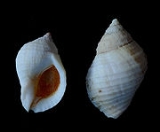
The dog whelk shell is small and rounded with a pointed spire
Spire (mollusc)

File:Turritella communis Turmschnecke.jpgFile:Little snail.JPGFile:Xerolenta obvia3pl.jpgFile:Planorbarius_corneus_top.jpgA spire is a descriptive term for part of the Animal shell of a snail, a gastropod mollusc shell or gastropod shell....
 and a short siphonal canal
Siphonal canal

In some sea snails, Marine gastropod molluscs, the animal has an anterior extension of the mantle called a siphon , through which water is drawn into the mantle cavity and over the gill....
. There is a groove on the underside of the shell. The overall shell shape varies quite widely according to the degree of exposure to wave action of the shore on which a particular population lives.

The shell surface can be fairly smooth interrupted only with growth lines, or when the snail is living in more sheltered areas the shell surface can be somewhat rough and lamellose.

The external shell color is usually a whitish grey, but it is occasionally banded with orange, brown, or black.

Prey species

This species feeds on a variety of mussel
Mussel

The common name mussel is used for members of several different families of clams or bivalve molluscs, from both saltwater and freshwater habitats....
s, tubeworms, barnacle
Barnacle

A barnacle is a type of arthropod belonging to infraclass Cirripedia in the Subphylum Crustacean, and is hence distantly related to crabs and lobsters....
s, and other dog whelks.

Life Habits


Feeding

Its adaptations include a modified radula
Radula

The radula is an anatomical structure found in mollusks and used for feeding. It is a minutely toothed, chitinous ribbon. It is typically used for scraping or cutting food before the food enters the esophagus....
 (a toothed chitin
Chitin

Chitin n is a long-chain polymer of a N-acetylglucosamine, a derivative of glucose, and is found in many places throughout the natural world....
ous structure) to bore holes in the shells of prey, complemented by an organ
Organ (anatomy)

In biology, an organ is a biological tissue that performs a specific function or group of functions. Usually there is a main tissue and sporadic tissues....
 on the foot which secretes a shell-softening chemical. When a hole has been formed paralysing
Paralysis

Paralysis is the complete loss of muscle function for one or more muscle groups. Paralysis can cause loss of feeling or loss of mobility in the affected area....
 chemicals and digestive enzymes are secreted inside the shell to break the soft body down into a ‘soup’ which can be sucked out with the proboscis
Proboscis

In general, a proboscis is an elongated appendage from the head of an animal, either a vertebrate or an invertebrate..The correct Greek plural is proboscides, but in English it is more common to simply add -es, forming proboscises....
. Mussels have developed a defensive strategy of tethering and immobilising with byssus threads any dog whelks invading their beds, leading to the whelks' starvation. The plates of barnacles can be pushed apart with the proboscis, and the entire individual is eaten in about a day, although larger animals such as mussels may take up to a week to digest
Digestion

Digestion is the mechanical and chemical breaking down of food into smaller components, to a form that can be Absorption, for instance, by a blood stream....
. Feeding only occurs when conditions are conducive to such an activity, and during these times the dog whelk consumes large quantities of food so that the gut is always kept as full as possible. This allows shelter until more food is required, when foraging
Foraging

Foraging theory is a branch of behavioral ecology that studies the foraging behavior of animals in response to the environment in which the animal lives....
 resumes. If waves
Ocean surface wave

In fluid dynamics wind waves, or more precisely wind generated waves, are surface waves that occur on the free surface of oceans, seas, lakes, rivers and canals ? or even on small puddles and ponds....
 are large or there is an excessive risk of water loss the dog whelk will remain inactive in sheltered locations for long periods.

Reproduction

Dog whelks reproduce by aggregating for the mating season in the spring. Eggs
Egg (biology)

In most birds and reptiles, an egg is the zygote, resulting from fertilization of the ovum. To enable incubation the egg is usually kept within a favourable temperature range as it nourishes and protects the growing embryo....
 are laid in yellow capsules in suitable crevices on the shore in April and May. The young feed on unfertilised eggs before emerging from the egg capsules as almost fully-formed but very small replicas of adult
Adult

The term adult has at least three distinct meanings. It can indicate a biologically grown or mature person. It may also mean a plant, animal, or person who has reached full growth or alternatively is capable of reproduction, or a person who has attained the legally fixed age of majority; as opposed to a minor....
s.

Juveniles are susceptible to drying out if exposed above the waterline at low tide, and a large proportion are killed in this way. Full maturity
Maturity

Maturity may refer to:*Sexual maturity*Mature technology, a term indicating that a technology has been in use and development for long enough that most of its initial problems have been overcome...
 is attained after three years.

For pollution-induced pathological growth of male sex organs in females of Nucella lapillus, please see the article: Imposex
Imposex

Imposex is a descriptive term applied to some sea snails, marine gastropod mollusks which, under the toxic effects of pollutants, develop sex organs that are in contrast to their actual sex....
.

Predators

Predators of the dog whelk include various species of crab
Crab

Crabs are Decapoda crustaceans of the infraorder Brachyura, which typically have a very short projecting "tail" , or where the reduced abdomen is entirely hidden under the thorax....
s and bird
Bird

Birds are wing, Bipedalismal, endothermic , vertebrate animals that lay egg . There are around 10,000 living species, making them the most numerous tetrapod vertebrates....
s. Protection against predation
Predation

In ecology, predation describes a biological interaction where a predator feeds on its prey, the organism that is attacked. Predators may or may not kill their prey prior to feeding on them, but the act of predation always results in the death of the prey....
 from crabs which attempt to pull the soft body out through the shell aperture
Aperture (mollusc)

The aperture is an opening in certain kinds of mollusc shells: it is the main opening of the shell, where part of the body of the animal emerges for locomotion, feeding, etc....
 can be afforded by growing teeth around the edge of the aperture. Many predators cannot smash the strong shell of an adult dog whelk, but juveniles are vulnerable to attack from many predatory species. Eider Ducks and various other birds simply swallow the entire body with its shell, while oystercatchers
Eurasian Oystercatcher

The Eurasian Oystercatcher Haematopus ostralegus, also known as the Common Pied Oystercatcher, or just Oystercatcher, is a wader in the oystercatcher bird family Haematopodidae....
 and various crustacean
Crustacean

Crustaceans are a large group of arthropods, comprising almost 52,000 described species , and are usually treated as a subphylum . They include various familiar animals, such as crabs, lobsters, crayfish, shrimp, krill and barnacles....
s are often capable of crushing or breaking the shells. In the winter they endure more predation from Purple Sandpiper
Purple Sandpiper

The Purple Sandpiper, Calidris, Arquatella or Erolia maritima is a small shorebird.Adults have short yellow legs and a medium thin dark bill with a yellow base....
s and similar wading birds, but in the summer crabs represent a greater threat. In general, the dog whelk can be thought of as being vulnerable to birds when emersed, and to crabs when immersed.

Effects of the habitat on the dog whelk

Wave action tends to confine the dog whelk to more sheltered shores, however, this can be counteracted, both by adaptations to tolerate it such as the shell and muscular foot, and by the avoidance of direct exposure to wave action afforded by making use of sheltered microhabitats in rocky crevices. The preferred substrate
Substrate (marine biology)

Stream substrate is the material that rests at the bottom of a stream. There are several classification guides. One is:*Mud ? Comprised of silt and clay....
 material of the dog whelk is solid rock
Rock (geology)

In geology, rock is a naturally occurring solid aggregate of minerals and/or mineraloids.The Earth's outer solid layer, the lithosphere, is made of rock....
 and not sand
Sand

Sand is a naturally occurring granular material composed of finely divided rock and mineral particles.As the term is used by geologists, sand particles range in diameter from 0.0625 to 2 millimeters....
, which adds to its problems at lower levels on the shore where weathering
Weathering

Weathering is the decomposition of earth Rock , soils and their minerals through direct contact with the planet's atmosphere. Weathering occurs in situ, or "with no movement", and thus should not be confused with erosion, which involves the movement of rocks and minerals by agents such as water, ice, wind, and gravity....
 is likely to have reduced the stability of the seabed
Seabed

The seabed is the bottom of the ocean. At the bottom of the continental slope is the continental rise, which is caused by sediment cascading down the continental slope....
. Water loss by evaporation
Evaporation

Evaporation is the slow vaporization of a liquid and the reverse of condensation. A type of phase transition, it is the process by which molecules in a liquid State of matter spontaneously become gaseous ....
 has to be tolerated (by means of the operculum
Operculum (gastropod)

The operculum, meaning little lid, is a corneous or calcareous structure which exists in some groups of marine, freshwater, but not in terrestrial snails or gastropods....
 which holds water in and prevents its escape as vapour), or avoided (by moving into water or a shaded area).

The peak in dog whelk population density
Population density

Population density is a measurement of population per unit area or unit volume. It is frequently applied to living organisms, and particularly to humans....
 is approximately coincidental with the mid tidal zone. It lives in the middle shore. In general it can be said that at high vertical heights on the shoreline the dog whelk is most threatened by biotic
Biotic

Biotic means relating to, produced by, or caused by living organisms.The term biotic may also refer to:*Life, or ecosystem, the condition of living organisms,...
 factors such as predation from birds and interspecific competition
Interspecific competition

Interspecific competition, in ecology, is a form of Competition in which individuals of different species vie for the same resource in an ecosystem ....
 for food, but abiotic factors are the primary concern, creating a harsh environment in which it is difficult to survive. At low vertical heights it is biotic factors, such as predation from crabs and intraspecific competition
Intraspecific competition

Intraspecific competition is a particular form of competition in which members of the same species vie for the same Natural resource in an ecosystem ....
, which cause problems. The upper limit of the range in which the dog whelk is generally found is approximately coincidental with the mean high water neap tide line, and the lower limit of the range is approximately coincidental with the mean low water neap tide line, so that the vast majority of dog whelks are found on the mid tidal zone.

Tidal pools and comparable microhabitats extend the vertical range of organism
Organism

In biology, an organism is any life thing . In at least some form, all organisms are capable of response to stimulus , reproduction, growth and developmental biology, and maintenance of homeostasis as a stable whole....
s such as the dog whelk as they provide a more constant environment, but they are prone to increased salinity
Salinity

Salinity is the saltiness or dissolved salt content of a body of water. Salinity in Australian English and North American English may also refer to the salt in soil ....
 because evaporation concentrates dissolved substances. This can create toxic
Toxicity

Toxicity is the degree to which a substance is able to damage an exposed organism. Toxicity can refer to the effect on a whole organism, such as an animal, bacterium, or plant, as well as the effect on a substructure of the organism, such as a cell or an organ , such as the liver ....
 conditions for many species.

The dog whelk can only survive out of water for a limited period, as it will gradually become desiccated
Desiccation

Desiccation is the state of extreme dryness, or the process of extreme drying. A desiccant is a hygroscopic substance that induces or sustains such a state in its local vicinity in a moderately-well sealed container....
 and die if emersed for too long. Metabolic
Metabolism

Metabolism is the set of chemical reactions that occur in living organisms in order to maintain life. These processes allow organisms to grow and reproduce, maintain their structures, and respond to their environments....
 processes within cells take place in solution, and a decrease in water content makes it impossible for the organism to function properly. In experiments it has been shown that 50% of dog whelks die at 40°C, and it can be assumed that at temperatures lower than this a smaller proportion will be killed off. Furthermore, the dog whelk has to excrete
Excretion

Excretion is the process of eliminating waste products of metabolism and other non-useful materials. It is an essential process in all forms of life....
 ammonia
Ammonia

Ammonia is a chemical compound with the chemical formula nitrogenhydrogen. It is normally encountered as a gas with a characteristic pungent odor....
 directly into water
Water

Water is a common chemical substance that is essential for the survival of all known forms of life. In typical usage, water refers only to its liquid form or States of matter, but the substance also has a solid state, ice, and a gaseous state, water vapor or steam....
, as it does not have the adaptation possessed by many upper shore species which would allow it to produce uric acid
Uric acid

Uric acid is an organic compound of carbon, nitrogen, oxygen and hydrogen with the formula C5H4N4O3....
 for excretion without loss of water. When kept emersed for seven days at a temperature of 18°C, 100% of dog whelks die, in contrast to many periwinkle species which can lose even more water than the dog whelk (i.e. more than 37% of their total body mass) but survive as a result of their ability to excrete toxic waste products more efficiently.