

Doboj

Encyclopedia
Doboj is a city and a municipality
in northern Bosnia and Herzegovina
, situated in the northern part of the Republika Srpska
entity on the river Bosna. Doboj is the largest national railway junction; as such, the seats of the Republika Srpska Railways, and the Railways Corporation of Bosnia and Herzegovina are located in Doboj. It is one of the oldest cities in the country and one of the most important urban centers in Northern Bosnia and Herzegovina.
, although there are numerous artefacts and objects that have been found (The National Museum of Bosnia/Herzegovina in Sarajevo & The Regional Museum in Doboj) and which confirm the fact that the area had been inhabited ever since the early stone age
, and that the Roman Empire
had an army camp (Castrum) and a settlement (Canabea) in the vicinity of the town dating from the 1st century AD. Following the arrival of the Slavs in the 6th century AD it became a part of the region/bannate
Usora
(in the medieval documents sometimes put together with the nearby province Soli
, hence, Usora and Soli).
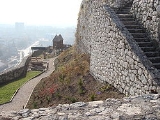
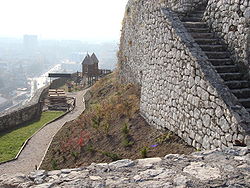
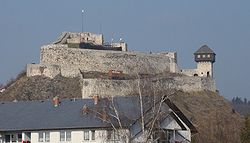
The Doboj fortress
, a royal Kotromanic fortress, was first built in the early 13th century and then expanded in the early 15th century (1415). It was expanded during the Ottoman Empire
in 1490. This newer stone foundation of the fortress was built on previous layers of older foundation (dating to 9th or 10th century AD) made of wood, mud and clay (Motte & Bailey type). It was a very important obstacle for the invaders coming from North, Hungarians, and later on, Austrians
and Germans
. It was built in the Gotho
-Roman
style with the gothic towers and romanic windows. The area has seen numerous battles in the Medieval times and the fortress often changed hands between Bosnian and Hungarian armies. Doboj was the site of a particularly major battle between Hungarians and Bosnian/Turkish coalition in early August of 1415 in which Hungarians were heavily defeated on the field where the modern City of Doboj lies today (esp. around Makljenovac and Usora area). As an important border fortress (between Bosnian Kingdom and Hungary
), it was also frequently attacked (officially recorded - 18 times) in the Austro-Ottoman Wars
, and finally fell to the Habsburg
s in 1878.
, Doboj was the site of the largest Austro-Hungarian
concentration camp for Serbs
. According to its official figures, it held, between December 27, 1915 and July 5, 1917:
In total, 45,791 persons.
By February 1916, the authorities began redirecting the prisoners to other camps. The Serbs from Bosnia were mostly sent to Győr
(Sopronyek, Šopronjek/Шопроњек).
Most of the interned from Bosnia were whole families from the border regions of eastern Bosnia and Herzegovina. It is said that 5,000 families alone were uprooted from the Sarajevo
district in eastern Bosnia along the border with the Kingdoms of Serbia & Montenegro.
The Nobel Prize
-laureate Ivo Andrić
was also an inmate of the camp.
During World War II
, Doboj was an important site for the partisan resistance movement
. From their initial uprising in August 1941 up until the end of the war, the Ozren partisan squad carried out numerous diversions against the occupation forces, among the first successful operations in Bosnia and Herzegovina.
During this time, the Ustaša fascist regime, a puppet state
of Nazi Germany
, purged many pro-Partizan civilians, including Serbs, Muslims, Jews and Roma to concentration and labor camps. Croat resistance members and political opponents were also sent to concentration camps and condemned to death. According to public records 291 civilians from Doboj, of various ethnic backgrounds, perished in the Jasenovac
concentration camp. In 2010, the remains of 23 people killed by Yugoslav Partisans were found in two pits near the Doboj settlement of Majevac. The non-governmental organization
which discovered the remains alleges that nearby pits contain the remains of hundreds more also killed by the Partisans.
The town was liberated on April 17, 1945.
 Doboj was strategically important during the Bosnian War
. In May 1992, the occupation of Doboj by the Serbian forces began. The Serbian Democratic Party took over the governing of the city. What followed was a mass disarming and subsequently mass arrests of all non-Serb civilians (namely Bosniaks
and Croats
). Many instances of war crimes and ethnic cleansing were committed by Serb forces.
In an effort to liberate the city, Doboj was shelled by Army of the Republic of Bosnia and Herzegovina
(over 5,500 mortar and tank rounds had hit the city itself and immediate surrounding area during the period of May 1992 - October 1995). As a result, 99 citizens of Doboj have been killed due to mortar and tank fire in the aerial attacks on downtown, and about 400 of Doboj's residents were wounded and maimed in the process..
Biljana Plavšić
acting individually or in concert with Radovan Karadžić
, Momčilo Krajišnik
and others planned, instigated, ordered, committed or otherwise aided and abetted the planning, preparation or execution of the destruction, in whole or in part, of the Bosniak and Bosnian Croat national, ethnical, racial or religious groups, as such, in several municipalities, including but not limited to Doboj.
After the Dayton Agreement
and the peace following in Bosnia and Herzegovina, the city served as a major HQ/base for IFOR
(later SFOR
) units.
homes and villages during the Bosnian War
. Women were raped and civilians tortured and killed. Widespread looting and destruction of Bosniak homes and property took place daily and the Bosnian Muslim mosques in town were destroyed. Many of the non-Serbs who were not immediately killed were detained at various locations in the town, subjected to inhumane conditions, including regular beatings, torture and strenuous forced labour. A school in Grabska and the factory used by the Bosanka company that produced jams and juices in Doboj was used as a rape camp. Four different types of soldiers were present at the rape camps including the local Serbian militia, the Yugoslav army (JNA), police forces based in the Serbian-occupied town of Knin (or "Marticevci" as their commander was Milan Martić
) and members of the "White Eagles" (Beli Orlovi
) paramilitary group who wore an insignia bearing three eagles and a "kokarda" on their hats. The man who oversaw the women's detention in the school was Nikola Jorgic
, a former police officer in Doboj, who has been convicted of genocide
in Germany and is currently serving a life sentence.
Biljana Plavšić
was charged with crimes against humanity that include but are not limited to the killings in Doboj.Plavisic's indictment related to genocide charges in Doboj specifically includes but is not limited to the following killings:
Other incidents currently under investigation include:
Although Jorgic's, Plavsic's, Karadzic's and Krajisnik's cases were tried in foreign jurisdictions, the court of Bosnia and Herzegovina has processed or is currently processing the following cases for war crimes in Doboj:
population is generally assumed to be near negligible, despite the fact that the last census was conducted in 1991.
It has been announced in 2007 that a country-wide census will likely take place in 2011. Currently, the only official census numbers are those from 1971 and 1991, but they do not reflect the current demographics as ethnic cleansing of the last decade has caused permanent population changes.
----
Population by settlements composing the town of Doboj:
represent the medieval origins of the city in the royal fortress Gradina built by the kings from the medieval Bosnian dynasty of Kotromanić.
, including the city itself, (the Doboj Region). The southern rural areas are part of the Zenica-Doboj Canton
of the Federation of Bosnia and Herzegovina
, and the eastern rural part of the municipality is part of the Tuzla Canton
, also in the Federation of Bosnia and Herzegovina. The parts of the pre-war Doboj Municipality that are in the Federation of Bosnia and Herzegovina
are the municipalities of Doboj South
(Doboj Jug) and Doboj East
(Doboj Istok) and the Municipality of Usora
. The northern suburbs of Doboj are extending into the peri-Pannonian plains, and effectively mark the southern tip of this great Central European plain. The southern (Doboj-South)and eastern suburbs (Doboj-East) are spread on the gentle hills which extend to larger Central Bosnian mountain areas (Mt. Ozren in south-east, Mt. Krnjin in the west).
• Božinci Donji
• Brestovo
• Brijesnica Mala
• Brijesnica Velika
• Bukovac
• Bukovica Mala
• Bukovica Velika
• Bušletić
• Cerovica
• Cvrtkovci
• Čajre
• Čivčije Bukovičke
• Čivčije Osječanske
• Doboj
• Dragalovci
• Foča
• Glogovica
• Grabovica
• Grapska Donja
• Grapska Gornja
• Jelanjska
• Johovac
• Kladari
• Klokotnica
• Komarica
• Kostajnica
• Kotorsko
• Kožuhe
• Lipac
• Lukavica Rijeka
• Ljeb
• Ljeskove Vode
• Majevac
• Makljenovac
• Matuzići
• Miljkovac
• Mitrovići
• Mravići
• Opsine
• Osječani Donji
• Osječani Gornji
• Osredak
• Ostružnja Donja
• Ostružnja Gornja
• Paležnica Donja
• Paležnica Gornja
• Pločnik
• Podnovlje
• Porječje
• Potočani
• Pridjel Donji
• Pridjel Gornji
• Prisade
• Prnjavor Mali
• Prnjavor Veliki
• Radnja Donja
• Raškovci
• Ritešić
• Sjenina
• Sjenina Rijeka
• Stanari
• Stanić Rijeka
• Stanovi
• Suho Polje
• Svjetliča
• Ševarlije
• Tekućica
• Tisovac
• Trnjani
• Ularice
• Vranduk i Zarječa
.
, Doboj focused much of its industrial activities around it. Moreover, as a regional center, it was home to several factories, now mostly bankrupt from mismanagement or privatized, including "Bosanka Doboj", a fruit and vegetable product factory; "Trudbenik", a maker of air compressors and equipment, etc. Nowadays, most of the economy, similar to the rest of the country and typical of poorly executed transition from state-controlled to a market economy, based around the service industry. High unemployment warrants a vibrant coffee shop and bar scene, crowded throughout most of the day and night(it is commonly believed that Doboj is one of the top three cities having largest number of coffee bars/pubs within city limits in Bosnia & Herzegovina).
In 1981 Doboj's GDP per capita was 53% of the Yugoslav average.
On the positive side, an approximately $800 million investment, due for ground braking during 2008 in the Stanari suburb, will start of with the building of an electrical power plant. Additionally, the $1 billion investments in the northern Modrica
Oil Refinery are likely to increase railroad traffic.
rising stars, ćevapčići and other oriental dishes, and all kinds of beer and other liquor are all available in this area. Magic Caffe, Orange Bar, Corner Cafe, Time Out, City, Irish Pub, La Linea are notable bars in the area.
The famous bar/club "The Hole" by the recently renovated Doboj City Park is located in a stylish underground location (a former city amateur theater) overlooking the park and surrounding neighbourhood. The largest club in Doboj is "Džungla" (The Jungle) but only open for Concerts, it is located by the river Bosna. The most visited area of the city, however, is the freshly renovated medieval city castle, Doboj Fortress
built in the early 13th century, now houses restaurants, shops and medieval exhibitions of preserved weaponry with children's playgrounds open during the day.
on the Adriatic Sea
, west to Banja Luka
and Zagreb
, north to Vinkovci
, Croatia
, and east to Tuzla
and Zvornik
. The route of the future E-75
highway is supposed to pass through the Doboj area, and a separate highway toward western Banja Luka
is in the planning stage.
, FK Sloga Doboj
, plays in the First League of the Republika Srpska
. The town's favourite sports activity, however, is team handball. It is being played by the local Sloga Doboj team. Sloga Doboj ranks among the country's top teams and consistently qualifies for international competitions. Very importantly, Doboj traditionally hosts "The Annual Doboj International Champions' Handball Tournament" every year during the last days of August. The year 2010 will see its 42nd tournament and once again, the best European handball teams will fight for the title of the Tournament's Winner. The prestige of this EHF-listed tournament was consistently strong enough to attract the most important names in the European team handball over the past five decades such as: Barcelona, Grasshopper, Gummersbach
, Ademar León
, CSKA
, Steaua
, Dinamo Bucureşti, Atlético Madrid, Red Star
, Metaloplastika
, Partizan
, Pelister
, Nordhorn
, Pick Szeged
, Veszprém, Göppingen
, Montpellier, d'Ivry
and Chekhovski Medvedi.
Municipality
A municipality is essentially an urban administrative division having corporate status and usually powers of self-government. It can also be used to mean the governing body of a municipality. A municipality is a general-purpose administrative subdivision, as opposed to a special-purpose district...
in northern Bosnia and Herzegovina
Bosnia and Herzegovina
Bosnia and Herzegovina , sometimes called Bosnia-Herzegovina or simply Bosnia, is a country in Southern Europe, on the Balkan Peninsula. Bordered by Croatia to the north, west and south, Serbia to the east, and Montenegro to the southeast, Bosnia and Herzegovina is almost landlocked, except for the...
, situated in the northern part of the Republika Srpska
Republika Srpska
Republika Srpska is one of two main political entities of Bosnia and Herzegovina, the other being the Federation of Bosnia and Herzegovina...
entity on the river Bosna. Doboj is the largest national railway junction; as such, the seats of the Republika Srpska Railways, and the Railways Corporation of Bosnia and Herzegovina are located in Doboj. It is one of the oldest cities in the country and one of the most important urban centers in Northern Bosnia and Herzegovina.
Middle Ages
The first official mention of the settlement is from 1415, as it was written in the charter issued by Dubrovnik to Holy Roman Emperor SigismundSigismund, Holy Roman Emperor
Sigismund of Luxemburg KG was King of Hungary, of Croatia from 1387 to 1437, of Bohemia from 1419, and Holy Roman Emperor for four years from 1433 until 1437, the last Emperor of the House of Luxemburg. He was also King of Italy from 1431, and of Germany from 1411...
, although there are numerous artefacts and objects that have been found (The National Museum of Bosnia/Herzegovina in Sarajevo & The Regional Museum in Doboj) and which confirm the fact that the area had been inhabited ever since the early stone age
Stone Age
The Stone Age is a broad prehistoric period, lasting about 2.5 million years , during which humans and their predecessor species in the genus Homo, as well as the earlier partly contemporary genera Australopithecus and Paranthropus, widely used exclusively stone as their hard material in the...
, and that the Roman Empire
Roman Empire
The Roman Empire was the post-Republican period of the ancient Roman civilization, characterised by an autocratic form of government and large territorial holdings in Europe and around the Mediterranean....
had an army camp (Castrum) and a settlement (Canabea) in the vicinity of the town dating from the 1st century AD. Following the arrival of the Slavs in the 6th century AD it became a part of the region/bannate
Ban (title)
Ban was a title used in several states in central and south-eastern Europe between the 7th century and the 20th century.-Etymology:The word ban has entered the English language probably as a borrowing from South Slavic ban, meaning "lord, master; ruler". The Slavic word is probably borrowed from...
Usora
Usora (region)
The region of Usora was a semi-independent banate in medieval Bosnia. It took its name from the river Usora. Its territory stretched roughly from the area of Kulaši and Prnjavor to its west, to Srebrenik and Lukavac to its east, the river Sava to its north and Žepče to its south...
(in the medieval documents sometimes put together with the nearby province Soli
Tuzla
Tuzla is a city and municipality in Bosnia and Herzegovina. At the time of the 1991 census, it had 83,770 inhabitants, while the municipality 131,318. Taking the influx of refugees into account, the city is currently estimated to have 174,558 inhabitants...
, hence, Usora and Soli).
The Doboj fortress
Doboj Fortress
Doboj Fortress or "Gradina" is located in the city of Doboj in northern Bosnia and Herzegovina.-History:One of the most important defenses in the medieval bannate/duchy of Usora, this large stone structure has been built in the early 13th century on the site of earlier, clay and wood-based...
, a royal Kotromanic fortress, was first built in the early 13th century and then expanded in the early 15th century (1415). It was expanded during the Ottoman Empire
Ottoman Empire
The Ottoman EmpireIt was usually referred to as the "Ottoman Empire", the "Turkish Empire", the "Ottoman Caliphate" or more commonly "Turkey" by its contemporaries...
in 1490. This newer stone foundation of the fortress was built on previous layers of older foundation (dating to 9th or 10th century AD) made of wood, mud and clay (Motte & Bailey type). It was a very important obstacle for the invaders coming from North, Hungarians, and later on, Austrians
Austrians
Austrians are a nation and ethnic group, consisting of the population of the Republic of Austria and its historical predecessor states who share a common Austrian culture and Austrian descent....
and Germans
Germans
The Germans are a Germanic ethnic group native to Central Europe. The English term Germans has referred to the German-speaking population of the Holy Roman Empire since the Late Middle Ages....
. It was built in the Gotho
Gothic architecture
Gothic architecture is a style of architecture that flourished during the high and late medieval period. It evolved from Romanesque architecture and was succeeded by Renaissance architecture....
-Roman
Roman architecture
Ancient Roman architecture adopted certain aspects of Ancient Greek architecture, creating a new architectural style. The Romans were indebted to their Etruscan neighbors and forefathers who supplied them with a wealth of knowledge essential for future architectural solutions, such as hydraulics...
style with the gothic towers and romanic windows. The area has seen numerous battles in the Medieval times and the fortress often changed hands between Bosnian and Hungarian armies. Doboj was the site of a particularly major battle between Hungarians and Bosnian/Turkish coalition in early August of 1415 in which Hungarians were heavily defeated on the field where the modern City of Doboj lies today (esp. around Makljenovac and Usora area). As an important border fortress (between Bosnian Kingdom and Hungary
Hungary
Hungary , officially the Republic of Hungary , is a landlocked country in Central Europe. It is situated in the Carpathian Basin and is bordered by Slovakia to the north, Ukraine and Romania to the east, Serbia and Croatia to the south, Slovenia to the southwest and Austria to the west. The...
), it was also frequently attacked (officially recorded - 18 times) in the Austro-Ottoman Wars
Ottoman wars in Europe
The wars of the Ottoman Empire in Europe are also sometimes referred to as the Ottoman Wars or as Turkish Wars, particularly in older, European texts.- Rise :...
, and finally fell to the Habsburg
Habsburg
The House of Habsburg , also found as Hapsburg, and also known as House of Austria is one of the most important royal houses of Europe and is best known for being an origin of all of the formally elected Holy Roman Emperors between 1438 and 1740, as well as rulers of the Austrian Empire and...
s in 1878.
World War I and World War II
During World War IWorld War I
World War I , which was predominantly called the World War or the Great War from its occurrence until 1939, and the First World War or World War I thereafter, was a major war centred in Europe that began on 28 July 1914 and lasted until 11 November 1918...
, Doboj was the site of the largest Austro-Hungarian
Austria-Hungary
Austria-Hungary , more formally known as the Kingdoms and Lands Represented in the Imperial Council and the Lands of the Holy Hungarian Crown of Saint Stephen, was a constitutional monarchic union between the crowns of the Austrian Empire and the Kingdom of Hungary in...
concentration camp for Serbs
Serbs
The Serbs are a South Slavic ethnic group of the Balkans and southern Central Europe. Serbs are located mainly in Serbia, Montenegro and Bosnia and Herzegovina, and form a sizable minority in Croatia, the Republic of Macedonia and Slovenia. Likewise, Serbs are an officially recognized minority in...
. According to its official figures, it held, between December 27, 1915 and July 5, 1917:
- 16,673 men from Bosnia and HerzegovinaBosnia and HerzegovinaBosnia and Herzegovina , sometimes called Bosnia-Herzegovina or simply Bosnia, is a country in Southern Europe, on the Balkan Peninsula. Bordered by Croatia to the north, west and south, Serbia to the east, and Montenegro to the southeast, Bosnia and Herzegovina is almost landlocked, except for the...
(mostly of Serb ethnicity) - 16,996 women and children from Bosnia and Herzegovina (mostly of Serb ethnicity)
- 9,172 soldiers and civilians (men, women, children) from the Kingdom of SerbiaSerbiaSerbia , officially the Republic of Serbia , is a landlocked country located at the crossroads of Central and Southeast Europe, covering the southern part of the Carpathian basin and the central part of the Balkans...
- 2,950 soldiers and civilians from the Kingdom of MontenegroMontenegroMontenegro Montenegrin: Crna Gora Црна Гора , meaning "Black Mountain") is a country located in Southeastern Europe. It has a coast on the Adriatic Sea to the south-west and is bordered by Croatia to the west, Bosnia and Herzegovina to the northwest, Serbia to the northeast and Albania to the...
In total, 45,791 persons.
By February 1916, the authorities began redirecting the prisoners to other camps. The Serbs from Bosnia were mostly sent to Győr
Gyor
-Climate:-Main sights:The ancient core of the city is Káptalan Hill at the confluence of three rivers: the Danube, Rába and Rábca. Püspökvár, the residence of Győr’s bishops can be easily recognised by its incomplete tower. Győr’s oldest buildings are the 13th-century dwelling tower and the...
(Sopronyek, Šopronjek/Шопроњек).
Most of the interned from Bosnia were whole families from the border regions of eastern Bosnia and Herzegovina. It is said that 5,000 families alone were uprooted from the Sarajevo
Sarajevo
Sarajevo |Bosnia]], surrounded by the Dinaric Alps and situated along the Miljacka River in the heart of Southeastern Europe and the Balkans....
district in eastern Bosnia along the border with the Kingdoms of Serbia & Montenegro.
The Nobel Prize
Nobel Prize
The Nobel Prizes are annual international awards bestowed by Scandinavian committees in recognition of cultural and scientific advances. The will of the Swedish chemist Alfred Nobel, the inventor of dynamite, established the prizes in 1895...
-laureate Ivo Andrić
Ivo Andric
Ivan "Ivo" Andrić was a Yugoslav novelist, short story writer, and the 1961 winner of the Nobel Prize in Literature. His writings dealt mainly with life in his native Bosnia under the Ottoman Empire...
was also an inmate of the camp.
During World War II
World War II
World War II, or the Second World War , was a global conflict lasting from 1939 to 1945, involving most of the world's nations—including all of the great powers—eventually forming two opposing military alliances: the Allies and the Axis...
, Doboj was an important site for the partisan resistance movement
Partisans (Yugoslavia)
The Yugoslav Partisans, or simply the Partisans were a Communist-led World War II anti-fascist resistance movement in Yugoslavia...
. From their initial uprising in August 1941 up until the end of the war, the Ozren partisan squad carried out numerous diversions against the occupation forces, among the first successful operations in Bosnia and Herzegovina.
During this time, the Ustaša fascist regime, a puppet state
Puppet state
A puppet state is a nominal sovereign of a state who is de facto controlled by a foreign power. The term refers to a government controlled by the government of another country like a puppeteer controls the strings of a marionette...
of Nazi Germany
Nazi Germany
Nazi Germany , also known as the Third Reich , but officially called German Reich from 1933 to 1943 and Greater German Reich from 26 June 1943 onward, is the name commonly used to refer to the state of Germany from 1933 to 1945, when it was a totalitarian dictatorship ruled by...
, purged many pro-Partizan civilians, including Serbs, Muslims, Jews and Roma to concentration and labor camps. Croat resistance members and political opponents were also sent to concentration camps and condemned to death. According to public records 291 civilians from Doboj, of various ethnic backgrounds, perished in the Jasenovac
Jasenovac
Jasenovac is a village and a municipality in Croatian Slavonia, in the southern part of the Sisak-Moslavina county at the confluence of the river Una into Sava.The name means "ash tree" or "ash forest" in Croatian, the area being ringed by such a forest....
concentration camp. In 2010, the remains of 23 people killed by Yugoslav Partisans were found in two pits near the Doboj settlement of Majevac. The non-governmental organization
Non-governmental organization
A non-governmental organization is a legally constituted organization created by natural or legal persons that operates independently from any government. The term originated from the United Nations , and is normally used to refer to organizations that do not form part of the government and are...
which discovered the remains alleges that nearby pits contain the remains of hundreds more also killed by the Partisans.
The town was liberated on April 17, 1945.
Bosnian War
Bosnian War
The Bosnian War or the War in Bosnia and Herzegovina was an international armed conflict that took place in Bosnia and Herzegovina between April 1992 and December 1995. The war involved several sides...
. In May 1992, the occupation of Doboj by the Serbian forces began. The Serbian Democratic Party took over the governing of the city. What followed was a mass disarming and subsequently mass arrests of all non-Serb civilians (namely Bosniaks
Bosniaks
The Bosniaks or Bosniacs are a South Slavic ethnic group, living mainly in Bosnia and Herzegovina, with a smaller minority also present in other lands of the Balkan Peninsula especially in Serbia, Montenegro and Croatia...
and Croats
Croats of Bosnia and Herzegovina
Croats of Bosnia and Herzegovina form one of the three constitutive nations in Bosnia and Herzegovina.There is no precise data regarding Bosnia and Herzegovina's population since the last war. Ethnic cleansing within Bosnia and Herzegovina in the 1990s saw the vast majority of Croats move and take...
). Many instances of war crimes and ethnic cleansing were committed by Serb forces.
In an effort to liberate the city, Doboj was shelled by Army of the Republic of Bosnia and Herzegovina
Army of the Republic of Bosnia and Herzegovina
The Army of the Republic of Bosnia and Herzegovina was the military force of the Republic of Bosnia and Herzegovina established by the government of Bosnia and Herzegovina in 1992 following the outbreak of the Bosnian War...
(over 5,500 mortar and tank rounds had hit the city itself and immediate surrounding area during the period of May 1992 - October 1995). As a result, 99 citizens of Doboj have been killed due to mortar and tank fire in the aerial attacks on downtown, and about 400 of Doboj's residents were wounded and maimed in the process..
Biljana Plavšić
Biljana Plavšic
Biljana Plavšić is a former president of Republika Srpska and war criminal. She is the highest ranking Bosnian Serb politician to be sentenced. She was indicted in 2001 by the International Criminal Tribunal for the former Yugoslavia for war crimes committed during the Bosnian war...
acting individually or in concert with Radovan Karadžić
Radovan Karadžic
Radovan Karadžić is a former Bosnian Serb politician. He is detained in the United Nations Detention Unit of Scheveningen, accused of war crimes committed against Bosnian Muslims and Bosnian Croats during the Siege of Sarajevo, as well as ordering the Srebrenica massacre.Educated as a...
, Momčilo Krajišnik
Momcilo Krajišnik
Momčilo Krajišnik is a Bosnian Serb former politician convicted of murder and other crimes against humanity during the Bosnian war .He co-founded the Bosnian Serb nationalist Serbian Democratic Party with Radovan...
and others planned, instigated, ordered, committed or otherwise aided and abetted the planning, preparation or execution of the destruction, in whole or in part, of the Bosniak and Bosnian Croat national, ethnical, racial or religious groups, as such, in several municipalities, including but not limited to Doboj.
After the Dayton Agreement
Dayton Agreement
The General Framework Agreement for Peace in Bosnia and Herzegovina, also known as the Dayton Agreement, Dayton Accords, Paris Protocol or Dayton-Paris Agreement, is the peace agreement reached at Wright-Patterson Air Force Base near Dayton, Ohio in November 1995, and formally signed in Paris on...
and the peace following in Bosnia and Herzegovina, the city served as a major HQ/base for IFOR
IFOR
The Implementation Force was a NATO-led multinational peacekeeping force in Bosnia and Herzegovina under a one-year mandate from 20 December 1995 to 20 December 1996 under the codename Operation Joint Endeavour. Its task was to implement the military Annexes of The General Framework Agreement for...
(later SFOR
SFOR
The Stabilisation Force was a NATO-led multinational peacekeeping force in Bosnia and Herzegovina which was tasked with upholding the Dayton Agreement. It replaced the previous force IFOR...
) units.
Ethnic cleansing and mass killings
Serb forces were implicated in the systematic looting and destruction of Bosniak and CroatianCroats of Bosnia and Herzegovina
Croats of Bosnia and Herzegovina form one of the three constitutive nations in Bosnia and Herzegovina.There is no precise data regarding Bosnia and Herzegovina's population since the last war. Ethnic cleansing within Bosnia and Herzegovina in the 1990s saw the vast majority of Croats move and take...
homes and villages during the Bosnian War
Bosnian War
The Bosnian War or the War in Bosnia and Herzegovina was an international armed conflict that took place in Bosnia and Herzegovina between April 1992 and December 1995. The war involved several sides...
. Women were raped and civilians tortured and killed. Widespread looting and destruction of Bosniak homes and property took place daily and the Bosnian Muslim mosques in town were destroyed. Many of the non-Serbs who were not immediately killed were detained at various locations in the town, subjected to inhumane conditions, including regular beatings, torture and strenuous forced labour. A school in Grabska and the factory used by the Bosanka company that produced jams and juices in Doboj was used as a rape camp. Four different types of soldiers were present at the rape camps including the local Serbian militia, the Yugoslav army (JNA), police forces based in the Serbian-occupied town of Knin (or "Marticevci" as their commander was Milan Martić
Milan Martic
Milan Martić is a Serbian politician, former president of the Republic of Serbian Krajina...
) and members of the "White Eagles" (Beli Orlovi
White Eagles (paramilitary)
The White Eagles , also known as the Avengers , were a Serbian paramilitary group associated with the Serbian National Renewal and the Serbian Radical Party...
) paramilitary group who wore an insignia bearing three eagles and a "kokarda" on their hats. The man who oversaw the women's detention in the school was Nikola Jorgic
Nikola Jorgic
Nikola Jorgic is a Bosnian Serb from the Doboj region who was the leader of a paramilitary group located in the Doboj region. In 1997, Nikola was convicted of genocide in Germany. This was the first conviction won against participants in the Bosnian Genocide...
, a former police officer in Doboj, who has been convicted of genocide
Genocide
Genocide is defined as "the deliberate and systematic destruction, in whole or in part, of an ethnic, racial, religious, or national group", though what constitutes enough of a "part" to qualify as genocide has been subject to much debate by legal scholars...
in Germany and is currently serving a life sentence.
Biljana Plavšić
Biljana Plavšic
Biljana Plavšić is a former president of Republika Srpska and war criminal. She is the highest ranking Bosnian Serb politician to be sentenced. She was indicted in 2001 by the International Criminal Tribunal for the former Yugoslavia for war crimes committed during the Bosnian war...
was charged with crimes against humanity that include but are not limited to the killings in Doboj.Plavisic's indictment related to genocide charges in Doboj specifically includes but is not limited to the following killings:
- the killing on or about 10 May 1992 of thirty-four Bosnian Muslim /Bosniak and/or Bosnian Croat civilians of the village of Gornja Grapska - Doboj municipality.
- many of the Bosnian Muslims /Bosniaks and Bosnian Croats who survived the attacks and forced marches were taken to these camps and detention facilities, including but not limited to: Bare ammunition warehouse from 1 May 1992, Spreca prison from 1 May 1992, the SUP station from 1 May to 31 July 1992, Percin’s Disco from 1 May 1992, Sevarlije JNA barracks from 1 May to 30 June 1992, and the JNA hangars near the Bosanska plantation from May 1992, all in the Doboj municipality.
Other incidents currently under investigation include:
- the execution of 15 civilians from the Spreca Central Prison in Doboj in May 1992;
- a series of mass executions of non-Serbs on the banks of the river Bosna on June 17–19, 1992;
- a series of mass executions in the "July 4th" military barracks in the village of Miljkovac on July 12, 1992; and
- the use of civilians as human shields against a Bosnian Army advance the same month.
Although Jorgic's, Plavsic's, Karadzic's and Krajisnik's cases were tried in foreign jurisdictions, the court of Bosnia and Herzegovina has processed or is currently processing the following cases for war crimes in Doboj:
- Milovan Stankovic, the former Bosnian Serb military commander for the town and surrounding region.
- Milan "Mico" Ninkovic, formerly chairman of the local branch of the Serb Democratic Party, SDS, as well as being a former Bosnian Serb defence minister.
- Andrija Bjelosevic, the one-time head of the Doboj Security Centre.
Demographics
The non-Serb population of Doboj municipality numbered approximately 55,000, including about 41,000 Bosniaks, 13,000 Croats and 1,000 others, at the outbreak of the Bosnian War in 1992, during which almost all left or were ethnically cleansed. With the city's post-war incorporation into Republika Srpska, very few non-Serbs have returned. As a result, Doboj's current Bosniak and CroatCroats of Bosnia and Herzegovina
Croats of Bosnia and Herzegovina form one of the three constitutive nations in Bosnia and Herzegovina.There is no precise data regarding Bosnia and Herzegovina's population since the last war. Ethnic cleansing within Bosnia and Herzegovina in the 1990s saw the vast majority of Croats move and take...
population is generally assumed to be near negligible, despite the fact that the last census was conducted in 1991.
It has been announced in 2007 that a country-wide census will likely take place in 2011. Currently, the only official census numbers are those from 1971 and 1991, but they do not reflect the current demographics as ethnic cleansing of the last decade has caused permanent population changes.
----
| Doboj | |||||||
| Year | 1991. | 1981. | 1971. |- |
Muslims Muslims by nationality Muslims by nationality was a term used in Socialist Federal Republic of Yugoslavia as an official designation of nationality of Slavic Muslims. They were one of the constitutive groups of Bosnia and Herzegovina... |
11.154 (40,56%) | 8.822 (37,44%) | 8.976 (49,14%) |
| Serbs Serbs The Serbs are a South Slavic ethnic group of the Balkans and southern Central Europe. Serbs are located mainly in Serbia, Montenegro and Bosnia and Herzegovina, and form a sizable minority in Croatia, the Republic of Macedonia and Slovenia. Likewise, Serbs are an officially recognized minority in... |
8.011 (29,13%) | 6.091 (25,85%) | 5.044 (27,61%) | ||||
| Croats Croats Croats are a South Slavic ethnic group mostly living in Croatia, Bosnia and Herzegovina and nearby countries. There are around 4 million Croats living inside Croatia and up to 4.5 million throughout the rest of the world. Responding to political, social and economic pressure, many Croats have... |
2.714 (9,86%) | 2.852 (12,10%) | 2.889 (15,81%) | ||||
| Yugoslavs Yugoslavs Yugoslavs is a national designation used by a minority of South Slavs across the countries of the former Yugoslavia and in the diaspora... |
4.365 (15,87%) | 5.211 (22,11%) | 919 (5,03%) | ||||
| Others and unknown | 1.254 (4,56%) | 582 (2,47%) | 436 (2,38%) | ||||
| Total | 27.498 | 23.558 | 18.264 | ||||
Population by settlements composing the town of Doboj:
- Bare: 732 (62%) Serbs, 153 (13%) Yugoslavs, 135 (11%) Croats, 112 (9%) Muslims, 53 (4%) others, 1,185 total
- Centar: 3,720 (35%) Serbs, 3,365 (31%) Muslims, 1,982 (18%) Yugoslavs, 1,236 (12%) Croats, 432 (4%) others, 10,735 total
- Čaršija: 3,561 (72%) Muslims, 594 (12%) Yugoslavs, 303 (6%) Serbs, 195 (4%) Croats, 273 (6%) others, 4,926 total
- Doboj Novi: 358 (48%) Muslims, 237 (32%) Serbs, 39 (5%) Yugoslavs, 7 (1%) Croats, 108 (14%) others, 749 total
- Donji Grad: 1,879 (37%) Serbs, 1,547 (31%) Muslims, 844 (17%) Yugoslavs, 569 (11%) Croats, 196 (4%) others, 5,035 total
- Orašje: 1,411 (66%) Muslims, 293 (14%) Serbs, 231 (11%) Yugoslavs, 111 (5%) Croats, 90 (4%) others, 2,136 total
- Usora: 924 (33%) Serbs, 779 (28%) Muslims, 502 (18%) Croats, 491 (17%) Yugoslavs, 117 (4%) others, 2,813 total
Symbol
The four squares represent the four mountains which mark the outer borders of Doboj valley in which the City of Doboj lies in: Ozren, Trebava, Vucjak, and Krnjin. The fleur-de-lisFleur-de-lis
The fleur-de-lis or fleur-de-lys is a stylized lily or iris that is used as a decorative design or symbol. It may be "at one and the same time, political, dynastic, artistic, emblematic, and symbolic", especially in heraldry...
represent the medieval origins of the city in the royal fortress Gradina built by the kings from the medieval Bosnian dynasty of Kotromanić.
Geography
Before the war in Bosnia the municipality of the same name had a bigger area surface. A larger part of the pre-war municipality is part of the Republika SrpskaRepublika Srpska
Republika Srpska is one of two main political entities of Bosnia and Herzegovina, the other being the Federation of Bosnia and Herzegovina...
, including the city itself, (the Doboj Region). The southern rural areas are part of the Zenica-Doboj Canton
Zenica-Doboj Canton
The Zenica-Doboj Canton is one of the cantons of the Federation of Bosnia and Herzegovina.-Geography:This canton is situated in the central part of Bosnia and Herzegovina. The cantonal capital is Zenica and the other town mentioned in the name is Doboj, which is in Republika Srpska, but part of the...
of the Federation of Bosnia and Herzegovina
Federation of Bosnia and Herzegovina
The Federation of Bosnia and Herzegovina is one of the two political entities that compose the sovereign country of Bosnia and Herzegovina . The two entities are delineated by the Inter-Entity Boundary Line...
, and the eastern rural part of the municipality is part of the Tuzla Canton
Tuzla Canton
The Tuzla Canton is a canton of the Federation of Bosnia and Herzegovina, an entity in Bosnia and Herzegovina. The cantonal seat is in Tuzla.-Municipalities:...
, also in the Federation of Bosnia and Herzegovina. The parts of the pre-war Doboj Municipality that are in the Federation of Bosnia and Herzegovina
Federation of Bosnia and Herzegovina
The Federation of Bosnia and Herzegovina is one of the two political entities that compose the sovereign country of Bosnia and Herzegovina . The two entities are delineated by the Inter-Entity Boundary Line...
are the municipalities of Doboj South
Doboj South
Doboj South is a small rural municipality in the Zenica-Doboj Canton of the Federation of Bosnia and Herzegovina.It borders with Doboj municipality, part of Republika Srpska entity.-About Doboj South:...
(Doboj Jug) and Doboj East
Doboj East
Doboj East is a small rural municipality in the Tuzla Canton of the Federation of Bosnia and Herzegovina.-Municipality:It consists of the villages of Stanić Rijeka, Klokotnica, Velika Brijesnica and Mala Brijesnica....
(Doboj Istok) and the Municipality of Usora
Municipality of Usora
Usora Municipality is a rural municipality in the Federation of Bosnia and Herzegovina with a Bosnian Croat majority.It borders with Doboj municipality, part of Republika Srpska entity. It is named after the Usora River....
. The northern suburbs of Doboj are extending into the peri-Pannonian plains, and effectively mark the southern tip of this great Central European plain. The southern (Doboj-South)and eastern suburbs (Doboj-East) are spread on the gentle hills which extend to larger Central Bosnian mountain areas (Mt. Ozren in south-east, Mt. Krnjin in the west).
Settlements
• AlibegovciAlibegovci
Alibegovci is a village in the municipality of Doboj, Bosnia and Herzegovina....
• Božinci Donji
Božinci Donji
Božinci Donji is a village in the municipality of Doboj, Bosnia and Herzegovina....
• Brestovo
Brestovo
Brestovo is a village in the municipality of Doboj, Bosnia and Herzegovina....
• Brijesnica Mala
Brijesnica Mala
Brijesnica Mala is a village in the municipality of Doboj East, Bosnia and Herzegovina.-References:...
• Brijesnica Velika
Brijesnica Velika
Velika Brijesnica is a village in Bosnia and Herzegovina. It is part of the municipality of Doboj East, in the Federation of Bosnia and Herzegovina. Before the Bosnian war it was part of the municipality of Doboj and had 1,771 resident in 1991. It is bordered by the river Spreča and the mountain of...
• Bukovac
Bukovac (Doboj)
Bukovac is a village in the municipality of Doboj, Bosnia and Herzegovina....
• Bukovica Mala
Bukovica Mala (Doboj)
Bukovica Mala is a village in the municipality of Doboj, Bosnia and Herzegovina....
• Bukovica Velika
Bukovica Velika (Doboj)
Bukovica Velika is a village in the municipality of Doboj, Bosnia and Herzegovina....
• Bušletić
Bušletić
Bušletić is a village in the municipality of Doboj, Bosnia and Herzegovina....
• Cerovica
Cerovica (Doboj)
Cerovica is a village in the municipality of Doboj, Bosnia and Herzegovina.-References:...
• Cvrtkovci
Cvrtkovci
Cvrtkovci is a village in the municipality of Doboj, Bosnia and Herzegovina....
• Čajre
Čajre
Čajre is a village in the municipality of Doboj, Bosnia and Herzegovina.-References:...
• Čivčije Bukovičke
Čivčije Bukovičke
Čivčije Bukovičke is a village in the municipality of Doboj, Bosnia and Herzegovina.-References:...
• Čivčije Osječanske
Čivčije Osječanske
Čivčije Osječanske is a village in the municipality of Doboj, Bosnia and Herzegovina.-References:...
• Doboj
• Dragalovci
Dragalovci
Dragalovci is a village in the municipality of Doboj, Bosnia and Herzegovina....
• Foča
Foča (Doboj)
Foča is a village in the municipality of Doboj, Bosnia and Herzegovina....
• Glogovica
Glogovica
Glogovica is a village in the municipality of Doboj, Bosnia and Herzegovina.-References:...
• Grabovica
Grabovica (Doboj)
Grabovica is a village in the municipality of Doboj, Bosnia and Herzegovina....
• Grapska Donja
Grapska Donja
Grapska Donja is a village in the municipality of Doboj, Bosnia and Herzegovina....
• Grapska Gornja
Grapska Gornja
Grapska Gornja is a village in the municipality of Doboj, Bosnia and Herzegovina.Grapska Gornja MassacreOn 10 May 1992, Serb forces attacked Bosniak village of Gornja Grapska in the municipality of Doboj. Pre-war population of the village consisted of 2,260 Bosniaks, 27 Croats, 6 Yugoslavs, and 4...
• Jelanjska
Jelanjska
Jelanjska is a village in the municipality of Doboj, Bosnia and Herzegovina....
• Johovac
Johovac (Doboj)
Johovac is a village in the municipality of Doboj, Bosnia and Herzegovina....
• Kladari
Kladari
Kladari is a village in the municipality of Doboj, Bosnia and Herzegovina....
• Klokotnica
• Komarica
Komarica
Komarica is a village in the municipality of Vlasotince, Serbia. According to the 2002 census, the village has a population of 198 people....
• Kostajnica
Kostajnica (Doboj)
Kostajnica is a village in the municipality of Doboj, Bosnia and Herzegovina.-References:...
• Kotorsko
Kotorsko
Kotorsko is a village in the municipality of Doboj, Bosnia and Herzegovina.-References: Kotorsko is a peaceful village with many ages of people. Although some parts of it may be run down - but that's because of the war that happened in the 90's. Many people from across the world live there, and it...
• Kožuhe
Kožuhe
Kožuhe is a village in the municipality of Doboj, Bosnia and Herzegovina.-References:...
• Lipac
Lipac
Lipac is a village in the municipality of Doboj, Bosnia and Herzegovina.-References:...
• Lukavica Rijeka
Lukavica Rijeka
Lukavica Rijeka is a village in the municipality of Doboj, Bosnia and Herzegovina....
• Ljeb
Ljeb
Ljeb is a village in the municipality of Doboj, Bosnia and Herzegovina.-References:...
• Ljeskove Vode
Ljeskove Vode
Ljeskove Vode is a village in the municipality of Doboj, Bosnia and Herzegovina.-References:...
• Majevac
Majevac (Doboj)
Majevac is a village in the municipality of Doboj, Bosnia and Herzegovina.-References:...
• Makljenovac
Makljenovac
Makljenovac is a village in the municipality of Doboj, Bosnia and Herzegovina.-References:...
• Matuzići
Matuzići
Matuzići is a village in the municipality of Doboj South, Bosnia and Herzegovina.-References:...
• Miljkovac
Miljkovac
Miljkovac is a village in the municipality of Doboj, Bosnia and Herzegovina.-References:...
• Mitrovići
Mitrovići (Doboj)
Mitrovići is a village in the municipality of Doboj, Bosnia and Herzegovina.-References:...
• Mravići
Mravići
Mravići is a village in the municipality of Doboj, Bosnia and Herzegovina.-References:...
• Opsine
Opsine
Opsine is a village in the municipality of Doboj, Bosnia and Herzegovina....
• Osječani Donji
Osječani Donji
Osječani Donji is a village in the municipality of Doboj, Bosnia and Herzegovina....
• Osječani Gornji
Osječani Gornji
Osječani Gornji is a village in the municipality of Doboj, Bosnia and Herzegovina....
• Osredak
Osredak (Doboj)
Osredak is a village in the municipality of Doboj, Bosnia and Herzegovina....
• Ostružnja Donja
Ostružnja Donja
Ostružnja Donja is a village in the municipality of Doboj, Bosnia and Herzegovina....
• Ostružnja Gornja
Ostružnja Gornja
Ostružnja Gornja is a village in the municipality of Doboj, Bosnia and Herzegovina.-References:...
• Paležnica Donja
Paležnica Donja
Paležnica Donja is a village in the municipality of Doboj, Bosnia and Herzegovina....
• Paležnica Gornja
Paležnica Gornja
Paležnica Gornja is a village in the municipality of Doboj, Bosnia and Herzegovina.-References:...
• Pločnik
Pločnik (Doboj)
Pločnik is a village in the municipality of Doboj, Bosnia and Herzegovina....
• Podnovlje
Podnovlje
Podnovlje is a village in the municipality of Doboj, Bosnia and Herzegovina....
• Porječje
Porječje
Porječje is a village in the municipality of Doboj, Bosnia and Herzegovina.-References:...
• Potočani
Potočani (Doboj)
Potočani is a village in the municipality of Doboj, Bosnia and Herzegovina.-References:...
• Pridjel Donji
Pridjel Donji
Pridjel Donji is a village in the municipality of Doboj, Bosnia and Herzegovina....
• Pridjel Gornji
Pridjel Gornji
Pridjel Gornji is a village in the municipality of Doboj, Bosnia and Herzegovina.This is a small rural village in the Doboj Region and is a part of Doboj municipality....
• Prisade
Prisade
Prisade is a village in the municipality of Doboj, Bosnia and Herzegovina....
• Prnjavor Mali
Prnjavor Mali (Doboj)
Prnjavor Mali is a village in the municipality of Doboj, Bosnia and Herzegovina....
• Prnjavor Veliki
Prnjavor Veliki
Prnjavor Veliki is a village in the municipality of Doboj, Bosnia and Herzegovina....
• Radnja Donja
Radnja Donja
Radnja Donja is a village in the municipality of Doboj, Bosnia and Herzegovina....
• Raškovci
Raškovci
Raškovci is a village in the municipality of Doboj, Bosnia and Herzegovina....
• Ritešić
Ritešić
Ritešić is a village in the municipality of Doboj, Bosnia and Herzegovina....
• Sjenina
Sjenina
Sjenina is a village in the municipality of Doboj, Bosnia and Herzegovina.-References:...
• Sjenina Rijeka
Sjenina Rijeka
Sjenina Rijeka is a village in the municipality of Doboj, Bosnia and Herzegovina.-References:...
• Stanari
Stanari
Stanari is a village in the municipality of Doboj, Bosnia and Herzegovina.-References:...
• Stanić Rijeka
Stanić Rijeka
Stanić Rijeka is a village in the municipality of Doboj, Bosnia and Herzegovina....
• Stanovi
Stanovi (Doboj)
Stanovi is a village in the municipality of Doboj, Bosnia and Herzegovina....
• Suho Polje
Suho Polje (Doboj)
Suho Polje is a village in the municipality of Doboj, Bosnia and Herzegovina....
• Svjetliča
Svjetliča
Svjetliča is a village in the municipality of Doboj, Bosnia and Herzegovina....
• Ševarlije
Ševarlije (Doboj)
Ševarlije is a village in the municipality of Doboj, Bosnia and Herzegovina.-References:...
• Tekućica
Tekućica
Tekućica is a village in the municipality of Doboj, Bosnia and Herzegovina....
• Tisovac
Tisovac (Doboj)
Tisovac is a village in the municipality of Doboj, Bosnia and Herzegovina.-References:...
• Trnjani
Trnjani
Trnjani is a village in the municipality of Doboj, Bosnia and Herzegovina.-References:...
• Ularice
Ularice
Ularice is a village in the municipality of Doboj, Bosnia and Herzegovina....
• Vranduk i Zarječa
Vranduk i Zarječa
Vranduk is a village in the municipality of Doboj, Bosnia and Herzegovina.-References:...
.
Economics
As a rail hub, before the Bosnian WarBosnian War
The Bosnian War or the War in Bosnia and Herzegovina was an international armed conflict that took place in Bosnia and Herzegovina between April 1992 and December 1995. The war involved several sides...
, Doboj focused much of its industrial activities around it. Moreover, as a regional center, it was home to several factories, now mostly bankrupt from mismanagement or privatized, including "Bosanka Doboj", a fruit and vegetable product factory; "Trudbenik", a maker of air compressors and equipment, etc. Nowadays, most of the economy, similar to the rest of the country and typical of poorly executed transition from state-controlled to a market economy, based around the service industry. High unemployment warrants a vibrant coffee shop and bar scene, crowded throughout most of the day and night(it is commonly believed that Doboj is one of the top three cities having largest number of coffee bars/pubs within city limits in Bosnia & Herzegovina).
In 1981 Doboj's GDP per capita was 53% of the Yugoslav average.
On the positive side, an approximately $800 million investment, due for ground braking during 2008 in the Stanari suburb, will start of with the building of an electrical power plant. Additionally, the $1 billion investments in the northern Modrica
Modrica
Modriča is a city and municipality in Bosnia and Herzegovina, in Republika Srpska entity. It is located near the towns of Šamac, Derventa and Doboj...
Oil Refinery are likely to increase railroad traffic.
Nightlife and Tourism
The City of Doboj is very colorful and contrasted to the extremes with a variety of urban cafés and bars mixed between older, traditional pubs and restaurants. Zanatski Centar is the central entertainment district located in Naselje Stadion (Stadium Village) in downtown Doboj. Within this relatively small urban oasis, there are numerous café bars, clubs, restaurants, arcade saloons, and sports-betting joints. Mixed Mediterranean and European continental food, hard rock and metal concerts, turbo-folkTurbo-folk
Turbo-folk is a popular musical sub-genre that originated in Serbia, the Balkans. Having mainstream popularity in Serbia, although closely associated with Serbian performers, its sound is as popular in Bosnia and Herzegovina, Croatia and Montenegro...
rising stars, ćevapčići and other oriental dishes, and all kinds of beer and other liquor are all available in this area. Magic Caffe, Orange Bar, Corner Cafe, Time Out, City, Irish Pub, La Linea are notable bars in the area.
The famous bar/club "The Hole" by the recently renovated Doboj City Park is located in a stylish underground location (a former city amateur theater) overlooking the park and surrounding neighbourhood. The largest club in Doboj is "Džungla" (The Jungle) but only open for Concerts, it is located by the river Bosna. The most visited area of the city, however, is the freshly renovated medieval city castle, Doboj Fortress
Doboj Fortress
Doboj Fortress or "Gradina" is located in the city of Doboj in northern Bosnia and Herzegovina.-History:One of the most important defenses in the medieval bannate/duchy of Usora, this large stone structure has been built in the early 13th century on the site of earlier, clay and wood-based...
built in the early 13th century, now houses restaurants, shops and medieval exhibitions of preserved weaponry with children's playgrounds open during the day.
Transportation
The city is the region's commanding railroad knot, going south to PločePloce
Ploče is a town and a notable seaport in the Dubrovnik-Neretva County of Croatia.The total population of Ploče is 10,102 , in the following settlements:* Baćina, population 564* Banja, population 176* Komin, population 1,222...
on the Adriatic Sea
Adriatic Sea
The Adriatic Sea is a body of water separating the Italian Peninsula from the Balkan peninsula, and the system of the Apennine Mountains from that of the Dinaric Alps and adjacent ranges...
, west to Banja Luka
Banja Luka
-History:The name "Banja Luka" was first mentioned in a document dated February 6, 1494, but Banja Luka's history dates back to ancient times. There is a substantial evidence of the Roman presence in the region during the first few centuries A.D., including an old fort "Kastel" in the centre of...
and Zagreb
Zagreb
Zagreb is the capital and the largest city of the Republic of Croatia. It is in the northwest of the country, along the Sava river, at the southern slopes of the Medvednica mountain. Zagreb lies at an elevation of approximately above sea level. According to the last official census, Zagreb's city...
, north to Vinkovci
Vinkovci
Vinkovci is a city in Croatia, in the Vukovar-Syrmia County. In the 2011 census, the total population of the city was 35,375, making it the largest town of the county...
, Croatia
Croatia
Croatia , officially the Republic of Croatia , is a unitary democratic parliamentary republic in Europe at the crossroads of the Mitteleuropa, the Balkans, and the Mediterranean. Its capital and largest city is Zagreb. The country is divided into 20 counties and the city of Zagreb. Croatia covers ...
, and east to Tuzla
Tuzla
Tuzla is a city and municipality in Bosnia and Herzegovina. At the time of the 1991 census, it had 83,770 inhabitants, while the municipality 131,318. Taking the influx of refugees into account, the city is currently estimated to have 174,558 inhabitants...
and Zvornik
Zvornik
Zvornik is a city on the Drina river in northeastern Bosnia and Herzegovina, located south of the town of Bijeljina in Bosnia and Herzegovina. The town Mali Zvornik lies directly across the river in Serbia, and not far north is Loznica.-History:Zvornik is first mentioned in 1410, although it was...
. The route of the future E-75
European route E75
European route E 75 is part of the International E-road network, which is a series of main roads in Europe.The E 75 starts from Vardø, Norway in the Barents Sea and runs south through Finland, Poland, Czech Republic, Slovakia, Hungary, Serbia and Republic of Macedonia to Sitia, Greece on...
highway is supposed to pass through the Doboj area, and a separate highway toward western Banja Luka
Banja Luka
-History:The name "Banja Luka" was first mentioned in a document dated February 6, 1494, but Banja Luka's history dates back to ancient times. There is a substantial evidence of the Roman presence in the region during the first few centuries A.D., including an old fort "Kastel" in the centre of...
is in the planning stage.
Education
Doboj hosts the private Slobomir P University branch, with several colleges. Doboj also seats the Mechanical and Electrical Engineering Technical School, as well as several specialized High Schools.Sport
The local football clubFootball team
A football team is the collective name given to a group of players selected together in the various team sports known as football.Such teams could be selected to play in an against an opposing team, to represent a football club, group, state or nation, an All-star team or even selected as a...
, FK Sloga Doboj
FK Sloga Doboj
FK Sloga is a football club from the city of Doboj, in Republika Srpska, Bosnia and Hercegovina. The club competes in the First League of the Republika Srpska. FK Sloga plays at the "Luke" stadium.-Supporters:...
, plays in the First League of the Republika Srpska
First League of the Republika Srpska
First League of the Republika Srpska is a second level football competition in Bosnia and Herzegovina. Since there were three different football championships in country, organized on ethnic principles, the "First League of the Republika Srpska" was the top flight in Republika Srpska before 2002....
. The town's favourite sports activity, however, is team handball. It is being played by the local Sloga Doboj team. Sloga Doboj ranks among the country's top teams and consistently qualifies for international competitions. Very importantly, Doboj traditionally hosts "The Annual Doboj International Champions' Handball Tournament" every year during the last days of August. The year 2010 will see its 42nd tournament and once again, the best European handball teams will fight for the title of the Tournament's Winner. The prestige of this EHF-listed tournament was consistently strong enough to attract the most important names in the European team handball over the past five decades such as: Barcelona, Grasshopper, Gummersbach
VfL Gummersbach
VfL Gummersbach is a team handball club from Germany. Currently, VfL Gummersbach competes in the German First League of Handball and the German Handball Cup.Gummersbach is one of the most successful team-handball club ever.-Accomplishments:...
, Ademar León
CB Ademar León
Club Balonmano Ademar León is a Spanish handball team based in León. The team plays in Liga ASOBAL.-History:Founded on 1956, the Ademar León is the handball team more representative of the city of León. Until 1975 it played in the provincial categories when not existing economic availability to be...
, CSKA
CSKA Moscow
CSKA Moscow is a major Russian sports club based in Moscow. It is popularly referred to in the West as "Red Army" or "the Red Army team" because during the Soviet era, it was a part of the Armed Forces sports society, which in turn was associated with the Soviet Army...
, Steaua
Steaua Bucuresti Handball
CSA Steaua Bucureşti is a team handball club from Bucharest, Romania, which plays in the Romanian Handball League.-Achievements:*Romanian League:...
, Dinamo Bucureşti, Atlético Madrid, Red Star
RK Crvena zvezda
RK Crvena zvezda is a team handball club from Belgrade, Serbia. Currently, RK Crvena Zvezda competes in the Serbian First League of Handball...
, Metaloplastika
RK Metaloplastika
RK Metaloplastika is a handball club from Šabac, Serbia. Founded in 1958 the club has been a regular member of the Yugoslav/Serbian top league since the late 1970s. The club has won 7 national titles and 5 national cups. Most important results were in Europe where Metaloplastika took two EHF...
, Partizan
RK Partizan
Rukometni klub Partizan is a handball club from Belgrade, Serbia. RK Partizan is one of the sport clubs in Serbia that are part of sport society Partizan. It was founded in 1948 and until now Partizan had won 8 national titles, 9 national cups and 2 national supercup...
, Pelister
RK Pelister
RK Pelister is a team handball club from Bitola, Republic of Macedonia. It was the most successful Macedonian club in the 90's when it won five domestic championship titles and qualified regularly for European competition. Pelister has participated in the EHF Champions League and EHF Cup Winners'...
, Nordhorn
HSG Nordhorn
HSG Nordhorn-Lingen is a team handball club from Nordhorn, Germany. Currently, HSG Nordhorn-Lingen competes in the Second Division of the German Bundesliga, following a mandatory relegation from the First Division in 2009 owing to insolvency.In 2008 Nordhorn won the EHF Cup.-2008/09 Team:...
, Pick Szeged
SC Pick Szeged
SC Pick Szeged is a Hungarian team handball club from Szeged, that plays in the Nemzeti Bajnokság I and the EHF Champions League.-Accomplishments:*Nemzeti Bajnokság I:**Gold: 1996, 2007...
, Veszprém, Göppingen
Frisch Auf Göppingen
Turn- und Polizeisportgemeinschaft Frisch Auf Göppingen e.V. is a sports club from Göppingen, Germany. The club's men's handball team plays under the name FRISCH AUF! Göppingen in TOYOTA Handball-Bundesliga...
, Montpellier, d'Ivry
US d'Ivry Handball
US d'Ivry is a team handball club from France. Currently, US d'Ivry competes in the French First League of Handball.-Accomplishments:*National Championship of France: 7**1963, 1964, 1966, 1970, 1971, 1983, 1997 et 2007...
and Chekhovski Medvedi.
Notable places/events in Doboj
- The Doboj FortressDoboj FortressDoboj Fortress or "Gradina" is located in the city of Doboj in northern Bosnia and Herzegovina.-History:One of the most important defenses in the medieval bannate/duchy of Usora, this large stone structure has been built in the early 13th century on the site of earlier, clay and wood-based...
from the early 13th century, looking over the town. The grounds of the fortress have been renovated during 2006. - A RomanAncient RomeAncient Rome was a thriving civilization that grew on the Italian Peninsula as early as the 8th century BC. Located along the Mediterranean Sea and centered on the city of Rome, it expanded to one of the largest empires in the ancient world....
military camp (Castrum) from 1st century AD (right above the confluence of the UsoraUsora RiverUsora is a river in central-northern Bosnia and Herzegovina. It begins at the confluence of two smaller Usora rivers, Mala Usora and Velika Usora, at the town of Teslić. Usora runs for some 20 km northeast of Teslić, and becomes a left tributary of the Bosna River, south of Doboj....
and the Bosna rivers) - The regional museum (Zavičajni Muzej Doboj)
- A monument dedicated to the Serb civilians died in the World War IWorld War IWorld War I , which was predominantly called the World War or the Great War from its occurrence until 1939, and the First World War or World War I thereafter, was a major war centred in Europe that began on 28 July 1914 and lasted until 11 November 1918...
Austro-HungarianAustria-HungaryAustria-Hungary , more formally known as the Kingdoms and Lands Represented in the Imperial Council and the Lands of the Holy Hungarian Crown of Saint Stephen, was a constitutional monarchic union between the crowns of the Austrian Empire and the Kingdom of Hungary in...
detention camp in Doboj - The annual Doboj International TV Handball Tournament
- The Doboj Synagogue located close to the city center
- "The Jungle" swimming/aqua complex
- The old Austro-Hungarian Railway Station Building (oldest railway station in Bosnia/Herzegovina, built in 1878).
- Small Business Trade Fair DOBOJEXPO
- FEST-TOUR Festival of Tourism of Bosnia and Herzegovina and Western Balkans, late June.
- Cultural Summer on Doboj fortress (June, July, August)
- Gastro show "Dobojgastro" - February
- International Theater Fest - May
Notable people
- Enis BešlagićEnis BešlagicEnis Bešlagić is an actor and TV personality from Bosnia and Herzegovina.- External links :...
, actor - Silvana ArmenulićSilvana ArmenulicSilvana Armenulić was one of the most prominent commercial folk music and traditional sevdalinka singers in former Yugoslavia...
, singer - Igor VukojevićIgor VukojevicIgor Vukojević is a Bosnian Serb singer, musician and songwriter.He sings in the Ijekavski dialect of Bosnian....
, singer - Nenad MarkovićNenad MarkovicNenad Marković is a famous former Bosnian professional basketball player and a basketball coach.-Playing career:...
, basketball player - Fahrudin OmerovićFahrudin OmerovicFahrudin Omerović is a retired Yugoslav/Bosnian football goalkeeper. He is assistant coach of Fenerbahçe. In Turkey he is known as Fahrettin Ömerli since he took Turkish citizenship while playing there.-Career:...
, association football player - Vedran ĆorlukaVedran CorlukaVedran Ćorluka is a Croatian footballer who plays for Premier League club Tottenham Hotspur as a defender. He is also a part of the Croatia national team...
, association football player - Izet SarajlićIzet SarajlicIzet Sarajlić was a Bosnian historian of philosophy, essayist, translator and poet. Sarajlić was Bosnia and Herzegovina's best-known poet after World War II, and the former Yugoslavia's most widely translated poet....
, historian - Aleksandar Đurić, football player
External links
- http://www.tipura.com
- http://www.esiweb.org/index.php?lang=en&id=156&document_ID=100 - ESI report: A Bosnian Fortress. Return, energy and the future of Republika Srpska (19 December 2007)
- http://www.dobojcaffe.com - Sve o Doboju
- http://www.dobojlive.com
- http://www.doboj.net - Prvi ISP na području Dobojske regije
- http://www.bhtourism.ba/eng/doboj.wbsp
- http://www.doboj.com
- http://www.dobojskatvrdjava.rs.ba
- http://sajam.doboj.net