|
|
|
|
Diyala Governorate
|
| |
|
| |
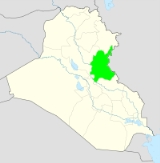
Diyala is one of the constituent governorates of the nation of Iraq.
Geography Diyala province extends to the northeast of Baghdad as far as the Iranian border. Its capital is Baqubah. It covers an area of 17,685 square kilometres (6,828 sq mi).
A large portion of the province is drained by the Diyala River, a major tributary of the Tigris. Because of its proximity to two major sources of water, Diyala's main industry is agriculture, primarily dates grown in large Date Palm groves.

Discussion
Ask a question about 'Diyala Governorate'
Start a new discussion about 'Diyala Governorate'
Answer questions from other users
|
Encyclopedia
Diyala is one of the constituent governorates of the nation of Iraq.
Provincial Government
- Governor: Ra’ad Hameed Al-Mula Jowad Al-Tamimi
- Deputy Governor: Auf Rahim
- Provincial Council Chairman (PCC): Ibrahim Hassan al-Bajellane
Geography Diyala province extends to the northeast of Baghdad as far as the Iranian border. Its capital is Baqubah. It covers an area of 17,685 square kilometres (6,828 sq mi).
A large portion of the province is drained by the Diyala River, a major tributary of the Tigris. Because of its proximity to two major sources of water, Diyala's main industry is agriculture, primarily dates grown in large Date Palm groves. It is also recognized as the orange capital of the Middle East.
The Hamrin mountains are in this governorate.
Population and Government
Diyala is overwhelmingly Sunni Muslim Arab but policemen and the current governor is Ra’ad Hameed Al-Mula Jowad Al-Tanimi are Shiite .
The local council of Diyala is composed of three political blocs: the Shiite Unified Iraqi Coalition (33 members), the Sunni Iraqi Islamic Party (1) and the Kurdistan Coalition (7). Voting turnout in the election for the council of Diyala governorate was very low.
The Kurds forms the majority of Kifri, Khanaqin, Baladrooz and Mandeli, Shi'a Arabs exist mostly in the villages of Kharnabat, Al Abarrah, Zaganiya and AlHowaider.
In 2003, it had an estimated population of some 1,224,000 people. about 80 percent are Sunni Arabs, with 16 percent Feyli Kurds and 2 percent Turkmen and 2 percent Shi'a Arabs and others.
75% of the population of Diyala are in the major cities : Baqubah, Muqdadiyah and Khanaqin.
Districts of Diyala Governorate
- Al-Khalis District (Al-Khalis)
- Al-Muqdadiya District (Al-Muqdadiya)
- Baladrooz District (Baladrooz)
- Ba'quba District (Ba'quba)
- Khanaqin District (Khanaqin)
- Kifri District (Kifri)
| Districts | Baqubah | Al-Muqdadiya | Khanaqin | Al khalis | Kifri | Baladrooz | Total |
|---|
| Population | 467,900 | 298,600 | 170,400 | 155,900 | 42,000 | 89,600 | 1,224,400 | | |
Cities and towns and villages
Infrastructure The Diyala Province also boasts the Diyala Media Center which has one of the Middle East's tallest radio and television antennas at 349 metres (1,047 ft). The Diyala Media Center was built under contract by a Japanese architectural firm in 1989. It is one of Iraq's few independent radio and television stations that offer local television and radio news coverage as well as rebroadcasting state-run television.
Civil unrest There is evidence that Al-Qaeda in Iraq has recently moved its base of operations from Anbar province to Diyala. During late 2006 Baqubah and much of the Diyala province were reported to have come under Sunni insurgent control.
This insurgent control is reported to have continued through 2007 and into early 2008.
On May 11, 2007, Army Maj. Gen. Benjamin Mixon, commander of the Multination Division North said he needed more troops in order to contain the current level of violence in the Diyala province, this coming in the recent wake of a troop "surge", involuntary recalls by the U.S. military, and the public debate about the level of commitment from the U.S. government.
By mid-2007 the Islamic State of Iraq, already holding Baqubah and most of the province under its control, declared its capital to be Baqubah. There is already strong evidence the Islamic State of Iraq has moved most of its command and control operations to Diyala.
In June 2007, US forces launched Operation Arrowhead Ripper with night air assaults in Baqubah. By August 19, Baqubah was largely secured, although some insurgent presence remained in the city and surrounding areas. Fighting continued in the Diyala River valley but by the beginning of October, US and Iraqi forces held most of the province while the insurgents were in retreat to the north and west. Diyala is still a contested province. On October 27 the Islamic State of Iraq attacked a police base in Baqubah, killing 28 Iraqi policemen and police recruits, showing that insurgent cells still remain in the province.
In January 2008 Operation Phantom Phoenix was launched in an attempt to eradicate the remaining insurgents following the Diyala province campaign between 2006 and 2007.
Mid 2008 saw many changes in Diyala province with an increased effort by U.S. Forces and a substantial Iraqi Army presence, and in the Baqubah region, Al Qaida in Iraq activity was dramatically hampered, and the Sons of Iraq program served only to further weaken Al-Qaida in Iraq.
External links
-
- - PBS article discussing Diyala, one of Iraq's deadliest provinces.
|
| |
|
|