

Distributor

Encyclopedia
A distributor is a device in the ignition system
of an internal combustion engine
that routes high voltage
from the ignition coil
to the spark plug
s in the correct firing order
. The first reliable battery operated ignition was developed by Dayton Engineering Laboratories Co.
(Delco) and introduced in the 1910 Cadillac. This ignition was developed by Charles Kettering
and was considered a wonder in its day.
). The distributor shaft is driven by a gear on the camshaft
. (Usually the distributor shaft extends to also drive the oil pump
.) The metal part of the rotor contacts the central high voltage cable from the coil via a spring-loaded carbon
brush
. The metal part of the rotor arm passes close to (but does not touch) the output contacts which connect via high tension leads
to the spark plug
of each cylinder
. As the rotor spins within the distributor, electrical current is able to jump the small gaps created between the rotor arm and the contacts due to the high voltage created by the ignition coil.
The distributor shaft has a cam
that operates the contact breaker
. Opening the points causes a high induction
voltage in the system's ignition coil
.
The distributor also houses the centrifugal advance unit: a set of hinged weights attached to the distributor shaft, that cause the breaker points mounting plate to slightly rotate and advance the spark timing with higher engine rpm
. In addition, the distributor has a vacuum advance unit that advances the timing even further as a function of the vacuum in the inlet manifold
. Usually there is also a capacitor
attached to the distributor. The capacitor is connected parallel
to the breaker points, to suppress sparking
and prevent wear of the points.
Around the 1970s the primary breaker points were largely replaced with Hall effect sensor
s. As this is a non-contacting device and the primary circuit is controlled by solid state electronics, a great amount of maintenance in point adjustment and replacement was eliminated. This also eliminates any problem with breaker follower or cam wear, and by eliminating a side load extends distributor shaft bearing
life. The remaining secondary (high voltage) circuit was as described above, using a single coil and a rotary distributor.
's engine
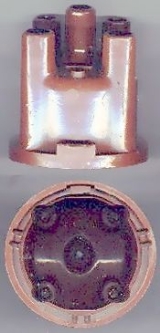
to cover the distributor and its internal rotor.
The distributor cap has one post for each cylinder, and in points ignition systems there is a central post for the current
from the ignition coil
coming into the distributor. In high energy ignition (HEI) systems there is no central post and the ignition coil sits on top of the distributor. On the inside of the cap there is a terminal that corresponds to each post, and the plug terminals are arranged around the circumference of the cap according to the firing order
in order to send the secondary voltage to the proper spark plug at the right time.
The rotor is attached to the top of the distributor shaft which is driven by a gear on the engine's camshaft
and thus synchronized to it. Synchronization to the camshaft is required as the rotor must turn at exactly half the speed of the main crankshaft
in the 4-stroke cycle. Often, the rotor and distributor are attached directly to the end of the one of (or the only) camshaft, at the opposite end to the timing drive belt. This rotor is pressed against a carbon
brush
on the center terminal of the distributor cap which connects to the ignition coil either through the top and wired directly to the coil in HEI systems, or via the center terminal in points ignition systems and remotely connected to the coil. The rotor is constructed such that the center tab is electrically connected to its outer edge so the current coming in to the center post travels through the carbon point to the outer edge of the rotor. As the camshaft rotates, the rotor spins and its outer edge passes each of the internal plug terminals to fire each spark plug in sequence.
Car
engines that use a mechanical distributor may fail if they run into deep puddles because any water that leaks into the distributor can short out the electric current that should go through the spark plug, rerouting it directly to the body of the vehicle. This in turn causes the engine to stop as the fuel is not ignited in the cylinders. This problem can be fixed by removing the distributor's cap and drying the cap, cam, rotor and the contacts by: wiping with tissue paper or a clean rag, by blowing hot air on them, or using a moisture displacement spray i.e. WD 40 or similar. Oil, dirt or other contaminants can cause similar problems, so the distributor should be kept clean inside and outside to ensure reliable operation.
The distributor cap is a prime example of a component that eventually succumbs to heat and vibration. It is a relatively easy and inexpensive part to replace if its bakelite housing does not break or crack first. Carbon
deposit accumulation or erosion of its metal terminals may also cause distributor-cap failure.
In traditional remote distributorless systems, the coils are mounted together in a transformer oil
filled 'coil pack', or separate coils for each cylinder, which are secured in a specified place in the engine compartment with wires to the spark plugs, similar to a distributor setup. General Motors
, Ford, Chrysler
, Hyundai
, and Toyota are among the automobile manufacturers known to have used coil packs. Coil packs by Delco for use with General Motors
engines allow removal of the individual coils in case one should fail, but in most other remote distributorless coil pack setups, if a coil were to fail, replacement of the whole pack would be required to fix the problem.
More recent layouts utilize a coil located very near to or directly on top of each spark plug (Direct Ignition, 'DI' or coil-on-plug). This setup avoids the need to switch very high voltages, which is very often a source of trouble, especially in damp conditions.
Both direct and remote distributorless systems also allow finer levels of ignition control by the engine computer, which assists in increasing power output, decreasing fuel consumption and emissions, and implementing features such as Active Fuel Management
. Spark plug wires, which need routine replacement due to wear, are also eliminated when the individual coils are set directly on top of each plug, with the spark being transported a short distance from the coil through a rubber boot to the plug.
Four-stroke 2-cylinder engines can be built without a distributor, as in the Citroen 2CV
of 1948 and BMW boxer twin motorcycles. Both spark plugs of the boxer twin are fired simultaneously, resulting in a wasted spark
on the cylinder currently on its exhaust stroke.
Four-stroke 4-cylinder engines can be built without a distributor, as in the Citroen ID19. Two coils are used with one coil firing two of the spark plugs simultaneously, resulting in a wasted spark on the cylinder currently on its exhaust stroke, and the other coil used for the other two cylinders.
Four-stroke one-cylinder engines can be built without a distributor, as in many mowers. The spark plug is fired on every stroke, resulting in a wasted spark in the cylinder when on its exhaust stroke.
Ignition system
An ignition system is a system for igniting a fuel-air mixture. Ignition systems are well known in the field of internal combustion engines such as those used in petrol engines used to power the majority of motor vehicles, but they are also used in many other applications such as in oil-fired and...
of an internal combustion engine
Internal combustion engine
The internal combustion engine is an engine in which the combustion of a fuel occurs with an oxidizer in a combustion chamber. In an internal combustion engine, the expansion of the high-temperature and high -pressure gases produced by combustion apply direct force to some component of the engine...
that routes high voltage
High voltage
The term high voltage characterizes electrical circuits in which the voltage used is the cause of particular safety concerns and insulation requirements...
from the ignition coil
Ignition coil
An ignition coil is an induction coil in an automobile's ignition system which transforms the battery's 12 volts to the thousands of volts needed to create an electric spark in the spark plugs to ignite the fuel...
to the spark plug
Spark plug
A spark plug is an electrical device that fits into the cylinder head of some internal combustion engines and ignites compressed fuels such as aerosol, gasoline, ethanol, and liquefied petroleum gas by means of an electric spark.Spark plugs have an insulated central electrode which is connected by...
s in the correct firing order
Firing order
The firing order is the sequence of power delivery of each cylinder in a multi-cylinder reciprocating engine.This is achieved by sparking of the spark plugs in a gasoline engine in the correct order, or by the sequence of fuel injection in a Diesel engine...
. The first reliable battery operated ignition was developed by Dayton Engineering Laboratories Co.
Delco Electronics
Delco Electronics Corporation was the automotive electronics design and manufacturing subsidiary of General Motors based in Kokomo, Indiana.The name Delco came from the Dayton Engineering Laboratories Co., founded in Dayton, Ohio by Charles Kettering and Edward A...
(Delco) and introduced in the 1910 Cadillac. This ignition was developed by Charles Kettering
Charles Kettering
Charles Franklin Kettering was an American inventor, engineer, businessman, and the holder of 186 patents. He was a founder of Delco, and was head of research for General Motors for 27 years from 1920 to 1947. Among his most widely used automotive inventions were the electrical starting motor and...
and was considered a wonder in its day.
Description
A distributor consists of a rotating arm or rotor inside the distributor cap, on top of the distributor shaft, but insulated from it and the body of the vehicle (groundGround (electricity)
In electrical engineering, ground or earth may be the reference point in an electrical circuit from which other voltages are measured, or a common return path for electric current, or a direct physical connection to the Earth....
). The distributor shaft is driven by a gear on the camshaft
Camshaft
A camshaft is a shaft to which a cam is fastened or of which a cam forms an integral part.-History:An early cam was built into Hellenistic water-driven automata from the 3rd century BC. The camshaft was later described in Iraq by Al-Jazari in 1206. He employed it as part of his automata,...
. (Usually the distributor shaft extends to also drive the oil pump
Oil pump (internal combustion engine)
The oil pump in an internal combustion engine circulates engine oil under pressure to the rotating bearings, the sliding pistons and the camshaft of the engine...
.) The metal part of the rotor contacts the central high voltage cable from the coil via a spring-loaded carbon
Carbon
Carbon is the chemical element with symbol C and atomic number 6. As a member of group 14 on the periodic table, it is nonmetallic and tetravalent—making four electrons available to form covalent chemical bonds...
brush
Brush (electric)
A brush is a device which conducts current between stationary wires and moving parts, most commonly in a rotating shaft. Typical applications include electric motors, alternators and electric generators.-Etymology:...
. The metal part of the rotor arm passes close to (but does not touch) the output contacts which connect via high tension leads
High tension leads
High tension leads or high tension cables are car components. They are the wires which go from the Ignition coil to the Distributor and the wires which go from the distributor to each of the spark plugs. Tension in this case is a synonym for voltage, the cables therefore carry a high voltage. HT...
to the spark plug
Spark plug
A spark plug is an electrical device that fits into the cylinder head of some internal combustion engines and ignites compressed fuels such as aerosol, gasoline, ethanol, and liquefied petroleum gas by means of an electric spark.Spark plugs have an insulated central electrode which is connected by...
of each cylinder
Cylinder (engine)
A cylinder is the central working part of a reciprocating engine or pump, the space in which a piston travels. Multiple cylinders are commonly arranged side by side in a bank, or engine block, which is typically cast from aluminum or cast iron before receiving precision machine work...
. As the rotor spins within the distributor, electrical current is able to jump the small gaps created between the rotor arm and the contacts due to the high voltage created by the ignition coil.
The distributor shaft has a cam
Cam
A cam is a rotating or sliding piece in a mechanical linkage used especially in transforming rotary motion into linear motion or vice-versa. It is often a part of a rotating wheel or shaft that strikes a lever at one or more points on its circular path...
that operates the contact breaker
Contact breaker
A contact breaker is a type of electrical switch, and the term typically refers to the switching device found in the distributor of the ignition systems of spark-ignition internal combustion engines.-Purpose:...
. Opening the points causes a high induction
Electromagnetic induction
Electromagnetic induction is the production of an electric current across a conductor moving through a magnetic field. It underlies the operation of generators, transformers, induction motors, electric motors, synchronous motors, and solenoids....
voltage in the system's ignition coil
Ignition coil
An ignition coil is an induction coil in an automobile's ignition system which transforms the battery's 12 volts to the thousands of volts needed to create an electric spark in the spark plugs to ignite the fuel...
.
The distributor also houses the centrifugal advance unit: a set of hinged weights attached to the distributor shaft, that cause the breaker points mounting plate to slightly rotate and advance the spark timing with higher engine rpm
Revolutions per minute
Revolutions per minute is a measure of the frequency of a rotation. It annotates the number of full rotations completed in one minute around a fixed axis...
. In addition, the distributor has a vacuum advance unit that advances the timing even further as a function of the vacuum in the inlet manifold
Inlet manifold
In automotive engineering, an inlet manifold or intake manifold is the part of an engine that supplies the fuel/air mixture to the cylinders...
. Usually there is also a capacitor
Capacitor
A capacitor is a passive two-terminal electrical component used to store energy in an electric field. The forms of practical capacitors vary widely, but all contain at least two electrical conductors separated by a dielectric ; for example, one common construction consists of metal foils separated...
attached to the distributor. The capacitor is connected parallel
Series and parallel circuits
Components of an electrical circuit or electronic circuit can be connected in many different ways. The two simplest of these are called series and parallel and occur very frequently. Components connected in series are connected along a single path, so the same current flows through all of the...
to the breaker points, to suppress sparking
Electric arc
An electric arc is an electrical breakdown of a gas which produces an ongoing plasma discharge, resulting from a current flowing through normally nonconductive media such as air. A synonym is arc discharge. An arc discharge is characterized by a lower voltage than a glow discharge, and relies on...
and prevent wear of the points.
Around the 1970s the primary breaker points were largely replaced with Hall effect sensor
Hall effect sensor
A Hall effect sensor is a transducer that varies its output voltage in response to a magnetic field. Hall effect sensors are used for proximity switching, positioning, speed detection, and current sensing applications....
s. As this is a non-contacting device and the primary circuit is controlled by solid state electronics, a great amount of maintenance in point adjustment and replacement was eliminated. This also eliminates any problem with breaker follower or cam wear, and by eliminating a side load extends distributor shaft bearing
Bearing (mechanical)
A bearing is a device to allow constrained relative motion between two or more parts, typically rotation or linear movement. Bearings may be classified broadly according to the motions they allow and according to their principle of operation as well as by the directions of applied loads they can...
life. The remaining secondary (high voltage) circuit was as described above, using a single coil and a rotary distributor.
Distributor cap
A distributor cap is used in an automobileAutomobile
An automobile, autocar, motor car or car is a wheeled motor vehicle used for transporting passengers, which also carries its own engine or motor...
's engine
Internal combustion engine
The internal combustion engine is an engine in which the combustion of a fuel occurs with an oxidizer in a combustion chamber. In an internal combustion engine, the expansion of the high-temperature and high -pressure gases produced by combustion apply direct force to some component of the engine...
to cover the distributor and its internal rotor.
The distributor cap has one post for each cylinder, and in points ignition systems there is a central post for the current
Electric current
Electric current is a flow of electric charge through a medium.This charge is typically carried by moving electrons in a conductor such as wire...
from the ignition coil
Ignition coil
An ignition coil is an induction coil in an automobile's ignition system which transforms the battery's 12 volts to the thousands of volts needed to create an electric spark in the spark plugs to ignite the fuel...
coming into the distributor. In high energy ignition (HEI) systems there is no central post and the ignition coil sits on top of the distributor. On the inside of the cap there is a terminal that corresponds to each post, and the plug terminals are arranged around the circumference of the cap according to the firing order
Firing order
The firing order is the sequence of power delivery of each cylinder in a multi-cylinder reciprocating engine.This is achieved by sparking of the spark plugs in a gasoline engine in the correct order, or by the sequence of fuel injection in a Diesel engine...
in order to send the secondary voltage to the proper spark plug at the right time.
The rotor is attached to the top of the distributor shaft which is driven by a gear on the engine's camshaft
Camshaft
A camshaft is a shaft to which a cam is fastened or of which a cam forms an integral part.-History:An early cam was built into Hellenistic water-driven automata from the 3rd century BC. The camshaft was later described in Iraq by Al-Jazari in 1206. He employed it as part of his automata,...
and thus synchronized to it. Synchronization to the camshaft is required as the rotor must turn at exactly half the speed of the main crankshaft
Crankshaft
The crankshaft, sometimes casually abbreviated to crank, is the part of an engine which translates reciprocating linear piston motion into rotation...
in the 4-stroke cycle. Often, the rotor and distributor are attached directly to the end of the one of (or the only) camshaft, at the opposite end to the timing drive belt. This rotor is pressed against a carbon
Carbon
Carbon is the chemical element with symbol C and atomic number 6. As a member of group 14 on the periodic table, it is nonmetallic and tetravalent—making four electrons available to form covalent chemical bonds...
brush
Brush (electric)
A brush is a device which conducts current between stationary wires and moving parts, most commonly in a rotating shaft. Typical applications include electric motors, alternators and electric generators.-Etymology:...
on the center terminal of the distributor cap which connects to the ignition coil either through the top and wired directly to the coil in HEI systems, or via the center terminal in points ignition systems and remotely connected to the coil. The rotor is constructed such that the center tab is electrically connected to its outer edge so the current coming in to the center post travels through the carbon point to the outer edge of the rotor. As the camshaft rotates, the rotor spins and its outer edge passes each of the internal plug terminals to fire each spark plug in sequence.
Car
Automobile
An automobile, autocar, motor car or car is a wheeled motor vehicle used for transporting passengers, which also carries its own engine or motor...
engines that use a mechanical distributor may fail if they run into deep puddles because any water that leaks into the distributor can short out the electric current that should go through the spark plug, rerouting it directly to the body of the vehicle. This in turn causes the engine to stop as the fuel is not ignited in the cylinders. This problem can be fixed by removing the distributor's cap and drying the cap, cam, rotor and the contacts by: wiping with tissue paper or a clean rag, by blowing hot air on them, or using a moisture displacement spray i.e. WD 40 or similar. Oil, dirt or other contaminants can cause similar problems, so the distributor should be kept clean inside and outside to ensure reliable operation.
The distributor cap is a prime example of a component that eventually succumbs to heat and vibration. It is a relatively easy and inexpensive part to replace if its bakelite housing does not break or crack first. Carbon
Carbon
Carbon is the chemical element with symbol C and atomic number 6. As a member of group 14 on the periodic table, it is nonmetallic and tetravalent—making four electrons available to form covalent chemical bonds...
deposit accumulation or erosion of its metal terminals may also cause distributor-cap failure.
Direct & distributorless ignition
Modern engine designs have abandoned the high-voltage distributor and coil, instead performing the distribution function in the primary circuit electronically and applying the primary (low-voltage) pulse to individual coils for each spark plug, or one coil for each pair of companion cylinders in an engine (two coils for a four-cylinder, three coils for a six-cylinder, four coils for an eight-cylinder, and so on).In traditional remote distributorless systems, the coils are mounted together in a transformer oil
Transformer oil
Transformer oil or insulating oil is usually a highly-refined mineral oil that is stable at high temperatures and has excellent electrical insulating properties. It is used in oil-filled transformers, some types of high voltage capacitors, fluorescent lamp ballasts, and some types of high voltage...
filled 'coil pack', or separate coils for each cylinder, which are secured in a specified place in the engine compartment with wires to the spark plugs, similar to a distributor setup. General Motors
General Motors
General Motors Company , commonly known as GM, formerly incorporated as General Motors Corporation, is an American multinational automotive corporation headquartered in Detroit, Michigan and the world's second-largest automaker in 2010...
, Ford, Chrysler
Chrysler
Chrysler Group LLC is a multinational automaker headquartered in Auburn Hills, Michigan, USA. Chrysler was first organized as the Chrysler Corporation in 1925....
, Hyundai
Hyundai
Hyundai ) is a global conglomerate company, part of the Korean chaebol, that was founded in South Korea by one of the most famous businessmen in Korean history: Chung Ju-yung...
, and Toyota are among the automobile manufacturers known to have used coil packs. Coil packs by Delco for use with General Motors
General Motors
General Motors Company , commonly known as GM, formerly incorporated as General Motors Corporation, is an American multinational automotive corporation headquartered in Detroit, Michigan and the world's second-largest automaker in 2010...
engines allow removal of the individual coils in case one should fail, but in most other remote distributorless coil pack setups, if a coil were to fail, replacement of the whole pack would be required to fix the problem.
More recent layouts utilize a coil located very near to or directly on top of each spark plug (Direct Ignition, 'DI' or coil-on-plug). This setup avoids the need to switch very high voltages, which is very often a source of trouble, especially in damp conditions.
Both direct and remote distributorless systems also allow finer levels of ignition control by the engine computer, which assists in increasing power output, decreasing fuel consumption and emissions, and implementing features such as Active Fuel Management
Active Fuel Management
Active Fuel Management is a trademarked name for the automobile variable displacement technology from General Motors. It allows a V6 or V8 engine to "turn off" half of the cylinders under light-load conditions to improve fuel economy...
. Spark plug wires, which need routine replacement due to wear, are also eliminated when the individual coils are set directly on top of each plug, with the spark being transported a short distance from the coil through a rubber boot to the plug.
Four-stroke 2-cylinder engines can be built without a distributor, as in the Citroen 2CV
Citroën 2CV
The Citroën 2CV |tax horsepower]]”) was an economy car produced by the French automaker Citroën between 1948 and 1990. It was technologically advanced and innovative, but with uncompromisingly utilitarian unconventional looks, and deceptively simple Bauhaus inspired bodywork, that belied the sheer...
of 1948 and BMW boxer twin motorcycles. Both spark plugs of the boxer twin are fired simultaneously, resulting in a wasted spark
Wasted spark
The wasted spark system is an ignition system used with some four-stroke cycle internal combustion engines. In a wasted spark system, the spark plugs fire in pairs even though one is on its compression stroke and one is on its exhaust stroke. The extra spark on the exhaust stroke has no effect and...
on the cylinder currently on its exhaust stroke.
Four-stroke 4-cylinder engines can be built without a distributor, as in the Citroen ID19. Two coils are used with one coil firing two of the spark plugs simultaneously, resulting in a wasted spark on the cylinder currently on its exhaust stroke, and the other coil used for the other two cylinders.
Four-stroke one-cylinder engines can be built without a distributor, as in many mowers. The spark plug is fired on every stroke, resulting in a wasted spark in the cylinder when on its exhaust stroke.
See also
- Engine control unitEngine control unitAn engine control unit is a type of electronic control unit that determines the amount of fuel, ignition timing and other parameters an internal combustion engine needs to keep running...
(ECU) - Ignition systemIgnition systemAn ignition system is a system for igniting a fuel-air mixture. Ignition systems are well known in the field of internal combustion engines such as those used in petrol engines used to power the majority of motor vehicles, but they are also used in many other applications such as in oil-fired and...
- Saab Direct IgnitionSaab Direct IgnitionSaab Direct Ignition is a capacitor discharge ignition system developed by Saab Automobile, then known as Saab-Scania, and Mecel AB during the 1980s....
- Timing markTiming markA timing mark is an indicator used for setting the timing of the ignition system of an engine, typically found on the crankshaft pulley or the flywheel, being the largest radius rotating at crankshaft speed and therefore the place where marks at one degree intervals will be farthest apart.On older...