
All Topics  
Distal radius fracture


   Email Print
   Bookmark   Link


Distal radius fracture


A distal radius fracture is a common bone fracture of the radius
Radius (bone)

The radius is the bone of the forearm that extends from the lateral side of the Elbow-joint to the thumb side of the wrist. The radius is situated on the lateral side of the ulna, which exceeds it in length and size....
 in the forearm. Because of its proximity to the wrist joint
Wrist

In human anatomy, the wrist is the flexible and narrower connection between the forearm and the hand. The wrist is essentially a double row of small short bones, called carpals, intertwined to form a malleable hinge....
, this injury is often called a wrist fracture. Treatment is usually with immobilization, although surgery is sometimes needed for complex fractures.

Specific types of distal radius fractures are Colles' fracture
Colles' fracture

A Colles' fracture, also Colles fracture, is a fracture of the distal radius . For more detailed discussion see distal radius fracture....
; Smith's fracture
Smith's fracture

A Smith's fracture, also sometimes known as a reverse Colles' fracture is a fracture of the distal radius caused by falling onto flexed wrists, as opposed to a Colles' fracture which occurs as a result of falling onto wrists in extension....
; Barton's fracture
Barton's fracture

A Barton's fracture is an intra-articular bone fracture of the distal radius with dislocation of the radiocarpal joint.There exist two types of Barton's fracture - dorsal and palmar, the latter being more common....
; Chauffeur's fracture
Chauffeur's fracture

A fracture of the distal radius, specifically the radial styloid. The injury is typically caused by compression of the scaphoid against the radius. Chauffeurs were known to get these injuries from hand-cranking early cars in the event the car backfired, forcing the crank backward into the chauffeur's palm....
 (so called because the crank used to start old cars often kicked back and broke the chauffeurs' wrists with a particular pattern).


Discussion
Ask a question about 'Distal radius fracture'
Start a new discussion about 'Distal radius fracture'
Answer questions from other users
Full Discussion Forum


Encyclopedia


A distal radius fracture is a common bone fracture of the radius
Radius (bone)

The radius is the bone of the forearm that extends from the lateral side of the Elbow-joint to the thumb side of the wrist. The radius is situated on the lateral side of the ulna, which exceeds it in length and size....
 in the forearm. Because of its proximity to the wrist joint
Wrist

In human anatomy, the wrist is the flexible and narrower connection between the forearm and the hand. The wrist is essentially a double row of small short bones, called carpals, intertwined to form a malleable hinge....
, this injury is often called a wrist fracture. Treatment is usually with immobilization, although surgery is sometimes needed for complex fractures.

Specific types of distal radius fractures are Colles' fracture
Colles' fracture

A Colles' fracture, also Colles fracture, is a fracture of the distal radius . For more detailed discussion see distal radius fracture....
; Smith's fracture
Smith's fracture

A Smith's fracture, also sometimes known as a reverse Colles' fracture is a fracture of the distal radius caused by falling onto flexed wrists, as opposed to a Colles' fracture which occurs as a result of falling onto wrists in extension....
; Barton's fracture
Barton's fracture

A Barton's fracture is an intra-articular bone fracture of the distal radius with dislocation of the radiocarpal joint.There exist two types of Barton's fracture - dorsal and palmar, the latter being more common....
; Chauffeur's fracture
Chauffeur's fracture

A fracture of the distal radius, specifically the radial styloid. The injury is typically caused by compression of the scaphoid against the radius. Chauffeurs were known to get these injuries from hand-cranking early cars in the event the car backfired, forcing the crank backward into the chauffeur's palm....
 (so called because the crank used to start old cars often kicked back and broke the chauffeurs' wrists with a particular pattern). Most of these names are applied to specific patterns of distal radius fracture but confusion exists because "Colles' fracture" is used (for example by the US National Library of Medicine) as a generic term for distal radius fracture.

Signs and symptoms


History

The most common cause of this type of fracture is a fall on an outstretched hand(acronym: FOOSH). In young adults this fracture is the result of moderate to severe force such as a fall from a significant height or a motor vehicle accident. The risk of injury is increased in patients with osteoporosis
Osteoporosis

Osteoporosis is a disease of bone that leads to an increased risk of bone fracture. In osteoporosis the bone mineral density is reduced, bone microarchitecture is disrupted, and the amount and variety of collagen proteins in bone is altered....
 and other metabolic bone diseases.

Patients usually present with a history of an injury and localized pain
Pain

Pain, in the sense of physical pain, is a typical sensory experience that may be described as the unpleasant awareness of a noxious stimulus or bodily harm....
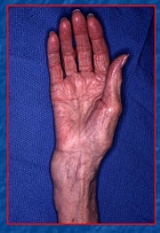
. There is often a deformity in the wrist with associated swelling (figure 1). Numbness of the hand can occur because of compression on the median nerve across the wrist (carpal tunnel syndrome). There is often limited digital motion secondary to the wrist deformity.

Examination

Swelling, deformity, tenderness and loss of wrist motion are normal features on examination of a patient with a distal radius fracture. Examination should rule out a skin wound which might suggest an open fracture. It is imperative to check for loss of sensation, loss of circulation to the hand, and more proximal injuries to the forearm, elbow and shoulder.

Injuries associated

The most commonly associated injury is to the ulnar styloid. Styloid fractures can occur either to the very tip of the styloid or at the base. Because the triangular fibrocartilage (TFCC) attaches to the base of the ulna styloid, displaced fractures can result in instability of the distal radio-ulnar joint. Carpal bone fractures such as those to the scaphoid have been described, whereas instability or dislocations of the wrist are seen with certain types of distal radius and ulna fractures. Injuries to the elbow, humerus and shoulder are also common after a FOOSH (fall on out-stretched hand). Swelling and displacement can cause compression in the median nerve across the wrist, an acute carpal tunnel syndrome
Carpal tunnel syndrome

Carpal tunnel syndrome , or median neuropathy at the wrist, is a medical condition in which the median nerve is compressed at the wrist, leading to paresthesias, numbness and muscle weakness in the hand....
. Very rarely is pressure on the muscle components of the hand or forearm sufficient to create a compartment syndrome.

Diagnosis

Diagnosis may be evident clinically when the distal radius is deformed but should be confirmed by x-ray. The differential diagnosis
Differential diagnosis

A differential diagnosis is a systematic method used to identify unknowns. This method, essentially a process of elimination, is used by taxonomy to identify living organisms, and by physicians and other qualified healthcare professionals to diagnosis the specific disease in a patient....
 includes scaphoid fractures and wrist dislocations, which can also co-exist with a distal radius fracture. Occasionally, fractures may not be seen on x-rays immediately after the injury. Delayed x-rays, CT scan, or MRI will confirm the diagosis.

Medical imaging

X-ray of the affected wrist is required if a fracture is suspected. CT scan is often performed to investigate the articular anatomy of the fracture, especially if surgery is considered. Investigation of a potential distal radial fracture includes assessment of the lateral articular angle, radial length, and subluxation of the distal radioulnar joint. Displacement of the articular surface is the most important factor affecting prognosis and treatment.

Articular surface

The articular joint surface must be smooth for it to function properly. Irregularity may result in radiocarpal arthritis
Arthritis

Arthritis is a group of conditions involving damage to the joints of the body. Arthritis is the leading cause of disability in people older than fifty-five years....
, pain
Pain

Pain, in the sense of physical pain, is a typical sensory experience that may be described as the unpleasant awareness of a noxious stimulus or bodily harm....
, and stiffness. More than 1 mm of incongruity places the patient at a high risk for posttraumatic arthritis
Arthritis

Arthritis is a group of conditions involving damage to the joints of the body. Arthritis is the leading cause of disability in people older than fifty-five years....
. Significant articular incongruity typically occurs in young patients after high energy injuries (Figure 2). If the surface is very irregular and cannot be reconstructed, then the only option may be a fusion.

Lateral articular angle

The lateral articular angle is the angle on an x-ray film between the axis of the radius and the articular cup. Normally, the angle is turned down toward the thumb
Thumb

The thumb is the Human_anatomical_terms#Anatomical_directions-most finger of the hand. The English adjective for thumb is pollical....
 (volar tilt) by 11°. As pressure is applied dorsally (to the back of the wrist), malalignment may occur. Alignment up to 0° is still considered to be functional, and does not require any intervention. However, tilt away from the thumb (dorsal tilt) beyond this point (>11° deviation) begins to create biomechanical changes that can lead to arthritis
Arthritis

Arthritis is a group of conditions involving damage to the joints of the body. Arthritis is the leading cause of disability in people older than fifty-five years....
, pain
Pain

Pain, in the sense of physical pain, is a typical sensory experience that may be described as the unpleasant awareness of a noxious stimulus or bodily harm....
, and stiffness. When dorsal tilt beyond the acceptable threshold occurs, distal radio-ulnar joint motion is altered, and forearm
Forearm

The forearm is the structure on the upper limb, between the Elbow-joint and the wrist.. This term is used in anatomy to distinguish it from the arm ....
 rotation becomes restricted. The upper limit of an acceptable deformity after reduction of the fracture is 20° of dorsal tilt.

Radial length

Radial length is an important consideration in distal radius fractures. When the fracture begins to shorten, there is relative lengthening of the ulnar because this is usually not fractured. With increasing relative lengthening of the ulna, ulnar positive variance, ulnar impaction syndrome may occur. Ulnar impaction is a degenerative tear of the TFCC and positive ulnar variance (Figure 3).

Classification

In medicine, classifications systems are devised to describe patterns of injury which will behave in predictable ways, to distinguish between conditions which have different outcomes or which need different treatments. Most wrist fracture systems have failed to accomplish any of these goals and there is no consensus about the most useful one.

At one extreme, a stable undisplaced extra-articular fracture has an excellent prognosis. On the other hand, an unstable, displaced intra-articular fracture is difficult to treat and has a poor prognosis without operative intervention.

Eponyms such as Colles', Smith's, and Barton's fractures are discouraged. Though the Frykman system has traditionally been used, there is little value in its use because it does not help direct treatment. The Universal system is descriptive but also does nto direct treatment. Universal codes include:
    • Type I: extra articular, undisplaced
    • Type II: extra articular, displaced
    • Type III intra articular, undisplaced
    • Type IV: intra articular, displaced


The system that comes closest to directing treatment has been devised by Melone:
    • I Stable fracture
    • II Unstable "die-punch"
    • III "Spike" fracture
    • IV Split fracture
    • V Explosion injuries


However, an anatomic description of the fracture is the easiest way to describe the fracture, decide on treatment, and make an assessment of stability.

    • Articular incongruity
    • Radial shortening
    • Radial angulation
    • Comminution of the fracture (the amount of crumbling at the fracture site
    • Open (coumpound fracture) or closed injury
    • Associated ulnar styloid fracture
    • Associated soft tissue injuries


Natural history

Nonunion
Nonunion

Nonunion is permanent failure of bone healing following a fracture .Nonunion is a serious Complication of a fracture and may occur when the fracture moves too much, has a poor blood supply or gets infected....
 is rare; almost all of these fractures heal. However, if the fracture is unstable the deformity at the fracture site will increase and cause limitation of wrist motion and forearm rotation, pronation
Pronation

In anatomy, pronation is a rotational movement of the forearm at the radioulnar joint, or of the foot at the subtalar joint and talocalcaneonavicular joints....
 and supination
Supination

Supination is a position of either the forearm or foot; in the forearm when the palm faces anteriorly, or faces up . Supination in the foot occurs when a person appears "Genu varum" with their weight supported primarily on the anterior of their feet....
. If the joint surface is damaged and heals with more than 1-2 mm of unevenness, the wrist joint will be prone to post traumatic osteoarthritis (Figures 4 and 5). Displaced fractures of the ulnar styloid base associated with a distal radius fracture result in instability of the distal radioulnar joint and resulting loss of forearm
Forearm

The forearm is the structure on the upper limb, between the Elbow-joint and the wrist.. This term is used in anatomy to distinguish it from the arm ....
 rotation (Figure 6).

Treatment

The type of treatment required depends on many fractures such as weather the fracture is displaced or undisplaced, stable or unstable.

Non-operative

For torus fractures a splint may be sufficient and casting may be avoided.

Where the fracture is undisplaced and stable, non operative treatment involves immobilization. Initially the wrist is splinted to allow swelling and subsequently a cast is applied. Depending on the nature of the fracture, the cast may be placed above the elbow to control forearm rotation.

In displaced fractures, the fracture may be manipulated under anaesthesia and casted in a position to minimize the risk of re-displacement. Typically, this involves injecting local anesthesia into the fracture (hematoma block) possibly combined with intravenous medication. The general principle is to reverse the mechanism of injury. The typical fracture has the articular surface facing toward the back side of the hand (dorsal tilt) causing over-extension of the wrist joint, often with some radial deviation. Therefore, the preferred position for this type of injury, following reduction, is flexion and ulnar deviation. This position is safe for only a brief period of time as it places excess pressure on the median nerve (carpal tunnel syndrome) and makes maintaining digital motion difficult.

During the period of follow-up, it is common practice to repeat x-rays at about 1 week to make sure the position is still acceptable. Follow-up is also needed to determine when the cast may be removed, when the fracture has healed and when rehabilitation is complete. The critical time after injury is between 2 and 3 weeks. The swelling will reduce during this time and the fracture can displace. More than 3 weeks after injury, the fracture will start to heal which makes options for treatment limited.

The length of time in the cast varies with different ages. Children heal more rapidly, but may ignore activity restrictions. Three weeks in a cast and 6 weeks off sports may be appropriate for certain fractures. In adults, the risk of stiffness of the joint increases the longer it is immobilized. If callus is seen on x-ray at 4 weeks, the cast may be replaced by a removable splint. However, many hand surgeons leave the patients in the cast for up to 6 weeks. In general, the x-rays will not show any callous until about a month after the fracture is healed; therefore the cast is removed before the x-rays confirm that it is healed.

Displaced fractures in the elderly or those physiologically unable to undergo surgery are treated differently. When the fracture is displaced and there are no plans for a surgery, a short arm cast is placed for only 4 weeks or until the tenderness resolves. A larger cast placed for an extended period of time only slows down recovery in this group of patients.

Following healing and cast removal a period of rehabilitation for recovery of strength and range of motion is necessary. Patients will continue to improve after the fracture for 4 to 12 months.

Reduction

Closed management of a distal radius fracture involves first anesthetizing
Anesthesia

Anesthesia, or anaesthesia , has traditionally meant the condition of having sensation blocked or temporarily taken away. This allows patients to undergo surgery and other procedures without the distress and pain they would otherwise experience....
 the affected area with a hematoma block
Hematoma block

A Hematoma block is an analgesia technique used to allow painless manipulation of bone fracture while avoiding the need for full anesthesia.This procedure in normally only appropriate for fractures of the radius and/or ulna, and occasionally for fractures of the lower ends of the tibia and fibula....
, regional anesthesia, sedation
Sedation

Sedation is a medical procedure involving the administration of sedative drugs, generally to facilitate a medical procedure with local anaesthesia....
 or a general anesthetic.

Manipulation generally includes first placing the arm
Arm

In anatomy, an arm is one of the upper limbs of an animal. The term arm can also be used for analogous structures, such as one of the paired upper limbs of a four-legged animal, or the cephalopod arm....
 under traction and unlocking the fragments. The deformity is then reduced with appropriate closed manipulations (depending on the type of deformity) reduction
Reduction (orthopedic surgery)

Reduction is a medical procedure to restore a Fracture or Dislocation to the correct alignment. When a bone fractures, the fragments lose their alignment in the form of Displacement or angulation....
, after which a splint or cast is placed and an X-ray
X-ray

X-radiation is a form of electromagnetic radiation. X-rays have a wavelength in the range of 10 to 0.01 nanometers, corresponding to frequency in the range 30 Hertz to 30 Hertz and energies in the range 120 Electron volt to 120 keV....
 is taken to ensure that the reduction
Reduction (orthopedic surgery)

Reduction is a medical procedure to restore a Fracture or Dislocation to the correct alignment. When a bone fractures, the fragments lose their alignment in the form of Displacement or angulation....
 was successful. The cast is usually maintained for about 6 weeks.

Closed treatment is frequently unsuccessful in maintaining a good position in adults, because there is frequently comminution
Comminution

Comminution is one of the four main groups of mechanical processing and describes the movement of the particle size distribution into a range of finer particle sizes ....
 of the fracture. Re-displacement and deformity can reoccur with an unacceptable ultimate result.

Risks of non-operative treatment

Failure of non-operative treatment is common and is the largest risk of an adverse outcome. Studies have shown that the fracture often re-displaces to its original position even in a cast. Only 27% - 32% of fractures are in acceptable alignment 5 weeks after closed reduction. In the long term this increases the risk of stiffness
Joint stiffness

Joint stiffness may be either the symptom of pain on moving a joint, the symptom of loss of range of motion or the Sign of reduced range of motion....
 and post traumatic osteoarthritis
Osteoarthritis

Osteoarthritis , is a group of diseases and mechanical abnormalities entailing degradation of joints, including articular cartilage and the subchondral bone next to it....
 leading to wrist pain and loss of function. It is because of these findings that most surgeons recommend operative intervention if the fracture is displaced enough to consider a reduction. Ultimately, the fractures that have a closed reduction usually end up back in the position before the reduction is attempted.

Stiffness of the wrist is universal following a fracture of the distal radius. The degree of stiffness in the wrist is dependent on the type of fracture and the period of mobilization. It is for this reason that an open reduction is advantageous. It is also quite common for patients to develop digital stiffness after a fracture of the distal radius. Aggressive movement of the digits while immobilized or following operative treatment should minimize the stiffness.

Other risks specific to cast treatment relate to the potential for compression of the swollen arm causing carpal tunnel syndrome
Carpal tunnel syndrome

Carpal tunnel syndrome , or median neuropathy at the wrist, is a medical condition in which the median nerve is compressed at the wrist, leading to paresthesias, numbness and muscle weakness in the hand....
 or compartment syndrome
Compartment syndrome

Compartment syndrome is an acute medical problem following injury, surgery or in most cases repetitive and extensive muscle use, in which increased pressure within a confined space in the body impairs perfusion....
. Carpal tunnel syndrome is related to the position of the wrist, that is, excess flexion or excess distraction if the wrist is placed in an external fixator. A compartment syndrome is swelling in the muscle compartments, usually in the forearm, leading to severe pain, loss of nerve function and a contracture. Finally, complex regional pain syndrome (reflex sympathetic dystrophy) is a serious complication following injury and is thought to be more common after cast immobilization than after surgery. The provoking factors for regional pain syndromes, however, are very complex but the condition often leads to chronic pain and stiffness.

Prognosis following non-operative treatment

In children the outcome of distal radius fracture treatment in casts is usually very successful with healing and return to normal function expected. Some residual deformity is common but this often remodels as the child grows. In the elderly, distal radius fractures heal and may result in adequate function following non-operative treatment. A large proportion of these fractures occur in elderly people with limited expectations and little requirement for strenuous use of their wrists. Some of these patients tolerate severe deformities and minor loss of wrist motion very well even without reduction of the fracture. In this low demand group only a short period of immobilization is indicated as rapid mobilization improves functional outcome.

In younger patients the injury requires greater force and results in more displacement particularly to the articular surface. Unless an accurate reduction of the joint surface is obtained, these patients are very likely to have long term symptoms of pain
Pain

Pain, in the sense of physical pain, is a typical sensory experience that may be described as the unpleasant awareness of a noxious stimulus or bodily harm....
, arthritis
Arthritis

Arthritis is a group of conditions involving damage to the joints of the body. Arthritis is the leading cause of disability in people older than fifty-five years....
, and stiffness.}}

Surgery

Contemporary surgical options have developed that really have revolutionized treatment of this common injury. Generally, techniques include Open Reduction Internal Fixation (ORIF), external fixation
External Fixation

External fixation is a surgical treatment used to set bone fractures in which a cast would not allow proper alignment of the fracture. In this kind of reduction, holes are drilled into uninjured areas of bones around the fracture and special bolts or wires are screwed into the holes....
, percutaneous pinning
Percutaneous pinning

Percutaneous pinning is a technique used by orthopedic surgeons for the stabilisation of unstable fractures.Many fractures can be manipulated into wholly satisfactory positions, immobilised in an appropriate cast and allowed to heal....
, or some combination of the above. The greatest recent advances have been with operative open reduction and internal fixation ORIF. A entire market of surgical implants are available to treat this specific fracture. The two most recent and promising developments have been fragment specific fixation and fixed angle volar plating. These attempt fixation rigid enough to allow almost immediate mobility, thus ultimately less stiffness and greater function is possible. Although restoration of radiocarpal alignment is of obvious importance, one must not overlook the alignment of the distal radioulnar joint as this can be a source of a frustrating pronation contracture down the road.

Each orthopaedic surgeon will treat the fracture according to what his/her preferences are and what works best for him/her. The surgeon should be open to discussion of the rationality of the decisions that are made.

Prognosis varies depending on dozens of variables. If the anatomy
Anatomy

Anatomy is a branch of biology that is the consideration of the body plan. It is a general term that includes human anatomy, animal anatomy and plant anatomy ....
 (bony alignment)is not properly restored, function may remain poor even after healing. Restoration of bony alignment is not a guarantee of success, as there are significant soft tissue contributions to the healing process.

An arthroscope can be used at the time of fixation to evaluate for soft tissue injury. Structures at risk include the triangular fibrocartilage complex and the scapholunate ligament. Beware of scapholunate injuries in radial styloid fractures where the fracture line exits distally at the scapholunate interval. TFCC injuries causing obvious DRUJ instability can be addressed at the time of fixation.

Incidence

Distal fracture of the radius is the most commonly occurring fracture in adults. It is common in the elderly because of the frequent osteopenia and osteoporosis in this age group. This is also a common injury in children which may involve the growth plate
Epiphysis

The epiphysis is the rounded end of a long bone, at its joint with adjacent bone. Between the epiphysis and diaphysis lies the metaphysis, including the epiphyseal plate ....
. A similar fracture in children involving the growth plate is called a Salter-Harris fracture
Salter-Harris Fractures

Salter-Harris Fractures: Descriptive terms for bone fractures affecting the growth plate of a bone. Once bone growth has completed, the term "Salter-Harris Fracture" no longer applies....
. In young adults, the injury is often very severe because it requires greater force to produce the injury.

External links

  • .
  • Radius and Ulna
  • Fractures of the Radius
  • Closed Reduction of Distal Radius Fractures - Good account and list of references.
  • Patient Education Page
  • Broken Wrist Page, written for the Patient Education website for the American Academy of Orthopedic Surgeons