


Disintegrator ray

Encyclopedia
Science fiction
Science fiction is a genre of fiction dealing with imaginary but more or less plausible content such as future settings, futuristic science and technology, space travel, aliens, and paranormal abilities...
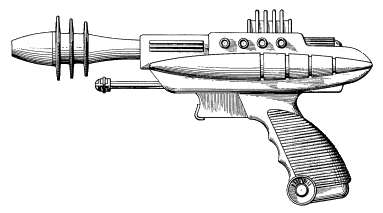
, a disintegrator ray is an energy beam that destroys an object by disintegrating it to its basic components, which usually disperse into the atmosphere. Ray gun is the generic term for the weapons that fire disintegrator beams. The disintegrator gun’s first literary appearance was in Edison's Conquest of Mars
Edison's Conquest of Mars
Edison's Conquest of Mars, by Garrett P. Serviss, is one of the many science fiction novels published in the 19th century. Although science fiction was not at the time thought of as a distinct literary genre, it was a very popular literary form, with almost every fiction magazine regularly...
(1898), the sequel novel to Fighters from Mars an unauthorized contemporary interpretation of The War of the Worlds
The War of the Worlds
The War of the Worlds is an 1898 science fiction novel written by H. G. Wells.The War of the Worlds may also refer to:- Radio broadcasts :* The War of the Worlds , the 1938 radio broadcast by Orson Welles...
(1898), by H.G. Wells:
In the sequel
Edison's Conquest of Mars
Edison's Conquest of Mars, by Garrett P. Serviss, is one of the many science fiction novels published in the 19th century. Although science fiction was not at the time thought of as a distinct literary genre, it was a very popular literary form, with almost every fiction magazine regularly...
, this was Earth’s counter-weapon against the Martian “Heat-Ray
Heat-Ray
The Heat-Ray is the primary offensive weapon used by the Martians in H. G. Wells' classic science fiction novel The War of the Worlds and its offshoots.- In the novel :...
” from the The War of the Worlds
The War of the Worlds
The War of the Worlds is an 1898 science fiction novel written by H. G. Wells.The War of the Worlds may also refer to:- Radio broadcasts :* The War of the Worlds , the 1938 radio broadcast by Orson Welles...
novel.