


Discovery of Neptune

Encyclopedia
Neptune
Neptune is the eighth and farthest planet from the Sun in the Solar System. Named for the Roman god of the sea, it is the fourth-largest planet by diameter and the third largest by mass. Neptune is 17 times the mass of Earth and is slightly more massive than its near-twin Uranus, which is 15 times...
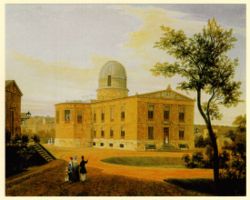
was mathematically predicted before it was directly observed. With a prediction by Urbain Le Verrier, telescopic observations confirming the existence of a major planet were made on the night of September 23, 1846, and into the early morning of the 24th, at the Berlin Observatory
Berlin Observatory
The Berlin Observatory is a series of observatories and related organizations in and around the city of Berlin in Germany, starting from the 18th century...
, by astronomer Johann Gottfried Galle
Johann Gottfried Galle
Johann Gottfried Galle was a German astronomer at the Berlin Observatory who, on 23 September 1846, with the assistance of student Heinrich Louis d'Arrest, was the first person to view the planet Neptune, and know what he was looking at...
(assisted by Heinrich Louis d'Arrest
Heinrich Louis d'Arrest
Heinrich Louis d'Arrest was a German astronomer, born in Berlin. His name is sometimes given as Heinrich Ludwig d'Arrest....
), working from Le Verrier's calculations. It was a sensational moment of 19th century science and dramatic confirmation of Newtonian gravitational theory. In François Arago
François Arago
François Jean Dominique Arago , known simply as François Arago , was a French mathematician, physicist, astronomer and politician.-Early life and work:...
's apt phrase, Le Verrier had discovered a planet "with the point of his pen."
In retrospect, after it was discovered it turned out it had been observed many times before, but not recognized, and there were others who made various calculations about its location, which did not lead to its observation. By 1846, the planet Uranus
Uranus
Uranus is the seventh planet from the Sun. It has the third-largest planetary radius and fourth-largest planetary mass in the Solar System. It is named after the ancient Greek deity of the sky Uranus , the father of Cronus and grandfather of Zeus...
had completed nearly one full orbit since its discovery by William Herschel
William Herschel
Sir Frederick William Herschel, KH, FRS, German: Friedrich Wilhelm Herschel was a German-born British astronomer, technical expert, and composer. Born in Hanover, Wilhelm first followed his father into the Military Band of Hanover, but emigrated to Britain at age 19...
in 1781, and astronomers had detected a series of irregularities in its path which could not be entirely explained by Newton's law of gravitation. These irregularities could, however, be resolved if the gravity of a farther, unknown planet were disturbing its path around the Sun. In 1845, astronomers Urbain Le Verrier in Paris
Paris
Paris is the capital and largest city in France, situated on the river Seine, in northern France, at the heart of the Île-de-France region...
and John Couch Adams
John Couch Adams
John Couch Adams was a British mathematician and astronomer. Adams was born in Laneast, near Launceston, Cornwall, and died in Cambridge. The Cornish name Couch is pronounced "cooch"....
in Cambridge
Cambridge
The city of Cambridge is a university town and the administrative centre of the county of Cambridgeshire, England. It lies in East Anglia about north of London. Cambridge is at the heart of the high-technology centre known as Silicon Fen – a play on Silicon Valley and the fens surrounding the...
separately began calculations to determine the nature and position of such a planet. Unfortunately, Le Verrier's triumph also led to a tense international dispute over priority, as, shortly after the discovery, George Airy, at the time British Astronomer Royal
Astronomer Royal
Astronomer Royal is a senior post in the Royal Household of the Sovereign of the United Kingdom. There are two officers, the senior being the Astronomer Royal dating from 22 June 1675; the second is the Astronomer Royal for Scotland dating from 1834....
, announced that Adams had also predicted the discovery of the planet. Nevertheless, the Royal Society
Royal Society
The Royal Society of London for Improving Natural Knowledge, known simply as the Royal Society, is a learned society for science, and is possibly the oldest such society in existence. Founded in November 1660, it was granted a Royal Charter by King Charles II as the "Royal Society of London"...
awarded Le Verrier the Copley medal
Copley Medal
The Copley Medal is an award given by the Royal Society of London for "outstanding achievements in research in any branch of science, and alternates between the physical sciences and the biological sciences"...
in 1846 for his achievement, without mention of Adams.
The discovery of Neptune led to the discovery of its moon Triton
Triton (moon)
Triton is the largest moon of the planet Neptune, discovered on October 10, 1846, by English astronomer William Lassell. It is the only large moon in the Solar System with a retrograde orbit, which is an orbit in the opposite direction to its planet's rotation. At 2,700 km in diameter, it is...
by William Lassell
William Lassell
William Lassell FRS was an English merchant and astronomer.Born in Bolton and educated in Rochdale after the death of his father, he was apprenticed from 1814 to 1821 to a merchant in Liverpool. He then made his fortune as a beer brewer, which enabled him to indulge his interest in astronomy...
just seventeen days later.
Earlier observations
Neptune is invisible to the naked eyeNaked eye
The naked eye is a figure of speech referring to human visual perception unaided by a magnifying or light-collecting optical device, such as a telescope or microscope. Vision corrected to normal acuity using corrective lenses is considered "naked"...
as it is too dim. Its apparent magnitude
Apparent magnitude
The apparent magnitude of a celestial body is a measure of its brightness as seen by an observer on Earth, adjusted to the value it would have in the absence of the atmosphere...
is never brighter than 7.7. Therefore, the first observations of Neptune were only possible after the invention of the telescope
Telescope
A telescope is an instrument that aids in the observation of remote objects by collecting electromagnetic radiation . The first known practical telescopes were invented in the Netherlands at the beginning of the 1600s , using glass lenses...
. There is evidence that Neptune was seen and recorded by Galileo Galilei
Galileo Galilei
Galileo Galilei , was an Italian physicist, mathematician, astronomer, and philosopher who played a major role in the Scientific Revolution. His achievements include improvements to the telescope and consequent astronomical observations and support for Copernicanism...
in 1613, Jérôme Lalande
Jérôme Lalande
Joseph Jérôme Lefrançois de Lalande was a French astronomer and writer.-Biography:Lalande was born at Bourg-en-Bresse...
in 1795 and John Herschel
John Herschel
Sir John Frederick William Herschel, 1st Baronet KH, FRS ,was an English mathematician, astronomer, chemist, and experimental photographer/inventor, who in some years also did valuable botanical work...
in 1830, but none is known to have recognized it as a planet at the time. These pre-discovery observations were important in accurately determining the orbit of Neptune. Neptune would appear prominently even in early telescopes so other pre-discovery observation records are likely.
Galileo's
Galileo Galilei
Galileo Galilei , was an Italian physicist, mathematician, astronomer, and philosopher who played a major role in the Scientific Revolution. His achievements include improvements to the telescope and consequent astronomical observations and support for Copernicanism...
drawings show that he observed Neptune on December 28, 1612, and again on January 27, 1613; on both occasions, Galileo mistook Neptune for a fixed star
Fixed star
The fixed stars are celestial objects that do not seem to move in relation to the other stars of the night sky. Hence, a fixed star is any star except for the Sun. A nebula or other starlike object may also be called a fixed star. People in many cultures have imagined that the stars form pictures...
when it appeared very close (in conjunction
Conjunction (astronomy)
Conjunction is a term used in positional astronomy and astrology. It means that, as seen from some place , two celestial bodies appear near one another in the sky...
) to Jupiter in the night sky
Night sky
The term night sky refers to the sky as seen at night. The term is usually associated with astronomy, with reference to views of celestial bodies such as stars, the Moon, and planets that become visible on a clear night after the Sun has set. Natural light sources in a night sky include moonlight,...
. Historically it was thought that he believed it to be a fixed blue star, and so he is not credited with its discovery. At the time of his first observation in December 1612, it was stationary in the sky because it had just turned retrograde that very day; because it was only beginning its yearly retrograde cycle, Neptune's motion was thought to be too slight, and its apparent size too small, to clearly appear to be a planet in Galileo's small telescope
Telescope
A telescope is an instrument that aids in the observation of remote objects by collecting electromagnetic radiation . The first known practical telescopes were invented in the Netherlands at the beginning of the 1600s , using glass lenses...
. However, in July 2009 University of Melbourne
University of Melbourne
The University of Melbourne is a public university located in Melbourne, Victoria. Founded in 1853, it is the second oldest university in Australia and the oldest in Victoria...
physicist David Jamieson announced new evidence suggesting that Galileo was indeed aware that he had discovered something unusual about this star. Galileo, in one of his notebooks, noted the movement of a background star (Neptune) on January 28 and a dot (in Neptune's position) drawn in a different ink suggests that he found it on an earlier sketch, drawn on the night of January 6, suggesting a systematic search among his earlier observations. However, so far there is neither clear evidence that he identified this moving object as a planet, nor that he published these observations of it. There is no evidence that he ever attempted to observe it again.
In 1847, Sears C. Walker of the U.S. Naval Observatory searched historical records and surveys for possible prediscovery sightings of the planet Neptune. He found that observations made by Lalande's
Jérôme Lalande
Joseph Jérôme Lefrançois de Lalande was a French astronomer and writer.-Biography:Lalande was born at Bourg-en-Bresse...
staff at the Paris Observatory
Paris Observatory
The Paris Observatory is the foremost astronomical observatory of France, and one of the largest astronomical centres in the world...
in 1795 were in the direction of Neptune's position in the sky. In the catalog observations for May 8 and again on May 10 of 1795 a star was observed in the approximate position expected for Neptune. The uncertainty of the position was noted with a colon. This notation was also used to indicate an observation error so it was not until the original records of the observatory were reviewed that it was established with certainty that the object was Neptune and the position error in the observations made two nights apart was due to the planet's motion across the sky. The discovery of these records of Neptune's position in 1795 led to a better calculation of the planet's orbit.
John Herschel
John Herschel
Sir John Frederick William Herschel, 1st Baronet KH, FRS ,was an English mathematician, astronomer, chemist, and experimental photographer/inventor, who in some years also did valuable botanical work...
almost discovered Neptune the same way his father, William Herschel
William Herschel
Sir Frederick William Herschel, KH, FRS, German: Friedrich Wilhelm Herschel was a German-born British astronomer, technical expert, and composer. Born in Hanover, Wilhelm first followed his father into the Military Band of Hanover, but emigrated to Britain at age 19...
, had discovered Uranus
Uranus
Uranus is the seventh planet from the Sun. It has the third-largest planetary radius and fourth-largest planetary mass in the Solar System. It is named after the ancient Greek deity of the sky Uranus , the father of Cronus and grandfather of Zeus...
in 1781, by chance observation. In an 1846 letter to Wilhelm Struve, John Herschel states that he observed Neptune during a sweep of the sky on July 14, 1830. Although his telescope was powerful enough to resolve Neptune into a small blue disk and show it to be a planet, he did not recognize it at the time and mistook it for a star.
Irregularities in Uranus's orbit
In 1781, Anders Johan LexellAnders Johan Lexell
Anders Johan Lexell was a Swedish-born Russian astronomer, mathematician, and physicist who spent most of his life in Russia where he is known as Andrei Ivanovich Leksel .Lexell made important discoveries in polygonometry and celestial mechanics; the latter led to a comet named in...
was the first to compute the orbit
Orbit
In physics, an orbit is the gravitationally curved path of an object around a point in space, for example the orbit of a planet around the center of a star system, such as the Solar System...
of Uranus
Uranus
Uranus is the seventh planet from the Sun. It has the third-largest planetary radius and fourth-largest planetary mass in the Solar System. It is named after the ancient Greek deity of the sky Uranus , the father of Cronus and grandfather of Zeus...
and notice that it had irregularities. He suggested that there might be other planets in Solar system
Solar System
The Solar System consists of the Sun and the astronomical objects gravitationally bound in orbit around it, all of which formed from the collapse of a giant molecular cloud approximately 4.6 billion years ago. The vast majority of the system's mass is in the Sun...
that perturb
Perturbation (astronomy)
Perturbation is a term used in astronomy in connection with descriptions of the complex motion of a massive body which is subject to appreciable gravitational effects from more than one other massive body....
the orbit
Orbit
In physics, an orbit is the gravitationally curved path of an object around a point in space, for example the orbit of a planet around the center of a star system, such as the Solar System...
of Uranus
Uranus
Uranus is the seventh planet from the Sun. It has the third-largest planetary radius and fourth-largest planetary mass in the Solar System. It is named after the ancient Greek deity of the sky Uranus , the father of Cronus and grandfather of Zeus...
, with the Solar system
Solar System
The Solar System consists of the Sun and the astronomical objects gravitationally bound in orbit around it, all of which formed from the collapse of a giant molecular cloud approximately 4.6 billion years ago. The vast majority of the system's mass is in the Sun...
ranging as far as 100 A. U.
Astronomical unit
An astronomical unit is a unit of length equal to about or approximately the mean Earth–Sun distance....
In 1821, Alexis Bouvard
Alexis Bouvard
Alexis Bouvard was a French astronomer. He is particularly noted for his careful observations of the irregularities in the motion of Uranus and his hypothesis of the existence of an eighth planet in the solar system.-Life:...
had published astronomical tables of the orbit
Orbit
In physics, an orbit is the gravitationally curved path of an object around a point in space, for example the orbit of a planet around the center of a star system, such as the Solar System...
of Uranus
Uranus
Uranus is the seventh planet from the Sun. It has the third-largest planetary radius and fourth-largest planetary mass in the Solar System. It is named after the ancient Greek deity of the sky Uranus , the father of Cronus and grandfather of Zeus...
, making predictions of future positions based on Newton's laws of motion
Newton's laws of motion
Newton's laws of motion are three physical laws that form the basis for classical mechanics. They describe the relationship between the forces acting on a body and its motion due to those forces...
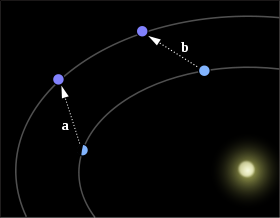
and gravitation. Subsequent observations revealed substantial deviations from the tables, leading Bouvard to hypothesize some perturbing body. These irregularities or "residuals", both in the planet's ecliptic longitude and in its distance from the Sun, or radius vector, might be explained by a number of hypotheses: the effect of the Sun's gravity, at such a great distance, might differ from Newton's description; or the discrepancies might simply be observational error; or perhaps Uranus was being pulled, or perturbed, by an as-yet undiscovered eighth planet.
Mass
Mass can be defined as a quantitive measure of the resistance an object has to change in its velocity.In physics, mass commonly refers to any of the following three properties of matter, which have been shown experimentally to be equivalent:...
, position and orbit of the perturbing body.
After his final examination
Final examination
A final examination is a test given to students at the end of a course of study or training. Although the term can be used in the context of physical training, it most often occurs in the academic world...
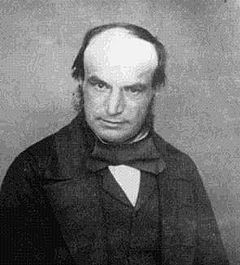
s in 1843, Adams was elected fellow of his college and spent the summer vacation in Cornwall calculating the first of six iterations.
Inverse problem
An inverse problem is a general framework that is used to convert observed measurements into information about a physical object or system that we are interested in...
, an attempt to deduce the parameters of a mathematical model
Mathematical model
A mathematical model is a description of a system using mathematical concepts and language. The process of developing a mathematical model is termed mathematical modeling. Mathematical models are used not only in the natural sciences and engineering disciplines A mathematical model is a...
from observed data. Though the problem is a simple one for modern mathematics after the advent of electronic computers, at the time it involved much laborious hand calculation. Adams began by assuming a nominal position for the hypothesised body, using the empirical Bode's law. He then calculated the path of Uranus using the assumed position of the perturbing body and calculated the difference between his calculated path and the observations, in modern terms the residual
Errors and residuals in statistics
In statistics and optimization, statistical errors and residuals are two closely related and easily confused measures of the deviation of a sample from its "theoretical value"...
s. He then adjusted the characteristics of the perturbing body in a way suggested by the residuals and repeated the process, a process similar to regression analysis
Regression analysis
In statistics, regression analysis includes many techniques for modeling and analyzing several variables, when the focus is on the relationship between a dependent variable and one or more independent variables...
.
On 13 February 1844, James Challis
James Challis
James Challis FRS was an English clergyman, physicist and astronomer. Plumian Professor and director of the Cambridge Observatory, he investigated a wide range of physical phenomena though made few lasting contributions outside astronomy...
, director of the Cambridge Observatory
Cambridge Observatory
Cambridge Observatory is an astronomical observatory at the University of Cambridge in the East of England. It was first established in 1823 and is now part of the site of the Institute of Astronomy...
, requested data on the position of Uranus, for Adams, from Astronomer Royal
Astronomer Royal
Astronomer Royal is a senior post in the Royal Household of the Sovereign of the United Kingdom. There are two officers, the senior being the Astronomer Royal dating from 22 June 1675; the second is the Astronomer Royal for Scotland dating from 1834....
George Biddell Airy
George Biddell Airy
Sir George Biddell Airy PRS KCB was an English mathematician and astronomer, Astronomer Royal from 1835 to 1881...
at the Royal Observatory, Greenwich
Royal Observatory, Greenwich
The Royal Observatory, Greenwich , in London, England played a major role in the history of astronomy and navigation, and is best known as the location of the prime meridian...
. Adams certainly completed some calculations on 18 September 1845.
Supposedly, Adams communicated his work to Challis in mid-September 1845 but there is some controversy as to how. The story and date of this communication only seem to have come to light in a letter from Challis to the Athenaeum
Athenaeum (magazine)
The Athenaeum was a literary magazine published in London from 1828 to 1921. It had a reputation for publishing the very best writers of the age....
dated 17 October 1846. However, no document was identified until 1904 when Sampson suggested a note in Adams's papers that describes "the New Planet" and is endorsed, in handwriting not Adams's, with the note "Received in September 1845".Sampson (1904) Though this has often been taken to establish Adams's priority, some historians have disputed its authenticity, on the basis that "the New Planet" was not a term current in 1845, and on the basis that the note is dated only after the fact by someone other than Adams. Further, the results of the calculations are different from those communicated to Airy a few weeks later. Adams certainly gave Challis no detailed calculations and Challis was unimpressed by the description of his method of successively approximating the position of the body, being disinclined to start a laborious observational programme at the observatory, remarking "while the labour was certain, success appeared to be so uncertain."
Paris
Paris is the capital and largest city in France, situated on the river Seine, in northern France, at the heart of the Île-de-France region...
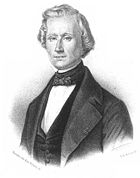
a memoir on Uranus, showing that the pre-existing theory failed to account for its motion. Unaware of Adams's work, he attempted a similar investigation, and on June 1, 1846, in a second memoir presented to a public meeting of the Académie, gave the position, but not the mass or orbit, of the proposed perturbing body. Le Verrier located Neptune within one degree of its predicted position.
The search
Upon receiving in England the news of Le Verrier's June prediction, George Airy immediately recognized the similarity of Le Verrier's and Adams' solutions. Up until that moment, Adams' work had been little more than a curiosity, but independent confirmation from Le Verrier spurred Airy to organize a secret attempt to find the planet. At a July 1846 meeting of the Board of Visitors of the Greenwich Observatory, with Challis and Sir John HerschelJohn Herschel
Sir John Frederick William Herschel, 1st Baronet KH, FRS ,was an English mathematician, astronomer, chemist, and experimental photographer/inventor, who in some years also did valuable botanical work...
present, Airy suggested that Challis urgently look for the planet with the Cambridge 11.25 inch equatorial telescope
Equatorial mount
An equatorial mount is a mount for instruments that follows the rotation of the sky by having one rotational axis parallel to the Earth's axis of rotation. This type of mount is used for astronomical telescopes and cameras...
, "in the hope of rescuing the matter from a state which is ... almost desperate". The search was begun by a laborious method on 29 July. Adams continued to work on the problem, providing the British team with six solutions in 1845 and 1846 which sent Challis searching the wrong part of the sky. Only after the discovery of Neptune had been announced in Paris and Berlin
Berlin
Berlin is the capital city of Germany and is one of the 16 states of Germany. With a population of 3.45 million people, Berlin is Germany's largest city. It is the second most populous city proper and the seventh most populous urban area in the European Union...
did it become apparent that Neptune had been observed on August the 8th and August the 12th but because Challis lacked an up-to-date star-map, it was not recognized as a planet.
Discovery Observation: September 24th 1846
Le Verrier was unaware that his public confirmation of Adams' private computations had set in motion a British search for the purported planet. On 31 August, Le Verrier presented a third memoir, now giving the mass and orbit of the new body. Having been unsuccessful in his efforts to interest any French astronomer in the problem, Le Verrier finally sent his results by post to Johann Gottfried GalleJohann Gottfried Galle
Johann Gottfried Galle was a German astronomer at the Berlin Observatory who, on 23 September 1846, with the assistance of student Heinrich Louis d'Arrest, was the first person to view the planet Neptune, and know what he was looking at...
at the Berlin Observatory
Berlin Observatory
The Berlin Observatory is a series of observatories and related organizations in and around the city of Berlin in Germany, starting from the 18th century...
. Galle received Le Verrier's letter on 23 September and immediately set to work observing in the region suggested by Le Verrier. Galle's student, Heinrich Louis d'Arrest
Heinrich Louis d'Arrest
Heinrich Louis d'Arrest was a German astronomer, born in Berlin. His name is sometimes given as Heinrich Ludwig d'Arrest....
, suggested that a recently drawn chart of the sky, in the region of Le Verrier's predicted location, could be compared with the current sky to seek the displacement characteristic of a planet
Planet
A planet is a celestial body orbiting a star or stellar remnant that is massive enough to be rounded by its own gravity, is not massive enough to cause thermonuclear fusion, and has cleared its neighbouring region of planetesimals.The term planet is ancient, with ties to history, science,...
, as opposed to a stationary star
Star
A star is a massive, luminous sphere of plasma held together by gravity. At the end of its lifetime, a star can also contain a proportion of degenerate matter. The nearest star to Earth is the Sun, which is the source of most of the energy on Earth...
.
Neptune was discovered just after midnight, after less than an hour of searching and less than 1 degree from the position Le Verrier had predicted, a remarkable match. After two further nights of observations in which its position and movement were verified, Galle replied to Le Verrier with astonishment: "the planet whose place you have [computed] really exists" (emphasis in original). The discovery telescope was an equatorial mounted achromatic refractor by Joseph Fraunhofer's firm Merz und Mahler.
Aftermath
On the announcement of the discovery, Herschel, Challis and Richard SheepshanksRichard Sheepshanks
Richard Sheepshanks was an English astronomer.He graduated from Trinity College of Cambridge University in 1816...
, foreign secretary of the Royal Astronomical Society
Royal Astronomical Society
The Royal Astronomical Society is a learned society that began as the Astronomical Society of London in 1820 to support astronomical research . It became the Royal Astronomical Society in 1831 on receiving its Royal Charter from William IV...
, announced that Adams had already calculated the planet's characteristics and position. Airy, at length, published an account of the circumstances, and Adams's memoir was printed as an appendix to the Nautical Almanac. However, it appears that the version published by Airy had been edited by the omission of a "crucial phrase" to disguise the fact that Adams had quoted only mean longitude and not the orbital elements.
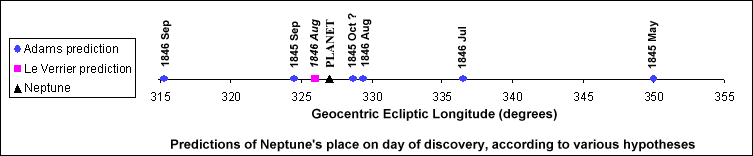
A keen controversy arose in France and England as to the merits of the two astronomers. There was much criticism of Airy in England. Adams was a diffident young man who was naturally reluctant to publish a result that would establish or ruin his career. Airy and Challis were criticised, particularly by James Glaisher
James Glaisher
James Glaisher FRS , was an English meteorologist and aeronaut.Born in Rotherhithe, the son of a London watchmaker, Glaisher was a Junior assistant at the Cambridge Observatory from 1833 to 1835 before moving to the Royal Greenwich Observatories, where he served as Superintendent of the Department...
, as failing to exercise their proper role as mentors of a young talent. Challis was contrite but Airy defended his own behaviour, claiming that the search for a planet was not the role of the Greenwich Observatory. On the whole, Airy has been defended by his biographers. In France the claims made for an unknown Englishman were resented as detracting from the credit due to Le Verrier's achievement.
The Royal Society
Royal Society
The Royal Society of London for Improving Natural Knowledge, known simply as the Royal Society, is a learned society for science, and is possibly the oldest such society in existence. Founded in November 1660, it was granted a Royal Charter by King Charles II as the "Royal Society of London"...
awarded Le Verrier the Copley medal
Copley Medal
The Copley Medal is an award given by the Royal Society of London for "outstanding achievements in research in any branch of science, and alternates between the physical sciences and the biological sciences"...
in 1846 for his achievement, without mention of Adams, but Adams's academic reputation at Cambridge, and in society, was assured. As the facts became known, some British astronomers pushed the view that the two astronomers had independently solved the problem of Uranus, and ascribed equal importance to each. But Adams himself publicly acknowledged Le Verrier's priority and credit (not forgetting to mention the role of Galle) in the paper that he gave to the Royal Astronomical Society in November 1846:
The criticism was soon afterwards made, that both Adams and Le Verrier had been over-optimistic in the precision they claimed for their calculations, and both had greatly overestimated the planet's distance from the sun. Further, it was suggested that they both succeeded in getting the longitude almost right only because of a "fluke of orbital timing". This criticism was discussed in detail by Danjon (1946) who illustrated with a diagram and discussion that while hypothetical orbits calculated by both LeVerrier and Adams for the new planet were indeed of very different size on the whole from that of the real Neptune (and actually similar to each other), they were both much closer to the real Neptune over that crucial segment of orbit covering the interval of years for which the observations and calculations were made, than they were for the rest of the calculated orbits. So the fact that both the calculators used a much larger orbital major axis than the reality was shown to be not so important, and not the most relevant parameter.
The new planet, at first called "Le Verrier" by François Arago
François Arago
François Jean Dominique Arago , known simply as François Arago , was a French mathematician, physicist, astronomer and politician.-Early life and work:...
, received by consensus the neutral name of Neptune. Its mathematical prediction was a great intellectual feat, but it showed also that Newton's law of gravitation, which Airy had almost called in question, prevailed even at the limits of the solar system
Solar System
The Solar System consists of the Sun and the astronomical objects gravitationally bound in orbit around it, all of which formed from the collapse of a giant molecular cloud approximately 4.6 billion years ago. The vast majority of the system's mass is in the Sun...
.
Adams held no bitterness towards Challis or Airy and acknowledged his own failure to convince the astronomical world:
By contrast, Le Verrier was arrogant and assertive, enabling the British scientific establishment to close ranks behind Adams while the French, in general, found little sympathy with Le Verrier. In 1874–1876, Adams was president of the Royal Astronomical Society when it fell to him to present the gold medal of the year to Le Verrier.
Later analysis
In 1999, Adams's correspondence with Airy, which had been lost by the Royal Greenwich Observatory, was rediscovered in Chile
Chile
Chile ,officially the Republic of Chile , is a country in South America occupying a long, narrow coastal strip between the Andes mountains to the east and the Pacific Ocean to the west. It borders Peru to the north, Bolivia to the northeast, Argentina to the east, and the Drake Passage in the far...
among the possessions of astronomer Olin J. Eggen
Olin J. Eggen
Olin Jeuck Eggen was an American astronomer. Some sources incorrectly give his name as Olin Jenck Eggen.-Biography:...
after his death. In an interview in 2003, historian Nicholas Kollerstrom
Nicholas Kollerstrom
Nicholas Kollerstrom is an English writer and historian of science. He is a former honorary research fellow in Science and Technology Studies at University College, London , and a former lunar gardening correspondent for the BBC...
concluded that Adams's claim to Neptune was far weaker than had been suggested, as he had vacillated repeatedly over the planet's exact location, with estimates ranging across 20 degrees of arc. Airy's role as the hidebound superior willfully ignoring the upstart young intellect was, according to Kollerstrom, largely constructed after the planet was found, in order to boost Adams's, and therefore Britain's, credit for the discovery. A later Scientific American
Scientific American
Scientific American is a popular science magazine. It is notable for its long history of presenting science monthly to an educated but not necessarily scientific public, through its careful attention to the clarity of its text as well as the quality of its specially commissioned color graphics...
article by Sheehan, Kollerstrom and Waff claimed more boldly "The Brits Stole Neptune" and concluded "The achievement was Le Verrier's alone."
Neptune Discovery Telescope
The telescope at New Berlin Observatory (1835–1913), that discovered Neptune, was an achromatic refractor of 9 Paris inchParis inch
The Paris inch, or pouce, is an old unit of measure, that among other uses, was common for giving the measurement of lenses. The Paris inch could be subdivided into 12 ligne , and 12 Paris inches made a Paris foot. The Paris inch and Paris foot could be abbreviated with " and ' like some other...
(9.6 English inches or 24.4 cm) aperture made by the late Joseph Fraunhofer's firm, Merz und Mahler. It was a high performance telescope of its era, with one of the largest achromatic doublets available and a finely made equatorial mount
Equatorial mount
An equatorial mount is a mount for instruments that follows the rotation of the sky by having one rotational axis parallel to the Earth's axis of rotation. This type of mount is used for astronomical telescopes and cameras...
, with a clockwork drive to move the 4 m (13.4′) main tube in time with Earth's rotation. Eventually the telescope was moved to Deutsches Museum
Deutsches Museum
The Deutsches Museum in Munich, Germany, is the world's largest museum of technology and science, with approximately 1.5 million visitors per year and about 28,000 exhibited objects from 50 fields of science and technology. The museum was founded on June 28, 1903, at a meeting of the Association...
in München, Germany, where it can still be seen in the 21st century as an exhibit.