
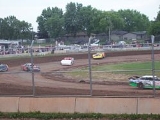
Dirt track racing is a type of
auto racingAuto racing is a motorsport involving the racing of cars for competition. It is one of the world's most watched televised sports.-The beginning of racing:...
performed on oval tracks. It began in the United States before World War I and became widespread during the 1920s and 30s. Two different types of racecars predominated—open wheel racers in the Northeast and West and
stock carsStock car racing is a form of automobile racing found mainly in the United States, Canada, New Zealand, Great Britain, Brazil and Argentina. Traditionally, races are run on oval tracks measuring approximately in length...
in the South. While open wheel racecars are purpose-built racing vehicles, stock cars (also known as fendered cars) can be either purpose-built racecars or street vehicles that have been modified to varying degrees.
Dirt track racing is the single most common form of auto racing in the United States. There are hundreds of local and regional racetracks throughout the nation: some estimates range as high as 1500. The sport is popular in Australia and Canada also. Many of the cars may also race on
asphalt short tracksIn North American auto racing, particularly with regard to NASCAR, a short track is a racetrack of less than one mile in length. Short track racing, often associated with fairgrounds and similar venues, is where stock car racing first got off the back roads and into organized and regulated...
during the racing season.
The racetrack
North America
Nearly all tracks are oval and less than 1 miles (1.6 km) in length with most being ½ mile (804 m) or less. The most common increments in the U.S. are ½ mile, ⅜ mile (603 m), ⅓ mile (536 m), ¼ mile (402 m), and ⅛ mile (201 m). With the longer tracks, the racecars achieve higher speeds and the interval between cars increases. This decreases the chance of crashes but increases the damage and chance of injury when cars do crash.
The track surface may be composed of any soil, but most racers prefer a track with a clay base. The track operators usually try to keep the surface tacky and may sprinkle water on it if it begins to dry. Some operators build flat ovals, but many are highly banked.
United Kingdom
In
Great BritainGreat Britain or Britain is an island situated to the northwest of Continental Europe. It is the ninth largest island in the world, and the largest European island, as well as the largest of the British Isles...
the oval tracks are normally on grass with lengths of 400 meters (¼ mile) to 800 meters (½ mile). The race consists of several qualifying heats, each lasting four laps of the track leading up to the final.
Grass Track is very much a family sport suitable for all ages and abilities. Boys and girls from as young as six can compete on automatic machines. The ages and capacity classes progress right through to adult status. There are also classes in youth grass track to run motocross machines on a grass track circuit. Youth events are carefully controlled to provide good racing for young competitors.
Rest of Europe
In mainland Europe Long Tracks can be used on grass, or sand and can be up to 1 kilometre (0.621372736649807 mi) long.
The race vehicle
Each racetrack or sponsoring organization maintains a rule book outlining each class of racecar; including dimensions, engine size, equipment requirements, prohibitions, etc. The requirements for each class are usually coordinated with other racetracks and associations to allow for the widest available venue for each type of car. This coordination allows the drivers to enter many different racetracks, increasing their chances of winning; allows the racetrack to field as many cars as possible; lets the racing associations develop a series of race events; and promotes fan interest.
Many fans prefer one or the other of the different type cars. Open wheel fans say, "Real racecars don't have fenders." Stock car (shown right and above) fans point out that even minimal contact between open wheel racers usually disables both cars. In reality, both types of vehicles have weak and strong points. Open wheel racers are usually lighter and nimbler. Stock cars can push and shove their way to advancement.
Many tracks support both types of racer in their programs. Both types range from powerful V8 engines to small, still powerful, 4-cylinder engines. Some of the smaller open wheel racers even have classes for single-cylinder powerplants. Depending on the class, the cars may have wings to aid in handling at higher speeds.
Open wheel cars
Open wheel cars are generally manufactured with tubular frames and a body purchased for that particular class. Classes include:
- Dwarf (5/8 replicas of 1928 to 1948 coupes and sedans)
- Kart (Go Kart
Kart racing or karting is a variant of open-wheel motorsport with small, open, four-wheeled vehicles called karts, go-karts, or gearbox/shifter karts depending on the design. They are usually raced on scaled-down circuits...
)
- Mini Sprint
A mini sprint is a type of open wheel racing vehicle. Mini sprint cars resemble the shape of a full-size sprint car and the size of a midget car...
- Sprint
Sprint cars are high-powered race cars designed primarily for the purpose of running on short oval or circular dirt or paved tracks. Sprint car racing is popular in the United States, Canada, Australia, New Zealand and South Africa....
- Midget (Speedcar)
- Quarter Midget
Quarter Midget racing is a form of automobile racing. The cars are approximately one quarter the size of a full size midget car. The adult size midget being raced during the start of quarter midget racing, used an oval track of one fifth of a mile in length. The childs quarter midget track is one...
- Micro Sprint
The sanctioning bodies include:
- USAC
The United States Auto Club is one of the sanctioning bodies of auto racing in the United States. From 1956 to 1979, the USAC sanctioned the United States National Championship, and from 1956 to 1997 the organization sanctioned the Indianapolis 500...
- The United States Automobile Club
- World of Outlaws
The World of Outlaws is an American motorsports sanctioning body. The body sanctions two major national touring series. It is best known for sanctioning a national tour of sprint cars. It later purchased a national tour of late model stockcars called the World of Outlaws Late Model Series...
Sprint cars
Modified cars
Modified cars are a hybrid of open wheel cars and stock cars - this class of car has the racing characteristics of a stock with the rear wheels covered by fenders and the front wheels open. There are sanctioning bodies that control the rules for this class at most tracks. Each Sanctioning body has their own set of guidelines provided in an annual rule book and their own registration fees. Sanctioning bodies include:
- Advance Auto Parts Super Dirt Series
- IMCA
The International Motor Contest Association was organized in 1915 by J. Alex Sloan, and is currently the oldest active auto racing sanctioning body in the United States. IMCA is currently headquartered in Vinton, Iowa, and features several classes and divisions of weekly racing in six geographical...
(International Motor Contest Association)
- UMP
United Midwestern Promoters is a short track racing sanctioning body in the United States that sanctions short track racing on dirt race tracks from 1/5 mile in length to in length. UMP currently sanctions eight different racing divisions on over 100 tracks in 19 states and one province in Canada...
(United Midwestern Promoters)
- USRA (United States Racing Association)
- USMTS (United States Modified Touring Series)
- WISSOTA (WISSOTA Promoters' Association)
- TSMA (Tri-State Modified Association)
Stock cars
Stock cars are generally automobiles manufactured by the major automakers with certain modifications as allowed for each class. There are several general types:
Non-production cars
These are stock cars custom built for racing, usually with welded tubular frames and custom built or purchased bodies.
The most popular type of dirt stock cars are late models. They are categorized depending on what track and series that is running. The racetrack dictates what type of late model is raced, but most fall in to one of three categories:
Super late Model
Today’s current dirt super
late modelA "late model car" is a car which has been recently designed or manufactured, often the latest model. The term is broadly used in car racing, and often appears in common use, as in "The officer was driving an unmarked, late model sedan."There is no precise...
s feature steel constructed tube frame chassis with aluminum bodies that give them a sleek aerodynamic appearance of a stock appearing race car but there is nothing stock about these 2300 pound machines. The cars are powered by an 800 hp motor than can turn in excess of 9,000 RPM. The engines are based on V-8
ChevroletChevrolet , also known as Chevy , is a brand of vehicle produced by General Motors Company . Founded by Louis Chevrolet and ousted GM founder William C. Durant on November 3, 1911, General Motors acquired Chevrolet in 1918...
, Ford and
MOPARMopar is the automobile parts and service arm of Chrysler Group LLC. The term was first used by Chrysler in the 1920s and has been in continuous use ever since. Mopar parts are original equipment manufactured parts for Chrysler vehicles...
power plants.
Most racing series and special events offer three motor options with the use of weight breaks to create an even playing field:
- Open Motor - There is no displacement
Engine displacement is the volume swept by all the pistons inside the cylinders of an internal combustion engine in a single movement from top dead centre to bottom dead centre . It is commonly specified in cubic centimeters , litres , or cubic inches...
limit with this type of motor. Most Open motors exceed 400 cubic inches but the 380 small block is a common open motor. These motors utilize aluminum blocks and heads and often have specially welded camA cam is a rotating or sliding piece in a mechanical linkage used especially in transforming rotary motion into linear motion or vice-versa. It is often a part of a rotating wheel or shaft that strikes a lever at one or more points on its circular path...
s. The cars which run this motor option must weigh at least 2300 lb (1,043.3 kg).
- Spec Motor- the two most popular are the SAS (Southern All Stars) and SURR (Southern United Professional Racing) Spec motors are built to the series' specifications. The motor can be either all-steel, all-aluminum or a combination of both. Cars using this motor option weigh in at 2200 pounds and run a 10 or 12 inches (304.8 mm) spoiler. Spec Motors cannot exceed 358 Cubic Inches.
- All Steel Motor - steel block
A cylinder block is an integrated structure comprising the cylinder of a reciprocating engine and often some or all of their associated surrounding structures...
and headsIn an internal combustion engine, the cylinder head sits above the cylinders on top of the cylinder block. It closes in the top of the cylinder, forming the combustion chamber. This joint is sealed by a head gasket...
, a maximum of 362 cubic inches, and weigh in at either 2200 or 2150 pounds depending on the series. Cars with an all-steel motor must run an 10 or 12 inches (304.8 mm) spoilerA spoiler is an automotive aerodynamic device whose intended design function is to 'spoil' unfavorable air movement across a body of a vehicle in motion. Spoilers on the front of a vehicle are often called air dams, because in addition to directing air flow they also reduce the amount of air...
.
Late Model Stock/Limited Late Model
Late Model Stocks/Limited Late Models have the same body rules as Super Late Models. The main difference in the two classes is the motor options, especially displacement.
Engine options:
1. Engines: Chevrolet 350, Chrysler 360, Ford 351 engines. Must be all-steel except intake.
2. Engine maximum displacement of 362 cubic inches.
3. Engines cannot be modified in anyway except for aftermarket
carburetorA carburetor , carburettor, or carburetter is a device that blends air and fuel for an internal combustion engine. It is sometimes shortened to carb in North America and the United Kingdom....
, intake manifold and
exhaust manifoldIn automotive engineering, an exhaust manifold collects the exhaust gases from multiple cylinders into one pipe. The word manifold comes from the Old English word manigfeald and refers to the folding together of multiple inputs and outputs.In contrast, an inlet manifold is the part of an engine...
.
Crate engines are sealed at the intake manifold,
cylinder headIn an internal combustion engine, the cylinder head sits above the cylinders on top of the cylinder block. It closes in the top of the cylinder, forming the combustion chamber. This joint is sealed by a head gasket...
, front cover, and oil pan with special twist off bolts. Crate engines must not be altered, modified, of changed in any way from factory specification.
Many tracks have variations on these rules in which the standard spec motor is the only option; however, the above rules are becoming more popular with the advent of the crate motor.
Crate Late Models
Use GM sealed-crate motors and have two of their own national touring series: the Nesmith Chevrolet Dirt Late Model Series and the Fastrak Crate Late Model Series. Currently, Ford and Chrysler have no plans to enter the Nesmith or Fastrak Late Model Series.
Popular Racing Series

- World of Outlaws
The World of Outlaws is an American motorsports sanctioning body. The body sanctions two major national touring series. It is best known for sanctioning a national tour of sprint cars. It later purchased a national tour of late model stockcars called the World of Outlaws Late Model Series...
- Lucas Oil Late Model Dirt Series
Lucas Oil Late Model Dirt Series is a racing championship series for dirt late model stock cars, founded in 2005. It is one of two such touring series' on dirt ovals in the United States...
- O'Reilly Auto Parts Southern All Stars
- International Motor Contest Association
The International Motor Contest Association was organized in 1915 by J. Alex Sloan, and is currently the oldest active auto racing sanctioning body in the United States. IMCA is currently headquartered in Vinton, Iowa, and features several classes and divisions of weekly racing in six geographical...
- United Midwestern Promoters
United Midwestern Promoters is a short track racing sanctioning body in the United States that sanctions short track racing on dirt race tracks from 1/5 mile in length to in length. UMP currently sanctions eight different racing divisions on over 100 tracks in 19 states and one province in Canada...
- Advance Auto Parts Super Dirt Series
- Southern Regional Racing Series
- Advanced Auto Parts Thunder Series
- O Reilly Auto Parts Southern United Professional Racing
- United Speed Contest Sanction
There are literally hundreds of additional unsanctioned regional and national special events run throughout the year.
Other major yearly events include:
- World 100
The World 100 is a dirt late model racing event that has been held every year since 1971 at the famed 1/2 mile Eldora Speedway in Rossburg, Ohio, and is considered by many to be the most prestigious dirt late model event in the United States...
- Ice Bowl
- Dart Winter Nationals
- The Show me 100
- The Magnolia State 100
The Magnolia State 100 is an annual dirt track race held at Columbus Speedway in Columbus, Mississippi. Super Late Models are the only cars allowed to take part in this race. The race is not sanctioned by a sanctioning body.-External links:*...
- The Dirt Track World Championship
- The Topless 100
- The Hillbilly 100
The Hillbilly 100 is a dirt Super Late Model race. The event was held at Pennsboro Speedway, but in 1998 the race was moved to Tyler County Speedway in Middlebourne, West Virginia and has been run there ever since. The event is currently sanctioned by the Lucas Oil Dirt Car Series. The 2009 event...
- Super Dirt Week
- USA Nationals
- Eastern States Weekend
- World Finals in Charlotte
- Knoxville Nationals
The Knoxville Nationals is an annual sprint car event held at Knoxville Raceway in Knoxville, Iowa. An Associated Press writer called winning the event "sprint car racing’s premiere title". It is nicknamed "The Granddaddy of Them All."-History:...
- Black Diamond 125
Modified production cars

These cars are modified manufactured automobiles. There is a high degree of variability between classes of modified cars. The lowest divisions of modified production cars may be completely stock except for having their interior or windshields removed. The highest divisions of modified production cars may have only a few original stock parts, and may be nearly as fast as late model racecars. Most cars have their glass windshields removed and their interiors stripped out. The original seat may be allowed to be used in the lowest classes, but a racing seat and roll cage is required to be installed in higher divisions. Other safety and performance features are added to higher division cars. The engines in lower divisions are completely stock, and higher divisions are highly modified and enhanced. Most modified production cars use full exhaust systems. Engines vary from unmodified 4 cylinders to highly modified V8. Cars in lower divisions use stock tires, and higher division cars use purpose-built specified racing tires.
Common names of modified production car divisions:
- Factory Stocks
- Mini Stocks
- Stingers
- Hornets
- Bombers
- Cruisers
- Hobby Stocks
- Stock Cars
- Pure Streets
- Pure Stocks
- Street Stocks
- Super Streets
- Super Stocks
- Pro Stocks
- Renegades
Unmodified production cars
These cars are automobiles just as driven on the street; including the original interiors. The engines may be modified as allowed under different rules:
Motorcycles
Dirt and Grass Track bikes have capacities of 250, 350 and 500 cc in the solo classes and can reach speeds of up to 80 mi/h on the straights and with no brakes fitted to the machine. There are three sidecar classes. The continental class has a 500 cc single-cylinder engine, also in Great Britain there are left- and right-handed sidecar machines with the engines up to 1000 cc. Sidecar races are some of the most exciting in Grass Track sport, with the driver and passenger working together to obtain the best grip and speed around the corners.
Vintage racing
Many obsolete race vehicles that were left in barns to rust are being restored to their former glory. The restored race vehicles are being displayed at car shows and sometimes raced. Cars that compete in vintage racing events are from the late 19th century to historic cars from a few years ago. There are more than 170 racing events in North America, and thousands of other vintage events sanctioned by hundreds of clubs.
The race program
The typical race program usually involves a number of classes, and many tracks offer both open wheel and stock car racing. There is a wide variety of event formats.
Qualifying
A qualifying session may happen before the start of the event. The session determines either the starting positions in the heat races or the starting positions in the feature event. There are other methods of selecting the starting positions in the heats or feature events, including random drawings and season points standings.
Heat races
Preliminary races for each class, called heat races, frequently open the schedule. The heat races may determine the starting race position in the main events and usually earn season championship points. The heat races are shorter than the feature races, and not as many cars race in each heat. There are numerous formats for qualifying for the feature event.
In
"Progressive racing", the starting lineup for the heat races are randomly selected, and a pre-determined number of drivers qualify for the main event directly from each heat race.
There may be a
"trophy dash" during the program to allow the heat winners or the season's top points-getters to compete for a trophy or reward. If the reward is monetary, the race may be called a
"dash for the cash" or a
"run for the money". Some tracks also use the qualifying dash in place of a heat race to determine where the top cars will start in the A feature.
In most sanctioned races or big races there will be qualifying that will determine the heat race line ups. In many races, the inversion is set at an established number (usually six cars), while other tracks (mostly for the A feature) the fastest qualifier will participate in a random drawing where he a number determines how many cars will be inverted.
Semi-Feature/B Main
There may be a semi-feature where unqualified racers may race their way into the remaining open starting positions in the feature event. Depending on the number of cars in each class, there may be more than one feature race (C feature; 3rd place heat winners, B feature; 2nd place heat winners, etc.) with the winners moving up through to the main feature (A feature). Other tracks utilize multiple semi-features with a predetermined number of cars from each semi-feature qualifying for the feature. Cars that qualify through the semi-feature usually start in the back of the feature in the order that they finished in the semi-feature.
Feature/Main
The A feature or main feature race is held for each division. The top cars from the event compete in the race. The starting positions may be determined by the season's point standings, or by a combination of the heat/trophy dash/semi-feature finishing positions. It is usually the longest race in the program. Points, a trophy, and frequently a purse are generally awarded, with the amount of each is determined by finishing position. The winner of the feature event is considered the winner of the event.
Special events
Many tracks have other special events. Occasionally, a track will sponsor a
"powder-puff" race to allow women the opportunity to drive the racecars for a few laps of racing. If enough women drivers express an interest in a separate event for themselves, the track operator may put the
powder puff into its regular race schedule; otherwise, most serious women racers compete in the same events as the men.
From time to time, the track may have a
"bonus points" race to attract racers and fans from competing tracks. Many times the track operators also promise a larger purse for winning these races.
Also, many tracks contract with a touring racing association to schedule an association sanctioned event. The racers in these events earn points for ranking in the association. The associations also usually require a guaranteed purse from the tracks for the winners of sanctioned events.
Many tracks also have a
"run-what-you-brung" contest (also
"Spectator class/division"). The event features two drivers from the stands who, after signing waivers, can run their personal automobiles against each other in a one-on-one 1 or 2 lap shootout.
Dirt tracks tend to be somewhat more makeshift and more versatile than asphalt pavements, and can be converted for use in other motorsports. For instance,
Little Valley SpeedwayThe Little Valley Speedway is a multi-purpose race track based in the village of Little Valley, New York, USA. The one-half-mile dirt track is situated in the western portion of the village and is part of the Cattaraugus County Fairgrounds facility.-Uses:...
in
Little Valley, New YorkLittle Valley is a village in Cattaraugus County, New York, USA. The population was 1,130 at the 2000 census.The Village of Little Valley is in the northwest corner of the Town of Little Valley....
is a half-mile dirt track that can be converted into a
figure-8 trackFigure 8 racing is a form of racing that combines elements of oval racing, demolition derby, and road racing.-Track:Racing is done on a track shaped like an 8. The cars cross paths at the center of the 8, which is known as the "crossover". Because of this layout, crashes are inevitable...
, a
demolition derbyDemolition derby is a motorsport usually presented at county fairs and festivals. While rules vary from event to event, the typical demolition derby event consists of five or more drivers competing by deliberately ramming their vehicles into one another...
pit, or a tractor pull straitaway.
Championships
Both the racetracks and the racing associations award championships as determined by the guidelines of the associated rulebooks. Awards, usually for the top ten racers in each class, may include a trophy, a jacket, and a monetary amount.
Track championships are awarded according to the points earned during the season. A certain number of points may be awarded for participation in an event and additional points added depending on the finish position in each race. The points earned at one track do not generally count toward another track's championship.
At dirt tracks sanctioned by
NASCARThe National Association for Stock Car Auto Racing is a family-owned and -operated business venture that sanctions and governs multiple auto racing sports events. It was founded by Bill France Sr. in 1947–48. As of 2009, the CEO for the company is Brian France, grandson of the late Bill France Sr...
, drivers can compete against drivers from other NASCAR-sanctioned tracks, both paved and dirt, for the statewide and provincial
Whelen All-American SeriesThe Whelen All-American Series is a points championship for NASCAR sanctioned local racetracks around the United States and Canada....
championship, where the best performer of the state and provincial champions will win the national championship. Dirt late model drivers won NASCAR's first such championship in 1982, and these drivers have frequently won regional and national championships in the 30-year history of NASCAR's short track championship, which only applies for local racing divisions (non-touring).
The racing associations count points earned at the tracks for certain sponsored races similarly. Additionally they may promote the appearances of their drivers and winners at various other events.
See also
- National Dirt Late Model Hall of Fame
The National Dirt Late Model Hall of Fame is a non-profit hall of fame for American drivers of Dirt Late Model racecars. It is located on the grounds of Florence Speedway, in Walton, Kentucky.-History:...
- Dirt track racing in the United States
- A.M.A. Grand National Championship
The AMA Grand National Championship is an American motorcycle racing series. The race series, founded and sanctioned by the American Motorcyclist Association in 1954, originally encompassed five distinct forms of competitions including; mile dirt track races, half-mile, short-track, TT...
External links