


Dinosaur renaissance

Encyclopedia
Paradigm shift
A Paradigm shift is, according to Thomas Kuhn in his influential book The Structure of Scientific Revolutions , a change in the basic assumptions, or paradigms, within the ruling theory of science...
that started in the late 1960s, and led to renewed academic and popular interest in dinosaur
Dinosaur
Dinosaurs are a diverse group of animals of the clade and superorder Dinosauria. They were the dominant terrestrial vertebrates for over 160 million years, from the late Triassic period until the end of the Cretaceous , when the Cretaceous–Paleogene extinction event led to the extinction of...
s. It was sparked by new discoveries and research indicating that dinosaurs may have been active and warm-blooded
Warm-blooded
The term warm-blooded is a colloquial term to describe animal species which have a relatively higher blood temperature, and maintain thermal homeostasis primarily through internal metabolic processes...
animals, rather than cold-blooded
Poikilotherm
A poikilotherm is an organism whose internal temperature varies considerably. It is the opposite of a homeotherm, an organism which maintains thermal homeostasis. Usually the variation is a consequence of variation in the ambient environmental temperature...
and sluggish as had been the prevailing view and description during the first half of the twentieth century.
The new view of dinosaurs was championed by John Ostrom
John Ostrom
John H. Ostrom was an American paleontologist who revolutionized modern understanding of dinosaurs in the 1960s, when he demonstrated that dinosaurs are more like big non-flying birds than they are like lizards , an idea first proposed by Thomas Henry Huxley in the 1860s, but which had garnered...
, who argued that birds evolved from coelurosaurian dinosaurs, and particularly Robert Bakker who argued passionately that dinosaurs were warm-blooded in a way similar to modern mammal
Mammal
Mammals are members of a class of air-breathing vertebrate animals characterised by the possession of endothermy, hair, three middle ear bones, and mammary glands functional in mothers with young...
s and bird
Bird
Birds are feathered, winged, bipedal, endothermic , egg-laying, vertebrate animals. Around 10,000 living species and 188 families makes them the most speciose class of tetrapod vertebrates. They inhabit ecosystems across the globe, from the Arctic to the Antarctic. Extant birds range in size from...
s. Bakker frequently portrayed his ideas as a renaissance of those popular in the late nineteenth century, referring to the period in between the wars as "the dinosaur doldrums
Doldrums
The doldrums is a colloquial expression derived from historical maritime usage for those parts of the Atlantic Ocean and the Pacific Ocean affected by the Intertropical Convergence Zone, a low-pressure area around the equator where the prevailing winds are calm...
".
The dinosaur renaissance led to a profound shift in thinking on nearly all aspects of dinosaur biology, including physiology
Physiology
Physiology is the science of the function of living systems. This includes how organisms, organ systems, organs, cells, and bio-molecules carry out the chemical or physical functions that exist in a living system. The highest honor awarded in physiology is the Nobel Prize in Physiology or...
, evolution
Evolution
Evolution is any change across successive generations in the heritable characteristics of biological populations. Evolutionary processes give rise to diversity at every level of biological organisation, including species, individual organisms and molecules such as DNA and proteins.Life on Earth...
, behaviour, ecology
Ecology
Ecology is the scientific study of the relations that living organisms have with respect to each other and their natural environment. Variables of interest to ecologists include the composition, distribution, amount , number, and changing states of organisms within and among ecosystems...
and extinction
Extinction
In biology and ecology, extinction is the end of an organism or of a group of organisms , normally a species. The moment of extinction is generally considered to be the death of the last individual of the species, although the capacity to breed and recover may have been lost before this point...
. It has also led to multiple depictions of dinosaurs in popular culture.
Dinosaurs and the origin of birds
In the mid and latter parts of the nineteenth century, many scientists thought there was a close relationship between birds and dinosaurs—and that dinosaurs represented an intermediate stage between "reptiles" and birds.It was shortly after the 1859 publication of Charles Darwin
Charles Darwin
Charles Robert Darwin FRS was an English naturalist. He established that all species of life have descended over time from common ancestry, and proposed the scientific theory that this branching pattern of evolution resulted from a process that he called natural selection.He published his theory...
's The Origin of Species
The Origin of Species
Charles Darwin's On the Origin of Species, published on 24 November 1859, is a work of scientific literature which is considered to be the foundation of evolutionary biology. Its full title was On the Origin of Species by Means of Natural Selection, or the Preservation of Favoured Races in the...
, British biologist and evolution-defender Thomas Henry Huxley proposed that birds were descendants of dinosaurs. He cited skeletal similarities, particularly among dinosaurs, the "first bird"—Archaeopteryx
Archaeopteryx
Archaeopteryx , sometimes referred to by its German name Urvogel , is a genus of theropod dinosaur that is closely related to birds. The name derives from the Ancient Greek meaning "ancient", and , meaning "feather" or "wing"...
—and modern birds.
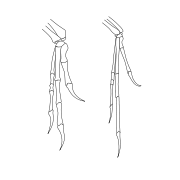
Gerhard Heilmann
Gerhard Heilmann was a Danish artist and paleontologist who created artistic depictions of Archeopteryx, Proavis and other early bird relatives apart from writing The Origin of Birds, a pioneering and influential account of bird evolution...
wrote his influential book The Origin of Birds
The Origin of Birds (book)
The Origin of Birds is an early synopsis of bird evolution written in 1926 by Gerhard Heilmann, a Danish artist and amateur zoologist. The book was born from a series of articles published between 1913 and 1916 in Danish, and although republished as a book it received mainly criticism from...
, in which he dismissed the dinosaur-bird link, based on the dinosaurs' supposed lack of a furcula
Furcula
The ' is a forked bone found in birds, formed by the fusion of the two clavicles. In birds, its function is the strengthening of the thoracic skeleton to withstand the rigors of flight....
(fused clavicles). Thereafter, the accepted hypotheses was that birds evolved from 'crocodylomorph' and 'thecodont' ancestors, rather than dinosaurs. This removed dinosaurs from playing a central role in debates about the origin of living species, and may have contributed to the decline of academic interest in dinosaur evolution.
This remained the situation until 1964, when John Ostrom discovered a small carnivorous dinosaur which he named Deinonychus antirrhopus
Deinonychus
Deinonychus was a genus of carnivorous dromaeosaurid dinosaur. There is one described species, Deinonychus antirrhopus. This 3.4 meter long dinosaur lived during the early Cretaceous Period, about 115–108 million years ago . Fossils have been recovered from the U.S...
, a theropod whose skeletal resemblance to birds seemed unmistakable. This led Ostrom to argue that Huxley had been right, and that birds had indeed evolved from dinosaurs. Although it was Deinonychus that inspired Ostrom to connect birds with dinosaurs, very similar birdlike dinosaurs, such as Velociraptor
Velociraptor
Velociraptor is a genus of dromaeosaurid theropod dinosaur that existed approximately 75 to 71 million years ago during the later part of the Cretaceous Period. Two species are currently recognized, although others have been assigned in the past. The type species is V. mongoliensis; fossils...
had been known for many decades, but no connection had been made. After Ostrom's discoveries, the idea that birds evolved from dinosaurs gained support among palaeontologists, and today it is almost universally accepted. Newer methods, such as cladistics
Cladistics
Cladistics is a method of classifying species of organisms into groups called clades, which consist of an ancestor organism and all its descendants . For example, birds, dinosaurs, crocodiles, and all descendants of their most recent common ancestor form a clade...
, and the discovery of several feathered dinosaurs
Feathered dinosaurs
The realization that dinosaurs are closely related to birds raised the obvious possibility of feathered dinosaurs. Fossils of Archaeopteryx include well-preserved feathers, but it was not until the early 1990s that clearly non-avialan dinosaur fossils were discovered with preserved feathers...
have helped confirm the relationship.
The relationship between dinosaurs and birds has led to considerable interest in dinosaur — particularly theropod — phylogeny, which is now far better understood.
Dinosaur monophyly
Initially, dinosaurs were thought to be a monophyletic group, comprising animals with a common ancestor not shared by other reptiles. However, Harry SeeleyHarry Seeley
Harry Govier Seeley was a British paleontologist.-Career:Seeley was born in London, the son of Richard Hovill Seeley, goldsmith, and his second wife Mary Govier. He attended classes at the Royal School of Mines, Kensington before becoming an assistant to Adam Sedgwick at the Woodwardian Museum,...
disagreed with this interpretation, and split the Dinosauria into two orders, the Saurischia
Saurischia
Saurischia meaning 'lizard' and ischion meaning 'hip joint') is one of the two orders, or basic divisions, of dinosaurs. In 1888, Harry Seeley classified dinosaurs into two orders, based on their hip structure...
("lizard-hipped") and the Ornithischia
Ornithischia
Ornithischia or Predentata is an extinct order of beaked, herbivorous dinosaurs. The name ornithischia is derived from the Greek ornitheos meaning 'of a bird' and ischion meaning 'hip joint'...
("bird-hipped"), which were seen as members of the Archosauria with no special relationship to each other. As such, the Dinosauria was no longer seen as a scientific grouping, and "dinosaur" was reduced to being a popular term, without scientific meaning. This became the standard interpretation throughout much of the twentieth century.
This changed in 1974, when Bakker and Peter Galton published a paper in Nature
Nature (journal)
Nature, first published on 4 November 1869, is ranked the world's most cited interdisciplinary scientific journal by the Science Edition of the 2010 Journal Citation Reports...
, arguing that not only were dinosaurs a natural monophyletic group, but that they should be raised to the status of a new class
Class (biology)
In biological classification, class is* a taxonomic rank. Other well-known ranks are life, domain, kingdom, phylum, order, family, genus, and species, with class fitting between phylum and order...
, which would also contain birds. Although initially this revival of dinosaur monophyly was controversial, the idea did gain acceptance, and since the rise of cladistic methodology, it has been nearly universally supported. The raising of the Dinosauria to class rank found less support, perhaps largely due to increasing use of phylogenetic taxonomy among vertebrate palaeontologists, in which ranks are entirely abandoned.
Warm-bloodedness and activity levels
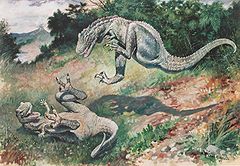
In a series of scientific papers, books, and popular articles in the 1970s and 1980s, beginning with his 1968 paper The superiority of dinosaurs, Robert Bakker argued strenuously that dinosaurs were warm-blooded and active animals, capable of sustained periods of high activity. In most of his writings Bakker framed his arguments as new evidence leading to a revival of ideas popular in the late 19th century, frequently referring to an ongoing dinosaur renaissance. He used a variety of anatomical and statistical arguments to defend his case, the methodology of which was fiercely debated among scientists.
These debates sparked interest in new methods for ascertaining the palaeobiology of extinct animals, such as bone histology, which have been successfully applied to determining the growth-rates of many dinosaurs.
Today, it is generally thought that many or perhaps all dinosaurs had higher metabolic rates than living reptiles, but also that the situation is more complex and varied than Bakker originally proposed. For example, while smaller dinosaurs may have been true endotherms, the larger forms could have been inertial homeotherms
Gigantothermy
Gigantothermy is a phenomenon with significance in biology and paleontology, whereby large, bulky ectothermic animals are more easily able to maintain a constant, relatively high body temperature than smaller animals by virtue of their smaller surface area to volume ratio...
, or many dinosaurs could have had intermediate metabolic rates.
New theories on dinosaur behaviour
The late 1960s also saw several new theories on the way dinosaurs behaved, often involving sophisticated social behaviour.On the basis of trackways
Fossil trackway
A fossil trackway is a type of trace fossil, a trackway made by an organism. Many fossil trackways were made by dinosaurs, early tetrapods, and other quadrupeds and bipeds on land...
, Bakker argued that sauropod dinosaurs moved in structured herds, with the adults surrounding the juveniles in a protective ring. However, shortly afterwards this particular interpretation was challenged by Ostrom among others, although the venerable dinosaur track expert Roland T. Bird apparently agreed with Bakker.
The first rigorous study of dinosaur nesting behaviour came in the late 1970s, when palaeontologist Jack Horner
Jack Horner (paleontologist)
John "Jack" R. Horner is an American paleontologist who discovered and named Maiasaura, providing the first clear evidence that some dinosaurs cared for their young. He is one of the best-known paleontologists in the United States...
showed that the duckbilled dinosaur Maiasaura
Maiasaura
Maiasaura is a large duck-billed dinosaur genus that lived in the area currently covered by the state of Montana in the Upper Cretaceous Period , about 74 million years ago....
cared for its young.
Changing portrayal of dinosaurs
The dinosaur renaissance changed not only scientific ideas about dinosaurs, but also their portrayal by artists. Bakker, himself a talented artist, often illustrated his ideas in a lively fashion. Indeed, Bakker's illustration of Deinonychus, made for Ostrom's 1969 description, has become one of the most recognisable and iconic of dinosaur restorations.During the 1970s, restorations of dinosaurs shifted from being lizard-like, to being more mammal- and bird-like. Artists started to show dinosaurs in more active poses, and incorporating newer theories of dinosaur locomotion and behaviour.
Besides Bakker, key artists in this "new wave" were first Mark Hallett, Gregory S. Paul
Gregory S. Paul
Gregory Scott Paul is a freelance researcher, author and illustrator who works in paleontology, and more recently has examined sociology and theology. He is best known for his work and research on theropod dinosaurs and his detailed illustrations, both live and skeletal...
in the 1970s, and during the 1980s Doug Henderson
Doug Henderson (artist)
Doug Henderson is an illustrator and artist specialising in the portrayal of fossil animals and environments. He has illustrated many books on dinosaurs and extinct life, and is credited as a "dinosaur specialist" on the film Jurassic Park in which his paintings appeared...
and John Gurche.
Gregory Paul in particular defended and expanded on Bakker's ideas on dinosaur anatomy. He expounded a rigorous and detailed approach to dinosaur restoration, in which he often criticised the errors of the traditionalist approach. He also produced a large number of restorations showing small dinosaurs with feathers, and defended the idea in a number of articles and his book Predatory Dinosaurs of the World. His view was proven largely correct in the late 90s with the discovery of several feathered dinosaurs
Feathered dinosaurs
The realization that dinosaurs are closely related to birds raised the obvious possibility of feathered dinosaurs. Fossils of Archaeopteryx include well-preserved feathers, but it was not until the early 1990s that clearly non-avialan dinosaur fossils were discovered with preserved feathers...
. Paul's ideas and style have had a significant impact on dinosaur art, and likely will continue to do so for some time.
New extinction theories, the meteor impact
Traditionally paleontology had followed geology in preferring uniformitarian mechanisms, despite the promotion by Eugene Merle ShoemakerEugene Merle Shoemaker
Eugene Merle Shoemaker , American geologist, was one of the founders of the fields of planetary science....
of the importance of catastrophic impacts.
During the renaissance period Walter Alvarez
Walter Alvarez
Walter Alvarez is a professor in the Earth and Planetary Science department at the University of California, Berkeley. He is most widely known for the theory that dinosaurs were killed by an asteroid impact, developed in collaboration with his father, Nobel Prize winning physicist Luis...
and others found iridium in the Cretaceous-Tertiary boundary layer. Also the Chicxulub Crater
Chicxulub Crater
The Chicxulub crater is an ancient impact crater buried underneath the Yucatán Peninsula in Mexico. Its center is located near the town of Chicxulub, after which the crater is named...
, was identified and determined to be due to a meteor impact. These discoveries led to the acceptance and popularisation of the idea that the extinction had been caused by a meteor impact
Impact event
An impact event is the collision of a large meteorite, asteroid, comet, or other celestial object with the Earth or another planet. Throughout recorded history, hundreds of minor impact events have been reported, with some occurrences causing deaths, injuries, property damage or other significant...
.
This in turn undermined the assumption that dinosaurs had become extinct because they were inferior to mammals. Instead it suggested they had fallen prey to a random event which no large animal could have survived.
Cultural impacts
The dinosaur renaissance has been cited as the cause of renewed public interest in dinosaurs. Bakker's non-technical articles and books, particularly The Dinosaur Heresies, have contributed significantly to the popularization of dinosaur science.The 1993 film version of Jurassic Park
Jurassic Park (film)
Jurassic Park is a 1993 American science fiction adventure film directed by Steven Spielberg. The film is based on the novel of the same name by Michael Crichton. It stars Sam Neill, Laura Dern, Jeff Goldblum, Richard Attenborough, Martin Ferrero, and Bob Peck...
was perhaps the most significant event in raising public awareness of dinosaur renaissance theories. For the first time in a major film, dinosaurs were portrayed as intelligent, agile, warm-blooded animals, rather than lumbering monsters more common to older films. Jack Horner
Jack Horner (paleontologist)
John "Jack" R. Horner is an American paleontologist who discovered and named Maiasaura, providing the first clear evidence that some dinosaurs cared for their young. He is one of the best-known paleontologists in the United States...
was a consultant, and the artwork of Gregory Paul, Mark Hallett, Doug Henderson, and John Gurche were used in pre-production. While the dinosaurs eventually shown in the films had various anatomical inaccuracies, all four of these artists are in the on-screen credits as "Dinosaur Specialists". Bakker himself was not consulted or credited, but his research is referenced by one of the characters in the film, and a Bakker look-alike appears in the sequel The Lost World
The Lost World: Jurassic Park
The Lost World: Jurassic Park is a 1997 science fiction thriller film, directed by Steven Spielberg. The film was produced by Bonnie Curtis, Kathleen Kennedy, Gerald R. Molen and Colin Wilson...
.