
Home      Discussion      Topics      Dictionary      Almanac
Signup       Login
Dinky Toy

Dinky Toy

Overview
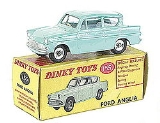
Dinky Toys are die-cast
Die-cast toy
The term die-cast toy here refers to any toy or collectible model produced by using the die casting method. The toys are made of metal, with plastic, rubber or glass details. Wholly plastic toys are made by a similar process of injection moulding, but the two are rarely confused...

 miniature vehicles which were produced by Meccano Ltd
Meccano Ltd
Meccano Ltd was a British toy company established in 1908 by Frank Hornby in England to manufacture and distribute Meccano and other model toys and kits created by the company...

 at Binns Road, Liverpool
Liverpool
Liverpool is a city and metropolitan borough of Merseyside, England, along the eastern side of the Mersey Estuary. It was founded as a borough in 1207 and was granted city status in 1880...

, England - makers of Hornby railway sets, named after founder Frank Hornby.
Discussion
Ask a question about 'Dinky Toy'
Start a new discussion about 'Dinky Toy'
Answer questions from other users
Full Discussion Forum
 
Unanswered Questions
Recent Discussions
Encyclopedia
Dinky Toys are die-cast
Die-cast toy
The term die-cast toy here refers to any toy or collectible model produced by using the die casting method. The toys are made of metal, with plastic, rubber or glass details. Wholly plastic toys are made by a similar process of injection moulding, but the two are rarely confused...

 miniature vehicles which were produced by Meccano Ltd
Meccano Ltd
Meccano Ltd was a British toy company established in 1908 by Frank Hornby in England to manufacture and distribute Meccano and other model toys and kits created by the company...

 at Binns Road, Liverpool
Liverpool
Liverpool is a city and metropolitan borough of Merseyside, England, along the eastern side of the Mersey Estuary. It was founded as a borough in 1207 and was granted city status in 1880...

, England - makers of Hornby railway sets, named after founder Frank Hornby.

Pre-war history


Frank Hornby established Meccano in 1901 to make toy erector sets (Dalefield no date). Some other early products were "British Village" houses, church, bridge, and mill with villagers and a canvas landscape with roads and stream in natural colours.

Prior to 1933, Meccano had made many types of tin plate and other metal cars, like the Morgan and BSA 3 wheelers, mostly in kit form (Interesting 1934, pp. 306-307). In 1933 Meccano Ltd
Meccano Ltd
Meccano Ltd was a British toy company established in 1908 by Frank Hornby in England to manufacture and distribute Meccano and other model toys and kits created by the company...

 issued a series of railway and trackside accessories to complement their O scale
O scale
O scale is a scale commonly used for toy trains and model railroading. Originally introduced by German toy manufacturer Märklin around 1900, by the 1930s three-rail alternating current O gauge was the most common model railroad scale in the United States and remained so until the early 1960s...

 (1/45) Hornby Railways
Hornby Railways
Hornby Railways is the leading brand of model railway in the United Kingdom. Its roots date back to 1901, when founder Frank Hornby received a patent for his Meccano construction toy. The first clockwork train was produced in 1920. In 1938, Hornby launched its first 00 gauge train...

 model train sets (Force 1988, p. 6; Ramsay 1933, p. 88). These were first called "Modelled Miniatures", but in the April 1934 issue of The Meccano Magazine were given the name Dinky Toys for the first time (Meccano Dinky 1934 p. 332).

The first model car available individually was numbered 23a which was a sports car based on an early MG
Mg
MG, M.G., M-G and variants may refer to:Business* MG Cars , a British automobile manufacturer, now part of SAIC* Champion Air , an American charter airline with IATA code MGEducation...

. Then, seven vehicles were introduced (six numbered 22 a through f) including a sports car, a sports coupe, a truck, a delivery van, a farm tractor, and a tank. These were produced alongside model track workers, passengers, station staff and other O scale trackside accessories (Meccano Dinky 1934 p. 332). The cars were basic representations rather than identifiable marques and had die-cast metal bodies, tin plate bases and wheels with rubber tyres. Later, Frank Hornby, owner of Meccano, expanded the range to include die-cast ships and aeroplanes. These retailed for four shillings. It has been said that the name came from a friend of one of Frank Hornby's daughters, and was likely derived from the Scottish "dink" meaning neat or fine, but according to Merriam-Webster the word has meant "overly or unattractively small" since the 1880s (McCullagh 2008; Merriam-Webster 2011).
Some pre-war Dinky Toys were cast from an impure alloy and suffer from zinc pest
Zinc pest
Zinc pest, , is a destructive, intercrystalline corrosion process of zinc alloys containing lead impurities. It was first discovered to be a problem in 1923....

 which makes the metal crack and crumble prematurely. Thus, survivors in good condition are rare today (Ramsay 1993, p. 88). Some early castings have survived in numbers, while it is difficult to find others without some form of damage such as the 28 Series vans. It is believed that lead from Hornby train production, as well as lead ties from sacks in the factory found their way into the metal, corrupting it.

Vehicles


By December 1935 there were around 200 different products in the Dinky range even including dolls house furniture (Ramsay 1993, p. 135). The first model cars were generic
Generic brand
Generic brands of consumer products are distinguished by the absence of a brand name. It is often inaccurate to describe these products as "lacking a brand name", as they usually are branded, albeit with either the brand of the store in which they are sold or a lesser-known brand name which may...

 representations of vehicle types and were available individually from trade packs of 6. Models would not be available in individual boxes until 1952. In 1935 a new series was introduced which featured accurate likenesses of specific vehicles.

Series 30 included:
  • 30a Chrysler
    Chrysler
    Chrysler Group LLC is a multinational automaker headquartered in Auburn Hills, Michigan, USA. Chrysler was first organized as the Chrysler Corporation in 1925....

     Airflow Saloon
  • 30b Rolls-Royce
    Rolls-Royce Limited
    Rolls-Royce Limited was a renowned British car and, from 1914 on, aero-engine manufacturing company founded by Charles Stewart Rolls and Henry Royce on 15 March 1906 as the result of a partnership formed in 1904....

  • 30c Daimler
    Daimler Motor Company
    The Daimler Motor Company Limited was an independent British motor vehicle manufacturer founded in London by H J Lawson in 1896, which set up its manufacturing base in Coventry. The right to the use of the name Daimler had been purchased simultaneously from Gottlieb Daimler and Daimler Motoren...

  • 30d Vauxhall
    Vauxhall Motors
    Vauxhall Motors is a British automotive company owned by General Motors and headquartered in Luton. It was founded in 1857 as a pump and marine engine manufacturer, began manufacturing cars in 1903 and was acquired by GM in 1925. It has been the second-largest selling car brand in the UK for...


The number of commercial vehicles expanded with the addition of Series 28 which included a series of delivery vans. Liveries of well known companies began to decorate these vehicles. Production was halted during the Second World War and the Binns Road factory in Liverpool was given over to the Allied War effort.

Military vehicles


In 1938 a number of military vehicles numbered from 151 to 162 were introduced. These were painted dark olive green and consisted of tanks, equipment trailers, Jeeps, six-wheeled vehicles and guns. These were produced through 1940 though a few like the clever 161b Anti-Aircraft Gun, some of the trailers and the Jeep were also made again in 1946-1948 right after the war (Force 1988, pp. 19,162-163). In some instances it is difficult to tell if the model is pre-war or post. Tracks on the tanks and the 162a personnel carriers were done with Meccano
Meccano
Meccano is a model construction system comprising re-usable metal strips, plates, angle girders, wheels, axles and gears, with nuts and bolts to connect the pieces. It enables the building of working models and mechanical devices....

 wire-link chain wrapped around the hubs. The Anti-Aircraft Gun was appealing as the side panels folded and not only did the gun swivel 360 degrees, but a little lever geared to its side moved it from level to about a 50 degree angle upward.

Aircraft and ships


In the early days of the Dinky Toys range aeroplanes and ships formed a considerable part of the output of the Binns Road factory alongside models of cars and vans. Both civilian and military aircraft were subjects for the Dinky modellers, and the model of the Spitfire
Supermarine Spitfire
The Supermarine Spitfire is a British single-seat fighter aircraft that was used by the Royal Air Force and many other Allied countries throughout the Second World War. The Spitfire continued to be used as a front line fighter and in secondary roles into the 1950s...

 was also sold in a special presentation box between 1939 and 1941 as part of The Spitfire Fund in order to raise money for the production of real Spitfires. Some models were clearly identified whereas others had generic names such as Heavy Bomber (66a) and Two Seater Fighter (66c). The reason for this is not clear and it may have been that these were not true representations of particular aircraft types, but there were rumours that some models of aircraft and ships were disguised so that enemy agents would not be able to recognise allied aircraft and shipping from the Dinky models. This was of particular importance in the production of French Dinky models due to the political friction in Europe before the war and the fact that France was occupied by the Nazis during hostilities.

Production of model aircraft continued after the war with a mixture of civilian airliners and new jet-powered aircraft. Production of Dinky planes tailed off in the 1950s and 1960s but was resurgent in the 1970s with a range of World War II types to coincide with the release of the film The Battle of Britain
Battle of Britain (film)
Battle of Britain is a 1969 Technicolor film directed by Guy Hamilton, and produced by Harry Saltzman and S. Benjamin Fisz. The film broadly relates the events of the Battle of Britain...

complete with battery-powered propellers; modern jet fighters; and even a helicopter. These are some examples of the sizeable range:
  • 60a Imperial Airways
    Imperial Airways
    Imperial Airways was the early British commercial long range air transport company, operating from 1924 to 1939 and serving parts of Europe but especially the Empire routes to South Africa, India and the Far East...

     Liner (Armstrong Whitworth Atalanta
    Armstrong Whitworth Atalanta
    -See also:-References:FootnotesNotesBibliography* Flight, 8 July 1932, pp. 619–623.* Flight, 15 July 1932, pp. 661–665.* The Illustrated Encyclopedia of Aircraft . London: Orbis Publishing, 1985....

    ) (1934)
  • 62a Supermarine Spitfire
    Supermarine Spitfire
    The Supermarine Spitfire is a British single-seat fighter aircraft that was used by the Royal Air Force and many other Allied countries throughout the Second World War. The Spitfire continued to be used as a front line fighter and in secondary roles into the 1950s...

     (1939)
  • 62g Boeing B-17 Flying Fortress (1939)
  • 67a Junkers Ju 89
    Junkers Ju 89
    |-See also:-External links:*...

     (1941)
  • 70a Avro York
    Avro York
    The Avro York was a British transport aircraft that was derived from the Second World War Lancaster heavy bomber, and used in both military and airliner roles between 1943 and 1964.-Design and development:...

     (1946)
  • 70c Vickers Viking
    Vickers VC.1 Viking
    The Vickers VC.1 Viking was a British twin-engine short-range airliner derived from the Vickers Wellington bomber and built by Vickers Armstrongs Limited at Brooklands near Weybridge in Surrey. In the aftermath of the Second World War, the Viking was an important airliner with British airlines...

     (1954)
  • 70e Gloster Meteor
    Gloster Meteor
    The Gloster Meteor was the first British jet fighter and the Allies' first operational jet. It first flew in 1943 and commenced operations on 27 July 1944 with 616 Squadron of the Royal Air Force...

     (1946)
  • 70f Lockheed P-80 Shooting Star (1947)
  • 702 de Havilland Comet
    De Havilland Comet
    The de Havilland DH 106 Comet was the world's first commercial jet airliner to reach production. Developed and manufactured by de Havilland at the Hatfield, Hertfordshire, United Kingdom headquarters, it first flew in 1949 and was a landmark in aeronautical design...

     BOAC
    British Overseas Airways Corporation
    The British Overseas Airways Corporation was the British state airline from 1939 until 1946 and the long-haul British state airline from 1946 to 1974. The company started life with a merger between Imperial Airways Ltd. and British Airways Ltd...

     (1954)
  • 703 Handley Page Herald (1955)
  • 707 Avro Vulcan - renumbered as 749 before release
  • 733 Lockheed P-80 Shooting Star - reissued
  • 734 Supermarine Swift
    Supermarine Swift
    The Supermarine Swift was a British single-seat jet fighter of the Royal Air Force , built by Supermarine during the 1950s. After a protracted development period, the Swift entered service as an interceptor, but, due to a spate of accidents, its service life was short...

     (1955)
  • 735 Gloster Javelin
    Gloster Javelin
    The Gloster Javelin was an "all-weather" interceptor aircraft that served with Britain's Royal Air Force in the late 1950s and most of the 1960s...

     (1956)
  • 736 Hawker Hunter
    Hawker Hunter
    The Hawker Hunter is a subsonic British jet aircraft developed in the 1950s. The single-seat Hunter entered service as a manoeuvrable fighter aircraft, and later operated in fighter-bomber and reconnaissance roles in numerous conflicts. Two-seat variants remained in use for training and secondary...

     (1955)
  • 738 de Havilland Sea Vixen
    De Havilland Sea Vixen
    The de Havilland DH.110 Sea Vixen was a twin boom 1950s–1960s British two-seat jet fighter of the Fleet Air Arm designed by de Havilland. Developed from an earlier first generation jet fighter, the Sea Vixen was a capable carrier-based fleet defence fighter that served into the 1970s...

     (1960)
  • 718 Hawker Hurricane
    Hawker Hurricane
    The Hawker Hurricane is a British single-seat fighter aircraft that was designed and predominantly built by Hawker Aircraft Ltd for the Royal Air Force...

     Mk IIe (1972)
  • 719 Supermarine Spitfire
    Supermarine Spitfire
    The Supermarine Spitfire is a British single-seat fighter aircraft that was used by the Royal Air Force and many other Allied countries throughout the Second World War. The Spitfire continued to be used as a front line fighter and in secondary roles into the 1950s...

     Mk IV (1969)
  • 721 Junkers Ju 87
    Junkers Ju 87
    The Junkers Ju 87 or Stuka was a two-man German ground-attack aircraft...

     'Stuka' (1969)
  • 724 Sea King Helicopter and Apollo Spacecraft Capsule
    Apollo Command/Service Module
    The Command/Service Module was one of two spacecraft, along with the Lunar Module, used for the United States Apollo program which landed astronauts on the Moon. It was built for NASA by North American Aviation...

     (1971)
  • 726 Messerschmitt Bf 109E
    Messerschmitt Bf 109
    The Messerschmitt Bf 109, often called Me 109, was a German World War II fighter aircraft designed by Willy Messerschmitt and Robert Lusser during the early to mid 1930s...

     (1972)
  • 730 US Navy McDonnell Douglas F-4 Phantom (1972)
  • 731 SEPECAT Jaguar
    SEPECAT Jaguar
    The SEPECAT Jaguar is an Anglo-French jet ground attack aircraft, originally used by the British Royal Air Force and the French Armée de l'Air in the close air support and nuclear strike role, and still in service with several export customers, notably the Indian Air Force and the Royal Air Force...

     (1973)
  • 749 Avro Vulcan
    Avro Vulcan
    The Avro Vulcan, sometimes referred to as the Hawker Siddeley Vulcan, was a jet-powered delta wing strategic bomber, operated by the Royal Air Force from 1956 until 1984. Aircraft manufacturer A V Roe & Co designed the Vulcan in response to Specification B.35/46. Of the three V bombers produced,...

     (1955) - boxes marked "992" - "Supertoy" range


Although the production of aircraft models continued after the war, the heyday of Dinky ships was between 1934 and 1939. The models were cast from the same unstable alloy that was used across the entire pre-war Dinky range and have therefore also suffered from metal fatigue that makes survivors all the more rare. Small metal wheels were also included in the design and concealed in the underside of the hull so that the models could be moved smoothly across surfaces. Mirroring the aircraft range, both civilian and military ships were issued, and again, some were disguised. It was not until the 1970s that any further models were added to the long line of maritime releases from Dinky Toys. Models in the pre-war range include:
  • 50a HMS Hood
    HMS Hood (51)
    HMS Hood was the last battlecruiser built for the Royal Navy. One of four s ordered in mid-1916, her design—although drastically revised after the Battle of Jutland and improved while she was under construction—still had serious limitations. For this reason she was the only ship of her class to be...

  • 50d HMS York
    HMS York (90)
    HMS York, pennant number 90, was a heavy cruiser of the Royal Navy built in the late 1920s. She mostly served on the North America and West Indies Station before World War II. Early in the war the ship escorted convoys in the Atlantic and participated in the Norwegian Campaign in 1940...

  • 50e HMS Dehli
    HMS Delhi (D47)
    HMS Delhi was a Danae class cruiser that served with the Royal Navy in the Baltic and in World War II. She was laid down in 1917 and scrapped in 1948 after war service in the Atlantic and Mediterranean....

  • 51g Cunard
    Cunard Line
    Cunard Line is a British-American owned shipping company based at Carnival House in Southampton, England and operated by Carnival UK. It has been a leading operator of passenger ships on the North Atlantic for over a century...

     Britannia
    RMS Britannia
    The RMS Britannia was an ocean liner of the British and North American Royal Mail Steam Packet Company, later known as Cunard Steamship Company. She was launched on 5 February 1840, at the yard of Robert Duncan & Company in Greenock, Scotland...

  • 52a Cunard/White Star
    White Star Line
    The Oceanic Steam Navigation Company or White Star Line of Boston Packets, more commonly known as the White Star Line, was a prominent British shipping company, today most famous for its ill-fated vessel, the RMS Titanic, and the World War I loss of Titanics sister ship Britannic...

     Queen Mary
    RMS Queen Mary
    RMS Queen Mary is a retired ocean liner that sailed primarily in the North Atlantic Ocean from 1936 to 1967 for the Cunard Line...

  • 52c SS Normandie
    SS Normandie
    SS Normandie was an ocean liner built in Saint-Nazaire, France for the French Line Compagnie Générale Transatlantique. She entered service in 1935 as the largest and fastest passenger ship afloat; she is still the most powerful steam turbo-electric-propelled passenger ship ever built.Her novel...


Post-war history


Besides some of the military vehicles offered before and after the war, the first significant releases from Dinky in the late 1940s were the 40 series of vehicles, which were all British Saloons. These were the opening chapter of the "golden age" of Dinky Toys in the post-war era and represented far greater accuracy and detail than their pre-war counterparts. These were very popular and today are often considered to be the quintessential Dinky models. The 40 series cars were manufactured from better quality alloy, meaning that the survival rate is higher and although originally sold from trade packs of six, they were re-coloured in two-tone paintwork and renumbered in 1954 becoming some of the first models sold in their own unique boxes. The first two were in 1:48 scale, while the others were in 1:45 scale (Schellekens 2010). The series included:
  • 40a Riley
    Riley
    - Animals :* Riley , an American Thoroughbred racehorse* Rileyasuchus, "Riley's crocodile," a genus of phytosaur from the Rhaetian of England- Canada :* Riley Park-Little Mountain, a neighborhood in Vancouver, British Columbia...

     Saloon (1947)
  • 40b Triumph
    Triumph Motor Company
    The Triumph Motor Company was a British car and motor manufacturing company. The Triumph marque is owned currently by BMW. The marque had its origins in 1885 when Siegfried Bettmann of Nuremberg initiated S. Bettmann & Co and started importing bicycles from Europe and selling them with his own...

     1800 (1948)
  • 40c Jowett Javelin
    Jowett Javelin
    The Jowett Javelin is an award-winning British car that was produced from 1947 to 1953 by Jowett Cars Ltd of Idle, near Bradford. The model went through five variants labelled PA to PE, each having a standard and "de luxe" option. The car was designed by Gerald Palmer during World War II and was...

     (not issued)
  • 40d Austin A40 Devon
    Austin A40 Devon
    The A40 Devon were automobiles marketed by the Austin Motor Company from 1947 to 1952 – the first post-war saloons to be produced by Austin – featuring a mix of old and new technologies...

     (1949)
  • 40e Standard Vanguard
    Standard Vanguard
    The car used a conventional chassis on which was mounted the American inspired semi-streamlined four-door body, which resembles a Plymouth. Suspension was independent at the front with coil springs and a live axle and leaf springs at the rear. Front and rear anti-roll bars were fitted. The brakes...

     (1948)
  • 40f Hillman Minx
    Hillman Minx
    The Hillman Minx was a series of middle-sized family cars produced under the Hillman marque by the Rootes Group between 1932 and 1970...

     (1951)
  • 40g Morris Oxford
    Morris Oxford
    After the Second World War the Oxford MO replaced the 10. It was introduced in 1948 and was produced until 1954. The design was shared with Nuffield Organisation stable-mate Wolseley 4/50....

     (1950)
  • 40h Austin FX3
    Austin FX3
    The Austin FX3 was a taxicab designed to comply with the Metropolitan Police Conditions of Fitness for London taxicabs, but was used in other towns and cities in the United Kingdom...

     Taxi (1952)
  • 40j Austin A40 Somerset
    Austin A40 Somerset
    The A40 Somerset is an automobile sold by the Austin Motor Company from 1952 until 1954. It replaced the A40 Devon and was quite similar to that body-on-frame car, including using the same 1.2 L straight-4 pushrod engine...

     (1953)

Into the 1950s


By the early 1950s, Dinky Toys had become popular in the United Kingdom. The smaller cars were in a scale of 1:48, while the larger cars and many Supertoys were in a scale of 1:45, which blended in with O scale railway sets, but many buses and lorries were scaled down further (Schellekens 2010). In 1954 the Dinky Toys range was reorganized with a new numbering system - there were no series of models differentiated by a letter, with many sold in sets with multiple vehicles. Now each model had its own unique three digit catalogue number, and cars were now sold in individual boxes.

The Dinky Toys range became more sophisticated throughout the 1950s. Several models introduced even today still seem to have been unique choices, and included several American vehicles. A 1954 Packard convertible, a 1955 Plymouth Belvedere, a Cunningham, the 1953 Studebaker Commander, a Chrysler New Yorker Convertible, a Connaught race car, and a Maserati Birdcage were made available.

Competing with the 'Ones with Windows'


Dinky offerings at this time were striking, but due to the lack of much competition, development of new models was perhaps a bit slow. That was until July 1956 when Mettoy introduced a rival line of models under the Corgi brand name. The most obvious difference was the addition of clear plastic windows. While Corgi called their vehicles, "The Ones With Windows", Meccano Ltd responded by updating the Dinky Toys range and the models from both companies quickly became more and more sophisticated featuring such things as working suspension, 'fingertip steering', detailed interiors, and jeweled headlights. In many cases Dinky models were just as interesting as those from Corgi, like the Rambler, late model Hudson Hornet, AC Aceca, late 1950s Packard and Studebaker, and Humber Super Snipe.

Truck offerings remained continuously creative including a Simca glass truck with sheets of 'glass' (clear plastic), a Leyland Octopus flatbed truck complete with realistic chain around the bed, a car carrier with a car carrying trailer, a Dunlop tire rack full of tires, a Berliet truck hauling an electrical transformer, and an intricately detailed Brockway bridgelaying truck. One of the most astounding was the Mighty Antar truck hauling a large gold ship's propeller (Force 1988, 42-56). A wide variety of military vehicles continued under production.

A rival third range of model cars also appeared in 1959 called "Spot-on
Spot-on
Spot-On Models, was a brand name for a line of diecast toy cars from 1959 through about 1967, built in Belfast, Northern Ireland, United Kingdom.-A Tri-Ang Product:...

" which were manufactured in Northern Ireland and produced by Tri-ang, a division of Lines Brothers
Lines Bros Ltd
Lines Bros Ltd was a British toy manufacturer of the 20th century, operating under the Tri-ang brand name.Lines Bros Ltd, at its peak, was claimed to be the largest toy maker in the world.-History:...

. This range were kept to one scale, 1:42, also featured mainly British makes, and were comparatively more expensive, never managing to sell as many units as Corgi and Dinky. To compete with Spot-on, the scale of British Dinky Toys was increaseed to 1:42 in 1963 (Schellekens 2010). In 1964 Tri-ang took over the parent Meccano company (which included Hornby trains as well as Meccano
Meccano
Meccano is a model construction system comprising re-usable metal strips, plates, angle girders, wheels, axles and gears, with nuts and bolts to connect the pieces. It enables the building of working models and mechanical devices....

 itself). Since Dinky Toys were more popular, Spot-On Models were phased out in 1967, although a few cars originally designed for Spot-On were made in Hong Kong and marketed as Dinky Toys. After the take-over, Dinky continued to use the 1:42 scale for many of the English made cars and trucks until 1977. The French factory stuck to 1:43 scale, which it had used since 1951 (Schellekens 2009).

In 1967, Mattel's Hot Wheels
Hot Wheels
Hot Wheels is a brand of die cast toy car, introduced by American toymaker Mattel in 1968. It was the primary competitor of Matchbox until 1996, when Mattel acquired rights to the Matchbox brand from Tyco.-Models:...

 entered the U.K. model car market. Their low-friction axles gave play value that Dinky and the other major British brands including Corgi and Matchbox did not possess. Each manufacturer responded with its own version of this innovation - Dinky's name for its wheel/axle assembly was "Speedwheels" (Force 1988, p. 8). The company continued to make innovative models, with all four doors opening (a first in British toy cars), retractable radio aerials (another first), Speedwheels, high quality metallic paint, and jewelled headlights (which were pretty, but not very realistic). Such features, however, were expensive to manufacture and the price could only be kept down if the quantities produced were sufficiently high, and in the face of Mattel's creation, Dinky was facing an uphill battle.

Supertoys


As part of the post-war development and expansion of the range, in 1947 Meccano Ltd introduced a series of model lorries also modelled to the usual Dinky scale of 1:48, and called the range Dinky Supertoys. To many collectors these are the most desirable Dinky Toys, and big premiums are paid for rare issues and difficult to find casting / wheel variations. Some models produced under the Dinky banner were issued in this line, including:
  • 501 Foden 8 Wheel Wagon (1947)
  • 502 Foden Flat Truck (1947)
  • 503 Foden Flat Truck with Tailboard (1947)
  • 504 Foden Tanker 'Mobilgas' (1953)
  • 505 Foden Flat Truck With Chains (1952)
  • 933 Leyland Comet 'Ferrocrete' (1954)
  • 942 Foden Tanker 'Regent' (1955)
  • 943 Leyland Tanker 'Esso' (1958)
  • 944 Leyland Tanker 'Shell BP' (1963)


In 1950 Dinky Supertoys introduced a number of Guy Vans finished in period liveries which have become among the most recognised and desirable the company have produced. Each model was an identical all metal box van with opening rear doors. The Guy cab was joined by a Bedford S cab in 1955 and a Guy Warrior cab was introduced in 1960.
  • 514 Guy Van 'Slumberland' (1950)
  • 514 Guy Van 'Lyons' (1952)
  • 514 Guy Van 'Weetabix' (1952)
  • 514 Guy Van 'Spratts' (1952)
  • 918 Guy Van 'Ever Ready' (1955)
  • 919 Guy Van 'Golden Shred' (1955)
  • 920 Guy Warrior Van 'Heinz' (1960)
  • 923 Bedford S Van 'Heinz' (1955)


Dinky Supertoys continued producing beautifully detailed commercials through the fifties and sixties, including such diverse subjects as a Mobile Television Control Room and Camera Van in both BBC Television and ABC Television liveries, a Leyland test chassis with removable miniature 5 ton weights, a series of military vehicles including a Corporal
MGM-5 Corporal
The MGM-5 Corporal missile was the first guided weapon authorized by the United States to carry a nuclear warhead.The first nuclear-authorized unguided rocket was the MGR-1 Honest John...

 Erector Vehicle and missile (a subject also modelled by Corgi Toys at the same time), a range of Mighty Antar
Thornycroft Antar
The Mighty Antar was a heavy-duty tractor unit built by Thornycroft from the 1940s onwards. For some decades it was the standard tank transporter of the British Army and was also used by other nations.- History :- Origins :...

 heavy haulage transporters complete with loads and a Horse Transporter in British Railways livery.

Dublo Dinky


In December 1957 Meccano Ltd introduced the Dublo Dinky range of models in 1:76 scale which were designed to be used with the Hornby Dublo railway system. They were relatively cheap to produce having a one piece die-cast metal body a baseplate and plastic wheels. There was the added bonus of being able to compete in the small scale toy car market which, at the time, was dominated by Lesney's Matchbox range.

A diverse range of vehicles were available despite the small number of models issued. There were a total 14 models in the range although with upgrades and modifications there are possibly up to 34 model variations (not including box variations) that were manufactured and all models came boxed. There were no colour changes throughout their short life.

They met with limited success and a comparison of the Ford Prefect with the corresponding Matchbox model will go some way towards understanding why the Dublo Dinky range suffered from low sales. The first models were withdrawn in September 1959 with one only having been on sale for 18 months. Further models were withdrawn in October 1960, April 1962 and April 1964 until in December 1964 those models that remained were taken off the shelf seven years after Dublo Dinky Toys were introduced.

The range:
  • 061 Ford Prefect: Introduced in March 1958 and withdrawn September 1959. There were 2 model variations and no box variations.
  • 062 Singer Roadster: Introduced in March 1958 and withdrawn October 1960. There were no model or box variations.
  • 063 Commer Van: Introduced in March 1958 and withdrawn October 1960. There were no model or box variations.
  • 064 Austin Lorry: Introduced at the launch in December 1957 and withdrawn April 1962. There were 3 model variations and 3 box variations.
  • 065 Morris Pick Up: Introduced at the launch in December 1957 and withdrawn September 1959. There were no model or box variations.
  • 066 Bedford Flat Truck: Introduced at the launch in December 1957 and withdrawn October 1960. There were 3 model variations and 3 box variations.
  • 067 Austin Taxi: Introduced in March 1959 and withdrawn April 1964. There were 3 model variations and no box variations.
  • 068 Royal Mail Van: Introduced in April 1959 and withdrawn April 1964. There were 2 model variations and no box variations.
  • 069 Massey-Ferguson Tractor: Introduced in September 1959 and withdrawn December 1964. There were 2 model variations and no box variations. This model was also issued with a low sided wagon as part of the Hornby Dublo railway system. It was numbered 4649 and was boxed.
  • 070 AEC Mercury Tanker: Introduced in October 1959 and withdrawn April 1962. There were 3 model variations and no box variations.
  • 071 Volkswagen Delivery Van: Introduced in March 1960 and withdrawn December 1964. There were 2 model variations and no box variations.
  • 072 Bedford Articulated Flat Truck: Introduced in June 1959 and withdrawn December 1964. There were 3 (possibly 4) model variations and 3 box variations.
  • 073 Land Rover & Horse Trailer: Introduced in September 1960 and withdrawn December 1964. The most complex of all there were 6 model variations and no box variations. The horse came in both light and dark tan.
  • 076 Lansing Bagnall Tractor & Trailer: Introduced in June 1960 and withdrawn December 1964. There were no model or box variations.
  • 078 Lansing Bagnall Trailer (Trade box of 6): Introduced in May 1961 and withdrawn December 1964. There were no box variations.

Mini-Dinkys


A second series of small scale models was introduced four years later in 1968, this time somewhat larger than the Matchbox range at 1:65. Mini-Dinky Toys, as the range was called, were of a high quality and featured opening bonnets, doors and boots and were produced in Hong Kong and Holland, with some construction models designed in Italy by Mercury to a smaller 1:130 scale. In a bid to make this series stand out in toy shops, each model was sold in a plastic garage, complete with opening door, rather than the usual cardboard box. This novel feature did not help sales, however, particularly in light of all the excitement Hot Wheels were causing.

Television and movie tie-ins


Although Dinky Toys were not known as widely for producing television related models as Corgi Toys, they still made a number of intriguing vehicles widely known from the small screen. Many of these models were the result of beating Corgi Toys to the signing of a licensing deal with Gerry Anderson
Gerry Anderson
Gerry Anderson MBE is a British publisher, producer, director and writer, famous for his futuristic television programmes, particularly those involving specially modified marionettes, a process called "Supermarionation"....

's Century 21 Productions, whose programmes are immensely popular in Britain.
  • 100 Lady Penelope's
    Lady Penelope Creighton-Ward
    Lady Penelope Creighton-Ward is the London Agent for the secret organisation International Rescue in the hit television series Thunderbirds...

     FAB1
    FAB1
    FAB1 is the name given to the pink six-wheeled car in the Thunderbirds franchise.-The original series and films:In the original Supermarionation TV series Thunderbirds , as well as the films Thunderbirds Are GO and Thunderbird 6 , FAB1 is a modified Rolls-Royce...

     (1967) Thunderbirds
    Thunderbirds (TV series)
    Thunderbirds is a British mid-1960s science fiction television show devised by Gerry and Sylvia Anderson and made by AP Films using a form of marionette puppetry dubbed "Supermarionation"...

  • 101 Thunderbird 2 (1967) Thunderbirds
  • 102 Joe's Car (1969) Joe 90
    Joe 90
    Joe 90 is a late-1960s British science-fiction television series documenting the exploits of a nine-year-old boy, Joe McClaine, who embarks on a double life as a schoolboy turned spy when his scientist father invents a pioneering machine capable of duplicating and transferring expert knowledge and...

  • 103 Spectrum Patrol Car - SPC (1968) Captain Scarlet and the Mysterons
    Captain Scarlet and the Mysterons
    Captain Scarlet and the Mysterons, often referred to as Captain Scarlet, is a 1960s British science-fiction television series produced by the Century 21 Productions company of Gerry and Sylvia Anderson, John Read and Reg Hill...

  • 104 Spectrum Pursuit Vehicle - SPV (1968) Captain Scarlet and the Mysterons
  • 105 Maximum Security Vehicle - MSV (1968) Captain Scarlet and the Mysterons
  • 106 The Prisoner Mini Moke
    Mini Moke
    The Mini Moke is a vehicle based on the Mini and designed for the British Motor Corporation by Sir Alec Issigonis. The name comes from "Mini"—the car with which the Moke shares many parts—and "Moke", which is an archaic dialect term for donkey...

     (1967) The Prisoner
    The Prisoner
    The Prisoner is a 17-episode British television series first broadcast in the UK from 29 September 1967 to 1 February 1968. Starring and co-created by Patrick McGoohan, it combined spy fiction with elements of science fiction, allegory and psychological drama.The series follows a British former...

  • 107 Stripey the Magic Mini
    Mini
    The Mini is a small car that was made by the British Motor Corporation and its successors from 1959 until 2000. The original is considered a British icon of the 1960s, and its space-saving front-wheel-drive layout influenced a generation of car-makers...

     (1967) The Magic Toyshop
  • 108 Sam's Car (1969) Joe 90
  • 109 Gabriel, Model T Ford
    Ford Model T
    The Ford Model T is an automobile that was produced by Henry Ford's Ford Motor Company from September 1908 to May 1927...

     (1969) The Secret Service
    The Secret Service
    The Secret Service is a British children's espionage television series, made as a Century 21 production for ITC Entertainment and broadcast in 1969...

  • 112 Purdy's Triumph TR7
    Triumph TR7
    The Triumph TR7 is a sports car manufactured from September 1974 to October 1981 by the Triumph Motor Company in the United Kingdom. It was initially produced at the Speke, Liverpool factory, moving to Canley, Coventry in 1978 and then finally to the Rover plant in Solihull in 1980...

     (1978) The New Avengers
  • 113 John Steed's Jaguar XJ12C (not issued) The New Avengers
  • 350 Tiny's Mini Moke (1970) The Enchanted House
  • 351 UFO Interceptor (1971) UFO
    UFO (TV series)
    UFO is a 1970-1971 British television science fiction series about an alien invasion of Earth, created by Gerry Anderson and Sylvia Anderson with Reg Hill, and produced by the Andersons and Lew Grade's Century 21 Productions for Grade's ITC Entertainment company.UFO first aired in the UK and Canada...

  • 352 Ed Straker's Car (1971) UFO
  • 353 S.H.A.D.O. 2 Mobile (1971) UFO
  • 354 The Pink Panther's Car (1972) The Pink Panther Show
    The Pink Panther Show
    The Pink Panther Show is a showcase of cartoon shorts produced by David H. DePatie and Friz Freleng between 1969 and 1979. The television series was produced by Mirisch Films and DePatie-Freleng Enterprises, and was broadcast on two American TV networks:...

  • 359 Eagle Transporter (1975) Space: 1999
    Space: 1999
    Space: 1999 is a British science-fiction television series that ran for two seasons and originally aired from 1975 to 1977. In the opening episode, nuclear waste from Earth stored on the Moon's far side explodes in a catastrophic accident on 13 September 1999, knocking the Moon out of orbit and...

  • 360 Eagle Freighter (1975) Space: 1999
  • 357 Klingon
    Klingon
    Klingons are a fictional warrior race in the Star Trek universe.Klingons are recurring villains in the 1960s television show Star Trek: The Original Series, and have appeared in all five spin-off series and eight feature films...

     Battle Cruiser (1977) Star Trek
    Star Trek: The Original Series
    Star Trek is an American science fiction television series created by Gene Roddenberry, produced by Desilu Productions . Star Trek was telecast on NBC from September 8, 1966, through June 3, 1969...

  • 358 USS Enterprise
    USS Enterprise (NCC-1701)
    The USS Enterprise, NCC-1701, is a fictional starship in the Star Trek media franchise. The original Star Trek series depicts her crew's mission "to explore strange new worlds; to seek out new life and new civilizations; to boldly go where no man has gone before" under the command of Captain James...

     (1977) Star Trek
  • 361 Zygon War Chariot (1978)
  • 363 Zygon Patroller (1979)
  • 368 Zygon Marauder (1979)
  • 477 Parsley's Car (1970) The Adventures of Parsley
    Parsley the Lion
    Parsley the Lion is a fictional character from the BBC1 children's show The Herbs, created by Michael Bond. There was a follow-up series of 5-minute episodes shown in 1970 called The Adventures of Parsley, which featured all of the other characters from the original show.-Character:He is a simple,...


France and Spain


In 1912 Frank Hornby
Frank Hornby
Frank Hornby was an English inventor, businessman and politician. He was a visionary in toy development and manufacture and produced three of the most popular lines of toys in the twentieth century: Meccano, Hornby Model Railways and Dinky Toys...

 set up an office in Paris on Rue Ambroise Thomas to import Meccano
Meccano
Meccano is a model construction system comprising re-usable metal strips, plates, angle girders, wheels, axles and gears, with nuts and bolts to connect the pieces. It enables the building of working models and mechanical devices....

 into France. By 1921 the French market had proved so successful that production of Meccano began in Paris at the newly opened factory on Rue Rebeval, with another plant opening in 1929 at Bobigny
Bobigny
Bobigny is a commune, or town, in the northeastern suburbs of Paris, France. It is located from the center of Paris. Bobigny is the préfecture of the Seine-Saint-Denis département, as well as the seat of the Arrondissement of Bobigny...

 where production of the Dinky Toys range would be based. In the early days production consisted mainly of model ships and aeroplanes, with vehicles gradually increasing in number. During the Second World War
World War II
World War II, or the Second World War , was a global conflict lasting from 1939 to 1945, involving most of the world's nations—including all of the great powers—eventually forming two opposing military alliances: the Allies and the Axis...

 the Meccano factories were commandered by the invading Germans and used in the Nazi war effort, as well as production of model vehicles in the German Märklin
Märklin
Gebr. Märklin & Cie. GmbH or Märklin is a German toy company. The company was founded in 1859 and is based at Göppingen in Baden-Wurttemberg. Although it originally specialised in doll house accessories, today it is best known for model railways and technical toys...

 range. In the early post-war years the model vehicles were forced to be shod with metal wheels due to Nazi activity during the war which had virtually cut off supplies of rubber to France, rubber tyres not being fitted on models until 1950. In 1951 the old factory at Rue Rebeval closed and Dinky Toys production was now solely based at Bobigny.

In 1951, French Dinky seems to have been the first manufacturer to introduce 1:43 scale. Initially, the scales of French Dinky Toys were similar to those of English Dinkys. The Citroën Traction Avant (24N), released in 1949, was 1:48, while the Ford Vedette 1949 (24Q), released in 1950, was 1:45, the same scales as used in the British 40 series. But then, in 1951 French Dinky released their first car in 1:43 scale: the Peugeot 203 (24R) (Schellekens 2009).

By the 1950s the French Dinky Toys range had begun to diversify from that of the British parent company, concentrating on the products of the French motor manufacturers; Citroën
Citroën
Citroën is a major French automobile manufacturer, part of the PSA Peugeot Citroën group.Founded in 1919 by French industrialist André-Gustave Citroën , Citroën was the first mass-production car company outside the USA and pioneered the modern concept of creating a sales and services network that...

, Renault
Renault
Renault S.A. is a French automaker producing cars, vans, and in the past, autorail vehicles, trucks, tractors, vans and also buses/coaches. Its alliance with Nissan makes it the world's third largest automaker...

, Peugeot
Peugeot
Peugeot is a major French car brand, part of PSA Peugeot Citroën, the second largest carmaker based in Europe.The family business that precedes the current Peugeot company was founded in 1810, and manufactured coffee mills and bicycles. On 20 November 1858, Emile Peugeot applied for the lion...

 and Simca, along with examples of American cars which were thought of as exotic at that time on mainland Europe. Some models such as the Volkswagen Karmann Ghia
Volkswagen Karmann Ghia
The Volkswagen Karmann Ghia is a 2+2 coupe and convertible marketed from 1955 to 1974 by Volkswagen – combining the chassis and mechanicals of the Type 1 , styling by Luigi Segre of the Italian carrozzeria Ghia, and hand-built bodywork by German coach-builder Karmann.The Karmann Ghia was...

 were produced both in France as 24m and in Great Britain at the Binns Road plant in Liverpool as number 187. By the 1960s there was virtually no crossover of products between the two countries resulting in a fascinating range that complemented the better known UK models. The vast majority of the French Dinky range were only available in the home market although a few models did make it across the English Channel to be sold in Britain. Similarly, some examples of the British range of Dinky Toys were exported to France at the same time. The factory at Bobigny closed in 1970 and production moved to Calais
Calais
Calais is a town in Northern France in the department of Pas-de-Calais, of which it is a sub-prefecture. Although Calais is by far the largest city in Pas-de-Calais, the department's capital is its third-largest city of Arras....

 where the range continued to be manufactured until closure in 1971, although the Spanish company Pilen
Auto Pilen
Auto Pilen was a diecast line of models made in Ibi, Alicante, in southeastern Spain by Pilen S.A.. Models were produced from the 1970s through the mid-1990s mostly in 1:43 scale. In the late 1980s, Pilen was apparently bought by AHC of the Netherlands...

 produced some models originally sold as French Dinky Toys until the early 1980s.

South Africa


Meccano Ltd
Meccano Ltd
Meccano Ltd was a British toy company established in 1908 by Frank Hornby in England to manufacture and distribute Meccano and other model toys and kits created by the company...

 exported Dinky Toys to all of Britain's
Great Britain
Great Britain or Britain is an island situated to the northwest of Continental Europe. It is the ninth largest island in the world, and the largest European island, as well as the largest of the British Isles...

 old colonies
British Empire
The British Empire comprised the dominions, colonies, protectorates, mandates and other territories ruled or administered by the United Kingdom. It originated with the overseas colonies and trading posts established by England in the late 16th and early 17th centuries. At its height, it was the...

 relatively cheaply because of existing Commonwealth
Commonwealth of England
The Commonwealth of England was the republic which ruled first England, and then Ireland and Scotland from 1649 to 1660. Between 1653–1659 it was known as the Commonwealth of England, Scotland and Ireland...

 trade agreements. South Africa was one of its big importers.

In the mid-1950s, Meccano Ltd shipped to South Africa a limited edition set of military vehicles for the South African Defence Force
South African Defence Force
The South African Defence Force was the South African armed forces from 1957 until 1994. The former Union Defence Force was renamed to the South African Defence Force in the Defence Act of 1957...

. They were all painted military green and included a Motor Truck, a Covered Wagon, an Ambulance, a Dispatch Rider and a Van.

When South Africa withdrew
History of South Africa in the apartheid era
Apartheid was a system of racial segregation enforced by the National Party governments of South Africa between 1948 and 1994, under which the rights of the majority 'non-white' inhabitants of South Africa were curtailed and white supremacy and Afrikaner minority rule was maintained...

 from the Commonwealth in 1961, it imposed a luxury goods import tax, making Dinky Toys very expensive – a potential loss for Meccano Ltd. To resolve this problem, in 1962 Meccano Ltd began shipping Dinky Toy parts to South Africa where models were assembled and painted locally. The importing of unfinished goods was not subject to import tax. These models were sold in South Africa between 1962 and 1963 and it is believed that only one batch of each model was produced, making South African Dinky Toys very rare. South Africa also imported Dinky Toy parts from the French factory in 1966 and six models were assembled and painted locally (Binns Road website).

Some of the distinguishing features of South African Dinky Toys are:
  • The boxes have Afrikaans
    Afrikaans
    Afrikaans is a West Germanic language, spoken natively in South Africa and Namibia. It is a daughter language of Dutch, originating in its 17th century dialects, collectively referred to as Cape Dutch .Afrikaans is a daughter language of Dutch; see , , , , , .Afrikaans was historically called Cape...

     lettering at the one end and "Printed in South Africa" on the side.
  • The colours are often different from those on the same models assembled in the UK.
  • The base plates have a glossy finish, whereas the same models released in the UK have matt black base plates.

India


Some toolwork was sold by Meccano to S. Kumar in India. First the toys were sold under the Dinky name. Apparently, copyright infringement halted use of the Dinky appelation in India and the brand name was changed to Nicky Toys (Dinky Toys 2008-2011). These were selected Dinky dies, and not the whole British range. In September of 2011 a Nicky Toys catalog sold on eBay for $105.00, so collectability doesn't only apply to original Dinky Toys.

Hong Kong


Between 1965 and 1967 six model cars were produced for Dinky Toys in Hong Kong for the lucrative U.S. market. Originally intended to be produced by Spot-On, but re-branded as Dinky Toys when the Spot-On parent company (Tri-ang) bought Meccano Ltd, they were built to the usual Spot-On scale of 1:42. These were all American vehicles:
  • 57-001 Buick Riviera
    Buick Riviera
    The Riviera by Buick is an automobile produced by Buick in the United States from the 1963 to 1999 model years, with 1,127,261 produced.A full-size coupé or personal luxury car, the early models of the Riviera in particular have been highly praised by automotive journalists and writers.A common...

  • 57-002 Chevrolet Corvair
    Chevrolet Corvair
    -First generation :The 1960 Corvair 500 and 700 series four-door sedans were conceived as economy cars offering few amenities in order to keep the price competitive, with the 500 selling for under $2,000...

     Monza
  • 57-003 Chevrolet Impala
    Chevrolet Impala
    The Chevrolet Impala is a full-size automobile built by the Chevrolet division of General Motors introduced for the 1958 model year. Deriving its name from the southern African antelope, Chevrolet's most expensive passenger model through 1965 had become the best-selling automobile in the United...

  • 57-004 Oldsmobile 88
    Oldsmobile 88
    The Oldsmobile 88 was a full-size car sold by the Oldsmobile division of General Motors and produced from 1949 until 1999. From 1950 to 1974 the 88 was the division's top-selling line, particularly the entry-level models such as the 88 and Dynamic 88...

  • 57-005 Ford Thunderbird
    Ford Thunderbird
    The Thunderbird , is an automobile manufactured by the Ford Motor Company in the United States over eleven model generations from 1955 through 2005...

  • 57-006 Rambler Classic
    Rambler Classic
    The Rambler Classic was an intermediate sized automobile that was built and sold by American Motors Corporation from model year 1961 to 1966...


During 1978 and 1979, production of Dinky Toys in Hong Kong was again resumed. These were poor quality models, however, compared to earlier Dinkys, and an attempt to cut production costs and possibly shift production should the Binns Road Factory Close, which it eventually did. So, the last new Dinky Toys made by Meccano were Hong Kong products. Ironically, these are now some of the most desirable of all Dinky Toys. A few, such as the Mk2 Ford Granada, and Steed's Jaguar from the New Avengers TV series exist as pre production samples only.

Demise


Changing fashions in the toy industry, international competition and the switch to cheap labour in lower wage countries meant that the days of British made toy vehicles like Dinky Toys were numbered. After attempts at simplifying the products as a means of saving costs, the famous Binns Road factory in Liverpool finally closed its doors in November 1979. Corgi Toys managed to struggle on until 1983. Matchbox was taken over by Universal International of Hong Kong
Hong Kong
Hong Kong is one of two Special Administrative Regions of the People's Republic of China , the other being Macau. A city-state situated on China's south coast and enclosed by the Pearl River Delta and South China Sea, it is renowned for its expansive skyline and deep natural harbour...

 in 1982 (McGimpsey & Orr 1989, p. 28). Thus ended the era when UK-made die-cast toy models were dominant.

The Dinky trade-name changed hands many times before ending up as part of Matchbox International Ltd in the late '80s. This seemed to be a logical and perhaps synergistic development, uniting two of the most valuable and venerated names in the British and world die-cast model car market under one roof. Matchbox began issuing model cars of the 1950s through the 'Dinky Collection' in the late 1980s - these models were marketed toward adult collectors. The models were attractive and honoured the tradition of the Dinky name in terms of both quality and scale, before production stopped after only a few years. The 'Dinky Collection' then became absorbed into the themed series offered by Matchbox Collectibles Inc, owned by US giants Mattel, who have shown little interest in or understanding of the Dinky brand preferring nowadays to rebadge normal Matchbox models as Dinky for some editions of their models in certain markets, or to reissue 1:43 models from the Matchbox era. No new "dedicated" Dinky castings have been created in the Mattel era since Matchbox Collectibles was shut down in 2000.

See also

  • Corgi Toys
  • Corgi Classics
  • Hot Wheels
    Hot Wheels
    Hot Wheels is a brand of die cast toy car, introduced by American toymaker Mattel in 1968. It was the primary competitor of Matchbox until 1996, when Mattel acquired rights to the Matchbox brand from Tyco.-Models:...

  • Auto Pilen
    Auto Pilen
    Auto Pilen was a diecast line of models made in Ibi, Alicante, in southeastern Spain by Pilen S.A.. Models were produced from the 1970s through the mid-1990s mostly in 1:43 scale. In the late 1980s, Pilen was apparently bought by AHC of the Netherlands...

  • Matchbox
  • Maisto
    Maisto
    Maisto International Inc. is a popular toy brand of the May Cheong Group . Maisto manufactures die-cast models of automobiles, aircraft, and motorcycles...

  • Majorette
    Majorette
    Majorette is a French toy manufacturer which mostly produces small die-cast cars, particularly in 1:64 scale. Traditionally, Majorette was centered in the area of Lyon.-History:...

  • Schuco Modell
  • Solido
    Solido
    Solido is a french manufacturer of die-cast model cars and trucks based in Oulins, Anet, France, about 40 miles west of Paris. Cars are usually made of the alloy zamac in varying sizes, but mostly 1:43 scale.-History:...


External links


Very large images of Dinky Toys