

Dihydrogen monoxide hoax

Encyclopedia
In the dihydrogen monoxide hoax, water is called by an unfamiliar name, "dihydrogen monoxide", followed by a listing of real negative effects of this chemical, in an attempt to convince people that it should be carefully regulated, labeled as hazardous, or banned. The hoax
is designed to illustrate how the lack of scientific literacy
and an exaggerated analysis can lead to misplaced fears. "Dihydrogen monoxide", shortened to "DHMO", is a name for water that is consistent with basic rules of chemical nomenclature,
but is not among the names published by IUPAC and is almost never used.
A popular version of the hoax was created by Eric Lechner, Lars Norpchen and Matthew Kaufman, housemates while attending University of California, Santa Cruz
in 1990, revised by Craig Jackson (also a UC Santa Cruz student) in 1994, and brought to widespread public attention in 1997 when Nathan Zohner, a 14-year-old student, gathered petitions to ban "DHMO" as the basis of his science project, titled "How Gullible Are We?".
"Dihydrogen monoxide" may sound dangerous to those with a limited knowledge of chemistry or who hold to an ideal of a "chemical-free
" life (chemophobia
). The only familiar common usage of the term "monoxide" is in the highly toxic gas "carbon monoxide
", and the simplified term "monoxide poisoning
" is commonly used to refer to poisoning by this colourless and odorless substance.
The joke has been frequently extended over the years. For example, a material safety data sheet
— a list of information about potentially dangerous materials used in research and industry — has been created for it.
to the so-called Coalition to Ban Dihydrogen Monoxide, a hoax organization started by Craig Jackson following the initial newsgroup discussions. The site included the following warning:
has the chemical formula
H2O, meaning each molecule
of water is composed of two hydrogen
atom
s and one oxygen
atom. Literally, the term "dihydrogen monoxide" means "two hydrogen, one oxygen", consistent with its molecular formula: the prefix di- in dihydrogen means "two", the prefix mono- in monoxide means "one", and an oxide
is a compound that contains one or more oxygen atoms.
Various names for water are commonly used within the scientific community. Some such names include hydrogen oxide, as well as an alkali
name of hydrogen hydroxide, and several acid names such as hydric acid, hydroxic acid, hydroxylic acid, and hydroxilic acid. The term "hydroxyl acid" used in the original hoax is a non-standard name. An additional name, μ-oxido dihydrogen, has been developed for this compound.
Under the 2005 revisions of IUPAC nomenclature of inorganic chemistry
, there is no single correct name for every compound. The primary function of chemical nomenclature is to ensure that each name refers, unambiguously, to a single substance. It is considered less important to ensure that each substance should have a single name, although the number of acceptable names is limited. Water is one acceptable name for this compound, even though it is neither a systematic nor an international name and is specific to just one phase of the compound. The other IUPAC recommendation is oxidane.
The use of numerical prefixes is typical nomenclature for compounds formed by covalent bond
s, which are present in water. The prefix for the first named element is often dropped if the elements involved commonly form only one compound, or even if the number of atoms of the first-named element is the same in all the compounds of the two (or more) elements. Thus H2S is often simply called hydrogen sulfide
, and lithium oxide
is a common name for Li2O. However, the names dihydrogen sulfide, dilithium oxide, and dilithium monoxide are also commonly used both in industry and in universities, despite the fact that Li2O is ionic.
The mono- prefix is often dropped for the second-named element if it is the only common compound the elements form. Thus for instance the IUPAC
name of H2S is hydrogen sulfide rather than hydrogen monosulfide. However, since carbon and oxygen can form several compounds (carbon monoxide, carbon dioxide, tricarbon dioxide
, and dicarbon monoxide
), the mono- prefix is kept, as it is with silicon monoxide and silicon dioxide. Indeed, hydrogen and oxygen do form another common compound, H2O2 (hydrogen peroxide
). Using prefix nomenclature, H2O2 would be called dihydrogen dioxide. Thus, keeping the mono- in dihydrogen monoxide does serve to distinguish it from another compound.
Hoax
A hoax is a deliberately fabricated falsehood made to masquerade as truth. It is distinguishable from errors in observation or judgment, or rumors, urban legends, pseudosciences or April Fools' Day events that are passed along in good faith by believers or as jokes.-Definition:The British...
is designed to illustrate how the lack of scientific literacy
Scientific literacy
Scientific literacy encompasses written, numerical, and digital literacy as they pertain to understanding science, its methodology, observations, and theories.-Definition:...
and an exaggerated analysis can lead to misplaced fears. "Dihydrogen monoxide", shortened to "DHMO", is a name for water that is consistent with basic rules of chemical nomenclature,
but is not among the names published by IUPAC and is almost never used.
A popular version of the hoax was created by Eric Lechner, Lars Norpchen and Matthew Kaufman, housemates while attending University of California, Santa Cruz
University of California, Santa Cruz
The University of California, Santa Cruz, also known as UC Santa Cruz or UCSC, is a public, collegiate university; one of ten campuses in the University of California...
in 1990, revised by Craig Jackson (also a UC Santa Cruz student) in 1994, and brought to widespread public attention in 1997 when Nathan Zohner, a 14-year-old student, gathered petitions to ban "DHMO" as the basis of his science project, titled "How Gullible Are We?".
"Dihydrogen monoxide" may sound dangerous to those with a limited knowledge of chemistry or who hold to an ideal of a "chemical-free
Chemical free
Chemical free or chemical-free is a term used in marketing to imply that a product is safe, healthy or environmentally friendly because it only contains natural ingredients. The term is a misnomer, as nothing that physically exists is free of chemicals...
" life (chemophobia
Chemophobia
Chemophobia literally means "fear of chemicals", but the term may be used in various ways. It is most often used to describe the assumption that "chemicals" are bad and harmful, while "natural" things Chemophobia literally means "fear of chemicals", but the term may be used in various ways. It is...
). The only familiar common usage of the term "monoxide" is in the highly toxic gas "carbon monoxide
Carbon monoxide
Carbon monoxide , also called carbonous oxide, is a colorless, odorless, and tasteless gas that is slightly lighter than air. It is highly toxic to humans and animals in higher quantities, although it is also produced in normal animal metabolism in low quantities, and is thought to have some normal...
", and the simplified term "monoxide poisoning
Carbon monoxide poisoning
Carbon monoxide poisoning occurs after enough inhalation of carbon monoxide . Carbon monoxide is a toxic gas, but, being colorless, odorless, tasteless, and initially non-irritating, it is very difficult for people to detect...
" is commonly used to refer to poisoning by this colourless and odorless substance.
The joke has been frequently extended over the years. For example, a material safety data sheet
Material safety data sheet
A Material Safety Data Sheet is a form with data regarding the properties of a particular substance....
— a list of information about potentially dangerous materials used in research and industry — has been created for it.
Original Internet appearance
The first appearance on the Internet was attributed by the Pittsburgh Post-GazettePittsburgh Post-Gazette
The Pittsburgh Post-Gazette, also known simply as the "PG," is the largest daily newspaper serving metropolitan Pittsburgh, Pennsylvania, USA.-Early history:...
to the so-called Coalition to Ban Dihydrogen Monoxide, a hoax organization started by Craig Jackson following the initial newsgroup discussions. The site included the following warning:
Public efforts involving DHMO
- In 1989, Eric Lechner, Lars Norpchen and Matthew Kaufman circulated a Dihydrogen Monoxide contamination warning on the University of California, Santa CruzUniversity of California, Santa CruzThe University of California, Santa Cruz, also known as UC Santa Cruz or UCSC, is a public, collegiate university; one of ten campuses in the University of California...
Campus via photocopied fliers. The concept originated one afternoon when Kaufman recalled a similar warning about "Hydrogen Hydroxide" that had been published in his mother's hometown paper, the Durand (Michigan) Express, and the three then worked to coin a term that "sounded more dangerous". Lechner typed up the original warning flier on Kaufman's computer, and a trip to the local photocopying center followed that night. - In 1994, Craig Jackson created a web page for the Coalition to Ban DHMO.
- The Friends of Hydrogen Hydroxide was created by Dan Curtis JohnsonDan Curtis JohnsonDan Curtis Johnson is a programmer and comic book writer, known primarily for his creation Dan Curtis Johnson (also DC Johnson, D. Curtis Johnson) is a programmer and comic book writer, known primarily for his creation Dan Curtis Johnson (also DC Johnson, D. Curtis Johnson) is a programmer and...
partly as a foil on the Coalition page, to provide evidence of 'misguided' supporters of dihydrogen monoxide. This form of collaborative connivance is a classic tool of internet spoofers. - In 1997, Nathan Zohner, a 14-year-old junior high student at Eagle Rock Junior High School in Idaho Falls, IdahoIdaho Falls, IdahoIdaho Falls is a city in and the county seat of Bonneville County, Idaho, United States, and the largest city in Eastern Idaho. As of the 2010 census, the population of Idaho Falls was 56,813, with a metro population of 130,374....
, gathered 43 votes to ban the chemical, out of 50 people surveyed among his classmates. Zohner received the first prize at Greater Idaho Falls Science FairScience fairA science fair is generally a competition where contestants present their science project results in the form of a report, display board, and models that they have created. Science fairs allow students in grade schools and high schools to compete in science and/or technology activities...
for analysis of the results of his survey. In recognition of his experiment, journalist James K. GlassmanJames K. GlassmanJames K. Glassman is an American conservative editorialist, journalist, diplomat and author. He is currently the host of the television program Ideas in Action, which airs on PBS member stations across the country. On December 11, 2007 Glassman was nominated by President George W...
coined the term "Zohnerism" to refer to "the use of a true fact to lead a scientifically and mathematically ignorant public to a false conclusion." - In 1998, drawing inspiration from Jackson's web page and Zohner's research, Tom Way created a website at DHMO.org, including links to some legitimate sites such as the Environmental Protection AgencyUnited States Environmental Protection AgencyThe U.S. Environmental Protection Agency is an agency of the federal government of the United States charged with protecting human health and the environment, by writing and enforcing regulations based on laws passed by Congress...
and National Institutes of HealthNational Institutes of HealthThe National Institutes of Health are an agency of the United States Department of Health and Human Services and are the primary agency of the United States government responsible for biomedical and health-related research. Its science and engineering counterpart is the National Science Foundation...
. - On April 1, 1998 (April Fools' DayApril Fools' DayApril Fools' Day is celebrated in different countries around the world on April 1 every year. Sometimes referred to as All Fools' Day, April 1 is not a national holiday, but is widely recognized and celebrated as a day when many people play all kinds of jokes and foolishness...
), a member of the Australian Parliament announced a campaign to ban dihydrogen monoxide internationally. - The idea was used for a segment of an episode of the Penn & TellerPenn & TellerPenn & Teller are Las Vegas headliners whose act is an amalgam of illusion and comedy. Penn Jillette is a raconteur; Teller generally uses mime while performing, although his voice can occasionally be heard during their performance...
show Penn & Teller: Bullshit!, in which an actor (Kris McGaha) and a camera crew gathered signatures from people considering themselves "concerned environmentalists" on a petition to ban DHMO. - In 2001 a staffer in New Zealand Green Party MP Sue KedgleySue KedgleySusan Jane Kedgley , BA , TTC , MA , is a New Zealand politician, food campaigner and author.-Early career and Wellington City Council:...
's office responded to a request for support for a campaign to ban dihydrogen monoxide by saying she was "absolutely supportive of the campaign to ban this toxic substance". This was criticised in press releases by the National Party , one of whose MPMember of ParliamentA Member of Parliament is a representative of the voters to a :parliament. In many countries with bicameral parliaments, the term applies specifically to members of the lower house, as upper houses often have a different title, such as senate, and thus also have different titles for its members,...
's fell for the very same hoax six years later. - In March 2004, Aliso Viejo, CaliforniaAliso Viejo, CaliforniaAliso Viejo is a city in Orange County, California. It had a population of 47,823 as of the 2010 census, up from 40,166 as of the 2000 census. It became Orange County's 34th city on July 1, 2001, the only city in the county to incorporate since 2000...
almost considered banning the use of foam containers at city-sponsored events because dihydrogen monoxide is part of their production. A paralegal had asked the city councilCity councilA city council or town council is the legislative body that governs a city, town, municipality or local government area.-Australia & NZ:Because of the differences in legislation between the States, the exact definition of a City Council varies...
to put it on the agenda; he later attributed it to poor research. The law was pulled from the agenda before it could come to a vote, but not before the city received a raft of bad publicity.
- In 2006, in Louisville, KentuckyLouisville, KentuckyLouisville is the largest city in the U.S. state of Kentucky, and the county seat of Jefferson County. Since 2003, the city's borders have been coterminous with those of the county because of a city-county merger. The city's population at the 2010 census was 741,096...
, David Karem, executive director of the Waterfront Development Corporation, a public body that operates Waterfront ParkLouisville Waterfront ParkLouisville Waterfront Park is a municipal park adjacent to the downtown area of Louisville, Kentucky and the Ohio River. Specifically, it is adjacent to Louisville's wharf and Riverfront Plaza/Belvedere, which are situated to the west of the park....
, wished to deter bathers from using a large public fountain. "Counting on a lack of understanding about water's chemical makeup," he arranged for signs reading: "DANGER! – WATER CONTAINS HIGH LEVELS OF HYDROGEN – KEEP OUT" to be posted on the fountain at public expense. - Several online petitions to the British Prime Minister on this subject have been correctly identified by the Prime Minister's office10 Downing Street10 Downing Street, colloquially known in the United Kingdom as "Number 10", is the headquarters of Her Majesty's Government and the official residence and office of the First Lord of the Treasury, who is now always the Prime Minister....
as hoaxes, and rejected. - In 2007 Jacqui DeanJacqui DeanJacqueline Isobel Dean is a New Zealand politician and the current Member of Parliament for the Waitaki electorate.-Early career:Dean has worked in a number of roles, including professional acting...
, New Zealand National Party MP, fell for the hoax, writing a letter to Associate Minister of Health Jim AndertonJim AndertonJames Patrick Anderton, usually known as Jim Anderton , is the leader of the Progressive Party, a New Zealand political party. He has served in Parliament since 1984. He served as Deputy Prime Minister from 1999 to 2002 and is currently also the sitting Father of the House, the longest...
asking "Does the Expert Advisory Committee on Drugs have a view on the banning of this drug?" - On April 1, 2010, the Dutch triathlonTriathlonA triathlon is a multi-sport event involving the completion of three continuous and sequential endurance events. While many variations of the sport exist, triathlon, in its most popular form, involves swimming, cycling, and running in immediate succession over various distances...
webzine at Triathlonweb.nl stated in an April Fool's joke that WADA has put DHMO on the banned substances list, as it is detrimental for your health (e.g. when inhaled or ingested in large quantities) and improves sporting performance. - On April 1, 2010, Canadian Member of Parliament Andrew Scheer used the DHMO hoax as the basis for an April Fool's Day "media release" on his web site, in which he claimed to have tabled a bill to ban the substance from all federal government buildings.
Terminology
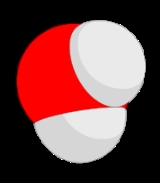
The water moleculeMolecule
A molecule is an electrically neutral group of at least two atoms held together by covalent chemical bonds. Molecules are distinguished from ions by their electrical charge...
has the chemical formula
Chemical formula
A chemical formula or molecular formula is a way of expressing information about the atoms that constitute a particular chemical compound....
H2O, meaning each molecule
Molecule
A molecule is an electrically neutral group of at least two atoms held together by covalent chemical bonds. Molecules are distinguished from ions by their electrical charge...
of water is composed of two hydrogen
Hydrogen
Hydrogen is the chemical element with atomic number 1. It is represented by the symbol H. With an average atomic weight of , hydrogen is the lightest and most abundant chemical element, constituting roughly 75% of the Universe's chemical elemental mass. Stars in the main sequence are mainly...
atom
Atom
The atom is a basic unit of matter that consists of a dense central nucleus surrounded by a cloud of negatively charged electrons. The atomic nucleus contains a mix of positively charged protons and electrically neutral neutrons...
s and one oxygen
Oxygen
Oxygen is the element with atomic number 8 and represented by the symbol O. Its name derives from the Greek roots ὀξύς and -γενής , because at the time of naming, it was mistakenly thought that all acids required oxygen in their composition...
atom. Literally, the term "dihydrogen monoxide" means "two hydrogen, one oxygen", consistent with its molecular formula: the prefix di- in dihydrogen means "two", the prefix mono- in monoxide means "one", and an oxide
Oxide
An oxide is a chemical compound that contains at least one oxygen atom in its chemical formula. Metal oxides typically contain an anion of oxygen in the oxidation state of −2....
is a compound that contains one or more oxygen atoms.
Various names for water are commonly used within the scientific community. Some such names include hydrogen oxide, as well as an alkali
Alkali
In chemistry, an alkali is a basic, ionic salt of an alkali metal or alkaline earth metal element. Some authors also define an alkali as a base that dissolves in water. A solution of a soluble base has a pH greater than 7. The adjective alkaline is commonly used in English as a synonym for base,...
name of hydrogen hydroxide, and several acid names such as hydric acid, hydroxic acid, hydroxylic acid, and hydroxilic acid. The term "hydroxyl acid" used in the original hoax is a non-standard name. An additional name, μ-oxido dihydrogen, has been developed for this compound.
Under the 2005 revisions of IUPAC nomenclature of inorganic chemistry
IUPAC nomenclature of inorganic chemistry
The IUPAC nomenclature of inorganic chemistry is a systematic method of naming inorganic chemical compounds, as recommended by the International Union of Pure and Applied Chemistry . The rules are commonly known as "The Red Book"...
, there is no single correct name for every compound. The primary function of chemical nomenclature is to ensure that each name refers, unambiguously, to a single substance. It is considered less important to ensure that each substance should have a single name, although the number of acceptable names is limited. Water is one acceptable name for this compound, even though it is neither a systematic nor an international name and is specific to just one phase of the compound. The other IUPAC recommendation is oxidane.
The use of numerical prefixes is typical nomenclature for compounds formed by covalent bond
Covalent bond
A covalent bond is a form of chemical bonding that is characterized by the sharing of pairs of electrons between atoms. The stable balance of attractive and repulsive forces between atoms when they share electrons is known as covalent bonding....
s, which are present in water. The prefix for the first named element is often dropped if the elements involved commonly form only one compound, or even if the number of atoms of the first-named element is the same in all the compounds of the two (or more) elements. Thus H2S is often simply called hydrogen sulfide
Hydrogen sulfide
Hydrogen sulfide is the chemical compound with the formula . It is a colorless, very poisonous, flammable gas with the characteristic foul odor of expired eggs perceptible at concentrations as low as 0.00047 parts per million...
, and lithium oxide
Lithium oxide
Lithium oxide or lithia is an inorganic chemical compound. Lithium oxide is formed along with small amounts of lithium peroxide when lithium metal is burned in the air and combines with oxygen:Pure can be produced by the thermal decomposition of lithium peroxide, at 450°C-Structure:In the solid...
is a common name for Li2O. However, the names dihydrogen sulfide, dilithium oxide, and dilithium monoxide are also commonly used both in industry and in universities, despite the fact that Li2O is ionic.
The mono- prefix is often dropped for the second-named element if it is the only common compound the elements form. Thus for instance the IUPAC
IUPAC nomenclature of inorganic chemistry
The IUPAC nomenclature of inorganic chemistry is a systematic method of naming inorganic chemical compounds, as recommended by the International Union of Pure and Applied Chemistry . The rules are commonly known as "The Red Book"...
name of H2S is hydrogen sulfide rather than hydrogen monosulfide. However, since carbon and oxygen can form several compounds (carbon monoxide, carbon dioxide, tricarbon dioxide
Carbon suboxide
Carbon suboxide, or tricarbon dioxide, is an oxide of carbon with chemical formula C3O2 or O=C=C=C=O. Its four cumulative double bonds make it a cumulene...
, and dicarbon monoxide
Dicarbon monoxide
Dicarbon monoxide is an extremely reactive molecule that contains two carbon atoms and one oxygen atom. Dicarbon monoxide, covalently bonded, is a product of the photolysis of carbon suboxide. It is closely related to CO, CO2 and C3O2, and other oxocarbons.It is stable enough to observe reactions...
), the mono- prefix is kept, as it is with silicon monoxide and silicon dioxide. Indeed, hydrogen and oxygen do form another common compound, H2O2 (hydrogen peroxide
Hydrogen peroxide
Hydrogen peroxide is the simplest peroxide and an oxidizer. Hydrogen peroxide is a clear liquid, slightly more viscous than water. In dilute solution, it appears colorless. With its oxidizing properties, hydrogen peroxide is often used as a bleach or cleaning agent...
). Using prefix nomenclature, H2O2 would be called dihydrogen dioxide. Thus, keeping the mono- in dihydrogen monoxide does serve to distinguish it from another compound.
See also
- Chemical nomenclature
- Parody scienceParody scienceParody science, sometimes called spoof science, is the act of mocking science in a satirical way. Science can be parodied for a purpose, ranging from social commentary and making political points, to humor for its own sake....
- Sense and referenceSense and referenceSinn and bedeutung are usually translated, respectively, as sense and reference. Two different aspects of some terms' meanings, a term's reference is the object that the term refers to, while the term's sense is the way that the term refers to that object.Sinn and bedeutung were introduced by...
- Water intoxicationWater intoxicationWater intoxication, also known as water poisoning, is a potentially fatal disturbance in brain functions that results when the normal balance of electrolytes in the body is pushed outside of safe limits by over-consumption of water....