


Diglyceride

Encyclopedia

Glyceride
Glycerides, more correctly known as acylglycerols, are esters formed from glycerol and fatty acids.Glycerol has three hydroxyl functional groups, which can be esterified with one, two, or three fatty acids to form monoglycerides, diglycerides, and triglycerides.Vegetable oils and animal fats...
consisting of two fatty acid
Fatty acid
In chemistry, especially biochemistry, a fatty acid is a carboxylic acid with a long unbranched aliphatic tail , which is either saturated or unsaturated. Most naturally occurring fatty acids have a chain of an even number of carbon atoms, from 4 to 28. Fatty acids are usually derived from...
chains covalently bonded
Covalent bond
A covalent bond is a form of chemical bonding that is characterized by the sharing of pairs of electrons between atoms. The stable balance of attractive and repulsive forces between atoms when they share electrons is known as covalent bonding....
to a glycerol
Glycerol
Glycerol is a simple polyol compound. It is a colorless, odorless, viscous liquid that is widely used in pharmaceutical formulations. Glycerol has three hydroxyl groups that are responsible for its solubility in water and its hygroscopic nature. The glycerol backbone is central to all lipids...
molecule through ester
Ester
Esters are chemical compounds derived by reacting an oxoacid with a hydroxyl compound such as an alcohol or phenol. Esters are usually derived from an inorganic acid or organic acid in which at least one -OH group is replaced by an -O-alkyl group, and most commonly from carboxylic acids and...
linkages.
One example, shown on the right, is 1-palmitoyl-2-oleoyl-glycerol, which contains side-chains derived from palmitic acid
Palmitic acid
Palmitic acid, or hexadecanoic acid in IUPAC nomenclature, is one of the most common saturated fatty acids found in animals and plants. Its molecular formula is CH314CO2H. As its name indicates, it is a major component of the oil from palm trees . Palmitate is a term for the salts and esters of...
and oleic acid
Oleic acid
Oleic acid is a monounsaturated omega-9 fatty acid found in various animal and vegetable fats. It has the formula CH37CH=CH7COOH. It is an odorless, colourless oil, although commercial samples may be yellowish. The trans isomer of oleic acid is called elaidic acid...
. Diacylglycerols can also have many different combinations of fatty acids attached at both the C-1 and C-2 positions.
Food additive
Mono- and diacylglycerols are common food additives used to blend together certain ingredients, such as oil and water, which would not otherwise blend well.The commercial source may be either animal (cow- or hog-derived) or vegetable, derived primarily from partially hydrogenated soy bean and canola oil [?evidence for this statement - reference needed]. They may also be synthetically produced. They are often found in bakery products, beverages, ice cream, chewing gum, shortening
Shortening
Shortening is any fat that is solid at room temperature and used to make crumbly pastry. The reason it is called shortening is because it prevents cross-linkage between gluten molecules. Cross linking is what causes doughs to be sticky. Seeing as cake is not meant to be sticky, shortening is used...
, whipped toppings, margarine, and confections.
PKC activation
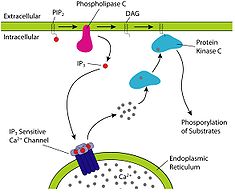
Lipid signaling
Lipid signaling, broadly defined, refers to any biological signaling event involving a lipid messenger that binds a protein target, such as a receptor, kinase or phosphatase, which in turn mediate the effects of these lipids on specific cellular responses...
, and is a product of the hydrolysis of the phospholipid PIP2 (phosphatidyl inositol-bisphosphate) by the enzyme
Enzyme
Enzymes are proteins that catalyze chemical reactions. In enzymatic reactions, the molecules at the beginning of the process, called substrates, are converted into different molecules, called products. Almost all chemical reactions in a biological cell need enzymes in order to occur at rates...
phospholipase
Phospholipase
A phospholipase is an enzyme that hydrolyzes phospholipids into fatty acids and other lipophilic substances. There are four major classes, termed A, B, C and D, distinguished by the type of reaction which they catalyze:*Phospholipase A...
C (PLC
Phospholipase C
Phosphoinositide phospholipase C is a family of eukaryotic intracellular enzymes that play an important role in signal transduction processes. In general, this enzyme is denoted as Phospholipase C, although three other families of phospholipase C enzymes have been identified in bacteria and in...
) (a membrane
Cell membrane
The cell membrane or plasma membrane is a biological membrane that separates the interior of all cells from the outside environment. The cell membrane is selectively permeable to ions and organic molecules and controls the movement of substances in and out of cells. It basically protects the cell...
-bound enzyme) that, through the same reaction, produces inositol trisphosphate (IP3). Although inositol trisphosphate (IP3) diffuses into the cytosol
Cytosol
The cytosol or intracellular fluid is the liquid found inside cells, that is separated into compartments by membranes. For example, the mitochondrial matrix separates the mitochondrion into compartments....
, diacylglycerol (DAG) remains within the plasma membrane, due to its hydrophobic
Hydrophobe
In chemistry, hydrophobicity is the physical property of a molecule that is repelled from a mass of water....
properties. IP3 stimulates the release of calcium ions from the smooth endoplasmic reticulum, whereas DAG is a physiological activator of protein kinase C
Protein kinase C
Protein kinase C also known as PKC is a family of enzymes that are involved in controlling the function of other proteins through the phosphorylation of hydroxyl groups of serine and threonine amino acid residues on these proteins. PKC enzymes in turn are activated by signals such as increases in...
(PKC). The production of DAG in the membrane facilitates translocation of PKC from the cytosol to the plasma membrane.
Diacylglycerol can be mimicked by the tumor-promoting compounds phorbol esters.
Other
In addition to activating PKC, diacylglycerol has a number of other functions in the cellCell (biology)
The cell is the basic structural and functional unit of all known living organisms. It is the smallest unit of life that is classified as a living thing, and is often called the building block of life. The Alberts text discusses how the "cellular building blocks" move to shape developing embryos....
:
- a source for prostaglandinProstaglandinA prostaglandin is any member of a group of lipid compounds that are derived enzymatically from fatty acids and have important functions in the animal body. Every prostaglandin contains 20 carbon atoms, including a 5-carbon ring....
s - a precursor of the endocannabinoid 2-arachidonoylglycerol2-Arachidonoylglycerol2-Arachidonoylglycerol is an endocannabinoid, an endogenous agonist of the CB1 receptor. It is an ester formed from the omega-6 fatty acid arachidonic acid and glycerol. It is present at relatively high levels in the central nervous system, with cannabinoid neuromodulatory effects. It has been...
- an activator of a subfamily of TRPCTRPCTRPC is a family of transient receptor potential cation channels in animals.TRPC channels form the subfamily of channels in human most closely related to drosophila TRP channels. In terms of structure, this family possesses a number of similar characteristics...
(Transient Receptor Potential Canonical) cation channels, TRPC3/6/7.
Metabolism
Synthesis of diacylglycerol begins with glycerol-3-phosphate, which is derived primarily from dihydroxyacetone phosphate, a product of glycolysisGlycolysis
Glycolysis is the metabolic pathway that converts glucose C6H12O6, into pyruvate, CH3COCOO− + H+...
(usually in the cytoplasm of liver or adipose tissue cells). Glycerol-3-phosphate is first acylated
Acylation
In chemistry, acylation is the process of adding an acyl group to a compound. The compound providing the acyl group is called the acylating agent....
with acyl-coenzyme A (acyl-CoA) to form lysophosphatidic acid
Lysophosphatidic acid
Lysophosphatidic acid is a phospholipid derivative that can act as a signaling molecule.-Function:LPA acts as a potent mitogen due to its activation of three high-affinity G-protein-coupled receptors called LPA1, LPA2, and LPA3...
, which is then acylated with another molecule of acyl-CoA to yield phosphatidic acid. Phosphatidic acid is then de-phosphorylated to form diacylglycerol.
Diacylglycerol is a precursor to triacylglycerol (triglyceride), which is formed in the addition of a third fatty acid to the diacylglycerol under the catalysis of diglyceride acyltransferase
Diglyceride acyltransferase
Diglyceride acyltransferase , DGAT, catalyzes the formation of triglycerides from diacylglycerol and Acyl-CoA. The reaction catalyzed by DGAT is considered the terminal and only committed step in triglyceride synthesis and to be essential for the formation of adipose tissue.- Isoforms :There are...
.
Since diacylglycerol is synthesized via phosphatidic acid, it will usually contain a saturated fatty acid at the C-1 position on the glycerol moiety and an unsaturated fatty acid at the C-2 position.