

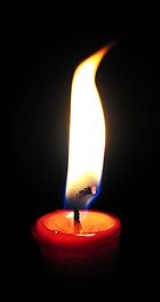
Diffusion flame

Encyclopedia

Combustion
Combustion or burning is the sequence of exothermic chemical reactions between a fuel and an oxidant accompanied by the production of heat and conversion of chemical species. The release of heat can result in the production of light in the form of either glowing or a flame...
, a diffusion flame is a flame
Flame
A flame is the visible , gaseous part of a fire. It is caused by a highly exothermic reaction taking place in a thin zone...
in which the oxidizer combines with the fuel
Fuel
Fuel is any material that stores energy that can later be extracted to perform mechanical work in a controlled manner. Most fuels used by humans undergo combustion, a redox reaction in which a combustible substance releases energy after it ignites and reacts with the oxygen in the air...
by diffusion
Diffusion
Molecular diffusion, often called simply diffusion, is the thermal motion of all particles at temperatures above absolute zero. The rate of this movement is a function of temperature, viscosity of the fluid and the size of the particles...
. As a result, the flame speed is limited by the rate of diffusion. Diffusion flames tend to burn slower and to produce more soot than premixed flame
Premixed flame
A premixed flame is a flame in which the oxidizer has been mixed with the fuel before it reaches the flame front. This creates a thin flame front as all of the reactants are readily available...
s because there may not be sufficient oxidizer for the reaction to go to completion, although there are some exceptions to the rule. The soot typically produced in a diffusion flame becomes incandescent from the heat of the flame and lends the flame its readily identifiable orange-yellow color. Diffusion flames tend to have a less-localized flame front than premixed flames.
The contexts for diffusion may vary somewhat. For instance, a candle
Candle
A candle is a solid block or cylinder of wax with an embedded wick, which is lit to provide light, and sometimes heat.Today, most candles are made from paraffin. Candles can also be made from beeswax, soy, other plant waxes, and tallow...
uses the heat of the flame itself to vaporize its wax
Wax
thumb|right|[[Cetyl palmitate]], a typical wax ester.Wax refers to a class of chemical compounds that are plastic near ambient temperatures. Characteristically, they melt above 45 °C to give a low viscosity liquid. Waxes are insoluble in water but soluble in organic, nonpolar solvents...
fuel and the oxidizer (oxygen
Oxygen
Oxygen is the element with atomic number 8 and represented by the symbol O. Its name derives from the Greek roots ὀξύς and -γενής , because at the time of naming, it was mistakenly thought that all acids required oxygen in their composition...
) diffuses into the flame from the surrounding air, while a gaslight
Gas lighting
Gas lighting is production of artificial light from combustion of a gaseous fuel, including hydrogen, methane, carbon monoxide, propane, butane, acetylene, ethylene, or natural gas. Before electricity became sufficiently widespread and economical to allow for general public use, gas was the most...
flame (or the safety flame of a bunsen burner
Bunsen burner
A Bunsen burner, named after Robert Bunsen, is a common piece of laboratory equipment that produces a single open gas flame, which is used for heating, sterilization, and combustion.- Operation:...
) uses fuel already in the form of a vapor.
Diffusion flames are often studied in counter flow (also called opposed jet) burners. Their interest is due to possible application in the flamelet model for turbulent combustion. Furthermore they provide a convenient way to examine strained flames and flames with holes. These are also known under the name of "edge flames", characterized by a local extinction on their axis because of the high strain rates in the vicinity of the stagnation point.
Diffusion flames have an entirely different appearance in a microgravity environment. There is no convection to carry the hot combustion products away from the fuel source, which results in a spherical flame front, such as in the candle seen here. This is a rare example of a diffusion flame which does not produce much soot and does not therefore have a typical yellow flame.
See also
- Premixed flamePremixed flameA premixed flame is a flame in which the oxidizer has been mixed with the fuel before it reaches the flame front. This creates a thin flame front as all of the reactants are readily available...
- Oxidizing and reducing flamesOxidizing and reducing flamesIn various burners, the oxidizing flame is a flame produced with an excessive amount of oxygen. A flame with a good balance of oxygen is clear blue. When the amount of oxygen increases, the color darkens, the flame shortens, and it hisses and roars...
- Oxy-fuel combustion processOxy-fuel combustion processOxy-fuel combustion is the process of burning a fuel using pure oxygen instead of air as the primary oxidant. Since the nitrogen component of air is not heated, fuel consumption is reduced, and higher flame temperatures are possible...
External links
- Diffusion flames in microgravity, NASANASAThe National Aeronautics and Space Administration is the agency of the United States government that is responsible for the nation's civilian space program and for aeronautics and aerospace research...
- Diffusion and edge flames in opposed-jet burners