

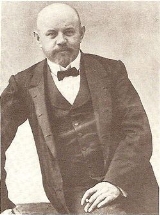
Dietrich Eckart

Encyclopedia
Dietrich Eckart was a German
journalist and politician, together with Adolf Hitler
one of the early key members of the Nazi Party (NSDAP) and a participant of the 1923 Beer Hall Putsch
.
, Upper Palatinate
(about twenty miles southeast of Nuremberg
) in the Kingdom of Bavaria
, the son of royal notary and lawyer Christian Eckart and his wife Anna, a devout Catholic. His mother died when he was ten years old. Young Dietrich was expelled from several schools; in 1895, his father died also, leaving him a considerable amount of money that Eckart soon spent.
Eckart initially studied law at Erlangen, later medicine at the Ludwig Maximilian University of Munich as an eagerly fencing and drinking corps
member, but finally decided in 1891 to work as a poet
, playwright
and journalist
. Diagnosed with morphine
addiction and nearly stranded, he moved to Berlin
in 1899, where he wrote a number of plays, often autobiographical, becoming the protégé of Count Georg von Hülsen-Haeseler (1858 – 1922), the artistic director of the Prussian
Royal Theatre. Eckart was a successful playwright, especially for his 1912 adaptation of Henrik Ibsen's Peer Gynt
, one of the best attended productions of the age with more than 600 performances in Berlin alone. It was this success that not only made Eckart a wealthy man, but gave him the social contacts needed to introduce Hitler to dozens of important German citizens of the day. These introductions proved to be pivotal in Hitler's ultimate rise to power.
Later on, Eckart developed an ideology of a "genius superman", based on writings by the Völkisch
author Jörg Lanz von Liebenfels; he saw himself following the tradition of Heinrich Heine
, Arthur Schopenhauer
and Angelus Silesius
. He also became fascinated by the Buddhist doctrine of Maya (illusion)
. Eckart loved and strongly identified with Peer Gynt, but never had much sympathy for the scientific method
. From 1907 he lived with his brother Wilhelm in the Döberitz
mansion colony west of the Berlin city limits. In 1913 he married Rosa Marx, an affluent widow from Bad Blankenburg
, and returned to Munich
.
After World War I
, Eckart edited the antisemitic periodical Auf gut Deutsch ("In plain German"), published along with Alfred Rosenberg
and Gottfried Feder
. A fierce critic of the German Revolution and the Weimar Republic
, he vehemently opposed the Treaty of Versailles
, which he viewed as treason, and was a proponent of the so-called stab-in-the-back legend (Dolchstoßlegende), according to which the Social Democrats
and Jews
were to blame for Germany's defeat in the war.
Eckart was involved in founding the Deutsche Arbeiterpartei (German Workers' Party
) together with Gottfried Feder
and Anton Drexler
in 1919, later renamed the Nationalsozialistische deutsche Arbeiterpartei (National Socialist German Workers' Party, NSDAP); he was the original publisher of the party newspaper, the Völkischer Beobachter
, and also wrote the lyrics of Deutschland erwache ("Germany awake"), which became an anthem of the Nazi Party.
Eckart met Adolf Hitler
during a speech he gave before party members in 1919. Eckart was involved with the Thule Society
, a secretive group of occultists that believed in the coming of a “German Messiah” who would redeem Germany after its defeat in World War I. Eckart expressed his anticipation in a poem he wrote months before he met Hitler for the first time. In the poem, Eckart refers to ‘the Great One’, ‘the Nameless One’, ‘Whom all can sense but no one saw’. When Eckart met Hitler, he was convinced that he had encountered the prophesied redeemer. Eckart exerted considerable influence on Hitler in the following years and is strongly believed to have helped establish the theories and beliefs of the Nazi party. Few other people had as much influence on Hitler in his lifetime.
It was Eckart who introduced Alfred Rosenberg
to Adolf Hitler
.
Between 1920 and 1923, Eckart and Rosenberg labored tirelessly in the service of Hitler and the party. Through Rosenberg, Hitler was introduced to the writings of Houston Stewart Chamberlain
, Rosenberg's inspiration. Rosenberg edited the Münchener Beobachter
, a party newspaper, originally owned by the Thule Society
. In the pages of the Münchener Beobachter
, Rosenberg published the Protocols of the Elders of Zion.
To raise funds for the party's newspaper, Eckart introduced Hitler into the influential circles that would eventually fund the Nazi party. While staying in the house of a wealthy manufacturer in Berlin
, Hitler was given instruction in public speaking by a teacher of drama.
On 9 November 1923, Eckart was involved in the Nazi party's failed Beer Hall Putsch
; he was arrested and placed in Landsberg Prison
along with Hitler and other party officials, but was released shortly thereafter due to illness. He died of a heart attack
in Berchtesgaden
on 26 December 1923. He was buried in Berchtesgaden's old cemetery, not far from the eventual graves of Nazi party official Hans Lammers
and his wife and daughter.
Hitler dedicated the second volume of Mein Kampf
to Eckart, and also named the Waldbühne arena near the Olympic Stadium
in Berlin as the "Dietrich-Eckart-Bühne" when it was opened for the 1936 Summer Olympics
. The 5th Standarte (regiment) of the SS-Totenkopfverbände
was given the honour-title Dietrich Eckart.
In 1925, Eckart's unfinished essay Der Bolschewismus von Moses bis Lenin: Zwiegespräch zwischen Hitler und mir ("Bolshevism from Moses
to Lenin: Dialogues Between Hitler and Me") was published posthumously, although it has been shown (Plewnia 1970) that the dialogues were an invention; the essay was written by Eckart alone. "However, this book still remains a reliable indicator of [Eckart's] own views." The historian Richard Steigmann-Gall
quotes from Eckart's book:
Steigmann-Gall concludes that, "far from advocating a paganism or anti-Christian religion, Eckart held that, in Germany's postwar tailspin, Christ was a leader to be emulated."
in the 2005 anime
movie Fullmetal Alchemist the Movie: Conqueror of Shamballa
.
In part 4, Phase 1 of the 2000AD story Zenith
by Grant Morrison
and Steve Yeowell
Eckardt is referred to and depicted as the poet and mystic who initiated a German army corporal (Adolf Hitler
) into the occult group called the Cult of the Black Sun after recognizing his potential as a medium. Eckardt and Haushofer put Hitler in contact with the Great Old Ones with their goal of helping the Nazis engineer superhuman bodies that could act as physical vehicles for these Dark Gods.
Germans
The Germans are a Germanic ethnic group native to Central Europe. The English term Germans has referred to the German-speaking population of the Holy Roman Empire since the Late Middle Ages....
journalist and politician, together with Adolf Hitler
Adolf Hitler
Adolf Hitler was an Austrian-born German politician and the leader of the National Socialist German Workers Party , commonly referred to as the Nazi Party). He was Chancellor of Germany from 1933 to 1945, and head of state from 1934 to 1945...
one of the early key members of the Nazi Party (NSDAP) and a participant of the 1923 Beer Hall Putsch
Beer Hall Putsch
The Beer Hall Putsch was a failed attempt at revolution that occurred between the evening of 8 November and the early afternoon of 9 November 1923, when Nazi Party leader Adolf Hitler, Generalquartiermeister Erich Ludendorff, and other heads of the Kampfbund unsuccessfully tried to seize power...
.
Biography
Eckart was born Johann Dietrich Eckart in 1868 in NeumarktNeumarkt in der Oberpfalz
Neumarkt in der Oberpfalz is the capital of the Neumarkt district in the administrative region of the Upper Palatinate, in Bavaria, Germany. With a population of about 40,000, Neumarkt is the seat of various projects, and acts as the economic and cultural center of the western Upper Palatinate,...
, Upper Palatinate
Upper Palatinate
The Upper Palatinate is one of the seven administrative regions of Bavaria, Germany, located in the east of Bavaria.- History :The region took its name first in the early 16th century, because it was by the Treaty of Pavia one of the main portions of the territory of the Wittelsbach Elector...
(about twenty miles southeast of Nuremberg
Nuremberg
Nuremberg[p] is a city in the German state of Bavaria, in the administrative region of Middle Franconia. Situated on the Pegnitz river and the Rhine–Main–Danube Canal, it is located about north of Munich and is Franconia's largest city. The population is 505,664...
) in the Kingdom of Bavaria
Kingdom of Bavaria
The Kingdom of Bavaria was a German state that existed from 1806 to 1918. The Bavarian Elector Maximilian IV Joseph of the House of Wittelsbach became the first King of Bavaria in 1806 as Maximilian I Joseph. The monarchy would remain held by the Wittelsbachs until the kingdom's dissolution in 1918...
, the son of royal notary and lawyer Christian Eckart and his wife Anna, a devout Catholic. His mother died when he was ten years old. Young Dietrich was expelled from several schools; in 1895, his father died also, leaving him a considerable amount of money that Eckart soon spent.
Eckart initially studied law at Erlangen, later medicine at the Ludwig Maximilian University of Munich as an eagerly fencing and drinking corps
German Student Corps
Corps are the oldest still-existing kind of Studentenverbindung, Germany's traditional university corporations; their roots date back to the 15th century. The oldest corps still existing today was founded in 1789...
member, but finally decided in 1891 to work as a poet
Poet
A poet is a person who writes poetry. A poet's work can be literal, meaning that his work is derived from a specific event, or metaphorical, meaning that his work can take on many meanings and forms. Poets have existed since antiquity, in nearly all languages, and have produced works that vary...
, playwright
Playwright
A playwright, also called a dramatist, is a person who writes plays.The term is not a variant spelling of "playwrite", but something quite distinct: the word wright is an archaic English term for a craftsman or builder...
and journalist
Journalist
A journalist collects and distributes news and other information. A journalist's work is referred to as journalism.A reporter is a type of journalist who researchs, writes, and reports on information to be presented in mass media, including print media , electronic media , and digital media A...
. Diagnosed with morphine
Morphine
Morphine is a potent opiate analgesic medication and is considered to be the prototypical opioid. It was first isolated in 1804 by Friedrich Sertürner, first distributed by same in 1817, and first commercially sold by Merck in 1827, which at the time was a single small chemists' shop. It was more...
addiction and nearly stranded, he moved to Berlin
Berlin
Berlin is the capital city of Germany and is one of the 16 states of Germany. With a population of 3.45 million people, Berlin is Germany's largest city. It is the second most populous city proper and the seventh most populous urban area in the European Union...
in 1899, where he wrote a number of plays, often autobiographical, becoming the protégé of Count Georg von Hülsen-Haeseler (1858 – 1922), the artistic director of the Prussian
Kingdom of Prussia
The Kingdom of Prussia was a German kingdom from 1701 to 1918. Until the defeat of Germany in World War I, it comprised almost two-thirds of the area of the German Empire...
Royal Theatre. Eckart was a successful playwright, especially for his 1912 adaptation of Henrik Ibsen's Peer Gynt
Peer Gynt
Peer Gynt is a five-act play in verse by the Norwegian dramatist Henrik Ibsen, loosely based on the fairy tale Per Gynt. It is the most widely performed Norwegian play. According to Klaus Van Den Berg, the "cinematic script blends poetry with social satire and realistic scenes with surreal ones"...
, one of the best attended productions of the age with more than 600 performances in Berlin alone. It was this success that not only made Eckart a wealthy man, but gave him the social contacts needed to introduce Hitler to dozens of important German citizens of the day. These introductions proved to be pivotal in Hitler's ultimate rise to power.
Later on, Eckart developed an ideology of a "genius superman", based on writings by the Völkisch
Völkisch movement
The volkisch movement is the German interpretation of the populist movement, with a romantic focus on folklore and the "organic"...
author Jörg Lanz von Liebenfels; he saw himself following the tradition of Heinrich Heine
Heinrich Heine
Christian Johann Heinrich Heine was one of the most significant German poets of the 19th century. He was also a journalist, essayist, and literary critic. He is best known outside Germany for his early lyric poetry, which was set to music in the form of Lieder by composers such as Robert Schumann...
, Arthur Schopenhauer
Arthur Schopenhauer
Arthur Schopenhauer was a German philosopher known for his pessimism and philosophical clarity. At age 25, he published his doctoral dissertation, On the Fourfold Root of the Principle of Sufficient Reason, which examined the four separate manifestations of reason in the phenomenal...
and Angelus Silesius
Angelus Silesius
Angelus Silesius was a German Catholic mystic and poet.-Life:Silesius was born in Breslau , Silesia as son of Polish noble and German mother...
. He also became fascinated by the Buddhist doctrine of Maya (illusion)
Maya (illusion)
Maya , in Indian religions, has multiple meanings, usually quoted as "illusion", centered on the fact that we do not experience the environment itself but rather a projection of it, created by us. Maya is the principal deity that manifests, perpetuates and governs the illusion and dream of duality...
. Eckart loved and strongly identified with Peer Gynt, but never had much sympathy for the scientific method
Scientific method
Scientific method refers to a body of techniques for investigating phenomena, acquiring new knowledge, or correcting and integrating previous knowledge. To be termed scientific, a method of inquiry must be based on gathering empirical and measurable evidence subject to specific principles of...
. From 1907 he lived with his brother Wilhelm in the Döberitz
Dallgow-Döberitz
Dallgow-Döberitz is a municipality in the Havelland district, in Brandenburg, Germany.-Geography:It consists of the villages Dallgow-Döberitz, Rohrbeck and Seeburg. To the east it shares border with the Spandau borough of Berlin. Neighbouring Brandenburg municipalities are Falkensee in the north...
mansion colony west of the Berlin city limits. In 1913 he married Rosa Marx, an affluent widow from Bad Blankenburg
Bad Blankenburg
Bad Blankenburg is a spa town in the district of Saalfeld-Rudolstadt, in Thuringia, Germany. It is situated 6 km southwest of Rudolstadt, and 37 km southeast of Erfurt....
, and returned to Munich
Munich
Munich The city's motto is "" . Before 2006, it was "Weltstadt mit Herz" . Its native name, , is derived from the Old High German Munichen, meaning "by the monks' place". The city's name derives from the monks of the Benedictine order who founded the city; hence the monk depicted on the city's coat...
.
After World War I
World War I
World War I , which was predominantly called the World War or the Great War from its occurrence until 1939, and the First World War or World War I thereafter, was a major war centred in Europe that began on 28 July 1914 and lasted until 11 November 1918...
, Eckart edited the antisemitic periodical Auf gut Deutsch ("In plain German"), published along with Alfred Rosenberg
Alfred Rosenberg
' was an early and intellectually influential member of the Nazi Party. Rosenberg was first introduced to Adolf Hitler by Dietrich Eckart; he later held several important posts in the Nazi government...
and Gottfried Feder
Gottfried Feder
Gottfried Feder was an economist and one of the early key members of the Nazi party. He was their economic theoretician. Initially, it was his lecture in 1919 that drew Hitler into the party.- Biography :...
. A fierce critic of the German Revolution and the Weimar Republic
Weimar Republic
The Weimar Republic is the name given by historians to the parliamentary republic established in 1919 in Germany to replace the imperial form of government...
, he vehemently opposed the Treaty of Versailles
Treaty of Versailles
The Treaty of Versailles was one of the peace treaties at the end of World War I. It ended the state of war between Germany and the Allied Powers. It was signed on 28 June 1919, exactly five years after the assassination of Archduke Franz Ferdinand. The other Central Powers on the German side of...
, which he viewed as treason, and was a proponent of the so-called stab-in-the-back legend (Dolchstoßlegende), according to which the Social Democrats
Social Democratic Party of Germany
The Social Democratic Party of Germany is a social-democratic political party in Germany...
and Jews
History of the Jews in Germany
The presence of Jews in Germany has been established since the early 4th century. The community prospered under Charlemagne, but suffered during the Crusades...
were to blame for Germany's defeat in the war.
Eckart was involved in founding the Deutsche Arbeiterpartei (German Workers' Party
German Workers' Party
The German Workers' Party was the short-lived predecessor of the Nazi Party .-Origins:The DAP was founded in Munich in the hotel "Fürstenfelder Hof" on January 5, 1919 by Anton Drexler, a member of the occultist Thule Society. It developed out of the "Freien Arbeiterausschuss für einen guten...
) together with Gottfried Feder
Gottfried Feder
Gottfried Feder was an economist and one of the early key members of the Nazi party. He was their economic theoretician. Initially, it was his lecture in 1919 that drew Hitler into the party.- Biography :...
and Anton Drexler
Anton Drexler
Anton Drexler was a German right-wing political leader of the 1920s, known for being Adolf Hitler's mentor during his early days in politics.-Biography:...
in 1919, later renamed the Nationalsozialistische deutsche Arbeiterpartei (National Socialist German Workers' Party, NSDAP); he was the original publisher of the party newspaper, the Völkischer Beobachter
Völkischer Beobachter
The Völkischer Beobachter was the newspaper of the National Socialist German Workers' Party from 1920. It first appeared weekly, then daily from February 8, 1923...
, and also wrote the lyrics of Deutschland erwache ("Germany awake"), which became an anthem of the Nazi Party.
Eckart met Adolf Hitler
Adolf Hitler
Adolf Hitler was an Austrian-born German politician and the leader of the National Socialist German Workers Party , commonly referred to as the Nazi Party). He was Chancellor of Germany from 1933 to 1945, and head of state from 1934 to 1945...
during a speech he gave before party members in 1919. Eckart was involved with the Thule Society
Thule Society
The Thule Society , originally the Studiengruppe für germanisches Altertum , was a German occultist and völkisch group in Munich, named after a mythical northern country from Greek legend...
, a secretive group of occultists that believed in the coming of a “German Messiah” who would redeem Germany after its defeat in World War I. Eckart expressed his anticipation in a poem he wrote months before he met Hitler for the first time. In the poem, Eckart refers to ‘the Great One’, ‘the Nameless One’, ‘Whom all can sense but no one saw’. When Eckart met Hitler, he was convinced that he had encountered the prophesied redeemer. Eckart exerted considerable influence on Hitler in the following years and is strongly believed to have helped establish the theories and beliefs of the Nazi party. Few other people had as much influence on Hitler in his lifetime.
It was Eckart who introduced Alfred Rosenberg
Alfred Rosenberg
' was an early and intellectually influential member of the Nazi Party. Rosenberg was first introduced to Adolf Hitler by Dietrich Eckart; he later held several important posts in the Nazi government...
to Adolf Hitler
Adolf Hitler
Adolf Hitler was an Austrian-born German politician and the leader of the National Socialist German Workers Party , commonly referred to as the Nazi Party). He was Chancellor of Germany from 1933 to 1945, and head of state from 1934 to 1945...
.
Between 1920 and 1923, Eckart and Rosenberg labored tirelessly in the service of Hitler and the party. Through Rosenberg, Hitler was introduced to the writings of Houston Stewart Chamberlain
Houston Stewart Chamberlain
Houston Stewart Chamberlain was a British-born German author of books on political philosophy, natural science and the German composer Richard Wagner. He later became a German citizen. Chamberlain married Wagner's daughter, Eva, some years after Wagner's death...
, Rosenberg's inspiration. Rosenberg edited the Münchener Beobachter
Münchener Beobachter
The Münchener Beobachter was a völkisch newspaper edited by Rudolf von Sebottendorf. In the course of 1920 it became the official Nazi organ, becoming the Voelkischer Beobachter. , and remained the leading Nazi party newspaper until 1945....
, a party newspaper, originally owned by the Thule Society
Thule Society
The Thule Society , originally the Studiengruppe für germanisches Altertum , was a German occultist and völkisch group in Munich, named after a mythical northern country from Greek legend...
. In the pages of the Münchener Beobachter
Münchener Beobachter
The Münchener Beobachter was a völkisch newspaper edited by Rudolf von Sebottendorf. In the course of 1920 it became the official Nazi organ, becoming the Voelkischer Beobachter. , and remained the leading Nazi party newspaper until 1945....
, Rosenberg published the Protocols of the Elders of Zion.
To raise funds for the party's newspaper, Eckart introduced Hitler into the influential circles that would eventually fund the Nazi party. While staying in the house of a wealthy manufacturer in Berlin
Berlin
Berlin is the capital city of Germany and is one of the 16 states of Germany. With a population of 3.45 million people, Berlin is Germany's largest city. It is the second most populous city proper and the seventh most populous urban area in the European Union...
, Hitler was given instruction in public speaking by a teacher of drama.
On 9 November 1923, Eckart was involved in the Nazi party's failed Beer Hall Putsch
Beer Hall Putsch
The Beer Hall Putsch was a failed attempt at revolution that occurred between the evening of 8 November and the early afternoon of 9 November 1923, when Nazi Party leader Adolf Hitler, Generalquartiermeister Erich Ludendorff, and other heads of the Kampfbund unsuccessfully tried to seize power...
; he was arrested and placed in Landsberg Prison
Landsberg Prison
Landsberg Prison is a penal facility located in the town of Landsberg am Lech in the southwest of the German state of Bavaria, about west of Munich and south of Augsburg....
along with Hitler and other party officials, but was released shortly thereafter due to illness. He died of a heart attack
Myocardial infarction
Myocardial infarction or acute myocardial infarction , commonly known as a heart attack, results from the interruption of blood supply to a part of the heart, causing heart cells to die...
in Berchtesgaden
Berchtesgaden
Berchtesgaden is a municipality in the German Bavarian Alps. It is located in the south district of Berchtesgadener Land in Bavaria, near the border with Austria, some 30 km south of Salzburg and 180 km southeast of Munich...
on 26 December 1923. He was buried in Berchtesgaden's old cemetery, not far from the eventual graves of Nazi party official Hans Lammers
Hans Lammers
Dr.jur. Hans Heinrich Lammers was a German jurist and prominent Nazi politician. From 1933 until 1945 he served as head of the Reich Chancellery under Adolf Hitler....
and his wife and daughter.
Hitler dedicated the second volume of Mein Kampf
Mein Kampf
Mein Kampf is a book written by Nazi leader Adolf Hitler. It combines elements of autobiography with an exposition of Hitler's political ideology. Volume 1 of Mein Kampf was published in 1925 and Volume 2 in 1926...
to Eckart, and also named the Waldbühne arena near the Olympic Stadium
Olympic Stadium (Berlin)
The Olympiastadion is a sports stadium in Berlin, Germany. There have been two stadiums on the site: the present facility, and one that is called the Deutsches Stadion which was built for the aborted 1916 Summer Olympics. Both were designed by members of the same family, the first by Otto March...
in Berlin as the "Dietrich-Eckart-Bühne" when it was opened for the 1936 Summer Olympics
1936 Summer Olympics
The 1936 Summer Olympics, officially known as the Games of the XI Olympiad, was an international multi-sport event which was held in 1936 in Berlin, Germany. Berlin won the bid to host the Games over Barcelona, Spain on April 26, 1931, at the 29th IOC Session in Barcelona...
. The 5th Standarte (regiment) of the SS-Totenkopfverbände
SS-Totenkopfverbände
SS-Totenkopfverbände , meaning "Death's-Head Units", was the SS organization responsible for administering the Nazi concentration camps for the Third Reich....
was given the honour-title Dietrich Eckart.
In 1925, Eckart's unfinished essay Der Bolschewismus von Moses bis Lenin: Zwiegespräch zwischen Hitler und mir ("Bolshevism from Moses
Moses
Moses was, according to the Hebrew Bible and Qur'an, a religious leader, lawgiver and prophet, to whom the authorship of the Torah is traditionally attributed...
to Lenin: Dialogues Between Hitler and Me") was published posthumously, although it has been shown (Plewnia 1970) that the dialogues were an invention; the essay was written by Eckart alone. "However, this book still remains a reliable indicator of [Eckart's] own views." The historian Richard Steigmann-Gall
Richard Steigmann-Gall
Richard Steigmann-Gall is Associate Professor of History at Kent State University, and was the Director of the Jewish Studies Program from 2004 to 2010. He received his BA in 1989 and MA in 1992 from the University of Michigan, and his PhD in 1999 from the University of Toronto...
quotes from Eckart's book:
"In Christ, the embodiment of all manliness, we find all that we need. And if we occasionally speak of Baldur, our words always contain some joy, some satisfaction, that our pagan ancestors were already so Christian as to have an indication of Christ in this ideal figure." – Dietrich Eckart
Steigmann-Gall concludes that, "far from advocating a paganism or anti-Christian religion, Eckart held that, in Germany's postwar tailspin, Christ was a leader to be emulated."
Portrayals in popular culture
A fictionalized, female version of Eckart (Dietlinde Eckhart) appeared as the main villain and head of the Thule SocietyThule Society
The Thule Society , originally the Studiengruppe für germanisches Altertum , was a German occultist and völkisch group in Munich, named after a mythical northern country from Greek legend...
in the 2005 anime
Anime
is the Japanese abbreviated pronunciation of "animation". The definition sometimes changes depending on the context. In English-speaking countries, the term most commonly refers to Japanese animated cartoons....
movie Fullmetal Alchemist the Movie: Conqueror of Shamballa
Fullmetal Alchemist the Movie: Conqueror of Shamballa
is a 2005 Japanese animated film directed by Seiji Mizushima and written by Sho Aikawa, and acts as a continuation of the first Fullmetal Alchemist television series...
.
In part 4, Phase 1 of the 2000AD story Zenith
Zenith (comics)
Zenith is a British superhero, who appeared in the science fiction comic 2000 AD. Created by writer Grant Morrison and artist Steve Yeowell, with original character designs by Brendan McCarthy, he first appeared in 2000 AD #536 .Shallow and sarcastic, Zenith was a distinctly Generation X superhero...
by Grant Morrison
Grant Morrison
Grant Morrison is a Scottish comic book writer, playwright and occultist. He is known for his nonlinear narratives and counter-cultural leanings, as well as his successful runs on titles like Animal Man, Doom Patrol, JLA, The Invisibles, New X-Men, Fantastic Four, All-Star Superman, and...
and Steve Yeowell
Steve Yeowell
Steve Yeowell is a British comics artist, well-known for his work on the long-running science fiction and fantasy weekly comic 2000 AD.-Biography:...
Eckardt is referred to and depicted as the poet and mystic who initiated a German army corporal (Adolf Hitler
Adolf Hitler
Adolf Hitler was an Austrian-born German politician and the leader of the National Socialist German Workers Party , commonly referred to as the Nazi Party). He was Chancellor of Germany from 1933 to 1945, and head of state from 1934 to 1945...
) into the occult group called the Cult of the Black Sun after recognizing his potential as a medium. Eckardt and Haushofer put Hitler in contact with the Great Old Ones with their goal of helping the Nazis engineer superhuman bodies that could act as physical vehicles for these Dark Gods.
Works
- Dietrich Eckart: "Der Bolschewismus von Moses bis Lenin". Zwiegespräch zwischen Adolf Hitler und mir, München, 1924 (PDF)
- Dietrich Eckart: "Bolshevism from Moses to Lenin: A Dialogue Between Adolf Hitler and Me", English translation (PDF)
- Dietrich Eckart: "El Bolchevismo de Moisés a Lenin: Un diálogo entre Adolfo Hitler y yo", Traducción al español (PDF)
Sources
- Above text lifted nearly word-for-word from: http://www.jewishvirtuallibrary.org/jsource/biography/Eckart.html
- Plewnia, M.: "Auf dem Weg zu Hitler. Der 'völkische' Publizist Dietrich Eckart", Bremen, Schünemann Universitätsverlag, 1970.
- Rosenberg, Alfred. Dietrich Eckart: Ein Vermächtnis, Munich, 1928 ff.
- Steigmann-Gall, Richard: The Holy Reich: Nazi Conceptions of Christianity, 1919–1945. Cambridge University Press, 2003. ISBN 978-0521823715, esp. pp. 17–19
External links
- http://www.archive.org/search.php?query=subject%3A%22Eckart%22 Online books from Dietrich Eckart
- Biography