

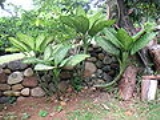
Dieffenbachia

Overview
Plant
Plants are living organisms belonging to the kingdom Plantae. Precise definitions of the kingdom vary, but as the term is used here, plants include familiar organisms such as trees, flowers, herbs, bushes, grasses, vines, ferns, mosses, and green algae. The group is also called green plants or...
s in the Family Araceae
Araceae
Araceae are a family of monocotyledonous flowering plants in which flowers are borne on a type of inflorescence called a spadix. The spadix is usually accompanied by, and sometimes partially enclosed in, a spathe or leaf-like bract. Also known as the Arum family, members are often colloquially...
noted for their patterned leaves
Leaves
-History:Vocalist Arnar Gudjonsson was formerly the guitarist with Mower, and he was joined by Hallur Hallsson , Arnar Ólafsson , Bjarni Grímsson , and Andri Ásgrímsson . Late in 2001 they played with Emiliana Torrini and drew early praise from the New York Times...
. Members of this genus
Genus
In biology, a genus is a low-level taxonomic rank used in the biological classification of living and fossil organisms, which is an example of definition by genus and differentia...
are popular as houseplant
Houseplant
A houseplant is a plant that is grown indoors in places such as residences and offices. Houseplants are commonly grown for decorative purposes, positive psychological effects, or health reasons such as indoor air purification...
s because of their tolerance for shade. The common name is "dumb cane" due to its poisoning effect on the throat due to raphides
Raphides
Raphides are needle-shaped crystals of calcium oxalate as the monohydrate or calcium carbonate as aragonite, found in more than 200 families of plants.Both ends are needle-like, but raphides tend to be more blunt at one end and more tapering at the other....
. The dieffenbachia was named by Heinrich Wilhelm Schott
Heinrich Wilhelm Schott
Heinrich Wilhelm Schott was an Austrian botanist well known for his extensive work on the aroids ....
, the director of the Botanical gardens in Vienna, to honor his head gardener Joseph Dieffenbach (1796–1863).
Dieffenbachia plants can grow outdoors in tropical climates, but specimens kept as houseplants must be kept indoors during most of the year outside the tropics.
