


Diane de Poitiers

Encyclopedia
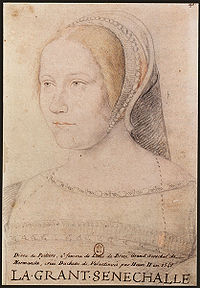
Diane de Poitiers was a French
noblewoman and a prominent courtier
at the courts of kings Francis I
and his son, Henry II of France
. She became notorious as the latter's favourite mistress
. It was in this capacity that she wielded much influence and power at the French Court, which continued until Henry was mortally wounded in a tournament
accident, during which his lance wore her favour (ribbon) rather than his wife's.
She was immortalized in art as the subject of paintings by François Clouet
as well as other anonymous painters.
and Jeanne de Batarnay in the Château de Saint-Vallier, in the town of Saint-Vallier, Drôme
, in the Rhône-Alpes
region of France. When still a girl, she was briefly in the retinue
of Anne de Beaujeu
, eldest sister of King Charles VIII
, a capable and highly intelligent woman who held the regency
of France during his minority.
Diane was educated according to the principles of Renaissance humanism
which was popular at the time, music, hunting, manners, languages, the art of conversation, and dancing. She learned how to read Latin and Greek, and became a keen hunter and sportswoman, remaining in good physical condition well into middle age.
At the age of fifteen, she married Louis de Brézé, seigneur d'Anet
, who was thirty-nine years her senior. He was a grandson of King Charles VII
who served as a courtier of King Francis I
. She bore him two daughters, Françoise de Brézé (1518–1574) and Louise de Brézé (1521–1577).
In 1524, her father was accused of treason
as an accomplice of the rebellious Connétable de Bourbon
. His head was already on the execution block when his life was spared by Francis I.
When Louis de Brézé died in 1531 in Anet, Diane adopted the habit of wearing the colours of black and white, her personal trademark for the rest of her life. These were among the permitted colours of mourning, which as a widow she was required to wear, but they were also the symbolic colours of the bright and dark sides of the moon. They played on her name, Diane, which derived from Diana
, the name of the beautiful Roman goddess of the moon.
Her keen interest in financial matters and legal shrewdness now became apparent for the first time. She retained her late husband's emoluments as governor and grand-sénéchal of Normandy
, assuming herself the title of "sénéchale de Normandie". She challenged in court the obligation to return Louis de Bézé's appanage
s to the royal domain
. The king allowed her to enjoy the appanage's income "until the status of those lands has been totally clarified."
When still the wife of Louis de Brézé, she became lady-in-waiting
to Queen Claude de France. After the queen died, she served in the same capacity to Louise de Savoie, then Éléonore de Habsburg.
 After the capture of Francis I by Charles V's troops during the battle of Pavia
(1525), the two eldest princes, François and Henri
, were retained as hostages in Spain in exchange for their father. Because the ransom was not paid in time, the two boys (eight and seven at the time) had to spend nearly four years isolated in a bleak castle, facing an uncertain future. Henri found solace by reading the knight-errant
ry tale Amadis de Gaula
. The experience may account for the strong impression that Diane made on him, as the very embodiment
of the ideal gentlewomen he read about in Amadis. As his mother was already dead, Diane gave him the farewell kiss when he was sent to Spain. When he was returned to France at the age of 12, she was ordered by Francis I to act as a mentor
to him and teach him courtly manners. At the tournament
held for the coronation
of Francis's new wife Eleanor in 1531, while the dauphin François saluted the new queen as expected, Henri addressed his salute to Diane.
In 1533 the future Henri II
married Catherine de' Medici
. There had been strong opposition to this alliance, the Medicis being no more than upstarts in the eyes of many in the French court. Diane, however, approved of this choice of bride. Diane and Catherine were actually related to one another, being both descendants of the La Tour d'Auvergne
family. Indeed, to Catherine, Diane was an intrusive elder cousin as well as a rival. As the future royal couple remained childless, concerned by rumours of a possible repudiation of a queen she had in control, Diane made sure that Henri's visits to his wife's bedroom would be frequent. In another act of preservation of the royal family, Diane helped nurse Catherine back to health when she contracted scarlet fever
. Diane was in charge of the education of her and Henri's children until 1551; her daughter Françoise managed the queen's servants. While Henri and Catherine would eventually produce 10 children together, and despite the occasional affair, Diane de Poitiers would remain Henri's lifelong companion, and for the next 25 years she would be the most powerful influence in his life. Based on allusions in their correspondence, it is generally believed that she became his mistress in 1538.
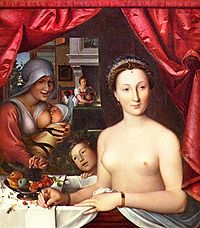 Remembered as a beautiful woman, she maintained her good looks well into her 50s, and her appearance was immortalized in art. Only two signed paintings by François Clouet
are known to exist, one being a painting of Diane. The subject of that painting shows her seated nude in her bath. She sat for other paintings of the time, often topless or nude, other times in traditional poses.
When Francis I was still alive, Diane had to compete at the court with Anne de Pisseleu, the king's favourite. She had the latter exile
d on her lands upon Francis I's death in 1547.
Diane possessed a sharp intellect and was so politically astute that King Henri II trusted her to write many of his official letters, and even to sign them jointly with the one name HenriDiane. Her confident maturity and loyalty to Henri II made her his most dependable ally in the court. Her position in the Court of the King was such that when Pope Paul III
sent the new Queen Catherine the "Golden Rose
", he did not forget to present the royal mistress Diane with a pearl necklace. Within a very short stretch of time she wielded considerable power within the realm. In 1548 she received the prestigious title of Duchess of Valentinois, then in 1553 was made Duchesse d'Étampes.
The king's adoration for Diane caused a great deal of jealousy on the part of Queen Catherine, particularly when Henri entrusted Diane with the Crown Jewels of France, had the Château d'Anet
built for her, and gave her the Château de Chenonceau
, a piece of royal property that Catherine had wanted for herself. However, as long as the king lived, the Queen was powerless to change this.
tournament
, Queen Catherine de' Medici assumed control, restricting access to him. Although the king was alleged to have called out repeatedly for Diane, she was never summoned or admitted, and on his death, she was also not invited to the funeral. Immediately thereafter, Catherine de' Medici banished Diane from Chenonceau to the Château de Chaumont
. She stayed there only a short time, and lived out her remaining years in her chateau in Anet
, Eure-et-Loir
, where she lived in comfortable obscurity.
She died at the age of sixty-six. In accordance with her wishes, and to provide a resting place for her, her daughter completed the funeral chapel built near the castle. During the French Revolution
, her tomb was opened and her remains thrown into a mass grave.
In 1866 Georges Guiffrey published her correspondence.
When French experts dug up the remains of Diane de Poitiers in 2009, they found high levels of gold in her hair. It is suggested that the "drinkable gold"
she regularly took — believed to preserve youth — may have ultimately killed her.
Novels:
Biography:
Films:
French people
The French are a nation that share a common French culture and speak the French language as a mother tongue. Historically, the French population are descended from peoples of Celtic, Latin and Germanic origin, and are today a mixture of several ethnic groups...
noblewoman and a prominent courtier
Courtier
A courtier is a person who is often in attendance at the court of a king or other royal personage. Historically the court was the centre of government as well as the residence of the monarch, and social and political life were often completely mixed together...
at the courts of kings Francis I
Francis I of France
Francis I was King of France from 1515 until his death. During his reign, huge cultural changes took place in France and he has been called France's original Renaissance monarch...
and his son, Henry II of France
Henry II of France
Henry II was King of France from 31 March 1547 until his death in 1559.-Early years:Henry was born in the royal Château de Saint-Germain-en-Laye, near Paris, the son of Francis I and Claude, Duchess of Brittany .His father was captured at the Battle of Pavia in 1525 by his sworn enemy,...
. She became notorious as the latter's favourite mistress
Mistress (lover)
A mistress is a long-term female lover and companion who is not married to her partner; the term is used especially when her partner is married. The relationship generally is stable and at least semi-permanent; however, the couple does not live together openly. Also the relationship is usually,...
. It was in this capacity that she wielded much influence and power at the French Court, which continued until Henry was mortally wounded in a tournament
Tournament
A tournament is a competition involving a relatively large number of competitors, all participating in a sport or game. More specifically, the term may be used in either of two overlapping senses:...
accident, during which his lance wore her favour (ribbon) rather than his wife's.
She was immortalized in art as the subject of paintings by François Clouet
François Clouet
François Clouet , son of Jean Clouet, was a French Renaissance miniaturist and painter, particularly known for his detailed portraits of the French ruling family.-Historical references:Clouet was born in Tours....
as well as other anonymous painters.
Early Life and Marriage
She was born the daughter of Jean de Poitiers, Seigneur de Saint VallierJean de Poitiers, Seigneur de Saint Vallier
Jean de Poitiers, Seigneur de Saint Vallier was a French nobleman best known as the father of Diane de Poitiers.He was the son of Aymar de Poitiers and Jeanne de La Tour d'Auvergne....
and Jeanne de Batarnay in the Château de Saint-Vallier, in the town of Saint-Vallier, Drôme
Saint-Vallier, Drôme
Saint-Vallier is a commune in the Drôme department in southeastern France.-Geography:The Galaure flows northwest through the southern part of the commune, crosses the town, then flows into the Rhone, which forms the commune's western border.-Population:...
, in the Rhône-Alpes
Rhône-Alpes
Rhône-Alpes is one of the 27 regions of France, located on the eastern border of the country, towards the south. The region was named after the Rhône River and the Alps mountain range. Its capital, Lyon, is the second-largest metropolitan area in France after Paris...
region of France. When still a girl, she was briefly in the retinue
Retinue
A retinue is a body of persons "retained" in the service of a noble or royal personage, a suite of "retainers".-Etymology:...
of Anne de Beaujeu
Anne of France
Anne of France was the eldest daughter of Louis XI of France and his second wife, Charlotte of Savoy. Anne was the sister of King Charles VIII of France, for whom she acted as regent during his minority; and of Joan of France, who was briefly queen consort to Louis XII...
, eldest sister of King Charles VIII
Charles VIII of France
Charles VIII, called the Affable, , was King of France from 1483 to his death in 1498. Charles was a member of the House of Valois...
, a capable and highly intelligent woman who held the regency
Regent
A regent, from the Latin regens "one who reigns", is a person selected to act as head of state because the ruler is a minor, not present, or debilitated. Currently there are only two ruling Regencies in the world, sovereign Liechtenstein and the Malaysian constitutive state of Terengganu...
of France during his minority.
Diane was educated according to the principles of Renaissance humanism
Renaissance humanism
Renaissance humanism was an activity of cultural and educational reform engaged by scholars, writers, and civic leaders who are today known as Renaissance humanists. It developed during the fourteenth and the beginning of the fifteenth centuries, and was a response to the challenge of Mediæval...
which was popular at the time, music, hunting, manners, languages, the art of conversation, and dancing. She learned how to read Latin and Greek, and became a keen hunter and sportswoman, remaining in good physical condition well into middle age.
At the age of fifteen, she married Louis de Brézé, seigneur d'Anet
Louis de Brézé, seigneur d'Anet
Louis de Brézé, seigneur d'Anet and comte de Maulevrier was a French nobleman, the grandson of King Charles VII of France by his natural daughter with his mistress Agnès Sorel.- Birthright, marriage, political intrigues :...
, who was thirty-nine years her senior. He was a grandson of King Charles VII
Charles VII of France
Charles VII , called the Victorious or the Well-Served , was King of France from 1422 to his death, though he was initially opposed by Henry VI of England, whose Regent, the Duke of Bedford, ruled much of France including the capital, Paris...
who served as a courtier of King Francis I
Francis I of France
Francis I was King of France from 1515 until his death. During his reign, huge cultural changes took place in France and he has been called France's original Renaissance monarch...
. She bore him two daughters, Françoise de Brézé (1518–1574) and Louise de Brézé (1521–1577).
In 1524, her father was accused of treason
Treason
In law, treason is the crime that covers some of the more extreme acts against one's sovereign or nation. Historically, treason also covered the murder of specific social superiors, such as the murder of a husband by his wife. Treason against the king was known as high treason and treason against a...
as an accomplice of the rebellious Connétable de Bourbon
Charles III, Duke of Bourbon
Charles III, Duke of Bourbon was a French military leader, the Count of Montpensier and Dauphin of Auvergne. He commanded the Imperial troops of Holy Roman Emperor Charles V in what became known as the Sack of Rome in 1527, where he was killed.-Biography:Charles was born at Montpensier...
. His head was already on the execution block when his life was spared by Francis I.
When Louis de Brézé died in 1531 in Anet, Diane adopted the habit of wearing the colours of black and white, her personal trademark for the rest of her life. These were among the permitted colours of mourning, which as a widow she was required to wear, but they were also the symbolic colours of the bright and dark sides of the moon. They played on her name, Diane, which derived from Diana
Diana (mythology)
In Roman mythology, Diana was the goddess of the hunt and moon and birthing, being associated with wild animals and woodland, and having the power to talk to and control animals. She was equated with the Greek goddess Artemis, though she had an independent origin in Italy...
, the name of the beautiful Roman goddess of the moon.
Her keen interest in financial matters and legal shrewdness now became apparent for the first time. She retained her late husband's emoluments as governor and grand-sénéchal of Normandy
Normandy
Normandy is a geographical region corresponding to the former Duchy of Normandy. It is in France.The continental territory covers 30,627 km² and forms the preponderant part of Normandy and roughly 5% of the territory of France. It is divided for administrative purposes into two régions:...
, assuming herself the title of "sénéchale de Normandie". She challenged in court the obligation to return Louis de Bézé's appanage
Appanage
An apanage or appanage or is the grant of an estate, titles, offices, or other things of value to the younger male children of a sovereign, who would otherwise have no inheritance under the system of primogeniture...
s to the royal domain
Crown lands of France
The crown lands, crown estate, royal domain or domaine royal of France refers to the lands, fiefs and rights directly possessed by the kings of France...
. The king allowed her to enjoy the appanage's income "until the status of those lands has been totally clarified."
When still the wife of Louis de Brézé, she became lady-in-waiting
Lady-in-waiting
A lady-in-waiting is a female personal assistant at a royal court, attending on a queen, a princess, or a high-ranking noblewoman. Historically, in Europe a lady-in-waiting was often a noblewoman from a family highly thought of in good society, but was of lower rank than the woman on whom she...
to Queen Claude de France. After the queen died, she served in the same capacity to Louise de Savoie, then Éléonore de Habsburg.
Life as a Royal Favourite
Battle of Pavia
The Battle of Pavia, fought on the morning of 24 February 1525, was the decisive engagement of the Italian War of 1521–26.A Spanish-Imperial army under the nominal command of Charles de Lannoy attacked the French army under the personal command of Francis I of France in the great hunting preserve...
(1525), the two eldest princes, François and Henri
Henry II of France
Henry II was King of France from 31 March 1547 until his death in 1559.-Early years:Henry was born in the royal Château de Saint-Germain-en-Laye, near Paris, the son of Francis I and Claude, Duchess of Brittany .His father was captured at the Battle of Pavia in 1525 by his sworn enemy,...
, were retained as hostages in Spain in exchange for their father. Because the ransom was not paid in time, the two boys (eight and seven at the time) had to spend nearly four years isolated in a bleak castle, facing an uncertain future. Henri found solace by reading the knight-errant
Knight-errant
A knight-errant is a figure of medieval chivalric romance literature. "Errant," meaning wandering or roving, indicates how the knight-errant would typically wander the land in search of adventures to prove himself as a knight, such as in a pas d'armes.The first known appearance of the term...
ry tale Amadis de Gaula
Amadis de Gaula
Amadis de Gaula is a landmark work among the knight-errantry tales which were in vogue in 16th century Iberian Peninsula, and formed the earliest reading of many Renaissance and Baroque writers, although it was written at the onset of the 14th century.The first known printed edition was published...
. The experience may account for the strong impression that Diane made on him, as the very embodiment
Embodiment
Embodied or embodiment may refer to:in psychology and philosophy,*Embodied cognition , a position in cognitive science and the philosophy of mind emphasizing the role that the body plays in shaping the mind...
of the ideal gentlewomen he read about in Amadis. As his mother was already dead, Diane gave him the farewell kiss when he was sent to Spain. When he was returned to France at the age of 12, she was ordered by Francis I to act as a mentor
Mentor
In Greek mythology, Mentor was the son of Alcimus or Anchialus. In his old age Mentor was a friend of Odysseus who placed Mentor and Odysseus' foster-brother Eumaeus in charge of his son Telemachus, and of Odysseus' palace, when Odysseus left for the Trojan War.When Athena visited Telemachus she...
to him and teach him courtly manners. At the tournament
Tournament
A tournament is a competition involving a relatively large number of competitors, all participating in a sport or game. More specifically, the term may be used in either of two overlapping senses:...
held for the coronation
Coronation
A coronation is a ceremony marking the formal investiture of a monarch and/or their consort with regal power, usually involving the placement of a crown upon their head and the presentation of other items of regalia...
of Francis's new wife Eleanor in 1531, while the dauphin François saluted the new queen as expected, Henri addressed his salute to Diane.
In 1533 the future Henri II
Henry II of France
Henry II was King of France from 31 March 1547 until his death in 1559.-Early years:Henry was born in the royal Château de Saint-Germain-en-Laye, near Paris, the son of Francis I and Claude, Duchess of Brittany .His father was captured at the Battle of Pavia in 1525 by his sworn enemy,...
married Catherine de' Medici
Catherine de' Medici
Catherine de' Medici was an Italian noblewoman who was Queen consort of France from 1547 until 1559, as the wife of King Henry II of France....
. There had been strong opposition to this alliance, the Medicis being no more than upstarts in the eyes of many in the French court. Diane, however, approved of this choice of bride. Diane and Catherine were actually related to one another, being both descendants of the La Tour d'Auvergne
Madeleine de la Tour d'Auvergne
Madeleine de La Tour d'Auvergne was a younger daughter of Jean III de La Tour , Count of Auvergne and Lauraguais, and Jeanne de Bourbon-Vendôme . She was a penultimate representative of the senior branch of the house de La Tour d'Auvergne...
family. Indeed, to Catherine, Diane was an intrusive elder cousin as well as a rival. As the future royal couple remained childless, concerned by rumours of a possible repudiation of a queen she had in control, Diane made sure that Henri's visits to his wife's bedroom would be frequent. In another act of preservation of the royal family, Diane helped nurse Catherine back to health when she contracted scarlet fever
Scarlet fever
Scarlet fever is a disease caused by exotoxin released by Streptococcus pyogenes. Once a major cause of death, it is now effectively treated with antibiotics...
. Diane was in charge of the education of her and Henri's children until 1551; her daughter Françoise managed the queen's servants. While Henri and Catherine would eventually produce 10 children together, and despite the occasional affair, Diane de Poitiers would remain Henri's lifelong companion, and for the next 25 years she would be the most powerful influence in his life. Based on allusions in their correspondence, it is generally believed that she became his mistress in 1538.
François Clouet
François Clouet , son of Jean Clouet, was a French Renaissance miniaturist and painter, particularly known for his detailed portraits of the French ruling family.-Historical references:Clouet was born in Tours....
are known to exist, one being a painting of Diane. The subject of that painting shows her seated nude in her bath. She sat for other paintings of the time, often topless or nude, other times in traditional poses.
When Francis I was still alive, Diane had to compete at the court with Anne de Pisseleu, the king's favourite. She had the latter exile
Exile
Exile means to be away from one's home , while either being explicitly refused permission to return and/or being threatened with imprisonment or death upon return...
d on her lands upon Francis I's death in 1547.
Diane possessed a sharp intellect and was so politically astute that King Henri II trusted her to write many of his official letters, and even to sign them jointly with the one name HenriDiane. Her confident maturity and loyalty to Henri II made her his most dependable ally in the court. Her position in the Court of the King was such that when Pope Paul III
Pope Paul III
Pope Paul III , born Alessandro Farnese, was Pope of the Roman Catholic Church from 1534 to his death in 1549. He came to the papal throne in an era following the sack of Rome in 1527 and rife with uncertainties in the Catholic Church following the Protestant Reformation...
sent the new Queen Catherine the "Golden Rose
Golden Rose
The Golden Rose is a gold ornament, which popes of the Catholic Church have traditionally blessed annually. It is occasionally conferred as a token of reverence or affection...
", he did not forget to present the royal mistress Diane with a pearl necklace. Within a very short stretch of time she wielded considerable power within the realm. In 1548 she received the prestigious title of Duchess of Valentinois, then in 1553 was made Duchesse d'Étampes.
The king's adoration for Diane caused a great deal of jealousy on the part of Queen Catherine, particularly when Henri entrusted Diane with the Crown Jewels of France, had the Château d'Anet
Château d'Anet
The Château d'Anet is a château near Dreux, France, built by Philibert de l'Orme from 1547 to 1552 for Diane de Poitiers, the mistress of Henry II of France...
built for her, and gave her the Château de Chenonceau
Château de Chenonceau
The Château de Chenonceau is a manor house near the small village of Chenonceaux, in the Indre-et-Loire département of the Loire Valley in France. It was built on the site of an old mill on the River Cher, sometime before its first mention in writing in the 11th century...
, a piece of royal property that Catherine had wanted for herself. However, as long as the king lived, the Queen was powerless to change this.
Henry's Death and her Downfall
Despite wielding such power over the king, Diane's status depended on the king's welfare, and his remaining in power. In 1559, when Henri was critically wounded in a joustingJousting
Jousting is a martial game or hastilude between two knights mounted on horses and using lances, often as part of a tournament.Jousting emerged in the High Middle Ages based on the military use of the lance by heavy cavalry. The first camels tournament was staged in 1066, but jousting itself did not...
tournament
Tournament (medieval)
A tournament, or tourney is the name popularly given to chivalrous competitions or mock fights of the Middle Ages and Renaissance . It is one of various types of hastiludes....
, Queen Catherine de' Medici assumed control, restricting access to him. Although the king was alleged to have called out repeatedly for Diane, she was never summoned or admitted, and on his death, she was also not invited to the funeral. Immediately thereafter, Catherine de' Medici banished Diane from Chenonceau to the Château de Chaumont
Château de Chaumont
The Château de Chaumont is a French castle at Chaumont-sur-Loire, Loir-et-Cher, France.The first château-fort on this site between Blois and Amboise was a primitive fortress built by Eudes II, Count of Blois, in the 10th century with the purpose of protecting Blois from attacks from his feudal...
. She stayed there only a short time, and lived out her remaining years in her chateau in Anet
Anet
Anet is a commune in the Eure-et-Loir department in northern France. It is situated between the rivers Eure and Vègre, northeast of Dreux by rail....
, Eure-et-Loir
Eure-et-Loir
Eure-et-Loir is a French department, named after the Eure and Loir rivers.-History:Eure-et-Loir is one of the original 83 departments created during the French Revolution on March 4, 1790 pursuant to the Act of December 22, 1789...
, where she lived in comfortable obscurity.
She died at the age of sixty-six. In accordance with her wishes, and to provide a resting place for her, her daughter completed the funeral chapel built near the castle. During the French Revolution
French Revolution
The French Revolution , sometimes distinguished as the 'Great French Revolution' , was a period of radical social and political upheaval in France and Europe. The absolute monarchy that had ruled France for centuries collapsed in three years...
, her tomb was opened and her remains thrown into a mass grave.
In 1866 Georges Guiffrey published her correspondence.
When French experts dug up the remains of Diane de Poitiers in 2009, they found high levels of gold in her hair. It is suggested that the "drinkable gold"
Elixir of life
The elixir of life, also known as the elixir of immortality and sometimes equated with the philosopher's stone, is a legendary potion, or drink, that grants the drinker eternal life and or eternal youth. Many practitioners of alchemy pursued it. The elixir of life was also said to be able to create...
she regularly took — believed to preserve youth — may have ultimately killed her.
In Fiction and Film
Diane de Poitiers has appeared in many novels and films.Novels:
- The Two DianasThe Two DianasThe Two Dianas is a novel by Alexandre Dumas, père. It tells the fictionalized story of Gabriel, comte de Montgomery, who mortally wounded king Henry II of France. The two Dianas in the title refer to Henry II's favorite, Diana de Poitiers, and her daughter, Diana de Castro. The novel also...
, Alexandre Dumas, pèreAlexandre Dumas, pèreAlexandre Dumas, , born Dumas Davy de la Pailleterie was a French writer, best known for his historical novels of high adventure which have made him one of the most widely read French authors in the world...
. - Courtesan, Diane Haeger.
- La Princesse de ClèvesLa Princesse de ClèvesLa Princesse de Clèves is a French novel which was published anonymously in March 1678. It is regarded by many as the beginning of the modern tradition of the psychological novel, and as a great classic work. Its author is generally held to be Madame de La Fayette.The action takes place between...
, Madame de La Fayette. - The Devil's Queen: A Novel of Catherine de Medici, Jeanne Kalogridis.
- Queen's Play and Checkmate, Dorothy DunnettDorothy DunnettDorothy Dunnett OBE was a Scottish historical novelist. She is best known for her six-part series about Francis Crawford of Lymond, The Lymond Chronicles, which she followed with the eight-part prequel The House of Niccolò...
.
Biography:
- The Serpent and the Moon, Princess Michael of KentPrincess Michael of KentPrincess Michael of Kent is an Austrian-Hungarian member of the British Royal Family. She is married to Prince Michael of Kent, who is a grandson of King George V....
.
Films:
- DianeDiane (film)Diane is a 1956 American historical film drama about the life of Diane de Poitiers, produced by MGM. It was directed by David Miller and produced by Edwin H. Knopf from a screenplay by Christopher Isherwood based on a story by John Erskine. The music score was composed by Miklós Rózsa, Robert H....
(1956), played by Lana TurnerLana TurnerLana Turner was an American actress.Discovered and signed to a film contract by MGM at the age of sixteen, Turner first attracted attention in They Won't Forget . She played featured roles, often as the ingenue, in such films as Love Finds Andy Hardy...
. - NostradamusNostradamus (film)Nostradamus is a 1994 biographical film directed by Roger Christian.-Cast:*Tchéky Karyo ... Nostradamus*F. Murray Abraham ... Scalinger*Rutger Hauer ... The Mystic Monk*Amanda Plummer ... Catherine De Medici*Julia Ormond ... Marie...
(1994), played by Diane Quick.
Books
- The Serpent and the Moon: Two Rivals for the Love of a Renaissance King, by Princess Michael of KentPrincess Michael of KentPrincess Michael of Kent is an Austrian-Hungarian member of the British Royal Family. She is married to Prince Michael of Kent, who is a grandson of King George V....
- Diane de Poitiers, by Ivan Cloulas
- Courtesan, by Diane Haeger (fictional)
- Diane de Poitiers, by Barbara CartlandBarbara CartlandDame Barbara Hamilton Cartland, DBE, CStJ , was an English author, one of the most prolific authors of the 20th century...
(N.B. Despite this being by Barbara Cartland, it is not a work of fiction.) - Madame Serpent, by Jean Plaidy
- The Devil's Queen: A Novel of Catherine de Medici by Jeanne KalogridisJeanne KalogridisJeanne Kalogridis , also known by the pseudonym J.M. Dillard is an Greek-American writer of historical and horror fiction.She was born in Florida and studied at the University of South Florida, earning first a BA in Russian and then an MA in Linguistics...