

Dhar

Encyclopedia
- This article Dhar, the Indian city. For the Kashmiri caste, see Dhar (surname).
Dhār (Hindi
Hindi
Standard Hindi, or more precisely Modern Standard Hindi, also known as Manak Hindi , High Hindi, Nagari Hindi, and Literary Hindi, is a standardized and sanskritized register of the Hindustani language derived from the Khariboli dialect of Delhi...
/Marathi
Marathi language
Marathi is an Indo-Aryan language spoken by the Marathi people of western and central India. It is the official language of the state of Maharashtra. There are over 68 million fluent speakers worldwide. Marathi has the fourth largest number of native speakers in India and is the fifteenth most...
: धार) is located in the Malwa region of western Madhya Pradesh
Madhya Pradesh
Madhya Pradesh , often called the Heart of India, is a state in central India. Its capital is Bhopal and Indore is the largest city....
state
States and territories of India
India is a federal union of states comprising twenty-eight states and seven union territories. The states and territories are further subdivided into districts and so on.-List of states and territories:...
in central India
India
India , officially the Republic of India , is a country in South Asia. It is the seventh-largest country by geographical area, the second-most populous country with over 1.2 billion people, and the most populous democracy in the world...
. It is the administrative headquarters of Dhar District
Dhar District
Dhar district is a district of Madhya Pradesh state in central India. The historic town of Dhar is administrative headquarters of the district....
. The town is located 33 miles (53.1 km) west of Mhow, 908 ft (276.8 m) above sea level. It is picturesquely situated among lakes and trees surrounded by barren hills, and possesses, besides its old ramparts, many interesting buildings, both Hindu
Hindu
Hindu refers to an identity associated with the philosophical, religious and cultural systems that are indigenous to the Indian subcontinent. As used in the Constitution of India, the word "Hindu" is also attributed to all persons professing any Indian religion...
and Muslim
Muslim
A Muslim, also spelled Moslem, is an adherent of Islam, a monotheistic, Abrahamic religion based on the Quran, which Muslims consider the verbatim word of God as revealed to prophet Muhammad. "Muslim" is the Arabic term for "submitter" .Muslims believe that God is one and incomparable...
, some of them containing records of cultural and historical importance.
Amusement and Festivals
Dhar district has been on the cultural map of India since time immemorial. People used to engage themselves in fine arts such as painting, sculpture, music, dancing, etc.Many of the Bagh cave paintings of the Gupta period have now been destroyed but whatever remain tell us about the high attainment during that period. There is a beautiful painting regarding music and dance, which is an example of the oriental Hallisak dance. The depiction of nature in its affluent forms, together with male and female figures in various emotional poses is the treasure of these caves. The construction of magnificent buildings, forts, temples, mosques, etc., during the medieval period at Dhar, Mandu and the surroundings indicate the engagements and amusements of the people of those days.
Young people even today draw inspiration from the famous love story of Baaz-Bahadur and Roopmati. In literature, music, dance, painting and sculpture Dhar has a very rich heritage.
During the middle of the 16th century, the science of music had attained considerable perfection in Malwa and it is said that Baaz Bahadur devoted himself to its cultivation and encouragement. His attachment to Rani Roopmati at that time become famous and the "Loves of Baaz Bahadur and Roopmati " have been handed down to posterity in song.
In rural areas, community bhajan singing at the village chaupals in the night with the accompaniment of harmonium (peti) mridang, tabala, dholak-manjire, mandal, zanch, kundi, thali, payli and dhak is the most common amusement.
Vasant Pnchmi, Maha Shivaratri, Holi, Ramnavmi, Raksha-Bandhan, Nag-Panchmi, Janmashtami, Ganesh Chaturthi, Anant Chaturdashi, Sarva Pitri Amavsya, dusshera, Deepawali, Dol Gyaras, Hanuman Jayanti, etc., are celebrated with great religious zeal and enthusiasm by the Hindus Shradha Paksha (fortnight) is celebrated from poornima of Bhadra to amavasya Kunwar.
Popular festivals of Muslims include muharram, Id, Miladunabi, etc., which they celebrate with their traditional gaiety.
Christians celebrate Christmas and Good Friday and Jains, Mahavir Jayanti and Paryooshan etc. In some castes, Radeoji and Tejaji are worshipped once in a year on their jayantis and their respective kathas are performed. The dates of celebration are different in the various tahsils.
Pilgrim Centres and Jatras
There are many religious places scattered throughout the district where people congregate at annual fairs arranged on auspicious occasions.Dhar district
District
Districts are a type of administrative division, in some countries managed by a local government. They vary greatly in size, spanning entire regions or counties, several municipalities, or subdivisions of municipalities.-Austria:...
has 5 tahsils inclucing Dhar itself, namely Badnawar
Badnawar
Badnawar is a town and a Nagar Panchayat of the Dhar district in the state of Madhya Pradesh, India.-Geography:Badnawar is located at . It has an average elevation of 506 metres .-Demographics:...
, Sardarpur
Sardarpur
Sardarpur is a town and a nagar panchayat in Dhar district in the Indian state of Madhya Pradesh. It is a town on Mahi river on the Malwa plateau.-History:...
, Dhar, Dharampuri
Dharampuri
Dharampuri is a town and a nagar panchayat in Dhar district in the state of Madhya Pradesh, India.-Geography:Dharampuri is located at . It has an average elevation of 139 metres .-History:...
and Manawar
Manawar
Manawar is a city and a municipality in Dhar district in the Indian state of Madhya Pradesh.-Geography:Manawar is located at .It has an average elevation of 180 metres ....
.
Koteshwar, Khakrol and Badnawar
Badnawar
Badnawar is a town and a Nagar Panchayat of the Dhar district in the state of Madhya Pradesh, India.-Geography:Badnawar is located at . It has an average elevation of 506 metres .-Demographics:...
are located in Badnawar
Badnawar
Badnawar is a town and a Nagar Panchayat of the Dhar district in the state of Madhya Pradesh, India.-Geography:Badnawar is located at . It has an average elevation of 506 metres .-Demographics:...
tahsil; Bhopawar, Sagwal and Amjhera are located in Sardarpur
Sardarpur
Sardarpur is a town and a nagar panchayat in Dhar district in the Indian state of Madhya Pradesh. It is a town on Mahi river on the Malwa plateau.-History:...
tahsil; Mandu
Mandu
Mandu or Mandavgad is a ruined city in the Dhar district in the Malwa region of western Madhya Pradesh state, central India. The distance between Dhar & Mandu is about 35 km. In the 11th century, Mandu was the sub division of the Tarangagadh or Taranga kingdom...
, Kesur Dhar and Sagor are located in Dhar tahsil; Lingwa and Kotda in Kukshi
Kukshi
Kukshi is a town and a nagar panchayat in Dhar district in the southwestern Madhya Pradesh state in central India. It is the administrative headquarters of Kukshi tehsil of the district.-Geography:...
tahsil, Dhamnod
Dhamnod
Dhamnod is a town and a nagar panchayat in Dhar district in the state of Madhya Pradesh, India.-Geography:Dhamnod is located at . It has an average elevation of 163 metres .-Demographics:...
in Dharampuri
Dharampuri
Dharampuri is a town and a nagar panchayat in Dhar district in the state of Madhya Pradesh, India.-Geography:Dharampuri is located at . It has an average elevation of 139 metres .-History:...
tahsil, Manawar
Manawar
Manawar is a city and a municipality in Dhar district in the Indian state of Madhya Pradesh.-Geography:Manawar is located at .It has an average elevation of 180 metres ....
, Bakaner and Singhana
Singhana
Singhana is a small town located in Jhunjhunu district of Rajasthan in India. It is located near Khetri Copper Limited, a government-owned company in copper production. Singhana is hometown of Singhania Family. Singhana is situated near a beautiful hill, it has good transport facilities buses are...
in Manawar
Manawar
Manawar is a city and a municipality in Dhar district in the Indian state of Madhya Pradesh.-Geography:Manawar is located at .It has an average elevation of 180 metres ....
tahsil, are a few out of a total about 40 such pilgrim centres.
Hanuman jayanti and Shivratri respectively attract thousands of pilgrims from the interiors of the District and outside, to the places of worship where special worship is offered to the concerned deities.
Gal and Hazrat Biyabani Yatra, Shantinathji ka Mela, Tejaji ka Mela, Ambikaji ka Mela, Urs Kamal-ud-din and Gular Shah Urs attract thousands of followers.
Mother goddess in various forms is worshipped with special reverence. Ambika Devi (Dhar and Dhammod) Mangala Devi (Manawar) Shitalamata Devi (Bakaner) Harsiddhi Mata (Singhana) and Jagni Mata (Jhiriya pura), are a few examples.
Mandu is the place where Jehangir came and stayed with Nur Jehan. He was accompanied by Sir Thomas Roe, the English ambassador. Jehangir wrote "I know of no place so pleasant in climate and so pretty in scenery as Manu in the rainy season. Shah Jahan too spent the rainy season of the year 1622 in Mandu. The famous Ram Navami fair is organised here by the mahant of the temple on Chaitra Sudi (March/April), in which thousands of people participate.
Historic Places and Monuments
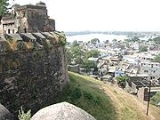
Ramparts and Circular City. The most ancient parts of Dhār presently visible are the massive earthen ramparts which are best preserved on the western and southern sides of the town. These were probably built beginning in the ninth century and show that the city was circular in plan and surrounded by a series of tanks and moats. The layout is similar to the circular city of WarangalWarangal
Warangal is a city and a municipal corporation in Warangal district in the Indian state of Andhra Pradesh. Warangal is located northeast of the state capital of Hyderabad and is the administrative headquarters of Warangal District. This district is a combination of three cities: Warangal,...
in the Deccan. The circular ramparts of Dhār, unique in north India and an important legacy of the Paramāras, is being rapidly destroyed by brick-makers and others using the material for construction purposes. On the north-east side of the town, the rampart and moat have disappeared beneath modern homes and other buildings.
Muhammad bin Tughluq
Muhammad bin Tughluq was the Turkic Sultan of Delhi from 1325 to 1351. He was the eldest son of Ghiyas-ud-din Tughlaq.He was born in Kotla Tolay Khan in Multan. His wife was daughter of the raja of Dipalpur...
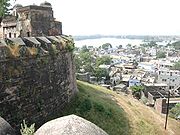
, the Sultan of Delhi, probably on the site of the ancient Dhārāgiri mentioned in early sources. One of the gateways, added at a later time, dates to 1684-85 in the time of 'Ālamgīr. Inside the fort is a deep rock-cut cistern, of great age, and a later palace of the Mahārāja of Dhār incorporating an elegant pillared porch of the Mughal period that probably belongs to the mid-seventeenth century. In the palace area is an outdoor museum with a small collection of temple fragments and images dating to medieval times.
Tomb of Shaykh Changāl. On the over-grown ramparts of the medieval city, overlooking the old moat, is the tomb of Shaykh ‘Abdullah Shāh Changāl, a warrior saint. He perhaps hailed from Changal
Changal
Changal is a village in north-west Tajikistan. It is located in Panjakent District in Sughd province. Changal is a western suburb of Panjakent and is located on the Zeravshan River. It is a border settlement with Uzbekistan and lies on the road from Panjakent to Samarkand.The economy is based on...
in central Asia. The tomb has been rebuilt, but the inscription, now incorporated into the compound gate, is written in Persian and dated 1455. A record of historical interest, it recounts the Shaykh's arrival in Dhār in the 13th century and his conversion of Bhoja to Islām after the local people had committed an atrocity against the small community of Muslims who had settled in the city. The story probably refers to Bhoja II, the last Paramāra king who ruled around 1285.
Nizamuddin Auliya
Sultan-ul-Mashaikh, Mehboob-e-Ilahi, Hazrat Shaikh Khwaja Syed Muhammad Nizamuddin Auliya , also known as Hazrat Nizamuddin, was a famous Sufi saint of the Chishti Order in the Indian Subcontinent, an order that believed in drawing close to God through renunciation of the world and service to...
(1238–1325). Some details about Kamāl al-Dīn are recorded in Muḥammad Ghauthi's Azkar-i Abrar, a reliable hagiography of Sufi saints composed in 1613. The cloak presented to Kamāl al-Dīn by Nizam al-Dīn is still displayed inside the tomb. The custodians of Kamāl al-Dīn’s tomb have served in an unbroken lineage for 700 years and are still resident.
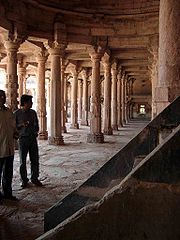
Bhoj Shala. The mosque next the tomb is made of re-cycled temple columns and other architectural parts except for the Mihrab
Mihrab
A mihrab is semicircular niche in the wall of a mosque that indicates the qibla; that is, the direction of the Kaaba in Mecca and hence the direction that Muslims should face when praying...
and Minbar
Minbar
A minbar is a pulpit in the mosque where the imam stands to deliver sermons or in the Hussainia where the speaker sits and lectures the congregation...
which were purpose-built for the monument. It is similar to the Lāṭ Masjid though earlier in date as an inscription of A.H. 795/C.E. 1392 found nearby records repairs by Dilāwar Khān. A Sanskrit and Prakrit inscription from the time of Arjunavarman (circa 1210-15) was found in the walls of the building in 1903 by K. K. Lele, Superintendent of Education in the Princely State of Dhār. The inscription, which is engraved with exceptional beauty, is displayed inside the entrance. The text includes part of a drama called Vijayaśrīnāṭikā composed by Madana, the king's preceptor who also bore the title 'Bālasarasvatī'. The other inscribed tablets recovered by Lele, among them a serpentine inscription giving grammatical rules of the Sanskrit
Sanskrit
Sanskrit , is a historical Indo-Aryan language and the primary liturgical language of Hinduism, Jainism and Buddhism.Buddhism: besides Pali, see Buddhist Hybrid Sanskrit Today, it is listed as one of the 22 scheduled languages of India and is an official language of the state of Uttarakhand...
language. The finds, particularly of the grammatical inscription, prompted Lele to describe the building as the Bhoj Shala
Bhoj Shala
The Bhojaśālā or 'Hall of Bhoja' is a term used to describe the centre for Sanskrit studies and temple of Sarasvatī, the goddess of learning associated with king Bhoja, the most celebrated ruler of the Paramāra dynasty in central India...
or 'Hall of Bhoja', because King Bhoja (circa 1000-55) was the author of a number of works on poetics and grammar, among them the Sarasvatīkaṇṭhābharaṇa or 'Necklace of Sarasvatī'. The term 'Bhoj Shala' was first published by Luard in 1908. The subsequent controversy surrounding the building and its identity is discussed under Bhoj Shala
Bhoj Shala
The Bhojaśālā or 'Hall of Bhoja' is a term used to describe the centre for Sanskrit studies and temple of Sarasvatī, the goddess of learning associated with king Bhoja, the most celebrated ruler of the Paramāra dynasty in central India...
.
Cenotaphs and Old City Palace. The old city palace of the Pawar Marathas at Dhār, now used as a school, is a modest building put up in the late 19th century. A marble statue of the Jain goddess Ambikā, found in 1875 on the site of the city palace is now in the British Museum
British Museum
The British Museum is a museum of human history and culture in London. Its collections, which number more than seven million objects, are amongst the largest and most comprehensive in the world and originate from all continents, illustrating and documenting the story of human culture from its...
. Of the same period as the palace are a collection of domed cenotaphs of the Pawar rulers on the edge of the large tank known as Muñj Talab. The name of the tank probably derives from Vākpati Muñja (circa 895-920), the Paramāra king who first entered Mālwa and made Ujjain his main seat.
Museum. A number of sculptures and antiquities from Dhār and its neighborhood are kept in the local museum, a utilitarian stone building in the British style of the late 19th century. The most important pieces from the collection have been moved to Mandu
Mandu
Mandu or Mandavgad is a ruined city in the Dhar district in the Malwa region of western Madhya Pradesh state, central India. The distance between Dhar & Mandu is about 35 km. In the 11th century, Mandu was the sub division of the Tarangagadh or Taranga kingdom...
where the Department of Archaeology, Museums and Archives has created a new museum with a wide range of displays.
Jheera Bagh. Outside the town, off the road to Māṇḍū, the Pawars built a palace at Hazīra Bāgh from the 1860s. Known as the Jheera Bāgh Palace and presently run as a heritage hotel, the complex was renovated by Mahārāja Anand Rao Pawar IV in the 1940s. Graciously designed in an unpretentious art deco style, it is one of the most elegant and forward-looking examples of early modern architecture in north India.
Political History
The town of Dhār, the name of which is usually derived from Dhārā Nagara ('city of sword blades'), is of considerable antiquity, the first reference to it appearing from JaunpurJaunpur, Uttar Pradesh
Jaunpur is a city and a municipal board in Jaunpur district in the Indian state of Uttar Pradesh.Jaunpur district is located to the northwest of the district of Varanasi in the eastern part of the North Indian state of Uttar Pradesh. According to the 2001 census, Jaunpur district had a population...
of the Maukhari
Maukhari
The Maukhari Dynasty, classically called the Megar Dynasty, was a royal Indian dynasty that controlled vast areas of Northern India for over six generations. They earlier served as vassals of the Guptas as well as related to Harsha and his short-lived Vardhan dynasty. The Maukhari's established...
dynasty. Despite this sixth century reference, Dhār only rose to historical prominence when it was made the seat of the Paramara
Paramara
Paramara is a Maratha, Gurjar,& Rajput clan of India.The Paramara clan belongs to the Agnivansha of Rajputs ancient Kshatriyas...
chiefs of Malwa by Vairisiṃha (circa 920-45 CE). He appears to have transferred his headquarters hither from Ujjain
Ujjain
Ujjain , is an ancient city of Malwa region in central India, on the eastern bank of the Kshipra River , today part of the state of Madhya Pradesh. It is the administrative centre of Ujjain District and Ujjain Division.In ancient times the city was called Ujjayini...
. During the rule of the Paramāras, Dhār became famous throughout India as a centre of culture and learning, especially under king Bhoja
Bhoja
Bhoja was a philosopher king and polymath of medieval India, who ruled the kingdom of Malwa in central India from about 1000 to 1050 CE. Also known as Raja Bhoja Of Dhar, he belonged to the Paramara dynasty...
(circa 1000-1055). The wealth and splendor of Dhār drew the attention of competing dynasties during the 11th century. The Cāḷukyas of Kalyāṇa under Someśvara I (circa CE 1042-68) captured and burnt the city, occupying also Māṇḍū (ancient Māṇḍava). Slightly later Dhār was sacked by the Cāḷukyas of Gujarāt under Siddharāja. The devastation and political fragmentation caused by these wars meant that no significant opposition was offered when Sultān of Delhi, Ala ud din Khilji dispatched an army to Mālwa in the early 14th century. The region was annexed to Delhi and Dhār made the capital of the province under 'Ayn al-Mulk Mūltānī. He served as governor until 1313. Events during the following seventy years are unclear, but some time in A.H. 793/C.E. 1390-91 Dilawar Khan
Dilawar Khan
Dilāwar Khān Ghaurī or Dilāwar Khān Ghōrī was governor of the Malwa province of central India during the decline of the Delhi Sultanate. After serving at the court in Delhi, he was appointed governor at Dhar in A.H. 793/C.E. 1390-91. Dilāwar Khān took the title of 'Amid Shāh Dā'ūd and caused the...
was appointed muqṭi of Dhār (and so governor of Mālwa) by Sulṭān Muḥammad Shāh. Dilāwar Khān took the title 'Amīd Shāh Dā'ūd and caused the khutba to be read in his name in A.H. 804/C.E. 1401-02, thereby establishing himself as an independent sulṭān. On his death in 1406, his son Hoshang Shah
Hoshang Shah
Originally known as Alp Khan, he had taken the title of Hoshang Shah or Hushang Shah Gori, when he was crowned the second King of Malwa. Alp Khan's father Dilawar Khan Ghori had belonged to the court of Firozshah Tughlaq, the Sultan of Delhi...
became king with his capital at Māṇḍū. Subsequently, in the time of Akbar, Dhār fell under the dominion of the Mughals, in whose hands it remained till 1730, when it was conquered by the Maratha
Maratha
The Maratha are an Indian caste, predominantly in the state of Maharashtra. The term Marāthā has three related usages: within the Marathi speaking region it describes the dominant Maratha caste; outside Maharashtra it can refer to the entire regional population of Marathi-speaking people;...
s.
In late 1723, Bajirao at the head of a large army and accompanied by his trusted lieutenants, Malharrao Holkar, Ranoji Shinde (Scindia) and Udaji Rao Pawar, swept through Malwa. A few years earlier the Mughal Emperor had been forced to give the Marathas the right to collect chauth
Chauth
Chauth was a tax or tribute imposed, from early 18th century, by the Maratha Empire in India. It was nominally levied at 25% on revenue or produce, hence the name....
taxes in Malwa and Gujarat. This levy added much value to the Maratha
Maratha
The Maratha are an Indian caste, predominantly in the state of Maharashtra. The term Marāthā has three related usages: within the Marathi speaking region it describes the dominant Maratha caste; outside Maharashtra it can refer to the entire regional population of Marathi-speaking people;...
s, as both the king Shahu and his Peshwa, Bajirao, were ear-deep in debt. The revenues they collected from their own lands were not sufficient to run the administration of the state and finance their large military expenditure. The Maratha
Maratha
The Maratha are an Indian caste, predominantly in the state of Maharashtra. The term Marāthā has three related usages: within the Marathi speaking region it describes the dominant Maratha caste; outside Maharashtra it can refer to the entire regional population of Marathi-speaking people;...
s lived by the sword and trade was alien to them. Agriculture in the Deccan depended heavily on the timeliness and sufficiency of the monsoons. The most important source of money were therefore the chauth (a 25% tax on produce) and sardeshmukhi (a ten percent surcharge) exacted by the Marathas. The Maratha armies defeated the Mughal
Mughal Empire
The Mughal Empire , or Mogul Empire in traditional English usage, was an imperial power from the Indian Subcontinent. The Mughal emperors were descendants of the Timurids...
governor and attacked the capital Ujjain
Ujjain
Ujjain , is an ancient city of Malwa region in central India, on the eastern bank of the Kshipra River , today part of the state of Madhya Pradesh. It is the administrative centre of Ujjain District and Ujjain Division.In ancient times the city was called Ujjayini...
. Bajirao established military outposts in the country as far north as Bundelkhand
Bundelkhand
Bundelkhand anciently known as Chedi Kingdom is a geographic region of central India...
.
Towards the close of the 18th and in the early part of the 19th century, the state was subject to a series of spoliations by Scindia of Gwalior and Holkar
Holkar
The Holkar dynasty , whose earliest known clan-man was Malhar Rao, who joined the service of the Peshwa in 1721, and quickly rose to the ranks of Subedar...
of Indore
Indore
Indore is one of the major city in India, the largest city and commercial center of the state of Madhya Pradesh in central India. Indore is located 190 km west of the state capital Bhopal. According to the 2011 Indian census, Indore city has a population of 1,960,631...
, (descendants of Ranoji Scindia and Malharao Holkar). It was only preserved from annihilation by the talents and courage of the adoptive mother of the fifth raja.
British rule
After the third Anglo-Maratha war, of 1818, Dhar passed under BritishUnited Kingdom
The United Kingdom of Great Britain and Northern IrelandIn the United Kingdom and Dependencies, other languages have been officially recognised as legitimate autochthonous languages under the European Charter for Regional or Minority Languages...
rule. Dhar became a princely state
Princely state
A Princely State was a nominally sovereign entitity of British rule in India that was not directly governed by the British, but rather by an Indian ruler under a form of indirect rule such as suzerainty or paramountcy.-British relationship with the Princely States:India under the British Raj ...
of British India, in the Bhopawar Agency
Bhopawar Agency
Bhopawar was an sub-agency of the Central India Agency in British India with the headquarters at the town of Bhopawar , so the name . Bhopawar Agency was created in 1882 from a number of princely states in the Western Nimar and Southern Malwa regions of Central India , which included :-# Dhar.#*...
of the Central India Agency
Central India Agency
The Central India Agency was a political office of the British Indian Empire, which covered the northern half of present-day Madhya Pradesh state. The Central India Agency was made up entirely of princely states, which were under native rulers...
. It included many Rajput and Bhil
Bhil
Bhils are primarily an Adivasi people of Central India. Bhils are also settled in the Tharparkar District of Sindh, Pakistan. They speak the Bhil languages, a subgroup of the Western Zone of the Indo-Aryan languages....
feudatories, and had an area of 1775 square miles (4,597.2 km²). The state was confiscated by the British in the Revolt of 1857, but in 1860 was restored to Raja Anand Rao III Pawar, then a minor, with the exception of the detached district of Bairusia, which was granted to the Begum of Bhopal. Anand Rao, who received the personal title Maharaja and the KCSI
Order of the Star of India
The Most Exalted Order of the Star of India is an order of chivalry founded by Queen Victoria in 1861. The Order includes members of three classes:# Knight Grand Commander # Knight Commander # Companion...
in 1877, died in 1898; he was succeeded by Udaji Rao II Pawar.
- The Punwars/Parmars of 12 villages in modern day Haryana claim proudly their descent from the king Bhoj (1010–1060).
Demographics
As of 2001 India censusCensus
A census is the procedure of systematically acquiring and recording information about the members of a given population. It is a regularly occurring and official count of a particular population. The term is used mostly in connection with national population and housing censuses; other common...
, Dhar had a population of 75,472. Males constitute 52% of the population and females 48%. Dhar has an average literacy rate of 70%, higher than the national average of 59.5%: male literacy is 76% and, female literacy is 63%. In Dhar, 14% of the population is under 6 years of age. Hindi is the main language today, but having been a Maratha state, Marathi
Marathi language
Marathi is an Indo-Aryan language spoken by the Marathi people of western and central India. It is the official language of the state of Maharashtra. There are over 68 million fluent speakers worldwide. Marathi has the fourth largest number of native speakers in India and is the fifteenth most...
is spoken and understood widely.