

Devils Tower National Monument

Encyclopedia
Devils Tower is an igneous
intrusion
or laccolith
located in the Black Hills
near Hulett
and Sundance
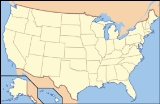
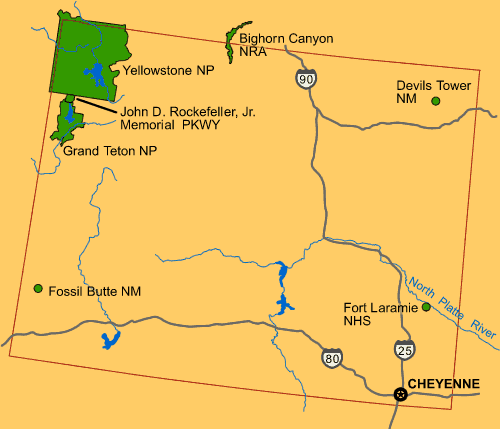
in Crook County, northeastern Wyoming
, above the Belle Fourche River
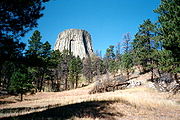
. It rises dramatically 1267 feet (386.2 m) above the surrounding terrain and the summit is 5112 feet (1,558.1 m) above sea level.
Devils Tower was the first declared United States National Monument
, established on September 24, 1906, by President Theodore Roosevelt
. The Monument's boundary encloses an area of 1347 acres (5.5 km²).
In recent years, about 1% of the Monument's 400,000 annual visitors climb
Devils Tower, mostly through traditional climbing
techniques.
, Crow, Cheyenne
, Kiowa
, Lakota, and Shoshone
had cultural and geographical ties to the monolith before European and early American immigrants reached Wyoming. Their names for the monolith include: Aloft on a Rock (Kiowa), Bear's House (Cheyenne, Crow), Bear's Lair (Cheyenne, Crow), Bear's Lodge (Cheyenne, Lakota), Bear's Lodge Butte (Lakota), Bear's Tipi (Arapaho, Cheyenne), Tree Rock (Kiowa), and Grizzly Bear Lodge (Lakota).
The name Devil's Tower originated in 1875 during an expedition led by Col. Richard Irving Dodge
when his interpreter misinterpreted the name to mean Bad God's Tower. This was later shortened to the Devil's Tower. All information sign
s in that area use the name "Devils Tower", following a geographic naming standard whereby the apostrophe is eliminated.
In 2005, a proposal to recognize several American Indian
ties through the additional designation of the monolith as Bear Lodge National Historic Landmark met with opposition from the US Representative Barbara Cubin
, arguing that a "name change will harm the tourist trade and bring economic hardship to area communities".
 The landscape surrounding Devils Tower is composed mostly of sedimentary rock
s. The oldest rocks visible in Devils Tower National Monument were laid down in a shallow sea during the Triassic
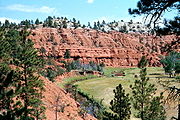
period, 225 to 195 million years ago. This dark red sandstone
and maroon siltstone
, interbedded with shale
, can be seen along the Belle Fourche River
. Oxidation of iron minerals causes the redness of the rocks. This rock layer is known as the Spearfish Formation.
Above the Spearfish formation is a thin band of white gypsum
, called the Gypsum Springs Formation
. This layer of gypsum was deposited during the Jurassic
period, 195 to 136 million years ago.
Created as sea levels and climates repeatedly changed, gray-green shales (deposited in low-oxygen environments such as marshes) were interbedded with fine-grained sandstones, limestone
s, and sometimes thin beds of red mudstone
. This composition, called the Stockade Beaver member, is part of the Sundance Formation
. The Hulett Sandstone member, also part of the Sundance formation, is composed of yellow fine-grained sandstone. Resistant to weathering, it forms the nearly vertical cliffs which encircle the Tower itself.
About 65 million years ago, during the Tertiary
period, the Rocky Mountains
and the Black Hills
were uplifted. Magma
rose through the crust
, intruding into the existing sedimentary rock layers.
of igneous material, but they cannot agree on how, exactly, that process took place. Geologists Carpenter and Russell studied Devils Tower in the late 19th century and came to the conclusion that the Tower was formed by an igneous intrusion. Later geologists searched for further explanations. Several geologists believe the molten rock comprising the Tower might not have surfaced; other researchers are convinced the tower is all that remains of what once was a large explosive volcano
.
In 1907, scientists Darton and O'Hara decided that Devils Tower must be an eroded remnant of a laccolith
. A laccolith is a large mass of igneous rock which is intruded through sedimentary rock beds without reaching the surface, but makes a rounded bulge in the sedimentary layers above. This theory was quite popular in the early 20th century since numerous studies had earlier been done on laccoliths in the Southwest.
Other theories have suggested that Devils Tower is a volcanic plug
or that it is the neck of an extinct volcano. Presumably, if Devils Tower was a volcanic plug, any volcanics created by it – volcanic ash, lava flows, volcanic debris – would have been eroded away long ago. Some pyroclastic material of the same age as Devils Tower has been identified elsewhere in Wyoming.
The igneous material that forms the Tower is a phonolite
porphyry
intruded about 40.5 million years ago, a light to dark-gray or greenish-gray igneous rock with conspicuous crystals of white feldspar
. As the lava cooled, hexagonal (and sometimes 4-, 5-, and 7-sided) columns formed. As the rock continued to cool, the vertical columns shrank horizontally in volume and cracks began to occur at 120 degree angles, generally forming compact 6-sided columns. Superficially similar, but with typically 2 foot (0.6096 m) diameter columns, Devils Postpile National Monument
and Giant's Causeway
are columnar basalt
.
Devils Tower did not visibly protrude out of the landscape until the overlying sedimentary rocks eroded
away. As the elements wore down the softer sandstones and shales, the more resistant igneous rock making up the tower survived the erosional forces. As a result, the gray columns of Devils Tower began to appear as an isolated mass above the landscape.
As rain and snow continue to erode the sedimentary rocks surrounding the Tower's base, more of Devils Tower will be exposed. Nonetheless, the exposed portions of the Tower still experience certain amounts of erosion. Cracks along the columns are subject to water and ice erosion. Erosion due to the expansion of ice along cracks and fractures within rock formations is common in colder climates – a prime example being the featured formations at Bryce Canyon National Park. Portions, or even entire columns, of rock at Devils Tower are continually breaking off and falling. Piles of broken columns, boulders, small rocks, and stones – or scree
– lie at the base of the tower, indicating that it was once wider than it is today.
and Lakota Sioux
, some girls went out to play and were spotted by several giant bears, who began to chase them. In an effort to escape the bears, the girls climbed atop a rock, fell to their knees, and prayed to the Great Spirit
to save them. Hearing their prayers, the Great Spirit made the rock rise from the ground towards the heavens so that the bears could not reach the girls. The bears, in an effort to climb the rock, left deep claw marks in the sides, which had become too steep to climb. (Those are the marks which appear today on the sides of Devils Tower.) When the girls reached the sky, they were turned into the star constellation the Pleiades
.
Another version tells that two Sioux
boys wandered far from their village when Mato the bear, a huge creature that had claws the size of teepee poles, spotted them, and wanted to eat them for breakfast. He was almost upon them when the boys prayed to Wakan Tanka
the Creator to help them. They rose up on a huge rock, while Mato tried to get up from every side, leaving huge scratch marks as he did. Finally, he sauntered off, disappointed and discouraged. The bear came to rest east of the Black Hills
at what is now Bear Butte
. Wanblee, the eagle, helped the boys off the rock and back to their village. A painting depicting this legend by artist Herbert A. Collins
hangs over the fireplace in the visitor's center at Devils Tower.
In a Cheyenne
version of the story, the giant bear pursues the girls and kills most of them. Two sisters escape back to their home with the bear still tracking them. They tell two boys that the bear can only be killed with an arrow shot through the underside of its foot. The boys have the sisters lead the bear to Devils Tower and trick it into thinking they have climbed the rock. The boys attempt to shoot the bear through the foot while it repeatedly attempts to climb up and slides back down leaving more claw marks each time. The bear was finally scared off when an arrow came very close to its left foot. This last arrow continued to go up and never came down.
Wooden Leg
, a Northern Cheyenne, relates another legend told to him by an old man as they were traveling together past the Devils Tower around 1866-1868. An Indian man decided to sleep at the base of Bear Lodge next to a buffalo head. In the morning he found that both himself and the buffalo head had been transported to the top of the rock by the Great Medicine with no way down. He spent another day and night on the rock with no food or water. After he had prayed all day and then gone to sleep, he awoke to find that the Great Medicine had brought him back down to the ground, but left the buffalo head at the top near the edge. Wooden Leg maintains that the buffalo head was clearly visible through the old man's spyglass. At the time, the tower had never been climbed and a buffalo head at the top was otherwise inexplicable.
The buffalo head gives this story special significance for the Northern Cheyenne. All the Cheyenne maintained in their camps a sacred teepee to the Great Medicine containing the tribal sacred objects. In the case of the Northern Cheyenne, the sacred object was a buffalo head.
 Fur trappers may have visited Devils Tower, but they left no written evidence of having done so. The first documented visitors were several members of Captain W. F. Raynold's 1859 Yellowstone Expedition. Sixteen years later, Colonel Richard I. Dodge escorted an Office of Indian Affairs scientific survey party to the massive rock formation and coined the name Devils Tower. Recognizing its unique characteristics, Congress designated the area a U.S. forest reserve in 1892 and in 1906 Devil's Tower became the nation's first National Monument.
The 1977 movie Close Encounters of the Third Kind
used the formation as a plot element and as the location of its climactic scenes.
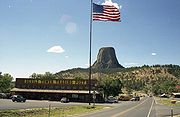 In recent years, climbing Devils Tower National Monument has increased in popularity. The first known ascent of Devils Tower by any method occurred on July 4, 1893, and is accredited to William Rogers and Willard Ripley, local ranchers in the area. They completed this first ascent after constructing a ladder of wooden pegs driven into cracks in the rock face. A few of these wooden pegs are still intact and are visible on the tower when hiking along the 1.3 miles (2.1 km) Tower Trail at Devils Tower National Monument. Over the following thirty years many climbs were made using this method before the ladder fell into disrepair. The man most famous for climbing the tower is Fritz Wiessner
who summited with William P. House and Lawrence Coveney in 1937. This was the first ascent using modern climbing techniques. Wiessner led the entire climb free
, placing only a single piece of fixed gear (piton
) which he later regretted, deeming it unnecessary.
Today hundreds of climbers scale the sheer rock walls of Devils Tower each summer. The most common route is the Durrance Route
which was the second free
route established in 1938. Today there are many established and documented climbing route
s covering every side of the tower, ascending the various vertical cracks and columns of the rock. The difficulty of these routes range from relatively easy to some of the hardest in the world. All climbers are required to register with a park ranger before and after attempting a climb.
The Tower is sacred to several Native American Plains tribes, including the Lakota Sioux, Cheyenne
and Kiowa
. Because of this, many Indian leaders objected to climbers ascending the monument, considering this to be a desecration. The climbers argued that they had a right to climb the Tower, since it is on federal land. A compromise was eventually reached with a voluntary climbing ban during the month of June when the tribes are conducting ceremonies around the monument. Climbers are asked, but not required, to stay off the Tower in June. According to the PBS documentary In the Light of Reverence, approximately 85% of climbers honor the ban and voluntarily choose not to climb the Tower during the month of June. However, several climbers along with the Mountain States Legal Foundation
sued the Park Service, claiming an inappropriate government entanglement with religion.
:
Igneous rock
Igneous rock is one of the three main rock types, the others being sedimentary and metamorphic rock. Igneous rock is formed through the cooling and solidification of magma or lava...
intrusion
Intrusion
An intrusion is liquid rock that forms under Earth's surface. Magma from under the surface is slowly pushed up from deep within the earth into any cracks or spaces it can find, sometimes pushing existing country rock out of the way, a process that can take millions of years. As the rock slowly...
or laccolith
Laccolith
A laccolith is a sheet intrusion that has been injected between two layers of sedimentary rock. The pressure of the magma is high enough that the overlying strata are forced upward, giving the laccolith a dome or mushroom-like form with a generally planar base.Laccoliths tend to form at relatively...
located in the Black Hills
Black Hills
The Black Hills are a small, isolated mountain range rising from the Great Plains of North America in western South Dakota and extending into Wyoming, USA. Set off from the main body of the Rocky Mountains, the region is something of a geological anomaly—accurately described as an "island of...
near Hulett
Hulett, Wyoming
Hulett is a town in Crook County, Wyoming, United States. The population was 408 at the 2000 census.- Geography :Hulett is located at . According to the United States Census Bureau, the town has a total area of 0.9 square miles , all of it land. The Belle Fourche River bisects the town...
and Sundance
Sundance, Wyoming
Sundance is a town in Crook County, Wyoming, United States. The population was 1,161 at the 2000 census. The town is named for the Sun Dance ceremony practiced by several North American Indian Nations.-Sundance in popular culture:...
in Crook County, northeastern Wyoming
Wyoming
Wyoming is a state in the mountain region of the Western United States. The western two thirds of the state is covered mostly with the mountain ranges and rangelands in the foothills of the Eastern Rocky Mountains, while the eastern third of the state is high elevation prairie known as the High...
, above the Belle Fourche River
Belle Fourche River
The Belle Fourche River is a tributary of the Cheyenne River, approximately long, in the U.S. states of Wyoming and South Dakota. It is part of the Mississippi River watershed via the Cheyenne and Missouri rivers....
. It rises dramatically 1267 feet (386.2 m) above the surrounding terrain and the summit is 5112 feet (1,558.1 m) above sea level.
Devils Tower was the first declared United States National Monument
U.S. National Monument
A National Monument in the United States is a protected area that is similar to a National Park except that the President of the United States can quickly declare an area of the United States to be a National Monument without the approval of Congress. National monuments receive less funding and...
, established on September 24, 1906, by President Theodore Roosevelt
Theodore Roosevelt
Theodore "Teddy" Roosevelt was the 26th President of the United States . He is noted for his exuberant personality, range of interests and achievements, and his leadership of the Progressive Movement, as well as his "cowboy" persona and robust masculinity...
. The Monument's boundary encloses an area of 1347 acres (5.5 km²).
In recent years, about 1% of the Monument's 400,000 annual visitors climb
Sport climbing
Sport climbing is a form of rock climbing that relies on permanent anchors fixed to the rock, and possibly bolts, for protection,...
Devils Tower, mostly through traditional climbing
Traditional climbing
Traditional climbing, or trad climbing, is a style of rock climbing in which a climber or group of climbers places all gear required to protect against falls , and removes it when a passage is complete...
techniques.
Name
Tribes including the ArapahoArapaho
The Arapaho are a tribe of Native Americans historically living on the eastern plains of Colorado and Wyoming. They were close allies of the Cheyenne tribe and loosely aligned with the Sioux. Arapaho is an Algonquian language closely related to Gros Ventre, whose people are seen as an early...
, Crow, Cheyenne
Cheyenne
Cheyenne are a Native American people of the Great Plains, who are of the Algonquian language family. The Cheyenne Nation is composed of two united tribes, the Só'taeo'o and the Tsétsêhéstâhese .The Cheyenne are thought to have branched off other tribes of Algonquian stock inhabiting lands...
, Kiowa
Kiowa
The Kiowa are a nation of American Indians and indigenous people of the Great Plains. They migrated from the northern plains to the southern plains in the late 17th century. In 1867, the Kiowa moved to a reservation in southwestern Oklahoma...
, Lakota, and Shoshone
Shoshone
The Shoshone or Shoshoni are a Native American tribe in the United States with three large divisions: the Northern, the Western and the Eastern....
had cultural and geographical ties to the monolith before European and early American immigrants reached Wyoming. Their names for the monolith include: Aloft on a Rock (Kiowa), Bear's House (Cheyenne, Crow), Bear's Lair (Cheyenne, Crow), Bear's Lodge (Cheyenne, Lakota), Bear's Lodge Butte (Lakota), Bear's Tipi (Arapaho, Cheyenne), Tree Rock (Kiowa), and Grizzly Bear Lodge (Lakota).
The name Devil's Tower originated in 1875 during an expedition led by Col. Richard Irving Dodge
Richard Irving Dodge
Richard Irving Dodge was a colonel in the United States Army.Dodge was born in North Carolina and died after a long and successful career in the U.S. Army. He began as a cadet in 1844 and retired as a Colonel May 19, 1891....
when his interpreter misinterpreted the name to mean Bad God's Tower. This was later shortened to the Devil's Tower. All information sign
Information sign
An information sign is a very legibly printed and very noticeable placard that informs people of the purpose of an object, or gives them instruction on the use of something. An example is a traffic sign such as a stop sign....
s in that area use the name "Devils Tower", following a geographic naming standard whereby the apostrophe is eliminated.
In 2005, a proposal to recognize several American Indian
Native Americans in the United States
Native Americans in the United States are the indigenous peoples in North America within the boundaries of the present-day continental United States, parts of Alaska, and the island state of Hawaii. They are composed of numerous, distinct tribes, states, and ethnic groups, many of which survive as...
ties through the additional designation of the monolith as Bear Lodge National Historic Landmark met with opposition from the US Representative Barbara Cubin
Barbara Cubin
Barbara Lynn Cubin was a Republican member of the United States House of Representatives, having served as the sole member of that body from Wyoming. In the 109th Congress, she was a member of the House Resources Committee and the House Energy and Commerce Committee...
, arguing that a "name change will harm the tourist trade and bring economic hardship to area communities".
Geological history
Sedimentary rock
Sedimentary rock are types of rock that are formed by the deposition of material at the Earth's surface and within bodies of water. Sedimentation is the collective name for processes that cause mineral and/or organic particles to settle and accumulate or minerals to precipitate from a solution....
s. The oldest rocks visible in Devils Tower National Monument were laid down in a shallow sea during the Triassic
Triassic
The Triassic is a geologic period and system that extends from about 250 to 200 Mya . As the first period of the Mesozoic Era, the Triassic follows the Permian and is followed by the Jurassic. Both the start and end of the Triassic are marked by major extinction events...
period, 225 to 195 million years ago. This dark red sandstone
Sandstone
Sandstone is a sedimentary rock composed mainly of sand-sized minerals or rock grains.Most sandstone is composed of quartz and/or feldspar because these are the most common minerals in the Earth's crust. Like sand, sandstone may be any colour, but the most common colours are tan, brown, yellow,...
and maroon siltstone
Siltstone
Siltstone is a sedimentary rock which has a grain size in the silt range, finer than sandstone and coarser than claystones.- Description :As its name implies, it is primarily composed of silt sized particles, defined as grains 1/16 - 1/256 mm or 4 to 8 on the Krumbein phi scale...
, interbedded with shale
Shale
Shale is a fine-grained, clastic sedimentary rock composed of mud that is a mix of flakes of clay minerals and tiny fragments of other minerals, especially quartz and calcite. The ratio of clay to other minerals is variable. Shale is characterized by breaks along thin laminae or parallel layering...
, can be seen along the Belle Fourche River
Belle Fourche River
The Belle Fourche River is a tributary of the Cheyenne River, approximately long, in the U.S. states of Wyoming and South Dakota. It is part of the Mississippi River watershed via the Cheyenne and Missouri rivers....
. Oxidation of iron minerals causes the redness of the rocks. This rock layer is known as the Spearfish Formation.
Above the Spearfish formation is a thin band of white gypsum
Gypsum
Gypsum is a very soft sulfate mineral composed of calcium sulfate dihydrate, with the chemical formula CaSO4·2H2O. It is found in alabaster, a decorative stone used in Ancient Egypt. It is the second softest mineral on the Mohs Hardness Scale...
, called the Gypsum Springs Formation
Gypsum Springs Formation
The Gypsum Springs Formation is a stratigraphical unit of Middle Jurassic age in the Williston Basin.It takes the name from Gypsum Springs in Wyoming, and was first described in outcrop in Freemont County by J.D...
. This layer of gypsum was deposited during the Jurassic
Jurassic
The Jurassic is a geologic period and system that extends from about Mya to Mya, that is, from the end of the Triassic to the beginning of the Cretaceous. The Jurassic constitutes the middle period of the Mesozoic era, also known as the age of reptiles. The start of the period is marked by...
period, 195 to 136 million years ago.
Created as sea levels and climates repeatedly changed, gray-green shales (deposited in low-oxygen environments such as marshes) were interbedded with fine-grained sandstones, limestone
Limestone
Limestone is a sedimentary rock composed largely of the minerals calcite and aragonite, which are different crystal forms of calcium carbonate . Many limestones are composed from skeletal fragments of marine organisms such as coral or foraminifera....
s, and sometimes thin beds of red mudstone
Mudstone
Mudstone is a fine grained sedimentary rock whose original constituents were clays or muds. Grain size is up to 0.0625 mm with individual grains too small to be distinguished without a microscope. With increased pressure over time the platey clay minerals may become aligned, with the...
. This composition, called the Stockade Beaver member, is part of the Sundance Formation
Sundance Formation
The Sundance Formation is a western North American sequence of Upper Jurassic age marine shales, sandy shales, and sandstones.The Sundance Formation underlies the western North American Morrison Formation, the most fertile source of dinosaur fossils in the Americas, and is separated by a...
. The Hulett Sandstone member, also part of the Sundance formation, is composed of yellow fine-grained sandstone. Resistant to weathering, it forms the nearly vertical cliffs which encircle the Tower itself.
About 65 million years ago, during the Tertiary
Tertiary
The Tertiary is a deprecated term for a geologic period 65 million to 2.6 million years ago. The Tertiary covered the time span between the superseded Secondary period and the Quaternary...
period, the Rocky Mountains
Rocky Mountains
The Rocky Mountains are a major mountain range in western North America. The Rocky Mountains stretch more than from the northernmost part of British Columbia, in western Canada, to New Mexico, in the southwestern United States...
and the Black Hills
Black Hills
The Black Hills are a small, isolated mountain range rising from the Great Plains of North America in western South Dakota and extending into Wyoming, USA. Set off from the main body of the Rocky Mountains, the region is something of a geological anomaly—accurately described as an "island of...
were uplifted. Magma
Magma
Magma is a mixture of molten rock, volatiles and solids that is found beneath the surface of the Earth, and is expected to exist on other terrestrial planets. Besides molten rock, magma may also contain suspended crystals and dissolved gas and sometimes also gas bubbles. Magma often collects in...
rose through the crust
Crust (geology)
In geology, the crust is the outermost solid shell of a rocky planet or natural satellite, which is chemically distinct from the underlying mantle...
, intruding into the existing sedimentary rock layers.
Theories of formation
Geologists agree that Devils Tower was formed by the intrusionIntrusion
An intrusion is liquid rock that forms under Earth's surface. Magma from under the surface is slowly pushed up from deep within the earth into any cracks or spaces it can find, sometimes pushing existing country rock out of the way, a process that can take millions of years. As the rock slowly...
of igneous material, but they cannot agree on how, exactly, that process took place. Geologists Carpenter and Russell studied Devils Tower in the late 19th century and came to the conclusion that the Tower was formed by an igneous intrusion. Later geologists searched for further explanations. Several geologists believe the molten rock comprising the Tower might not have surfaced; other researchers are convinced the tower is all that remains of what once was a large explosive volcano
Volcano
2. Bedrock3. Conduit 4. Base5. Sill6. Dike7. Layers of ash emitted by the volcano8. Flank| 9. Layers of lava emitted by the volcano10. Throat11. Parasitic cone12. Lava flow13. Vent14. Crater15...
.
In 1907, scientists Darton and O'Hara decided that Devils Tower must be an eroded remnant of a laccolith
Laccolith
A laccolith is a sheet intrusion that has been injected between two layers of sedimentary rock. The pressure of the magma is high enough that the overlying strata are forced upward, giving the laccolith a dome or mushroom-like form with a generally planar base.Laccoliths tend to form at relatively...
. A laccolith is a large mass of igneous rock which is intruded through sedimentary rock beds without reaching the surface, but makes a rounded bulge in the sedimentary layers above. This theory was quite popular in the early 20th century since numerous studies had earlier been done on laccoliths in the Southwest.
Other theories have suggested that Devils Tower is a volcanic plug
Volcanic plug
A volcanic plug, also called a volcanic neck or lava neck, is a volcanic landform created when magma hardens within a vent on an active volcano. When forming, a plug can cause an extreme build-up of pressure if volatile-charged magma is trapped beneath it, and this can sometimes lead to an...
or that it is the neck of an extinct volcano. Presumably, if Devils Tower was a volcanic plug, any volcanics created by it – volcanic ash, lava flows, volcanic debris – would have been eroded away long ago. Some pyroclastic material of the same age as Devils Tower has been identified elsewhere in Wyoming.
The igneous material that forms the Tower is a phonolite
Phonolite
Phonolite is a rare igneous, volcanic rock of intermediate composition, with aphanitic to porphyritic texture....
porphyry
Porphyry (geology)
Porphyry is a variety of igneous rock consisting of large-grained crystals, such as feldspar or quartz, dispersed in a fine-grained feldspathic matrix or groundmass. The larger crystals are called phenocrysts...
intruded about 40.5 million years ago, a light to dark-gray or greenish-gray igneous rock with conspicuous crystals of white feldspar
Feldspar
Feldspars are a group of rock-forming tectosilicate minerals which make up as much as 60% of the Earth's crust....
. As the lava cooled, hexagonal (and sometimes 4-, 5-, and 7-sided) columns formed. As the rock continued to cool, the vertical columns shrank horizontally in volume and cracks began to occur at 120 degree angles, generally forming compact 6-sided columns. Superficially similar, but with typically 2 foot (0.6096 m) diameter columns, Devils Postpile National Monument
Devils Postpile National Monument
Devils Postpile National Monument is located near Mammoth Mountain in extreme northeastern Madera County in eastern California. It was established in 1911, and protects Devils Postpile, an unusual formation of columnar basalt.-Geography:...
and Giant's Causeway
Giant's Causeway
The Giant's Causeway is an area of about 40,000 interlocking basalt columns, the result of an ancient volcanic eruption. It is located in County Antrim on the northeast coast of Northern Ireland, about three miles northeast of the town of Bushmills...
are columnar basalt
Basalt
Basalt is a common extrusive volcanic rock. It is usually grey to black and fine-grained due to rapid cooling of lava at the surface of a planet. It may be porphyritic containing larger crystals in a fine matrix, or vesicular, or frothy scoria. Unweathered basalt is black or grey...
.
Devils Tower did not visibly protrude out of the landscape until the overlying sedimentary rocks eroded
Erosion
Erosion is when materials are removed from the surface and changed into something else. It only works by hydraulic actions and transport of solids in the natural environment, and leads to the deposition of these materials elsewhere...
away. As the elements wore down the softer sandstones and shales, the more resistant igneous rock making up the tower survived the erosional forces. As a result, the gray columns of Devils Tower began to appear as an isolated mass above the landscape.
As rain and snow continue to erode the sedimentary rocks surrounding the Tower's base, more of Devils Tower will be exposed. Nonetheless, the exposed portions of the Tower still experience certain amounts of erosion. Cracks along the columns are subject to water and ice erosion. Erosion due to the expansion of ice along cracks and fractures within rock formations is common in colder climates – a prime example being the featured formations at Bryce Canyon National Park. Portions, or even entire columns, of rock at Devils Tower are continually breaking off and falling. Piles of broken columns, boulders, small rocks, and stones – or scree
Scree
Scree, also called talus, is a term given to an accumulation of broken rock fragments at the base of crags, mountain cliffs, or valley shoulders. Landforms associated with these materials are sometimes called scree slopes or talus piles...
– lie at the base of the tower, indicating that it was once wider than it is today.
Native American folklore
According to the Native American tribes of the KiowaKiowa
The Kiowa are a nation of American Indians and indigenous people of the Great Plains. They migrated from the northern plains to the southern plains in the late 17th century. In 1867, the Kiowa moved to a reservation in southwestern Oklahoma...
and Lakota Sioux
Sioux
The Sioux are Native American and First Nations people in North America. The term can refer to any ethnic group within the Great Sioux Nation or any of the nation's many language dialects...
, some girls went out to play and were spotted by several giant bears, who began to chase them. In an effort to escape the bears, the girls climbed atop a rock, fell to their knees, and prayed to the Great Spirit
Great Spirit
The Great Spirit, also called Wakan Tanka among the Sioux, the Creator or the Great Maker in English, and Gitchi Manitou in Algonquian, is a conception of a supreme being prevalent among some Native American and First Nations cultures...
to save them. Hearing their prayers, the Great Spirit made the rock rise from the ground towards the heavens so that the bears could not reach the girls. The bears, in an effort to climb the rock, left deep claw marks in the sides, which had become too steep to climb. (Those are the marks which appear today on the sides of Devils Tower.) When the girls reached the sky, they were turned into the star constellation the Pleiades
Pleiades (star cluster)
In astronomy, the Pleiades, or Seven Sisters , is an open star cluster containing middle-aged hot B-type stars located in the constellation of Taurus. It is among the nearest star clusters to Earth and is the cluster most obvious to the naked eye in the night sky...
.
Another version tells that two Sioux
Sioux
The Sioux are Native American and First Nations people in North America. The term can refer to any ethnic group within the Great Sioux Nation or any of the nation's many language dialects...
boys wandered far from their village when Mato the bear, a huge creature that had claws the size of teepee poles, spotted them, and wanted to eat them for breakfast. He was almost upon them when the boys prayed to Wakan Tanka
Wakan Tanka
In the Sioux way of life, Wakan Tanka is the term for "the sacred" or "the divine". This is usually translated as "The Great Spirit"...
the Creator to help them. They rose up on a huge rock, while Mato tried to get up from every side, leaving huge scratch marks as he did. Finally, he sauntered off, disappointed and discouraged. The bear came to rest east of the Black Hills
Black Hills
The Black Hills are a small, isolated mountain range rising from the Great Plains of North America in western South Dakota and extending into Wyoming, USA. Set off from the main body of the Rocky Mountains, the region is something of a geological anomaly—accurately described as an "island of...
at what is now Bear Butte
Bear Butte
Bear Butte is a geological butte feature located in western South Dakota, United States, that was established as a State Park in 1961. An important landmark and religious site for the Plains Indians tribes long before Europeans reached South Dakota, Bear Butte is called Mathó Pahá, or Bear...
. Wanblee, the eagle, helped the boys off the rock and back to their village. A painting depicting this legend by artist Herbert A. Collins
Herbert A. Collins
Herbert Alexander Collins, Sr., was a Canadian-born American artist. He was known nationally in the United States as a landscape and portrait painter.-Early years:...
hangs over the fireplace in the visitor's center at Devils Tower.
In a Cheyenne
Cheyenne
Cheyenne are a Native American people of the Great Plains, who are of the Algonquian language family. The Cheyenne Nation is composed of two united tribes, the Só'taeo'o and the Tsétsêhéstâhese .The Cheyenne are thought to have branched off other tribes of Algonquian stock inhabiting lands...
version of the story, the giant bear pursues the girls and kills most of them. Two sisters escape back to their home with the bear still tracking them. They tell two boys that the bear can only be killed with an arrow shot through the underside of its foot. The boys have the sisters lead the bear to Devils Tower and trick it into thinking they have climbed the rock. The boys attempt to shoot the bear through the foot while it repeatedly attempts to climb up and slides back down leaving more claw marks each time. The bear was finally scared off when an arrow came very close to its left foot. This last arrow continued to go up and never came down.
Wooden Leg
Wooden Leg
Wooden Leg was a Northern Cheyenne warrior who fought against Custer at the Battle of the Little Big Horn.-Biography:...
, a Northern Cheyenne, relates another legend told to him by an old man as they were traveling together past the Devils Tower around 1866-1868. An Indian man decided to sleep at the base of Bear Lodge next to a buffalo head. In the morning he found that both himself and the buffalo head had been transported to the top of the rock by the Great Medicine with no way down. He spent another day and night on the rock with no food or water. After he had prayed all day and then gone to sleep, he awoke to find that the Great Medicine had brought him back down to the ground, but left the buffalo head at the top near the edge. Wooden Leg maintains that the buffalo head was clearly visible through the old man's spyglass. At the time, the tower had never been climbed and a buffalo head at the top was otherwise inexplicable.
The buffalo head gives this story special significance for the Northern Cheyenne. All the Cheyenne maintained in their camps a sacred teepee to the Great Medicine containing the tribal sacred objects. In the case of the Northern Cheyenne, the sacred object was a buffalo head.
Recent history
The 1977 movie Close Encounters of the Third Kind
Close Encounters of the Third Kind
Close Encounters of the Third Kind is a 1977 science fiction film written and directed by Steven Spielberg. The film stars Richard Dreyfuss, François Truffaut, Melinda Dillon, Teri Garr, Bob Balaban, and Cary Guffey...
used the formation as a plot element and as the location of its climactic scenes.
Climbing
Fritz Wiessner
Fritz Wiessner was a pioneer of free climbing. Born in Dresden, Germany, he emigrated to New York City in 1929. He became a U.S. citizen in 1935.-Early days:...
who summited with William P. House and Lawrence Coveney in 1937. This was the first ascent using modern climbing techniques. Wiessner led the entire climb free
Free climbing
Free climbing is a type of rock climbing in which the climber uses only hands, feet and other parts of the body to ascend, employing ropes and forms of climbing protection to prevent falls only....
, placing only a single piece of fixed gear (piton
Piton
In climbing, a piton is a metal spike that is driven into a crack or seam in the rock with a hammer, and which acts as an anchor to protect the climber against the consequences of a fall, or to assist progress in aid climbing...
) which he later regretted, deeming it unnecessary.
Today hundreds of climbers scale the sheer rock walls of Devils Tower each summer. The most common route is the Durrance Route
Durrance Route (Devils Tower)
The Durrance Route is a climbing route on Devils Tower in the U.S. state of Wyoming. First pioneered by Jack Durrance and Harrison Butterworth in September of 1938, it was the second free ascent of Devils Tower, following the first ascent led by Fritz Wiessner in 1937. The Weissner Route lies a...
which was the second free
Free climbing
Free climbing is a type of rock climbing in which the climber uses only hands, feet and other parts of the body to ascend, employing ropes and forms of climbing protection to prevent falls only....
route established in 1938. Today there are many established and documented climbing route
Climbing route
A climbing route is a path by which a climber reaches the top of a mountain, rock, or ice wall. Routes can vary dramatically in difficulty and, once committed to that ascent, can be difficult to stop or return. Choice of route can be critically important...
s covering every side of the tower, ascending the various vertical cracks and columns of the rock. The difficulty of these routes range from relatively easy to some of the hardest in the world. All climbers are required to register with a park ranger before and after attempting a climb.
The Tower is sacred to several Native American Plains tribes, including the Lakota Sioux, Cheyenne
Cheyenne
Cheyenne are a Native American people of the Great Plains, who are of the Algonquian language family. The Cheyenne Nation is composed of two united tribes, the Só'taeo'o and the Tsétsêhéstâhese .The Cheyenne are thought to have branched off other tribes of Algonquian stock inhabiting lands...
and Kiowa
Kiowa
The Kiowa are a nation of American Indians and indigenous people of the Great Plains. They migrated from the northern plains to the southern plains in the late 17th century. In 1867, the Kiowa moved to a reservation in southwestern Oklahoma...
. Because of this, many Indian leaders objected to climbers ascending the monument, considering this to be a desecration. The climbers argued that they had a right to climb the Tower, since it is on federal land. A compromise was eventually reached with a voluntary climbing ban during the month of June when the tribes are conducting ceremonies around the monument. Climbers are asked, but not required, to stay off the Tower in June. According to the PBS documentary In the Light of Reverence, approximately 85% of climbers honor the ban and voluntarily choose not to climb the Tower during the month of June. However, several climbers along with the Mountain States Legal Foundation
Mountain States Legal Foundation
Mountain States Legal Foundation is a nonprofit, public-interest law firm dedicated to individual liberty, the right to own and use property, limited and ethical government, and economic freedom...
sued the Park Service, claiming an inappropriate government entanglement with religion.
See also
Four areas of Devils Tower National Monument on the National Register of Historic PlacesNational Register of Historic Places
The National Register of Historic Places is the United States government's official list of districts, sites, buildings, structures, and objects deemed worthy of preservation...
:
- Entrance Road (Devils Tower National Monument)Entrance Road (Devils Tower National Monument)The Entrance Road at Devils Tower National Monument is a scenic road that provides the approach to the Devil's Tower eminence, affording planned views to arriving visitors. The entrance road is a long, two-lane, asphalt paved road that spans the distance between the Entrance Station and the...
- Entrance Station (Devils Tower National Monument)Entrance Station (Devils Tower National Monument)The Entrance Station at Devils Tower National Monument is a log cabin in the National Park Service Rustic style, built in 1941. The cabin is based on 1933 plans created by the National Park Service Landscape Division for a now-vanished caretaker's cabin at Aspenglen Campground in Rocky Mountain...
- Old Headquarters Area Historic DistrictOld Headquarters Area Historic DistrictThe Old Headquarters Area at Devils Tower National Monument includes three structures and their surroundings, including the old headquarters building, the custodian's house, and the fire hose house...
- Tower Ladder (Devils Tower National Monument)Tower Ladder (Devils Tower National Monument)The Ladder at Devils Tower was first constructed and used in 1893 by William Rogers and Willard Ripley to publicly ascend Devil's Tower. Two years later Roger's wife Linnie ascended the tower via the ladder, one of a total of about 215 who have used the ladder...
External links
- Devils Tower National Monument. National Park ServiceNational Park ServiceThe National Park Service is the U.S. federal agency that manages all national parks, many national monuments, and other conservation and historical properties with various title designations...
.