


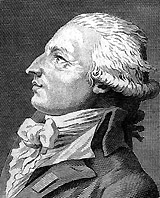
Destutt de Tracy

Encyclopedia
France
The French Republic , The French Republic , The French Republic , (commonly known as France , is a unitary semi-presidential republic in Western Europe with several overseas territories and islands located on other continents and in the Indian, Pacific, and Atlantic oceans. Metropolitan France...
Enlightenment aristocrat
Aristocracy (class)
The aristocracy are people considered to be in the highest social class in a society which has or once had a political system of Aristocracy. Aristocrats possess hereditary titles granted by a monarch, which once granted them feudal or legal privileges, or deriving, as in Ancient Greece and India,...
and philosopher who coined the term "ideology".
Life
The son of a distinguished soldier, Claude Destutt, he was born in ParisParis
Paris is the capital and largest city in France, situated on the river Seine, in northern France, at the heart of the Île-de-France region...
. His family was of Scottish descent, tracing its origin to Walter Stutt, who in 1420 had accompanied the Earls of Buchan and Douglas to the court of France, and whose family afterwards rose to be counts of Tracy. He was educated at home and at the University of Strasbourg
University of Strasbourg
The University of Strasbourg in Strasbourg, Alsace, France, is the largest university in France, with about 43,000 students and over 4,000 researchers....
, where he was noted for his athletic skill. He went into the army, and when the French Revolution
French Revolution
The French Revolution , sometimes distinguished as the 'Great French Revolution' , was a period of radical social and political upheaval in France and Europe. The absolute monarchy that had ruled France for centuries collapsed in three years...
broke out, he took an active part in the provincial assembly of Bourbonnais. Elected a deputy of the nobility to the states-general, he sat alongside his friend, the Marquis de La Fayette. In the spring of 1792, he received the rank of maréchal de camp in command of the cavalry in the army of the north; but the influence of the extremists becoming predominant he took indefinite leave of absence, and settled at Auteuil
Auteuil
Auteuil may refer to:* Auteuil-Neuilly-Passy, an area of Paris* Auteuil, Quebec, a borough of Laval, Quebec, CanadaAuteuil is the name of several communes in France:* Auteuil, Oise* Auteuil, YvelinesAuteuil is also a surname:...
, where, with Condorcet
Marquis de Condorcet
Marie Jean Antoine Nicolas de Caritat, marquis de Condorcet , known as Nicolas de Condorcet, was a French philosopher, mathematician, and early political scientist whose Condorcet method in voting tally selects the candidate who would beat each of the other candidates in a run-off election...
and Cabanis
Pierre Jean George Cabanis
-Further reading:- Further reading :----...
, he devoted himself to scientific studies.
Under the Reign of Terror
Reign of Terror
The Reign of Terror , also known simply as The Terror , was a period of violence that occurred after the onset of the French Revolution, incited by conflict between rival political factions, the Girondins and the Jacobins, and marked by mass executions of "enemies of...
, he was arrested and imprisoned for nearly a year, during which he studied Condillac
Étienne Bonnot de Condillac
Étienne Bonnot de Condillac was a French philosopher and epistemologist who studied in such areas as psychology and the philosophy of the mind.-Biography:...
and Locke
John Locke
John Locke FRS , widely known as the Father of Liberalism, was an English philosopher and physician regarded as one of the most influential of Enlightenment thinkers. Considered one of the first of the British empiricists, following the tradition of Francis Bacon, he is equally important to social...
, and abandoned the natural sciences for philosophy. On the motion of Cabanis, he was named associate of the Institute in the class of the moral and political sciences. He soon began to attract attention by the memoires which he read before his colleagues—papers which formed the first draft of his comprehensive work on ideology
Ideology
An ideology is a set of ideas that constitutes one's goals, expectations, and actions. An ideology can be thought of as a comprehensive vision, as a way of looking at things , as in common sense and several philosophical tendencies , or a set of ideas proposed by the dominant class of a society to...
, named Eléments d'idéologie. He conceived of ideology as the "science of ideas." The society of "ideologists" at Auteuil embraced, besides Cabanis and Tracy, Constantin-François de Chassebœuf, Comte de Volney and Dominique Joseph Garat
Dominique Joseph Garat
Dominique Joseph Garat was a French writer and politician.- Biography :Garat was born at Bayonne...
, professor in the National Institute. (See also: Les Neuf Sœurs
Les Neuf Sœurs
Loge Les Neuf Sœurs , established in Paris in 1776, was a prominent French Masonic Lodge of the Grand Orient de France that was influential in organising French support for the American Revolution. A "Société des Neuf Sœurs," a charitable society that surveyed academic curricula, had been active at...
)
Under the Empire
First French Empire
The First French Empire , also known as the Greater French Empire or Napoleonic Empire, was the empire of Napoleon I of France...
, Tracy was a member of the senate, but took little part in its deliberations. Under the Restoration he became a peer of France, but protested against the reactionary split of the government, and remained in opposition. In 1808, he was elected a member of the Académie française
Académie française
L'Académie française , also called the French Academy, is the pre-eminent French learned body on matters pertaining to the French language. The Académie was officially established in 1635 by Cardinal Richelieu, the chief minister to King Louis XIII. Suppressed in 1793 during the French Revolution,...
in place of Cabanis, and in 1832, he was also named a member of the Academy of Moral Sciences on its reorganization. He appeared, however, only once at its conferences, owing to his age and to disappointment at the comparative failure of his work. Destutt de Tracy was one of the principal advocates of liberalism
Liberalism
Liberalism is the belief in the importance of liberty and equal rights. Liberals espouse a wide array of views depending on their understanding of these principles, but generally, liberals support ideas such as constitutionalism, liberal democracy, free and fair elections, human rights,...
during and after the Revolution. He died in Paris
Paris
Paris is the capital and largest city in France, situated on the river Seine, in northern France, at the heart of the Île-de-France region...
.
Philosophy
Destutt de Tracy was the last eminent representative of the sensualistic school which Condillac founded in France upon a one-sided interpretation of Locke. In full agreement with the materialist views of Cabanis, de Tracy pushed the sensualist principles of Condillac to their most necessary consequences. While the attention of Cabanis was devoted mostly to the physiological side of man, Tracy's interests concerned the then newly determined "ideological," in contrast to "psychological," sides of humanity. His grounding notion of ideology, he frankly stated, fell as "a part of zoology" (biology). The four faculties into which de Tracy divides the conscious life—perception, memory, judgment, volition—are all varieties of sensation. Perception is sensation caused by a present affection of the external extremities of the nerves; memory is sensation caused, in the absence of present excitation, by dispositions of the nerves which are the result of past experiences; judgment is the perception of relations between sensations, and is itself a species of sensation, because if we are aware of the sensations we must be aware also of the relations between them; and volition he identifies with the feeling of desire, and is therefore included as a type of sensation.Considered for the influences of his philosophy, de Tracy minimally deserves credit for his distinction between active and passive touch, which ultimately fed the development of psychological theories of muscular sense. His account of the notion of external existence, as it derived not from pure sensation, but from the experience of action on the one hand and resistance on the other, stands in this light to be compared with the works of Alexander Bain
Alexander Bain
Alexander Bain was a Scottish philosopher and educationalist in the British school of empiricism who was a prominent and innovative figure in the fields of psychology, linguistics, logic, moral philosophy and education reform...
and later psychologists.
Works
His chief works are the five-volume Elémens d'idéologie (1817–1818), the first volume of which was presented as "Ideology Strictly Defined," and which completed the arguments made in earlier completed monographs; Commentaire sur l'esprit des lois de Montesquieu (1806), and Essai sur le génie, et les ouvrages de Montesquieu (1808). The fourth volume of the Eléments d'idéologie the author regarded as the introduction to a second section of the planned nine-part work, which he titled Traité de la volonté (Treatise on the Will and Its Effects). When translated into English, editor Thomas JeffersonThomas Jefferson
Thomas Jefferson was the principal author of the United States Declaration of Independence and the Statute of Virginia for Religious Freedom , the third President of the United States and founder of the University of Virginia...
retitled the volume A Treatise on Political Economy, which obscured the aspects of Tracy's concern not with politics, but with far more basic questions of will, and the possibility of understanding the conditions of its determinations.
Legacy
Tracy advanced a rigorous use of deductive method in social theory, seeing economics in terms of actions (praxeologyPraxeology
Praxeology is the study of human action. Praxeology rejects the empirical methods of the natural sciences for the study of human action, because the observation of how humans act in simple situations cannot predict how they will act in complex situations...
) and exchanges (catallactics
Catallactics
Catallactics is the praxeological theory of the way the free market system reaches exchange ratios and prices.It aims to analyse all actions based on monetary calculation and trace the formation of prices back to the point where an agent makes his or her choices. It explains prices as they are and...
). Tracy's influence can be seen both on the Continent, particularly on Stendhal
Stendhal
Marie-Henri Beyle , better known by his pen name Stendhal, was a 19th-century French writer. Known for his acute analysis of his characters' psychology, he is considered one of the earliest and foremost practitioners of realism in his two novels Le Rouge et le Noir and La Chartreuse de Parme...
, Augustin Thierry, Auguste Comte
Auguste Comte
Isidore Auguste Marie François Xavier Comte , better known as Auguste Comte , was a French philosopher, a founder of the discipline of sociology and of the doctrine of positivism...
, and Charles Dunoyer
Charles Dunoyer
Barthélemy-Charles-Pierre-Joseph Dunoyer de Segonzac was a French liberal economist....
, and in America, where the general approach of the French Liberal School
French Liberal School
The French Liberal School is a 19th century school of economic thought, that was centered around the Collège de France and the Institut de France. The Journal des Économistes was essential in promulgating the ideas of the School...
of political economy competed evenly with British classical political economy
Classical economics
Classical economics is widely regarded as the first modern school of economic thought. Its major developers include Adam Smith, Jean-Baptiste Say, David Ricardo, Thomas Malthus and John Stuart Mill....
well until the end of the 19th century, as evidence in the work and reputation of Arthur Latham Perry
Arthur Latham Perry
Arthur Latham Perry , born in Lyme, New Hampshire, was a prominent American economist and advocate of free trade. He graduated from Williams College in 1852 and was Orrin Sage Professor of history and political economy there from 1853 to 1891, when he became professor emeritus...
and others. In his political writings, Tracy rejected monarchism, favoring the American republican form of government. This republicanism, as well as his advocacy of reason in philosophy and laissez-faire
Laissez-faire
In economics, laissez-faire describes an environment in which transactions between private parties are free from state intervention, including restrictive regulations, taxes, tariffs and enforced monopolies....
for economic policy, lost him favor with Napoleon, who turned Tracy's coinage of "ideology" into a term of abuse; Karl Marx
Karl Marx
Karl Heinrich Marx was a German philosopher, economist, sociologist, historian, journalist, and revolutionary socialist. His ideas played a significant role in the development of social science and the socialist political movement...
followed this vein of invective to refer to Tracy as a "fischblütige Bourgeoisdoktrinär"—a "fish-blooded bourgeois doctrinaire."
Thomas Jefferson, on the other hand, thought highly enough of Destutt de Tracy's work to ready two of his manuscripts for American publication. In his preface to the 1817 publication, Jefferson wrote, "By diffusing sound principles of Political Economy, it will protect the public industry from the parasite institutions now consuming it. . . ."
Also, Stendhal
Stendhal
Marie-Henri Beyle , better known by his pen name Stendhal, was a 19th-century French writer. Known for his acute analysis of his characters' psychology, he is considered one of the earliest and foremost practitioners of realism in his two novels Le Rouge et le Noir and La Chartreuse de Parme...
was much influenced by de Tracy's enlightenment ideals, and attended the De Tracy salon regularly, in the 1820s