Home      Discussion      Topics      Dictionary      Almanac
Signup       Login
Dependency (project management)

Dependency (project management)

Overview
In a project network
Project network
A project network is a graph depicting the sequence in which a project's terminal elements are to be completed by showing terminal elements and their dependencies....

, a dependency is a link amongst a project
Project
A project in business and science is typically defined as a collaborative enterprise, frequently involving research or design, that is carefully planned to achieve a particular aim. Projects can be further defined as temporary rather than permanent social systems that are constituted by teams...

's terminal elements.
Discussion
Ask a question about 'Dependency (project management)'
Start a new discussion about 'Dependency (project management)'
Answer questions from other users
Full Discussion Forum
 
Recent Discussions
Encyclopedia
In a project network
Project network
A project network is a graph depicting the sequence in which a project's terminal elements are to be completed by showing terminal elements and their dependencies....

, a dependency is a link amongst a project
Project
A project in business and science is typically defined as a collaborative enterprise, frequently involving research or design, that is carefully planned to achieve a particular aim. Projects can be further defined as temporary rather than permanent social systems that are constituted by teams...

's terminal elements.

There are four kinds of dependencies with respect to ordering terminal elements (in order of decreasing frequency of use):
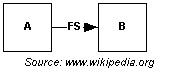
  1. Finish to start (FS)
    • A FS B = B can't start before A is finished
    • (Foundations dug) FS (Concrete poured)
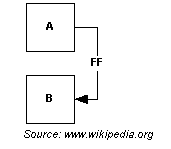
  2. Finish to finish (FF)
    • A FF B = B can't finish before A is finished
    • (Last chapter written) FF (Entire book written)
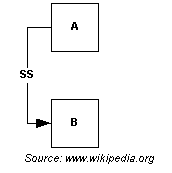
  3. Start to start (SS).
    • A SS B = B can't start before A starts
    • (Project work started) SS (Project management activities started)
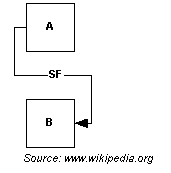
  4. Start to finish (SF)
    • A SF B = B can't finish before A starts
    • (New shift started) SF (Previous shift finished)


Finish-to-start is considered a "natural dependency" whereas all the others are constraints imposed by the scheduler to reflect resource constraints or preferential dependencies. SF is rarely used, and should generally be avoided.

There are three kinds of dependencies with respect to the reason for the existence of dependency:
  1. Causal (logical)
    • It is impossible to edit a text before it is written
    • It is illogical to pour concrete before you dig the foundations
  2. Resource
    Resource (project management)
    In project management terminology, resources are required to carry out the project tasks. They can be people, equipment, facilities, funding, or anything else capable of definition required for the completion of a project activity. The lack of a resource will therefore be a constraint on the...

     constraints
    • It is logically possible to paint four walls in a room simultaneously but there is only one painter
  3. Discretionary (preferential)
    • I want to paint the living room before painting the dining room, although I could do it the other way round, too


Early critical path
Critical path method
The critical path method is an algorithm for scheduling a set of project activities. It is an important tool for effective project management.-History:...

-derived schedules often reflected only on causal (logical) or discretionary (preferential) dependencies because the assumption was that resources would be available or could be made available. Since at least the mid-1980s, competent project managers and schedulers have recognized that schedules must be based on resource availability. The critical chain
Critical chain
Critical chain project management is a method of planning and managing projects that puts the main emphasis on the resources required to execute project tasks. It was developed by Eliyahu M. Goldratt. This is in contrast to the more traditional critical path and PERT methods, which emphasize task...

 method necessitates taking into account resource constraint-derived dependencies as well.

In addition, these dependencies can be modified by leads, and lags.
For example:
When building two walls from a novel design, one might start the second wall 2 days after the first so that the second team can learn from the first. This is an example of a lag in a Start-Start relationship.

It may also be useful to specify lead time when tasks are performed in parallel in a Finish-Finish relationship.
For example:
The work for 'Document A' should finish 5 days before the work for 'Document B' so that the reviewers have time to read each individually.
Although Document A and Document B may take different times to write, they will be planned to finish 5 days apart.

See also

  • Dependency Structure Matrix
  • list of project management topics
  • project network
    Project network
    A project network is a graph depicting the sequence in which a project's terminal elements are to be completed by showing terminal elements and their dependencies....

  • project planning
    Project planning
    Project planning is part of project management, which relates to the use of schedules such as Gantt charts to plan and subsequently report progress within the project environment....