


Denver International Airport

Encyclopedia
Denver International Airport , often referred to as DIA, is an airport
in Denver, Colorado
. By land size, at 53 square miles (137.3 km²), it is the largest international airport
in the United States
, and the third largest international airport in the world after King Fahd International Airport
and Montréal-Mirabel International Airport
. Runway 16R/34L is the longest public use runway in the United States.
So far this year, January-May 2011, Denver International Airport is the 11th-busiest airport in the world
by passenger traffic with 20,608,318 passengers. It was also the fifth-busiest airport in the world
by aircraft movements with over 635,000 movements in 2010.
The airport is located in northeastern Denver, Colorado
, and is operated by the City and County of Denver
. Denver International Airport is the busiest and largest airport in the United States without non-stop service to and from Asia
, although the airport is actively seeking such flights. DIA was voted Best Airport in North America by readers of Business Traveler Magazine six years in a row (2005–2010) and was named "America's Best Run Airport" by Time
in 2002.
Denver International Airport is the main hub for low-cost carrier Frontier Airlines
and commuter carrier Great Lakes Airlines
. It is also the second-largest hub for United Airlines
(after Chicago's O'Hare International Airport
). Following United's merger with Continental Airlines
, the airport will be the fourth largest hub for United after Houston, Chicago, and Newark respectively. The airport is also a focus city
for Southwest Airlines
. Since commencing service to Denver in January 2006, Southwest has added over 40 destinations, making Denver its fastest-growing market.
Denver International Airport is the only airport in the United States to have designed and implemented an ISO 14001-certified environmental management system that covers the entire airport.
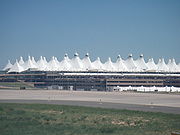 The airport's distinctive white Teflon-coated fiberglass roof is aesthetically designed to be reminiscent of the snow-capped Rocky Mountains
in winter. The catenary steel cable system, similar to the Brooklyn Bridge
design, supports the roof. DIA is also known for a pedestrian bridge connecting the terminal
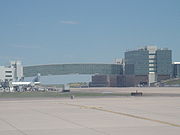
to Concourse A that allows travelers to view planes taxiing directly underneath and provides sweeping views of the Rocky Mountains to the West and the high plains to the East.
Mustang, by New Mexico artist Luis Jiménez
, was one of the earliest public art commissions for Denver International Airport in 1993. Standing at 32 feet (9.8 m) tall and weighing 9000 pounds (4,082.3 kg), "Mustang" is a blue cast-fiberglass sculpture with red shining eyes located between the inbound and outbound lanes of Peña Boulevard
. Jiménez died in 2006 while creating the sculpture when the head of it fell on him and severed an artery in his leg. At the time of his death, Jiménez had completed painting the head of the mustang. The sculpture was completed with the help of the artist's staff, family, and professional race-car painters, Camillo Nuñez and Richard LaVato. Upon completion, the sculpture was sent to California for assembly and then shipped to Denver. "Mustang" was unveiled at DEN on February 11, 2008.
"Mustang" has received a mixed review from Colorado citizens. Many critics of the sculpture are attempting to have it removed, however the city plans to leave the installation in place for 5 years before making any decisions regarding its future. The controversy over the sculpture has received a great deal of media attention as well with coverage from the local news outlets to The Wall Street Journal
, CNN
, and The Daily Show
.
The system's $186 million original construction costs grew by $1 million per day during months of modifications and repairs. Incoming flights on the airport's B Concourse made very limited use of the system, and only United, DIA's dominant airline, used it for outgoing flights. The 40-year-old company responsible for the design of the automated system, BAE Automated Systems of Carrollton, Texas
, at one time responsible for 90% of the baggage systems in the United States, was acquired in 2002 by G&T Conveyor Company, Inc.
The automated baggage system never worked as designed, and in August 2005, it became public knowledge that United would abandon the system, a decision that would save them $1 million per month in maintenance costs.
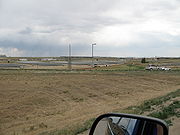 Between February and August 2008, construction of an on-site, two-megawatt solar energy system took place. The single-axis tracking system provides 3.5 million kilowatt-hours of energy per year and uses 9,200 solar panels made by Sharp. Originally designed to power a jail, it spares the environment of more than five million pounds of carbon emissions annually. The system generates the equivalent of half the energy needs of the underground trains that move people between concourses. The $13 million-plus system sits on 7.5 acres (or 30,000 m2), clearly visible to people entering and exiting the airport. WorldWater & Solar Technologies Corp. designed and built the system, while MMA Renewable Ventures LLC—rather than DIA—owns the solar farm and sells its energy to the airport. Denver International Airport’s three solar array systems now produce approximately six percent of the airport’s total power requirements. The output makes DEN the largest
distributed generation photovoltaic energy producer in the state of Colorado.
access available throughout the airport. The free service is ad-supported through an advertising-filled HTML frame that is inserted into the top of the browser window. Users of the Wi-Fi network are also required to view a 30-second advertising video in the browser before Internet access is granted, although in many cases a click-through button is provided to avoid viewing the ad. The network is managed by FreeFi Networks, a Los Angeles-based firm. T-Mobile
HotSpot service is available in the airport lounge
s run by United Airlines
and American Airlines
. The airport has pay-per-use kiosks which can be used to access the Internet
and to play video games. The current stations were developed by Zoox Stations and were installed in 2007.
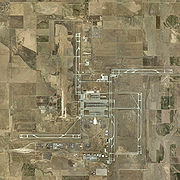 The airport is 25 miles (40.2 km) driving distance from downtown Denver, which is 19 miles (30.6 km) farther away than Stapleton International Airport
, the airport it replaced. The distant location was chosen to avoid aircraft noise affecting developed areas, to accommodate a generous runway
layout that would not be compromised by winter storms, and to allow for future expansion. The 33457 acre (52.3 sq mi; 135.4 km²) of land occupied by the airport is nearly twice the land area of Manhattan
. The land was transferred from Adams County
to Denver after a 1989 vote, increasing the city's size by 50 percent. However, much of the city of Aurora
is actually closer to the airport than the developed portions of Denver, and all freeway traffic accessing the airport from central Denver passes through Aurora.
Airport officials say its large area contributes to it having the highest number of wildlife strikes
in the United States (2,090 this decade – although it ranked seventh on basis of takeoffs and landings).
(after whom Peña Boulevard is named), federal officials authorized the outlay of the first $60 million for the construction of DIA. Two years later, Mayor Wellington Webb
inherited the megaproject
, scheduled to open on October 29, 1993.
Delays caused by poor planning and repeated design changes due to changing requirements from United Airlines
caused Mayor Webb to push opening day back, first to December 1993, then to March 1994. By September 1993, delays due to a millwright
strike and other events meant opening day was pushed back again, to May 15, 1994.
In April 1994, the city invited reporters to observe the first test of the new automated baggage system. Reporters were treated to scenes of clothing and other personal effects scattered beneath the system's tracks, while the actuator
s that moved luggage from belt to belt would often toss the luggage right off the system instead. The mayor cancelled the planned May 15 opening. The baggage system continued to be a maintenance hassle and was finally terminated in September 2005, with traditional baggage handler
s manually handling cargo and passenger luggage.
On September 25, 1994, the airport hosted a fly-in
that drew several hundred general aviation
aircraft, providing pilot
s with a unique opportunity to operate in and out of the new airport, and to wander around on foot looking at the ground-side facilities—including the baggage system, which was still under testing. FAA
controllers also took advantage of the event to test procedures, and to check for holes in radio coverage as planes taxied around and among the buildings.
DIA finally replaced Stapleton
on February 28, 1995, 16 months behind schedule and at a cost of $4.8 billion, nearly $2 billion over budget. The construction employed 11,000 workers.
United flight 1062 to Kansas City International Airport
was the first to depart and United flight 1474 from Colorado Springs Airport
was the first to arrive.
After the airport's runway
s were completed but before it opened, the airport used the codes . DIA later took over as its codes from Stapleton when the latter airport closed.
During the blizzard
of March 17–19, 2003, heavy snow tore a hole in the terminal's white fabric roof. Over two feet of snow on the paved areas closed the airport (and its main access road, Peña Boulevard
) for almost two days. Several thousand people were stranded at DIA.
In 2004, DIA was ranked first in major airports for on-time arrivals according to the FAA.
Another blizzard on December 20 and 21st, 2006 dumped over 20 inches (50.8 cm) of snow in about 24 hours. The airport was closed for more than 45 hours, stranding thousands.
 Denver has traditionally been home to one of the busier airports in the nation because of its location. Many airlines including United Airlines
, Continental Airlines
, Western Airlines
, TWA
, the old Frontier Airlines
and People Express were hubbed in Denver and there was also a significant Southwest Airlines
operation at the old Stapleton International Airport
. At times, Denver was a hub
for three or four airlines. Gate space was severely limited at Stapleton, and the runways at the old Stapleton were unable to deal efficiently with Denver's weather and wind patterns, causing nationwide travel disruption. These problems were the main justification for the new airport. The project began with Perez Architects and was completed by Fentress Bradburn Architects
of Denver. The signature DIA profile, suggestive of the snow capped Rocky Mountains, was first hand sketched by Design Director Curtis W. Fentress
. Seized upon by then Mayor, Federico Peña
, as the iconic form he was looking for – "similar to the Sydney Opera House
" – DIA's design as well as its user-optimized curbside-to-airside navigation has won DIA global acclaim and propelled its designer, Fentress, to one of the foremost airport designers in the world. Fentress Architects is currently at work on the modernization of LAX.
With the construction of DIA, Denver was determined to build an airport that could be easily expanded over the next 50 years to eliminate many of the problems that had plagued Stapleton International Airport
. This was achieved by designing an easily expandable midfield terminal and concourses, creating one of the most efficient airfields in the world.
At 33457 acres (13,540 ha), DIA is by far the largest land area commercial airport in the United States. Dallas/Fort Worth International Airport is a distant second at 18100 acres (7,325 ha). The 327 feet (99.7 m) control tower is one of the tallest in North America
. The airfield is arranged in a pinwheel formation around the midfield terminal and concourses. This layout allows independent flow of aircraft to and from each runway without any queuing or overlap with other runways. Additional runways can be added as needed, up to a maximum of 12 runways. Denver currently has four north/south runways (35/17 Left and Right; 34/16 Left and Right) and two east/west runways (7/25 and 8/26).
 DIA's sixth runway (16R/34L) is the longest commercial precision-instrument runway in North America with a length of 16000 feet (4,877 m). Compared to other DIA runways, the extra 4000 feet (1,219.2 m) length allows fully loaded jumbo jets such as the Boeing 747
or Airbus 380 to take off in Denver's mile-high altitude during summer months, thereby providing unrestricted global access for any airline using DIA.
The midfield concourses allow passengers to be screened in a central location efficiently and then transported via a rail system to three different passenger concourses. Unlike Hartsfield-Jackson Atlanta International Airport
upon which the midfield design was based, Concourses B and C are not connected by any kind of walkway; they are only accessible via train
.
The taxiway
s at Denver have been positioned so that each of the midfield concourses can expand significantly before reaching the taxiways. B Concourse, which is primarily used by United Airlines
, is longer than the other two concourses, but all three concourses can be expanded as needed. Once this expansion is exhausted, space has been reserved for Concourses D and E.
All international flights requiring customs
and immigration
services currently fly into Concourse A. Currently eight gates are used for international flights. These north facing gates on Concourse A are equipped to divert incoming passengers to a hallway which connects to the upper level of the air bridge, and enters Customs and Immigration in the north side of the Jeppesen Terminal. These gates could also be easily modified to allow boarding on both the upper deck and the lower deck of larger planes such as the Airbus A380.
As part of the original design of the airport the city specified passenger volume "triggers" that would lead to a redevelopment of the master plan and possible new construction to make sure the airport is able to meet Denver's needs. The city hit its first-phase capacity threshold in 2008, and DIA is currently revising the master plan. As part of the master plan update, the airport announced selection of Parson's transportation group to design a new hotel, rail station and two bridges leading into the main terminal. Santiago Calatrava
has been selected as the architect for the project. In addition, before hitting the 60 million passenger volume trigger, the airport is planning on constructing an additional runway, 20+ new gates on the existing concourses, two additional International Gates as well as improvements to the baggage system and passenger train.
Once fully built out, DIA should be able to handle 110 million passengers per year, up from 32 million at its opening.
 Jeppesen Terminal, named after aviation safety pioneer Elrey Jeppesen
, is the land side of the airport. Road traffic accesses the airport directly off of Peña Boulevard, which in turn is fed by Interstate 70
and E-470
. Two covered and uncovered parking areas are directly attached to the terminal – three garages and an economy parking lot on the east side; and four garages and an economy lot on the west side.
The terminal is separated into west and east terminals for passenger drop off and pickup. Linked below is a map of the airlines associated with the terminals.
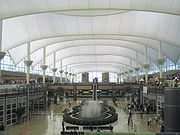
The central area of the airport houses two security screening areas and exits from the underground train system. The north side of the Jeppesen Terminal contains a third security screening area and a segregated immigration and customs area. A large fountain is currently being removed due to the expansion project currently underway.
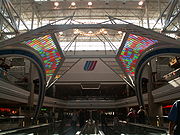
Passengers are routed first to airline ticket counters or kiosks for checking in. Since all gates at Denver are in the outlying concourses, passengers must pass through any one of the three separate security screening areas for admittance into the secure air side of the airport (one at each end of the main terminal, with escalators down to the trains, plus one at the end of the walkway to Concourse A).
After leaving the main terminal via the train or pedestrian bridge, passengers can access 95 full-service gates on 3 separate concourses (A, B, & C), plus gates for regional flights.
Stone used in the terminal walls was supplied by the Yule Marble Quarry
, also used for the Tomb of the Unknown Soldier
and the Lincoln Memorial
.
's (RTD) FasTracks system, a 500-room hotel, to be run by Westin Hotels & Resorts, and a conference center, and create over 6,600 jobs that will be completed on 2016. The rail link will provide a direct linkage between downtown Denver and the airport. The design concept of the South Terminal was envisioned by architect Santiago Calatrava
. Calatrava claims that the South Terminal Redevelopment Program was inspired by an eagle flying, and will keep the Jeppesen terminal a visible icon.
s, spaced far apart. Concourse A is accessible via a pedestrian bridge directly from the terminal building, as well as via the underground train system that services all three concourses. For access to Concourses B and C, passengers must utilize the Denver International Airport Automated Guideway Transit System
. On one occasion in the late 1990s, the train system encountered technical problems and shut down for several hours, creating a tremendous back-log of passengers in Jeppesen Terminal since no pedestrian walkways exist between the terminal and the B and C Concourses. Since that day the airport's train system has continued to operate without any further major service interruption.
The concourses and main terminal have a similar layout to Atlanta's airport
, except that Denver has no T gates directly attached to the terminal and the space between concourses at DIA is much wider than the space between the concourses in Atlanta. This allows for maximum operating efficiency as aircraft can be pushed away from their gate awaiting departure and other arriving and departing aircraft can still taxi through the alley behind them without delay.
The airport collects landing fees, rent and other revenues from the airlines to help offset its operating costs. Denver International Airport is owned and operated by the City and County of Denver, but does not operate using tax dollars. Instead, the airport is an "enterprise fund" generating its own revenues in order to cover operating expenses. The airport operates off of revenue generated by the airlines – landing fees, rents and other payments – and revenues generated by non-airline resources – parking, concessions revenues, rent and other payments.
On December 14, 2006, The Denver Post
reported that DIA is in the design phase of expanding Concourse C in the airport's "first major concourse expansion." At least eight new gates are planned for construction at the east end of Concourse C and the project has an estimated pricetag of approximately $160 million. If the project is given the green light to move past the design phase, construction on Concourse C is estimated to take 3 years and will allow primarily Southwest Airlines
, but also other carriers, to increase flight schedules at one of the nation's fastest-growing airports.
Concourse B also recently expanded with the addition of a regional jet terminal at the east side of Concourse B. This Regional Jet
concourse consists of one smaller concourse or finger which is connected to Concourse B a bridges. These gates allow direct jet bridge access to smaller Regional Jet
s. With the opening of the Regional Jet Concourse, United Airlines has left Concourse A entirely and now operates solely from Concourse B, with the exception of international flights requiring customs support.
The Airport has also announced plans to revise the Airport Master Plan to account for changing circumstances since the airport opened. According to the December 14, 2006, Denver Post and Rocky Mountain News
articles, plans being drafted could possibly include an extension of the Main terminal to the South. This change would increase the number of ticketing counters and would also include a rail station for the terminus of the FasTracks
commuter rail line from Denver's Union Station
.
) as well as certain departing flights:
Concourse A has 37 Gates: A24–A68 with four international boarding gates, gate A37 is used by British Airways and gates A41 & A43 are used by Aeromexico, Air Canada and Lufthansa. Denver is one of the busiest airports worldwide with only limited international operations.
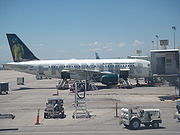
Frontier Airlines is the main carrier in Concourse A.
American Airlines' Admiral's Club is located in Concourse A.
In November 2009, United and DIA reached an agreement in which United released five of its gates in the western end of the concourse. DIA in return leased these gates to United's Star Alliance partners US Airways
and Continental Airlines
.
United Airlines has two United Clubs on Concourse B, both one level above the main area of the concourse. One is adjacent to gate B32, and the other is adjacent to gate B44.
This concourse is exclusive to Star Alliance partners.
Southwest is the main carrier in Concourse C though AirTran and Delta use the concourse as well.
hangar
. However, before construction on Concourses D and E begins, Concourses A, B, and C can be extended in both directions.
and the second-largest hub
for United Airlines
(not combined with Continental and will be fourth-largest hub after merger with Continental).
Southwest Airlines continues to grow rapidly at the airport even after a failed bid to buy rival Frontier Airlines
. Denver is the point to point carrier's seventh largest city. The airport is also the main hub of Great Lakes Airlines
. DIA was a hub for the now defunct Western Pacific Airlines
and is also a growing focus city for Southwest Airlines
.
The three largest airlines serving DIA are United Airlines, Southwest Airlines, and Frontier Airlines, controlling about 42.3%, 21.4%, and 20.9% of all passenger traffic at DEN in December 2010, respectively.
United and Frontier serve destinations in Canada
, Costa Rica
, and Mexico
while foreign flag carrier
s Aeroméxico
, Air Canada
, British Airways
and Lufthansa
operate flights to their hubs.

(RTD) operates five bus routes under the frequent airport express bus service called skyRide, as well as one Express bus route and one Limited bus route, between DIA and various locations throughout the Denver-Aurora
and Boulder
metropolitan areas.
The skyRide services operate on comfortable coaches with ample space for luggage, while the Express and Limited bus routes operate on regular city transit buses and are mainly geared for use for airport employees.
skyRide services drop-off and pick-up from both the West and East side of the Jeppesen Terminal while the Express and Limited services drop-off only on the West side of the Terminal and pick-up only from the East side of the Terminal.
By 2015, RTD plans to build a commuter rail
line from downtown Denver's Union Station through Aurora
to DIA, as part of the FasTracks
expansion program. Scheduled bus service is also available to points such as Fort Collins, Colorado
and van services stretch into Nebraska
, Wyoming
, and Colorado summer and ski resort
areas. Amtrak
offers a Fly-Rail plan for ticketing with United Airlines for trips into scenic areas in the Western U.S.
via a Denver stopover.
relating to the airport's design and construction.
Murals painted in the baggage claim area have been claimed to contain themes referring to future military oppression and a one-world government. However, the artist, Leo Tanguma, said the murals, entitled "In Peace and Harmony With Nature" and "The Children of the World Dream of Peace," depict man-made environmental
destruction and genocide
along with human
ity coming together to heal nature and live in peace.
In the mid-1990s, Philip Schneider gave lectures about highly secretive government information concerning "deep underground military bases" that were constructed by the United States government, and said that one of these bases exists underneath the Denver International Airport. Author Alex Christopher claimed to have worked in the tunnels under the airport, and described what appeared to be vast holding areas for prisoners, strange nausea-inducing electromagnetic forces, and caverns big enough to drive trucks through, presumably to be filled with helpless political prisoners. This theory has been challenged, since photos have revealed that these tunnels are used for transportation of baggage by way of conveyor belts
People have found out that there have been unusual markings in the terminals in DIA and have recorded them as masonic markings. One person found these markings and traced them to a series of tunnels where people believe were built shortly after the airport was built in the 1980s.
Conspiracists have pointed to unusual words cut into the floor as being Satanic, Masonic, or just some impenetrable secret code of the New World Order: Cochetopa, Sisnaajini, and the baffling Dzit Dit Gaii. These words are actually Navajo terms for geographical sites in Colorado. "Braaksma" and "Villarreal" are actually the names of Carolyn Braaksma and Mark Villarreal, artists who worked on the airport’s sculptures and paintings.
There is a dedication marker in the airport inscribed with the Square and Compasses
of the Freemasons
, along with a listing of the two Grand Lodges of Freemasonry in Colorado. It is mounted over a time capsule that was sealed during the dedication of the airport. The Freemasons participated in laying this “capstone” (the last, finishing stone) of the airport project. The capstone also is inscribed with a line that simply states "New World Airport Commission".
Airport
An airport is a location where aircraft such as fixed-wing aircraft, helicopters, and blimps take off and land. Aircraft may be stored or maintained at an airport...
in Denver, Colorado
Colorado
Colorado is a U.S. state that encompasses much of the Rocky Mountains as well as the northeastern portion of the Colorado Plateau and the western edge of the Great Plains...
. By land size, at 53 square miles (137.3 km²), it is the largest international airport
International airport
An international airport is any airport that can accommodate flights from other countries and are typically equipped with customs and immigration facilities to handle these flights to and from other countries...
in the United States
United States
The United States of America is a federal constitutional republic comprising fifty states and a federal district...
, and the third largest international airport in the world after King Fahd International Airport
King Fahd International Airport
King Fahd International Airport is located 20 kilometers northwest of Dammam, Saudi Arabia. It is the largest airport in the world in terms of land area . The airport's basic infrastructure was complete by the end of 1990, which allowed the Allied forces engaged in the first Gulf War in early...
and Montréal-Mirabel International Airport
Montréal-Mirabel International Airport
Montréal-Mirabel International Airport, originally called Montréal International Airport and widely known simply as Mirabel is an airport located in Mirabel, Quebec, Canada, northwest of Montreal and was opened October 4, 1975...
. Runway 16R/34L is the longest public use runway in the United States.
So far this year, January-May 2011, Denver International Airport is the 11th-busiest airport in the world
World's busiest airports by passenger traffic
The world's busiest airports by passenger traffic are measured by number of total passengers . One passenger is described as someone who arrives in, departs from, or transfers through the airport on a given day...
by passenger traffic with 20,608,318 passengers. It was also the fifth-busiest airport in the world
World's busiest airports by traffic movements
The thirty world's busiest airports by aircraft movements are measured by total movements . One total movement is a landing or take off of an aircraft.- 2010 final statistics :-2009 final statistics:...
by aircraft movements with over 635,000 movements in 2010.
The airport is located in northeastern Denver, Colorado
Colorado
Colorado is a U.S. state that encompasses much of the Rocky Mountains as well as the northeastern portion of the Colorado Plateau and the western edge of the Great Plains...
, and is operated by the City and County of Denver
Denver, Colorado
The City and County of Denver is the capital and the most populous city of the U.S. state of Colorado. Denver is a consolidated city-county, located in the South Platte River Valley on the western edge of the High Plains just east of the Front Range of the Rocky Mountains...
. Denver International Airport is the busiest and largest airport in the United States without non-stop service to and from Asia
Asia
Asia is the world's largest and most populous continent, located primarily in the eastern and northern hemispheres. It covers 8.7% of the Earth's total surface area and with approximately 3.879 billion people, it hosts 60% of the world's current human population...
, although the airport is actively seeking such flights. DIA was voted Best Airport in North America by readers of Business Traveler Magazine six years in a row (2005–2010) and was named "America's Best Run Airport" by Time
Time (magazine)
Time is an American news magazine. A European edition is published from London. Time Europe covers the Middle East, Africa and, since 2003, Latin America. An Asian edition is based in Hong Kong...
in 2002.
Denver International Airport is the main hub for low-cost carrier Frontier Airlines
Frontier Airlines
Frontier Airlines, Inc., is an American airline headquartered in Indianapolis, Indiana, United States. The carrier, which is a subsidiary and operating brand of Republic Airways Holdings, operates flights to 83 destinations throughout the United States, Mexico, and Costa Rica and maintains hubs at...
and commuter carrier Great Lakes Airlines
Great Lakes Airlines
Great Lakes Airlines , is an American regional airline operating domestic scheduled and charter services. Corporate headquarters are located in Cheyenne, Wyoming, with hubs at Denver International Airport, Phoenix Sky Harbor International Airport, Los Angeles International Airport, McCarran...
. It is also the second-largest hub for United Airlines
United Airlines
United Air Lines, Inc., is the world's largest airline with 86,852 employees United Air Lines, Inc., is the world's largest airline with 86,852 employees United Air Lines, Inc., is the world's largest airline with 86,852 employees (which includes the entire holding company United Continental...
(after Chicago's O'Hare International Airport
O'Hare International Airport
Chicago O'Hare International Airport , also known as O'Hare Airport, O'Hare Field, Chicago Airport, Chicago International Airport, or simply O'Hare, is a major airport located in the northwestern-most corner of Chicago, Illinois, United States, northwest of the Chicago Loop...
). Following United's merger with Continental Airlines
Continental Airlines
Continental Airlines was a major American airline now merged with United Airlines. On May 3, 2010, Continental Airlines, Inc. and UAL, Inc. announced a merger via a stock swap, and on October 1, 2010, the merger closed and UAL changed its name to United Continental Holdings, Inc...
, the airport will be the fourth largest hub for United after Houston, Chicago, and Newark respectively. The airport is also a focus city
Focus city
In the airline industry, a focus city is a location that is not a hub, but from which the airline has non-stop flights to several destinations other than its hubs...
for Southwest Airlines
Southwest Airlines
Southwest Airlines Co. is an American low-cost airline based in Dallas, Texas. Southwest is the largest airline in the United States, based upon domestic passengers carried,...
. Since commencing service to Denver in January 2006, Southwest has added over 40 destinations, making Denver its fastest-growing market.
Denver International Airport is the only airport in the United States to have designed and implemented an ISO 14001-certified environmental management system that covers the entire airport.
Aesthetics
Rocky Mountains
The Rocky Mountains are a major mountain range in western North America. The Rocky Mountains stretch more than from the northernmost part of British Columbia, in western Canada, to New Mexico, in the southwestern United States...
in winter. The catenary steel cable system, similar to the Brooklyn Bridge
Brooklyn Bridge
The Brooklyn Bridge is one of the oldest suspension bridges in the United States. Completed in 1883, it connects the New York City boroughs of Manhattan and Brooklyn by spanning the East River...
design, supports the roof. DIA is also known for a pedestrian bridge connecting the terminal
Airport terminal
An airport terminal is a building at an airport where passengers transfer between ground transportation and the facilities that allow them to board and disembark from aircraft....
to Concourse A that allows travelers to view planes taxiing directly underneath and provides sweeping views of the Rocky Mountains to the West and the high plains to the East.
Art
Both during construction and after the opening of the airport, Denver International Airport has set aside a portion of its construction and operation budgets for art. Gargoyles hiding in suitcases are present above the exit doors from baggage claim. The corridor from the Jeppesen Terminal and Concourse A usually contains additional temporary exhibits. Finally a number of different public art works are present in the underground train that links the main terminal with the concourses.Mustang, by New Mexico artist Luis Jiménez
Luis Jiménez (sculptor)
Luis Jimenez or Luis Jiménez was an American sculptor of Mexican descent. He was born in El Paso, Texas and died in New Mexico. He studied art and architecture at the University of Texas in Austin and El Paso, earning a bachelor's degree in 1964...
, was one of the earliest public art commissions for Denver International Airport in 1993. Standing at 32 feet (9.8 m) tall and weighing 9000 pounds (4,082.3 kg), "Mustang" is a blue cast-fiberglass sculpture with red shining eyes located between the inbound and outbound lanes of Peña Boulevard
Peña Boulevard
Federico Peña Boulevard, named for former Denver Mayor Federico Peña, is a long freeway located in Adams County and the City and County of Denver, Colorado. The freeway, which opened in 1993, provides the only access into the Denver International Airport which opened at the same time...
. Jiménez died in 2006 while creating the sculpture when the head of it fell on him and severed an artery in his leg. At the time of his death, Jiménez had completed painting the head of the mustang. The sculpture was completed with the help of the artist's staff, family, and professional race-car painters, Camillo Nuñez and Richard LaVato. Upon completion, the sculpture was sent to California for assembly and then shipped to Denver. "Mustang" was unveiled at DEN on February 11, 2008.
"Mustang" has received a mixed review from Colorado citizens. Many critics of the sculpture are attempting to have it removed, however the city plans to leave the installation in place for 5 years before making any decisions regarding its future. The controversy over the sculpture has received a great deal of media attention as well with coverage from the local news outlets to The Wall Street Journal
The Wall Street Journal
The Wall Street Journal is an American English-language international daily newspaper. It is published in New York City by Dow Jones & Company, a division of News Corporation, along with the Asian and European editions of the Journal....
, CNN
CNN
Cable News Network is a U.S. cable news channel founded in 1980 by Ted Turner. Upon its launch, CNN was the first channel to provide 24-hour television news coverage, and the first all-news television channel in the United States...
, and The Daily Show
The Daily Show
The Daily Show , is an American late night satirical television program airing each Monday through Thursday on Comedy Central. The half-hour long show premiered on July 21, 1996, and was hosted by Craig Kilborn until December 1998...
.
Automated baggage system
The airport's computerized baggage system, which was supposed to reduce flight delays, shorten waiting times at luggage carousels, and save airlines in labor costs, turned into an unmitigated failure. An airport opening originally scheduled for October 31, 1993, with a single system for all three concourses turned into a February 28, 1995, opening with separate systems for each concourse, with varying degrees of automation.The system's $186 million original construction costs grew by $1 million per day during months of modifications and repairs. Incoming flights on the airport's B Concourse made very limited use of the system, and only United, DIA's dominant airline, used it for outgoing flights. The 40-year-old company responsible for the design of the automated system, BAE Automated Systems of Carrollton, Texas
Carrollton, Texas
-Climate:*On average, the warmest month is July.*The highest recorded temperature was 112°F in 1980.*The average coolest month is January.*The lowest recorded temperature was 1°F in 1989.*The most precipitation on average occurs in May....
, at one time responsible for 90% of the baggage systems in the United States, was acquired in 2002 by G&T Conveyor Company, Inc.
The automated baggage system never worked as designed, and in August 2005, it became public knowledge that United would abandon the system, a decision that would save them $1 million per month in maintenance costs.
Solar energy system
distributed generation photovoltaic energy producer in the state of Colorado.
Telecommunications
DIA has public Wi-FiWi-Fi
Wi-Fi or Wifi, is a mechanism for wirelessly connecting electronic devices. A device enabled with Wi-Fi, such as a personal computer, video game console, smartphone, or digital audio player, can connect to the Internet via a wireless network access point. An access point has a range of about 20...
access available throughout the airport. The free service is ad-supported through an advertising-filled HTML frame that is inserted into the top of the browser window. Users of the Wi-Fi network are also required to view a 30-second advertising video in the browser before Internet access is granted, although in many cases a click-through button is provided to avoid viewing the ad. The network is managed by FreeFi Networks, a Los Angeles-based firm. T-Mobile
T-Mobile
T-Mobile International AG is a German-based holding company for Deutsche Telekom AG's various mobile communications subsidiaries outside Germany. Based in Bonn, Germany, its subsidiaries operate GSM and UMTS-based cellular networks in Europe, the United States, Puerto Rico and the US Virgin Islands...
HotSpot service is available in the airport lounge
Airport lounge
An airport lounge is a lounge owned by a particular airline . Many offer private meeting rooms, phone, fax, wireless and Internet access and other business services, along with provisions to enhance comfort such as free drinks and snacks...
s run by United Airlines
United Airlines
United Air Lines, Inc., is the world's largest airline with 86,852 employees United Air Lines, Inc., is the world's largest airline with 86,852 employees United Air Lines, Inc., is the world's largest airline with 86,852 employees (which includes the entire holding company United Continental...
and American Airlines
American Airlines
American Airlines, Inc. is the world's fourth-largest airline in passenger miles transported and operating revenues. American Airlines is a subsidiary of the AMR Corporation and is headquartered in Fort Worth, Texas adjacent to its largest hub at Dallas/Fort Worth International Airport...
. The airport has pay-per-use kiosks which can be used to access the Internet
Internet
The Internet is a global system of interconnected computer networks that use the standard Internet protocol suite to serve billions of users worldwide...
and to play video games. The current stations were developed by Zoox Stations and were installed in 2007.
Geography
Stapleton International Airport
Stapleton International Airport was Denver, Colorado's primary airport from 1929 to 1995. At different times it served as a hub for TWA, People Express, Frontier Airlines and Western Airlines as well as a hub for Continental Airlines and United Airlines at the time of its closure.In 1995 Stapleton...
, the airport it replaced. The distant location was chosen to avoid aircraft noise affecting developed areas, to accommodate a generous runway
Runway
According to ICAO a runway is a "defined rectangular area on a land aerodrome prepared for the landing and take-off of aircraft." Runways may be a man-made surface or a natural surface .- Orientation and dimensions :Runways are named by a number between 01 and 36, which is generally one tenth...
layout that would not be compromised by winter storms, and to allow for future expansion. The 33457 acre (52.3 sq mi; 135.4 km²) of land occupied by the airport is nearly twice the land area of Manhattan
Manhattan
Manhattan is the oldest and the most densely populated of the five boroughs of New York City. Located primarily on the island of Manhattan at the mouth of the Hudson River, the boundaries of the borough are identical to those of New York County, an original county of the state of New York...
. The land was transferred from Adams County
Adams County, Colorado
Adams County is the fifth most populous of the 64 counties of the state of Colorado of the United States. The United States Census Bureau estimates that the county population was 441,603 in 2010 census, a 21.4% increase since 2000 census. Adams County is named for Alva Adams, Governor of the...
to Denver after a 1989 vote, increasing the city's size by 50 percent. However, much of the city of Aurora
Aurora, Colorado
City of Aurora is a Home Rule Municipality spanning Arapahoe, Adams, and Douglas counties in Colorado. Aurora is an eastern suburb of the Denver-Aurora-Broomfield, CO Metropolitan Statistical Area . The city is the third most populous city in the Colorado and the 56th most populous city in the...
is actually closer to the airport than the developed portions of Denver, and all freeway traffic accessing the airport from central Denver passes through Aurora.
Airport officials say its large area contributes to it having the highest number of wildlife strikes
Bird strike
A bird strike—sometimes called birdstrike, avian ingestion , bird hit, or BASH —is a collision between an airborne animal and a man-made vehicle, especially aircraft...
in the United States (2,090 this decade – although it ranked seventh on basis of takeoffs and landings).
History
In September 1989, under the leadership of Denver Mayor Federico PeñaFederico Peña
Federico Fabian Peña is a former United States Secretary of Transportation from 1993 to 1997 and United States Secretary of Energy from 1997 to 1998, during the presidency of Bill Clinton....
(after whom Peña Boulevard is named), federal officials authorized the outlay of the first $60 million for the construction of DIA. Two years later, Mayor Wellington Webb
Wellington Webb
Wellington E. Webb is a former mayor of Denver, Colorado. He is a graduate of the city's Manual High School. He was Denver's first African-American Mayor.Webb served as mayor of Denver for 12 years, from 1991 to 2003...
inherited the megaproject
Megaproject
A megaproject is an extremely large-scale investment project. Megaprojects are typically defined as costing more than US$1 billion and attracting a lot of public attention because of substantial impacts on communities, environment, and budgets. Megaprojects can also be defined as "initiatives that...
, scheduled to open on October 29, 1993.
Delays caused by poor planning and repeated design changes due to changing requirements from United Airlines
United Airlines
United Air Lines, Inc., is the world's largest airline with 86,852 employees United Air Lines, Inc., is the world's largest airline with 86,852 employees United Air Lines, Inc., is the world's largest airline with 86,852 employees (which includes the entire holding company United Continental...
caused Mayor Webb to push opening day back, first to December 1993, then to March 1994. By September 1993, delays due to a millwright
Millwright
A millwright is a craftsman or tradesman engaged with the construction and maintenance of machinery.Early millwrights were specialist carpenters who erected machines used in agriculture, food processing and processing lumber and paper...
strike and other events meant opening day was pushed back again, to May 15, 1994.
In April 1994, the city invited reporters to observe the first test of the new automated baggage system. Reporters were treated to scenes of clothing and other personal effects scattered beneath the system's tracks, while the actuator
Actuator
An actuator is a type of motor for moving or controlling a mechanism or system. It is operated by a source of energy, usually in the form of an electric current, hydraulic fluid pressure or pneumatic pressure, and converts that energy into some kind of motion. An actuator is the mechanism by which...
s that moved luggage from belt to belt would often toss the luggage right off the system instead. The mayor cancelled the planned May 15 opening. The baggage system continued to be a maintenance hassle and was finally terminated in September 2005, with traditional baggage handler
Baggage handler
In the airline industry, a baggage handler is a person who loads and unloads baggage , and other cargo for transport via aircraft...
s manually handling cargo and passenger luggage.
On September 25, 1994, the airport hosted a fly-in
Fly-in
A fly-in is a pre-arranged gathering of aircraft, pilots and passengers for recreational and social purposes.Fly-ins may be formally or informally organised, members of the public may or may not be invited, the gathering may be at an airport or in a farmer's field.Fly-ins can be aimed at specific...
that drew several hundred general aviation
General aviation
General aviation is one of the two categories of civil aviation. It refers to all flights other than military and scheduled airline and regular cargo flights, both private and commercial. General aviation flights range from gliders and powered parachutes to large, non-scheduled cargo jet flights...
aircraft, providing pilot
Aviator
An aviator is a person who flies an aircraft. The first recorded use of the term was in 1887, as a variation of 'aviation', from the Latin avis , coined in 1863 by G. de la Landelle in Aviation Ou Navigation Aérienne...
s with a unique opportunity to operate in and out of the new airport, and to wander around on foot looking at the ground-side facilities—including the baggage system, which was still under testing. FAA
Federal Aviation Administration
The Federal Aviation Administration is the national aviation authority of the United States. An agency of the United States Department of Transportation, it has authority to regulate and oversee all aspects of civil aviation in the U.S...
controllers also took advantage of the event to test procedures, and to check for holes in radio coverage as planes taxied around and among the buildings.
DIA finally replaced Stapleton
Stapleton International Airport
Stapleton International Airport was Denver, Colorado's primary airport from 1929 to 1995. At different times it served as a hub for TWA, People Express, Frontier Airlines and Western Airlines as well as a hub for Continental Airlines and United Airlines at the time of its closure.In 1995 Stapleton...
on February 28, 1995, 16 months behind schedule and at a cost of $4.8 billion, nearly $2 billion over budget. The construction employed 11,000 workers.
United flight 1062 to Kansas City International Airport
Kansas City International Airport
Kansas City International Airport , originally named Mid-Continent International Airport, is a public airport located 15 miles northwest of the central business district of Kansas City, in Platte County, Missouri, United States. In 2008, 10,469,892 passengers used the airport...
was the first to depart and United flight 1474 from Colorado Springs Airport
Colorado Springs Airport
Colorado Springs Airport , also known as the City of Colorado Springs Municipal Airport, is a city-owned, public-use, joint civil-military airport located six miles southeast of the central business district of Colorado Springs, a city in El Paso County, Colorado, United States. It is the second...
was the first to arrive.
After the airport's runway
Runway
According to ICAO a runway is a "defined rectangular area on a land aerodrome prepared for the landing and take-off of aircraft." Runways may be a man-made surface or a natural surface .- Orientation and dimensions :Runways are named by a number between 01 and 36, which is generally one tenth...
s were completed but before it opened, the airport used the codes . DIA later took over as its codes from Stapleton when the latter airport closed.
During the blizzard
Blizzard
A blizzard is a severe snowstorm characterized by strong winds. By definition, the difference between blizzard and a snowstorm is the strength of the wind. To be a blizzard, a snow storm must have winds in excess of with blowing or drifting snow which reduces visibility to 400 meters or ¼ mile or...
of March 17–19, 2003, heavy snow tore a hole in the terminal's white fabric roof. Over two feet of snow on the paved areas closed the airport (and its main access road, Peña Boulevard
Peña Boulevard
Federico Peña Boulevard, named for former Denver Mayor Federico Peña, is a long freeway located in Adams County and the City and County of Denver, Colorado. The freeway, which opened in 1993, provides the only access into the Denver International Airport which opened at the same time...
) for almost two days. Several thousand people were stranded at DIA.
In 2004, DIA was ranked first in major airports for on-time arrivals according to the FAA.
Another blizzard on December 20 and 21st, 2006 dumped over 20 inches (50.8 cm) of snow in about 24 hours. The airport was closed for more than 45 hours, stranding thousands.
Design and expandability
United Airlines
United Air Lines, Inc., is the world's largest airline with 86,852 employees United Air Lines, Inc., is the world's largest airline with 86,852 employees United Air Lines, Inc., is the world's largest airline with 86,852 employees (which includes the entire holding company United Continental...
, Continental Airlines
Continental Airlines
Continental Airlines was a major American airline now merged with United Airlines. On May 3, 2010, Continental Airlines, Inc. and UAL, Inc. announced a merger via a stock swap, and on October 1, 2010, the merger closed and UAL changed its name to United Continental Holdings, Inc...
, Western Airlines
Western Airlines
Western Airlines was a large airline based in California, with operations throughout the Western United States, and hubs at Los Angeles International Airport, Salt Lake City International Airport, and the former Stapleton International Airport in Denver...
, TWA
Twa
The Twa are any of several hunting peoples of Africa who live interdependently with agricultural Bantu populations, and generally hold a socially subordinate position: They provide the farming population with game in exchange for agricultural products....
, the old Frontier Airlines
Frontier Airlines (1950-1986)
Frontier Airlines was formed from a merger of Arizona Airways, Challenger Airlines, and Monarch Airlines on June 1, 1950. They established their headquarters at Stapleton Airport in Denver. However, the airline dated itself to November 27, 1946, when Monarch Airlines began service in Colorado,...
and People Express were hubbed in Denver and there was also a significant Southwest Airlines
Southwest Airlines
Southwest Airlines Co. is an American low-cost airline based in Dallas, Texas. Southwest is the largest airline in the United States, based upon domestic passengers carried,...
operation at the old Stapleton International Airport
Stapleton International Airport
Stapleton International Airport was Denver, Colorado's primary airport from 1929 to 1995. At different times it served as a hub for TWA, People Express, Frontier Airlines and Western Airlines as well as a hub for Continental Airlines and United Airlines at the time of its closure.In 1995 Stapleton...
. At times, Denver was a hub
Airline hub
An airline hub is an airport that an airline uses as a transfer point to get passengers to their intended destination. It is part of a hub and spoke model, where travelers moving between airports not served by direct flights change planes en route to their destinations...
for three or four airlines. Gate space was severely limited at Stapleton, and the runways at the old Stapleton were unable to deal efficiently with Denver's weather and wind patterns, causing nationwide travel disruption. These problems were the main justification for the new airport. The project began with Perez Architects and was completed by Fentress Bradburn Architects
Fentress Architects
Fentress Architects is an international design studio known for sustainable and iconic public architecture. Founded in 1980 by Curtis W. Fentress, FAIA, RIBA, the firm is internationally recognized for innovative designs of international airports, national museums, convention centers, high-rise...
of Denver. The signature DIA profile, suggestive of the snow capped Rocky Mountains, was first hand sketched by Design Director Curtis W. Fentress
Curtis W. Fentress
Curtis Fentress, FAIA, RIBA an American Architect, is the Principal-in-Charge of Design at Fentress Architects, an international design studio he founded in Denver, Colorado in 1980...
. Seized upon by then Mayor, Federico Peña
Federico Peña
Federico Fabian Peña is a former United States Secretary of Transportation from 1993 to 1997 and United States Secretary of Energy from 1997 to 1998, during the presidency of Bill Clinton....
, as the iconic form he was looking for – "similar to the Sydney Opera House
Sydney Opera House
The Sydney Opera House is a multi-venue performing arts centre in the Australian city of Sydney. It was conceived and largely built by Danish architect Jørn Utzon, finally opening in 1973 after a long gestation starting with his competition-winning design in 1957...
" – DIA's design as well as its user-optimized curbside-to-airside navigation has won DIA global acclaim and propelled its designer, Fentress, to one of the foremost airport designers in the world. Fentress Architects is currently at work on the modernization of LAX.
With the construction of DIA, Denver was determined to build an airport that could be easily expanded over the next 50 years to eliminate many of the problems that had plagued Stapleton International Airport
Stapleton International Airport
Stapleton International Airport was Denver, Colorado's primary airport from 1929 to 1995. At different times it served as a hub for TWA, People Express, Frontier Airlines and Western Airlines as well as a hub for Continental Airlines and United Airlines at the time of its closure.In 1995 Stapleton...
. This was achieved by designing an easily expandable midfield terminal and concourses, creating one of the most efficient airfields in the world.
At 33457 acres (13,540 ha), DIA is by far the largest land area commercial airport in the United States. Dallas/Fort Worth International Airport is a distant second at 18100 acres (7,325 ha). The 327 feet (99.7 m) control tower is one of the tallest in North America
North America
North America is a continent wholly within the Northern Hemisphere and almost wholly within the Western Hemisphere. It is also considered a northern subcontinent of the Americas...
. The airfield is arranged in a pinwheel formation around the midfield terminal and concourses. This layout allows independent flow of aircraft to and from each runway without any queuing or overlap with other runways. Additional runways can be added as needed, up to a maximum of 12 runways. Denver currently has four north/south runways (35/17 Left and Right; 34/16 Left and Right) and two east/west runways (7/25 and 8/26).
Boeing 747
The Boeing 747 is a wide-body commercial airliner and cargo transport, often referred to by its original nickname, Jumbo Jet, or Queen of the Skies. It is among the world's most recognizable aircraft, and was the first wide-body ever produced...
or Airbus 380 to take off in Denver's mile-high altitude during summer months, thereby providing unrestricted global access for any airline using DIA.
The midfield concourses allow passengers to be screened in a central location efficiently and then transported via a rail system to three different passenger concourses. Unlike Hartsfield-Jackson Atlanta International Airport
Hartsfield-Jackson Atlanta International Airport
Hartsfield–Jackson Atlanta International Airport , known locally as Atlanta Airport, Hartsfield Airport, and Hartsfield–Jackson, is located seven miles south of the central business district of Atlanta, Georgia, United States...
upon which the midfield design was based, Concourses B and C are not connected by any kind of walkway; they are only accessible via train
Denver International Airport Automated Guideway Transit System
The Denver International Airport Automated Guideway Transit System is a people mover system operating at Denver International Airport in Denver, Colorado...
.
The taxiway
Taxiway
A taxiway is a path on an airport connecting runways with ramps, hangars, terminals and other facilities. They mostly have hard surface such as asphalt or concrete, although smaller airports sometimes use gravel or grass....
s at Denver have been positioned so that each of the midfield concourses can expand significantly before reaching the taxiways. B Concourse, which is primarily used by United Airlines
United Airlines
United Air Lines, Inc., is the world's largest airline with 86,852 employees United Air Lines, Inc., is the world's largest airline with 86,852 employees United Air Lines, Inc., is the world's largest airline with 86,852 employees (which includes the entire holding company United Continental...
, is longer than the other two concourses, but all three concourses can be expanded as needed. Once this expansion is exhausted, space has been reserved for Concourses D and E.
All international flights requiring customs
Customs
Customs is an authority or agency in a country responsible for collecting and safeguarding customs duties and for controlling the flow of goods including animals, transports, personal effects and hazardous items in and out of a country...
and immigration
Immigration
Immigration is the act of foreigners passing or coming into a country for the purpose of permanent residence...
services currently fly into Concourse A. Currently eight gates are used for international flights. These north facing gates on Concourse A are equipped to divert incoming passengers to a hallway which connects to the upper level of the air bridge, and enters Customs and Immigration in the north side of the Jeppesen Terminal. These gates could also be easily modified to allow boarding on both the upper deck and the lower deck of larger planes such as the Airbus A380.
As part of the original design of the airport the city specified passenger volume "triggers" that would lead to a redevelopment of the master plan and possible new construction to make sure the airport is able to meet Denver's needs. The city hit its first-phase capacity threshold in 2008, and DIA is currently revising the master plan. As part of the master plan update, the airport announced selection of Parson's transportation group to design a new hotel, rail station and two bridges leading into the main terminal. Santiago Calatrava
Santiago Calatrava
Santiago Calatrava Valls is a Spanish architect, sculptor and structural engineer whose principal office is in Zürich, Switzerland. Classed now among the elite designers of the world, he has offices in Zürich, Paris, Valencia, and New York City....
has been selected as the architect for the project. In addition, before hitting the 60 million passenger volume trigger, the airport is planning on constructing an additional runway, 20+ new gates on the existing concourses, two additional International Gates as well as improvements to the baggage system and passenger train.
Once fully built out, DIA should be able to handle 110 million passengers per year, up from 32 million at its opening.
Terminal and concourses
Jeppesen Terminal
Elrey Borge Jeppesen
Elrey Borge Jeppesen was an American aviation pioneer. He developed manuals and charts that allowed pilots worldwide to fly safely.-Biography:He was born on January 28, 1907....
, is the land side of the airport. Road traffic accesses the airport directly off of Peña Boulevard, which in turn is fed by Interstate 70
Interstate 70
Interstate 70 is an Interstate Highway in the United States that runs from Interstate 15 near Cove Fort, Utah, to a Park and Ride near Baltimore, Maryland. It was the first Interstate Highway project in the United States. I-70 approximately traces the path of U.S. Route 40 east of the Rocky...
and E-470
E-470
E-470 is a 46-mile limited-access tollway traversing the eastern portion of the Denver-Aurora Metropolitan Area in Colorado. The toll road is not a state highway, but is instead maintained by the E-470 Public Highway Authority.-Route description:...
. Two covered and uncovered parking areas are directly attached to the terminal – three garages and an economy parking lot on the east side; and four garages and an economy lot on the west side.
The terminal is separated into west and east terminals for passenger drop off and pickup. Linked below is a map of the airlines associated with the terminals.
The central area of the airport houses two security screening areas and exits from the underground train system. The north side of the Jeppesen Terminal contains a third security screening area and a segregated immigration and customs area. A large fountain is currently being removed due to the expansion project currently underway.
Passengers are routed first to airline ticket counters or kiosks for checking in. Since all gates at Denver are in the outlying concourses, passengers must pass through any one of the three separate security screening areas for admittance into the secure air side of the airport (one at each end of the main terminal, with escalators down to the trains, plus one at the end of the walkway to Concourse A).
After leaving the main terminal via the train or pedestrian bridge, passengers can access 95 full-service gates on 3 separate concourses (A, B, & C), plus gates for regional flights.
Stone used in the terminal walls was supplied by the Yule Marble Quarry
Yule Marble
Yule Marble is a type of metamorphed limestone found only in the Yule Creek Valley, in the West Elk Mountains of Colorado, just south of the town of Marble, Colorado . Quarried today at 9,300 feet above sea level, Yule Marble is famous for its uniform pure white consistency, lacking, for the most...
, also used for the Tomb of the Unknown Soldier
Tomb of the Unknowns
The Tomb of the Unknowns is a monument dedicated to American service members who have died without their remains being identified. It is located in Arlington National Cemetery in the United States...
and the Lincoln Memorial
Lincoln Memorial
The Lincoln Memorial is an American memorial built to honor the 16th President of the United States, Abraham Lincoln. It is located on the National Mall in Washington, D.C. The architect was Henry Bacon, the sculptor of the main statue was Daniel Chester French, and the painter of the interior...
.
South Terminal Redevelopment Program
A new $500 million adjunct terminal next to the Jeppesen terminal will house a railway station, to be run by Regional Transportation DistrictRegional Transportation District
The Regional Transportation District, or RTD, was organized in 1969 and is the regional authority operating public transit services in eight of the twelve counties in the Denver-Aurora-Boulder Combined Statistical Area in Colorado. RTD is governed by a 15-member, publicly elected Board of...
's (RTD) FasTracks system, a 500-room hotel, to be run by Westin Hotels & Resorts, and a conference center, and create over 6,600 jobs that will be completed on 2016. The rail link will provide a direct linkage between downtown Denver and the airport. The design concept of the South Terminal was envisioned by architect Santiago Calatrava
Santiago Calatrava
Santiago Calatrava Valls is a Spanish architect, sculptor and structural engineer whose principal office is in Zürich, Switzerland. Classed now among the elite designers of the world, he has offices in Zürich, Paris, Valencia, and New York City....
. Calatrava claims that the South Terminal Redevelopment Program was inspired by an eagle flying, and will keep the Jeppesen terminal a visible icon.
Concourses
Denver International Airport has three midfield concourseConcourse
A concourse is a place where pathways or roads meet, such as in a hotel, a convention center, a railway station, an airport terminal, a hall, or other space.-Examples:Examples of concourses include:* Meeting halls* Universities* Railway stations...
s, spaced far apart. Concourse A is accessible via a pedestrian bridge directly from the terminal building, as well as via the underground train system that services all three concourses. For access to Concourses B and C, passengers must utilize the Denver International Airport Automated Guideway Transit System
Denver International Airport Automated Guideway Transit System
The Denver International Airport Automated Guideway Transit System is a people mover system operating at Denver International Airport in Denver, Colorado...
. On one occasion in the late 1990s, the train system encountered technical problems and shut down for several hours, creating a tremendous back-log of passengers in Jeppesen Terminal since no pedestrian walkways exist between the terminal and the B and C Concourses. Since that day the airport's train system has continued to operate without any further major service interruption.
The concourses and main terminal have a similar layout to Atlanta's airport
Hartsfield-Jackson Atlanta International Airport
Hartsfield–Jackson Atlanta International Airport , known locally as Atlanta Airport, Hartsfield Airport, and Hartsfield–Jackson, is located seven miles south of the central business district of Atlanta, Georgia, United States...
, except that Denver has no T gates directly attached to the terminal and the space between concourses at DIA is much wider than the space between the concourses in Atlanta. This allows for maximum operating efficiency as aircraft can be pushed away from their gate awaiting departure and other arriving and departing aircraft can still taxi through the alley behind them without delay.
The airport collects landing fees, rent and other revenues from the airlines to help offset its operating costs. Denver International Airport is owned and operated by the City and County of Denver, but does not operate using tax dollars. Instead, the airport is an "enterprise fund" generating its own revenues in order to cover operating expenses. The airport operates off of revenue generated by the airlines – landing fees, rents and other payments – and revenues generated by non-airline resources – parking, concessions revenues, rent and other payments.
On December 14, 2006, The Denver Post
The Denver Post
-Ownership:The Post is the flagship newspaper of MediaNews Group Inc., founded in 1983 by William Dean Singleton and Richard Scudder. MediaNews is today one of the nation's largest newspaper chains, publisher of 61 daily newspapers and more than 120 non-daily publications in 13 states. MediaNews...
reported that DIA is in the design phase of expanding Concourse C in the airport's "first major concourse expansion." At least eight new gates are planned for construction at the east end of Concourse C and the project has an estimated pricetag of approximately $160 million. If the project is given the green light to move past the design phase, construction on Concourse C is estimated to take 3 years and will allow primarily Southwest Airlines
Southwest Airlines
Southwest Airlines Co. is an American low-cost airline based in Dallas, Texas. Southwest is the largest airline in the United States, based upon domestic passengers carried,...
, but also other carriers, to increase flight schedules at one of the nation's fastest-growing airports.
Concourse B also recently expanded with the addition of a regional jet terminal at the east side of Concourse B. This Regional Jet
Regional jet
A Regional jet , is a class of short to medium-range turbofan powered airliners.-History:The term "Regional jet" describes a range of short to medium-haul turbofan powered aircraft, whose use throughout the world expanded after the advent of Airline Deregulation in the United States in...
concourse consists of one smaller concourse or finger which is connected to Concourse B a bridges. These gates allow direct jet bridge access to smaller Regional Jet
Regional jet
A Regional jet , is a class of short to medium-range turbofan powered airliners.-History:The term "Regional jet" describes a range of short to medium-haul turbofan powered aircraft, whose use throughout the world expanded after the advent of Airline Deregulation in the United States in...
s. With the opening of the Regional Jet Concourse, United Airlines has left Concourse A entirely and now operates solely from Concourse B, with the exception of international flights requiring customs support.
The Airport has also announced plans to revise the Airport Master Plan to account for changing circumstances since the airport opened. According to the December 14, 2006, Denver Post and Rocky Mountain News
Rocky Mountain News
The Rocky Mountain News was a daily newspaper published in Denver, Colorado, United States from April 23, 1859, until February 27, 2009. It was owned by the E. W. Scripps Company from 1926 until its closing. As of March 2006, the Monday-Friday circulation was 255,427...
articles, plans being drafted could possibly include an extension of the Main terminal to the South. This change would increase the number of ticketing counters and would also include a rail station for the terminus of the FasTracks
FasTracks
FasTracks is a twelve-year, $6.5 billion public transportation expansion plan for the Denver-Aurora and Boulder metropolitan areas in Colorado, USA, developed by the Regional Transportation District...
commuter rail line from Denver's Union Station
Union Station (Denver)
Union Station is Denver, Colorado, USA's historic train station at 17th and Wynkoop in the LoDo district. The station first opened in 1881.-History:...
.
Concourse A
Note: Concourse A handles all international arrivals at Denver (excluding airports with border preclearanceUnited States border preclearance
The United States operates border preclearance facilities at a number of ports and airports in foreign countries. They are staffed and operated by U.S. Customs and Border Protection officers. Travelers pass through Immigration and Customs, Public Health, and Department of Agriculture inspections...
) as well as certain departing flights:
Concourse A has 37 Gates: A24–A68 with four international boarding gates, gate A37 is used by British Airways and gates A41 & A43 are used by Aeromexico, Air Canada and Lufthansa. Denver is one of the busiest airports worldwide with only limited international operations.
Frontier Airlines is the main carrier in Concourse A.
American Airlines' Admiral's Club is located in Concourse A.
Concourse B
Concourse B has 77 Gates: B15–B29, B31–B33, B35–B39, B42–B95In November 2009, United and DIA reached an agreement in which United released five of its gates in the western end of the concourse. DIA in return leased these gates to United's Star Alliance partners US Airways
US Airways
US Airways, Inc. is a major airline based in the U.S. city of Tempe, Arizona. The airline is an operating unit of US Airways Group and is the sixth largest airline by traffic and eighth largest by market value in the country....
and Continental Airlines
Continental Airlines
Continental Airlines was a major American airline now merged with United Airlines. On May 3, 2010, Continental Airlines, Inc. and UAL, Inc. announced a merger via a stock swap, and on October 1, 2010, the merger closed and UAL changed its name to United Continental Holdings, Inc...
.
United Airlines has two United Clubs on Concourse B, both one level above the main area of the concourse. One is adjacent to gate B32, and the other is adjacent to gate B44.
This concourse is exclusive to Star Alliance partners.
Concourse C
Concourse C has 22 Gates: C28–C49Southwest is the main carrier in Concourse C though AirTran and Delta use the concourse as well.
Concourses D and E
The airport has reserved room for two more Concourses to be built beyond Concourse C for future expandability. Concourse D can be built without having to move any existing structure. The underground train system, however, will have to be extended. Concourse E will require moving a United AirlinesUnited Airlines
United Air Lines, Inc., is the world's largest airline with 86,852 employees United Air Lines, Inc., is the world's largest airline with 86,852 employees United Air Lines, Inc., is the world's largest airline with 86,852 employees (which includes the entire holding company United Continental...
hangar
Hangar
A hangar is a closed structure to hold aircraft or spacecraft in protective storage. Most hangars are built of metal, but other materials such as wood and concrete are also sometimes used...
. However, before construction on Concourses D and E begins, Concourses A, B, and C can be extended in both directions.
Airlines and destinations
Denver International Airport is the largest hub of Frontier AirlinesFrontier Airlines
Frontier Airlines, Inc., is an American airline headquartered in Indianapolis, Indiana, United States. The carrier, which is a subsidiary and operating brand of Republic Airways Holdings, operates flights to 83 destinations throughout the United States, Mexico, and Costa Rica and maintains hubs at...
and the second-largest hub
Airline hub
An airline hub is an airport that an airline uses as a transfer point to get passengers to their intended destination. It is part of a hub and spoke model, where travelers moving between airports not served by direct flights change planes en route to their destinations...
for United Airlines
United Airlines
United Air Lines, Inc., is the world's largest airline with 86,852 employees United Air Lines, Inc., is the world's largest airline with 86,852 employees United Air Lines, Inc., is the world's largest airline with 86,852 employees (which includes the entire holding company United Continental...
(not combined with Continental and will be fourth-largest hub after merger with Continental).
Southwest Airlines continues to grow rapidly at the airport even after a failed bid to buy rival Frontier Airlines
Frontier Airlines
Frontier Airlines, Inc., is an American airline headquartered in Indianapolis, Indiana, United States. The carrier, which is a subsidiary and operating brand of Republic Airways Holdings, operates flights to 83 destinations throughout the United States, Mexico, and Costa Rica and maintains hubs at...
. Denver is the point to point carrier's seventh largest city. The airport is also the main hub of Great Lakes Airlines
Great Lakes Airlines
Great Lakes Airlines , is an American regional airline operating domestic scheduled and charter services. Corporate headquarters are located in Cheyenne, Wyoming, with hubs at Denver International Airport, Phoenix Sky Harbor International Airport, Los Angeles International Airport, McCarran...
. DIA was a hub for the now defunct Western Pacific Airlines
Western Pacific Airlines
Western Pacific Airlines, or WestPac, took up service on April 28, 1995 using eight Boeing 737-300 jets. The low-cost airline was formed in 1994 under the name Commercial Air but the name was changed to Western Pacific for marketing reasons. Edward Gaylord of Gaylord Entertainment Company was...
and is also a growing focus city for Southwest Airlines
Southwest Airlines
Southwest Airlines Co. is an American low-cost airline based in Dallas, Texas. Southwest is the largest airline in the United States, based upon domestic passengers carried,...
.
The three largest airlines serving DIA are United Airlines, Southwest Airlines, and Frontier Airlines, controlling about 42.3%, 21.4%, and 20.9% of all passenger traffic at DEN in December 2010, respectively.
United and Frontier serve destinations in Canada
Canada
Canada is a North American country consisting of ten provinces and three territories. Located in the northern part of the continent, it extends from the Atlantic Ocean in the east to the Pacific Ocean in the west, and northward into the Arctic Ocean...
, Costa Rica
Costa Rica
Costa Rica , officially the Republic of Costa Rica is a multilingual, multiethnic and multicultural country in Central America, bordered by Nicaragua to the north, Panama to the southeast, the Pacific Ocean to the west and the Caribbean Sea to the east....
, and Mexico
Mexico
The United Mexican States , commonly known as Mexico , is a federal constitutional republic in North America. It is bordered on the north by the United States; on the south and west by the Pacific Ocean; on the southeast by Guatemala, Belize, and the Caribbean Sea; and on the east by the Gulf of...
while foreign flag carrier
Flag carrier
A flag carrier is a transportation company, such as an airline or shipping company, that, being locally registered in a given country, enjoys preferential rights or privileges, accorded by the government, for international operations. It may be a state-run, state-owned or private but...
s Aeroméxico
Aeroméxico
Airways of Mexico, SA de CV , operating as Aeroméxico, is the flag carrier airline of Mexico based in Colonia Cuauhtémoc, Cuauhtémoc, Mexico City. It operates scheduled domestic and international services to North America, South America, Central America and the Caribbean, Europe, and Asia...
, Air Canada
Air Canada
Air Canada is the flag carrier and largest airline of Canada. The airline, founded in 1936, provides scheduled and charter air transport for passengers and cargo to 178 destinations worldwide. It is the world's tenth largest passenger airline by number of destinations, and the airline is a...
, British Airways
British Airways
British Airways is the flag carrier airline of the United Kingdom, based in Waterside, near its main hub at London Heathrow Airport. British Airways is the largest airline in the UK based on fleet size, international flights and international destinations...
and Lufthansa
Lufthansa
Deutsche Lufthansa AG is the flag carrier of Germany and the largest airline in Europe in terms of overall passengers carried. The name of the company is derived from Luft , and Hansa .The airline is the world's fourth-largest airline in terms of overall passengers carried, operating...
operate flights to their hubs.
Cargo airlines
Top destinations
| Rank | City | Passengers | Carriers |
|---|---|---|---|
| 1 |  Los Angeles, California Los Angeles, CaliforniaLos Angeles International Airport Los Angeles International Airport is the primary airport serving the Greater Los Angeles Area, the second-most populated metropolitan area in the United States. It is most often referred to by its IATA airport code LAX, with the letters pronounced individually... |
980,000 | American, Frontier, Southwest, United |
| 2 |  Phoenix, Arizona Phoenix, ArizonaPhoenix Sky Harbor International Airport Phoenix Sky Harbor International Airport is a joint civil-military public airport located southeast of the central business district of the city of Phoenix, in Maricopa County, Arizona, United States... |
940,000 | Frontier, Southwest, United, US Airways |
| 3 |  Las Vegas, Nevada Las Vegas, NevadaMcCarran International Airport McCarran International Airport is the principal commercial airport serving Las Vegas and Clark County, Nevada, United States. The airport is located five miles south of the central business district of Las Vegas, in the unincorporated area of Paradise in Clark County. It covers an area of and... |
892,000 | Frontier, Southwest, United |
| 4 | San Francisco, California San Francisco International Airport San Francisco International Airport is a major international airport located south of downtown San Francisco, California, United States, near the cities of Millbrae and San Bruno in unincorporated San Mateo County. It is often referred to as SFO... |
798,000 | Frontier, Southwest, United |
| 5 |  Minneapolis/St. Paul, Minnesota Minneapolis/St. Paul, Minnesota |
752,000 | Delta, Frontier, Southwest, United |
| 6 |  Dallas/Fort Worth, Texas Dallas/Fort Worth, Texas |
732,000 | American, Frontier, United |
| 7 |  Seattle/Tacoma, Washington Seattle/Tacoma, WashingtonSeattle-Tacoma International Airport The Seattle–Tacoma International Airport , also known as Sea–Tac Airport or Sea–Tac , is an American airport located in SeaTac, Washington, at the intersections of State Routes 99 and 509 and 518, about west of Interstate 5... |
732,000 | Alaska, Frontier, Southwest, United |
| 8 | .svg.png) Atlanta, Georgia Atlanta, Georgia |
725,000 | AirTran, Delta, Frontier, United |
| 9 |  Chicago, Illinois (O'Hare) Chicago, Illinois (O'Hare)O'Hare International Airport Chicago O'Hare International Airport , also known as O'Hare Airport, O'Hare Field, Chicago Airport, Chicago International Airport, or simply O'Hare, is a major airport located in the northwestern-most corner of Chicago, Illinois, United States, northwest of the Chicago Loop... |
710,000 | American, United |
| 10 |  Salt Lake City, Utah Salt Lake City, UtahSalt Lake City International Airport Salt Lake City International Airport is a major public airport in Utah. A joint civil-military facility, it is located in western Salt Lake City, approximately four miles from the central business district... |
689,000 | Delta, Frontier, Southwest, United |
| Rank | Airport | Passengers | Carriers |
|---|---|---|---|
| 1 |  London (Heathrow), United Kingdom London (Heathrow), United KingdomLondon Heathrow Airport London Heathrow Airport or Heathrow , in the London Borough of Hillingdon, is the busiest airport in the United Kingdom and the third busiest airport in the world in terms of total passenger traffic, handling more international passengers than any other airport around the globe... |
356,798 | British Airways |
| 2 |  Cancún, Mexico Cancún, MexicoCancún International Airport Cancún International Airport is located in Cancún, Quintana Roo, on the Caribbean coast of Mexico's Yucatán Peninsula. It is Mexico's second busiest airport, after Mexico City International Airport in Mexico City, but the biggest in Mexico and Latin America for International passengers... |
218,469 | Frontier Airlines, United Airlines |
| 3 |  Toronto (Pearson), Canada Toronto (Pearson), CanadaToronto Pearson International Airport Toronto Pearson International Airport is an international airport serving Toronto, Ontario, Canada; its metropolitan area; and the Golden Horseshoe, an urban agglomeration that is home to 8.1 million people – approximately 25% of Canada's population... |
206,954 | Air Canada, United Express |
| 4 | Calgary, Canada |
200,300 | United Airlines, United Express |
| 5 |  Frankfurt, Germany Frankfurt, GermanyFrankfurt Airport Frankfurt Airport may refer to:Airports of Frankfurt, Germany:*Frankfurt Airport , the largest airport in Germany*Frankfurt Egelsbach Airport, a general aviation airport*Frankfurt-Hahn Airport , a converted U.S... |
194,566 | Lufthansa |
| 6 | Vancouver, Canada |
155,096 | United Airlines, United Express |
| 7 | Edmonton, Canada |
130,562 | United Express |
| 8 | Winnipeg, Canada |
101,169 | United Express |
| 9 | Puerto Vallarta, Mexico |
94,867 | Frontier Airlines, United Airlines |
| 10 | Mexico City, Mexico |
63,966 | Aeromexico, United Airlines |
Access
The Regional Transportation DistrictRegional Transportation District
The Regional Transportation District, or RTD, was organized in 1969 and is the regional authority operating public transit services in eight of the twelve counties in the Denver-Aurora-Boulder Combined Statistical Area in Colorado. RTD is governed by a 15-member, publicly elected Board of...
(RTD) operates five bus routes under the frequent airport express bus service called skyRide, as well as one Express bus route and one Limited bus route, between DIA and various locations throughout the Denver-Aurora
Denver-Aurora Metropolitan Area
The Denver-Aurora-Broomfield, CO Metropolitan Statistical Area is a United States Census Bureau defined Metropolitan Statistical Area in the State of Colorado that includes the City and County of Denver and nine suburban counties. The Census Bureau estimates that the population was 2,357,404 on...
and Boulder
Boulder, Colorado
Boulder is the county seat and most populous city of Boulder County and the 11th most populous city in the U.S. state of Colorado. Boulder is located at the base of the foothills of the Rocky Mountains at an elevation of...
metropolitan areas.
The skyRide services operate on comfortable coaches with ample space for luggage, while the Express and Limited bus routes operate on regular city transit buses and are mainly geared for use for airport employees.
| Route | Title | Areas Served | |||||||||||||||||||||||||||
|---|---|---|---|---|---|---|---|---|---|---|---|---|---|---|---|---|---|---|---|---|---|---|---|---|---|---|---|---|---|
skyRide| AA | Wagon Road / DIA | Westminster, Northglenn, Thornton, Commerce City | AB | Boulder / DIA | Boulder, Louisville, Superior, Broomfield, Westminster | AF | Federal Center / Downtown / DIA | Lakewood, Downtown Denver (Market Street Station), Northeast Denver | AS | Stapleton / DIA | Northeast Denver | AT | Arapahoe County / DIA | Greenwood Village, Southeast Denver, Central Aurora | Limited | 169L | Buckley / Tower / DIA | South and East Aurora, Northeast Denver | Express | 145X | Brighton / DIA | Brighton | | ||||||
skyRide services drop-off and pick-up from both the West and East side of the Jeppesen Terminal while the Express and Limited services drop-off only on the West side of the Terminal and pick-up only from the East side of the Terminal.
By 2015, RTD plans to build a commuter rail
RTD East Corridor
The East Corridor will be a commuter rail line in Denver and Aurora, Colorado. The East Corridor was the second line of FasTracks to break ground, on August 26, 2010. It will be completed in 2015...
line from downtown Denver's Union Station through Aurora
Aurora, Colorado
City of Aurora is a Home Rule Municipality spanning Arapahoe, Adams, and Douglas counties in Colorado. Aurora is an eastern suburb of the Denver-Aurora-Broomfield, CO Metropolitan Statistical Area . The city is the third most populous city in the Colorado and the 56th most populous city in the...
to DIA, as part of the FasTracks
FasTracks
FasTracks is a twelve-year, $6.5 billion public transportation expansion plan for the Denver-Aurora and Boulder metropolitan areas in Colorado, USA, developed by the Regional Transportation District...
expansion program. Scheduled bus service is also available to points such as Fort Collins, Colorado
Fort Collins, Colorado
Fort Collins is a Home Rule Municipality situated on the Cache La Poudre River along the Colorado Front Range, and is the county seat and most populous city of Larimer County, Colorado, United States. Fort Collins is located north of the Colorado State Capitol in Denver. With a 2010 census...
and van services stretch into Nebraska
Nebraska
Nebraska is a state on the Great Plains of the Midwestern United States. The state's capital is Lincoln and its largest city is Omaha, on the Missouri River....
, Wyoming
Wyoming
Wyoming is a state in the mountain region of the Western United States. The western two thirds of the state is covered mostly with the mountain ranges and rangelands in the foothills of the Eastern Rocky Mountains, while the eastern third of the state is high elevation prairie known as the High...
, and Colorado summer and ski resort
Ski resort
A ski resort is a resort developed for skiing and other winter sports. In Europe a ski resort is a town or village in a ski area - a mountainous area, where there are ski trails and supporting services such as hotels and other accommodation, restaurants, equipment rental and a ski lift system...
areas. Amtrak
Amtrak
The National Railroad Passenger Corporation, doing business as Amtrak , is a government-owned corporation that was organized on May 1, 1971, to provide intercity passenger train service in the United States. "Amtrak" is a portmanteau of the words "America" and "track". It is headquartered at Union...
offers a Fly-Rail plan for ticketing with United Airlines for trips into scenic areas in the Western U.S.
Western United States
.The Western United States, commonly referred to as the American West or simply "the West," traditionally refers to the region comprising the westernmost states of the United States. Because the U.S. expanded westward after its founding, the meaning of the West has evolved over time...
via a Denver stopover.
Accidents and incidents
See Stapleton International Airport for accidents and incidents prior to March 1995- On September 5, 2001, a British Airways Boeing 777Boeing 777The Boeing 777 is a long-range, wide-body twin-engine jet airliner manufactured by Boeing Commercial Airplanes. It is the world's largest twinjet and is commonly referred to as the "Triple Seven". The aircraft has seating for over 300 passengers and has a range from , depending on model...
caught on fire while it was being refueled at the gate. None of the deplaning passengers or crew were injured, but the refueler servicing the aircraft died from his injuries six days after the fire. The NTSB found that the accident occurred due to a failure of the aircraft's refueling ring when the fuel hose was torn out of it at an improper angle.
- On February 16, 2007, 14 aircraft suffered windshield failures within a three-and-a-half-hour period at the airport. A total of 26 windshields on these aircraft failed. The NTSB opened an investigation, determining that foreign object damage was the cause, possibly the sharp sand used earlier that winter for traction purposes combined with wind gusts of 48 mi/h.
- On December 20, 2008, a Continental AirlinesContinental AirlinesContinental Airlines was a major American airline now merged with United Airlines. On May 3, 2010, Continental Airlines, Inc. and UAL, Inc. announced a merger via a stock swap, and on October 1, 2010, the merger closed and UAL changed its name to United Continental Holdings, Inc...
Boeing 737-500 operating as Flight 1404Continental Airlines Flight 1404Continental Airlines Flight 1404 was a Continental Airlines flight from Denver International Airport in Denver, Colorado, United States to George Bush Intercontinental Airport in Houston, Texas...
to Houston-Intercontinental Airport in Houston, TX, veered off the left side of runway 34R, and caught fire, during its takeoff roll at Denver International Airport. There was no snow or ice on the runway, however there were 31 knot (36 mph) crosswindCrosswindA crosswind is any wind that has a perpendicular component to the line or direction of travel. In aviation, a crosswind is the component of wind that is blowing across the runway making landings and take-offs more difficult than if the wind were blowing straight down the runway...
s at the time of the accident. On July 13, 2010 the NTSB published that the probable cause of this accident was the captain's cessation of right rudder input, which was needed to maintain directional control of the airplane. Of the 115 people on board, at least 38 sustained injuries: at least two of these injured critically.
- On October 15, 2009, northbound departures were rerouted to other runways when a balloon reported to be carrying a young boy came into proximity of the airport. The boy was not in the balloon, though, and it turned out to be a publicity stunt planned by the boy's father.
- On April 7, 2010, the U.S. Air Force dispatched two F-16s to escort a United Airlines flight, UA 663United Airlines Flight 663 incidentThe United Airlines Flight 663 incident was a "minor international incident" in 2010 involving a Qatari diplomat on the leg of a United Airlines flight from Ronald Reagan Washington National Airport to Denver International Airport...
from Washington-Reagan National Airport to Denver after a Qatari diplomat remarked, after being confronted by Federal Air Marshals on board, that he had lit his shoes on fire. He had been in fact, smoking a pipe in the plane's lavatory. The United Airlines plane, a Boeing 757, landed safely along with the two fighter jets from Buckley Air Force Base.
- On July 20, 2010, a United Airlines Boeing 777, registered N773UA, operating Flight 967 en-route from Washington/Dulles to Los Angeles, encountered a severe and unexpected jolt of turbulence while cruising at 34000 feet (10,363.2 m). The aircraft made a safe emergency landing at Denver International Airport but thirty passengers and crew were hurt, including one critically, as they were rushed to Denver-area hospitals. The unhurt passengers continued on to LAX on another aircraft.
Controversy
There are several conspiracy theoriesConspiracy theory
A conspiracy theory explains an event as being the result of an alleged plot by a covert group or organization or, more broadly, the idea that important political, social or economic events are the products of secret plots that are largely unknown to the general public.-Usage:The term "conspiracy...
relating to the airport's design and construction.
Murals painted in the baggage claim area have been claimed to contain themes referring to future military oppression and a one-world government. However, the artist, Leo Tanguma, said the murals, entitled "In Peace and Harmony With Nature" and "The Children of the World Dream of Peace," depict man-made environmental
Natural environment
The natural environment encompasses all living and non-living things occurring naturally on Earth or some region thereof. It is an environment that encompasses the interaction of all living species....
destruction and genocide
Genocide
Genocide is defined as "the deliberate and systematic destruction, in whole or in part, of an ethnic, racial, religious, or national group", though what constitutes enough of a "part" to qualify as genocide has been subject to much debate by legal scholars...
along with human
Human
Humans are the only living species in the Homo genus...
ity coming together to heal nature and live in peace.
In the mid-1990s, Philip Schneider gave lectures about highly secretive government information concerning "deep underground military bases" that were constructed by the United States government, and said that one of these bases exists underneath the Denver International Airport. Author Alex Christopher claimed to have worked in the tunnels under the airport, and described what appeared to be vast holding areas for prisoners, strange nausea-inducing electromagnetic forces, and caverns big enough to drive trucks through, presumably to be filled with helpless political prisoners. This theory has been challenged, since photos have revealed that these tunnels are used for transportation of baggage by way of conveyor belts
People have found out that there have been unusual markings in the terminals in DIA and have recorded them as masonic markings. One person found these markings and traced them to a series of tunnels where people believe were built shortly after the airport was built in the 1980s.
Conspiracists have pointed to unusual words cut into the floor as being Satanic, Masonic, or just some impenetrable secret code of the New World Order: Cochetopa, Sisnaajini, and the baffling Dzit Dit Gaii. These words are actually Navajo terms for geographical sites in Colorado. "Braaksma" and "Villarreal" are actually the names of Carolyn Braaksma and Mark Villarreal, artists who worked on the airport’s sculptures and paintings.
There is a dedication marker in the airport inscribed with the Square and Compasses
Square and Compasses
The Square and Compasses is the single most identifiable symbol of Freemasonry. Both the square and compasses are architect's tools and are used in Masonic ritual as emblems to teach symbolic lessons...
of the Freemasons
Freemasonry
Freemasonry is a fraternal organisation that arose from obscure origins in the late 16th to early 17th century. Freemasonry now exists in various forms all over the world, with a membership estimated at around six million, including approximately 150,000 under the jurisdictions of the Grand Lodge...
, along with a listing of the two Grand Lodges of Freemasonry in Colorado. It is mounted over a time capsule that was sealed during the dedication of the airport. The Freemasons participated in laying this “capstone” (the last, finishing stone) of the airport project. The capstone also is inscribed with a line that simply states "New World Airport Commission".
See also
- Busiest airports in the United States by international passenger traffic
- Busiest airports in the United States by total passenger boardings
- List of airports in the Denver area
- List of the busiest airports in the United States
- World's busiest airports by passenger trafficWorld's busiest airports by passenger trafficThe world's busiest airports by passenger traffic are measured by number of total passengers . One passenger is described as someone who arrives in, departs from, or transfers through the airport on a given day...
- World's busiest airports by traffic movementsWorld's busiest airports by traffic movementsThe thirty world's busiest airports by aircraft movements are measured by total movements . One total movement is a landing or take off of an aircraft.- 2010 final statistics :-2009 final statistics:...
- World's busiest airports by cargo trafficWorld's busiest airports by cargo trafficThe world's thirty busiest airports by cargo traffic for various periods . Numbers listed refer to loaded and unloaded freight in metric tonnes.-2010 final statistics:...
- World's busiest airports by international passenger trafficWorld's busiest airports by international passenger trafficThe following is a list of the world's busiest airports by international passenger traffic.London Heathrow has been the busiest since 2000-2010 year-to-date statistics:Airports Council International's year-to-date figures are as follows....
External links
- Denver International Airport, official site