


Dendra panoply

Encyclopedia
Mycenaean Greece
Mycenaean Greece was a cultural period of Bronze Age Greece taking its name from the archaeological site of Mycenae in northeastern Argolis, in the Peloponnese of southern Greece. Athens, Pylos, Thebes, and Tiryns are also important Mycenaean sites...
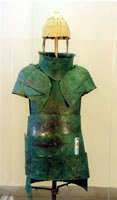
full-body armour ("panoply") made of bronze plates uncovered in the village of Dendra
Dendra
Dendra is a prehistoric archaeological site situated outside the village with the same name belonging to the municipality of Midea in the Argolid, Greece....
in the Argolid, Greece
Greece
Greece , officially the Hellenic Republic , and historically Hellas or the Republic of Greece in English, is a country in southeastern Europe....
.
Description
Several elements of body armour (body cuirass, shoulder guards, breast plates and lower protection plates) from the late Mycenaean period have been found at ThebesThebes, Greece
Thebes is a city in Greece, situated to the north of the Cithaeron range, which divides Boeotia from Attica, and on the southern edge of the Boeotian plain. It played an important role in Greek myth, as the site of the stories of Cadmus, Oedipus, Dionysus and others...
, some bronze bands have been also found at Mycenae
Mycenae
Mycenae is an archaeological site in Greece, located about 90 km south-west of Athens, in the north-eastern Peloponnese. Argos is 11 km to the south; Corinth, 48 km to the north...
and Phaistos
Phaistos
Phaistos , also transliterated as Phaestos, Festos and Phaestus is an ancient city on the island of Crete. Phaistos was located in the south-central portion of the island, about 5.6 kilometres from the Mediterranean Sea. It was inhabited from about 4000 BC. A palace, dating from the Middle Bronze...
. Bronze scales were found at Mycenae
Mycenae
Mycenae is an archaeological site in Greece, located about 90 km south-west of Athens, in the north-eastern Peloponnese. Argos is 11 km to the south; Corinth, 48 km to the north...
and Troy
Troy
Troy was a city, both factual and legendary, located in northwest Anatolia in what is now Turkey, southeast of the Dardanelles and beside Mount Ida...
; scale armour, the oldest form of metal body armour, was used widely throughout the eastern Mediterranean and the Near East. In May 1960 Swedish archaeologists discovered the earliest example of a beaten bronze cuirass
Cuirass
A cuirass is a piece of armour, formed of a single or multiple pieces of metal or other rigid material, which covers the front of the torso...
at Dendra
Dendra
Dendra is a prehistoric archaeological site situated outside the village with the same name belonging to the municipality of Midea in the Argolid, Greece....
, dated to the end of the fifteenth century. It forms part of the Late Helladic (LHIIIa) Dendra Panoply, which consists of fifteen separate pieces of bronze sheet which encased the wearer from neck, protected by a high collar, to knees, held together with leather thongs. The panoply
Panoply
A panoply is a complete suit of armour. The word represents the ancient Greek πανοπλια. The word παν means "all", and όπλον, "arms". Thus "panoply" refers to the full armour of a hoplite or heavy-armed soldier, i.e...
includes both greave
Greave
A greave is a piece of armour that protects the leg.-Description:...
s and lower arm-guards. The arm-guard is unique but greaves, probably made of linen, are often depicted in late Mycenaean art. The few bronze examples that have been found only covered the shins and may have been worn over linen ones, as much for show of status Diane Fortenberry has suggested, as for protection. Although we have only this one complete panoply to date, armor of similar type appears as an ideogram on Linear B
Linear B
Linear B is a syllabic script that was used for writing Mycenaean Greek, an early form of Greek. It pre-dated the Greek alphabet by several centuries and seems to have died out with the fall of Mycenaean civilization...
tablets from Knossos
Knossos
Knossos , also known as Labyrinth, or Knossos Palace, is the largest Bronze Age archaeological site on Crete and probably the ceremonial and political centre of the Minoan civilization and culture. The palace appears as a maze of workrooms, living spaces, and store rooms close to a central square...
(Sc series), Pylos
Pylos
Pylos , historically known under its Italian name Navarino, is a town and a former municipality in Messenia, Peloponnese, Greece. Since the 2011 local government reform it is part of the municipality Pylos-Nestoras, of which it is the seat and a municipal unit. It was the capital of the former...
(Sh series) and Tiryns
Tiryns
Tiryns is a Mycenaean archaeological site in the prefecture of Argolis in the Peloponnese, some kilometres north of Nauplion.-General information:...
(Si series).
The panoply’s cuirass consists of two pieces, for the chest and back. These are joined on the left side by a hinge. There is a bronze loop on the right side of the front-plate and a similar loop on each shoulder. Large shoulder-guards fit over the cuirass. Two triangular plates are attached to the shoulder-guards and gave protection to the wearer’s armpits when his arms were in the raised position. There is also a deep neck-guard. The Linear B ideogram depicting armour of this type makes the neck-guard clearly discernible, and protection by a high bronze collar was a typical feature of Near Eastern body armour. Three pairs of curved plates hang from the waist to protect the groin and the thighs. All these pieces are made of beaten bronze sheet and are backed with leather and loosely fastened by ox-hide thongs to allow some degree of movement. The complete panoply thus forms a cumbersome tubular suit of armour, which fully protects the neck and torso, and extends down to the knees. It appears that lower arm-guards and a set of greaves further protected the warrior, all made of bronze, as fragments of these were also found in the grave at Dendra. Slivers of boars’ tusks were also discovered, which once made up a boars’-tusk helmet.
The figures on the Warrior Vase (Mycenae, ca 1200 BC, National Gallery, Athens) are wearing body armour. However this is an embossed waist-length leather corslet
Corslet
A corslet is defined by the Oxford English Dictionary as "a piece of defensive armour covering the body." In Ancient Greek armies, the 'hoplite', or heavy infantryman, wore a bronze corslet or known as the thorax to protect his upper body. The corslet consisted of two plates connected on the sides...
with a fringed leather apron that reaches to mid-thigh and possible shoulder-guards, very much like that worn by the Peoples of the Sea depicted on the mortuary temple of Ramesses III (died c. 1155 BC) at Medinet Habu
Medinet Habu (temple)
Medinet Habu is the name commonly given to the Mortuary Temple of Ramesses III, an important New Kingdom period structure in the location of the same name on the West Bank of Luxor in Egypt...
, Lower Egypt. Alternatively, the body armour was a ‘bell’ corselet of beaten bronze sheet, a type also found in central Europe at this time.
External links
- Dendra panoply, NafplionNafplionNafplio is a seaport town in the Peloponnese in Greece that has expanded up the hillsides near the north end of the Argolic Gulf. The town was the first capital of modern Greece, from the start of the Greek Revolution in 1821 until 1834. Nafplio is now the capital of the peripheral unit of...
Museum, on youtube.